 Write to the booksellers
2181 books for « weber ch m de »Edit
-
Type
Artists book (3)
Autograph (6)
Book (2160)
Magazine (1)
Music sheets (7)
New book (1)
Photographs (3)
-
Latest
Last 24h (1)
Last 3 days (1)
Last month (52)
Last week (3)
-
Language
Dutch (2)
English (2)
French (2141)
German (6)
Russian (30)
-
Century
17th (1)
18th (5)
19th (123)
20th (660)
21st (227)
-
Countries
Belgium (152)
Canada (10)
Côte d'Ivoire (3)
Denmark (36)
France (1514)
Germany (1)
Greece (1)
Netherlands (9)
Switzerland (422)
United Kingdom (3)
United States of America (30)
-
Syndicate
ALAC (9)
CLAM (6)
CLAQ (1)
ILAB (1069)
NVVA (138)
SLACES (138)
SLAM (817)
SNCAO (3)
Topics
- Algebra (6)
- Alps (21)
- Alsace (45)
- Archaeology (9)
- Architecture (11)
- Autographs (11)
- Beekeeping - bees (5)
- Belgium (13)
- Bible (27)
- Biography (29)
- Caricature (5)
- Children’s books (6)
- Christianity (8)
- Comic strip (22)
- Communism (8)
- Cooking (11)
- Dedication (10)
- Dog (the) (6)
- Drawings (7)
- Early printed books (4)
- Economics (29)
- Education (9)
- Encyclopaedia (5)
- English (10)
- Engraving (books about) (14)
- Engravings (17)
- Entomology (8)
- Essays (8)
- Ethic (6)
- Fine arts (21)
- First edition (6)
- Florence (14)
- Fox (13)
- French speaking swiss literature (6)
- Geography (12)
- Germanic languages (62)
- Germany (14)
- Halbwachs g (24)
- Helvética (132)
- History (116)
- Hoffmann (16)
- Hydrotherapy (5)
- Industrial arts & crafts - fine arts (9)
- Italy (6)
- Latin (10)
- Law (10)
- Literature (115)
- Lorrain (6)
- Magazine (10)
- Maria theresa (6)
- Mathematics (6)
- Medicine (24)
- Memories (4)
- Mountaineering climbing (10)
- Music (19)
- Musicology (13)
- Newspapers press (16)
- Opera (5)
- Opera ballet (7)
- Painters (7)
- Painting (17)
- Philosophy (42)
- Photography (29)
- Physics (5)
- Piano (8)
- Poetry (15)
- Policy (26)
- Protestantism (6)
- Provence (6)
- Psychology (11)
- Railway (5)
- Regionalism (12)
- Religions (22)
- Reviews (10)
- Schubert f. (4)
- Sciences (12)
- Scores (255)
- Sociology (35)
- Songs (9)
- Switzerland (116)
- Tea (5)
- Theatre (19)
- Theology (27)
- Translation (7)
- Travel (7)
- Travels & tourism (10)
- Various (15)
- Wagner richard (4)
- War (22)
- Weber alfred (20)
- Weber eugen (31)
- Weber jean-paul (17)
- Weber max (37)
- Weber olivier (35)
- Youth (5)
- Zoology (6)
- Zurich (20)
Die römische Agrargeschichte in ihrer Bedeutung für das Staats- un Privatrecht. Mit zwei Tafeln. - [THE FOUNDATION OF MODERN SOCIAL SCIENCE]
Stuttgart, Verlag von Ferdinand Enke, 1891. 8vo. Near cont. full green cloth w. gilt lettering to spine. Old library marking removed from bottom of spine. Extremities w. traces of wear. Inner hinges reinforced. Old stamps to verso of title-page. VIII, 284 pp + 2 plates.
The rare first edition of Weber's influential Habilitationsschrift on Roman law and agrarian history, ""Roman Agrarian History and its Significance for Public and Private Law"".Maximilian Carl Emil Weber (1864-1920) is one of the most important founders of modern sociology and cultural sciences (together with Karl Marx and Émile Durkheim). His works have been, and are, of the utmost importance to the fields of sociology, corporational-, social-, musical-, political-sciences etc., and the terms and categories coined by him are now part of the normal vocabulary of these fields of study.In his groundbreaking Habilitationsschrift, which he published at the age of 27, Weber examined the economic, social and political developments of Roman society, and thus laid the foundations of his establishing of modern sociology. He examined the methods of land surveying in Roman society, the terms that were used for the resulting land units, and agricultural works written by Roman authors.As opposed to e.g. Durkheim, Weber took part in creating the antipositivist tradition, opposing the scientific methods of the social sciences to those of the natural sciences.Weber began teaching at the University of Berlin, and later he taught at the Universities of Freiburg, Heidelberg, Vienna and Munich. He greatly influenced German politics at the time, and he was appointed the advisor of the German negotiators at both the Treaty of Versailles and the drafting of the Weimar Constitution.Being without doubt the most important social theorist of the twentieth century and a principal architect of modern social science, Weber's seminal contributions helped form the new academic disciplines of sociology and public administration, and changed the way of perceiving law, economics, political science and religious studies. Most of Max Weber's works were published posthumously with the aid of his wife.
Die specifischen Wärmen der Elemente Kohlenstoff, Bor und Silicium. (2 Parts).
Leipzig, Johann Ambrosius Barth, 1875. Contemp. hcalf. Spine gilt. raised bands. Spine slightly rubbed. In ""Annalen der Physik und Chemie. Hrsg. von J.C. Poggendorff"", Bd. 154. X,644 pp. and 5 folded engraved plates. (Entire volume offered). Weber's paper: pp. 367-423 a. pp. 553-582.
First appearance of this importent paper in which Weber was able to explain why the Law of Dulon & Petit, based on the specific heat of only thirteen elements, was only approximately true. ""An explanation of this anomalous behaviour is to be found in the fact that, as shown by the physicist Heinrich Friedrich Weber, and confirmed by many workers in more recent times, the atomic heat increases at different rates with rise of temperature.... A theoretical basis for this law was obtained in more recent times by P. Debye.""(Findley ""A Hundred Years of Chemistry"", p. 77-78).""The three curious exceptions (C, B, Si) to the Dulong-Petit Law which were until now a cause for despair have been eliminated: the Dulong-Petit law for the specific heats of solid elements has become an exceptional rigorous law...""(Weber).On Albert Einstein and Weber's specific heat, see Pais: ""Subtle is the Lord"", pp. 389 ff.
Resultate aus den Beobachtungen des Magnetischen Vereins im Jahre 1836. Mit 10 Steindrucktafeln.
Göttingen, Dieterischen Buchhandlung, 1837. 8vo. Original blue blank boards. Uncut. The first leaves a bit brownspotted. (2),103 pp., 11 tables a. 10 lithographed plates (also showing the magnetic observatory, its equipment and instruments).
First edition of the first volume reporting the results from ""magnetische verein"", which was set up by Gauss and Weber under the inspiration from Humboldt.""Gauss and Weber organized the Magnetische Verein, which united a worldwide network of observatories. Its Resultate aus den Beobachtungen des magnetischen Vereins appeared in six volumes (1836–1841) and included fifteen papers by Gauss, twenty-three by Weber, and the joint Atlas des Erdmagnetismus (1840). These and other publications elsewhere dealt with problems of instrumentation (including one of several inventions of the bifilar magnetometer), reported observations of the horizontal and vertical components of magnetic force, and attempted to explain the observations in mathematical terms."" (DSB).
"WEBER, W. (WILHELM) AND R. KOHLRAUSCH. - THE VELOCITY OF LIGHT.
Reference : 43497
(1867)
Ueber die Elektricitätsmenge, welche bei galvanischen Strömen durch den Querschnitt der Kette fliest.
Leipzig, Johann Ambrosius Barth, 1867. Contemp. hcalf, raised bands, gilt spine with gilt lettering. A few scratches to binding. In ""Annalen der Physik und Chemie. Hrsg.von Poggendorff"", Bd. 99. (Entire volume offered). (2),X,652 pp. and 4 folded engraved plates. Weber & Kohlrausch's paper:pp. 10-25.
First appearance of this importent paper, the results of which Maxwell later used as a crucial support for his electromagnetical theory of light.""...The velocity of light c were measured by W. Weber and R. Kohlrausch in 1855 (the paper offered). They used an electrometer to determine the charge of a condnsor in electrostatic units, and a ballistic galvanometer to measure the same charge in electrodynamic units. The resulting value for c was in good agreement with that obtained by Fizeau in 1849, and Maxwell accordingly felt entitled to identify light and electromagnetic vibrations. This conclusion recalls Newton's identification of gravity with universal attraction: it was not only because they obeyed the same formal law, but also because both led to the same mathematical results, that Newton saw fit to combine them.""(Taton, Réne in ""History of Sciencein The Nineteenth Century"", p. 163).
Das veranderte Russland, in welchem die ietzige Verfassung des Geist- und weltlichen Regiments, der Krieges-Staat zu Lande und zu Wasser, wahre Zustand der russischen Finantzen (...) - [IMPORTANT ACCOUNT OF RUSSIA]
Franckfurth, Forster, 1721. 4to. In contemporary full calf with five raised bands and gilt lettering and ornamentation to spine. Small paper-label pasted on to top of spine. Wear to extremities, boards with some scratches and part of gilting to spine worn off. Ex-libris pasted on to pasted down front end-paper. Inner hindges split. A few leaves with dampstain to upper margin, and a few occassional brownspots throughout. The map of Russia missing lower half. (14), 490, (6) pp. + frontipiece and 7 engraved plates (complete)

The uncommon first edition of Weber’s important and influential account of the changes and innovations in Russian politics, army, church, finances, sciences, industry, etc., initiated by Peter the Great – arguably one of the most important accounts of the period during and immediately after Peter the Great's reign. The present work eventually appeared in three volumes in 1721 (The present), 1739 and 1740, however, when this first volume was published in 1721 it was intended to a single-volume work and it is a separate work in itself – 18 years was to pass until a second volumes was published.
Theorie der Zungenpfeifen.
(Leipzig, Joh. Ambrosius Barth, 1829) Without wrappers. In ""Annalen der Physik und Chemie. Hrsg.von Poggendorff"", Bd. 17, Zehntes Stück. Pp. 193-304. (The entire issue offered). Weber's paper: pp. 193-246. Clean and fine.
First appearance of this pioneer-paper which helped establishing the foundation of the acoustic theory of this group of musical instruments which depends on coupling of the tongue and the air cavity in the instruments. One of the subjects treated was the use of this coupling to maintain constancy of pitch of a pipe under different intensities of blowing, and the possibility that this might provide an improved standard of pitch.
Dymocritos oder hinterlassene Papiere eines lachenden Philosophen. (Von dem Verfasser der Briefe eines in Deutschland reisenden Deutschen). 12 Bde. (alles). (10. u. 11. Bd. in zweite Auflage).
Stuttgart, Brodbag'sche Buchhandlung, 1832-40. Bound in 5 contemp. full cloth. Gilt spines with gilt lettering. Covers richly blindtooled. A stamp on titlepages. Some scattered brownspots. very light wear to extremities.
Extremely scarce in complete state as this. ""Weber is best known for his writings, in which he displays a fresh, original spirit, fine powers of observation, and a talent for witty satire. He was largely influenced by the humanistic teachings of the French literature and philosophy, but his reading was wider than France and his sympathies were cosmopolitan. The most celebrated of his works is Demokritos, oder hinterlassene Papiere eines lachenden Philosophen (Demokritos, or the literary remains of a laughing philosopher, 1832-40)."" (Wikipedia).
Note zu Riemanns Beweis des Dirichletschen Princips
Berlin, Georg Reimer 4to. As extracted without back backstip, with the original front wrapper. Wrapper with a few nicks. Small stamp to verso of title page and occassional brown spotting. Pp. 29-40.
First appearance of Weber's important paper on Riemann's doctor dissertation.
Bruce Weber. My Education, A Deep Dive into Bruce Weber?s Photographic Journey
, Taschen, 2025 Hardcover, XL 24.3 x 35.5 cm, 3.43 kg, 564 pages, Edition: Multilingual (English, French, German) *New. ISBN 9783836599443.
Photographer and filmmaker Bruce Weber first rose to international prominence in the early 1980s on the success of images that combined classical styling with more visceral underpinnings of mood and sexuality. His ability to construct a seamless sense of romance and drama created the central public images for fashion houses like Ralph Lauren, Calvin Klein, Versace, and Abercrombie and Fitch, as well as earning him an enduring presence as a contributor to magazines at the very highest levels in the industry. Throughout his career, Weber has worked in various forms?he has directed seven short- and feature- length films, published more than 37 books, and has held more than 60 exhibitions worldwide?extending his lifelong exploration of the nature of human relationships. With more than 500 images, this volume showcases the full artistic range of Bruce Weber, featuring iconic fashion shoots and his vibrant portraits of famous personalities as well as previously unpublished and lesser known photographs. Anecdotes from the photographer provide insights into the stories and people behind his most famous works.
Carillons de Noël en Alsace. Textes de Suzanne Weber. Illustrations d'Ernest Schmitt. Préface de Mgr Jean-Julien Weber évêque de Strasbourg
F.-X. Le Roux 1945 48 pages 1945. 48 pages.

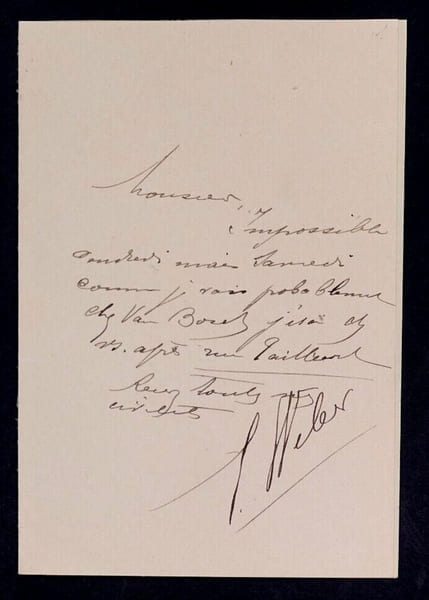
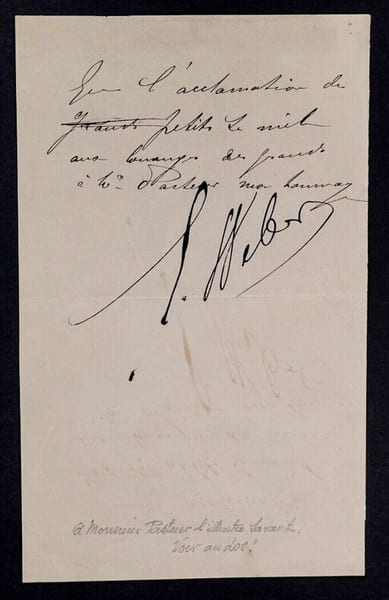
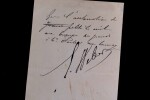
Caroline-Eugénie SECONG-WEBER, Actrice de théâtre - LETTRE AUTOGRAPHE SIGNÉE
Lettre autographe signée de Caroline-Eugénie SECONG-WEBER . État : Très bon état, présence d'onglets au verso. Voir photos pour plus de détails. Dimensions : 8,3 x 12,3 cm. 1 page. Caroline-Eugénie Weber, dite Mᵐᵉ Segond-Weber, née le 6 février 1867 à Paris dans le 11ᵉ arrondissement, et morte le 14 juin 1945 dans le 17ᵉ arrondissement, est une actrice française. Wikipédia Envoi soigné dans un emballage rigide et étanche. Satisfait ou remboursé. Si vous n'êtes pas entièrement satisfait, je reprends la marchandise avec retour à ma charge pour l'Europe et à la charge de l'acheteur pour le reste du monde. N’hésitez pas à visiter ma boutique et affiner vos recherches en fonction des catégories qui vous intéressent. Ma boutique L'Art Délivré. Lettres autographes, vieux papiers, livres anciens, photographies, gravures, timbres… Nous expertisons et/ou rachetons dans toute la France vos lettres, collections de lettres et livres anciens. Merci de votre visite. Jérôme KAYSER.

Caroline-Eugénie SECONG-WEBER, Actrice de théâtre - LETTRE AUTOGRAPHE SIGNÉE
Lettre autographe signée de Caroline-Eugénie SECONG-WEBER . État : Bon état, présence d'onglets au verso. Voir photos pour plus de détails. Dimensions : 10 x 16,3 cm. 3 pages. Caroline-Eugénie Weber, dite Mᵐᵉ Segond-Weber, née le 6 février 1867 à Paris dans le 11ᵉ arrondissement, et morte le 14 juin 1945 dans le 17ᵉ arrondissement, est une actrice française. Wikipédia Envoi soigné dans un emballage rigide et étanche. Satisfait ou remboursé. Si vous n'êtes pas entièrement satisfait, je reprends la marchandise avec retour à ma charge pour l'Europe et à la charge de l'acheteur pour le reste du monde. N’hésitez pas à visiter ma boutique et affiner vos recherches en fonction des catégories qui vous intéressent. Ma boutique L'Art Délivré. Lettres autographes, vieux papiers, livres anciens, photographies, gravures, timbres… Nous expertisons et/ou rachetons dans toute la France vos lettres, collections de lettres et livres anciens. Merci de votre visite. Jérôme KAYSER.
La Fin des terroirs. La modernisation de la France rurale (1870-1914).
Fayard, Editions Recherches, 1984 fort in-8°, 843 pp, traduit de l'anglais, biblio, index, broché, couv. illustrée, bon état
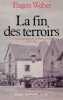
La modernisation tardive de la paysannerie française : le livre d’Eugen Weber fit, à l’époque de sa parution, l’effet d’une bombe : contrairement à ce que l’on croyait jusqu’alors, la France rurale était longtemps restée prisonnière de coutumes, de traditions, de cultures routinières et de particularismes locaux. La modernisation de cette France rurale fut très tardive : l’auteur la date des dernières années du XIXe siècle. Ce n’est qu’avec la troisième République qu’on transforma les paysans en Français, pour reprendre le titre original de ce livre. Ce livre, devenu un classique, fait revivre un monde disparu celui des ruralités particularistes, d’une vie quotidienne vouée à la répétition, de modes de vie routiniers scandés par d’innombrables rituels, où l’on parle une multiplicité de dialectes et de patois, où les principales distractions sont les veillées et les chansons. — Voici un portrait saisissant, nouveau, étrange du paysan français du XIXe siècle. Etrange en effet, et étranger, ce "sauvage" couchant dans des huttes sur des bottes de fougère, largement illettré, ignorant le système métrique, la monnaie et la langue française, parfois même le plus grand pays au-delà du sien. Les proverbes – ce livre en fourmille –, les chansons et les contes populaires, les témoignages des contemporains – fonctionnaires, magistrats, prêtres, militaires, instituteurs, touristes – constituent la palette de l'historien Eugen Weber. L'un des bénéfices de son approche est de faire apparaître le fossé qui sépare la France des villes de la France des campagnes, et la diversité de ces dernières. Fiction d'une nation une et indivisible, qui ne fut réalisée qu'au XXe siècle. La communauté paysanne n'est pas une non plus. De notables différences existent entre les paysans bretons et ceux du Limousin, de l'Ardèche, des Alpes, du Morvan, des Pyrénées, entre les parlers, les coutumes, l'alimentation, l'habitat, les modes de cultures... Autant de chapitres encore sur les fêtes et les veillées, la religion, l'émigration, la criminalité et la nuptialité, les communications et la politique, les foires et les marchés, la circulation des nouvelles... Une foison de détails tantôt saugrenus, tantôt monstrueux, insoupçonnés. Weber fait renaître, ce monde disparu. Car le "sauvage" s'est urbanisé, civilisé, policé. Il a gagné les villes, parce que c'est là qu'on peut gagner sa vie ; et les modes des villes l'ont gagné à leur tour. Les grandes peurs, les anciennes croyances, la misère, les maladies ont reculé. Comment ce monde est-il passé de son isolement à l'ouverture sur l'extérieur, d'une économie de subsistance à une économie de marché, de l'usage de la langue locale à celui de la langue officielle ? Weber analyse les facteurs de changement : la francisation de la France. Désormais les frais d'envoi sont de 6 € seulement pour les livres jusqu'à 1 kg (colissimo suivi), pour la France métropolitaine.
Handbuch der allgemeinen und speciellen Chirurgie, mit Einschluss der topographischen Anatomie, Operations- und Verbandlehre. Insges. 5 Bände.- Bd. 1.1 (1865): HAESER, H. (& Weber): Uebersicht der Geschichte der Chirurgie und des chirurgischen Standes. - Und ab S. 27: WEBER, O.: Die Gewebserkrankungen im Allgemeinen und ihre Rückwirkung auf den Gesammtorganismus. Mit 6 Kurventafeln /- Bd. 2.1 u. 2.2, A (1869, 1882): LÜCKE: Die Lehre von den Geschwülsten in anatomischer und klinischer Beziehung. - 2. Abt.: WEBER, O.: Krankheiten der Haut ... - VOLKMANN, R.: Verletzungen und Krankheiten der Bewegungsorgane. Mit 3 Farbendrucktafeln. /- Bd. 3.1, A (1866, 1873): BERGMANN: Die Lehre von den Kopfverletzungen. - HEINEKE, W.: Chirurgische Krankheiten des Kopfes. - TRÖLTSCH, v.: Die Krankheiten des Ohrs. - WEBER, O. Verletzungen und chirurg. Krankheiten des Gesichts. Mit 1 Kupfertafel. /- Bd. 4.1, B (1879): OLSHAUSEN, R.: Die Krankheiten der Ovarien. - BREISKY: Die Krankheiten der Vagina. - HILDEBRANDT, H.: Die Krankheiten der äussern weiblichen Genitalien. - WINCKEL, F.: Die Krankheiten der weiblichen Harbnröhre und Blase.- Bd. 4.2 (1868): PITHA, (F.) v.: Verletzungen und Krankheiten der Extremitäten. Mit 3 lithogr. Tafeln.
Erlangen und Stuttgart, Ferdinand Enke, 1865-82, gr. in-8°, vereinzelt stockfleckig, Halblederbände auf Bünden, gold- und blindgepr. Rücken, einige Schabspuren und etwas berieben.
Erste Ausgabe eines Teiles des umfangreichsten deutschen Handbuchs der Chirurgie im 19. Jahrhundert. Vorliegende 5 Bände enthalten insgesamt 14 Beiträge, ill. mit zahlr. Text-Holzschnitten und einigen Tafeln: Hirsch I/619-620 (Pitha).

(SLACES, NVVA)
Phone number : 41 (0)26 3223808
FREYSCHULTZ (Robin des Bois) Opera romantique en trois actes arrangé pour Chant et Piano par C. M. de Weber ,traduit et imité en français par Crevel de Charlemagne
Paris, Marquerie Frères - milieu XIXe siècle - Relié demi cuir posterieure - 172p.gravés encadrées, rousseurs,relié avec Giovacchino Antonio Rossini la Generentola (d'après Cendrillon),séparable
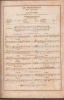
Carl Maria von Weber (1786-1826) a German composer, conductor, pianist, guitarist, and critic. Remise de 20% pour toutes commandes supérieures à 200 €
Mémoires de Weber, concernant Marie-Antoinette, archiduchesse d'Autriche et Reine de France et de Navarre ; avec des notes et des éclaircissemens historiques, par MM. Berville et Barrière.
P., Baudouin Frères, 1822, 2 vol. in-8°, viii-511 et 380 pp, reliures demi-basane havane, dos lisse avec filets dorés, pièces de titre et d'auteur basane noire, tranches mouchetées (rel. de l'époque), qqs rares rousseurs, dos lég. frottés, pt. manque de cuir au tome 2, erreur de tomaison aux dos, bon état (Coll. des Mémoires relatifs à la Révolution française)
"Fils de la nourrice de Marie-Antoinette, Weber suivit sa sœur de lait en France, fut nommé commis aux finances en 1782, émigra après les massacres de septembre 1792. Ses mémoires n'ont pas été rédigés par lui, on a cru pouvoir y discerner plusieurs mains, dont celle de Lally-Tollendal. Ils constituent essentiellement une biographie de la Reine." (Fierro, 1494) – Les frères Baudouin, lors du procès que leur fit Weber, produisirent "une lettre de Lally-Tollendal par laquelle il reconnaissait avoir rédigé d'après ses souvenirs personnels et ceux du duc de Choiseul, ce qui concernait l'intérieur de la Reine et d'après un petit nombre de notes de Weber, l'avant-propos et les 3 premiers chapitres." (Tourneux) — "On trouve dans chaque tome d'abondantes notes biographiques et historiques." (Martin et Walter, 33860) – Les “Eclaircissemens historiques et pièces officielles” (pp. 293-380 du tome II) contiennent notamment le récit de la conduite du régiment des gardes-suisses le 10 août 1792, par Pfyffer d'Altishoffen, avec les noms de ceux qui prirent part à cette journée. Désormais les frais d'envoi sont de 6 € seulement pour les livres jusqu'à 1 kg (colissimo suivi), pour la France métropolitaine.
Handbuch der Ziegeleitechnik enthaltend moderne Hilfsmittel und Einrichtungen für Ziegeleien. Mit 251 Abb. und zahlreichen Tabellen.
Berlin, Meusser, 1914. Orig. full cloth. XI,441 pp. + Inseratenanhang.
Fra Hjulskibenes Dage. Nogle fragmentariske Optegnelser for en Del som et bidrag til det Danske Koffardidampskibs Historie i de første 50 Aar efter dets Fremkomst i 1819.
4to. Uden foromslag. 248 pp. Rigt illustr.
Der Literatur der Babylonier und Assyrer. Ein Überblick.
leipzig, 1907. Orig. full cloth. XVI,312 pp., 1 plate and 2 illustr.
Das Papstthum and die Päpste. 1.-2. Theil (v.3).
Stuttg., 1834. 2 cont.hcalf. Richly gilt backs. LXXII, XLII, 432, 360 pp.
Gesammelte Aufsätze zur Wissenschaftslehre. Dritte erweiterte und verbesserte Auflage, herausgegeben von Johannes Winckelmann.
Tübingen, J.C.B. Mohr, 1968. Orig. full cloth. XII,614 pp.
Süsswasserfische aus Niederländisch Süd- und Nord - Neu - Guinea.
Leiden, Brill, (1914). Large 4to. Loose. Frontwrapper with tears. (101) pp., textillustr. and 3 fine plates in heliogravure. Offprint.
(Nova Guinea. Resultats de L'Expedition scientifique Neerlandaise á la Nouvelle - Guinée, Tirage apart du Vol. IX, Zoologie, Livr. 4).
Die Möncherey oder geschichtliche Darstellung der Kloster=Welt. 3 Bde. (in 4 Theile).
Stuttgart, J.B. Wetzler'schen Buchhandlung, 1819-20. Small 8vo. Bound in 4 contemp. full cloth. Spines gilt with gilt lettering. Some wear to spine ends. Some wear along hinges on 2 volumes. XXIV,414,II(4),522,(2)(4),394,(2)(4),413 pp. Some brownspots and browning throughout.
Scarce first edition.

