 Write to the booksellers
182 books for « urban j »Edit
-
Type
Book (152)
Music sheets (30)
-
Latest
Last month (2)
Last week (1)
-
Language
English (2)
French (172)
Norwegian (1)
Russian (7)
-
Century
17th (1)
18th (8)
19th (28)
20th (74)
21st (16)
-
Countries
Belgium (5)
Canada (1)
Denmark (4)
France (140)
Netherlands (1)
Switzerland (23)
United Kingdom (1)
United States of America (7)
-
Syndicate
ALAC (1)
ILAB (72)
NVVA (8)
SLACES (8)
SLAM (53)
SNCAO (1)
Topics
- Aeronautics (2)
- Alsace (2)
- Antichrist (1)
- Apollinaire guillaume (1)
- Archaeology (3)
- Architecture (2)
- Atlantis (1)
- Austria (3)
- Bach j. s. (1)
- Bard (6)
- Berlin (1)
- Biography (1)
- Birds (2)
- Botany (6)
- Celt (1)
- Chapelle jean (1)
- China (2)
- Christianity (1)
- Christmas (1)
- Collections (1)
- Communism (2)
- Denmark (1)
- Early printed books (1)
- Economics (1)
- Education (1)
- Education - morals (1)
- Encyclopaedia (1)
- English (2)
- Esotericism (2)
- Family (1)
- Fine arts (2)
- First edition (4)
- Garat henry (1)
- Genealogy (1)
- Geography (2)
- Germanic languages (5)
- Germany (3)
- Grammar (1)
- Guitry sacha (3)
- Hannibal (1)
- Helvética (7)
- History (13)
- Iceland (1)
- Jacques-charles (1)
- Klee paul (1)
- Language (1)
- Law (1)
- Literature (11)
- Lorrain (2)
- Malacology (1)
- Medicine (1)
- Memories (2)
- Mercier rené (2)
- Methodology (1)
- Middle ages (2)
- Military arts (4)
- Mineralogy pc (1)
- Museums (1)
- Newspaper (1)
- Newspapers press (1)
- Palaeography (1)
- Paris (3)
- Philosophy (3)
- Photography (1)
- Picasso (1)
- Post office (1)
- Postcards (1)
- Propaganda (1)
- Provence (7)
- Psychology (1)
- Pujol rene (2)
- Regionalism (1)
- Religions (3)
- Review (1)
- Russia (1)
- Sciences (5)
- Sciences & mineralogy (1)
- Scores (22)
- Sexuality (5)
- Sheep (5)
- Songs (21)
- Switzerland (8)
- Theology (3)
- Travel (1)
- Trial (1)
- Ussr (1)
- Verdun (1)
- War (2)
- Wine (2)
- Zurich (1)
Regler for Tidens nöiagtige Afmaaling ved Uhre. (Rules govening the measurement of the accuracy of time by Watches and Clocks). - [MAGNUM OPUS OF MODERN WATCHMAKING]
Kiöbenhavn, N. Möller og Sön, 1804. 4to. Near contemporary brown half calf with cloth-covered boards gilt title to spine (UREMAKER KUNST), with Australian bookbinder's etiquette: ""W. Detmold, Melbourne"" to inside of front board. Pencil name and doodles to front end-papers and traces of the same kind of pencil-names and doodling to the first leaves, removed. Front free end-paper with a portrait inserted (possibly of Urban Jürgensen, possibly of his brother Jøregen Jørgensen - see below under Provenance). Hinges and capitals worn. Hinges professionally re-enforced from verso and restorations to capitals. Text overall nice and clean, with the occasinal browning or dampstaining. Plates have some overall toning/even soiling and staining and some occasional offsetting or spotting. They have been lightly, and very professionally, cleaned, and a few of them have edge restorations (far from affecting image) or a small re-enfircement from verso, barely noticeable. Bothe text and plates printed on thick, heavy paper. XXVI,242 pp. and 18 double-page folded engraved plates.
Exceedingly scarce first edition of the first Danish book on watchmaking, constituting a magnum opus of modern watchmaking. After having trained abroad, in Le Locle, Paris, and London, Urban Jürgensen was one of the best-trained watchmakers in the world by the time he returned to Copenhagen in 1801. Not only did he master to perfection the finest techniques of the age, he also improved upon them and experimented with various technologies. His great treatise from 1804, Rules for the Accurate Measurement of Time by Watches and Clocks, is arguably the most important treatise on watchmaking from this period"" it was used as a manual for watchmakers all over Europe and is still in use today. The first edition is of the utmost scarcity, with very few copies known on private hands and only a handful of copies in libraries worldwide. The work was quickly translated into French, and a second edition of the Danish translation appeared in 1839. “The story starts with Jørgen Jürgensen, an early Danish watchmaker, in 1773. To give a sense of what Danish watchmaking looked like in the late 1700s, around 20 craftsmen were registered to the trade in Copenhagen. Before Jørgen received Royal support for his business in 1781, the majority of watches in Denmark were imported and of low quality. He successfully made the case over many years that with the government's support, he could create a true domestic industry. As a result, Jørgen can be described as the father of Danish watchmaking. He trained apprentices and was given the right to run a manufacturer. This right was even extended to his sons... ""if they possessed the necessary competence for the task."" Jørgen's eldest son, Urban Jürgensen, proved to possess more than the necessary competence. Born in 1776, Urban was incredibly intelligent, leaving Copenhagen at the age of 21 after Jørgen decided he had learned all that he could in his home country. His travels brought him to Le Locle, studying under Jacques-Frédéric Houriet" to Paris, to learn from Abraham-Louis Breguet and Ferdinand Berthoud and then to London, apprenticing for John Arnold and John Brockbank. Urban Jürgensen was one of the best-trained watchmakers in the world by the time he returned to Copenhagen in 1801 – and he backed it up. Before his death in 1830, he produced over 700 watches, including 45 marine chronometers. Urban experimented with various escapement technologies he had encountered during his travels, working with various ébauches, but he certainly preferred the chronometer or detent escapement. He even improved upon the work of Thomas Earnshaw and John Arnold in England by developing the detached double-wheel chronometer escapement toward the end of his career. Jørgen established the idea of Danish watchmaking, and Urban ran with it – particularly with an eye for scientific precision and accuracy.” (https://www.hodinkee.com/articles/urban-jurgensen-then-and-now). “In 1773, Danish horologist Jürgen Jürgensen presented his masterpiece, a repeating watch, to the Danish Watchmakers Guild in Copenhagen, Denmark. The culmination of six years of training in Germany and Switzerland, his efforts earned him the title of Master Watchmaker. Three years later, his eldest son Urban was born. Urban’s star would eclipse even that of his talented father, sparking a multigenerational saga that continues to this day. … Urban, born in 1776, set out on an apprenticeship journey — much as his father had before him — at the age of 21. Having already studied horology under his father’s tutelage, he made his way to France and England, where he had the tremendous fortune of studying in the workshops of Abraham-Louis Breguet, Ferdinand Berthoud and John Arnold. Due to his Danish citizenship, Jürgensen was able to navigate the geopolitical waters that would otherwise have stifled the ambition of an Englishman or a Frenchman desiring to work with his fellows across the Channel. (The two countries were archrivals and soon to be engaged in the Napoleonic Wars.). Returning to Copenhagen in 1801, Urban got to work designing marine chronometers, astronomical pendulum clocks, and even a bi-metallic pocket thermometer that functioned better than standard mercury-based models in freezing temperatures. His 1804 treatise Rules for the Accurate Measurement of Time by Watches and Clocks — published at the age of 28 — was the first Danish book on watchmaking and is still in use today. The influence of Breguet, Arnold and Berthoud combined with his Danish sense of design in functional, forward-thinking, beautiful timepieces began to impress in the highest circles: In quick succession, Jürgensen became the official supplier of marine chronometers to the Royal Danish Navy the first tradesman inducted into the Royal Danish Academy of Sciences" and, in 1824, a Knight of the Order of the Dannebrog.” (https://www.insidehook.com/watches/urban-jurgensen-historical-watchmaker-returns) “Urban Jürgensen is an independent high-end brand known for obsessing over details, creating masterpieces that may appear minimalistic, but hide an execution of subtleties that few ateliers can match. Founded in Copenhagen in 1773 by Jürgen Jürgensen, the company is among the foremost watchmaking dynasties in history. During the 18th and 19th centuries, the Jürgensen family worked with legends like Jacques-Frédéric Houriet, Abraham-Louis Breguet and John Arnold to set standards for fine watchmaking that still apply today. Urban Jürgensen, first son of Jürgen, continued building the family's brand with innovations like a cylinder escape wheel comprised of hardened steel (instead of traditional brass) to greatly reduce wear and increase reliability. His book, Principes Généraux de l'Exacte Mesure du temps par les Horloges [i.e. the present book, French translation], is still a relevant reference for today's watchmakers. Headquartered in Biel/Bienne, Switzerland, the company was for a time under Danish ownership with Soren Petersen (formerly with Nokia) as President and CEO, before being acquired in 2025 by US-based Rosenfield family and a group of investors, with Finnish independent watchmaker Kari Voutilainen serving as Co-CEO and head of watchmaking.” (https://monochrome-watches.com/urban-jurgensen/) On OCLC, we have been able to locate no more than four copies outside of Copenhagen: Paris, London, Stockholm, and Chicago. Provenance: It is curious that a book like the present should end up in Melbourne (where it was bound) in the mid 19th century. The portrait inserted on the front free end-paper may point to an explanation. This portrait bears quite a bit of resemblance with that of Urban Jürgensen printed in the second edition of the work. But it also bears great resemblance with the portrait (by Eckersberg) of his famous brother Jørgen Jørgensen (the Danish version of the name Jürgensen), who spent the lest part of his life in Tasmania. We have not been absle to establish with certainty whether it is Jørgen or Urban himself, but it seems likely that Jørgen will have brought his brother's great treatise with him to Australia, where it will have remained after his death in 1841. Jørgen Jørgensen (1780-1841), also known as “The King of Iceland”, was a famous Danish adventurer, who led a rather remarkable life. “The ‘Viking of Van Diemen’s Land', Jørgen Jørgensen is without a doubt the most colourful and (in)famous Dane to have come to Australia. He was once called one of the most interesting human comets ever recorded in history. In his 61 years of life, he was a sailor, diplomatic agent, convict, self-proclaimed king of Iceland, police officer, gambler, convict, naval captain, writer, explorer and the list goes on.” (Danes in Australia) “Jørgen Jørgensen (later anglicised to Jorgen Jorgenson) was born on 29 March 1780 in Copenhagen as the second son of royal clockmaker Jürgen Jürgensen and wife Anna Leth Bruun, a very well-respected family. At the age of 14, Jorgen took his first job as an apprentice on an English coal ship sailing mainly in the North Sea and the Baltic. In the next years he worked on several Danish and English ships, including a whaling ship bound for South Africa. In 1800, he was taken on as a second-mate on the Lady Nelson, an English brig commissioned by New South Wales Governor King to discover whether Van Diemen’s Land (now known as Tasmania) was part of the mainland or not (all maps prior to 1800 showed that this was the case). In January 1801, the brig made its first passage through the Bass Strait. Jorgen served on the survey ship during which time Launceston was discovered, Hobart was founded and a permanent settlement was established at Newcastle. In 1804, Jorgen joined the whaling ship Alexander where, at the age of 24, he became an assistant captain. The large pod of whales, which he had discovered during his voyages around the Bass Strait, resulted in a very successful whaling expedition. Eventually, this led to a permanent whaling station at Hobart, which played a huge part in the Tasmanian economy right into the 20th century. Jorgen then sailed a cargo of whale blubber back to Europe, and eventually returned to Copenhagen in 1806 where he was hailed as the first Dane to sail around the world. After Denmark’s declaration of war against England he was appointed captain on a Danish privateer, the Admiral Juul, and sent out to destroy British warships. However, he was quickly captured, and subsequently taken back to England as a prisoner of war. In London he befriended a merchant, Samuel Phelps, and later went with him on a trading expedition to Iceland, which was ruled by Denmark. Upon arrival in Iceland, the Danish officials refused to let the Icelanders trade with the newly arrived ship. After a week or so with no change, Jorgen, along with Phelps and a dozen British seamen, marched to the governor’s residence and declared him a prisoner of war. Jorgen, at the time 28 years old, subsequently announced himself as His Excellency the Protector of Iceland, Commander in Chief by Sea and Land and soon after his proclamations began “We, Jorgen Jorgensen, Rex”. He designed a flag and built a fort, Fort Phelps. He is still known today by the Icelanders as Jörundur hundadaga konungur (Jorgen the king of the dog-days). His rule was short-lived. A British war ship arrived and the Captain put an end to Jorgen’s two months as a ‘king’, and took him back to England where he was imprisoned, yet again. Through powerful connections, Jorgen managed to get out of this prison sentence and was sent to Continental Europe as a spy. His gambling, drinking and ever-mounting debts, however, were getting the better of him, and the final straw was after he was caught pawning off his landlady’s furnishings and bed linen. He was sentenced to 7 years of exile, caught a month later for still remaining in the country, and sentenced to death, which was then commuted to exile for life. During the next three years, he managed to stay in England, even working as an assistant to the surgeon at Newgate Prison. Antagonised by one of Jorgen’s religious publications, the Home Secretary eventually was forced to send him to Van Diemen’s Land. In 1825 he boarded the convict ship Woodman and arrived on 29 April, 1826, some 22 years after he had first sailed through these waters. The island now had a population of 13,000 (of which 6,000 were convicts) with 5,000 living in Hobart. Jorgen’s first job was working as a clerk in the local customs office. Here he discovered a suspected forgery of government bonds, which led to the police arresting the forgers and confiscating 4000 pounds worth of forged bonds. In recognition of exposing the forgery, Jorgen was put in touch with the manager of the Van Diemen’s Land Company. Here he was chosen to lead an expedition to the unexplored northwest corner of the island, a journey of 300 km. Together with another convict, they were the first white men to cross the Central Plateau. However, snow, lack of provisions and exhaustion, forced them to turn back. In July 1827, Jorgen got a conditional pardon and started a new career as a police officer. This involved protecting the white colonists in the village of Oatlands, northwest of Hobart, against the so-called ‘hostile natives’ as well as escaped convicts. He was also made member of a special police corps, responsible for the ‘black wars’, an unsuccessful attempt by the colonial government to drive all the aborigines out of the island. As a reward for his services Jorgen was awarded 100 acres of land. Eventually, Jorgen received his full pardon, and in 1831 he resigned from the police force. A week later, he married an Irish convict, Norah Corbett, who was half his age and an alcoholic. She proved to be the greatest trial of his life and was often seen chasing her husband down the streets of Oatlands. Jorgen wrote several books and contributed regularly to two daily newspapers in Hobart during his last years.” Bookbinder William Detmold was among the earliest and most important bookbinders in Australia. ""William Detmold (1828-1884) of Melbourne, who began in 1854, was an important bookbinder. Hannover-born, Detmold is believed to have trained in New York, where he lived from 1846 until 1852."" ""Binding skills were originally immigrant. Training by apprenticeship, formal or otherwise followed. Trades training away from the workplace began about the beginning of the twentieth century. Examples of the second generation of binders are Charles Harwood, originally a convict, trained by Moffitt, later in business for himself in Sydney for at least twenty years, and the Wrigleys, who arrived in Melbourne as children in the 1850s, worked for Detmold, and for themselves in the 1870s and 1880s. By the second half of the nineteenth century, we find a gradual separation of specialised book trades into freestanding businesses. The emergence was slow and incomplete. The association of binding with related trades makes it difficult to determine who were the BOOK binders. The emphasis of advertisments sometimes provides a clue. John L Sherriff, of Sydney, in The Australian almanac for the year 1874 advertises himself as 'bookseller, stationer and publisher', although stating 'JLS gives his attention to the following branches of business:- Bookselling, publishing, binding, printing, engraving and lithographing, picture framing, account book manufacturing' (p37). In A glance at Australia in 1880 by Mortimer Franklyn (Melbourne, 1881) Maddock advertises himself as, 'importer of books and stationery', listing bookbinding in a long list of services provided. Bookseller George Robertson of Melbourne's new premises were described by the Bookseller in 1872 as having a bindery for the manufacture of account books. Without the ledger trade, in particular, it is dubious if the competence to be found in much nineteenth century Australian binding would have been possible. From stickers we know that Robertson bound books, presumably for customers, and his own publications. Even binders working independently offered services such as the manufacture of account books or fancy boxes. William Detmold (1828-1884) of Melbourne, who began in 1854, was an important bookbinder. Hannover-born, Detmold is believed to have trained in New York, where he lived from 1846 until 1852. As well as Detmold, Tanner's Melbourne directory for 1859. (Melbourne, John Tanner) lists Cook & Fox, E. Esquilant and T.J. Walters. The publication itself, bound in khaki coloured buckram with a blind embossed rectangular cover design, gilt lettering on the front cover and a blank spine, is a publisher's binding with Detmold's sticker on the endpapers.W. Detmold, Bookbinder, paper Ruler, and Manufacturer of Account Books, In acknowledging the liberal patronage he has received from the Victorian Public, desires to inform them that, to his already extensive Bookbinding Establishment he has added all the latest improvements in machinery, by the aid of which, and by careful attention, he is enabled to execute orders with increased promptitude, in a more SUPERIOR AND FINISHED STYLE than hitherto, and at REDUCED PRICES"" and ventures to hope for a continuance of the support which he has hitherto been honoured. W. Detmold is employed by all the Leading Houses, the Clergy and Gentry, as well as the Public Library, University, and most other Libraries in the Colony. 163, Swanston street, Melbourne."" (Carol Mills: Australian Bookbinders and Bookbinding History of the Nineteenth Century).

Journal of Urban Archaeology 12 (2025) Featuring a special section, Lost Cities and Legacy Data.
, Brepols - Harvey Miller, 2025 Paperback, 296 Pages, Size:216 x 280 mm, Illustrations:78 b/w, 116 col., 2 tables b/w., Language:English, *new. ISBN 9782503615646.
This issue of Journal of Urban Archaeology combines an open call for papers with a special thematic section focused on the entanglement of political control and colonialism with the archaeology of urban sites in the Near East and Egypt during the late Ottoman and the Mandate periods. The articles in this special issue examine how earlier colonial and orientalist approaches informed and shaped archaeological fieldwork, and created persistent legacies in the study of ancient urban sites, through the use of specifi c case studies. Through this approach, these articles demonstrate how the critical re-examination of legacy data can structure nuanced narratives, and together, the authors point the way forwards for dismantling current paradigms around the urban archaeology of the region. TABLE OF CONTENTS List of Illustrations ?The House we Live in? Rubina Raja and S ren M. Sindb k Recent Research in Nicomedia: New Reliefs and the Location of the Hippodrome Within the Urban Context Tuna ?are A?t rk An Egyptian Villa with Animal Pens in New Kingdom Nubia: Reinterpreting Building H4 and Area H4W on Sai Island Carl G. Elkins, Julia Budka, and Chlo Ward Inventing Urban Public Space: Morphogenesis and Energized Crowding in Mohenjo-Daro Kim Dovey and Michael E. Smith Ephemeral Rituals and Urban Timescapes: Family Ties and Object Biography at the Asklepieia of Epidauros and Pergamon Pim Schievink and Christina Williamson Do Warmer, Wetter, and More Unpredictable Environments Matter? Differences in Institutional and Infrastructural Arrangements and Intergenerational Wealth Distributions between Premodern Cities in the Humid and Semiarid Neotropics Vernon L. Scarborough and Christian Isendahl Special Issue: Lost Cities and Legacy Data Cities ?Lost? and ?Found?: The Impact of Western Research on Ancient Sites in the Perception of their Urbanism Olympia Bobou and Rubina Raja Shelving Urban Excavations: Revisiting Ottoman and Mandate Period Archives in Western Asia Olympia Bobou, Filiz T t nc a?lar, Miriam K hn, Eleanor Q. Neil, and Rubina Raja Lost Cities in the Near East: Reassembling Knowledge through Archival Research and Excavation Documentation Olympia Bobou, Miriam K hn, and Rubina Raja Note sur l?urbanisme antique en Syrie durant la p riode du Mandat Fran ais Michel Al-Maqdissi From Tadmor to Palmyra, 1923?1929: The (Re-)creation of an Ancient City Olympia Bobou and Rubina Raja From ?Secondary? City to Primary Focus: A Historiographical Approach to the Urbanity of Seleucia in Pieria Michael Bl mer, Olympia Bobou, Eleanor Q. Neil, and Rubina Raja The Organization of Archaeological Fieldwork and Selective Publication of Findings as Appropriation of Knowledge: Observations on the 1931 Spring Campaign in Gerasa Rubina Raja Alexandria as an Observatory of the Difficulties of Ancient Urban History Marie-Dominique Nenna
Mémoires sur l'horlogerie exacte.
Paris, Bachelier, 1832.
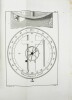
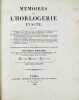
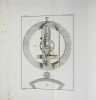
Première édition sous forme de livre, très rare. Ces mémoires ont parus en danois dans les publications de la Société des sciences de Copenhague. - Remarques sur l'horlogerie exacte et proposition d'un échappement libre (à double roue) avec une réduction considérable de frottement. - Description de l'échappement libre à double roue. - De l'isochronisme des vibrations du pendule et proposition suivant laquelle on peut facilement faire vibrer le pendule des horloges astronomiques dans des arcs d'égale étendue. - Description d'un pendule compensateur... - De l'influence de l'air sur le régulateur des pendules astronomiques et des horloges à longitudes. - Description d'un nouveau thermomètre métallique à minimum. Illustré par 5 belles planches dépliantes. Ces mémoires sont publiés et traduits par le fils de l'auteur Louis-Urbain Jürgensen. Le célèbre horloger danois Urban Bruun Jürgensen (1776 - 1830) était fils d'un horloger royal. Il entreprit à l'âge de 20 ans un voyage de cinq ans à l'étranger pour observer les avancées technique de l'horlogerie à Neuchâtel, Genève, Locle, Paris et Londres. Jürgensen reprit l'atelier de son père en 1811. Il a été élu en 1815 à l'Académie des sciences, un honneur inhabituel pour un artisan. L'entreprise Jurgensen existe encore aujourd'hui. Quelques rousseurs. Bon exemplaire. /// In-8 de 63 pp., 5 planches dépl. Demi-basane bleue. (Reliure moderne.) //// First edition in book form, quite scarce. These memoirs were published in Danish by the Copenhagen Society of Science. They are here published and translated by the author's son Louis-Urbain Jürgensen. "Louis Urban collected five of his father's written contributions in a booklet titled Mémoires sur lHorlogerie exacte. Being in French, it inevitably made the material accessible to many more, as compared to if it had been published in Danish. This work includes five plates and is quite scarce." (F. Plum, Urban Jürgensen and the Royal Danish Academy of Sciences and Letters). The famous Danish watchmaker Urban Bruun Jürgensen (1776 - 1830) was the son of a royal watchmaker. At the age of 20, he embarked on a five-year journey abroad, to see the technical developments of horology in Neuchâtel, Geneva, Locle, Paris and London. Jürgensen took over his father's workshop in 1811. In 1815, he was elected to the Academy of Sciences, an unusual honor for a craftsman. The Jurgensen company still exists today. Illustrated with 5 beautiful folding plates. Some foxing. A good copy.

[Heinrich Lefler / Joseph Urban] - Labler, W. - Illustriert Von H. Lefler Und J. Urban
Reference : 4032
(1907)
Kling-Klang Gloria. Deutsche Volks- und Kinderlieder, ausgewählt und in Musik Gesetzt
Heinrich Lefler / Joseph Urban Tempsky und Freytag 32 x 25,5 Wien - Leipzig 1907 Recueil de 46 poèmes lyriques allemands pour voix et piano. Album oblong, cartonnage de l'éditeur, couverture sur fond vert ornée d'un semis de fleurs, dos toilé bleu, pages de garde décoré de guirlandes florales dans les tons de vert et de bleu pâles, 64 p., associant chansons avec leur partition musicale dans des encadrements floraux et des illustrations en couleurs des illustrateurs "Jugendstil" viennois Heinrich Lefler (1863-1919) et son beau-frère Joseph Urban (1872-1933). Superbes illustrations. Coins de l'album un peu usés, les deux premières pages (titre et Inhaltsverzeichnis) ont été coupées sur 7 cm en marge droite. Hormis ce défaut, bon exemplaire, superbes illustrations en parfait état.(ApC122) PHOTOS NUMERIQUES DISPONIBLES PAR EMAIL SUR SIMPLE DEMANDE-DIGITAL PHOTOGRAPS MAY BE AVAILABLE ON REQUEST. Livre
[Urban Council of Hong Kong] - Institute of Vertebrate Paleontology & Paleoanthropology ; Academia Sinica ; Urban Council Hong Kong ; Hong Kong Museum of History
Reference : 51262
(1994)
Evolution and Extinction , History of life evidenced by Chinese fossils ( 29th October 1994 - 22nd January 1995 )
1 vol. 4to. softcover, col. cover, lots of col. illustr., Urban Council of Hong Kong, 1994, 126 pp. Text in both English and Chinese



Very nice copy for this catalogue of an exhibition produced by the Hong Kong Museum of History. With texts and plates by the Nanjing Institute of Geology & Paleontology
Ein schön Cantzleysch Tittelbuch Inn reden und schreybenn nach Rettorischer ardt, wie mans von alterhar Jm bruch gehept, mit allerley misseifen unnd ubergschrifften, Schenckungen unnd zierlichen dancksagungen, nach Jeder Stend unnd personen harkommen, stadt. unnd Wirden zustellen zugebruchen, Allen unnd Jeden vast dienslich unnd nutzbarlich'. By Urban Wyss, Anno 1553 (Bern).
Zürich, Schweizer Verlagshaus AG, 1979.
(158),9 p. Cloth. 21 cm (In slipcase) (Facsimile of a treatise on calligraphy, examples and use of the chancery hand, by the Swiss Master of Writing Urban Wyss, the middle of the16th century. Wyss is also known of the copybook 'Libellus Valde Doctus' from 1549) (Introductory afterword of 9 pages at the end by Fritz Juntke, Halle)
Andächtiges Kind Gottes, Wie dasselbe sich sowohl Morgens und Abends in seinen Anliegen, an Sonn- und Fest-Tagen, bey der Beicht und heil. Abendmahl mit gläubigen Beten und Singen vor Gott darstellet. Nebst Hn. Caspar Neumanns Kern aller Gebete. Mit denen Sonn- und Festtägl. Evangelien und Episteln angewiesen und einer Vorrede von Urban Gottlieb Haussdorff. - (Angebunden): (Grünewald, Martin): M.G. Episteln und Evangelia Wie solche Auf alle Sonn- Fest- und Feyer-Tage durchs gantze Jahr verlesen werden ...: Benebst der Historia von Zerstorung der Stadt Jerusalem: Zusamt denen drey Haupt-Symbolis des Christlichen Glaubens. - (Angebunden): (Ders.): Andächtiger Seelen Compendiöses Gesang-Buch. Darinnen alle Lieder Martini Lutheri und anderer geistreichen Männer zu finden ...
3 Werke in 1 Band. Zittau, Johann Jacob Schöps. 1729, 1760, 1748. 17x7,5 cm. 8 n.n. Bl., 504 S., 7 n.n. S. Register, mit gestochenem Frontispiz; 168 S.; 304 S., 8 n.n. S. Register. Originallederband über Holzdeckeln mit gepunzter Blattschliesse und gepunztem Ganzgoldschnitt.
In dieser Zusammenstellung mehrfach im 18. Jahrhundert aufgelegtes Gebet- und Gesangsbuch. - Urban Gottlieb Hausdorf (* 21. Februar 1685 in Bernstadt auf dem Eigen/Oberlausitz, † 17. April 1762), war ein deutscher evangelisch-lutherischer Pfarrer, Chronist und Dichter. - Martin Grünewald, "unter den Epigonen der lutherischen Orthodoxie einer der wackersten und durch seine Thätigkeit für Waisenpflege und Volksschulwesen in engerem Kreise ein sehr verdienter Mann, geb. zu Zittau den 26. April 1664, † daselbst den 2. April 1716." (ADB). - Frontispiz, erste und letzte Blätter mit Oxydationsflecken der Messingschliessen. 2 kleine Kratzspuren auf dem Vorderdeckel. Stellenweise fingerfleckig. Offenbar vom Verleger in dieser Einbandform mehrfach hergestellt. - Für ein religiöses Gebrauchsgut überdurchschnittlich gut erhalten. - Lohnend auf S. 303 des "Gesang-Buchs" das als Anhang gedruckte Liede "Wider die Theuerung".
Lefler, Heinrich und Urban, Joseph (Illustriert) - Labler, Wladimir:
Reference : 53413BB
(1907)
Kling-Klang Gloria. Deutsche Volks und Kinderlieder. Ausgewählt und in Musik gesetzt.
Wien, F. Tempsky, Leipzig, G. Freytag 1907. Quer-4°. 66 S. Mit 16 ganzseitigen Farbillustrationen, s/w. Ornamenten, Bildrahmen und Vignetten von Heinrich Lefler und Joseph Urban. Originalhalbleinwandband mit illustriertem Deckel und illustrierten Vorsätzen.
Kinderwelt im Bilderbuch 545. - Seebass 1089 - Villa Stuck 421. - Originalausgabe der bekannten Sammlung mit 46 Volksliedern. Die Illustrationen entstanden aus der Zusammenarbeit von Lefler mit seinem Schwager Urban und gehören zu den schönsten Bildern des Wiener Jugendstils. - Das Buch wurde offenbar schon 1906 vertrieben. Unser Exemplar mit einem auf Weihnachten 1906 datierten Schenkungsvermerk auf dem Titel. - Einband beschabt. Durchgehen an der oberen äusseren Ecke bestossen.
FORTIA D'URBAN (Agricole-Joseph-François-Xavier, marquis de).
Reference : 41543
(1832)
Essai sur l'origine de l'écriture, sur son introduction dans la Grèce et son usage jusqu'au tems d'Homère. C'est-à-dire jusqu'à l'an 1000 avant notre ère.
Paris, H. Fournier jeune, 1832. In-8 de (4)-306 pp.FORTIA D'URBAN. Mémoires sur la langue phénicienne. Paris, H. Fournier jeune, 1830. In-8 de 55 pp.FORTIA D'URBAN. Sur les trois sistèmes d'écriture des Égiptiens. Paris, H. Fournier jeune, 1833. In-8 de 15-(1) pp.Ensemble 1 vol. in-8, demi-chagrin vert bouteille, dos lisse orné (reliure de l'époque).
1. Édition originale. Ouvrage illustré de 5 planches dont 4 dépliantes : Souchet papirier (représentation exacte du papyrus en couleur) ; Alphabet cunéiforme ou persépolitain ; Alphabet grec ; Alphabet copte ou égiptien. Caillet II, 4103.2. Ce mémoire, dont la plus grande partie avait déjà paru dans le Journal de la Société Asiatique, est extrait des Additions aux Annales du Hainaut.3. Édition originale. Mémoire lu à l'Académie des Inscriptions, le 5 juillet 1833. Des rousseurs.
Théâtre Edouard VII. Kinemacolor Tous les jours en matinée et en soirée. Le Spectacle le plus attrayant, la plus jolie salle de Paris. La Vie et la Nature en couleurs naturelles dans toutes leurs manifestations intéressantes. L'après-midi de 5 à 7 heures Kinemacolor-Thé sous la direction de l'Hôtel Edouard VII ainsi que les Bars et Buffets dans les Salons les plus sélects. Orchestre spécial Piano Pleyel, Lyon & Cie
1 brochure in-12, J.A. Poincelin [ circa 1913-1914 ], 8 ff. et 1 f. volant joint (traduction des titres anglais et les grands voyages du Kinemacolor). Rappel du titre complet : Théâtre Edouard VII. Kinemacolor Tous les jours en matinée et en soirée. Le Spectacle le plus attrayant, la plus jolie salle de Paris. La Vie et la Nature en couleurs naturelles dans toutes leurs manifestations intéressantes. L'après-midi de 5 à 7 heures Kinemacolor-Thé sous la direction de l'Hôtel Edouard VII ainsi que les Bars et Buffets dans les Salons les plus sélects. Orchestre spécial Piano Pleyel, Lyon & Cie
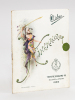
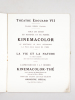
Très rare programme du Kinémacolor, procédé cinématographique mis au point par par George Smith et Charles Urban. L'obturateur de la caméra contenait un filtre orangé et bleu vert, donnant l'impression de couleur au film. Charles Urban fit construire le Théâtre Edouard VII à Paris en 1913 afin de projeter ses films en Kinemacolor ; la société de ce nom formée avec George Smith fit faillite en 1914. Le programme se compose de films de voyage ("La saison des bains à Ostende", "les chutes du Niagara", "le Lac de Lucerne", "Paris Pittoresque", "Le Japon" (avec tous les détails dans l'encart joint), mais aussi "La Lettre Infamante" (la lettre écarlate de Hawthorne), "Le Tentateur", etc... Bon état (couv. lég. frottée, très bon exemplaire par ailleurs) pour ce très rare document.
[Chez Xhrouet, Déterville, Petit, Chez les Frères Seguin] - FORTIA D'URBAN ; (HOLSTENIUS ; HOLSTE, Lukas)
Reference : 57378
(1809)
Plan d'un Atlas historique portatif [ Edition originale ] Suivi d'une Liste des Ecrivains et Artistes célèbres jusques et y compris le troisième siècle avant l'ère chrétienne ; Terminé par un Catalogue raisonné des géographes grecs, composé en latin par Luc Holsténius [ Mélanges de Géographie et d'Histoire ]
Publié pour la première fois, avec une traduction française, par M. de Fortia d'Urban, 1 vol. in-12 reliure demi-chagrin vert, dos à 4 nerfs, Chez Xhrouet, Déterville, Petit, Paris, Chez les Frères Seguin, à Avignon, Paris, 1809, 2 ff., 342 pp.Rappel du titre complet : Plan d'un Atlas historique portatif [ Edition originale ] Suivi d'une Liste des Ecrivains et Artistes célèbres jusques et y compris le troisième siècle avant l'ère chrétienne ; Terminé par un Catalogue raisonné des géographes grecs, composé en latin par Luc Holsténius [ Mélanges de Géographie et d'Histoire ]
![Plan d'un Atlas historique portatif [ Edition originale ] Suivi d'une Liste des Ecrivains et Artistes célèbres jusques et y compris le troisième ...](https://static.livre-rare-book.com/pictures/CDL/57378_thumb.jpg)
![Plan d'un Atlas historique portatif [ Edition originale ] Suivi d'une Liste des Ecrivains et Artistes célèbres jusques et y compris le troisième ...](https://static.livre-rare-book.com/pictures/CDL/57378_2_thumb.jpg)
![Plan d'un Atlas historique portatif [ Edition originale ] Suivi d'une Liste des Ecrivains et Artistes célèbres jusques et y compris le troisième ...](https://static.livre-rare-book.com/pictures/CDL/57378_3_thumb.jpg)
Ainsi que Fortia d'Urban l'indique dans sa préface, "ces mélanges sont moins un ouvrage [ ... ] que l'annonce de plusieurs ouvrages". (ex-libris de René Amédée Choppin de Villy). Bon état pour ce titre peu commun, qui propose notamment la première traduction française de Catalogue des géographes grecs rédigé par l'humaniste Lukas Holste (1596-1661) plus connu sous sa forme latinisée de Lucas Holstenius. Quérard, III, 170
Mémoires pour servir à l'histoire des propriétés territoriales dans le département de Vaucluse et principalement dans la ville et le terroir d'Avignon.
1808 in-12, VIII, 243pp., br. Paris Xhrouet 1808,
Pernes, la Tour de Sabran, Orange...où les Fortia d'Urban avaient des propriétés.
[De l'Imprimerie de Delance] - VAUVENARGUES ; [ VAUVENARGUES, Luc de Clapiers, Marquis de ] ; [ FORTIA D'URBAN, Agricol-Joseph ]
Reference : 54203
(1797)
Oeuvres complètes de Vauvenargues (2 Tomes - Complet) revues et augmentées sur les manuscrits communiqués par sa famille ; accompagnées de notes, et terminées par un table analitique des matières.
2 vol. in-12 reliure de l'époque pleine basane racinée, De l'Imprimerie de Delance, Paris, l'An Cinq, 1797, viii pp., pp. 13-313 ; 411 pp.
Complet. Etat très satisfaisant (reliures un peu frottées, le premier cahier paginé de 1 à 12 du tome premier manque, mais sans absence visible dans le texte, et ce manque semble un défaut commun à l'édition) pour cette édition établie par Fortia d'Urban.
Teoriya rascheta staticheski neopredelimykh konstruktsiy. In Russian /Calculati
Short description: In Russian. Urban, Ivan Vladimirovich. The Theory of Calculation of Statically Undefinable Structures. Moscow: Publishing House and Type 5. Transjeldorizdat, 1937. You are welcome to reach out to us for a detailed description of the copies currently available. Delivery of this book may take longer than usual including extended processing and pre-shipping time, no expedited shipping is available. Please advise us if you have a set date or a deadline to receive your order.SKU5179858
Antiquités et monumens du département de Vaucluse. I. Première partie, contenant l'histoire des Cavares et du passage d'Annibal par le département de Vaucluse. - II. Seconde partie, contenant l'histoire de la conquête de la Gaule méridionale par les Romains, l'explication de médailles celtiques nouvellement découvertes, et l'histoire de l'ancienne Atlantide
Paris, Xhrouet, Avignon, Seguin frères, 1808 in-8, XII-240 pp. puis VIII pp., puis pp. 241-483 en numérotation continue, avec une planche, broché sous couverture d'attente de papier bleu. Rousseurs.
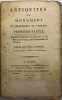
Edition originale. Cette étude du prolifique Fortia d'Urban (1756-1843) sur les populations celtes de la région et la situation géographique de plusieurs localités anciennes figure parmi les contributions estimées de l'érudit avignonnais. - - VENTE PAR CORRESPONDANCE UNIQUEMENT - LIEN DE PAIEMENT, NOUS CONSULTER.
Beskrivelse over et nyt Metal-Thermometer.
(København, 1823). 4to. Bound uncut in recent marbled paper covered boards. Published in ""Videnskabernes Selskabs Skrifter"". Fine and clean. (3), 284-288 pp. + 2 engraved plates.
First appearance of Jürgensen’s description of his metal-thermometer Jürgensen ”starts the article by applauding the mercury thermometer and calls it one of the most perfect instruments in the world of natural sciences. The metal thermometer is however, he states, much more portable and rugged than the former. This new design included an arrangement that allows the user to observe the lowest temperature since the last resetting of the hand. Moreover, the metal thermometer is more dependable in conditions where the temperature is well below nil degrees, as the mercury may freeze in such an environment. The thermometer described in this article is of a slightly larger size than the first iteration and thus meant as a stationary tool for better readability. Jürgensen goes on to describe the construction of the thermometer, using two illustrations – one of the front and one of the back of the device.” (Insight: Urban Jürgensen and the Royal Danish Academy of Sciences and Letters).
Management international Urban, Sabine
PHOTOS SUR DEMANDE
Merci de nous contacter à l'avance si vous souhaitez consulter une référence dans notre boutique à Authon-du-Perche.
La formule du succès Urban, Linda and Ayakatsikas, Cyrielle
Ecole des Loisirs POCHE COMME NEUF.
Merci de nous contacter à l'avance si vous souhaitez consulter une référence dans notre boutique à Authon-du-Perche.
Remontrances de la noblesse de Provence au Roy, pour la revocation des arrêts de son Conseil portant réunion à son domaine des Terres aliénées & inféodées par les Comtes de Provence. Vec les preuves tirées de leurs Testaments & actes authentiques.
Aix J.B. et E. Roize 1669 In folio de 246 pp., 2 ff. + 1 ff. n.ch. entre 242 et 243 (Epitre de MM. Puilobier, Pomerols et Gailhard), demi cartonnage, papier ancien. Trace de mouillure ancienne sur le bas des premiers ff..
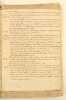
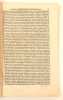
Bel exemplaire de ce fort rare ouvrage, particulièrement précieux pour les "Preuves", qui en constituent la plus grande partie: l'avocat Gailhard a reproduit in-extenso nombre de pièces officielles, arrêts et testaments, qui font de cet ouvrage une source de premier ordre pour l'histoire des Comtes de Provence. Saffroy III 48068. Seize feuillets manuscrits recto-verso ont été placés en tête du volume donnant "l'état des domaines aliénés par les Comtes de Provence". Une note de l'époque précise que "les nombreuses notes qui précèdent le volume et les remontrances qui le suivent sont toutes de la main du Mis de Fortia d'Urban.
URSS en construction n°4, 1932
1932 Moscou, Izoghiz, 1932, 416x300mm, 32p., broché sous couverture illustrée. (104691)
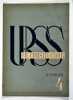
Montage photographique de P.Urban. Numéro consacré au Kouznetskstroï.Exemplaire en langue française. Mouillure coin haut droit.
Homère et ses écrits.
Paris, H. Fournier, 1832 in-8, [4]-285 pp., demi-veau blond à coins, dos à larges faux-nerfs ornés de filets dorés, guirlande et fleurons à froid dans les entre-nerfs, pièce de titre prune, tranches mouchetées (reliure de l'époque). Coiffes un peu rognées.

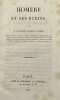
Les doutes sur l'existence personnelle d'un aède appelé "Homère" ne remontent pas à hier, et ils sont presque coextensifs à la lecture des poèmes qui lui sont attribués : le prolixe et profus marquis de Fortia d'Urban (1756-1843) prend ici partie en faveur du caractère individuel dudit Homère, en dépit de ses compétences limitées en philologie. Mais l'homme aimait à écrire "de quacumque re scibili", et même de quelques autres .. - - VENTE PAR CORRESPONDANCE UNIQUEMENT - LIEN DE PAIEMENT, NOUS CONSULTER.
HISTOIRE ANCIENNE DES SALIENS, NATION LIGURIENNE OU CELTIQUE, ET DES SALIENS, PRÊTRES DE MARS, précédé par l'histoire Liguriens, et des mémoires sur l’académie celtique.
Édition originale, Dix volumes en 10 tomes In-12 plein veau blond, dos lisse, tranches rouges, triples liserets dorés sur les plats, titres et tomaisons dorés dos richement ornés. intérieur frais. Chez XHROUET. Paris. Quelques trous a la reliure dos et mors, coins effondrés et/ou manques, coiffe de tête absente tome 2, 6, 7, 8, et coiffe de pieds tome 8.
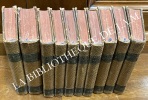
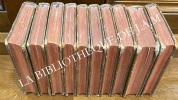
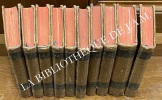
Histoire ancienne du globe Terrestre. -T1 Histoire ancienne des Saliens, nations Ligurienne ou Celtique 1705192 pp. -T2 considération sur l'origine et l'histoire ancienne du globe ou introduction a l'histoire ancienne de l’Europe 1807 463pp & 3 planches. -T3 mémoire et plan de travail sur l'histoire des celtes ou gaulois c'est a dire sur l'histoire de France avant Clovis 1807 231 pp. -T4 et 5 : histoire de la Chine avant le déluge. 1807 251pp, 260pp. -T6 : essais sur l'origine des anciens peuples suivi d'une théorie élémentaire des comètes, appliquée à la comète de 1807. -T7 : Bérose et Annius de Viterbe ou les antiquités chaldéennes.1808, 268pp. -T8 : essai sur quelques-uns des plus anciens monuments de la géographie, terminé par les preuves de l'identité des déluges d'yao...289 pp. -T9 : histoire et théorie du déluge d'Ogiés ou de Noé et de la submersion de l'Atlantide.1809 298 pp. -T 10 nouveau système préadamite ou conciliation de la genèse 1809 307pp Fortia Agricole-Joseph- marquis de Fortia d'Urban 1756-1843.
Daily living in the twelfth century Based on the observation of Alexander Neckam in London and Paris
1964 Madison, The University of Wisconsin Press, 1964 21,5 x 14 cm, ix-337 pp Good condition
Paperback edition with black & white illustrations.
Le fouet vivant
2013 Paris, Fayard, 2013 15 x 23,5 cm, 366 pp, broché, couverture souple à rabats, état neuf,
roman traduit du slovaque, préfacé et annoté par Michel Chasteau.

