Write to the booksellers
1 books for « thucydide francesco d... »Edit
Gli otto libri di Thucydide Atheniese, delle guerre fatte tra popoli della Morea, et gli Atheniesi, nuovamente dal Greco idioma, nella lingua Thoscana, con ogni diligenza tradotto, per Francesco di Soldo Strozzi Fiorentino.
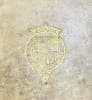
(Description en français plus bas.) Venice: Baldassare Costantini, at the sign of San Giorgio, 1545. First edition of this Renaissance translation, in-16, 11.5 x 15 cm, 5 cm thick. (11 ff.) 440 ff. An important sixteenth-century Venetian edition of the complete historical work of Thucydides, translated directly from Greek into Italian by Francesco di Soldo Strozzi, preserved in an attractive early full-vellum binding bearing gilt armorial insignia. One of the foundational works of Western historical writing, Thucydides' History of the Peloponnesian War recounts the conflict between Athens, Sparta, and their respective allies in the fifth century BC. Renowned for its analytical approach to political power, military strategy, human ambition, and the causes of war, the work remains a cornerstone of classical historiography and political thought. Translated from Greek into the Tuscan vernacular by the Florentine humanist Francesco di Soldo Strozzi, this edition reflects the Renaissance rediscovery and dissemination of classical historical literature. By presenting Thucydides in Italian, it helped make one of antiquity's most influential historical texts accessible beyond the traditional readership of Greek and Latin scholars. The volume contains all eight books, preceded by a dedication to Cosimo I de' Medici, Duke of Florence, and supplemented by an extensive alphabetical index of historical events, geographical locations, persons, and subjects. Fine Venetian printing in italic type, featuring an ornamented title page with printer's devices, historiated woodcut initials, and a full-page woodcut depicting Laocoön, inspired by the celebrated ancient sculptural group. Early full ivory vellum binding, with rounded spine, five raised bands, and the title "Tucidide" lettered in black ink. The front cover bears a gilt crowned coat of arms encircled by a garter inscribed "Honi soit qui mal y pense", the motto of the English Order of the Garter. The armorial decoration adds considerable interest from the perspective of provenance, historical book ownership, and the circulation of Renaissance books. The precise identification of the arms remains to be established. Provenance: Illustrated bookplate of Brazilian diplomat Mario de Pimentel Brandão (1889-1956), incorporating the motto "Knowledge is Power", pasted onto the front inner cover. An earlier manuscript inscription reading "Challock, Rome 1804" appears on the title page, suggesting ownership or the book's presence in Rome in the early nineteenth century. A particularly appealing copy combining a major classical historical text, Renaissance Venetian typography, early gilt armorial vellum, and several layers of historical provenance. An attractive acquisition for collectors of classical literature, Renaissance printing, early Italian translations, armorial bindings, and historical private libraries. ********************** Venise, Baldassare Costantini, à l'enseigne de San Giorgio, 1545. Édition originale de cette traduction renaissante. in-16, 11,5 x 15 cm, 5 cm d'épaisseur. (11 f.) 440 f. Précieuse édition vénitienne du XVIe siècle de l'œuvre historique complète de Thucydide, traduite du grec en italien par Francesco di Soldo Strozzi, dans une remarquable reliure ancienne en plein vélin portant les armes dorées d'un ancien possesseur. L'un des textes fondateurs de l'historiographie occidentale, La Guerre du Péloponnèse retrace le conflit qui opposa Athènes à Sparte et à leurs alliés au Ve siècle avant notre ère. Par sa rigueur analytique, son examen des motivations politiques, des rapports de force et des mécanismes de la guerre, Thucydide demeure l'un des premiers grands théoriciens de l'histoire politique et des relations entre puissances. Cette traduction italienne, réalisée directement à partir du grec par l'humaniste florentin Francesco di Soldo Strozzi, témoigne de la diffusion de l'historiographie classique dans les milieux lettrés de la Renaissance. Sa publication en langue toscane rendait accessible à un lectorat plus large une œuvre jusque-là principalement étudiée dans ses versions grecques et latines. L'ouvrage comprend les huit livres de Thucydide, précédés d'une dédicace à Cosme Ier de Médicis, duc de Florence, et accompagnés d'une importante table alphabétique des événements, personnages, lieux et matières traités dans le texte. Belle impression vénitienne en caractères italiques, avec titre orné de marques typographiques, initiales historiées gravées sur bois et illustration à pleine page représentant le Laocoon, d'après le célèbre groupe sculpté antique. Reliure ancienne en plein vélin ivoire, à dos arrondi orné de cinq nerfs apparents, titre « Tucidide » inscrit à l'encre noire, plats sobres et patinés. Le premier plat porte, frappées à l'or, des armes couronnées entourées d'une jarretière portant la devise « Honi soit qui mal y pense », devise de l'ordre anglais de la Jarretière. Cette décoration héraldique confère à l'exemplaire un intérêt supplémentaire pour l'histoire des bibliothèques et de la circulation des livres anciens. L'identification précise des armes reste à établir. Provenance : ex-libris illustré de Mario de Pimentel Brandão, portant la devise « Knowledge is Power », collé au contreplat antérieur. Ancienne inscription manuscrite « Challock, Rome 1804 » sur la page de titre, témoignant d'une possession ou d'un passage de l'ouvrage à Rome au début du XIXe siècle. Un exemplaire particulièrement séduisant par la réunion d'un grand texte de l'Antiquité, d'une impression humaniste vénitienne du XVIe siècle, d'une reliure héraldique ancienne et de plusieurs marques de provenance. Ouvrage intéressant tant pour les collectionneurs de littérature classique et de livres de la Renaissance que pour les amateurs de reliures armoriées et de bibliothèques historiques.
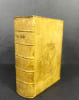
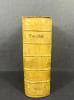
Condition: Attractive age-toned vellum binding showing rubbing, surface wear, and minor defects to the headcaps and corners. Formerly coloured edges, now faded, with a small visible irregularity or tear along one edge. Generally well-preserved early paper, with occasional spotting, browning, and signs of handling. Some weakness to the inner hinges and preliminary leaves. The printing remains clear and legible. *************** État de conservation : reliure présentant une patine ancienne, des frottements et quelques défauts aux coiffes et aux coins. Tranches anciennement colorées, aujourd'hui passées, avec une petite irrégularité ou déchirure visible sur la tranche. Papier ancien généralement bien conservé, avec rousseurs, brunissures et traces d'usage. Quelques fragilités visibles aux charnières intérieures et sur certains feuillets préliminaires. Impression nette et bien lisible.