 Write to the booksellers
70 books for « thomas aquinas »Edit
-
Language
French (69)
Latin (1)
-
Century
16th (2)
18th (1)
19th (12)
20th (33)
21st (1)
-
Countries
Belgium (40)
Canada (3)
Denmark (3)
France (12)
Netherlands (9)
Switzerland (3)
-
Syndicate
ALAC (3)
ILAB (17)
SLAM (11)
Summa theologiae - Incipit tertia pars summe sancti Thome de Aquino. Questio prima deconnenientia incarnationis. - [THE ""FIVE WAYS"" OF PROVING THAT GOD EXISTS]
Venedig, Bernardino de Tridino - Stagnatius (Bernardino Benalio and Giovanni de Tridino / Bernardino Benalio and Giovanni de Tridino alias Tacuino), 10. April 1486. Folio (binding: 33x22 cm, block: 31,5x21,5 cm). In a charming contemporary full blindstamped pigskin binding over wooden boards. Five raised bands and early handwritten paper title-labels to spine. Spine and upper parts of boards with wear. Front hinge cracked, but still holding, although inner hinge very weak. Brass clasps, but no ties. Boards richly blindstamped with panels of acanthus-stamps and diamond-shaped stamps with two-headed dragons. Centre-panel with round stamps inside which a lion. Front board with ""Iohannes"" repeated four times inside banners. Pasted down front end-paper richly annotated in various hands - contemporary and early - and with several Ex libris - Ditlev Duckert, Sigurd&Gudrun Wandel, and ""A-D"". First blank with contemporary or near contemporary two-line inscription and a discreet stamp (""Veräusserte Dublette aus Stadtbibliothek Frankfurt am Main""). Neat, contemporary handwritten annotations to margins of many leaves. Pasted-down end-paper with many contemporary handwritten annotations as well. Beautifully printed in two columns throughout, 70 lines to each. Handpainted initials in red throughout and rubricated in red. A few leaves cropped at lower blank margin (far from affecting text), one leaf with a vertital tear (no loss), one leaf with a large brown stain, and one leaf with the red initials smudged. Otherwise just some occasional brownspotting. Generally very nice and well preserved. All in all a lovely copy. 200 ff. (a-p8, q-r6 (incl. the 3 ff. of Tabula) + aa-mm8 + 2 ff. Tabula) - thus fully complete, with both registers and the first blank.
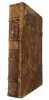
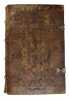
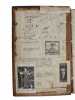
The scarce and magnificent Tridino-edition of the seminal third part of the Summa Theologiae, Aquinas' unfinished magnum opus, of which each part constitutes a work in its own right, the third dealing with Christology. It is here that we find Aquinas' groundbreaking ""Five Ways"", his five arguments for the existence of God, arguably the most influential demonstration that God exists ever written. Each individual part of the ""Summa"" has its own separate printing history and its own bibliography, and the three parts are not expected to be found together. The ""Pars Tertia"" was printed for the first time in the 1470'ies, by Michael Wenssler. A reissue of this appeared in 1485. The present edition, by the renowned Venice book printer Tridino, constitutes the second edition of this landmark work of Western thought and the third appearance overall. Aquinas wrote his seminal magnum opus, the ""Summa Theologiae"", as an instructional guide for theology students and those interested in understanding Christian theology. Together, the three volumes that he wrote present the reasoning for almost all parts of Christian theology in the West, following a cycle beginning and ending with God, in between which we find Creation, Man, the Purpose of Man, Christ, and the Sacraments (unfinished), the third part dealing with Christ, the most fundamental question of the existence of God, and man's way of knowing him to exist. Although he left the ""Summa"" as such unfinished, the individual parts have come to form ""one of the classics of the history of philosophy and one of the most influential works of Western literature."" (Ross, James F.: ""Summa theologiae, Christian Wisdom Explained Philosophically"", 2003. P. 165). Determining that the way which leads to God is Christ, the path to God becomes the theme of Pars III of the ""Summa"", where we find Aquinas' Christology developed in full, his seminal demonstration of the existence of God, and his assertation of the necessity of the incarnation. Centering on the unity of the divine and human in the person of Christ, Pars III argues that all human potentialities are made perfect in Jesus. Aquinas here focuses on Christ's true humanity, including his birth, passion, resurrection, and the symbolism of the cross, and combines the Christian and the non-Christian in a synthesis that comes to be defining for all later Christian thought and theological philosophy. The most famous and influential part of Pars III of the ""Summa"", however, is probably Aquinas' considerations of - and arguments for - the existence of God. Exploring the rational belief in God, amongst other things, Aquinas here presents his ""Five Ways"" for the first time. ""Aquinas considers whether we can prove that God exists in many places in his writings. But his best-known arguments for the existence of God come in Ia, 2, 3(the ""Five Ways"")... [i]t would be foolish to suggest that the reasoning of the Five Ways can be quickly summarized in a way that does them justice. But their substance can be indicated in fairly uncomplicated terms. In general, Aquinas' Five Ways employ a simple pattern of argument. Each begins by drawing attention to some general feature of things known to us on the basis of experience. It is then suggested that none of these features can be accounted for in ordinary mundane terms, and that we must move to a level of explanation which transcends any with which we are familiar..."" (Marenbon, Medieval Philosophy, 2004. Pp. 244-45). ""The Five Ways, Latin Quinquae Viae, in the philosophy of religion, the five arguments proposed by St. Thomas Aquinas (1224/25-1274) as demonstrations of the existence of God. Aquinas developed a theological system that synthesized Western Christian (and predominantly Roman Catholic) theology with the philosophy of the ancient Greek thinker Aristotle (384-322 BCE), particularly as it had been interpreted by Aristotle's later Islamic commentators. In his ""Summa Theologica"", which he intended as a primer for theology students, Aquinas devised five arguments for the existence of God, known as the Five Ways, that subsequently proved highly influential. While much of Aquinas's system is concerned with special revelation-the doctrine of the Incarnation of God's Word in Jesus Christ-the Five Ways are examples of natural theology. In other words, they are a concerted attempt to discern divine truth in the order of the natural world. Aquinas's first three arguments-from motion, from causation, and from contingency-are types of what is called the cosmological argument for divine existence. Each begins with a general truth about natural phenomena and proceeds to the existence of an ultimate creative source of the universe. In each case, Aquinas identifies this source with God. Aquinas's first demonstration of God's existence is the argument from motion. He drew from Aristotle's observation that each thing in the universe that moves is moved by something else. Aristotle reasoned that the series of movers must have begun with a first or prime mover that had not itself been moved or acted upon by any other agent. Aristotle sometimes called this prime mover ""God."" Aquinas understood it as the God of Christianity. The second of the Five Ways, the argument from causation, builds upon Aristotle's notion of an efficient cause, the entity or event responsible for a change in a particular thing. Aristotle gives as examples a person reaching a decision, a father begetting a child, and a sculptor carving a statue. Because every efficient cause must itself have an efficient cause and because there cannot be an infinite chain of efficient causes, there must be an immutable first cause of all the changes that occur in the world, and this first cause is God. Aquinas's third demonstration of God's existence is the argument from contingency, which he advances by distinguishing between possible and necessary beings. Possible beings are those that are capable of existing and not existing. Many natural beings, for example, are possible because they are subject to generation and corruption. If a being is capable of not existing, then there is a time at which it does not exist. If every being were possible, therefore, then there would be a time at which nothing existed. But then there would be nothing in existence now, because no being can come into existence except through a being that already exists. Therefore, there must be at least one necessary being-a being that is not capable of not existing. Furthermore, every necessary being is either necessary in itself or caused to be necessary by another necessary being. But just as there cannot be an infinite chain of efficient causes, so there cannot be an infinite chain of necessary beings whose necessity is caused by another necessary being. Rather, there must be a being that is necessary in itself, and this being is God. Aquinas's fourth argument is that from degrees of perfection. All things exhibit greater or lesser degrees of perfection. There must therefore exist a supreme perfection that all imperfect beings approach yet fall short of. In Aquinas's system, God is that paramount perfection. Aquinas's fifth and final way to demonstrate God's existence is an argument from final causes, or ends, in nature (see teleology). Again, he drew upon Aristotle, who held that each thing has its own natural purpose or end. Some things, however-such as natural bodies-lack intelligence and are thus incapable of directing themselves toward their ends. Therefore, they must be guided by some intelligent and knowledgeable being, which is God."" (Encycl. Britt.). ""Thomas Aquinas's ""Summa theological"" was originally written as a teaching document, a guide for beginning theology students. At more than 3,500 pages, it may seem an intimidating introduction to Christian theology"" however, the influence of the ""Summa"" exceeds its volume. Aquinas's work influenced every subject in the liberal arts, especially astronomy, logic, and rhetoric. Aquinas's methodical disputations, rhetorical style, and logic are as much an education as his insights on the balance of faith and reason within Christian doctrine."" (University of Dayton Library). ""During the high Middle Ages theology itself underwent important changes. In the eleventh and twelfth centuries, the study of logic and dialectic began to expand at the expense of grammar and rhetoric… Another change that accompanied this development was the effort to transform Christian doctrine from scattered pronouncements of Scripture, the Councils, and the Church Fathers into a coherent and systematic body of statements. This process culminates in Peter Lombard's ""Sentences""…, and in St. Thomas Aquinas' ""Summa Theologiae""."" (Kristeller, Renaissance Thought and its Sources, 1979. P. 117). Hain:1470" Proctor: 4826 Graesse: 7:139.

Selected writings
London, Penguin Books 1998 xxxviii + 841pp., 20cm., softcover, good condition, [selected texts of Thomas Aquinas, edited and translated with an introduction and notes by R. McInery], F78187
De gelovige Thomas. Beschouwingen over de hymne Sacris sollemniis van Thomas van Aquino.
Baarn, Ambo, 1986.
121 p. Pb. (9 essays)
Thomas von Aquin.
Darmstadt, WB, 1978.
2 vols: 491;572 p. Cloth. (Wege der Forschung) (A few small feltpen underlinings on one p.)
Inleiding tot leven en leer van S. Thomas van Aquino. 2e geheel omgewerkte dr.
Nijmegen, Utrecht, Dekker & v.d. Vegt, 1929.
VII,214 p. Wrs.
Disputed questions on virtue
South Bend, St.Augustine's Press 1999 xix + 140pp., hardcover (editor's cart.cover), 24cm., Very good condition, ISBN: 1-890318-20-5, [content: English translation of Thomas' Quaestio Disputata de Virtutibus in communi & Quaestio Disputata de Virtutibus Cardinalibus, translated and prefaced by Ralph McInery], F78189
Aquinas on Creation Writings on the 'Sentences' of Peter Lombard.Book 2, Distinction 1, Question 1,
Turnhout, Brepols, 1998 Paperback, 166 pages., 140 x 210 mm. ISBN 9780888442857.
The six articles that comprise Book 2, Distinction 1, Quetion 1 of Aquinas' Writings on the 'Sentences' of Peter Lombard (Scriptum super libros Sententiarum Petri Lombardi) represent his earliest and most succinct account of creation. These texts contain the essential Thomistic doctrines on the subject, and are here translated into English for the first time, along with an introduction and analysis. Languages : English.
Über das Sein und das Wesen. Deutsch-Lateinische Ausgabe. Übersetzt und erläutert von Rudolf Allers.
Köln, Olten, Hegner, 1953.
166 p. Cloth (Cover a bit foxed and yellowed)
St. Thomas and the Greek moralists.
Milwaukee, Marquette Univ. Press, 1947.
(The Aquinas Lecture, 1947). (VIII),63 p. Cl.
Manuel de philosophie Thomiste. Réédition par R. TERRIBILINI. (Vol.) 1: logique formelle, ontologie, esthétique.
Paris, 1950.
244 p. Wrs. (Cover partly discol. & sl. dam.)
De formuleering en fundeering van het causaliteitsbeginsel.
Nijmegen, Dekker & v.d. Vegt, 1942.
64 p. Wrs. 25 cm
Inleiding tot de wijsbegeerte en tot het Thomisme.
Amst., Mechelen, Kompas, de Spieghel, 1933.
271 p. Wrs.
THOMAS AQUINAS [AQUINO] (ALBERT Karl & ENGELHARDT Paulus, hrsg.)
Reference : R69004
(1987)
Thomas von Aquin. Summe gegen die Heiden. Erster Band: Buch I. Zweiter Band: Buch II. Dritter Band, Teil 1: Buch III Kapitel 1-83. Dritter Band, teil 2: Buch III Kapitel 84-163. Vierter Band: Buch IV [complete in 4 parts in 5 vols.]
Darmstadt, Wissenschaftliche Buchgesellschaft 1987-1996 complete in 4 parts in 5 vols.: xxiv,373 + xx,513 + xvii,363 + xvii,385 + xv,580pp., 22cm., cart.cover, [bilingual: Latin-German], VG, R69004
THOMAS AQUINAS (REGAN Richard, transl. & DAVIES Brian, ed.)
Reference : F101371
(2001)
The 'De Malo' of Thomas Aquinas (with facing-page translation, edited with an introduction and notes)
Oxford, Oxford University Press 2001 xiv + 986 pp., 25cm., publisher red hardcover with gilt lettering, very good, ISBN 0-19-509182-5, F101371
Aquinas, and problems of his time.
Leuven, Leuven Univ. Press, 1976.
VIII,229 p. Stiff wrs. 25 cm (Mediaevalia Lovaniensia I,5)
De verbo incarnato. Commentarius in tertiam partem S. Thomae
Romae, Ex typographia polyglotta 1900 583pp., 22cm., editio tertia, cart.cover (marbled plates, spine in leather with gilt lettering and decorations), some annotations, G, R68614
TOMMASO D'AQUINO [THOMAS AQUINAS] (& PEROTTO Lorenzo, ed.)
Reference : R104984
(1995)
Commento al Libro di Giobbe (Introduzione, traduzione e riflessioni conclusive a cura di Lorenzo Perotto)
Bologna, Edizioni Studio Domenicano 1995 523pp., 22cm., publisher's hardcover with gilt lettering, very good condition, R104984
LOMBARDUS Petrus [PIERRE LE LOMBARD] & THOMAS AQUINAS [THOMAS D'AQUIN, AQUINO] (& MIGNE, ed.)
Reference : R61325
(1841)
Petri Lombardi Sententiarum Libri quatuor, per Joannem Aleaume, pristono suo nitori vere restituti; necnon Divi Thomae Aquinatis Summa Theologica, ad manuscriptos codices a Francisco Garcia, Gregorio Donato, Lovaniensibus ac Duacensibus Theologis, Joanne Nicolai, ac Thoma Madalena diligentissime collata ; novisque curis ac dissertationibus a Bernardo Maria de Rubeis illustrata [4 volumes]
Paris, Migne 1841 4 volumes (ouvrage complet), texte imprimé en 2 colonnes: 1346 + 984 + 1420 + 1560 colonnes, reliures cart. (plats marbrés, dos en cuir avec titres dorés), feuilles de garde marbrées, cachet sur la p.d.t., 27cm., texte frais, texte en Latin, bon état, R61325
Commentaria in libros de caelo et mundo, de generatione et corruptione et meteorologicorum [in: Opera Omnia Thomas Aquinatis, Tomus tertius (3)]
Romae [Rome], Ex Typographia Polyglotta 1886 xl + 455 + cxlviii pp., 42cm., publisher's hardcover with spine in white leather, text in Latin, text printed in 2 columns, 1 stamp on first title page & 2 stamps on title page, some foxing on edges, text is clean and bright, good condition, weight: 4.5kg., [Volume 3 in "Sancti Thomas Aquinatis.. Opera Omnia iussu impensaque Leonis XIII P.M. edita", ad codices manuscriptos exacta, cura et studio Fratrum Ordinis Praedicatorum], F114029
Summa Theologic Prima Secundae Partis
Ex Typographia Forzani et S. (Ioannis Bardi) Sans date.
Bon état
Gli autografi di Tommaso d'Aquino
, Brepols, 2021 Hardback, xx + 156 pages, Size:155 x 245 mm, Illustrations:291 b/w, 3 col., 1 tables b/w., Language(s):Italian, Latin. ISBN 9782503597898.
Summary Di Tommaso d'Aquino, il più noto e studiato teologo medievale, ci sono giunti cinque testi autografi, che vengono presentati qui per la prima volta all'interno di uno studio complessivo. La scrittura che li caratterizza è talmente ostica da essersi guadagnata, già nel Medioevo, l'appellativo di littera inintelligibilis, e spesso viene considerata una scrittura assolutamente personale. Quando si studiano le opere di un uomo considerato eccezionale, in effetti, è facile incorrere nell'errore di giudicare anomalo, o straordinario, tutto ciò che egli produsse, anche sul piano materiale. Obiettivo principale di questo lavoro è quello di descrivere la scrittura di Tommaso e di inserirla nel suo contesto, esaminandola come un'espressione della scrittura dei dotti del tempo. Il volume è suddiviso in tre parti. Dopo una descrizione codicologica dei manoscritti conservati, ci si concentra sulla scrittura attraverso una minuziosa descrizione dei fatti grafici. Infine, a partire dagli elementi materiali ricavati dall'esame degli autografi, viene esaminato il metodo di lavoro seguito da Tommaso e dai suoi collaboratori. Il punto di vista privilegiato è quello della storia della cultura scritta: gli autografi di Tommaso sono analizzati nella loro materialità come testimonianze importanti che aprono spiragli di conoscenza sul lavoro intellettuale nel medioevo.
In Aristotelis libros De sensu et sensatio, De memoria et reminiscentia commentarium
Taurini / Romae [Torino / Roma], Marietti 1949 viii + 130pp., 25cm., text printed in 2 columns, nice modern binding (cloth), original softcover preserved, VG, [introduction and text in Latin]
A commentary on Aristotle's De anima
New Haven / London, Yale University Press 1999 xlviii + 450pp., 24cm., previous owner's name on first page, hardcover (cloth), fine condition
The Treatise on Law (being Summa Theologiae, I-II, QQ. 90 through 97)
Notre Dame, University of Notre Dame Press 1993 xvi + 367pp., 23cm., softcover, previous owner's name on first title page, good condition, ISBN 978-0-268-01881-2, [Edited with introduction, Latin Text, Translation and Commentary], F101245
THOMAS AQUINAS (BAUMGARTH William P. & REGAN Richard J. S.J., eds.)
Reference : F101246
(1988)
On Law, Morality and Politics
Indianapolis, Hackett 1988 xxvii + 288pp., 23cm., softcover, ISBN 0-87220-031-0, previous owner's name on first title page, good condition, F101246

