Write to the booksellers
103 books for « theodor w adorno »Edit
-
Language
English (2)
French (100)
German (1)
-
Century
20th (45)
21st (19)
-
Countries
Belgium (9)
Brazil (2)
Canada (2)
Denmark (3)
France (59)
Switzerland (28)
-
Syndicate
ALAC (2)
ILAB (46)
NVVA (2)
SLACES (2)
SLAM (33)
Topics
- Aesthetics (2)
- Artists (1)
- Autographs (2)
- Biography (2)
- Brecht bertolt (1)
- Durkheim emile (2)
- Essays (1)
- Ethic (1)
- Germanic languages (3)
- Germany (1)
- History (4)
- Humanitarian sciences (2)
- Industrial arts & crafts - fine arts (1)
- Judaism (judaica) (2)
- Judaism pc (1)
- Literature (1)
- Marx karl (1)
- Metaphysics (1)
- Music (8)
- Musical theory (1)
- Musicology (8)
- Opera (1)
- Opera ballet (1)
- Philosophy (31)
- Piaget jean (1)
- Pierre bernard (1)
- Policy (4)
- Prussia (1)
- Psychology (4)
- Review (1)
- School (1)
- Sciences (2)
- Social sciences (2)
- Sociology (2)
- Sportsmen (1)
- Translation (2)
- Wagner richard (1)
Theodor Wiesengrund Adorno - Leleu - Leydenbach
Reference : RO20278421
(1988)
ISBN : 270730137X
Malher - Une physionomie musicale - Collection Le sens commun
DE MINUIT. 1988. In-8. Broché. Etat d'usage, Couv. convenable, Dos satisfaisant, Quelques rousseurs. 265 PAGES - Dos légèrement insolé. . . . Classification Dewey : 780-Musique
Theodor Wiesengrund Adorno - Leleu Jean-Louis + Leydenbach Theo : traduction & presentation Classification Dewey : 780-Musique


Métaphysique
EDITIONS PAYOT & RIVAGES (1 novembre 2006)
Livre à l'état de neuf, très frais sans annotations ni défauts dissmulés.
Filosofia y Supersticion
Alianza / Taurus 1962 182 pages in12. 1962. Broché. 182 pages.
bon état couverture défraîchie intérieur propre
Dialectique négativeTraduit par le groupe de traduction du collège de philosophie
Payot 1978
Serivice de presse
Zur Metakritik Der Erkenntnis Theorie - Studien Über Hussert Und Die Phanomenologischen Antinomien
Kohlhammer Jaquette en état satisfaisant Stuttgart Ed. originale 1956 251 pages en foramt grand -8 - reliure rigide en percaline brune avec titres en dorure
Très Bon État
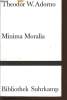
MINIMA MORALIA: Réflexions sur la vie mutilée
Payot (21 février 1991)
Livre à l'état de neuf, très frais sans annotations ni défauts dissmulés.
AUTOUR DE LA THEORIE ESTHETIQUE. PARALIPOMENA, INTRODUCTION PREMIERE
Klincksieck 1976
Broché, comme neuf.
Jean Leymarie, James Sweeney, Theodor W. Adorno, Yves Bonnefoy, Alejo Carpentier y Valmont, Gaëtan Picon, René Clair
Reference : lc_51972
L'art dans la société d'aujourd'hui - Rencontres internationales de Genève
Baconnière, Neuchâtel, 1968
Broché, comme neuf.
Dissonanzen einleitung in die musiksoziologie / Gesammelete shcirften 14
Suhrkamp 1973 in8. 1973. Broché.
Bon Etat de conservation cependant couverture défraîchie jaunie dos ridé intérieur propre
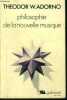
Philosophie de la nouvelle musique. Collection tel
gallimard. 1985. In-12. Broché. Etat d'usage, Couv. convenable, Dos satisfaisant, Intérieur frais. 222 pages.. . . . Classification Dewey : 190-Philosophie occidentale moderne
Classification Dewey : 190-Philosophie occidentale moderne
LANGENSCHEIDT'S GERMAN ENGLISH - ENGLISH GERMAN dictionary
WÖRTERBUCH. 1993. In-12. Relié. Bon état, Couv. convenable, Dos satisfaisant, Intérieur frais. 333 pages. Texte en allemand.. Avec Jaquette. . . Classification Dewey : 830-Littératures des langues germaniques
Classification Dewey : 830-Littératures des langues germaniques
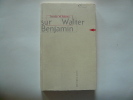
Sur Walter Benjamin
Paris, Ed. Allia, 1999, in-8, Broché, 173 pages. Petit accroc sur la couverture, sinon bon état.
NB. Les commandes et questions sont traitées dans les 48h, les expéditions reprendront le 23 octobre. Merci.
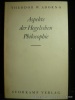
Aspekte der Hegelschen Philosophie.
Berlin und Frankfurt am Main., Suhrkamp Verlag., 1957, in-8°., broché, 60 pages. Broschiert mit Schutzumschlag, in guter Verfassung.
NB. Les commandes et questions sont traitées dans les 48h, les expéditions reprendront le 23 octobre. Merci.
[REVUE] Anouar Abd-El-Malek, Theodor W. Adorno, Kostas Axelos, Georges Balandier, Roger Bastide, Pierre Bernard, Jacques Berque, Norman Birnbaum, Frédéric Bon, Wlodzimierz Brus, Michel-Antoine Burnier, Pablo Gonzalès Casanova, Jean-Paul Charnay, Jean Chesneaux, René Depestre, Jean Duvignaud, Joseph Gabel, Roger Garaudy, Lucien Goldmann, Georges Gurvitch, Robert Jaulin, Serge Jonas, Cesare Luporini, Henri Lefèbvre, Jacques Lombard, René Lourau, Georg Lukacs, Herbert Marcuse, Karl Marx, Serge Moscovici, Pierre Naville, Jean Piaget, Jean Piel, Jacques Rancière, Wilhelm Reich, Jorge Semprun, Jan Szczepanski, Karel Teige, C. Wright Mills, Jean Ziegler...
Reference : 19425
L'homme et la société, revue internationale de recherches et de synthèses sociologiques, du N° 1 au N° 28, juillet 1966 - juin 1973. 27 fascicules (dont un numéro double) in-8°, brochés.
[19425]
Theodor W. Adorno, Else Frenkel-Brunswik, Daniel J. Levinson, R. Nevitt Sanford et al.
Reference : 486
(1982)
The Authoritarian Personality. Abridged Edition
New York, Norton, 1982 [1950]. Abridged edition of Adorno et al.'s landmark study. A duodecimo softcover book of 130 x 195 mm; (xxv) 493 pp. + 3 pp. of catalog. With a foreword for the Abridged Edition, a foreword by editor Max Horkheimer, numerous tables and figures throughout. Index at the end of the book. "Since its first publication in 1951, when it was hailed as a monumental study which blazes new trails in the investigation of prejudice, this book has remained an essential document for the modern world. Written after the single most evil and deliberate act of the century, it undertook the challenging task of determining scientifically what personality traits characterized the phenomenom of authoritarianism and what internal and external forces allowed for its development." Front cover gapes a little, some rubbing on the front cover and tail, a blue pencil mention at the bottom of the half-title page, paper slightly yellowed.
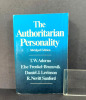
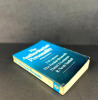
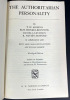
A still sought-after title.
Theodor W. Adorno, Else Frenkel-Brunswik, Daniel J. Levinson, R. Nevitt Sanford et al.
Reference : 487
(1964)
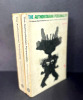
The Authoritarian Personality. A Study in Prejudice
New York, Wiley / Science Editions, 1964 [1950]. Complete two-volumes edition. Two softcover volumes of 142 x 214 mm, (xxxi) 990 pp. With a foreword by editor Max Horkheimer, numerous tables and figures throughout. Index at the end of the book. "Since its first publication in 1951, when it was hailed as a monumental study which blazes new trails in the investigation of prejudice, this book has remained an essential document for the modern world. Written after the single most evil and deliberate act of the century, it undertook the challenging task of determining scientifically what personality traits characterized the phenomenom of authoritarianism and what internal and external forces allowed for its development." First pages of vol. 1 disbound, yellowed paper. Complete text.
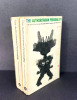
A still sought-after title.
MAX HORKHEIMER-THEODOR W. ADORNO
Reference : ABE-1765662622001
(2017)
ISBN : 3596274044
DIALEKTIK DER AUFKLARUNG Philosophische Fragmente
N°7404-278 PAGES-12,5 CM X 19 CM-TEXTE EN ALLEMAND-(E1225)
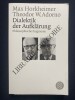
FISCHER COUVERTURE SOUPLE ETAT COMME NEUF
JARGON DE L'AUTHENTICITE De l'idéologie allemande
COLLECTION CRITIQUE DE LA POLITIQUE-PREFACE ET TRADUCTION D'ELIANE ESCOUBAS-POSTFACE DE GUY PETITDEMANGE-IN 8-200 PAGES-(17B)
PAYOT COUVERTURE SOUPLE ETAT NEUF
QUASI UNA FANTASIA
COLLECTION BIBLIOTHEQUE DES IDEES-PRESENTATION ET NOTES DE JEAN-LOUIS LELEU-TRADUIT DE L'ALLEMAND PAR JEAN-LOUIS LELEU AVEC LA COLLABORATION DE OLE HANSEN-LOVE ET PHILIPPE JOUBERT-IN 8-360 PAGES-(500H)
GALLIMARD-NRF COUVERTURE SOUPLE ETAT NEUF
Kritik des logischen Absolutismus. - [THE CRITIQUE OF LOGICAL ABSOLUTISM - PRESENTATION-COPY]
(Stuttgart, W. Kohlhammer, 1954). 8vo. Stapled with paper backstrip. Recto of f.1 with stamp: ""Sonderdruck aus Archiv für Philosophie Band ""5"" (in hand-writing) Heft ""2"" (in handwriting)"" and with a four-line presentation-inscription from the author, signed ""Theodor Adorno"" and dated ""Frankfurth, Sept. 1954."" Pp. 130-169.
![Kritik des logischen Absolutismus. - [THE CRITIQUE OF LOGICAL ABSOLUTISM - PRESENTATION-COPY]. "ADORNO, THEODOR W.](https://static.livre-rare-book.com/pictures/LLX/49008_1_thumb.jpg)
![Kritik des logischen Absolutismus. - [THE CRITIQUE OF LOGICAL ABSOLUTISM - PRESENTATION-COPY]. "ADORNO, THEODOR W.](https://static.livre-rare-book.com/pictures/LLX/49008_2_thumb.jpg)
First edition, off-print, presentation-copy, of Adorno's ""Critique of the Logical Absolutism"", constituting his foundational critique of Husserls' theory of logical validity and its assistance on the absolute separartion between logical validity and subjective thought process, for which Adorno introduced the them ""logical absolutism"". The present critique of Husserl's logical absolutism profoundly influenced 20th century continental philosophy. The important and influential German philosopher and sociologist, Theodor Ludwig Wiesengrund Adorno (1903 - 1969), was a leading member of the Frankfurt School, together with e.g. Horkheimer, Benjamin, and Habermas. He taught philosophy at the university of Frankfurt, but as a Jew, his teaching position was taken from him in 1933. He went to Oxford to teach, and in 1938 he emigrated to America, where he was the leader of several sociological projects in both New York and Los Angeles. Together with Horkheimer he wrote the theoretical manifest of the Frankfurt School, the ""Dialektik der Aufklärung"". In 1949 he returned to Frankfurt, where he became professor of philosophy and sociology. ""Theodor W. Adorno was one of the most important philosophers and social critics in Germany after World War II. Although less well known among anglophone philosophers than his contemporary Hans-Georg Gadamer, Adorno had even greater influence on scholars and intellectuals in postwar Germany. In the 1960s he was the most prominent challenger to both Sir Karl Popper's philosophy of science and Martin Heidegger's philosophy of existence. Jürgen Habermas, Germany's foremost social philosopher after 1970, was Adorno's student and assistant. The scope of Adorno's influence stems from the interdisciplinary character of his research and of the Frankfurt School to which he belonged. It also stems from the thoroughness with which he examined Western philosophical traditions, especially from Kant onward, and the radicalness to his critique of contemporary Western society. He was a seminal social philosopher and a leading member of the first generation of Critical Theory."" (SEP).
Zur Metakritik der Erkenntnistheorie. Studien über Husserl und die Phänomenologischen Antinomien. - [FIGHTING EPISTEMOLOGY - PRESENTATION-COPY]
Stuttgart, (1956). 8vo. Orig. fulll brown cloth w. gilt lettering to spine and front board" original red dust-jacket w. a bit of sunning to spine, otherwise near perfect condition. A very nice, clean, and fresh copy. 251, (1) pp.
First edition, presentation-copy, of one of Adorno's most interesting and important works. With a five lines long presentation-inscription signed ""Th. W. Adorno"", dated ""Frankfurt, 16. November 1956.""Most of text was written between 1934 and 1937, when Adorno was not allowed to teach in Frankfurt, but parts of the book were written shortly before the first printing of the book, in 1956. The important and influential German philosopher and sociologist, Theodor Ludwig Wiesengrund Adorno (1903 - 1969), was a leading member of the Frankfurt School, together with e.g. Horkheimer, Benjamin, and Habermas. He taught philosophy at the university of Frankfurt, but as a Jew, his teaching position was taken from him in 1933. He went to Oxford to teach, and in 1938 he emigrated to America, where he was the leader of several sociological projects in both New York and Los Angeles. Together with Horkheimer he wrote the theoretical manifest of the Frankfurt School, the ""Dialektik der Aufklärung"". I 1949 he returned to Frankfurt, where he became professor of philosophy and sociology. ""Theodor W. Adorno was one of the most important philosophers and social critics in Germany after World War II. Although less well known among anglophone philosophers than his contemporary Hans-Georg Gadamer, Adorno had even greater influence on scholars and intellectuals in postwar Germany. In the 1960s he was the most prominent challenger to both Sir Karl Popper's philosophy of science and Martin Heidegger's philosophy of existence. Jürgen Habermas, Germany's foremost social philosopher after 1970, was Adorno's student and assistant. The scope of Adorno's influence stems from the interdisciplinary character of his research and of the Frankfurt School to which he belonged. It also stems from the thoroughness with which he examined Western philosophical traditions, especially from Kant onward, and the radicalness to his critique of contemporary Western society. He was a seminal social philosopher and a leading member of the first generation of Critical Theory."" (SEP).In this anti-epistemological work, Adorno deals with the more general question of the possibility of truth and of epistemology in principle (""die Frage nach Möglichkeit und Wahrheit von Erkenntnistheorie prinzipiell"", Vorrede, p. 9), although the outer structure of the work is that of the philosophy of Husserl. Adorno comes to the conclusion that all epistemology is misguided, because it is based on some sort of ""prima philosophia"", an original or first principle, which cannot in reality be an absolutely first, because it is a concept, which is mediated. Adorno's work became hugely influential throughout philosophical and sociological circles, and his ""Zur Metakritik der Erkenntnistheorie"" (translated as ""Against Epistemology"") counts as one of his most important works. ""It inspired Habermas and Marcuse and continues to influence other eminent thinkers in philosophy and the social sciences today."" (From the English language translation by Willis Domingo).
Dissonanzen. Musik in der verwaltete Welt. 2., erweiterte Ausgabe. - [PRESENTATION-COPY]
(Göttingen, 1958). 8vo. Original self-wrappers. Slight discolouration to spine, otherwise near mint. Inscribed by Adorno to title-page. 143, (3) pp.
Second, expanded edition, presentation-copy, of Adorno's important essay about music paedagogy, which constitutes a comprehensive and utterly consistent exposition of the matter. With a three lines long presentation-inscription signed ""Th. W. Adorno"", dated ""Mai 1959""The important and influential German philosopher and sociologist, Theodor Ludwig Wiesengrund Adorno (1903 - 1969), was a leading member of the Frankfurt School, together with e.g. Horkheimer, Benjamin, and Habermas. He taught philosophy at the university of Frankfurt, but as a Jew, his teaching position was taken from him in 1933. He went to Oxford to teach, and in 1938 he emigrated to America, where he was the leader of several sociological projects in both New York and Los Angeles. Together with Horkheimer he wrote the theoretical manifest of the Frankfurt School, the ""Dialektik der Aufklärung"". I 1949 he returned to Frankfurt, where he became professor of philosophy and sociology. ""Theodor W. Adorno was one of the most important philosophers and social critics in Germany after World War II. Although less well known among anglophone philosophers than his contemporary Hans-Georg Gadamer, Adorno had even greater influence on scholars and intellectuals in postwar Germany. In the 1960s he was the most prominent challenger to both Sir Karl Popper's philosophy of science and Martin Heidegger's philosophy of existence. Jürgen Habermas, Germany's foremost social philosopher after 1970, was Adorno's student and assistant. The scope of Adorno's influence stems from the interdisciplinary character of his research and of the Frankfurt School to which he belonged. It also stems from the thoroughness with which he examined Western philosophical traditions, especially from Kant onward, and the radicalness to his critique of contemporary Western society. He was a seminal social philosopher and a leading member of the first generation of Critical Theory."" (SEP).
Briefwechsel 1926-1969. Musikalische Briefwechsel Band II. Herausgegeben von Claudia Maurer Zenck.
Erste Auflage. Berlin, Suhrkamp Verlag. 2023. 8°. 858 S., 1 S., 1 w. Bl. Originalleinwand mit Schutzumschlag.
"Theodor W. Adorno. Briefe und Briefwechsel. Herausgegeben vom Theodor W. Adorno Archiv. Band 9." - Sehr schönes Exemplar.
Métaphysique : concept et problèmes.
Paris Payot, coll. "Critique de la politique" 2006 1 vol. broché in-8, broché, 260 pp. Traduit de l'allemand et présenté par Christophe David. Petit choc au plat inférieur, sans gravité. Sinon en bon état général. Epuisé.