 Write to the booksellers
3410 books for « the g c »Edit
-
Type
Book (3218)
Disk (1)
Engraving (8)
Magazine (41)
Maps (2)
Music sheets (133)
New book (1)
Photographs (5)
Posters (1)
-
Latest
Last 3 days (3)
Last month (9)
Last week (4)
-
Language
Czech (1)
Dutch (1)
English (137)
French (3262)
Italian (1)
Latin (2)
Russian (6)
-
Century
16th (8)
17th (35)
18th (152)
19th (732)
20th (1231)
21st (87)
-
Countries
Belgium (388)
Brazil (4)
Canada (28)
China (45)
Côte d'Ivoire (6)
Denmark (913)
France (1765)
Germany (3)
Greece (6)
Netherlands (165)
Switzerland (80)
United Kingdom (1)
United States of America (6)
-
Syndicate
ALAC (26)
CLAM (5)
CLAQ (1)
ILAB (1650)
NVVA (12)
SLACES (12)
SLAM (661)
SNCAO (4)
Topics
- Alexandria (8)
- Ampere andré - marie (10)
- Archaeology (30)
- Architecture (12)
- Army (13)
- Assembly (29)
- Astronomy (36)
- Atlas (16)
- Belief (12)
- Bible (9)
- Bibliography (40)
- Biology (27)
- Catholicism (12)
- Chemistry (153)
- China (46)
- Comic strip (43)
- Daily (24)
- Director (8)
- Discovery (99)
- Earth (11)
- Economics (15)
- Economics (22)
- Egyptology (8)
- Einstein (12)
- England (24)
- English (36)
- Entomology (19)
- Faith (11)
- Fantastic (10)
- Flora (10)
- Geography (9)
- Geology (17)
- Gold (85)
- Greek (59)
- Guide books (9)
- History (313)
- Hollywood (32)
- Jacob (12)
- Jazz (11)
- Lamp (26)
- Language (12)
- Latin (41)
- Law (61)
- Literature (44)
- London (200)
- Magazine (131)
- Mathematics (44)
- Mechanics (8)
- Medicine (21)
- Music (13)
- Newspaper (130)
- Newspapers press (113)
- Orchestra (21)
- Oxford (14)
- Patrology (14)
- Periodicals (10)
- Philosophy (17)
- Photography (14)
- Physics (183)
- Police (8)
- Popular novel (16)
- Posters (13)
- Quartet (9)
- Railway (11)
- Regency (29)
- Religions (19)
- Reverend (10)
- Review (32)
- Reviews (42)
- Rock (29)
- Rock (29)
- Scandinavian (9)
- School (22)
- Science fiction (16)
- Sciences (13)
- Scores (133)
- Short stories (11)
- Songs (128)
- Star (12)
- State (16)
- Studio (16)
- Sun (8)
- Tea (3131)
- Technology (30)
- Theology (13)
- Theorem (14)
- Theory (22)
- Trade (9)
- Travel (45)
- United kingdom (19)
- United states (17)
- Universe (14)
- Various (18)
- Version (12)
- View (15)
- War (25)
- Zoology (15)
"FRESNEL, AUGUSTIN ( ARAGO, AMPÉRE, BIOT, FOURIER). - THE FINAL DOWNFALL OF THE CORPUSCULAR THEORY OF LIGHT.
Reference : 44516
(1816)
Mémoire sur la Diffraction de la lumière, où l'on examine particululièrement le phénomène des franges colorées que présentent les ombres des corps éclairés par un point lumineux. - Extrait d'une Lettre de M. Fresnel à M. Arago, sur l'influence de ...
Paris, Crochard, 1816-25. Bound in 2 fine recent hmorocco. In: ""Annales de Chimie et de Physique, Redigées par MM. Gay-Lussac et Arago"", Tome I, IV, IX, X, XI, XV, XVII, XX, XXI, XXIII, XXVIII and XXIX. Some memoirs with scattered brownspots. All but volume 15 with the orig. titlepages to the volumes. Vol. XV having instead of the titlepage, a sample of the orig. printed wrappers, December issue 1820. Bound at end of volume 2. The memoir, no. 25a below is inserted at the end of volume 2. Some of the memoirs having textillustrations. Some versos of titlepages with stamps.
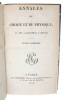
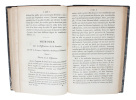
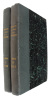
First appearances of this groundbreaking series of papers and memoirs in which Fresnel established the scientific basis for the wave theory of light and gave the theoretical framework for explaining, in the context of his theory of the transversal nature of lightwaves, the phenomena of double refraction, refraction, dispersion, polarization, interference, diffraction patterns, diffraction fringes as light spreads around objects, etc. He developed mathematically the hypothesis of the wave nature of light and he demonstrates its conformity with experience. His study of light was a dynamic interplay between theory and observation, between mathematics and experiment. - The offered series also comprises the contributions from Arago and the rapports from The French Academy's committees by Ampère, Biot and Fourier - see below nos. 6,11,14,15,a.nd 18.""From the point of view of method, his investigations extended from the manual operations of the laboratory to the most abstract mathematical analyses. Few physicists since Newton had been so versatile.""(Silliman in ""Historical Studies in the Physical Sciences"", vol. 4, p. 155.).""The wave-thory at this time was still encumbered with difficulties. Diffraction was not satisfactorily explained" for polarization no explanation of any kind was forthcoming the Huygenian construction appeared to require two different luminiferous media within double refracting bodies and the universality of that construction had been impugned by Brewster's discovery of biaxial crystals. The upholders of the emission theory, emboldened by the success of Laplace's theory of double refraction, thought the time ripe for their final triunph and as a step to this, in March 1817 they proposed Diffration as the subject of the Academy's prize for 1818. Their expectation was disappointed" and the successful memoir afforded the first of a series of reverses of which, in the short space of seven years, the corpuscular theory was completely owerthrown. The author was Augustin Fresnel...""(Whittaker ""A History of the Theories of Aether & Electricity"", vol. 1, p.107 ff.).""This concept of transverse waves met with the greatest hostility from the scientists of the day, who could not imagine an extremely fluid and rarified ether which at the same time possessed the mechanical properties of a rigid body. Even Arago admitted that he could not follow the exuberant engineer in his ideas. ButFresnel was convinced that at last he had the key to many mysteries, and with his model of waves he gave a full clarification of the phenomena of polarization. With insuperable precision he explained a long series of extremely complicated experiments, such as those of chromatic polarization that Arago himself had discovered by chance in 1811, and which the followers of Newton could not explain in spite of all their efforts. Following this line Fresnel reached the synthesis which is his masterpiece....we must recall the final interpretation that he gave of the famous phenomenon of partial reflection by transparent surfaces, that simple phenomenon which until then had puzzled Grimaldi, Newton, and Huygens, and which in Malus's experiments had unexpectedly acquired a special importencee as it had been compared to the great mystery of double refraction.""(Ronchi ""The Nature of Light"", p. 255 ff.).Comprising:1. Mémoire sur la Diffraction de la lumière, où l'on examine particululièrement le phénomène des franges colorées que présentent les ombres des corps éclairés par un point lumineux. ""Ann.Chim.P."" Tome 1. 1816. With titlepage to vol. 1. Pp. 239-281 and 1 folded engraved plate.2. Extrait d'une Lettre de M. Fresnel à M. Arago, sur l'influence de la chaleur dans les couleurs développées par la polarisation.Tome 4. 1817. With titlepage to vol. 4. Pp. 298-300.3. Lettre de M. Fresnel à M. Arago, sur l'influence du mouvement terrestres dans quelques phénomènes terrestres dans quelques phénoménes d'optique. Tome 9. 1818. With titlepage to vol. 18. Pp. 57-70.4. Note additionelle à la Lettre de M. Fresnel à M. Arago, insérée dans le dernier Cahier des Annales. Tome 9. 1818. Pp. 286-287.5. FRESNEL & ARAGO. Sur l'Action que le rayons de lumiére polarisés exercent les uns sur les autres. Tome 10. 1819. With titlepage to vol. 10. Pp. 288-305. - Also with ""Extrait d'un ouvrage du P. Grimaldi intitulé: Traité physico-mathérmatique de la lumiere des couleurs et de l'iris"". Pp. 306-312.6. ARAGO. Rapport par M. Arago à l'Academie des Sciences, au nom de la Commission qui avait été chargée d'examiner les Mémoires envoyés au concours pour le prix de la diffraction. Tome 11. 1819. With titlepage to vol. 11. Pp. 5-30.7. Mémoire sur la Diffraction de la Lumiere. (Extrait). (This importent Price-Memoir was only printed in full in 1826). Tome 11. 1819. Pp. 246-296.8. Suite Du Mémoire sur la Diffraction de la Lumière. Tome 11. 1819. Pp. 337-378. + Note sur des Essais ayant pour but de décomposer l'eau avec un aimant. Pp. 219-222.9. Note sur des Essais ayant pour but de décomposer l'eau avec un aimant. Tome 15. 1820. Pp. 219-222. No titlepage to vol. 15.10. Résume d'un Mémoire sur la Reflexion de la lumière. Tome 15. 1820. Pp. 379-386. Tome 15 is here represented with the last issue of the year (Decembre 1820, pp. 337-448) and instead of the titlepage having the orig. printed wrappers (bound at end of the second volume).11. ARAGO & AMPÈRE. Rapport fait à l'Academie des Sciences, le lundi 4 juin 1821, sur un Mémoire de M. Fresnel relatif aux couleurs des lames cristallisées douées de la double réfraction. Tome 17. 1821. Titlepage to vol. 17. Pp. 80-102.12. Note sur le Calcul des teintes que la polarisation développe dans les lames cristallisées. Tome 17. 1821. Pp. 102-111.13. IIe Note sur la Coloration des lames cristallisées. Tome 17. 1821. Pp. (167-)196.14. BIOT. Remarques de M. Biot sur un Rapport lu, le 4 juin 1821, à l'Academie des Sciences, par MM. Arago et Ampere. Tome 17. 1821. Pp. 225-258.15. ARAGO. Examen des Remarques de M. Biot. Tome 17. 1821. Pp. 258-273. 16. Addition à la IIe Note insérée dans le Cahier précédent, par M. Fresnel. Tome 17. 1821. Pp. 312-315.17. Note sur les remarques de M. Biot, publiées dans le Cahier précédent. Tome 17. 1821. Pp. 393-403.18. FOURIER, AMPÈRE ET ARAGO. Rapport fait à l'Academie sur un Mémoire de M. Fresnel, relatif à la double réfraction. Commission: Fourier, Ampère et Arago. Tome 20, 1822. With titlepage to vol. 20. Pp. 337-344.19. Note sur la double réfraction du verre comprimé. Tome 20. 1822. Pp. 376-383.20. Explication de la Réfraction dans le système des ondes. Tome 21, 1822. Titlepage to vol. 21. Pp. 225-241. + LAGRANGE. Sur la Théorie de la lumière d'Huygens. Pp. 241-246.21. Sur l'Ascension des nuages dans l'atmosphère. Tome 21, 1822. Pp. 260-263.22. Réponse de M. Fresnel à la Lettre de M. Poisson insérée dans le tome XXII des Annales, p. 270. Tome 23, 1823. Titlepage to vol. 23. Pp. 32-49.23. Note sur le Phénomène des anneaux colorés. Tome 23, 1823. Pp. 129-134.24. Suite de la Réponse de M.A. Fresnel à la Lettre de M. Poisson. Tome 23, 1823. Pp. 113-122.25. Extrait d'un Mémoire sur la double Réfraction particulière que présente le cristal de roche dans la irection de son axe. Tome 28, 1825. Titlepage to vol. 28. Pp. 147-161. + (25 a) Extrait d'un Mémoire sur la double Réfraction. Tome 28, 1825. Pp. 263-279. (According to Buchwald ""The Rise of the Wave Theory opf Light"" , p. 462, these 2 extracts composes the entire memoire.26. Note sur la Répulsion que des corps échauffés exercent les uns sur les autres à des distances sensibles. (Lue à l'Institut le 13 juin 1825). Tome 29, 1825. Titlepage to vol. 29. Pp. 57-62.27. Extrait d'un Mémoire sur la Loi des modifications imprimées à la lumière polarisée par sa réflexion totale dans l'intérieur des corps transparens. Tome 29, 1825. Pp. 175-187. (This paper was never printed in full).

"LEIBNIZ (LEIBNITZ), G.F. - CHRISTIAAN HUYGENS - JOHANN BERNOULLI - JACOB BERNOULLI ET AL. - THE DISCOVERY OF THE ""CATENARY CURVE"" , THE ""LOGARITHMIC CURVE"" AND THE ""POLAR COORDINATES"".
Reference : 41859
(1691)
1. De Linea in quam Flexile se pondere proprio curvat, ejeuque usu insignia adinveniendi quotcunque medias proportionales & Logarithmos. - 2. De Solutionibus Problematis Catenarii vel Funicularis in Actis A. 1691, aliisque a Dn. I.B. propositis. (1-2:...
Leipzig, Grosse & Gleditsch, 1691. 4to. Contemp. full vellum. Faint handwritten title on spine. a small stamp on titlepage. In: ""Acta Eruditorum Anno MDCLXXXXI"". (8),590,(6) pp. and 13 (of 15) folded engraved plates. The 2 first plates lacks, but they do not belong to the papers listed.Leibniz' papers: pp.277-281 a. 1 plate, pp. 435-439. Johann Bernoulli: pp. 274-276 a. 1 plate. Huygens: pp. 281-282. - Jacob Bernoulli: pp. 282-290 a. 1 plate.
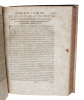
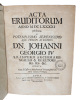
All papers first apperance. All 5 of extreme importence in the development of the Calculus. Leibniz' 2 papers on the catenary curve (paper 1-2 offered here) was written at the instigation of Jacques Bernoulli. Following the example of Blaise Pascal, who had initiated, in 1658, a contest for the construction of the cycloid, Leibniz also provoked the geometers of his time, by challenging them to submit, at the fixed date of mid-1691, their geometric method for the construction of the catenary curve. Leibniz later provided the answer, followed by Johann Bernoulli and Huygens.'These two papers are a historical account of the origin of the study of this transcendental curve, and, at the same time, the first physical-geometric construction showing the species-relationship between the catenary and the logarithmic curves, as two companion curves" one arithmetic, the other geometric. All of the differentials of the catenary curve, are arithmetic means of corresponding differentials of the logarithmic curve" and, all of the differentials of the logarithmic curve, are geometric means of the catenary.'""The Catenary is the form of a hanging fully flexible rope or chain (the name comes from ""catena"", which means 'chain'), suspended on two points. The interest in this curve originated with Galileo, who thought that is was a parabola. Young Christiaan Huygens proved in 1646 that this cannot be the case. What the actual form was remained an open question till 1691, when Leibniz, Johann Bernoulli and the then much older Huygens sent solutions to the problem to the ""Acta"" (Jakob Bernoulli, 1690, Johann Bernoulli 1691, Huygens 1691 and Leibniz 1691), - these 4 1691-papers offered here - in which the previous year Jakob Bernoulli had challenged mathematicians to solve it. As published, the solutions did not reveal the methods, but through later publications of manuscripts these methods have been known. Huygens applied with great ( paper 4) virtuosity the by then classical methods of 17th century infinitesimal mathematics, and he needed all his ingenuity to reach a satisfactory solution. Leibniz ( the papers 1-2) and Bernoulli (paper 3), applying the new Calculus, found the solutions in a much direct way. In fact, the catenary was a test-case between the old and the new style in the study of curves, and only because the champion of the old style was a giant like Huygens, the test-case can formally be considered as ending in a draw."" (Grattan-Guiness in ""From the Calculus to Set Theory, 1630-1910."").The paper by JACOB BERNOULLI ( no. 5 offered here) is a milestone papers as it marks the invention of the ""SYSTEM OF POLAR COORDINATES"" with points located by reference to a fixed point and a line through that point. Although newton had earlier also devised such a coordinate system (in 1671), his work was not known, so that the credit for the discovery generally goes to Bernoulli. (Parkinson, Breakthroughs (1691).Further papers contained in this volume of Acta Eruditorum:DENYS PAPIN: Mecanicorum de Viribus Motricibus sententia, asserta a D. Papino adversius C.G.G. L. (Leibniz) objectiones. pp. 6-13. The plate lacks. - and Dion. Papini Observationes quaedam circa materias ad Hydraulicam spectantes. Pp. 208-213 a. 1 plate. This importent paper is part of the LEIBNIZ-PAPIN-CONTROVERSY.JACOB BERNOULLI: Specimen Calculi Differentialis in dimensione Parabolæ helicoidis, ubi de flexuris curvarum in genere, carundem evolutionibus. Pp. 13-22. The plate lacks. - and J.B. Demonstratio Centri Oscillationis ex Natura Vectis, reperta occassione eorum, quæ super hac materia in Historia Literaria Roterodamensi recensentur, articulo...Pp.317-321.LEIBNIZ: O.V.E. Additio ad Schediasma de Medii Resistentia publicatum in Actis mensis Febr. 1889. Pp. 177-178. and O.V.E. Quadratura Arithmetica Communis Sectionum Conicarum quæ centrum babent,...Pp. 178-182 a. 1 plate.TSCHIRNHAUS: Singularia Effecta Vitri Caustici bipedalis, quod omnia magno sumtu hactenus constructa specula ustoria virtute superat, per D.T. Pp. 517-520
[Samuel Hoare] [Society for the Improvement of Prison Discipline, and for the Reformation of Juvenile Offenders.]
Reference : AMO-2714
(1820)
Rules proposed for the government of gaols, houses of correction, and penitentiaries. Compiled from various acts of parliament for the regulation of prison, and selected from rules in force at the best conducted gaols in Europe : to which are added, plans of prisons on improved principles ; and a description, with plates, of A Corn Mill and Water Mill, adapted for the employment of prisoners. Published by the Society for the Improvement of Prison Discipline, and for the Reformation of Juvenile Offenders.
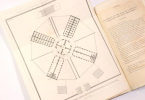
London, Printed by T. Bensley, 1820 1 vol. in-8 (23 x 14 cm) de VI-(1)-65 pages. 10 planches hors-texte (la plupart dépliantes). Voir le détail des sujets ci-après. Cartonnage de l'époque plein papier gris, relié sur brochure, non rogné, étiquette de titre imprimée au dos (d'origine). 1 planche détachée. Quelques rousseurs et feuillets jaunis, néanmoins excellent papier de qualité (papier vélin de cuve). légères usures au cartonnage néanmoins solide. First edition. "The society for the improvement of Prison Discipline, in submitting to the public the following suggestions respecting the proper regulations to be adopted in Prisons, deem it superfluous to detain their readers by endeavouring to prouve what is already obvious, that the judicious mangement of Gaols is a subject of the utmost importance. An intention has been imputed to this society, than which nothing can be more foreign from its real purpose, that of making the interior of a prison a more desirable residence than the habitations of the poor ; the motives which actuate the members of the society are allowed to be benevolent, but the consequences of carrying their views of reform or improvement into effect, are supposed by some persons to be mischievous ; it is presumed that offenders are intimidated, by the miseries and privations they have experienced or anticipate ; if prisons, it is said, are rendered places of comfort, where food and lodging are gratuitously provided, they become incentives to crime and a recompence for its commission. In this view of the subject, however, the society cannot coincide : it is true, they consider it desirable that prisons should be clean, and the food given to the prisoners, plain, wholesome, and sufficient ; but they are equally anxious that everything which borders on sensual gratification or unnecessary comfort should be entirely prohibited. They are of opinion that the punishment contemplated by the law should alone be inflicted, and that no collateral evils, the horrors of disease, and the corruption of principle, should be superadded ; but they are decidedly adverse to any permission of idleness, dissolute behaviour, or to any indulgencies, excepting those conferred as the reward of good conduct ; they are desirous that constant and imperative labour should occupy the prisoners, and prepare their minds for such instruction as may eradicate evil habits, and substitute good dispositions: a prison thus regulated offers no attraction to the vicious, and the society confidently appeal to the evidence of facts as confirming the deductions of reason, wherever this experiment has been fairly tried. It must be apparent to all who have directed their attention to this subject, that the system of Prison Discipline too. generally prevalent in England was confined to a single object, the safe custody of the prisoner ; and to one method of accomplishing that object, severe and sometimes unnecessary coercion : if the prisoner could be retained within the walls of a gaol by bars, by chains, or by subterraneous and unventilated dungeons, by the use of any rigour or privation ; this plan, aiming only at his personal security, was deemed sufficient: the possibility of reforming the criminal seems never to have been contemplated ; no rule was in force, no arrangement existed which could be referred to such a purpose: the attempt to disengage the culprit from long formed habits of vice, and to rekindle in his breast the latent sparks of virtue, were schemes known indeed by the writings of Howard, but generally regarded as the visionary efforts of an excessive philanthropy. Such has been the progress of public opinion, that it is not now requisite to dwell upon the expediency of making these attempts, or to contend against a system calculated to multiply offences, and to ripen indiscretion into crime; a new plan has been gradually developed, in which moral restraint removes the necessity of brutal violence ; in which the prisoner is justly considered as possessing rights which we must not v violate, and feelings which we must not wound, beyond what the sentence of the law demands: a system equally opposed to that dangerous indulgence which permits scenes of vice, drunkenness, or debauchery to be exhibited ; and to that useless cruelty, which, producing no beneficial effect in the way of example, tends to harden the character of those who are subjected to its operation ; a system, in short, which suppresses for a time at least many evil habits, and substitutes those of industry, decency, sobriety, and order. The strong interest taken by the public in this momentous question, the examples which have been adduced of the successful application of these principles to practice ; the zeal manifested by the magistrates in general throughout the country, and the appointment of committees in both houses of Parliament, furnish a well-grounded confidence that the improved system of Prison Discipline will now be fairly and fully tried. The society for the improvement of Prison Discipline have received so many applications for information respecting numerous particulars, that they apprehend they cannot more effectually consult the wishes or convenience of the public, than by an endeavour to collect and arrange those recommendations which the result of reflection and experience enables them to offer. Much consideration has been bestowed upon the plans which accompany this tract, and great assistance has been derived from the architectural skill of Mr. Ainslie, and Mr. Bullar, in the arrangement and illustration of these designs: these gentlemen have gratuitously afforded the Society most valuable aid, for which the Committee beg to express their sincere acknowledgments ; the object in view was to give such plans, as might best combine the advantages of inspection and classification, leaving it to the discretion of different districts to accommodate the same to their own local circumstances. With regard to the rules which are suggested, there is no pretension to originality ; the first aim of the society has been to obtain an accurate acquaintance with the actual management of the best regulated gaols ; to compare attentively the course pursued in each, with their practical consequences ; and then to select and combine, under one arrangement, those rules which appeared upon the whole most judicious and effective. The importance of providing employment for prisoners, and the difficulty of procuring it, have deeply engaged the attention of the society, but hitherto without enabling them to arrive at any conclusion which is universally applicable ; but there is one species of labour obtained by the introduction of mills, and especially of stepping mills, which may furnish constant occupation to a determinate proportion of the prisoners. The advantages derived from the use of mills in several prisons, have been very conspicuous, not so much perhaps in a pecuniary point of view, as in the moral benefits resulting to the prisoner. A stepping mill of a superior description, and which the Committee cannot too earnestly recommend for the employment of prisoners, has been lately constructed, on very ingenious principles, by Mr. Cubitt, Civil Engineer, of Ipswich. To the liberality and kind attention of this gentleman, the Committee are indebted for the annexed illustrations of the machinery, and explanation of its power and effects. . Should the recommendations here collected, be found useful in assisting those gentlemen, who unite the power with the inclination to promote the grand and progressive work of improvement in Prison Discipline, the object of the society will be fully attained. (Preface, London, 1st January, 1820, Samuel Hoare, Jun., Chairman of the Committee). Samuel Hoare Jr (9 August 1751 – 14 July 1825), chairman of the committee was a wealthy British Quaker banker and abolitionist born in Stoke Newington, then to the north of London. His London seat was Heath House on Hampstead Heath. He was one of the twelve founding members of the Society for the Abolition of the Slave Trade. The engravings are : 1. Plan of a County Gaols for 400 prisoners. Designed by George Ainslie. 2. Plan of a Gaol for on hundred and twenty prisoners. G.T. Bullar architect. 3. Plan of the Chapel and sleeping cells. 4. Plan of a house of correction for sixty prisoners. G.T. Bullar architect. 5. House of correction for twenty eight prisoners. G.T. Bullar architect. 6. Ground Plan of a design for a Prison Corn Mill. 7. Crofs section of design for Prison Mill shewing the elevation of Machinery. 8. Crofts sectiloln of design for Prison Mill, shewing the elevation of the tread wheels and method of working. 9. Longitudinal section of design for Prison Mill, shewing elevation of Machinery. 10. Plan and section for a Pump Mill. (complete). Very rare.
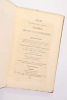
The Freemason's Magazine or General and Complete Library. Vol. 1 - 11. - [“THE ARCHTYPE OF LATER MASONIC PERIODICALS”]
London, Scatcherd & Whitaker Parsons Cawthorn, 1793 - 1798. 8vo. Bound in 11 volumes. Volume 2 - 11 uniformly bound in contemporary half calfs. Volume 1 in half calf with later marbled paper covered boards. Bindings with wear and stains. Leather on spines cracked. Volume 1 with reinforced hinges a dampstain to first leaves. A few volumes with dampstain to first leaves but, internally, generally a nice and clean set. 616, (4) pp. + 2 frontispiece and 7 engraved plates (4), 480 pp. + 7 plates (Wolstieg only calling for 5) (4), 450, (4) pp. + 7 engraved plates (4), 426, (6), 8 pp. + 7 engraved plates (Wolstieg only calling for 3) (2), 436 pp. + 6 engraved plates (Wolstieg only calling for 2) (2), 452, (4) pp. + 6 engraved plates (Wolstieg only calling for 4) (6), 438, (4) pp. + 8 engraved plates (Wolstieg only calling for 6) (4), 464, (4) pp. + 8 engraved plates (Wolstieg only calling for 4) (6), 506 pp. + 9 engraved plates (Wolstieg only calling for 4) (2), 430 pp. + 6 engraved plates (Wolstieg only calling for 1) (2), IV, 338, (8) pp. + 9 engraved plates (Wolstieg only calling for 2). This set has a total of 79 engraved plates, Wolfstieg only calls for 47 plates.
![The Freemason's Magazine or General and Complete Library. Vol. 1 - 11. - [“THE ARCHTYPE OF LATER MASONIC PERIODICALS”]. THE FREEMASONS MAGAZINE -](https://static.livre-rare-book.com/pictures/LLX/63098_1_thumb.jpg)
![The Freemason's Magazine or General and Complete Library. Vol. 1 - 11. - [“THE ARCHTYPE OF LATER MASONIC PERIODICALS”]. THE FREEMASONS MAGAZINE -](https://static.livre-rare-book.com/pictures/LLX/63098_2_thumb.jpg)
![The Freemason's Magazine or General and Complete Library. Vol. 1 - 11. - [“THE ARCHTYPE OF LATER MASONIC PERIODICALS”]. THE FREEMASONS MAGAZINE -](https://static.livre-rare-book.com/pictures/LLX/63098_3_thumb.jpg)
Rare complete run of the first English periodical dedicated to freemasonry, “the archetype of later Masonic periodicals” (Önnerfors, The Freemasons’ Magazine 1793–1798) published at a crucial time in the history of European Freemasonry in the immediate aftermath of the French Revolution. It represents one of the first efforts by the fraternity to define, consolidate and disseminate its intellectual and moral identity in public. Its contents - lodge proceedings, philosophical essays, antiquarian inquiries, biographical notices, poetry and finely executed symbolic engravings - reflect the full breadth of late Enlightenment Masonry. The importance of the work lies in its function as a precursor since it anticipates the Masonic journals in the 19th century and marks the transition of Freemasonry into a self-conscious, print-based intellectual culture. ”The Freemasons’ Magazine represent a forceful statement of British Freemasonry concerning its vigour, loyalty, and societal engagement. During 1794 the journal for the first time served as a platform to refute anti-Masonic writings that circulated in the public. Important apologies such as Defence of masonry (1730) or Cousto’s spiced account of his treatment by the Portuguese inquisition were republished. Parts of Ramsay’s ‘Oration’ were republished not just once but twice. We can also witness how the Knights Templar (called the ‘sublime degree of masonry’) entered the world of British Masonic imagination, long after the continental development. Nevertheless at the very same time Freemasonry in Britain was also celebrating technological progress in industry, agriculture, and science, which makes its relationship to modernity complex. The Freemasons’ Magazine managed to attract correspondents in different parts of the empire and even the USA. A particularly strong link throughout the first seven volumes was Edinburgh. In the last four volumes we find more material inserted from Ireland, at exactly the time when political tensions there erupted into a full-scale rebellion. The political tense years of 1797 and 1798 offer an intriguing insight into the British psyche at the time. Under constant (real and imagined) threat of French invasion, internally shaken by the Irish rebellion, uprisings, and repeated mutinies, public opinion was fuelled with anti-Masonic ideas, not at least by Robison’s book Proofs of a conspiracy. The Freemasons’ Magazine unfortunately did not survive 1798. Most importantly perhaps it can be regarded as the archetype of later Masonic periodicals, developing into a archtype Masonic press by the middle of the nineteenth century with titles such as he Freemasons’ Quarterly Magazine and Review (1834–53), The Masonic observer (1856–9), he Freemason’s Magazine and Masonic mirror (1856–71), the Freemason (1869–1951), some of them surviving well into the twentieth century. Whereas Masonic periodicals during the first century of their existence tied into the ongoing debates and controversies surrounding Freemasonry in culture and society, they developed more and more into purely internal membership magazines with little connection to the outside world.” (Önnerfors, The Freemasons’ Magazine 1793–1798). Wolfsteig 516
Theorie des Groupes fuchsiens (+) Mémoire sur les Fonctions fuchsiennes (+) Sur les Fonctions de deux Variables (+) Mémoire sur les groupes kleinéens (+) Sur les groupes des équations linéaires (+) Mémoire sur les fonctions zétafuchsiennes. - [THE DISCOVERY OF AUTOMORPHIC FUNCTIONS]
Berlin, Stockholm, Paris, F. & G. Beijer, 1882-84. Large4to (272 x 230 mm). Three volumes uniformly bound in contemporary half calf with gilt lettering to spine. In ""Acta Mathematica"", volume 1-5. Light wear to extremities, boards and spines with scratches. Stamp to verso of front board in all volumes. First three leaves in first volume detached, otherwise internally fine and clean. Vol. I, pp. 1-62" Pp. 193-294 Vol. II, pp. 97-113 Vol. III. pp. 49-92 Vol. IV pp. 201-312" Vol. V pp. 209-278.
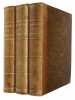
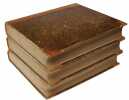
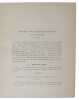
First publication of these groundbreaking papers which together constitute the discovery of Automorphic Functions. ""Before he was thirty years of age, Poincaré became world famous with his epoch-making discovery of the ""automorphic functions"" of one complex variable (or, as he called them, the ""fuchsian"" and ""kleinean"" functions)."" (DSB).These manuscripts, written between 28 June and 20 December 1880, show in detail how Poincaré exploited a series of insights to arrive at his first major contribution to mathematics: the discovery of the automorphic functions. In particular, the manuscripts corroborate Poincaré's introspective account of this discovery (1908), in which the real key to his discovery is given to be the recognition that the transformations he had used to define Fuchsian functions are identical with those of non-Euclidean geometry. (See Walter, Poincaré, Jules Henri French mathematician and scientist).The idea was to come in an indirect way from the work of his doctoral thesis on differential equations. His results applied only to restricted classes of functions and Poincaré wanted to generalize these results but, as a route towards this, he looked for a class functions where solutions did not exist. This led him to functions he named Fuchsian functions after Lazarus Fuchs but were later named automorphic functions. First editions and first publications of these epochmaking papers representing the discovery of ""automorphic functions"", or as Poincaré himself called them, the ""Fuchsian"" and ""Kleinian"" functions.""By 1884 Poincaré published five major papers on automorphic functions in the first five volumes of the new Acta Mathematica. When the first of these was published in the first volume of the new Acta Mathematica, Kronecker warned the editor, Mittag-Leffler, that this immature and obscure article would kill the journal. Guided by the theory of elliptic functions, Poincarë invented a new class of automorphic functions. This class was obtained by considering the inverse function of the ratio of two linear independent solutions of an equation. Thus this entire class of linear diffrential equations is solved by the use of these new transcendental functions of Poincaré."" (Morris Kline).Poincaré explains how he discovered the Automorphic Functions: ""For fifteen days I strove to prove that there could not be any functions like those I have since called Fuchsian functions, I was then very ignorant" every day I seated myself at my work table, stayed an hour or two, tried a great number of combinations and reached no results. One evening, contrary to my custom, I drank black coffee and could not sleep. Ideas rose in crowds I felt them collide until pairs interlocked, so to speak, making a stable combination. By the next morning I had established the existence of a Class of Fuchsian functions, those which come from hypergeometric series" i had only to write out the results, which took but a few hours...the transformations that I had used to define the Fuchsian functions were identical with those of Non-Euclidean geometry...""
Biblia Det er Den gantske Hellige Scrifft paa Danske igien offuerseet oc Prentet effter vor allernaadigste Herris oc Kongis K. Christian den IV. Befaling. Mett Register/ alle D. Lutheri Fortaler ghans Udledning i Brædden oc Viti Theodori Summarier. Cu... - [THE MAGNIFICENT CHRISTIAN IV FOLIO BIBLE]
Kiøbenhaffn, (Melchior Martzan og Salomon Sartor), (1632-) 1633. Folio (binding: 37 x 25 cm.). Bound in a spledid, contemporary full calf binding over wooden boards. Rich, elaborate gilding to both boards and spine. The gilding is vague, especially on the front board, but the tooling is very sharp, and the binding overall is magnificent. With four beautiful, ornamented brass edges to each board and two large ornamented brass clasps. All edges are gilt and beautifully blindtooled. Wear to capitals, where the cords are loosening a bit, and with a bit of loss of leather. A bit of wear to hinges, at the cords, which are showing. But overall the binding is in splendid condition. Also internally extremely well preserved. The title-page has a tiny restored hole to lower right corner, and the first four leaves might have been inserted. They are slightly smaller at the outer margin than the other leaves. But that might also be due to restoration, as the binding has not been tampered with at any point and is completely unrestored. The text is unusually nice, clean and fresh, by far the nicest copy we have ever come across. Pasted-down front end-paper with the ownership signature and lacquered coat-of-arms seal of Severin Svanenhielm (Severin Seehusen (1664-1726) ) as well as the ownership signatures of Søren Schiøtz (1796-1863) (with names of members of his family), C. Th. Zahle and Erik Zahle. With the book plate of William Davignon (d. 1924). The brass corners carry the initials HL and are depicted in Johannes Rudbeck's Svenska Bokband I (fig. 26, p.53). The binding there is dated 1622, whereas our binding is from 1633 or right after. The brass fittings were a commercial merchandise for sale in Germany and probably also in both Sweden and Denmark. Engraved title-page as well as the engraved portrait of Christian IV, all by the royal engraver Simon the Pas. Without the half-title, which merely contains the printed words ""BIBLIA / Paa Danske"", which is almost never present. (21 - not counting the engraved title-page and the portrait), 353 (i.e. 354 due to the erroneous double pagination 353), 226, 159 ff.
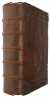
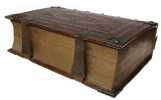
A magnificent copy of the scarce first edition of the last (i.e. the third) of the Danish folio-bibles, known as ""Christian IV's Bible"", being a slightly revised edition of the Bible of 1589. Christian IV is the most famous Danish king ever to have lived, and the Christian IV bible is extremely sought-after. An unusually fresh and complete (apart from the always lacking half-title) copy of this splendid bible, printed by the first royal printer Melchior Martzan and Salomon Sartor (part 2). The numerous woodcut illustrations are the same that were used for the Frederik II Bibel from 1589. The four engraved leaves - the portrait and the three title-pages - are by Simon de Pas.Bibl. Dan.I,9 - Thesaurus II, 378. - Birkelund, 41. - Darlow and Moule, 3160. Provenance: Svanenhielm was a family of Danish and Norwegian nobility. Morten Hansen Seehuusen (1629-1694) was a merchant from Bredstedt in Schleswig-Holstein, who re-located to Stavanger, Norway. His son, Severin Seehusen (1664-1726) was an official in Bergen as well as in Stavanger and Northern Norway. He owned, among other properties, Damsgård Manor outside Bergen, Svanøy in Sunnfjord, and Arnegård in Stavanger. In 1720, Severin Seehausen was ennobled under the name Svanenhielm. Søren Daniel Schiøtz (1796-1863) was a Norwegian bailiff and judge, who was also very much engaged in religious matters and came to play an important role in the history of theology in Norway. He was one of the founders of the Norwegian Mission Society and the Norwegian Israeli Mission. He translated several important upbuilding pieces from German, among them a comprehensive bible history. Carl Theodor Zahle (1866 – 1946) was a highly important Danish lawyer and politician. He was prime minister of Denmark from 1909 to 1910 and again from 1913 to 1920. In 1895, he was elected member of the lower chamber of the Danish parliament, for the Liberal Party. A campaigner for peace, in 1905 he co-founded the Social Liberal Party (Det Radikale Venstre). He stayed on as a member of Parliament for Det Radikale Venstre until 1928, when he became a member of the upper chamber of Parliament (Landstinget). In 1929, he became Minister of Justice , a post which he held until 1935. Zahle was instrumental in starting negotiations for a new Danish–Icelandic Act of Union in 1917, which resulted in Iceland being recognized as a sovereign nation in a personal union with the king of Denmark the following year. Erik Zahle (1898-1969) was a famous Danish art historian, author, and museum director.
"FARADAY, MICHAEL. - THE FIRST ELECTRIC MOTOR - INTRODUCING ""LINES OF FORCE"" AND THE UNIVERSE OF ""FIELDS"" (FRENCH EDITION).
Reference : 43750
(1821)
Sur les Mouvemens électro-magnétiques et la théorie du magnétisme. (Traduit par M. Anatole-Riffault). + (André-Marie Ampere et Felix Savary:) Notes relatives au Mémoire de M. Faraday.
(Paris, Crochard, 1821). No wrappers. In: ""Annales de Chimie et de Physique, Par MM. Gay-Lussac et Arago."", tome 18 (Septembre Cahier). Pp. 337-443. (Entire issue offered). Faraday's paper: pp. 337-370 a. 2 folded engraved plates (showing the experimental apparatus). Ampère & Savary's Notes: pp. 370-379. Clean and fine.
First French edition of Faraday's famous paper ""On some new Electro-Magnetical Motion, and on the Theory of Magnetism. By Michael Faraday, Chemical Assistant in the Royal Institution. (1821)"", recording one of the most influential discoveries in physics in the 19th Century, as Faraday here, as the very first, showed how to CONVERT THE ELECTRICAL AND MAGNETIC FORCES INTO CONTINUAL MECHANICAL MOVEMENT, thus creating the first electric motor, using the principle of electromagnetic rotation. In the first paper he introduced for the first time the concept of ""LINE OF FORCE"" and hereby deliniating ""a picture of the universe as consisting of fields of various types, one that was more subtle, flexible, and useful than the purely mechanical picture of Galileo and Newton. The FIELD UNIVERSE was to be recognized with Maxwell half a century later and with Einstein, after an interval of another halfcentury.""(Asimov).""Ever since Hans Christian oersted's announcement of the discovery of electromagnetism in the summer of 1820, editors of scientific journals had been inundated with articles on the phenomenon. Theories to explain it had multiplied, and the net effect was confusion. Were all the effects reported real ? Did the theories fit the facts ? It was to answer these questions that Phillips turned to Faraday and asked him to review the experiments and theories of the past months and separate truth from fiction,...Faraday agreed to to undertake a short historical survey...His entusiasm was aroused in September 1821, when he turned to the investigation of the peculiar nature of the magnetic force created by an electrical current. Oersted had spoken of the ""electrical conflict"" surrounding the wiree and had noted that ""this conflict performs circles"".....Yet as he experimented he saw precisely what was happening. Using a small magnetic needle to map the pattern of magnetic force, he noted that oneof the poles of the needle turned in a circle as it was carried around the wire. He immediately realized that a single magnetic pole would rotate unceasingly around a current-carrying wire so long as the current flowed. He then set about devising an instrument to illustrate this effect. His paper ""On some new Electro-Magnetical Motion, and on the Theory of Magnetism"" appeared in the 21 October 1821 issue of the ""Quarterly Journal of Science"" (The paper offered in the first French edition). It records the first conversion of electrical into mechanical energy. It also contained the first notion of the line of force.""(DSB IV, pp. 533).
FARADAY, MICHAEL. .- THE ORIGIN OF THE ELECTROMAGNETIC THEORY OF LIGHT.
Reference : 42292
(1852)
Experimental Researches in Electricity. - Twenty-eight Series. 36. On the Lines of Magnetic Force their definite character" and their distribution within a Magnet and through Space. (Sections 3070-3176). Recieved October 22, - Read November 27 and ...
(London, Richard Taylor and William Francis, 1852). 4to. No wrappers as extracted from ""Philosophical Transactions"" 1852 - Part I. Pp. 25-56, textillustr. Clean and fine.
First appearance of a historical paper in electromagnetical theory. Faraday in this paper defines his key concept ""lines of force"" and summarizes in what connections he used it and he shows how it explains the pehenomena of magnetism and electricity. His insistance of the importence of the electromagnetic fields of force was the historical starting point of the electrical side of modern theories of field physics. Maxwell later translated these ideas into mathematical form, and developed them into his theory of electromagnetic waves.Especially notable in this paper is: As all space is permeated by lines of force, Faraday suggests that light and radiant heat might be tranverse vibrations propagated along these lines of force. In this way he proposed to ""dismiss the aether"" and to replace it by lines of force between centres, the centres together with their lines of force constituting the particles of material substance. If the existance of a luminiferous aether were to be admitted he suggests that it might be the vehicle of magnetic force ""for it is not at all unlikely that if there be an aether, it should have other uses than simply the conveyance of radiations"" (section 3075 in this paper offered). This sentece may be regarded as THE ORIGIN OF THE ELECTROMAGNETIC THEORY OF LIGHT (Whittaker in: A History of the theories of the Aether and Electricity, I: pp. 194-95).From 1831 to 1852 Michael Faraday published his ""Experimental Researches in Electricity"" in The Philosophical Transactions of the Royal Society. These papers contain not only an impressive series of experimental discoveries, but also a collection of heterodox theoretical concepts on the nature of these phenomena expressed in terms of lines of forces and fields. He published 30 papers in all under this general title.They represents Faraday's most importent work, are classics in both chemistry and physics and are the experimental foundations for Maxwell's electro-magnetic theory of light, using Faraday's concepts of lines of force or tubes of magnetic and electrical forces. His many experiments on the effects of electricity and magnetism presented in these papers lead to the fundamental discoveries of 'induced electricity' (the Farday current), the electronic state of matter, the identity of electricity from different sources, equivalents in electro-chemical decomposition, electrostatic induction, hydro-electricity, diamagnetism, relation of gravity to electricity, atmospheric magnetism and many other.""Among experimental philosophers Faraday holds by universal consent the foremost place. The memoirs in which his discoveries are enshrined will never ceaseto be read with admiration and delight"" and future generations will preserve with an affection not less enduring the personal records and familiar letters, which recall the memory of his humble and unselfish spirit.""(Edmund Whittaker in A History of the Theories of Aether and Electricity).
LE VERRIER, URBAIN JEAN JOSEPH. - A CONFIRMATION OF THE GENERAL THEORY OF RELATIVITY.
Reference : 42922
(1843)
Recherches sur L'Orbite de Mercure et sur ses Pertubations. Détermination de la Masse de Vénus et du Diamètre du Soleil"
(Paris, Imprimerie de Bachelier), 1843. 4to. No wrappers as extracted from ""Journal de Mathématiques pures et appliquées...Publié par Joseph Liouville"", tome VIII. Pp. 273-360. Clean and fine.
First appearance of Le Verrier's provisional theory on the motion of Mercury, his studies of which eventually did much to demonstrate the validity of Einstein's Theory of Relativity. The planetary orbits should agree with the predictions of the General Theory of relativity, but as Einstein pointed out in his ""Erklärung der Perihelbewegung des Merkurs aus der allgemeinen Relativitätstheorie"" from 1915, the divergences predicted were too small to be observed, except in the case of the nearest planet Mercury, where the perihelion advance, according to the formula, reaches the value of 43"""" per 100 years, being in full agreement with the calculations of Le Verrier, who found this unexplained rest in the perihelion advance of Mercury per century, if the perturbations due to the other planets are deduced.- Einstein tells in a letter to a friend that for several days he was in a 'state of delirious joy' by this wonderful astronomical confirmation of his theory.""Le Verrier first began to study Mercury on the suggestion of Arago in 1840. Astronomers realized that Mercury's perihelion (the point at which the orbit of a planet is closest to the sun) advanced along its orbit at a rate of 566 seconds per century. Le Verrier calculated that, even when taking into account the forces exerted by other planets in the solar system, there still existed a discrepancy between calculation and observation. Le Verrier's accurate calculations showed that the planet's perihelion...did indeed advance forty seconds of an arc per century more than could be accounted for by Newton's theory of gravitation, even after the minor pertubing effects of the other planets had been allowed for."" (Asimov). - Le verrier published these findings in the present work, carefully as to the mass of the planet, comparison with other orbits of planets and their perihelia. At the time, Le Verrier put down the discrepancy to mis-observation or mis-calculation.- Sparrow, Milestones of Science No. 133.
"HITTORF, JOHANN WILHELM. - INTRODUCING THE NOTION OF ""TRANSPORT NUMBERS"" OF IONS.
Reference : 43082
(1853)
Ueber die Wanderungen der Ionen während der Elektrolyse. Erste-Zweite und Dritte Mittheilung (+) Rechtfertigung seiner Mittheilungen ""Ueber Wanderungen der Ionen"". Elektrolyse einer lösung zweier Salze. (4 papers).
Leipzig, Johann Ambrosius Barth, 1853, 1856, 1858, 1859. Without wrappers in ""Annalen der Physik und Chemie. Hrsg. von J.C. Poggendorff"", Dritte und Vierte Reihe, Bd. 89 No. 6 u. 7, Bd. 98 No 5, Bd. 103 No 1, Bd. 106 No. 3. The 5 entire issues offered. Hittorf's papers pp. 177-211 (Bd. 89), pp. 1-33 (Bd.98), pp. 1-56 (Bd.103), pp.337-411 a. 513-586 (Bd. 106). In all 7 engraved plates. All issues fine and clean.
First printing of all 4 fundamental papers on electrochemistry, where Hittorf states his concepts of ionic migration and transport numbers, concepts that should be the foundation stones of the later evolved theory of ionization, culminating in Svante Arrhenius's famous discovery of electrolytic dissociation.""After Faraday's experimental investigations in 1834, it was accepted that the electricity passing through an electrolytic cell was carried by the movement of charged ions produced from the decomposition of the compounds making up the solution. Daniell had extended these ideas in 1839 and showed that salts were compounds not of acid anhydrides and metallic oxides as had been thought, but of metallic cations and elemental or compound acid anions. Believing that the conductivity of solutions was due to these ions, he began a study of their transference. In 1853 Hittorf took up the problem. He extended the ideas of Daneill by reasoning inthe following manner: Cations and anions exist in solutions and migrate under the influence of current through the solution. The migration of the cation toward the cathode and away from the anode, and the deposition of the anode on the positive electrode, together result in a decrease of teh salt in the neighborhood of the anode. A similar analysis shows that there is also a decrease in the concemtration of the salt in the neighborhood of the cathode. If the motion of the two dissimilar ions were the same, the decrease in the concentration of the salt would be the same at the two electrodes.....Hwe concluded that the speeds of migration...were different and he characterized this fact by defining ""transport numbers"", which specified the portion of the transport of electricity carried by each ion. (DSB VI, p. 439). - Leicester & Klickstein ""A Source Book of Chemistry"", p. 400-406.In the 2 issues of 1853 are contained 2 papers by Helmholtz of fundamental cjharacter, both in physiology and on the theory on the conservation of energy. HERMAN HELMHOLTZ: ""Ueber einige Gesetze der Vertheilung elektrischer Ströme in körperlichen Leitern mit Anwendung auf die thierisch-elektrischen Versuche (+) Ueber einige Gesetze....(Schluss). 2 papers. 1853. (Bd. 89 No.6 a. 7). Pp. 211-233 a. pp. 353-377.""In this work (the papers offered) Helmholtz for the first time enters the field of mathematical physics and physiology, with the full equipment of the higher mathematical analysis, of which he was the only master in its application to the latter science.....This very interesting and fundamental work on the distribution of electrical currents in material conductors is purely mathematical in character, owing to Helmholtz's method of proving the theorems, which are intelligible enough from the physical point of view, It is essentially connected with the treatise on the CONSERVATION OF ENERGY, since helmholtz merely substitutes for the expression 'free tension' there employed, the identical concept of Gauss's potentia, or Green's potential function.""(Koenigsberger in ""Hermann von helmholtz"", p. 99-103.).
"KIRCHHOFF, G. (GUSTAV ROBERT).- THE KEY TO THE NEW WORLD OF QUANTA - INTRODUCING ""BLACK-BODY RADIATION""
Reference : 43085
(1860)
Über das Verhältnis zwischen dem Emissionsvermögen und dem Absorptionsvermögen der Körper für Wärme und Licht. (On the relation between the radiating and the absorbing powers of different bodies for light and heat). (+) Über die Frauenhofer'schen Lin...
Leipzig, Johann Ambrosius Barth, 1860. Contemp. hcalf, raised bands, gilt spine. A few scratches to spine. In ""Annalen der Physik und Chemie. Hrsg. von J.C. Poggendorff"", Bd. 109. X,660 pp. and 4 folded engraved plates. Kirchhoff's papers: pp. 275-301 and pp. 148-150. Internally clean and fine. Small stamps to verso of titlepage and plates.
First printing of a milestone paper by ""The Grandfather of Quantum Theory"" in which he formulates the law named after him, ""KIRCHHOFF'S LAW"", which was the ""key to the whole thermodynamics of radiation. In the hands of Planck, Kirchhoff's successor to the Berlin chair, it proved to be the key to the new world of the quanta, well beyond Kirchhoff's conceptual horizon.""(DSB, VII, p.382).""Kirchhoff's Law of Thermal Emission was formulated in 1859 (Über das Verhältnis....) - the paper offered. It is at the same time the simplest and least understood law in physics. Kirchhoff's law states that given thermal equilibrium with an enclosure, the radiation inside will be always black, or normal, in a manner which is independent of the nature of the walls, or the objects they contain. This is known as the concept of universality. That is, that radiation within an enclosure can always be described by a universal function dependent only ontemperature and frequency. This universal function was first given us by Max Planck, in 1900. Kirchhoff's law STANDS AT THE HEARTH OF ALL MODERN ASTROPHYSICS. It is the basis for setting the temperature of the stars, for the gaseous model of the Sun, and for believing that we now know the temperature of the entire universe.""(Pierre-Marie Robitaille)..The research background for the paper was his unexpected observation that if the intensity of the solar spectrum increased above a certain limit, the dark D lines were made much darker by the interposition of the sodium flame. he instantly felt, that he had got hold of ""something fundamental"". These observations are described in the second paper offered here ""Über die Frauenhofer'schen Linien..."" which was published first in 1859 in Monatsschrift der Berliner Academie.The volume contains many other importent papers in physics and chemistry, by C.F. Schönbein, Zöllner, H. Fizeau, Eisenlohr, W. Heine, Knoblauch, K.G. Neumann, W. Siemens etc.
OHM, GEORG SIMON. - THE PRELIMINARY ANNOUNCEMENT OF OHM'S LAW.
Reference : 43090
(1825)
Vorläufige Anzeige des Gesetzes, nach welchem Metalle die Contaktelectricität leiten"
Leipzig, Johann Ambrosius Barth, 1825. Contemp. hcalf. 5 raised bands, gilt spine and gilt lettering to spine. A few scratches to spine. Small stamp on verso and on titlepage. A tear to right margin of titlepage repaired. In: ""Annalen der Physik und Chemie. Hrsg. von J.C. Poggendorff"", Poggendorff Bd. 4. (10),476 pp., 4 large folded tables, 6 engraved plates, some folding. Small stamp on verso of plates. Ohm's paper: pp.79-88. Internally fine and clean.
First appearance of a paper of outmost importence in the history of electricity, - it is Ohm's first scientific paper, and it contains the report on the different original experiments (sending a current through a variety of test wires) that was the foundation for his famous law, Ohm's Law. The paper contains the original research material that was to immortalize his name, for the mathematical formulation of the law two years later in the well-known work ""Die galvanische Kette, mathematisch bearbeitet"" (1827). - This paper was at the same time published in Schweiggers Journal.""Ohm's first scientific paper was ""Vorläufige Anzeige des Gesetzes..."" (the paper offered). In it he sought a functional relationship between the decrease in the electromagnetic force excerted by a current-carrying wire and the lenght of the wire...Fromthe zinc and copper poles of a voltaic pile he ran two wires, A and B, the free ends of which terminated in small mercury-filled cups, M and N"" between M and another cup, O, he ran a third wire, C. Together A,B, and C formed what he called the ""invariable conductor"", to distinguish it from one of the seven wires of different lenghts that, when placed in a circuit between O and N, constituted the ""variable conductor"". Among the latter was one ""veru thick"" wire, four inches long, and six thinner ones, 0.3 line (.025"") in diameter, ranging in lenght from one foot to seventy-five feet. Finally, over wire C hung the magnetic needle of a Coulomb torsion balance, which served to measure the electromagnetic force exerted when one of the variable conductors completed the circuit....(He then found that) the loss in force was equal to the difference between the normal force and the lesser force occasioned by one of the other wires, divided by the normal force. Tabulating these value against the lenghts of the wires, he found that his data were well represented by the formula v=0.41 log (1+x), where v is the loss in force and x is the lenght of the wire in feet....""(DSB X, p.187). - This expression is the preliminary formula for his famous relations between voltage, amperage and resistance, R=V/I.Parkinson ""Breakthrough"" 1825 P. - Ronald's Library p. 376.The volume contains other importent papers in the history of chemistry and physics, Berzelius, F. Wöhler, F.E. Neumann, Heinrich Rose, Chr. Hansteen, Fresnel etc.
FIZEAU, ARMAND HIPPOLYTE - THE FIZEAU EXPERIMENT ON THE VELOCITY OF LIGHT IN MEDIA.
Reference : 43122
(1859)
Sur les Hypothèses relatives a Lèther lumineux. Et sur une expérience qui parait démontrer que le mouvement des corps change la vitesse avec laquelle la lumiere se propage dans leur interieur" Presenté à l'Academie des Sciences dans sa séance du 29 se...
Paris, Victor Masson, Imprimerie de Bachelier, 1859. 8vo. Contemp. hcalf, raised bands, gilt spine. Light wear along edges. Small stamps on verso of titlepage and on verso of plates. In ""Annales de Chimie et de Physique"", 3me Series - Tome LVII. 512 pp. and 4 plates. (The entire volume offered). Fizeau's paper: pp. 385-404. Some scattered brownspots.
First printing of a highly importent paper in the history of physics, ""It is less famous, for some reason, than the failure of Michelson and Morley to detect the aether drag, but NO LESS SIGNIFICANT. For it showed that the velocity of light increases in a medium according to the formula, v (1 - 1/n2), where v is the velocity of the medium, and n is the refractive index""(Gillespie in ""The Edge of Objecticity"" p. 427). Fizeau shows that the velocity of light is higher in water flowing in the direction of the beam than that of light propagating in the direction opposite the direction of flow. The paper offered is the full text of the research, there appeared an extract of it in Comptes Rendus in 1851. Albert Einstein later pointed out the IMPORTENCE OF THE EXPERIMENT FOR SPECIAL RELATIVITY.Fizeau's result was replicated by Albert Michelson and Edward Morley in 1886 repeated the experiment on a larger scale and confirmed Fizeau's results., and in 1914 it was confirmed by Pieter Zeeman. It was Arago in 1838, who suggested this ""crucial experiment"" to decide between the corpuscular and undulatory theories of light by comparingthe speed of light in water and in air.. It vindicated the undulatory position.It was shown by Hendrik Lorentz (1892, 1895) that the experiment can be explained by the reaction of the moving water upon the interfering waves without the need of any aether entrainment. On this occasion, Lorentz introduced a different time coordinate for moving bodies within the aether, the so called Local time (an early form of the Lorentz transformation for small velocities compared to the speed of light). In 1895, Lorentz went a step further and explained the coefficient by local time alone and without mentioning any interaction of light and matter.
"JOULE, JAMES PRESCOTT. - THE MECHANICAL EQUIVALENT OF HEAT.
Reference : 43531
(1854)
Ueber die mechanische Wärme-Aequivalent.
Leipzig, Johann Ambrosius Barth, 1854. Conemp. hcalf. 5 raised bands, gilt spine and gilt lettering to spine. A few scratches to spine. Light wear to spine ends. A small nick to top of spine. Small stamp on verso of first -and general- titlepage and small stamps to verso of plates. In: ""Annalen der Physik und Chemie. Hrsg. von J.C. Poggendorff"", Ergänzungsband IV. VIII,632 pp. and 2 folded engraved plates. Joule's paper: pp. 601-632. Internally celan and fine.
First German edition of one of the most importent papers in 1900th century physics, and the culmination of Joule's work. The offered paper is a translation of Joule's great memoir ""On the Mechanical equivalent of Heat"", published 1850, and one of the founding papers of the principle of ""The conservation of energy"", - Joule here gave the experimental proof of the conservation law.""Joule was not the first to determine the mechanical equivalent of heat. Rumford had attempted it but had come out with a value that was far too high. Mayer produced a fairly good value before Joule did, but it was Joule who was most accurate (up to his time), who backed up his figure with a large variety of careful experimental data, and who /with Thomson's help) forced the view on the world of science. He therefore gets the credit, and in his honour a unit of work, equal to 10,000,000 ergs, is called the Joule.""(Asimov). - Dibner, Heralds of Science No.158 (the 1843 paper).Joule's first measurement of the mechanical equivalent of heat was published...in 1843. It was made by comparing the heat generated by the current of a magnetoelectric machine with the excess of work which was used in turning the machine when the circuit was closed above that used when it was open....In the following papers in which the mechanical equivalent was measured in different ways we find the same elaborate description of the experiments and a brief statement of the final results. This is particularly true of the GREAT MEMOIR OF 1850 IN WHICH JOULE'S WORK CULMINATED. (Magie ""Source Book in Physics"" p. 203).The volume contains further STOKES, G.G.: ""Ueber die Veränderung der Brechbarkeit des Lichts."" Pp. 177-345 in first German edition.
"BOLTZMANN, LUDWIG. - THE STEFAN-BOLTZMANN LAW - BLACKBODY RADIATION
Reference : 43536
(1884)
Ableitung des Stefan'schen Gesetzes, betreffend die Abhängigkeit der Warmestrahlung von der Temperatur aus der electromagnetischen Lichttheorie.
Leipzig, Johann Ambrosius Barth, 1884. Without wrappers as issued in ""Annalen der Physik und Chemie. Hrsg. von G. Wiedemann."", Neue Folge Bd. 22, 6. Heft (= No 6). Titlepage to vol. 22. Pp. 145-304 (entire issue offered ""Heft"" 6). Boltzmann's paper: pp. 291-294. Small stamp to titlepage and verso of.
First appearance of this importent paper in which Boltzmann uses the second law of thermodynamics and Maxwell's electromagnetic theory to derive theoretically, based on Stefan's experimental observations, the proportionality of the radiation emitted from a body and the fourth power of the temperature of the body in Kelvin units. ""The law show a possible connection between thermodynamics and electromagnetism that was exploited in the later quantum theory. In the 1920s it was applied by Edington and others in explaining the equilibrium of stellar atmospheres.""(DSB II, p. 266).""The law states that the total energy radiated per unit surface area of a black body per unit time (known variously as the black-body irradiance, energy flux density, radiant flux, or the emissive power), is directly proportional to the fourth power of the black body's thermodynamic temperature T (also called absolute temperature).The Stefan Boltzmann law was experimentally discovered in the year 1879 by Josef Stefan and deduced 1884 by Ludwig Boltzmann theoretically by thermodynamic considerations from the classical electromagnetic theory of the radiation. In the year 1900, thus 21 years after the Stefan Boltzmann law, discovered Max Planck the Planck radiation law designated after it, from which the Stefan Boltzmann law follows simply by integration over all directions and wavelengths. The Planck radiation law could attribute the Stefan Boltzmann constant also for the first time with the introduction of the quantum of action h to fundamental natural constants.""Parkinson ""Breakthroughs"" 1883 P.
"FARADAY, MICHAEL. - THE FIRST ELECTRIC MOTOR - INTRODUCING ""LINES OF FORCE"" AND THE UNIVERSE OF ""FIELDS"" (GERMAN EDITION).
Reference : 43751
(1822)
Ueber electrisch-magnetische ewegungen, und die Theorie des Magnetismus"" von Faraday, chem. Assistenten in d. Roy. Inst. (geschrieben London d. 11 Sept. 1821: mit Anmerkungen von einem Freunde des Hrn Ampère. Frei bearbeitet und mit einigen Erläuterun...
Leipzig, Johann Ambrosius Barth, 1822. Without wrappers as extracted from ""Annalen der Physik und der Physikalischen Chemie. Hrsg. Ludwig Wilhelm Gilbert"", Bd. 71. Titlepage to vol. 71, pp. 124-171 a. pp. 172-176 and 1 folded engraved plate showing experimental apparatus. Clean and fine.
First German edition of Faraday's famous paper ""On some new Electro-Magnetical Motion, and on the Theory of Magnetism. By Michael Faraday, Chemical Assistant in the Royal Institution. (1821)"", recording one of the most influential discoveries in physics in the 19th Century, as Faraday here, as the very first, showed how to CONVERT THE ELECTRICAL AND MAGNETIC FORCES INTO CONTINUAL MECHANICAL MOVEMENT, thus creating the first electric motor, using the principle of electromagnetic rotation. In the first paper he introduced for the first time the concept of ""LINE OF FORCE"" and hereby deliniating ""a picture of the universe as consisting of fields of various types, one that was more subtle, flexible, and useful than the purely mechanical picture of Galileo and Newton. The FIELD UNIVERSE was to be recognized with Maxwell half a century later and with Einstein, after an interval of another halfcentury.""(Asimov).""Ever since Hans Christian oersted's announcement of the discovery of electromagnetism in the summer of 1820, editors of scientific journals had been inundated with articles on the phenomenon. Theories to explain it had multiplied, and the net effect was confusion. Were all the effects reported real ? Did the theories fit the facts ? It was to answer these questions that Phillips turned to Faraday and asked him to review the experiments and theories of the past months and separate truth from fiction,...Faraday agreed to to undertake a short historical survey...His entusiasm was aroused in September 1821, when he turned to the investigation of the peculiar nature of the magnetic force created by an electrical current. Oersted had spoken of the ""electrical conflict"" surrounding the wiree and had noted that ""this conflict performs circles"".....Yet as he experimented he saw precisely what was happening. Using a small magnetic needle to map the pattern of magnetic force, he noted that oneof the poles of the needle turned in a circle as it was carried around the wire. He immediately realized that a single magnetic pole would rotate unceasingly around a current-carrying wire so long as the current flowed. He then set about devising an instrument to illustrate this effect. His paper ""On some new Electro-Magnetical Motion, and on the Theory of Magnetism"" appeared in the 21 October 1821 issue of the ""Quarterly Journal of Science"" (The paper offered in the first German edition). It records the first conversion of electrical into mechanical energy. It also contained the first notion of the line of force.""(DSB IV, pp. 533).
"FRIEDRICH, W., P. KNIPPING, MAX v. LAUE. - THE NATURE OF X RAYS AND THE ATOMIC STRUCTURE OF CRYSTALS.
Reference : 43821
(1913)
Inteferenzerscheinungen bei Röntgenstrahlen. (+ M. Laue:) Eine quantitative Prüfung der Theorie für die Inteferenzerscheinungen bei Röntgenstrahlen. (+ M. Laue und F. Tank:) Die gestalt der Interferenzpunkte bei den Röntgenstrahlinterferenzen. (3 pape...
(Leipzig, Ambrosius Barth, 1913). Without wrappers in ""Annalen der Physik"", Vierte Folge, Bd. 41, No.10. The entire issues offered. Pp. 873-1064 a. 6 plates. Laue's papers: pp. 971-988, pp. 989-1002 a. pp. 1003-1011. With the 5 famous plates in collotype (reproductions of the photographic plates), showing the X-Ray diffraction spectrum of different salt and substances (The ""Laue diagram"").
These papers represents the first full exposition of Laue's and his co-worker's discovery of the nature of X-Rays. The first two papers were printed the year before in ""Münchener Sitzungsberichte"", but finds their final form here and with the experimental confirmation by Laue and Tank. He showed that the regular spacing of the atoms in a crystal can serve as a grating of the desired precision, and he measures the wave-lenght of the X-rays.That crystals might be the appropriate grating for the X-rays proved to be well founded when Knipping, Friedrich and Tank found experimental confirmation of the theory.""It was in 1895 that Röntgen discovered a new form of radiation, to which, as its nature was so uncertain, he gave the name of the X-ray.....It was not until 1912, when von Laue showed it could be diffracted like ordinary light, that it was recognized with certainty as an ether wave of extremely short wave-lenght.Laue used a crystal for his diffraction grating...The X-ray is therefore identical with with light in respect to its nature, but differs greatly in quality: a state of things which is very favourable to an extension of our general knowledge of such radiations.""(William Bragg in ""The Universe of Light"", pp. 228 ff.).""It was the work of Laue and the experiments done by Friedrich and Knipping on his suggestion that cleared up the nature of X rays once and for all and that, moreover, beautifully demonstrated that crystals are composed of atoms arranged in a regular lattice......As in the case of Röntgen's original discovery, the photographs were extremely convincing. Other researchers immediately were attracted by the new field of X-ray spectroscopy and the discoveries by the Braggs and Mosely soon followed.""(Siegmund Brandt ""The harvest of a Century"", Episode 20, p. 80 ff.).""The awarding of the Nobel Prize in physics for 1914 to Laue indicated the significance of the discovery that Albert Einstein called ""ONE OF THE MOST BEAUTIFUL IN PHYSICS"". Subsequently it was possible to investigate X radiation itself by means of wavelenght determinations as well as to study the structure of the irradiated material. In the truest sense of the word scientists began to cast light on the structure of matter.""(DSB VIII, p. 51).PMM: 406 (the first 2 papers in Münchener Sitzungsberichte).The offered issue of ""Annalen"" contains also an importent paper by P. DEBYE & A. SOMMERFELD: ""Theorie des lichtelektrischen Effektes vom Standpunkt des Wirkungsquantums"", pp. 873-930
"CAVENDISH, HENRY. - WEIGHING THE WORLD - THE MOST IMPORTENT ADDITION TO GRAVITATION THEORY SINCE NEWTON.
Reference : 43865
(1799)
Versuche über die Dichtigkeit der Erde zu Bestimmen. Erläutert vom Herausgegeber (Gilbert). (Experiments to determine the Density of the Earth.).
Halle, Rengerschen Buchhandlung, 1799. Without wrappers. In ""Annalen der Physik. Herausgegeben von Ludwig Wilhelm Gilbert"", Bd. 2, Erstes Stück. (The entire issue offered). Titlepage to vol. 2. Pp. 1-118 a. 2 folded engraved plates. Cavendish's paper: pp. 1-62. (the torsion balance of Michell shown on the plates).
First German edition of Cavendish's famous paper in which he calculated the weight of the earth and determined its mass. He also, as the first, observed gravitational motion of minute portions of matter. He estimates the earth's mass to 6,6 x 10 to the potential of 24 kg. The original paper ""Experiments to determine the Density of the Earth"" appeared in Philosophical Transaction, 1798.""Cavendish published five papers between 1784 and 1809...With one exception they were comparatively minor productions....The exception was his determination of the density of the earth or weighing of the world in 1798, by means of John Michell's torsion balance. The apparatus consisted of two lead balls on either end of a suspended beam" these movable balls were attracted by a pair of stationary lead balls. Cavendish calculated the the force of attraction between the balls fro the observed period of oscillation of the balance and deduced the density of the earth from the force. He found it to be 5.48 times that of water. Cavendish was the first to observe gravitational motions induced by comparatively minute portions of ordinary matter...By weighing the world he rendered the law of gravitation complete. The law was no longer a proportionally statement but a quantitatively exact one" this was the most importent addition to the science of gravitation since Newton.""(DSB III, p. 158.).
"FRESNEL, AUGUSTIN. - OVERTHROWING THE CORPUSCULAR THEORY OF LIGHT.
Reference : 43910
(1816)
Mémoire Sur la Diffraction de la lumière, où l'on examine particulièrement le phénomène des franges colorées que présentent les ombres des corps éclairés par un point lumineux. (Memoir on the Diffraction of Light....)
(Paris, Crochard, 1816) No wrappers. In: 'Annales de Chimie et de Physique', Tome I, Sec. Series, Cahier Mars 1816. With htitle to vol. I. Pp. 225-336 and 1 folded engraved plate. (The entire issue offered). Fresnel's paper: pp. 239-281. The plate shows the diffraction patterns.
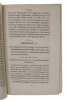
First appearance of Fresnel's landmark mémoir - this mémoir was his first paper on diffraction, and was later given the prize of the French Academy and published in Memoires de l'Academie in 1826 in full, together with his further developments of his light theory - in which he for the first time explained the causes of the diffraction effects as the mutual interference of the secondary waves emitted by those portions of the original wave-front which have not been obstructed by the diffraction screen. His methods of calculation utilized the principles of both Huygens and Young and he summed the effects due to different portions of the same primary wave-front. The memoir records also Fresnel's famous mirror-experiment.""In broad context Fresnel's work can be viewed as the first successfull assault on the theory of imponderables and a major influence on the development of nineteenth-centurty energetics."" (DSB V, p. 171).""Augustin Fresnel seems to have adopted a wave theory of light from the very beginning of his studies. His first paper, presented to the Academy...in October 1815, and entitled ""La Diffraction de la Lumiere"" (the paper offered), was written after a long correspondance with Arago, who had promised Fresnel his full support. ""The wave theory"" Fresnel wrote, ""is well suited to explaining the complicated propagation of light phenomena, and since, as we know from the case of sound, waves can surcomvent obstacles, I decided to make a study of shadows.....It is because they cross in regions common to them both that two pencils of rays can produce fringes. hence it follows that the vibrations of rays which cross at very small angles can cancel out whenever crests of one correspond to the throughs of the other.""
"FRESNEL, AUGUSTIN. - THE UNDULATORY THEORY OF LIGHT ESTABLISHED.
Reference : 43919
(1833)
Ueber die Diffraction des Lichts. (Mèmoires de l'acad. roy. des Scences etc. T. V. p. 339). (+) Auszug aus einer Abhandlung über die Reflexion des Lichts. (Ann. de chim. et de phys. T. XV p.379).
(Leipzig, Joh. Ambrosius Barth, 1833). Contemp. hcalf. Spine gilt. Very light wear to spine ends and edges. In: ""Annalen der Physik und Chemie. Hrsg.von Poggendorff"", Jahrgang 1833 (Bd. 30), Ergäntzungsheft. 376 pp. a. 2 folded engraved plates. 2 small stamps to p.1 and a small stamp to verso of plates. (Entire volume offered). Fresnel's papers: pp. 100-255 a. pp. 255-261. Clean and fine.
First German edition of Fresnel's epoch-making memoir from the French Academy (1826) and incorporating his experimental results from the years 1815-19, in which he for the first time explained the causes of the diffraction effects as the mutual interference of the secondary waves emitted by those portions of the original wave-front which have not been obstructed by the diffraction screen. His methods of calculation utilized the principles of both Huygens and Young and he summed the effects due to different portions of the same primary wave-front. He demonstrates that the transverse wave theory of light explains the observed phenomena of reflection, refraction, interference, polarization, difraction patterns, diffraction fringes etc., making a strong case for the theory of the transverse nature of light waves. The memoir records also Fresnel's famous mirror-experiment.""In broad contect Fresnel's work can be viewed as the first successfull assault on the theory of imponderables and a major influence on the development of nineteenth-centurty energetics."" (DSB V, p. 171).""Augustin Fresnel seems to have adopted a wave theory of light from the very beginning of his studies. His first paper, presented to the Academy...in October 1815, and entitled ""La Diffraction de la Lumiere"" (the paper offered), was written after a long correspondance with Arago, who had promised Fresnel his full support. ""The wave theory"" Fresnel wrote, ""is well suited to explaining the complicated propagation of light phenomena, and since, as we know from the case of sound, waves can surcomvent obstacles, I decided to make a study of shadows.....It is because they cross in regions common to them both that two pencils of rays can produce fringes. hence it follows that the vibrations of rays which cross at very small angles can cancel out whenever crests of one correspond to the throughs of the other.""The voume contains further a notable paper by AMPÈRE ""Bestimmung der krummen Fläche der Lichtswellen in einem Mittel, dessen Elasticität verschieden ist nach den drei Hauptrichtungen, d.h. nach debjenigen, in welchem die von der Elasticität erregte Kraft in desselben Richtung wirkt, in der die Theilchen dieses Mittels verschoben wurden."" First German edition. Pp. 262-295.
"YOUNG, THOMAS. - THE DISCOVERIES OF THE INTERFERENCE OF LIGHT - GERMAN EDITIONS.
Reference : 44092
(1811)
Ueber die Theorie des Lichts. Frei übersetzt vom Professor Lüdicke. (+) Nachricht von einigen Fällen einer bisher noch nicht beschriebenen Entstehung der Farben. (+) Beschreibung einer Vorrichtung, um mittelst des Sonnen-Mikroskops die Farben dünner F...
Leipzig, Johann Ambrosius Barth, 1811. Without wrappers. In: ""Annalen der Physik. Hrsg. Ludwig Wilhelm Gilbert"", Bd. 39 (der Reihe), Eilftes u. Zwölftes Stück. Titlepage to vol. 39. Pp. 129-244 a. 2 engraved plates. (The entire issue offered). Young's papers: pp. 156-205 a. pp. 206-220. And pp. 245-360 a. 2 engraved plates. (The entire issue offered). Young's papers: pp. 255-261 a. pp. 262-290.
First appearance in German of Youngs 3 groundbreaking papers ( On the Theory of Light and Colours 1802 - An account of some Cases of the Production of Colours not hitherto described 1802 - The Bakerian Lecture. Experiments and Calculations relative to physical Optics. 1804) - which gives the first really convincing evidence that the fringes are produced by interference of light waves, and giving the experimental demonstrations of the general law of Interference.These importent demonstrations served as the experimental basis for the wave hypothesis of light. - In his two first papers ""On the Theory of Light and Colours"", 1802 and ""An account of Some Cases of the Production of Colours not hitherto described"", 1802 - he only partially announced his principle of Interference, and the statement of it in ""An Account..."" was entirely hypothetical and not experimental. (Magie. Source Book in Physics gives extracts of this paper and a later paper under the head: Discovery of the interference of light, pp.308-15).Young also shows here that diffraction effects can be explained by the interference law.""The experimental basis for the wave hypothesis of light as Young formulated it was interference. The fact has already been observed that two trauins of water waves may be so superposed that in certain regions the throughs of one train will lie continuously on the crests of another, thereby producing zero disturbance...Destryctive interference is said to occur between the two trains of waves in the former case and constructivee interference in lthe latter. Similarly, two sound waves may be so combined as to produce alternate regions of silence and enhanced sound. The phenomenon of interference, of which the forgoing are familiar examples, is easely comprehensible in the case of combining waves, but would be utterly incomprehensible in the case of combining streams of particles. So when Young demonstrated that two beams of light could, under properly controlled conditions be made to combine in such a way as to produce alternate regions of darkness and light, he was rightly considered to have identified in light a characteristic property of waves."" (Lloyd Taylor in: Physics. The Pioneer Science. p. 511).Of the three papers published in the years 1802-04 the last is the most importent as it gives the experimental demonstrations of the interference of light. (Dibner in Heralds of Science No. 151 list the first paper, so does PMM: 259).
Ueber die durch polarisirtes Lichts in homogenen Flüssigkeiten hervorgebrachten Farben. (...der Pariser Academie am 30. März 1818 vorgelegt). (+) Ueber die Reflexion des Lichts. (Der Pariser Academie vorgelegt am 15. Nov. 1819). (2 Mémoirs).
Leipzig, Johann Ambrosius Barth, 1848. Without wrappers. In ""Annalen der Physik und Chemie. Hrsg. von J.C. Poggendorff"", Ergänzungsbd., Bd. II, Stück 2. Titlepage to Erg-Bd. 2. Pp. 193-368. (The entire issue offered). Fresnel's papers: pp. 304-331, textillustr. a. pp. 332-355, textillustr. A stamp on titlepage and verso of. Clean and fine.
First German editions of two importent memoirs on polarization and reflexion of light by ""the founder of the new optics"". The French versions of the papers appeared in ""Annales de Chimie et de Physique""(1846).The first paper takes on a central role in Fresnel's dealing with polarization in general and specially with chromatioc polarization and the explaining the phenomena that arises when light travels through crystals. The paper was read at the Academy on march 30, was not printed at the time as it disappeared and only turned up many years later, around 1845, when it was found in the papers of Fresnel's brother. ""On croyait ou Mémoire perdu. Il a été retrouvé dans les papiers de M. Léonor Fresnel, frère de l'illustre académicien."" Thus, the offered paper is here PRINTED FOR THE FIRST TIME AND IN ITS FULL LENGHT (in the German version).The second paper deals with reflection and explains the different phenomena seen when light is reflected from glassplates having two surfaces parallel or with curvature, interference of reflected waves and the measure of their different wavelenghts, all explained according to the wave theory of light. The paper offered is for the FIRST TIME PRINTED IN ITS FULL LENGHT (in the German version), as it only appeared in the résumé-form in 1820 ""Résumé d'un Mémoire sur la Réflexion de la lumière"" (Annales de Chimie et de Physique, tome 15, pp. 379-386).""As it was, Fresnel succeeded fully in attaining his explicit goal, the establishment of the wave conception of light. Not long after his death scientific opinion definitely shiftedin favor of waves and opened up the pathway leading to the deeper insight of Maxwell. In broad context Fresnel's work can be viewed as the first successfull assault on the theory of imponderables and a major influence on the development of nineteenth-centurty energetics."" (DSB V, p. 171).
"KIRCHHOFF, G. (GUSTAV ROBERT).- THE KEY TO THE NEW WORLD OF QUANTA - INTRODUCING ""BLACK-BODY RADIATION""
Reference : 44131
(1861)
Du Rapport entre le pouvoir émissif et le pouvoir absorbant des Corps pou la Chaleur et la Lumière. Traduit de l'allemand par Georges Leclanche.
Paris, Victor Masson et Fils, 1861. Without wrappers. In: ""Annales de Chimie et de Physique"", 3e Series - Tome 62, Cahier Juin 1861. Titlepage to vol. 62. Pp. 129-256. (The entire issue offered). Kirchhoff's paper: pp. 160-192. Small stamps to verso oftitlepage.
First French edition of a milestone paper by ""The Grandfather of Quantum Theory"" in which he formulates the law named after him, ""KIRCHHOFF'S LAW"", which was the ""key to the whole thermodynamics of radiation. In the hands of Planck, Kirchhoff's successor to the Berlin chair, it proved to be the key to the new world of the quanta, well beyond Kirchhoff's conceptual horizon.""(DSB, VII, p.382).""Kirchhoff's Law of Thermal Emission was formulated in 1859 (Über das Verhältnis....) - the paper offered here in the first French version. It is at the same time the simplest and least understood law in physics. Kirchhoff's law states that given thermal equilibrium with an enclosure, the radiation inside will be always black, or normal, in a manner which is independent of the nature of the walls, or the objects they contain. This is known as the concept of universality. That is, that radiation within an enclosure can always be described by a universal function dependent only ontemperature and frequency. This universal function was first given us by Max Planck, in 1900. Kirchhoff's law STANDS AT THE HEARTH OF ALL MODERN ASTROPHYSICS. It is the basis for setting the temperature of the stars, for the gaseous model of the Sun, and for believing that we now know the temperature of the entire universe.""(Pierre-Marie Robitaille)..The research background for the paper was his unexpected observation that if the intensity of the solar spectrum increased above a certain limit, the dark D lines were made much darker by the interposition of the sodium flame. he instantly felt, that he had got hold of ""something fundamental"". Another notable, and importent paper in the development of photography, is in the same issue ALPHONSE POITEVIN ""De l'Action chimique de la Lumiere sur les Substances organiques. Son emploi à l'impression photographique.""Pp. 192-210.
"JANSSEN, PIERRE JULES CÉSAR - THE DISCOVERY OF HELIUM IN THE SUN.
Reference : 44231
(1878)
Éclipse de Soleil du 18 Aout 1868. Rapport adressé par M. Janssen au Maréchal de France Président du Bureau des Longitude.
Paris, G. Masson, 1878. 8vo. Contemp. hcalf, raised bands, gilt spine. Light wear along edges. Small stamps on verso of titlepage. In: ""Annales de Chimie et de Physique"", 4e Series - Tome 15. 512 pp. a. 3 folded engraved plates. (The entire volume offered). Janssen's memoir: pp. 414-426.
First appearance of this milestone paper in chemistry, physics and astronomy, announcing the discovery of the helium lines in the spectrum of the sun. It was Lockyer in the same year that named it 'helium' for Helios, the Greek God of the Sun. Helium was not discovered on the earth before 1895 by William Ramsay, and it was Crookes who established its identity with the helium Janssen and Lockyer observed in the spectrum of the sun.""He Janssen) met immortality by travelling to India in 1868 to study the total eclipse. It was then that he observed the helium line and forwarded the spectral data to ockyer. He also noted the size of the solar prominences. The day after the eclipse he attempted to take their spectra again and succeeded despite the absence of the obscuring moon. he then announced jubilantly that it was the day after the eclipse that was the real eclipse day for him. Lockyer also reported this method of studying prominences without an eclipse....Like Lockyer he lived to see his observation of the helium line vindicated by Ramsay's discovery of that element on earth.""(Asimov).""This (the discovery of helium lines in the sun by Lockyer) was announced on the same day by the French astronomer Janssen, who was in India observing a total eclipse. As a result, the French government some ten years later struck a medallion showing the heads of both scientists.By that time, the two men had made a much more dramatic discovery at the same time, this time in cooperation. Janssen, studying the spectrum ofthe sun during the eclipse, had noted a fine line he did not recognize. he send a report on this to Lockyer, an acknowledges expert on solar spectra. Lockyer compared the reported position of the line with lines of known elements, concluding that it must belong to a yeat unknown element, possibly not even existing on the earth. He named the element, from the Greek word for the sun.""(Asimov).Parkinson ""Breakthroughs"" 1868 A. - The volume contains other notable papers by Dumas, Berthelot et al.
"HERTZ, H. (HEINRICH RUDOLF). - THE BIRTH OF RADIO-COMMUNICATION, TELEVISON AND RADAR
Reference : 44842
(1887)
Ueber sehr schnelle electrische Schwingungen. (+) Nachtrag zu der Abhandlung über sehr Schnelle electrische Schwingungen.
Leipzig, Johann Ambrosius Barth, 1887. Without wrappers as issued in ""Annalen der Physik und Chemie. Hrsg. von G. Wiedemann."", Neue Folge Bd. 31, 7. Heft. With the titlepage to vol. 31. Pp. 337-544 a. 2 folded plates, (entire issue offered ""Heft"" 7). Hertz's paper: pp. 421-448 A. PP. 543-544. A Stamp on titlepage and verso of. Clean and fine.
First edition of Hertz's seminal paper on electromagnetic waves in which he empirically demonstrates Maxwell's equations. This discovery and its demonstration led directly to the invention radio of communication, television and Radar. The paper is the ""ANNOUNCEMENT OF THE DISCOVERY OF THE PRODUCTION BY ELECTRICAL DISCHARGE OF WAVES WHICH HAVE THE PROPERTY OF VERY LONG WAVES""(H.M. Evans).Hertz demonstrates what Maxwell had predicted that electromagnetic waves radiated in space with the speed of light. Hertz determined these waves to be of greater length than light and that they could be reflected.""Experimental proof by Hertz of the Faraday-Maxwell hypothesis that electrical waves can be projected through space was begun in 1887, eight years after Maxwell's death. The two main requirements were (a) a method of producing the waves, supposing that they existed, and (b) a method of detecting them once they were produced."" (PMM, 377.). In the present paper Hertz ""describes the apparatus that he had devised for the detection and measurement of electromagnetic waves, the key to his later success. To prove that electromagnetic waves can be projected through space it was necessary to devise a means of both producing the waves and, more difficult at the time, of detecting them once produced."" (Norman Library, No. 1123).""Hertz's researches on electrical waves vindicated the Helmholtz ideal of the physicist as one whose competences embraced both experiment and mathematics. Hertz entered physics at the right time for one of his abilities to make a critical contribution"" because the outstanding problem of physics was the disorderly condition of electrodynamics, what was needed was someone with the theoretical power to analyze the competing theories and with the experimental judgment to produce the evidence that would persuade the physical community that a decision between the theories had been reached."" (DSB, VI, 348b.)""In the early 1890's the young inventor Guglielmo Marconi read of Hertz's electric wave experiments in an Italian electrical journal and began considering the Possibility of communication by wireless waves. Hertz's work initiated a technological development as momentous as it physical counterpart."" (DSB, VI, 349a.).

