 Write to the booksellers
282 books for « tacitus »Edit
-
Language
French (278)
Latin (1)
Russian (3)
-
Century
16th (2)
17th (10)
18th (8)
19th (9)
20th (10)
-
Countries
Belgium (7)
Denmark (9)
France (41)
Germany (1)
Netherlands (209)
Switzerland (12)
United States of America (3)
-
Syndicate
ILAB (33)
NVVA (2)
SLACES (2)
SLAM (20)
Topics
- Early printed books (1)
- English (1)
- Gastronomy (1)
- Germanic languages (4)
- Gravelot (1)
- Greek (192)
- Helvética (1)
- History (23)
- Humanism (1)
- Latin (208)
- Latin greek (1)
- Literature (5)
- Opera (1)
- Opera ballet (1)
- Philosophy (2)
- Religions (1)
- Reliure (3)
- Roman history (1)
- Roman literature (1)
- Rome (5)
- Sciences (1)
- Switzerland (1)
- Teaching (1)
C. Cornelius Tacitus, accurante Matthia Berneggero.
Strassburg (Argentorati), Ediderunt Georgius Andreas Dolhopfius & Johannes Eberhardus Zetznerus, 1664.
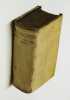
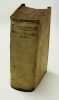

8vo. (XVIII,1122,(2 blank)) p. Overlapping vellum 17 cm (Ref: VD17 547:695101K; Schweiger 2,1002; Dibdin 2,452; Moss 2,643; Graesse 6/2 9; Fabricius/Ernesti 2,398) (Details: 6 thongs laced through the joints. Engraved title, depicting an altar, left of which stands a Roman emperor, right a German warrior; on the surface of the altar the text 'Aeternitati', for Eternity; just above the altar hangs the globe, upon which stands an eagle with spread wings. This scene seems a combination of two Roman coins. It was perhaps made after the verso side of a coin struck by Constantine the Great in Trier in 321 A.D.; on this coin there is however no eagle; a scene consisting of a globe on which an eagle stands, is to be seen on a denarius of Caracalla, struck after 217 A.D. This frontispiece is purely propagandistic in its presentation. It depicts not so much the struggle between the Romans and the German tribes, that Tacitus tells about. It rather symbolizes the claim of the Holy Roman Empire (Sacrum Romanum Imperium, Heiliges Römisches Reich), that it was the legitimate successor 'for eternity' of the Roman Empire. The imperial banner of the Holy Roman Empire depicted a black eagle) (Condition: Vellum age-tanned and slightly worn & spotted. Head of the spine chafed. Front & rear joint starting to split for 1 cm. Some old ink underlinings. Paper browning. Bookplate on the front pastdown) (Note: The Roman historian Publius Cornelius Tacitus offered ammunition for many intellectual and political battles in 16th and 17th century Europe. The turmoil caused by the emerging new monarchies in England, France en Spain, civil and religious wars in Italy and Germany, and the plague, made Tacitus' account of the state of the early Roman Empire increasingly topical and relevant. The debate Tacitus provoked in intellectual circles was of course on Roman history, but also on literary style, in Latin and the vernacular, but more so on historical and political thought. Tacitus ideas were not original, but he brought them in a forceful lapidary way, oneliners ready for the use in debate. Tacitus became in a corrupted world 'the one true guide for those involved in the awful revolution of modern times: he "teaches well the mode of life under tyrants, just as he teaches tyrants how to establish tyranny'' '. (The Classical Tradition, Cambr. Mass., 2010, p. 921) The French humanist scholar Muretus (Marc Antoine Muret, 1526-1585) declared that 'Tacitus' descriptions of lost liberty, failed revolutions, vicious civil wars, and mad emperors amounted to a theater of our time'. (Op. cit., ibid.) The editor of this Tacitus edition, the German classical scholar Matthias Bernegger, 1582-1640, was the founder of the School of Roman history at Strassburg, where a protestant university was founded in 1621. The model of this school was the Flemish editor of Tacitus, Justus Lipsius, 1547-1606, who was one of the most learned men of his day. His great Tacitus editions placed and still places Lipsius in the front rank of classical scholarship. Our Tacitus edition of 1664 is an exact reissue of Bernegger's Tacitus, that was first published in in Strassburg in 1638. It includes 'many excellent notes and emendations due to his pupil and son-in-law Johannes Casper Freinsheim (1608-1660), the foremost representative of this school'. (Sandys,J.E., 'A History of Classical Scholarship', N.Y., 1964, p. 367) The edition offers also a 144 page treatise 'Ioannis Freinshemii expositio locorum cornelianorum intactorum interpretibus, aut secus acceptorum' and an elaborate and exemplary 272 page 'Index in Tacitum confectus industria et labore Melchiore Freinshemii'. Lipsius praised Tacitus as a teacher of vital political lessons. In his Politica (Politicorum sive Civilis doctrinae libri sex, 1589) 'a brilliant textbook in mosaic form, composed of passages from the ancients, far more of them taken from Tacitus than from any other source - Lipsius showed how to make a version of Tacitus' analysis of empire fit the practical needs of the modern governing classes'. (The Classical Tradition, Cambr. Mass., 2010, p. 921) Bernegger, professor of History, from 1613 till his death in 1640, produced a revised and augmented edition of Lipsius' Politica, which was published posthumously in Strassburg in 1642. It saw several reissues in that city and in Frankfurt. Bernegger was from his appointment in Strassburg in 1613 the starting point of the so-called Lipsian tradition, an historic-political school of thought in late humanist philology, which exercised well into the 18th century influence on the German protestant universities of Jena, Altorf, Marburg and Strassburg ('Justus Lipsius, Politica: Six Books of Politics Or Political Instruction', Edited with translation and introduction by J. Waszink, Assen 2004, p. 194/95) Bernegger lectured on Lipsius' Politica, and like Lipsius he considered Tacitus' view on politics the best guiding principle leading to 'prudentia' in the turmoil of his time.) (Provenance: Bookplate: 'Bibliothek Oberherrlingen, E.M. 1839'. Eugen von Maucler, 1783-1859, was a German politician and bibliophile. His library was located at 'Schloss Oberherrlingen' near Ulm; see for Eugen von Maucler, his library, a portrait, and a picture of the bookplate: Wikipaedia)(Collation: a8 (minus leaf a8), b2; A-4A8, 4B2 (leaf 4B2 blank)) (Photographs on request)
C. Cornelius Tacitus, accurante Matthia Berneggero.
Strassburg, (Argentorati), Ediderunt Haeredes Lazari Zezneri, 1638.
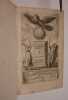
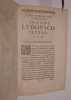
8vo. (XVIII,1123,(1 blank)) p. Vellum 17.5 cm (Ref: VD17 23:249104Z; Schweiger 2,1002; Dibdin 2,452; Moss 2,643; Graesse 6/2 9; Fabricius/ Ernesti 2,398) (Details: Fine contemporary vellum. 6 thongs laced through the joints. Engraved title, depicting an altar, left of which stands a Roman emperor, right a German warrior; on the surface of the altar the text 'Aeternitati', for Eternity; just above the altar hangs the globe, upon which stands an eagle with spread wings. This scene seems a combination of two Roman coins. It was perhaps made after the verso side of a coin struck by Constantine the Great in Trier in 321 A.D.; on this coin there is however no eagle; a scene consisting of a globe on which an eagle stands, is to be seen on a denarius of Caracalla, struck after 217 A.D.; this old eagle-and-globe symbol adorns since 1883 the escutcheon of the United States Marine Corps. This frontispiece is purely propagandistic in its presentation. It depicts not so much the struggle between the Romans and the German tribes, that Tacitus tells about. It rather symbolizes the claim of the Holy Roman Empire (Sacrum Romanum Imperium, Heiliges Römisches Reich), that it was the legitimate successor 'for eternity' of the Roman Empire. The imperial banner of the Holy Roman Empire depicted a black eagle) (Condition: A bookplate has been pasted on the front pastedown. A small piece of the blank margin of preliminary leaf a8 has been torn off, without loss of text, and was not successfully repaired. The lower margin of some gatherings is faintly waterstained) (Note: The Roman historian Publius Cornelius Tacitus offered ammunition for many intellectual and political battles in 16th and 17th century Europe. The turmoil caused by the emerging new monarchies in England, France en Spain, civil and religious wars in Italy and Germany, and the plague, made Tacitus' account of the state of the early Roman Empire increasingly topical and relevant. The debate Tacitus provoked in intellectual circles was of course on Roman history, but also on literary style, in Latin and the vernacular, but more so on historical and political thought. Tacitus ideas were not original, but he brought them in a forceful lapidary way, oneliners ready for the use in debate. Tacitus became in a corrupted world 'the one true guide for those involved in the awful revolution of modern times: he "teaches well the mode of life under tyrants, just as he teaches tyrants how to establish tyranny'' '. (The Classical Tradition, Cambr. Mass., 2010, p. 921) The French humanist scholar Muretus (Marc Antoine Muret, 1526-1585) declared that 'Tacitus' descriptions of lost liberty, failed revolutions, vicious civil wars, and mad emperors amounted to a theater of our time'. (Op. cit., ibid.) The editor of this Tacitus edition, the German classical scholar Matthias Bernegger, 1582-1640, was the founder of the School of Roman history at Strassburg, where a protestant university was founded in 1621. The model of this school was the Flemish editor of Tacitus, Justus Lipsius, 1547-1606, who was one of the most learned men of his day. His great Tacitus editions placed and still places him in the front rank of classical scholarship. This Tacitus edition of Bernegger includes 'many excellent notes and emendations due to his pupil and son-in-law Johannes Casper Freinsheim (1608-1660), the foremost representative of this school'. (Sandys,J.E., 'A History of Classical Scholarship', N.Y., 1964, p. 367) The edition offers also a 144 page treatise 'Ioannis Freinshemii expositio locorum cornelianorum intactorum interpretibus, aut secus acceptorum' and an elaborate and exemplary 272 page 'Index in Tacitum confectus industria et labore Melchiore Freinshemii'. Lipsius praised Tacitus as a teacher of vital political lessons. In his Politica (Politicorum sive Civilis doctrinae libri sex, 1589) 'a brilliant textbook in mosaic form, composed of passages from the ancients, far more of them taken from Tacitus than from any other source- Lipsius showed how to make a version of Tacitus' analysis of empire fit the practical needs of the modern governing classes'. (The Classical Tradition, Cambr. Mass., 2010, p. 921) Bernegger, professor of History from 1613 till his death in 1640, produced a revised and augmented edition of Lipsius' Politica, which was published posthumously in Strassburg in 1642. It saw several reissues in that city and in Frankfurt. Bernegger was from his appointment in Strassburg in 1613 the starting point of the so-called Lipsian tradition, an historic-political school of thought in late humanist philology, which exercised well into the 18th century influence on the German protestant universities of Jena, Altorf, Marburg and Strassburg ('Justus Lipsius, Politica: Six Books of Politics Or Political Instruction', Edited with translation and introduction by J. Waszink, Assen 2004, p. 194/95) Bernegger lectured on Lipsius' Politica, and like Lipsius he considered Tacitus' view on politics the best guiding principle leading to 'prudentia' in the turmoil of his time) (Provenance: On the front pastedown a bookplate: 'Ex libris Bibliothecarii Paul Scherrer - Bylund', with the text: 'Vita fluit pilumque ferit rapidum, tamen astra lucent in tenebris clarius atque manent' and also its translation: 'Unser Leben verrint und Pfeile verwunden doch immer, leuchten je dunkler es wird, heller die Sterne für uns'. The Swiss librarian and author Paul Scherrer-Bylund, 1908-1992, was 'Direktor der Zentralbibliothek Zürich (Universitätsbibliothek) und ... Direktor der Bibliothek der Eidgenössischen Technischen Hochschule (ETH) Zürich. Schrieb u.a.: "Von der Macht und der Sendung des Buchdrucks" (1961), "Die Stellung des Bibliothekars in der modernen Gesellschaft" (1967), "Gottfried Keller - Wildling des Glaubens" (1969). (source: the German version of Who's Who) (Collation: a8, b2 (minus b2); A-4A8, 4B2) (Photographs on request)
C. Cornelius Tacitus ex I. Lipsii accuratissima editione.
Leiden (Lugduni Batavorum), Ex officina Elzeviriana, 1634.
12mo. (XX),786,(29 index),(1 blank) p., engraved title, 1 plate with 3 portraits. Overlapping vellum 13 cm (Ref: STCN ppn 833597485; Willems 415: 'l'édition est fort belle et très recherchée'. Berghman 2145; Rahir 403; Copinger 4630; Schweiger 2,1001/1002: 'Sehr niedlicher Abdruck des Textes nach Lipsius'; Moss 2,643; Brunet 5,634; Graesse 6/2 9: 'Édition très jolie'; Ebert 22157) (Details: 5 thongs laced through the joints. Nice title engraved by C.C. Duysent, depicting the river god Tiberinus, who sits at the border of the Tiber, and holds in his arms a big jar from which water flows, and a cornucopia; behind him stands a woman who has a mirror in her hand. At the end of the preliminary pages a plate, also engraved by Duysent, showing within an oval frame 3 portraits, of Tiberius, Augustus and his wife Livia. Clear typography. Latin text only, no commentary or notes) (Condition: Vellum age-tanned, a bit soiled and slightly scuffed. Occasionally a small number has been written in ink in the margins) (Note: The Roman historian Publius Cornelius Tacitus offered ammunition for many intellectual and political battles in 16th and 17th century Europe. The turmoil caused by the emerging new monarchies in England, France en Spain, civil and religious wars in Italy and Germany, and the plague, made Tacitus' account of the state of the early Roman Empire increasingly topical and relevant. The debate Tacitus provoked in intellectual circles was of course on Roman history, but also on literary style, in Latin and the vernacular, but more so on historical and political thought. Tacitus ideas were not original, but he brought them in a forceful lapidary way, oneliners ready for the use in debate. Tacitus became in a corrupted world 'the one true guide for those involved in the awful revolution of modern times: he 'teaches well the mode of life under tyrants, just as he teaches tyrants how to establish tyranny''. ('The Classical Tradition', Cambr. Mass., 2010, p. 921) The French humanist scholar Muretus (Marc Antoine Muret, 1526-1585) declared that 'Tacitus' descriptions of lost liberty, failed revolutions, vicious civil wars, and mad emperors amounted to a theater of our time'. (Op. cit., ibid.) The Flemish latinist Justus Lipsius, 1547-1606, one of the most learned men of his day, was invited in 1579 to come to Leiden to the recently founded university as a Honorary Professor of History. At that date he already had produced his great Tacitus-edition, published by Plantin, a work that placed and still places him in the front rank of classical scholarship. (Antwerp 1574) His main strength lay in textual criticsm and in exegesis. His emendations are considered to be very clever, and his commentary rich. Plantin published a second edition in 1581, with new emendations and variae lectiones. Lipsius's third edition, Antwerp 1585, offered a new recension. The fourth edition was published by the son in law of Plantin, Franciscus Raphelengius, in Leiden in 1588. Lipsius remained in Leiden for 11 years, a period of his greatest productivity. Lipsius praised Tacitus as a teacher of vital political lessons. In his 'Politics' ('Politicorum sive Civilis doctrinae libri sex', 1589) 'a brilliant textbook in mosaic form, composed of passages from the ancients, far more of them taken from Tacitus than from any other source- Lipsius showed how to make a version of Tacitus' analysis of empire fit the practical needs of the modern governing classes'. (Op. cit., ibid.) At the University of Leiden, the intellectual powerhouse of the new Dutch Republic, 'dozens of young intellectuals busied themselves in what they called the study of 'politics'. They studied and summarized in pointed, abrupt, witty Latin theses the Tacitean lessons about absolute monarchy'. (Op. cit., 922) By reading Tacitus' 'Annals' and 'Histories' the student could learn what constructive role the members of the social elite could play in the creation of a political and military system. Dutch students found ammunition especially in Tacitus' 'Germania', a detailed description of the peoples in Germany and the Low Countries. To show that the new Dutch Republic, founded in 1588, 'rested on solid historical foundations, they turned to Tacitus, who made clear that their ancestors, the Batavi, had resisted the tyranny of Rome, just as the modern citizens of Holland and Zeeland resisted that of Spain'. (Op.cit., 923)) (Collation: *10, A-2L12 (leaf 2L12 verso blank) (Photographs on request)
C. Cornelii Taciti Opera quae exstant, integris Beati Rhenani, Fulvii Ursini, M. Antonii Mureti, Josiae Merceri, Justi Lipsii, Valentis Acidalii, Curtii Pichenae, Jani Gruteri, Hugonis Grotii, Joannis Freinshemii, Joannis Frederici Gronovii, & selectis aliorum commentariis illustrata. Ex recensione & cum notis Jacobi Gronovii.
Utrecht (Trajecti ad Rhenum), Apud Jacobum a Poolsum & Johannem Visch, 1721.
4to. 2 volumes. Frontispiece, (XXXVI),756 (recte 764);578,(158 index) p. Vellum 26 cm (Ref: STCN ppn 198473214; Schweiger 2,1003/04; Dibdin 2,454: 'A very ample and excellent edition; containing the notes and observations of almost all the old and best editors'; Moss 2,644/45; Brunet 5, 635; 398/99; Graesse 6/2, p. 9/10; Ebert 22169; Fabricius/Ernesti 2,398/99) (Details: Backs with 6 raised bands. Short title in ink in the second compartment. Boards with blindstamped double fillet borders, enclosing another blindstamped rectangle and ornament. Frontispiece designed and engraved by J. Goeree, the upperpart of which shows 2 women crowning a bust of Agricola, in the foreground stands a royal woman with a crown (Roma?) on her head; she points at a big engraving in the middle of a Caesar, which is being engraved by winged woman (a Muse?). Title printed in red & black. Engraved printer's device on the first title, showing a scholar in his study, he is flanked by statues of Athena and Artemis; the motto is: 'Ingenio stat sine morte decus'. (Propertius III,2,26) On the second title page we find a portrait of Tacitus, engraved by Goeree; Tacitus is flanked there by Athena, an eagle & 2 putti) (Condition: Vellum age-tanned and slightly soiled. The boards are rather curved and outstanding) (Note: The Roman historian Publius Cornelius Tacitus offered ammunition for many intellectual and political battles in 16th and 17th century Europe. The turmoil caused by the emerging new monarchies in England, France en Spain, civil and religious wars in Italy and Germany, and the plague, made Tacitus' account of the state of the early Roman Empire increasingly topical and relevant. The debate Tacitus provoked in intellectual circles was of course on Roman history, but also on literary style, in Latin and the vernacular, but more so on historical and political thought. Tacitus ideas were not original, but he brought them in a forceful lapidary way, oneliners ready for the use in debate. Tacitus became in a corrupted world 'the one true guide for those involved in the awful revolution of modern times', he 'teaches well the mode of life under tyrants, just as he teaches tyrants how to establish tyranny''. ('The Classical Tradition', Cambr. Mass., 2010, p. 921) The French humanist scholar Muretus (Marc Antoine Muret, 1526-1585) declared that 'Tacitus' descriptions of lost liberty, failed revolutions, vicious civil wars, and mad emperors amounted to a theater of our time'. (Op. cit., ibid.) The Flemish latinist Justus Lipsius, 1547-1606, one of the most learned men of his day, praised Tacitus as a teacher of vital political lessons. Students and men of letters busied themselves in what they called the study of 'politics', summarizing in pointed, abrupt, witty Latin theses the Tacitean lessons about politics. By reading Tacitus' Annals and Histories the student could learn what constructive role the members of the social elite could play in the creation of a political and military system. Students in the Netherlands found ammunition especially in Tacitus' Germania, a detailed description of the peoples in Germany and the Low Countries. To show that the new Dutch Republic, founded in 1588, 'rested on solid historical foundations, they turned to Tacitus, who made clear that their ancestors, the Batavi, had resisted the tyranny of Rome, just as the modern citizens of Holland and Zeeland resisted that of Spain'. (Op.cit., 923) This Tacitus edition of 1721 is based on the edition of 1672 of the Dutch scholar of German origin Johannes Fredericus Gronovius, 1611-1671, who was professor of Greek at the University of Leiden. That edition (of 1672) appeared one year after his death, and was posthumously produced by his son Jacobus (Jakob) Gronovius, 1645-1716, who was also professor of classics at Leiden. This edition of 1721 was produced by the next Gronovius in line, a son of Jacobus Gronovius, the classical scholar Abraham Gronovius, 1695-1775, who became librarian at Leyden University, from 1741 until his death. This copious and excellent Tacitus edition of 1721 is a so-called 'Variorum' edition. It offers a 'textus receptus' which is widely accepted, accompanied with the commentary and the annotations of various specialists, taken, or excerpted from earlier useful, normative or renewing editions. Editions like these, 'cum notis Variorum', were useful, but never broke new ground. Their production was the specialty of Dutch scholars of the 17th and 18th century) (Collation: pi2 (frontispiece & title), *-4*4, A-5C4, 5D2; A-4Z4) (Photographs on request) (Heavy set, may require extra shipping costs)
TACITUS, CORNELIUS (+) GROTNITZ VON GRODNAU, CARL MELCHIOR (translator).
Reference : 61325
(1657)
Des C. Corn. Tacitus Beschreibung 1. Etlicher der ersten romischen Keiser, und anderer denkwurdiger Geschichte (...) 2. Der Teutschen-Volcker Ursprunges, uralten Vaterlandes, Versezungen, Kriege, Sitten und Gebrauche (...) 3. Der Romer, weiland i... - [FIRST COMPLETE GERMAN TRANSLATION OF TACITUS]
Franckfurt, Georg Mullers, 1657. 8vo. In a nice contemporary Cambridge-style mirror binding with four raised bands and richly gilt spine. All edges marbled. Small paper-label pasted on to top of spine. Margin of front board faded. Ex-libris (Carl Juel, Danish statesman and owner of Valdemar's Castle) pasted on to pasted down front end-paper. First 20 ff. with damp stain in upper outer corner, otherwise a nice and clean copy. (34), 1266, (26) pp. + frontispiece.
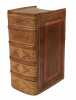
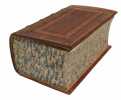
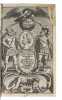
The rare first complete German translation of Tacitus. Tacitus’ texts had a profound influence in Germany, more so than most other classical works. Tacitus’ works influenced German identity and nationalism by providing a romanticized view of ancient Germans, contributing to the development of a distinct cultural identity. Tacitus’s description of ancient Germanic tribes in Germania was idealized by many German intellectuals as depicting noble and pure ancestors. It created a romanticized image of Germanic virtues like bravery, simplicity, and freedom. From the 16th century onward, particularly during the Renaissance and the Romantic era, Germania was used to foster a sense of national pride and distinct identity. It played a role in the rise of German nationalism, especially in the 19th century leading up to the unification of Germany in 1871. In the 20th century - particularly under Nazi rule – ‘Germania’ was misinterpreted and misused to promote ideas of racial purity and Aryan superiority, contributing to the ideology that justified many of the regime's atrocities. “The first printed translation of Tacitus’ texts sees the light in 1535 in Mainz and offer a German version of A.[De vita Iulii Agricolae], the H.[Historiae], and the G.[De origine et situ Germanorum], by Jacob Micyllus. Although German inaugurates the European movements of translations of Tacitus, the initial momentum ceases immidialtely. We must wait until 1612 before a new version of A. and the H. are worked on by Ludwig Kepler. German readers do not gain access to the entirety of the works of Tacitus (without the D.[Dialogus de oratoribus]) until 1657 [the present], thanks to the translation of Carl Melchior Gronitz von Grodnau. For the first time, also the Ag. is translated in this language.” (The Tacitus Encyclopedia). During the 16th and 17th centuries, the works of the Latin historian Caius Cornelius Tacitus, who wrote in the irst century AD, became bestsellers in Europe. From Italy to France, and in England, the Netherlands, the German Empire, and the Spanish monarchy, Tacitus’s Annals, Histories, Life of Agricola, Germania, and even the Dialogue on Orators – which in that period was not consistently attributed to him – became privileged objects of reading. Soon, a wide array of derivative works appeared. Commentaries on the text, discourses based on selected passages, aphorisms, judgments or notes, and virtually any kind of book related to Tacitus’s texts in any possible form found a printer and readers” (Bermejo, Translating Tacitus).

C. Corneli Taciti Quae exstant opera. Recensuit J.N. Lallemand.
Paris (Parisiis), Apud Desaint & Saillant, (...) typis J. Barbou, 1760.
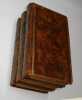
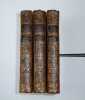
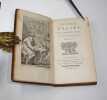
12mo. 3 volumes: XXIV,444; (VI),480; 456 p., 3 frontispieces. Mottled calf. 16 cm (Ref: Schweiger 2,1004: 'L.'s Noten sind von Werth'; Dibdin 2,455: 'one of the most beautiful and correct of all his classics'; Moss 2,645: 'A pleasing and accurate little edition'; Graesse 6/2,10: 'Jolie edition dans laquelle le texte d'Ernesti (of 1752) a ete corrigé à l'aide d'un manuscript de Paris'; Ebert 22175; Brunet 5,636: 'Bon texte') (Details: Backs with 2 shields, and gilt with fleurettes. Edges of the boards and the bookblocks also gilt. Boards with triple fillet gilt borders. Marbled endpapers. The frontispiece of the first volume, designed by Ch. Eisen and executed by L. Lempereur depicts Tacitus in his study; Tacitus looks at a bust of Agricola, his father in law. The second frontispiece depicts Messalina, the wife of the emperor Claudius; the third Galba. Barbou's woodcut printer's mark on the three titles, depicting an old man who stands in the shade of a vine-entwined elmtree, symbolising the symbiotic relationship between scholar and publisher. The motto is: 'Non solus'. Three nice engravings in the text) (Condition: Bindings scuffed, especially at the extremities. Corners bumped. Two joints are splitting. Front joint of volume three is cracking. Old ink inscription on the front flyleaf of volume one) (Note: The Roman historian Publius Cornelius Tacitus offered ammunition for many intellectual and political battles in 16th and 17th century Europe. The turmoil caused by the emerging new monarchies in England, France en Spain, civil and religious wars in Italy and Germany, and the plague, made Tacitus' account of the state of the early Roman Empire increasingly topical and relevant. The debate Tacitus provoked in intellectual circles was of course on Roman history, but also on literary style, in Latin and the vernacular, but more so on historical and political thought. Tacitus ideas were not original, but he brought them in a forceful lapidary way, oneliners ready for the use in debate. Tacitus became in a corrupted world 'the one true guide for those involved in the awful revolution of modern times: he "teaches well the mode of life under tyrants, just as he teaches tyrants how to establish tyranny'' '. (The Classical Tradition, Cambr. Mass., 2010, p. 921) The French humanist scholar Muretus (Marc Antoine Muret, 1526-1585) declared that 'Tacitus' descriptions of lost liberty, failed revolutions, vicious civil wars, and mad emperors amounted to a theater of our time'. (Op. cit., ibid.) The French encyclopedists of the 18th century 'turned Tacitus into an enlightened enemy of obscurantist princes. This is the Tacitus, wise and mild, who prevailed in Europe immediately before the French revolution'. (R. Ash editor, 'Tacitus', Oxford, 2012, p. 429) In the preface to this Tacitus edition of 1760 the French scholar Nicolas Lallemand acknowledges that he used for his work the editions of Lipsius, Ryckius, Ernesti, and especially the edition of J. Gronovius that was published in Leiden in 1721; he was advised, he tells, by Claudius Capperonerius, or Claude Capperonnier, custos of the Royal Library, and 'Regius linguae Graecae professor'. Lallemand's text contains the readings of some manuscripts of the Royal Library, especially of those which coincide with the 'editio princeps'. Worldcat records 20 reissues of Lallemand's edition between 1760 and 1832) (Provenance: On the front pastedown of all three volumes the armorial bookplate of G.C.J. Vosmaer. Gualtherus Carel Jacob Vosmaer, 1854 - 1916, was a Dutch zoologist. He was the son of the Dutch author Carel Vosmaer, who produced a successful translation of Homer's Ilias and Odyssea) (Collation: pi1, a12, A-S12, T6; pi2, A-T12, V-X6; pi2, A-S12, T-V6) (Photographs on request)
C. Cornelius Tacitus ex I. Lipsii accuratissima editione
Lugduni Batavorum Ex Officina Elzeviriana 1634 Première édition. Contient toutes les oeuvres de Tacite selon l'édition définitive de Iustus Lipsius. Bel exemplaire. Reliure cartonnée de l'époque. Motifs estampés dorés au dos et étiquette de titre en cuir. La reliure est assez frottée, avec une usure des bords du dos avec une certaine perte de surface. Le dessin et le dos sont très décolorés. Titre gravé montrant une figure allégorique féminine tenant un miroir devant un dieu de la rivière avec une corne d'abondance. Une planche supplémentaire, par C. C. Duysent, montre un bouclier avec les portraits d'Auguste, de Livie et de Tibère. 16mo. Les feuilles de garde portent des marques et des signatures au crayon et à l'encre. Le coin de la première page de garde a été coupé pour enlever une signature. Le reste du livre est en très bon état, propre. Texte en latin. Un bel exemple de la typographie d'Elsevier. Pp. [xx]786 +[29] index. Publius Cornelius Tacitus, connu sous le nom de Tacite (v.AD 56 - v.120), était un historien et homme politique romain. Tacite est largement considéré comme l'un des plus grands historiens romains par les chercheurs modernes. 12.5cm x 8cm.
First edition Thus. Contains all the works of Tacitus according to the definitive edition of Iustus Lipsius. Nice copy. Contemporary hardback boards. Gilt embossed designs to the spine and leather title label. The binding is quite rubbed, with edgewear to the spine edges with some loss of surface. The Design and spine are very faded. Engraved title showing a female allegorical figure holding a mirror before a river god with cornucopia. Additional plate, by C. C. Duysent, shows a shield with portraits of Augustus, Livia, and Tiberius. 16mo. End papers have pencil and ink marking and signatures. The corner of the front end paper has been clipped to remove a signature. Rest of the book is in very good, clean condition. Text in Latin. A nice example of Elsevier typography. Pp. [xx]786 +[29] index. Publius Cornelius Tacitus, known as Tacitus (c.AD 56 c.120), was a Roman historian and politician. Tacitus is widely regarded as one of the greatest Roman historians by modern scholars. 12.5cm x 8cm. .
Les Annales de Tacite. Premiere Partie. Contenant le Regne de Tibere. Nouvelle edition (+) Les Annales de Tacite. Seconde partie contenant les regnes de Claudius & de Neron.
Paris, J. Camusat & P. Le Petit, 1650 & 1651. 8vo. In a nice contemporary Cambridge-style mirror binding with four raised bands and richly gilt spine. Small paper-label pasted on to upper compartment on spine. A few scratches to front board with a bit of loss of leather. Ex-libris pasted on to pasted down front end-paper. Title-page of vol. 1 with red underlignings and previous owner's name in contemporary hand and closely trimmed in lower margin with loss of print-year. A few occassional underlinings in text, but generally internally nice and clean. (40), 456, (42), (8), 448, (56) pp.
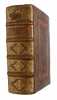
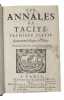
Fine copy of D’Ablancourt’s translation of Tacitus’ Annals, arguably the best and most popular 17th and 18th French translation of Tacitus. “Some translators interpreted efforts to bring Tacitus’s texts into the vernacular in similarly political terms. One of those was Nicolas Perrot d’Ablancourt, who produced his innovative French version between 1640 and 1650. For him, Tacitus not only had been translated into all languages and appreciated by all peoples, he also had “given birth to all of Spanish and Italian politics. During the 16th and 17th centuries, the works of the Latin historian Caius Cornelius Tacitus, who wrote in the irst century AD, became bestsellers in Europe. From Italy to France, and in England, the Netherlands, the German Empire, and the Spanish monarchy, Tacitus’s Annals, Histories, Life of Agricola, Germania, and even the Dialogue on Orators – which in that period was not consistently attributed to him – became privileged objects of reading. Soon, a wide array of derivative works appeared. Commentaries on the text, discourses based on selected passages, aphorisms, judgments or notes, and virtually any kind of book related to Tacitus’s texts in any possible form found a printer and readers” (Bermejo, Translating Tacitus). Not in Dibdin
C. Cornelius Tacitus, Jaarboeken en Historien, ook zyn Germanië, en 't leeven van J. Agricola, in 't Hollandsch vertaalt door den Heer Pieter Corneliszoon Hooft.
Amsterdam, By Hendrik Boom, en de Weduwe van Dirk Boom, 1684.
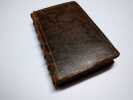
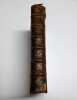
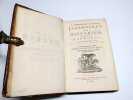
Folio. (XL),528,(4),11;(72) p., 14 engraved portraits & 8 folding historical plates. Calf 33 cm (Ref: STCN ppn 171376293; Geerebaert 137,5,II; OiN p. 359; Schweiger 2,1028) (Details: Back gilt and with 6 raised bands. Boards with double fillet gilt borders. Title in red & black. Woodcut printer's mark on the title, depicting Ceres and Flora under a palmtree (Boom means tree); the banner at their feet reads: I.V.S. A.W. H.D.B., which means: 'Johannes Van Someren, Abraham Wolfgangk, Hendrik en Dirk Boom'. Woodcut initials. 14 magnificent full-page portraits of Roman emperors engraved by A. Vaillandt, and 8 double-page battle and rural scenes engraved by I. Mulder) (Condition: Binding scuffed and scratched. Back rubbed and damaged at the head and tail. Corners bumped. Front pastedown stained, slightly damaged and with a bookplate. Faint name on the front flyleaf, small hole in somewhat soiled front flyleaf. Interior fine) (Note: The Dutch Renaissancist poet, playwright and historian Pieter Corneliszoon Hooft, 1581-1647, may be considered the founder of the literature of Holland's Golden Age. His style is not easily accessible, and often shows a sentence structure derived from Latin. Around 1630 he started with his translation into Dutch of the works of the Roman historian Tacitus, 56-117 A.D. These translations of the 'Annales', 'Historiae', 'Germania' and the 'Agricola' were posthumely published in 1684 by his able biographer Geeraert Brandt, 1626-1685. Hooft, in who the genius of Tacitus had arisen, according to Brandt, was not satisfied with the previously published translations, and decided to make a translation of his own which suited the style of the Roman historian better. Hooft however never found time to publish his translation. In the preface Brandt tells that the manuscript with the translations came into his hands by chance, long after the death of Hooft. He then decided to rescue them from oblivion, and to publish them, more than 50 years after Hooft had begun to translate Tacitus. In the same year the firm of Boom brought also a cheaper and smaller quarto-edition on the market. According to Geerebaert, this folio-edition was printed first) (Provenance: On the front pastedown a woodcut bookplate of J.J.A. Poley and F. Poley-Scheele, made by the Dutch graphic artist Johan Melse (See: Johan Schwencke in 'Den Gulden Winckel 31 (1932), p. 29-30) Johannes Adriaan Poleij, 1889-1951, married Francina Scheele, born 1891, in 1915 in the Dutch city of Goes) (Collation: (a)-(c)4, (d)-(g)2; A-3N-4, 3O-6, 3P-3S4, 3T6, 3V-3X4; A-S2 (leaf S2 verso blank)) (Photographs on request) (Heavy book, may require extra shipping costs)
C. Cornelii Taciti Opera quae exstant, Ex Justi Lipsi editione ultima: & cum eiusdem ad ea omnia Commentariis aut Notis. Scripta & addita ab eodem singulis libris Breviaria valde ad memoriam, & Historia lucem
Antverpiae [Antwerpen, i.e. Leiden], Apud Christophorum Plantinum [Chr. Plantin] 1585 [12] + 252 + [8] + 188 + [8] + 48 + [22] + [8bl.] pp. , with engraved printer's device (on all three title pages), ornamental initials, 33x22cm., full-leather binding (original covers and ends rubbed and discoloured, professionally re-backed), two unidentified heraldic ex-libris tipped-in, two ancient manuscript ex-libris on title page ("Timoleon Grangis (?), iii Jan 1588" & "Ex libris Adriani Augustini de Lamet doctoris & socij Sorbonis" = Adrien-Augustin de Bussy de Lamet, 1621-1691), paper is browned but text is always well readable, few ancient text underlinings, text in Latin, [First folio edition of the collected works by Tacitus with commentaries and notes by Justus Lipsius. The first Lipsius edition of Tacitus was published in 1574 by Plantin, but this 1585-edition uses new manuscripts found in Spain and Germany, now lost, and an incunable of Venice ca. 1470. Title is mentioning Antwerp but it is in fact the 3rd Leiden edition], Ref. Voet 2279B-1562B-1563B, K121056
C. Cornelii Taciti Opera quae exstant. Ad exemplar quod I. Lipsius quintum recensuit. Seorsum excusi commentarii eiusdem Lipsii meliores plenioresque cum curis secundis, & auctariolo non ante adiecto. Guil. Barclayus praemetia quaedam ex vita Agricolae libavit. Adiecti sunt indices aliquanto ditiores.
Paris (Parisiis), Apud Ioannem Gesselin, 1599.
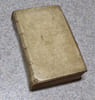
8vo. (XVI),790,(2 blank),(24 index) p. Overlapping vellum 18.5 cm (Ref: Schweiger 2,1000; Dibdin 2,450/2; Ebert 22148; Graesse 6/2,8) (Details: This is the first part of a two volume edition of Tacitus; it contains the Latin text of Tacitus only, and lacks the commentary part. Vellum thong laced through joints at the head and tail of the spine; 4 thongs (partly) gone. Short title in ink on the back. Woodcut printer's mark on the title: depicting the winged mythological horse Pegasus (though cloven-hoofed), the motto in an oval reads: 'Sic aetas non retinenda fugit') (Condition: Vellum age-tanned. Outer edges of the overlapping vellum partly damaged. Book-block almost loose in the binding. Front flyleaf with folds. Title slightly soiled and thumbed. Small and faint waterstain at the right lower corner of the first 5 leaves) (Note: The Flemish latinist Justus Lipsius, 1547-1606, was invited in 1579 to come to Leiden to the recently founded university as a Honorary Professor of History. At that date he already had produced his great Tacitus-edition, published by Plantin, a work that placed and still places him in the front rank of classical scholarship (Antwerp 1574). His main strength lay in textual criticsm and in exegesis. His emendations are considered to be very clever, and his commentary rich. Plantin published a second edition in 1581, with new emendations and 'variae lectiones'. Lipsius's third edition, Antwerp 1585, offered a new recension. The fourth edition was published by the son in law of Plantin, Franciscus Raphelengius, in Leiden in 1588. Lipsius remained there for 11 years, a period of his greatest productivity. Plantin in Antwerp published again in 1588 Lipsius' 5th recension of the text, with commentary. The Leiden branch of Raphelengius brought in 1595, after the departure of Lipsius, a reissue, 'secundis curis' of this 5th recension on the market. Of this 1595 edition, 'our' edition, which is the text volume, is a reissue) (Collation: *8, A-Z8, Aa-Zz8, Aaa-Ccc8, Ddd4 (leaf Ddd4 blank), Eee8, Fff4) (Photographs on request)
Tacitus K. Annala. Small Works. History. In Russian /Tatsit K. Annaly. Malye pr
Tacitus K. Annala. Small Works. History. In Russian /Tatsit K. Annaly. Malye proizvedeniya. Istoriya. Translated from the Latin series: Classical thought. M. AST, Ladomir. 2003. You are welcome to reach out to us for a detailed description of the copies currently available. Delivery of this book may take longer than usual including extended processing and pre-shipping time, no expedited shipping is available. Please advise us if you have a set date or a deadline to receive your order.SKUalb50971a49b2c8885b
Tacitus P. K. Annala. History In Russian /Tatsit P. K. Annaly. Istoriya
Tacitus P. K. Annala. History In Russian /Tatsit P. K. Annaly. Istoriya Translated from Latin by the National Foundation of Pushkin Library 2005, 828 p.We have thousands of titles and often several copies of each title may be available. Please feel free to contact us for a detailed description of the copies available.SKUalb0d49a45d53a2c0d8.
[Apud C. Gosselin et L. Mame-Delaunay] - TACITUS, Caius Cornelius ; [ TACITE ] ; OBERLIN, J. J. ; DE CALONNE, P. F. de
Reference : 37093
(1824)
Caius Cornelius Tacitus, cum selectis variorum interpretum notis, ex postrema editione Jer. Jac. Oberlini, curante P. F. de Calonne (5 Tomes - Complet)
5 vol. in-12 reliure demi-percaline marron, Apud C. Gosselin et L. Mame-Delaunay, Parisiis [ Paris ], 1824, xxiii-396 ; 2 ff., 420 pp. et 1f. ; 447 ; 2 ff, 595 ; 79-318 pp.
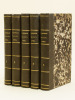
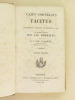
Complet. Bon état (des rouss., qq. frott. en coins).
Sochineniya. In Russian /Works
Short description: In Russian. Tacitus, Cornelius. Works. Leningrad: Science. Leningrad Division, 1969. You are welcome to reach out to us for a detailed description of the copies currently available. Delivery of this book may take longer than usual including extended processing and pre-shipping time, no expedited shipping is available. Please advise us if you have a set date or a deadline to receive your order.SKU6786318
Annalium ab excessu divi Augusti libri. The annals of Tacitus. Edited with introduction & notes by H. FURNEAUX. Second edition (revised by Pelham & C.D. Fisher).
Oxford, Clarendon Press, 1951 - 1956.
2 volumes: XI,691;(III),519 p. Cl. 23 cm (Cover of vol. 1 slightly worn; pencil annotations in vol. 1; a few small ballpoint annotations in vol. 1) (Heavy book, may require extra shipping costs)
Nero. Volgens de Jaarboeken van Publius Cornelius Tacitus vertaald door S. KOPERBERG.
Amst., Antw., Wereldbibliotheek, 1951.
129 p. Stiff wrappers. 18 cm (OiN 360)
Tacitus, Annals, Book XIV. Edited (with introduction, text, commentary and indexes) by E.C. Woodcock.
Oxford, Basil Blackwell, 1988.
186 p. Paperback 21.5 cm (Blackwell Classical Texts)
Die Germania des Tacitus. Erläutert von Rudolf Much. 2. Auflage, durchgesehen von Richard Kienast.
Heidelberg, Carl Winter, 1959.
XV,464 p.; 12 plates; 1 folding map. Cloth 20 cm ((Right edge of the book block slightly spotted)
The Germania of Tacitus. A critical edition by R.P. ROBINSON.
Middletown, 1935.
XIV,388 p. Cloth. 24 cm (Philological Monographs published by the American Philological Association V) (Bookplate on inside frontcover. Lettering on the back slightly faded. Corners just a bit bumped)
The Germania of Tacitus. A critical edition by R.P. ROBINSON.
Hildesheim etc., Olms, 1991.
XIV,388 p., fold. table. Cl. 24 cm (Repr. Middletown 1935)
Tacitus als geschiedschrijver.
Groningen, J.B. Wolters, 1960.
24 p. Stiff wrappers. 24 cm (Lecture)
Tacitus als geschiedschrijver.
Groningen, J.B. Wolters, 1960.
24 p. Stiff wrappers. 24 cm (Lecture)
Cornelius Tacitus, der Geschichtsschreiber.
Stuttgart, Druckenmüller, 1968.
139 columns. Stiff wrappers 24 cm (Reprint RE)
Tacitus, Annales (XI-XVI) et Historiae. Codex Leidensis Bibliothecae Publicae Latinus 16B (Codex Agricolae). Praefatus est C.W. Mendell, addenda ad praefationem adiecit E. Hulshoff Pol.
Leiden, A.W. Sijthoff, 1966.
Folio. XXIV p., 192 & 3 leaves. Cloth. 40x30 cm (Codices Graeci et Latini photographice depicti duce Scatone de Vries, et post eum G.I. Lieftinck, Tomus XX) (Photographs of this facsimile edition on request) (Heavy book, may require extra shipping costs)

