 Write to the booksellers
8 books for « stopes marie c »Edit
-
Language
English (1)
French (7)
-
Topics
Eugenics (1)
Family (2)
Feminism (1)
Literature (2)
Marriage (2)
Sexuality (1)
-
Countries
Brazil (1)
France (7)
-
Syndicate
ILAB (5)
SLAM (5)
Le couple à l'âge critique
Victor attinger in12. Sans date. Broché.


Bon état bords un peu frottés intérieur propre circa 1950
Le couple à l'âge critique
Victor Attinger. sans date. In-12. Broché. Bon état, Couv. convenable, Dos satisfaisant, Intérieur bon état. 249p.. . . . Classification Dewey : 306.8-Mariage et famille
Classification Dewey : 306.8-Mariage et famille
LE COUPLE A L'AGE CRITIQUE.
VICTOR ATTINGER. NON DATE. In-12. Broché. Etat d'usage, Tâchée, Dos satisfaisant, Intérieur frais. 251 pages.. . . . Classification Dewey : 820-Littératures anglaise et anglo-saxonne
Traduit de l'anglais par Eve Paul Margueritte. Classification Dewey : 820-Littératures anglaise et anglo-saxonne
L'amour et le mariage - Contribution nouvelle à la solution des difficultés sexuelles - Nouvelle édition revue et augmentée.
Victor Attinger. non daté. In-12. Broché. Etat d'usage, Couv. légèrement passée, Dos satisfaisant, Non coupé. 201 pages - tâches brunes sur les plats.. . . . Classification Dewey : 306.8-Mariage et famille

Traduction de l'anglais par Cecil Georges Bazile. Classification Dewey : 306.8-Mariage et famille
L'amour et le mariage. Contribution nouvelle à la solution des difficultés sexuelles.
Attinger. 1919. In-12. Broché. Etat d'usage, Couv. défraîchie, Dos abîmé, Papier jauni. 156 pages.. . . . Classification Dewey : 840-Littératures des langues romanes. Littérature française

Traduit par Cécile Georges-Bazile. Classification Dewey : 840-Littératures des langues romanes. Littérature française
L'amour et le mariage. Contribution nouvelle à la solution des difficultés sexuelles. Nouvelle édition revue et augmentée.
P., Attinger, 1934, in 12 broché, 203 pages.
...................... Photos sur demande ...................


Phone number : 04 77 32 63 69
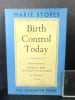
Birth Control Today. A Practical Handbook [signed w/ ephemera]
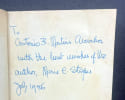
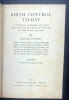
London: The Hogarth Press, 1954. Tenth edition, revised and brought up to date. Illustrated. 12.5 × 19 cm. [iii] leaves, 178 pp., [7] pp. An especially interesting signed presentation copy of Marie Stopes's influential handbook on contraception and family planning, personally inscribed by the author in blue ink: “To Antonio B. Martins Abranches, with the best wishes of the author, Marie C. Stopes. July 1956.” Accompanied by a printed “With Compliments” card from the C.B.C. and The Mother's Clinic, naming Marie C. Stopes as president and giving the organisation's address at 108 Whitfield Street, London, W.1. Also preserved is a fragment of the original envelope associated with the dedicatee. The combination of the personal inscription, the institutional compliments card, and the accompanying postal material provides a particularly appealing association with Stopes's own circle and with the organisation through which she disseminated her ideas. Marie Stopes occupies a complex and controversial position in the history of twentieth-century reproductive politics. A pioneering campaigner for access to contraceptive information and the founder of one of Britain's earliest birth-control clinics, she was instrumental in bringing subjects previously regarded as private, improper, or taboo into public and medical discussion. Her work helped establish contraception as an increasingly mainstream subject of scientific, social, and public-health debate. Yet her advocacy was also deeply intertwined with the eugenics movement. Stopes supported selective reproduction and established the Society for Constructive Birth Control and Racial Progress in 1921, linking reproductive control to contemporary theories of hereditary improvement and social reform. Rather than representing a straightforward abandonment of eugenics in favour of modern family planning, her career illustrates the considerable ideological overlap between these movements during the first half of the twentieth century. Indeed, the title page of this 1954 edition still identifies her as founder and president of the Society C.B.C. and Racial Progress. First published in 1934, Birth Control To-day was conceived as a practical guide for general readers. Its chapters discuss reproductive anatomy, domestic and clinical contraceptive methods, male contraception, ineffective or dangerous practices, comparative costs, and the role of specialist clinics and public authorities. The text is supplemented by anatomical illustrations and diagrams. The book also documents the gradual transition of birth control from a controversial social cause into a more widely accepted component of reproductive healthcare, while retaining traces of the eugenic assumptions that shaped part of its early institutional development. A notable association copy, signed only two years before Stopes's death in 1958, and accompanied by printed ephemera directly connected with her London clinic and birth-control organisation. Condition: Original blue printed wrappers, with some age-related spotting, light soiling, and minor edge wear. Interior generally clean and well preserved, with occasional signs of handling. Manuscript inscription clearly legible. The accompanying compliments card is preserved separately, together with the envelope fragment.
An attractive and historically significant signed copy, of particular interest to collectors of the history of medicine, women's history, contraception, reproductive rights, eugenics, social reform, and twentieth-century British intellectual history.
Married Love: A New Contribution to the Solution of Sex Difficulties [Hardcover]
PHOTOS SUR DEMANDE
Merci de nous contacter à l'avance si vous souhaitez consulter une référence dans notre boutique à Authon-du-Perche.

