 Write to the booksellers
217 books for « soren kierkegaard »Edit
-
Language
English (1)
French (216)
-
Century
19th (53)
20th (73)
21st (5)
-
Countries
Belgium (17)
Canada (1)
Denmark (57)
France (109)
Germany (1)
Switzerland (32)
-
Syndicate
ALAC (1)
ILAB (96)
NVVA (1)
SLACES (1)
SLAM (35)
Topics
- Aesthetics (1)
- Biblical studies (1)
- Christ (the) (1)
- Christianity (3)
- Constantius constantin (1)
- Death (1)
- Denmark (1)
- Diseases (1)
- Ethic (1)
- Exegesis (1)
- Existentialism (3)
- History (2)
- Japan (4)
- Kierkégaard (202)
- Marriage (1)
- Metaphysics (2)
- Newspaper (1)
- Newspapers press (1)
- Philosophy (6)
- Religions (10)
- Review (4)
- Speeches (1)
- Theology (3)
A collection of 40 books about Søren Kierkegaard's life and writings.
Bound in 50 volumes of which most are in original wrappers. Generally in good condition.
Contains works by Paul V. Rubow, Peter P. Rohde, Carl Jørgensen, Paul Müller, Frithiof Brandt, Hjalmar Helweg et al.

Soren Kierkegaard, Jacques Lafarge (Préface) ...
Reference : RO20267945
(2004)
ISBN : 2743612827
La dialectique de la communication ethique et ethico religieuse - Petite bibliotheque N°470
RIVAGES POCHE/ PETITE BIBLIOTHEQUE N°470. 2004. In-12. Broché. Bon état, Couv. convenable, Dos satisfaisant, Intérieur frais. 91 pages. . . . Classification Dewey : 100-PHILOSOPHIE ET DISCIPLINES CONNEXES
Soren Kierkegaard, Jacques Lafarge (Préface), Paul-Henri Tisseau + Else-Marie Jacquet-Tisseau (Traduction) Classification Dewey : 100-PHILOSOPHIE ET DISCIPLINES CONNEXES

L’éternité dans le tempsSix discours présentés par Flemming Fleinert
Les bergers et les mages 2000
LA MALADIE A LA MORTLe concept du desespoir ( traduit du danois par P.H.Tisseau ) Exposé Psychologique et Chrétien pour l'édification et le renouvellement spirituel par Anti-Climacus
Broché - 14 x 22 - 124 pp - sans date - Editions chez le Traducteur Bazoges en Pareds Vendée -
ANTHROLOGIE HISTOIR PHILOSOPHIE LITTERATURE PARADES
Der Begriff Angst Vorworte
Güttersloher Verlaghaus broché Couverture Illustrée 1983 280 pages en format -12
Très Bon État
Post-scriptum aux miettes philosophiques
Gallimard (30 juin 2002)
Livre à l'état de neuf, très frais sans annotations ni défauts dissmulés.
DIARIO DE UN SEDUCTOR, TEMOR Y TREMBLOR
EDICIONES GUADARRAMA. 1976. In-12. Broché. Etat d'usage, Couv. légèrement passée, Dos plié, Intérieur frais. 394 pages. Premier plat illustré en couleurs. Texte en espagnol. Couverture plastifiée.. . . . Classification Dewey : 830-Littératures des langues germaniques
Traduit du danois par Demetrio Gutierrez Riviero. Classification Dewey : 830-Littératures des langues germaniques
Traité du désespoir
Folio essais. 1995. In-12. Broché. Bon état, Couv. convenable, Dos satisfaisant, Intérieur frais. 251 pages.. . . . Classification Dewey : 100-PHILOSOPHIE ET DISCIPLINES CONNEXES
Classification Dewey : 100-PHILOSOPHIE ET DISCIPLINES CONNEXES
OBLIQUES-KIERKEGAARD
208 PAGES-21 CM X 27 CM-LIRE KIERKEGAARD-ANGOISSE, PARADOXE, IRONIE, LIBERTE-THEOLOGIES, IDEOLOGIES, PHILOSOPHIES-TEXTES-LEGERES ROUSSEURS EN COUVERTURE-(E1025)
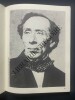
BORDERIE COUVERTURE SOUPLE ETAT TRES BON
L'alternative (deuxième Partie). La Valeur esthétique du Mariage ... Traduction par P.-H Tisseau.
Chez le traducteur 1940. Bon in-8 broché, couverture d'éditeur, in-8, II + 313 pages avec présentation.
L'instant
ed. Tisseau 1948 - pages non coupées , papier fragile de l'époque un peu jauni mais ensemble bien conservé quand même - écriture au bic p1 -
philosophie, c'est notre spécialité, n'hésitez pas à demander des titres
LA REPETITION
ESSAI D'EXPERIENCE PSYCHOLOGIQUE PAR CONSTANTIN CONSTANTIUS-TRADUIT DU DANOIS PAR P.-H.TISSEAU-118 PAGES FORMAT IN 8-(6E)
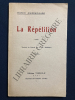
TISSEAU-BAZOGES-EN-PAREDS (VENDEE) COUVERTURE SOUPLE ETAT COMME NEUF
Af en endnu Levendes Papirer. Udgivet mod hans Villie. - [KIERKEGAARD'S FIRST BOOK]
Kjøbenhavn, 1838. Ubeskåret, i et senere blankt omslag. Gennemgående skjold i øverste venstre hjørne, overvejende ganske svagt. Første og sidste blade mest påvirkede. X, 79pp.
Originaludgaven af Kierkegaards debut, -værket i hvilket han skarpt kritiserer H.C. Andersen, og i hvilket inspirationen fra Poul Martin Møller (til hvem han dedikerede værket ""Begrebet Angest"" - den eneste uden for familien, der er blevet beæret med en trykt dedikation af Kierkegaard) formenlig er tydeligst at spore. Den specielle titel kan med en vis rimelighed siges at hentyde til en villet videreførelse af den beundrede og på tidspunktet for udgivelsen netop afdøde Poul Martin Møllers nærmest upublicerede produktion. Den ""endnu Levende"" skulle således være ""Danmarks Gæde i Glæden over Danmark"", ""Mindet i den danske Sommer"", Poul Martin Møller, den mand, der ved sin person har inspireret Kierkegaard mere end nogen anden. Himmelstrup 6.Uncut in a very nice later halfleatherbdg. of dark red morocco w. green marbled paper and dark red gilt leather-title-label on front board. Gilt lines to back. (Oscar Jacobsen). Some brownspotting. X + 79pp.First edition of Kierkegaard's first work" -the work in which he sharply critisizes Hans Christian Andersen and ridicules the genre of fairy tales in general.
Atten opbyggelige Taler.
K., 1843-1845. 8vo. Smukt lidt senere hldrbd.m. rig rygforgyldn., ophøjet ""bind"", dannet af heftesnoren. 2. blad (indhold) repareret. Pp 1-50 m. svagt skjold for neden, ellers pæn. (Iv)+52+62+84+59+70+111pp.
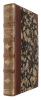
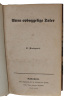
Originaludgave. Himmelstrup 85.First edition of Kierkegaard's important eighteen upbuilding discourses, which comprise his two, three, and four upbuilding discourses from the years 1843-45, with the joint title-page of all eighteen. The work constitutes Kierkegaard's religious works, which supplement his theological and philosophical ones.The first upbuilding discourses were published the same year as Either-Or, and it is interesting to note that in opposition to his major philosophical works, the religious upbuilding discourses actually bear the name of the author on the title-page, -a fact that was by no means incidental. While the pseudonymous works could make one doubt the religiousness of the author, the parallelly written religious discourses stress the fact that we are dealing with an author, who was religious from the very beginning, -a fact that Kierkegaard also wished to establish himself"" in his journals he clearly states that the religious discourses bear as much significance for his work as a whole as do the larger pseudonymous works, ""I began with ""Either-Or"" and two upbuilding discourses..."" he says, and explains that he intended the upbuilding, the religious, to advance, and that he wanted to show ""that the writer was not an aesthetic author who in the course of time grew older and for that reason became religious"" (Journals, IX A 227).The importance of the upbuilding discourses and the close relationship they have with the major works and Kierkegaard's philosophical development also becomes evident with the fact that every pseudonymous work was accompanied by a little collection of ""upbuilding discourses"" until ""Concluding Postscript"" appeared.
Atten opbyggelige Taler.
Kjøbenhavn [Copenhagen], P. G. Philipsens Forlag, 1843-1845. 8vo. Bound uncut in a recent pastiche cardboardbinding, imitating the original brown cardboard binding, in which it was issued. Printed pastice paper label to spine. Some brownspotting as always, due to the paper quality. (4), 52, 62, 84, 59 (recte 57 pp., i.e. without the blank leaf between the title-page and the preface), 70, 111 pp. Complete with all the titles and the joint title-page (without the blank leaf after the preface of ""To opbyggelige Taler, 1844"" - which is not called for and hardly ever present).
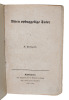
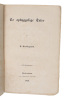
First edition of Kierkegaard's important eighteen upbuilding discourses, which comprise his two, three, and four upbuilding discourses from the years 1843-45, with the joint title-page of all eighteen. The work constitutes Kierkegaard's religious works, which supplement his theological and philosophical ones.The first upbuilding discourses were published the same year as Either-Or, and it is interesting to note that in opposition to his major philosophical works, the religious upbuilding discourses actually bear the name of the author on the title-page, a fact that was by no means incidental. While the pseudonymous works could make one doubt the religiousness of the author, the parallelly written religious discourses stress the fact that we are dealing with an author, who was religious from the very beginning, a fact that Kierkegaard also wished to establish himself"" in his journals he clearly states that the religious discourses bear as much significance for his work as a whole as do the larger pseudonymous works, ""I began with ""Either-Or"" and two upbuilding discourses..."" he says, and explains that he intended the upbuilding, the religious, to advance, and that he wanted to show ""that the writer was not an esthetic author who in the course of time grew older and for that reason became religious"" (Journals, IX A 227).The importance of the upbuilding discourses and the close relationship they have with the major works and Kierkegaard's philosophical development also becomes evident with the fact that every pseudonymous work was accompanied by a little collection of ""upbuilding discourses"" until ""Concluding Postscript"" appeared.Himmelstrup 85.
Enten – Eller. Et Livs=Fragment udgivet af Victor Eremita. Anden Udgave. Første Deel, indeholdende A.’s Papirer + Anden Deel, indeholdende B.’s Papirer, Breve til A.
Kjøbenhavn, Reitzel, 1849. 8vo. In contemporary half calf. Spine with wear and scratches. Back hinge partly split. Previous owner's name ""P. O. Bugge / 1852"". First and last leaves slightly browned, otherwise internally nice and clean. XIV, (2), 320" (4), 250 pp + final blank.
Second edition of Kierkegaard’s Either-Or, his magnum opus, widely regarded as a foundational work of existentialism and among the most celebrated writings of the greatest Scandinavian philosopher. Kierkegaard is “now generally considered to be, however eccentric, one of the most important Christian philosophers” (PMM 314). Kierkegaard's monumental magnum opus seminally influenced later as well as contemporary philosophy and ranks as one of the most important works of philosophy of modern times. Either-Or is the earliest of Kierkegaard’s major works and the work with which he begins his pseudonymous authorship. Kierkegaard’s pseudonymity is an entire subject unto its own. The various cover names he uses play a significant role in his way of communicating and are essential to the understanding of his philosophical and religious messages. And it all properly begins here, with his groundbreaking magnum opus. Conjuring up two distinctive figures with diverging beliefs and modes of life – the aesthetic “A” of Part One, and the ethical B (note that this is the first “pseudonym” that Kierkegaard uses, in his earliest articles – no. I above)/Judge Vilhelm of Part Two, Kierkegaard presents us with the most basic reflections on the search for a meaningful existence, seen from two completely different philosophical views. This masterpiece of duality explores the foundational conflict between the ethical and the aesthetical, providing us along the way with the now so famous contemplations on music (Mozart), drama, boredom, pleasures, virtues, and, probably most famously, seduction (and rejection – The Seducer’s Diary). It is primarily Judge Vilhelm from Part Two of Either-Or that has bestowed upon Kierkegaard the reputation as the Father of Existentialism. His emphasis on taking ownership of oneself and the importance of making choices has made him the (first) personification of Existentialism and the idea that one does not passively develop into the self that he or she should be or ought to become. Kierkegaard went to great lengths to ensure that the public would not know the identity of the author was of Either-Or. He even had the draft of the work done by several hands, so that employees at the printer’s would also be deceived. Despite his efforts, however, it did not take long for the public to guess that Kierkegaard had written this astounding work. But Kierkegaard himself kept up the façade and did not accept authorship until several years later. Nothing Kierkegaard did was left to chance, which his carefully chosen pseudonyms also reflect. This also spills over in his presentation-inscriptions, which follow as strict a pattern as the pseudonyms themselves – he never signed himself the author, if his Christian name was not listed as the author on the title-page. And seeing that he had not accepted authorship of Either-Or and is not mentioned by name anywhere on the title-page (also not as the editor nor publisher as with the other pseudonymous works), he was not able to give away copies of his magnum opus, which is why no presentation-copy of the first edition exists. The appearance of the second edition of this monumental work was, naturally, carefully planned. Either-Or first appeared in 1843, and due to the great demand for the work, which had originally only been printed in ca 525 copies, it had quickly been sold out but Kierkegaard refused to have it reprinted. In 1849, finally, he decided to let it appear again, in a textually unchanged version. When the second edition appeared (recte second issue), Kierkegaard had meanwhile owned up to the authorship of Either-Or. He had done so in 1846, in his Concluding Unscientific Postscript to The Philosophical Fragments (own translation): “For the sake of manners and etiquette I hereby acknowledge, what can hardly in reality be of interest to anybody to know, that I am, as one says, the author of Either-Or (Victor Eremita), Copenhagen in February 1843...”. Now, finally, Kierkegaard could give away his magnum opus! In his Papers from 1849, Kierkegaard states (own translation): “The poets here at home each received a copy of Either-Or. I thought it my duty and now I was able to do it because now one cannot reasonably claim that a conspiracy is made concerning the book. -because the book is now old and its crisis over. Of course they were given the copy from Victor Eremita...” (Pap., X1A 402). Naturally, because “as little as I in Either-Or is the Seductor or the Assessor, as little am I the publisher Victor Eremita, exactly as little he is a poetically-real subjective thinker, as he is also found in “in vino veritas.” “ (the postscript to the Postscript, 1846) Either-Or is now not only the title of Kierkegaard’s most famous and widely read work, it is also a phrase that summarizes much of the thinking for which he is best known and a cornerstone of what we now characterize as Existentialism. The first edition caused a sensation. The second issue (termed “edition”, although it is textually unaltered) is not only the first edition of the work to appear after Kierkegaard had acknowledged authorship of it and thus also confirmed being one and the same with his most famous pseudonym, it is also the first of Kierkegaard’s works to appear in a second edition or issue. The second edition of the work is thus also of the utmost importance and is one of the only important second editions of any of Kierkegaard’s works. PMM: 314 Himmelstrup 21
Forførerens Dagbog. Med et indledende Forord af Hans Brix.
København, Christians=Pressens Forlag, 1919. Ubeskåret i orig. helldrbd. med blindtryk på ryg og permer. 163 pp. Kobberstukket titelvignet of kobberstukket portræt af Søren Kierkegaard, stukket af Knud Hendriksen, trykt af kobbertrykker Johan Beck. Trykt på Van Gelder Zonen papir.Nr. 71 af 325 eksemplarer.

