 Write to the booksellers
3895 books for « smith g m »Edit
-
Type
Book (3840)
Disk (5)
Engraving (1)
Maps (2)
Music sheets (38)
New book (3)
Photographs (6)
-
Latest
Last 24h (5)
Last 3 days (4)
Last month (37)
Last week (2)
-
Language
Dutch (2)
English (52)
French (3832)
Italian (1)
Russian (7)
Spanish (1)
-
Century
16th (9)
17th (9)
18th (50)
19th (206)
20th (1748)
21st (542)
-
Countries
Belgium (185)
Brazil (1)
Canada (24)
China (10)
Côte d'Ivoire (4)
Denmark (73)
France (3214)
Germany (2)
Greece (8)
Netherlands (11)
Switzerland (343)
United Kingdom (13)
United States of America (7)
-
Syndicate
ALAC (20)
CLAM (16)
CLAQ (5)
CNE (4)
ILAB (1806)
NVVA (39)
SLACES (36)
SLAM (1623)
SNCAO (5)
Topics
- Adam (65)
- Africa (19)
- Animals (15)
- Arabic (13)
- Archaeology (23)
- Architecture (47)
- Atlas (21)
- Biography (21)
- Biology (9)
- Botany (25)
- Bradley (53)
- Children’s books (64)
- China (10)
- China (15)
- Christianity (11)
- Cinema (9)
- Comic strip (26)
- Cooking (30)
- Culinary art (12)
- Decoration (11)
- Detective novels (22)
- Dictionaries (23)
- Drama (9)
- Drawings (17)
- Early printed books (12)
- Earth (9)
- Economics (16)
- Economics (59)
- Egypt (12)
- Egyptology (9)
- England (23)
- English (162)
- Entomology (49)
- Ethic (11)
- Ethnology (9)
- Europe (10)
- Fantastic (35)
- Fine arts (40)
- First edition (51)
- Flora (26)
- Gastronomy (15)
- Geography (17)
- Germanic languages (9)
- Guide books (13)
- History (130)
- Holland (16)
- Industrial arts & crafts - fine arts (22)
- Islam muslim (9)
- Japan (9)
- Jazz (27)
- Law (19)
- Literature (339)
- Lovatt smith lisa (11)
- Lucie-smith edward (28)
- Medicine (24)
- Middle east (12)
- Mitchell margaret (20)
- Music (9)
- Navy (26)
- Painters (15)
- Painting (20)
- Palaeontology (13)
- Paris (13)
- Philosophy (38)
- Photography (45)
- Policy (21)
- Religions (20)
- Reptiles (9)
- Rock (25)
- Rock (25)
- Russia (10)
- Ruth (10)
- Science fiction (28)
- Sciences (28)
- Scores (49)
- Shelley (25)
- Smith adam (22)
- Smith anthony (15)
- Smith betty (12)
- Smith hedrick (18)
- Smith sydney (16)
- Smith thorne (13)
- Smith william (43)
- Songs (37)
- Sports (8)
- Spying (12)
- Tea (18)
- Theology (11)
- Translation (23)
- Travel (25)
- United kingdom (21)
- United states (16)
- Ussr (18)
- Various (26)
- Venice (10)
- War (34)
- Woodham-smith cecil (9)
- Youth (18)
- Zoology (19)
Untersuchung der Natur und Ursachen von Nationalreichthümern, Aus dem Englischen. 2 Bände. - [THE SEMINAL FIRST TRANSLATION OF 'WEALTH OF NATIONS']
Leipzig, Weidmann, 1776-78. 8vo. Bound in two nice uniform contemporary half calf bindings with five raised bands and gilt lettering to spine. Ex-libris pasted on to pasted down front free end-papers and a small embossed stamp to front free end paper on volume 1 (""Buchhändler u. Antiquar Carl Helf""). Stamp to p. 1 of both volumes. Spines with light soiling and capital on volume 1 lacking a small part of the leather. A few light brown spots throught. A fine set. VIII, 632 pp"" XII, 740 pp.
First German edition, also being the very first overall translation, of Adam Smith's ground-breaking main work, the ""Inquiry into the Nature and Causes of the Wealth of Nations"". This seminal first translation of the work was undertaken by J.F. Schiller, who finished the first part of the translation in time for it to appear as soon as 1776, the same year as the original English edition. The second part appeared in 1778, the same year as the exceedingly scarce first French translation. This first German translation has been of the utmost importance to the spreading of Smith's ideas throughout Europe, and, after the true first, this must count as the most important edition of the work.""The influence of the Wealth of Nations [...] in Germany [...] was so great that 'the whole of political economy might be divided into two parts - before and since Adam Smith"" the first part being a prelude, and the second a sequel."" (Backhouse, Roger E., The Methodology of Economics: Nineteenth-Century British Contributions, Routledge, 1997.)""The first review of the translation, which appeared in the Göttingische gelehrte Anzeigen for March 10, 1777, by J. G. H. Feder, professor of Philosophy at the University of Göttingen, was very favorable. In the words of the reviewer: ""It is a classic"" very estimable both for its thorough, not too limited, often far-sighted political philosophy, and for the numerous, frequently discursive historical notes,"" but the exposition suffers from too much repetition."" (Lai, Cheng-chung. Adam Smith Across Nations: Translations and Receptions of The Wealth of Nations, Clarendon Press, UK, 2000).Until 1797, [...], the work of Adam Smith received scant attention in Germany. While Frederick II was living, Cameralism held undisputed sway in Prussia, and the economic change which began with the outbreak of the French Revolution had still not gained sufficient momentum to awake the economic theorists from their dogmatic slumber."" (Lai, Cheng-chung. Adam Smith Across Nations: Translations and Receptions of The Wealth of Nations, Clarendon Press, UK, 2000).Various German economist read the german translations and was inspired by it.""Christian Garve, [...], must be considered as among the important contributors to the spread of Smith's views. Himself a popularizer of philosophical doctrines, he was early attracted by the Scotch writers and became one of their foremost exponents in Germany."" In 1791 Garve began a second translation of the Smith's work and in the introduction to the the translation he wrote: ""It (Smith's work) attracted me as only few books have in the course of my studies through the number of new views which it gave me not only concerning the actual abject of his investigations, but concerning all related material from the philosophy of civil and social life"". Georg Sartorius, August Ferdinand Lueder and, perhaps the most important economist of the period, Christian Jacob Kraus, were all important figures in the spread of Smith's thought. ""The most significant of Kraus' works and that also which shows his conception of economic science most clearly is the five-volume work entitled State Economy. The first four volumes of this work are little more than a free paraphrase of the Wealth of Nations"". Kraus was: ""to a large extent responsible for the economic changes which took place in Prussia after 1807, in so far as they can be ascribed to Smithan influence."" (Lai, Cheng-chung. Adam Smith Across Nations: Translations and Receptions of The Wealth of Nations, Clarendon Press, UK, 2000).Kraus wrote of the present volume: ""[T]he world has seen no more important book than that of Adam Smith.... [C]ertainly since the times of the New Testament no writing has had more beneficial results than this will have.... [Smith's doctrines form] the only true, great, beautiful, just and beneficial system."" (Fleischacker, Samuel , A Third Concept of Liberty, Princeton University Press, 1999.)_____________Hailed as the ""first and greatest classic of modern thought"" (PMM 221), Adam Smith's tremendously influential main work has had a profound impact on thought and politics, and is considered the main foundation of the era of liberal free trade that dominated the nineteenth century. Adam Smith (1723-1790) is considered the founder of Political Economy in Britain, mainly due to his groundbreaking work, the ""Wealth of Nations"" from 1776. The work took him 12 years to write and was probably in contemplation 12 years before that. It was originally published in two volumes in 4to, and was published later the same year in Dublin in three volumes in 8vo. The book sold well, and the first edition, the number of which is unknown, sold out within six months, which came as a surprise to the publisher, and probably also to Smith himself, partly because the work ""requires much thought and reflection (qualities that do not abound among modern readers) to peruse to any purpose."" (Letter from David Hume, In: Rae, Life of Adam Smith, 1895, p. 286), partly because it was hardly reviewed or noticed by magazines or annuals. In spite of this, it did evoke immense interest in the learned and the political world, and Buckle's words that the work is ""in its ultimate results probably the most important book that has ever been written"", and that it has ""done more towards the happiness of man than has been effected by the united abilities of all the statesmen and legislators of whom history has preserved an authentic account"" (History of Civilisation, 1869, I:214) well describes the opinion of a great part of important thinkers then as well as now. Kress S. 2567Goldsmith 11394Menger 521Not in Einaudi
Untersuchung der Natur und Ursachen von Nationalreichthümern, Aus dem Englischen. 2 Bände. - [THE SEMINAL FIRST TRANSLATION OF 'WEALTH OF NATIONS']
Leipzig, Weidmann, 1776-78. 8vo. Bound in two nice uniform contemporary half calf bindings with five raised bands, black title-label and gilt lettering to spine. Small paper-label to upper compartment (Catalogue-number from an estate-library). Light wear to extremities, otherwise a very nice set. VIII, 632 pp" XII, 740 pp.
First German edition, also being the very first overall translation, of Adam Smith's ground-breaking main work, the ""Inquiry into the Nature and Causes of the Wealth of Nations"". This seminal first translation of the work was undertaken by J.F. Schiller, who finished the first part of the translation in time for it to appear as soon as 1776, the same year as the original English edition. The second part appeared in 1778, the same year as the exceedingly scarce first French translation. This first German translation has been of the utmost importance to the spreading of Smith's ideas throughout Europe, and, after the true first, this must count as the most important edition of the work.""The influence of the Wealth of Nations [...] in Germany [...] was so great that 'the whole of political economy might be divided into two parts - before and since Adam Smith"" the first part being a prelude, and the second a sequel."" (Backhouse, Roger E., The Methodology of Economics: Nineteenth-Century British Contributions, Routledge, 1997.)""The first review of the translation, which appeared in the Göttingische gelehrte Anzeigen for March 10, 1777, by J. G. H. Feder, professor of Philosophy at the University of Göttingen, was very favorable. In the words of the reviewer: ""It is a classic"" very estimable both for its thorough, not too limited, often far-sighted political philosophy, and for the numerous, frequently discursive historical notes,"" but the exposition suffers from too much repetition."" (Lai, Cheng-chung. Adam Smith Across Nations: Translations and Receptions of The Wealth of Nations, Clarendon Press, UK, 2000).Until 1797, [...], the work of Adam Smith received scant attention in Germany. While Frederick II was living, Cameralism held undisputed sway in Prussia, and the economic change which began with the outbreak of the French Revolution had still not gained sufficient momentum to awake the economic theorists from their dogmatic slumber."" (Lai, Cheng-chung. Adam Smith Across Nations: Translations and Receptions of The Wealth of Nations, Clarendon Press, UK, 2000).Various German economist read the german translations and was inspired by it.""Christian Garve, [...], must be considered as among the important contributors to the spread of Smith's views. Himself a popularizer of philosophical doctrines, he was early attracted by the Scotch writers and became one of their foremost exponents in Germany."" In 1791 Garve began a second translation of the Smith's work and in the introduction to the the translation he wrote: ""It (Smith's work) attracted me as only few books have in the course of my studies through the number of new views which it gave me not only concerning the actual abject of his investigations, but concerning all related material from the philosophy of civil and social life"". Georg Sartorius, August Ferdinand Lueder and, perhaps the most important economist of the period, Christian Jacob Kraus, were all important figures in the spread of Smith's thought. ""The most significant of Kraus' works and that also which shows his conception of economic science most clearly is the five-volume work entitled State Economy. The first four volumes of this work are little more than a free paraphrase of the Wealth of Nations"". Kraus was: ""to a large extent responsible for the economic changes which took place in Prussia after 1807, in so far as they can be ascribed to Smithan influence."" (Lai, Cheng-chung. Adam Smith Across Nations: Translations and Receptions of The Wealth of Nations, Clarendon Press, UK, 2000).Kraus wrote of the present volume: ""[T]he world has seen no more important book than that of Adam Smith.... [C]ertainly since the times of the New Testament no writing has had more beneficial results than this will have.... [Smith's doctrines form] the only true, great, beautiful, just and beneficial system."" (Fleischacker, Samuel , A Third Concept of Liberty, Princeton University Press, 1999.)_____________Hailed as the ""first and greatest classic of modern thought"" (PMM 221), Adam Smith's tremendously influential main work has had a profound impact on thought and politics, and is considered the main foundation of the era of liberal free trade that dominated the nineteenth century. Adam Smith (1723-1790) is considered the founder of Political Economy in Britain, mainly due to his groundbreaking work, the ""Wealth of Nations"" from 1776. The work took him 12 years to write and was probably in contemplation 12 years before that. It was originally published in two volumes in 4to, and was published later the same year in Dublin in three volumes in 8vo. The book sold well, and the first edition, the number of which is unknown, sold out within six months, which came as a surprise to the publisher, and probably also to Smith himself, partly because the work ""requires much thought and reflection (qualities that do not abound among modern readers) to peruse to any purpose."" (Letter from David Hume, In: Rae, Life of Adam Smith, 1895, p. 286), partly because it was hardly reviewed or noticed by magazines or annuals. In spite of this, it did evoke immense interest in the learned and the political world, and Buckle's words that the work is ""in its ultimate results probably the most important book that has ever been written"", and that it has ""done more towards the happiness of man than has been effected by the united abilities of all the statesmen and legislators of whom history has preserved an authentic account"" (History of Civilisation, 1869, I:214) well describes the opinion of a great part of important thinkers then as well as now. Kress S. 2567Goldsmith 11394Menger 521Not in Einaudi
Undersøgelse om National-Velstands Natur og Aarsag. Af det Engelske oversat og med nogle Anmærkninger oplyst af Dræbye. 2 Deele. [Anden Deel:] Hertil er føiet Gourvenør Pownals Brev til Forfatteren i hvilket nogle af de i dette Værk fremsatte Læresætn... - [FIRST DANISH EDITION OF ""THE WEALTH OF NATIONS""]
Kiøbenhavn [Copenhagen], 1779-80. 8vo. Two very nice contemporary brown half calf bindings with raised bands, gilt ornamentations and gilt leather title- and tome-labels. Volume two with a bit of wear to upper capital. Corners slightly bumped. Pencil annotations to verso of title-page in volume one" title-page in volume two mounted to cover up a small hole caused by the removal of an old owner's name. Internally very clean and bright. All in all a very nice, clean, fresh, and tight copy. Engraved (by Weise, 1784) armorial book plate to inside of front boards (Gregorius Christianus Comes ab Haxthausen). (12), 575" (8), 775, (3, - errata) pp.
The extremely scarce first Danish edition of Adam Smith's seminal main work, ""the first and greatest classic of modern economic thought"" (PMM 221), the main foundational work of the era of liberal free trade. This publication constitutes the first Danish work worth mentioning in the history of economic thought - in spite of the great interest in political economy that dominated Danish political thought in the last quarter of the 18th century. The value of Smith's work was not immediately recognized in Denmark at the time of its appearance and a quarter of a century had to go by for its importance to be acknowledged and for Danish political economy to adapt the revolutionizing theories of Adam Smith. Few copies of the translation were published and sold, and the book is now a great scarcity. As opposed to for instance the German translation of the work, Smith concerned himself a great deal with this Danish translation. As is evident from preserved correspondence about it, he reacted passionately to it and was deeply concerned with the reaction to his work in Scandinavia (see ""Correspondence of Adam Smith"", Oxford University Press, 1977).- As an example, Smith writes in a letter to Andreas Holt on Oct. 26th, 1780: ""It gives me the greatest pleasure to hear that Mr. Dreby has done me the distinguished honour of translating my Book into the Danish language. I beg you will present to him my most sincere thanks and most respectful Compliments. I am much concerned that I cannot have the pleasure of reading it in his translation, as I am so unfortunate as not to understand the Danish language."" The translation was made by Frants Dræby (1740-1814), the son a whiskey distiller in Copenhagen, who mastered as a theologian and was then hired by the great Norwegian merchant James Collett as tutor to his son. There can be no doubt that Dræbye's relation to the Collett house had a great impact upon his interest in economics. In the middle of the 1770'ies, Dræbye accompanied Collett's son on travels throughout Europe, which took them to England in the year 1776, the same year that the ""Wealth of Nations"" was published for the first time. Through the Colletts, Dræbye was introduced to the mercantile environment in England and here became thoroughly acquainted with English economics and politics at the time. It is presumably here that he gets acquainted with Adam Smith's freshly published revolutionary work. When Dræbye returned to Denmark at the end of 1776, he was appointed chief of the Norwegian secretariat of the Board of Economics and Trade. He began the translation of the ""Wealth of Nations"" that he brought back with him from England immediately after his return.""WN [i.e. Wealth of Nations] was translated into Danish by Frants Dræbye and published in 1779 (three years after the first English edition). The translation was initiated by Andreas Holt and Peter Anker, who were acquainted with Smith. Dræbye was a Dane who lived mainly in Norway, reflecting the fact that Norway was much more British-oriented than Denmark proper (Denmark and Norway were united until 1814, when Sweden took Norway away from the Danes"" in 1905 Norway became an independent state). Norwegian merchants lived from exporting timber to Britain and tended on the whole to be adherents of a liberal economic policy, whereas the absolutist government in Copenhagen was more German-oriented and had economic views similar to those in contemporary Prussia."" (Cheng-chung Lai (edt.): ""Adam Smith Across Nations"", p. (37)). The last quarter of the eighteenth century in Denmark was dominated by a lively discussion of monetary policy and the institutional framework best suited to realize that policy. There was a vital interest in questions of economic concern, and contemporary Danish sources refer to the period as ""this economic age"" and state things such as ""never was the world more economically minded"" (both from ""Denmark and Norway's Economic Magazine""). During this period, Smith's revolutionary ideas did not play a major role, however, and only at the beginning of the 19th century did Danish politicians and economists come to realize the meaning of Smith's views. ""Without exaggeration it can essentially be said that a quarter of a century was to pass from the time of the publication of the book in Denmark before Danish political economy fully made Adam Smith's theories and points of view its own. It took so long a time because the economic conditions as a whole in the years from 1780-1800 did not make desirable or necessary the changing of their concepts. That glorious commercial period had to pass before it was understood that we had altogether too little help in our own natural resources and that a different course was, therefore, necessary. Only when one had come so far could the new thinking find a nourishing soil so that it could develop strength with which to push aside the old ideas.""(Hans Degen: ""On the Danish Translation of Adam Smith and Contemporary Opinion Concerning It."" Translated by Henrietta M. Larson. In: Adam Smith Across Nations, p. 51). This first Danish translation is one of the very earliest translations of ""Wealth of Nations"""" it is only preceded by the German (1776-78) and the extremely scarce French (1778-79). As a comparison, the Italian translation does not appear until 1790-91, the Spanish 1792, the Swedish 1800-1804, the Russian 1802, etc.Adam Smith Across Nations: A4 - nr. 1. ""All five books were translated"" appears to be a complete translation. The long letter from Governor Pownall to Adam Smith (25 Sept. 1776) is added as the Appendix (vol. 2, pp. 683 ff.).""(PMM 221 - first edition)
Undersøgelse om National-Velstands Natur og Aarsag. Af det Engelske oversat og med nogle Anmærkninger oplyst af Dræbye. 2 Deele. [Anden Deel:] Hertil er føiet Gourvenør Pownals Brev til Forfatteren i hvilket nogle af de i dette Værk fremsatte Læresætn... - [FIRST DANISH EDITION OF ""THE WEALTH OF NATIONS""]
Kiøbenhavn [Copenhagen], 1779-80. 8vo. Two nice contemporary half calf bindings with four raised bands and gilt leather title label to spines. Volume one lacking one cm of upper part of spine. Volume two with a small tear to lower part of spine. Both volumes with light brown spotting throughout, however, mainly affecting first and last five leaves of both volumes. A fine set. (12), 575"" (8), 775, (3, - errata) pp.
![Undersøgelse om National-Velstands Natur og Aarsag. Af det Engelske oversat og med nogle Anmærkninger oplyst af Dræbye. 2 Deele. [Anden Deel:] Hertil ...](https://static.livre-rare-book.com/pictures/LLX/50523_1_thumb.jpg)
![Undersøgelse om National-Velstands Natur og Aarsag. Af det Engelske oversat og med nogle Anmærkninger oplyst af Dræbye. 2 Deele. [Anden Deel:] Hertil ...](https://static.livre-rare-book.com/pictures/LLX/50523_2_thumb.jpg)
![Undersøgelse om National-Velstands Natur og Aarsag. Af det Engelske oversat og med nogle Anmærkninger oplyst af Dræbye. 2 Deele. [Anden Deel:] Hertil ...](https://static.livre-rare-book.com/pictures/LLX/50523_3_thumb.jpg)
The extremely scarce first Danish edition of Adam Smith's seminal main work, ""the first and greatest classic of modern economic thought"" (PMM 221), the main foundational work of the era of liberal free trade. This publication constitutes the first Danish work worth mentioning in the history of economic thought - in spite of the great interest in political economy that dominated Danish political thought in the last quarter of the 18th century. The value of Smith's work was not immediately recognized in Denmark at the time of its appearance and a quarter of a century had to go by for its importance to be acknowledged and for Danish political economy to adapt the revolutionizing theories of Adam Smith. Few copies of the translation were published and sold, and the book is now a great scarcity. As opposed to for instance the German translation of the work, Smith concerned himself a great deal with this Danish translation. As is evident from preserved correspondence about it, he reacted passionately to it and was deeply concerned with the reaction to his work in Scandinavia (see ""Correspondence of Adam Smith"", Oxford University Press, 1977).- As an example, Smith writes in a letter to Andreas Holt on Oct. 26th, 1780: ""It gives me the greatest pleasure to hear that Mr. Dreby has done me the distinguished honour of translating my Book into the Danish language. I beg you will present to him my most sincere thanks and most respectful Compliments. I am much concerned that I cannot have the pleasure of reading it in his translation, as I am so unfortunate as not to understand the Danish language."" The translation was made by Frants Dræby (1740-1814), the son a whiskey distiller in Copenhagen, who mastered as a theologian and was then hired by the great Norwegian merchant James Collett as tutor to his son. There can be no doubt that Dræbye's relation to the Collett house had a great impact upon his interest in economics. In the middle of the 1770'ies, Dræbye accompanied Collett's son on travels throughout Europe, which took them to England in the year 1776, the same year that the ""Wealth of Nations"" was published for the first time. Through the Colletts, Dræbye was introduced to the mercantile environment in England and here became thoroughly acquainted with English economics and politics at the time. It is presumably here that he gets acquainted with Adam Smith's freshly published revolutionary work. When Dræbye returned to Denmark at the end of 1776, he was appointed chief of the Norwegian secretariat of the Board of Economics and Trade. He began the translation of the ""Wealth of Nations"" that he brought back with him from England immediately after his return.""WN [i.e. Wealth of Nations] was translated into Danish by Frants Dræbye and published in 1779 (three years after the first English edition). The translation was initiated by Andreas Holt and Peter Anker, who were acquainted with Smith. Dræbye was a Dane who lived mainly in Norway, reflecting the fact that Norway was much more British-oriented than Denmark proper (Denmark and Norway were united until 1814, when Sweden took Norway away from the Danes"" in 1905 Norway became an independent state). Norwegian merchants lived from exporting timber to Britain and tended on the whole to be adherents of a liberal economic policy, whereas the absolutist government in Copenhagen was more German-oriented and had economic views similar to those in contemporary Prussia."" (Cheng-chung Lai (edt.): ""Adam Smith Across Nations"", p. (37)). The last quarter of the eighteenth century in Denmark was dominated by a lively discussion of monetary policy and the institutional framework best suited to realize that policy. There was a vital interest in questions of economic concern, and contemporary Danish sources refer to the period as ""this economic age"" and state things such as ""never was the world more economically minded"" (both from ""Denmark and Norway's Economic Magazine""). During this period, Smith's revolutionary ideas did not play a major role, however, and only at the beginning of the 19th century did Danish politicians and economists come to realize the meaning of Smith's views. ""Without exaggeration it can essentially be said that a quarter of a century was to pass from the time of the publication of the book in Denmark before Danish political economy fully made Adam Smith's theories and points of view its own. It took so long a time because the economic conditions as a whole in the years from 1780-1800 did not make desirable or necessary the changing of their concepts. That glorious commercial period had to pass before it was understood that we had altogether too little help in our own natural resources and that a different course was, therefore, necessary. Only when one had come so far could the new thinking find a nourishing soil so that it could develop strength with which to push aside the old ideas.""(Hans Degen: ""On the Danish Translation of Adam Smith and Contemporary Opinion Concerning It."" Translated by Henrietta M. Larson. In: Adam Smith Across Nations, p. 51). This first Danish translation is one of the very earliest translations of ""Wealth of Nations"""" it is only preceded by the German (1776-78) and the extremely scarce French (1778-79). As a comparison, the Italian translation does not appear until 1790-91, the Spanish 1792, the Swedish 1800-1804, the Russian 1802, etc.Adam Smith Across Nations: A4 - nr. 1. ""All five books were translated"" appears to be a complete translation. The long letter from Governor Pownall to Adam Smith (25 Sept. 1776) is added as the Appendix (vol. 2, pp. 683 ff.).""
Recherches sur la Nature et les Causes de la Richesse des Nations. Traduit de l'Anglois de M. Smith [by Blavet]. 2 Tomes.
Londres, Pierre J. Duplain, 1788. 8vo, Two nice uniform contemporary full calf bindings with gilt spines. Some loss of leather to back hinge and lower capital of volume one and minor loos of leather to spine of volume two, all due to worming. Worming is not bad and does not affect anything but outer layer of small parts of the bindings. Apart from the worming a very nice, fresh and clean copy indeed. (8), IV, 503" (4), 496 pp. With both half-titles, the advertisment, both prefaces and the table of contents.
Rare early French translation of Adam Smith's political and economic classic, the ""Wealth of Nations"". Translated by Blavet. The present edition constitutes the third reprint of the second French translation. The second French translation was done by Blavet and is the first translation into French of which the translator and publisher are known. ""The reprint of Blavet's version appeared at Yverdon in 1781 in 6 volumes 12mo, and at Paris in the same year in 3 volumes 12mo, and again at London and Paris in 1788 in 2 volumes 8vo [the present edition], and revised and corrected, with Blavet's name as translator, at Paris An, ix (1800-01) in 4 volumes 8vo.He [Blavet] had no intention of publishing it until his friend M. Ameilhon happened to complain of scarcity of interesting articles for his Journal de l'Agriculture, du Commerce, des Arts et des Finances, which had just come under the control of the Mercantilist. It struck him that he might offer it to him which he did, with the explanation that it was far from perfect. It was accepted, and appeared in the issues of the Journal between January, 1779, and December 1780. He did not anticipate that it would go further. The edition of 1788 likewise appeared without his knowledge or consent, and was still more marred by errors than that of Yverdon"". (Lai, Cheng-chung. Adam Smith Across Nations: Translations and Receptions of The Wealth of Nations, Clarendon Press, UK, 2000). Hailed as the ""first and greatest classic of modern thought"" (PMM 221), Adam Smith's tremendously influential main work has had a profound impact on thought and politics, and is considered the main foundation of the era of liberal free trade that dominated the nineteenth century. Adam Smith (1723-1790) is considered the founder of Political Economy in Britain, mainly due to his groundbreaking work, the ""Wealth of Nations"" from 1776. The work took him 12 years to write and was probably in contemplation 12 years before that. It was originally published in two volumes in 4to, and was published later the same year in Dublin in three volumes in 8vo. The book sold well, and the first edition, the number of which is unknown, sold out within six months, which came as a surprise to the publisher, and probably also to Smith himself, partly because the work ""requires much thought and reflection (qualities that do not abound among modern readers) to peruse to any purpose."" (Letter from David Hume, In: Rae, Life of Adam Smith, 1895, p. 286), partly because it was hardly reviewed or noticed by magazines or annuals. In spite of this, it did evoke immense interest in the learned and the political world, and Buckle's words that the work is ""in its ultimate results probably the most important book that has ever been written"", and that it has ""done more towards the happiness of man than has been effected by the united abilities of all the statesmen and legislators of whom history has preserved an authentic account"" (History of Civilisation, 1869, I:214) well describes the opinion of a great part of important thinkers then as well as now. Considering the groundbreaking views presented in ""Wealth of Nations"", it comes as no surprise that the work was considered part of the revolutionary cultural development in France. As Adam Smith's friend, the Marquis of Lansdowne, said after quoting Smith's work: ""With respect to French principles, as they had been denominated, those principles had been exported from us to France, and could not be said to have originated among the population of the latter country."" (Quoted in: Rae, p. 291). The ideas of Adam Smith were often considered so dangerously closely connected with French ideas at the time that the term ""political economy"" almost became synonymous with questions concerning the constitution of governments. ""The French Revolution seems to have checked for a time the growing vogue of Smith's book and the advance of his principles in this country, just as it checked the progress of parliamentary and social reform, because it filled men's mind with a fear of change, with a suspicion of all novelty, with an unreasoning dislike of anything in the nature of general principle."" (Rae, p. 293). There can be no question that this seminal work greatly influenced French opinion at the time.
David Smith, A Centennial
, Guggenheim Museum, 2006 Hardcover with dusjacket, 447 pages, very richly illustrated with coloured illustrations, English text. ISBN 9780892073436.
Deemed the "foremost sculptor of his generation" by art critic Clement Greenberg, David Smith, who lived from 1906 to 1965, is about to be celebrated in his first retrospective since 1969--to be held at the Guggenheim Museum, New York, from February through May of 2006. David Smith: A Centennial features new photographs of nearly every selected sculpture--110 pieces dating from 1932 to 1965, including important examples from each period, many rarely seen in public. Essays from writers including David Anfam, Michael Brenson, Rosalind Krauss and Paul Hayes Tucker tackle key areas, such as Smith's relationship to the painters of the New York School, the dual development of his family life and series sculpture through the 1950s and 60s, and his use of the landscape outside his studio in formulating his late works. Perhaps most importantly, David Smith: A Centennial also features the most comprehensive research on Smith yet published, including a newly compiled and extended bibliography; a comprehensive exhibition history; a chronology; and an illustrated checklist tracking provenance, exhibition history, and bibliographic references for each featured sculpture, finally bringing scholarship on Smith to the level of that on other important American artists of his generation, such as Barnett Newman, Jackson Pollock and Mark Rothko. David Smith: A Centennial considers Smith's oeuvre as a totality, and offers readers the chance to understand the complexity of his aesthetic concerns as well as his impact on the course of American sculpture, and American art at large.
""Om Beskatning"" (+) ""Om Jordbrukets förfall i Europa, efter Romerska Väldets undergäng"" (+) ""Om Handelsbalancen"" (+) ""Om Jordbruks-systemet I en Rikshushållning, samt om Economisterne I Frankrike"" (+) ""Om Pappers-myntet I Norr-Amerika Kolonierne, före... - [""THE EARLIEST APPEARANCE IN SWEDISH OF A NUMBER OF TRANSLATIONS FROM ADAM SMITH""]
Stockholm, Henrik A. Nordström, 1797-1801. 8vo. Uncut, partly unopened in the original wrappers. In 22 volumes as issued. Last volume name written on title-page, otherwise an exceptionally fine, clean and untouched set rarely seen in this condition. (4),102 pp." (2),182 pp. (2),107 pp. (2),157,(1) pp. (2),176,(4) pp. (4),138,(2) pp. (2),205,(1) pp. + 1 folded table (2),188 pp (2),190 pp. (2),89,(4) pp. (4),135,(1) pp. (2),116,(1) pp. (2),157 pp. (2),120 pp. (2),151,(1 blank,10) pp. + 1 folded map (2),215 pp. + 1 folded table (2),131,(5) pp. (4),207 pp. (2),183,(1) pp. + 1 folded table (2),218 pp. (2),144,(4) pp." (6),449,(1) pp. + 5 folded plates.""Om Beskatning"", Part: 36, 37, 38:Pp. 145-177""Om Jordbrukets förfall i Europa, efter Romerska Väldets undergäng"", Part: 27, 28. Pp. 93-120""Om Handelsbalancen"", Part: 25,26. Pp. 92-114""Om Jordbruks-systemet I en Rikshushållning, samt om Economisterne I Frankrike"", Part: 25-26. Pp. 43-92""Om Pappers-myntet I Norr-Amerika Kolonierne, före Revolutionen"". Part: 27-28. Pp.57-62""Om Krono-jord"". Part: 29,30,31. Pp 139-146.""Theorien för statsskulder"". Part: 44, 45, 46, 47, 48, 49 & 50. Pp. 151-161.

First, however partial, translation of Adam Smith's Wealth of Nations in Swedish rarely seen in this condition, thus making it the very first opportunity for Swedish speakers to study Adam Smith. A more lengthy translation was made in 1909 - 1911 but to this day a full Swedish translation has not been made.""Von Schulzenheim [nobleman, physician, country squire and politician] also published shorter articles in the review 'Läsning I blandade ämnen', an organ of the opposition to the absolutist and obscurantist regime of Gustavus IV Adolphus. The editor of the review was count Georg Adlersparre, an army officer and a political writer who in 1809 was to become one of the prime-movers behind the dethronement of the king. Adlersparre to was an admirer of Adam Smith. In 1799-1800 he published in the 'Läsning' his own Swedish translation of several selections from Wealth of Nations. In some cases Adlersparre added footnotes, making it easier for the readers to apply Smith's ideas to Swedish conditions. Those translations, to the best of my knowledge, were the first ones of Wealth of Nations in Sweden. They were followed by translations of other parts of Wealth of Nations, published in 1800 amd 1808. This time the translator was Erik Erland Bodell, an official of the Swedish Customs and thus, if you like, a colleague of Adam Smith."" ( Cheng-chung, Adam Smith Across Nations). Despite the comparatively late translation into Swedish, it still had a profound influence, not on economists since they were well aware of the original work in English, but upon politics and public opinion in general: ""There are few things more striking to the modem student of the history of ideas in Sweden than the negative phenomenon that Sweden was almost entirely uninfluenced by this fact and thus remained almost unaffected by English economic thought during a period when its superiority was most evident. As far as I am acquainted with the Swedish economic discussion and our popular economic literature of the 1860's and 1870's, there is almost no trace of any influence from English writers. [...]Of Adam Smith we have still only one abbreviated translation of his famous work and that was published as late as during this century"" and, as far as I know, nothing of Ricardo's or Malthus' exists in Swedish, nor do any of the major economic works of J.S. Mill."" (Heckscher, A survey of economic thought in Sweden, 1875-1950).The journal was preceded by Adlersparre's ""Läsning för landtmän"" 1795-96. The content is a mixture of literature, agriculture, law, philosophy and politics. Apart from the many contributions by Swedish authors, ""Läsning i blandade ämnen"" also contains texts by Kant, Gibbon and De Lolme OCLC lists copies at Yale, Minnesota, and Texas.
Patti Smith: Before Easter After
, Rizzoli, 2024 Hardcover with dustjacket, 8-1/2 x 11-4/5, 287 pages. *As new. ISBN 9780847874088.
Hundreds of rarely seen images by legendary photographer Lynn Goldsmith offer an intimate portrait of rock ?n? roll icon Patti Smith during a transformative moment in her career. Images of Smith performing on stage combine with candid behind-the-scenes photographs and striking studio shoots to create a deeply personal look at the singer during her rise to fame. The photographs include Smith?s life-changing accident while on tour in 1977 and the aftermath, as well as closeup, empathetic portraits that reveal Smith?s self-assurance, her defiance of cultural norms, and her effortless poise. This poignant visual narrative is punctuated throughout by Smith?s original poetry and song lyrics. This book is both a glimpse into a fabled time in music history, documenting a young artist creating what turned out to be a revolutionary work, as well as a celebration of an enduring partnership between two close friends who continue to be creative collaborators to this day.
Before Easter After. Patti Smith. Art Edition No. 1-100 NYC, 1977 **Edition of 100 ** Collector's Edition ART A. NUMBERD No. 0058 - 1,500, each numbered and signed by Patti Smith and Lynn Goldsmith.
, Taschen, 2019 Edition of 100 ; Hardcover in clamshell box, 26.9 x 37.4 cm, 6.42 kg, 296 pages, numbered and signed by Patti Smith and Lynn Goldsmith; with the archival pigment print 'NYC, 1976' on Epson Legacy Baryta paper, 30.5 x 46 cm, signed by Goldsmith. ISBN 9783836573887.
An intimate visual survey of the unparalleled Patti Smith by Lynn Goldsmith, whose lens has immortalized a golden era of rock and roll history. With hundreds of unseen photographs and exclusive texts by Smith, this signed edition documents a transformative moment in the artist's career and celebrates two greats whose creative partnership continues to this day.
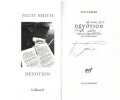
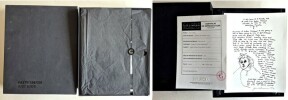
Just Kids. ( Exemplaire limité du tirage de luxe, dans une boite, enrichi d’une oeuvre originale de Patti Smith, signée, intitulée " Portrait de Rimbaud ", avec certificat de la Galerie Gallimard ).
Editions Gallimard 2017. In-8 cartonnage éditeur de 354 pages au format 19 x 3,5 x 25 cm. Couverture cartonnée, illustrée par une photographie en noir représentant Patti Smith et Robert Mapplethorpe. Dos carré. Plats et intérieur frais. Souvenirs de la poétesse et rockeuse accompagné de nombreuses photographies en noir et blanc. Facsimilés en hors texte. Un des exemplaires de luxe, en tirage limité, présenté dans une boite, avec titre imprimé, au format 21 x . Exemplaire enrichi d’une oeuvre originale de Patti Smith, reproduite en facsimilé, signée par Patti Smith et intitulée " Portrait de Rimbaud ". Le tirage à été réalisé à l’encre pigmentaire imprimé sur papier Canson Ultra Smooth par l’Atelier Granon à Paris. On joint le certificat de la Galerie Gallimard, ainsi que 3 feuilles dont une avec photographie inédite de l'artiste, prise pour la sortie du livre. Edition en partie originale et en état de neuf. Rarissimeen tirage de luxe, ultra limité.

Vente exclusivement par correspondance. Le libraire ne reçoit, exceptionnellement que sur rendez-vous. Il est préférable de téléphoner avant tout déplacement.Forfait de port pour un livre 10 € sauf si épaisseur supérieure à 3 cm ou valeur supérieure ou égale à 100 €, dans ce cas expédition obligatoire au tarif Colissimo en vigueur. A partir de 2 livres envoi en colissimo obligatoire. Port à la charge de l'acheteur pour le reste du monde.Les Chèques ne sont plus acceptés.Pour destinations extra-planétaire s'adresser à la NASA.Membre du Syndicat Lusitanien Amateurs Morues
History of the Adventures and Sufferings of Moses Smith during five years of his life; From the Beginning of the year 1806, when he was Betrayed into the Miranda Expedition, until June 1811 when he was Nonsuited in an Action at Law which lasted three years and a half. To which is added a Biographical Sketch of Gen. Miranda
Albany Packard & Van Benthuysen for the author 1814 Deuxième édition. Reliure cartonnée en plein cuir. Deux planches gravées. Veau de l'époque. "L'un des rares récits contemporains relatifs à l'expédition Miranda". Le général Francesco Miranda a connu une carrière militaire fructueuse avant de décider de révolutionner l'Amérique du Sud. La croisade fut un désastre. Smith et deux de ses camarades s'échappèrent de la prison de Carthagène et furent sauvés en mer. Moses Smith était originaire de Huntington (né en 1785). La première édition a été publiée à Brooklyn en 1812. Les pages 19/20 sont endommagées dans la marge extérieure, ce qui affecte le texte. L'ouvrage est raturé et légèrement assombri. Porte la signature de Bushniell Benedict. Il figure dans la liste des souscripteurs. Bushnell Benedict (1766-1842) était un habitant important de Ballston (parfois Ballstown), dans le comté de Saratoga, New York. Il est enregistré comme vivant à Ballston Spa en 1800 et figure sur la liste des juges de paix de Ballston en 1810. Son mandat a été renouvelé en 1812, 1815, 1818 et 1821. Légers frottements sur le bord supérieur du dos. iv, 13-146, [6]. pp. 175 par 115mm (7 par 4œ pouces). Sabuin 83640. Howes S-644.
Second edition. Hardback full leather binding. Two engraved plates. Contemporary calf. "one of the few contemporary narratives relating to the Miranda expedition." General Francesco Miranda enjoyed a successful military career before he decided to revolutionize South America. The crusade was a disaster. Smith and two comrades escaped from prison in Carthagena and were rescued at sea. Moses Smith was a native of Huntington (born 1785). First edition was published in Brooklyn in 1812. Pages 19/20 have damage to the outside margin, affecting text. Foxed and a little darkened. Bears the ownership signature of Bushniell Benedict. He is listed in the list of subscribers. Bushnell Benedict (17661842) was a prominent resident of Ballston (sometimes Ballstown), Saratoga County, New York. He is recorded as living in Ballston Spa in 1800 and was listed as a justice of the peace in Ballston in 1810. He was re-appointed 1812, 1815, 1818, 1821. Slight rubbing / splitting to the top edge of the spine. iv, 13-146, [6]. pp. 175 by 115mm (7 by 4œ inches). Sabuin 83640. Howes S-644. .
Umbrellas to mend
London J.T. Smith 1816 Belle gravure sur cuivre représentant un vieux vendeur ambulant proposant la réparation de parapluies cassés. Non colorée (telle qu'elle a été publiée). Légère trace d'eau sur le bord droit et un peu d'assombrissement sur les bords, mais dans l'ensemble en très bon état. La plaque mesure 17 cm x 12 cm. La feuille mesure 25,5 cm x 16,5 cm. Une pièce rare. Collection Wellcome 44003i. Smith, John Thomas, (1766-1833). Également connu sous le nom d'Antiquity Smith, était un peintre, graveur et antiquaire anglais. Il fut également conservateur des estampes au British Museum.
Beautiful copperplate engraving of an old traveling salesman offering to repair broken umbrellas. Uncolored (as published). Slight water mark on the right edge and some darkening around the edges, but overall in very good condition. The plate measures 17 cm x 12 cm. The sheet measures 25.5 cm x 16.5 cm. A rare piece. Wellcome Collection 44003i. Smith, John Thomas, (1766-1833). Also known as Antiquity Smith, was an English painter, engraver and antiquarian. He was also curator of prints at the British Museum. First Edition. .
Book/Shelf
New York l'artiste 2008 In-8 illustré, n.p. Couverture à rabats d'après une affiche de l'exposition réalisée par Smith. Notes manuscrite sur les rabats de la couverture : Display Copy et 3/2008.
:: Livre d'artiste composé de photocopies de pages des carnets de Josh Smith et divers. Dans cette expo, Smith présentait une pièce composée de : Bookcase with set of 74 artist's books and two stools. Un feuillet de texte présente le projet, feuillet intercalé à quelques reprises dans le bouquin : "This book in your hands was intended to give an idea of what the books are like and about. This book was made for this Exhibition..." Dans la présentation de cette oeuvre le MoMA explique que l'artiste "compiled pages selected from throughout the collection into two volumes for visitors to look through." Il s'agirait ici, de l'un des 2 "Display copy", :: L'affiche est composée de ce texte peint : MARCH 26 / JULY 7 2008 / BOOK SHELF / Paul J. Sachs / prints + books gallery / 2nd floor / Museum of / modern art NY. C'est également un tableau de Josh Smith, "Untitled". :: Exposition collective : Featuring works that transform books through a variety of mediums, Book/Shelf stresses an expanded notion of the illustrated book. The exhibition begins with a documentation of Marcel Duchamp’s Unhappy Readymade (1919)... Finally, the exhibition surveys several artists who have created installations that display books in public contexts, including Brian Belott, Allen Ruppersberg, Josh Smith, and Lawrence Weiner." (https://www.moma.org/calendar/exhibitions/70) :: Reliure japonaise. Bon état.

(CLAQ, ALAC)
Phone number : 1 514 820 2324
Recherches sur la nature et les causes de la richesse des Nations.
A Neuchatel, 1792. Cinq tomes reliés en trois volumes in-12. 406, 400, 437, 432 .Premier tome : faux-titre, titre, table, adresse, avertissement, 384 pages . Puis 406 pp., 400 pp., 437 pp., 432 pp. Chaque tome ayant un titre et une table. Traduction de l'anglois par M. Roucher. Bon état intérieur . Demi-percaline vert foncé chagrinée du XIXème, dos lisse orné de sept larges filets or en creux. En bon état.
![Recherches sur la nature et les causes de la richesse des Nations.. [ECONOMIE] SMITH (Adam).](https://static.livre-rare-book.com/pictures/BTR/img23048_1_thumb.jpg)
![Recherches sur la nature et les causes de la richesse des Nations.. [ECONOMIE] SMITH (Adam).](https://static.livre-rare-book.com/pictures/BTR/img23048_2_thumb.jpg)
![Recherches sur la nature et les causes de la richesse des Nations.. [ECONOMIE] SMITH (Adam).](https://static.livre-rare-book.com/pictures/BTR/img23048_3_thumb.jpg)
Précieuse édition de la deuxième traduction française (après celle de Blavet) du célèbre ouvrage classique publié par Smith en 1776, l'un des jalons de la pensée économique moderne. Le traducteur M. Roucher (1743-1794) était un érudit très estimé Edition neuchâteloise établie sur celle parue à Paris chez Buisson en 1790-1791. Adam Smith, philosophe écossais et écrivain célèbre, fondateur du système d'économie politique généralement admis aujourd'hui. Selon Adam Smith, l'Economie politique, considérée comme une branche des connaissances du législateur et de l'homme d'Etat, se propose deux objets distincts : le premier, de procurer au peuple un revenu ou une substance abondante, ou, pour mieux dire, de le mettre en état de se procurer lui-même ce revenu et cette subsistance abondante ; le second, de fournir à l'Etat ou à la communauté un revenu suffisant pour le service public : elle se propose d'enrichir à la fois le peuple et le souverain. En écrivant ses Recherches sur la nature et les causes de la richesse des nations (1776), Adam Smith ne se doutait pas que son ouvrage serait de ceux qui, en décrivant le monde, contribuent à le créer. Comprenant la nation concept éminemment politique comme espace de marché, c'est-à-dire comme surface d'échange, Adam Smith est le théoricien d'une modernité qui, deux siècles après, est toujours la nôtre.

( Rock - Littérature en Anglais - Photographies ) - Patti Smith - Claire Alexandra Hatfield.
Reference : 5564
(2015)
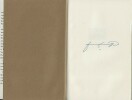
M. Train. ( Exemplaire signé par Patti Smith ).
Editions Borzoi Book. Published by Alfred A. Knopf 2015. In-8 reliure éditeur de 254 pages au format 20,5 x 13,5 cm. Complet de la jaquette illustrée par une photographie de Patti Smith par Claire Alexandra Hatfield. Souvenirs de la poétesse et rockeuse accompagné de 55 photographies en noir et blanc de Patti Smith. Edition originale en état de neuf. Rare exemplaire signé par Patti Smith.

Vente exclusivement par correspondance. Le libraire ne reçoit, exceptionnellement que sur rendez-vous. Il est préférable de téléphoner avant tout déplacement.Forfait de port pour un livre 10 € sauf si épaisseur supérieure à 3 cm ou valeur supérieure ou égale à 100 €, dans ce cas expédition obligatoire au tarif Colissimo en vigueur. A partir de 2 livres envoi en colissimo obligatoire. Port à la charge de l'acheteur pour le reste du monde.Les Chèques ne sont plus acceptés.Pour destinations extra-planétaire s'adresser à la NASA.Membre du Syndicat Lusitanien Amateurs Morues
( Rock - Littérature en Anglais - Photographies ) - Patti Smith.
Reference : 29184
(2015)
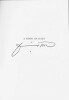
A Book of Day. ( Exemplaire signé par Patti Smith ).
Editions Random House, New York 2022. Fort in-12 relié de 388 pages au format 18,5 x 3,5 x 13,5 cm. Couverture avec titre imprimé. Dos rond avec titre. Complet de la jaquette illustrée d'une photographie de Patti Smith. Plats et intérieur frais. Préface de l'auteure. Recueil de photographies en couleurs et en noir, légendées, de Patti Smith. Superbe état général, proche du neuf. Edition originale. Précieux exemplaire signé par Patti Smith.

Vente exclusivement par correspondance. Le libraire ne reçoit, exceptionnellement que sur rendez-vous. Il est préférable de téléphoner avant tout déplacement.Forfait de port pour un livre 10 € sauf si épaisseur supérieure à 3 cm ou valeur supérieure ou égale à 100 €, dans ce cas expédition obligatoire au tarif Colissimo en vigueur. A partir de 2 livres envoi en colissimo obligatoire. Port à la charge de l'acheteur pour le reste du monde.Les Chèques ne sont plus acceptés.Pour destinations extra-planétaire s'adresser à la NASA.Membre du Syndicat Lusitanien Amateurs Morues
En Undersökning av Folkens Välstånd dess Natur och Orsaker. Översättning av D:r Emil Sommarin. 2 volumes. - [FIRST SWEDISH EDITION OF ""THE WEALTH OF NATIONS""]
Lund, C. W. K. Gleerups förlag, 1909 & 1911. 8vo. Bound with the original wrappers of volume 1 in one contemporary half blue cloth binding with red leather titel label with gilt lettering to spine. A fine and clean copy. XVI,191, (4), 179 pp.

First edition of the first Swedish translation of Adam Smith's ground-breaking main work, the ""Inquiry into the Nature and Causes of the Wealth of Nations"". Smaller parts of the book had previously been translated into Swedish (in 1800, 1804 and 1869), but the present translation is considered the first actual translation of the work (even though some parts have been excluded by translator Emil Sommarin, who based his translation the 5th English edition, the last edition to be supervised by Adam Smith himself). It is to this date the only Swedish translation of the work, which tells us a lot about the history of Swedish economics. Despite the comparatively late translation into Swedish, it still had a profound influence, not on economists since they were well aware of the original work in English, but upon politics and public opinion in general: ""There are few things more striking to the modem student of the history of ideas in Sweden than the negative phenomenon that Sweden was almost entirely uninfluenced by this fact and thus remained almost unaffected by English economic thought during a period when its superiority was most evident. As far as I am acquainted with the Swedish economic discussion and our popular economic literature of the 1860's and 1870's, there is almost no trace of any influence from English writers. [...]Of Adam Smith we have still only one abbreviated translation of his famous work and that was published as late as during this century"" and, as far as I know, nothing of Ricardo's or Malthus' exists in Swedish, nor do any of the major economic works of J.S. Mill."" (Heckscher, A survey of economic thought in Sweden, 1875-1950).Translator Emil Sommarin (1874-1955) was a student of Knut Wicksell, arguably the most influential Swedish economist, and Sommarin succeeded Wicksell's professorship in national economics. Wicksell ""came to know his classics very well and became and remained an admirer of Adam Smith. Around 1910 he also assisted his former student and successor as economics professor in Lund, Emil Sommarin, with the translation of WN, still the most complete we have in Sweden. In this connection he wrote to a friend in Uppsala, ""It is almost unbelievable that we have been denied this masterpiece for 125 years and our economic policy is a result of the omission"" (Cheng-Chung Lai, Adam Smith Across Nations, p. 384).
En Undersökning av Folkens Välstånd dess Natur och Orsaker. Översättning av D:r Emil Sommarin. [i.e. Swedish ""Wealth of Nations""]. 2 volumes. - [FIRST SWEDISH EDITION OF ""THE WEALTH OF NATIONS""]
Lund, C. W. K. Gleerups förlag, 1909 & 1911. 8vo. Both volumes in the original printed wrappers. Light wear to spines, otherwise a very fine and clean set. XVI,191, (4), 179 pp.
![En Undersökning av Folkens Välstånd dess Natur och Orsaker. Översättning av D:r Emil Sommarin. [i.e. Swedish ""Wealth of Nations""]. 2 volumes. - ...](https://static.livre-rare-book.com/pictures/LLX/58833_1_thumb.jpg)
First edition of the first Swedish translation of Adam Smith's ground-breaking main work, the ""Inquiry into the Nature and Causes of the Wealth of Nations"". Smaller parts of the book had previously been translated into Swedish (in 1800, 1804 and 1869), but the present translation is considered the first actual translation of the work (even though some parts have been excluded by translator Emil Sommarin, who based his translation the 5th English edition, the last edition to be supervised by Adam Smith himself). It is to this date the only Swedish translation of the work, which tells us a lot about the history of Swedish economics. Despite the comparatively late translation into Swedish, it still had a profound influence, not on economists since they were well aware of the original work in English, but upon politics and public opinion in general: ""There are few things more striking to the modem student of the history of ideas in Sweden than the negative phenomenon that Sweden was almost entirely uninfluenced by this fact and thus remained almost unaffected by English economic thought during a period when its superiority was most evident. As far as I am acquainted with the Swedish economic discussion and our popular economic literature of the 1860's and 1870's, there is almost no trace of any influence from English writers. [...]Of Adam Smith we have still only one abbreviated translation of his famous work and that was published as late as during this century"" and, as far as I know, nothing of Ricardo's or Malthus' exists in Swedish, nor do any of the major economic works of J.S. Mill."" (Heckscher, A survey of economic thought in Sweden, 1875-1950).Translator Emil Sommarin (1874-1955) was a student of Knut Wicksell, arguably the most influential Swedish economist, and Sommarin succeeded Wicksell's professorship in national economics. Wicksell ""came to know his classics very well and became and remained an admirer of Adam Smith. Around 1910 he also assisted his former student and successor as economics professor in Lund, Emil Sommarin, with the translation of WN, still the most complete we have in Sweden. In this connection he wrote to a friend in Uppsala, ""It is almost unbelievable that we have been denied this masterpiece for 125 years and our economic policy is a result of the omission"" (Cheng-Chung Lai, Adam Smith Across Nations, p. 384).
Métaphysique de l'Ame, ou Théorie des sentimens moraux, traduit de l'anglais de M. Adam Smith, Professeur de Philosophie Morale, dans l'Université de Glasgow, par M.*** (Marc Antoine Eidous).
Paris, Briasson, 1764 ; 2 tomes in-12, veau marbré, dos lisse décoré «à la grotesque» de croisillons étoilés, pièce de titre et de tomaison havane (reliure de l'époque) ; VIII (le premier feuillet est blanc), 302 pp. , (1) f. blanc ; (4), 370, (2) pp. (privilège).


Edition originale rare de ce premier texte d'Adam Smith en Français, traduit par Marc-Antoine Eidous, né à Marseille (1724-1790), collaborateur de l'Encyclopédie (450 articles dont l'héraldique et l'art de monter), traducteur de nombreux ouvrages dont le célèbre Dictionnaire universel de médecine de Robert James, en collaboration avec son ami Denis Diderot, Julien Busson, Eidous et François-Vincent Toussaint. Philosophe, économiste et même fondateur de l'économie politique, Adam Smith, Ecossais, va mener une carrière universitaire ; d'abord professeur de logique à l'université de Glasgow, puis de philosophie morale, il va se faire connaitre en Grande-Bretagne et en Europe grâce au présent ouvrage où il développe l'idée d'immédiateté et d'universalité de jugements moraux en affirmant que les individus partagent les sentiments les uns envers les autres par un mécanisme de sympathie. Les convictions religieuses d'Adam Smith sont relativement floues et font référence au «Grand Architecte de l'Univers» cher aux Francs-Maçons. On peut lire sur sa pierre tombale : Ci-gît Adam Smith, auteur de «Les sentiments moraux» et «La Richesse des Nations». Minuscule accroc à la coiffe supérieure et usure à l'inférieure du tome 1er avec petite fente au mors, sans gravité. Table des matières manuscrite en fin de chaque tome, bon exemplaire dans l'ensemble.
THE TREATMENT OF CATARACT. With Appendix by A. E. J. Lister. Illustrations by Dr. Derrick T. Vail.
Calcutta. Thacker, Spink and Co. 1910. In-8°, reliure pleine percaline havane. VIII + 121 pages + 52 planches hors texte. Les planches sont tirées sur papier couché, au seul recto des pages. E.O. Envoi autographe signé du Dr. Henry Smith et deux lettres autographes du même (dont une de trois feuillets, écrite en français et adressée au docteur ophtalmologue Henri Dor, figure importante des débuts de la médecine ophtalmologique, fondateur (vers 1880) de la première clinique ophtalmologique de Lyon, qui devint un important centre international d'enseignement). Très bon état.
Henry Smith, dit Henry " Jullundur " Smith, (1859-1948) fut un médecin irlandais qui fit sa carrière dans le service médical de l'armée des Indes. Il est l'inventeur d'un procédé de chirurgie de la cataracte qui porte encore son nom.
SMITH (Georges [?]) et APPIAN (Adolphe). Album de vingt fusains. Vers 1870
SMITH (Georges [?]) et APPIAN (Adolphe), d’après. Album de vingt fusains. S.l.n.d. [vers 1870-1880]. Chemise in-4 oblong contenant une suite de 20 reproductions d’après fusains, dont 18 d’après Émile-Joseph Smith et 2 d’après Adolphe Appian, contrecollées sur carton fort. Plusieurs planches sont signées dans la composition et certaines datées 1870. Intéressante suite consacrée au paysage au fusain, technique particulièrement en faveur dans la seconde moitié du XIXe siècle. L’ensemble comprend notamment des paysages de Smith, peut-être Georges Smith, dont un sujet intitulé La Cascade de Cernay, ainsi que deux compositions d’après Adolphe Appian, artiste lyonnais recherché pour ses paysages dessinés et gravés.
![SMITH (Georges [?]) et APPIAN (Adolphe). Album de vingt fusains. Vers 1870. SMITH (Georges [?]) et APPIAN (Adolphe)](https://static.livre-rare-book.com/pictures/GMF/gmf-563_1_thumb.jpg)
![SMITH (Georges [?]) et APPIAN (Adolphe). Album de vingt fusains. Vers 1870. SMITH (Georges [?]) et APPIAN (Adolphe)](https://static.livre-rare-book.com/pictures/GMF/gmf-563_2_thumb.jpg)
![SMITH (Georges [?]) et APPIAN (Adolphe). Album de vingt fusains. Vers 1870. SMITH (Georges [?]) et APPIAN (Adolphe)](https://static.livre-rare-book.com/pictures/GMF/gmf-563_3_thumb.jpg)
( Photographies - Musique Rock - Patti Smith ) - Jean-Louis Rancurel.
Reference : 28407
Patti Smith : Ensemble de 2 photographies en noir et blanc, prises par Jean-Louis Rancurel, lors d'un concert de Patti Smith.
Bel ensemble de 2 photographies en tirage argentique, noir et blanc, prises par Jean-Louis Rancurel, lors d'un concert de Patti Smith dans les années 80. Format 24 x 17,8 cm. Jean-Louis Rancurel, photographe et grand amateur de rock, a assidûment suivi les groupes de rock en tournée à travers la France et sur les scènes parisiennes du début des années 1960 aux années 1980. Il a toujours restitué fidèlement les plus beaux moments du rock français, sur scène ou pour des pochettes de disques. Il est un des photographes mythiques de cette période, tels Jean-Marie Périer ou Tony Franck. Ces clichés proviennent des fonds de l'artiste, elles sont notées au bas du verso : " Patti Smith de Rancurel (JL ) ". Rare ensemble.
Vente exclusivement par correspondance. Le libraire ne reçoit, exceptionnellement que sur rendez-vous. Il est préférable de téléphoner avant tout déplacement.Forfait de port pour un livre 10 € sauf si épaisseur supérieure à 3 cm ou valeur supérieure ou égale à 100 €, dans ce cas expédition obligatoire au tarif Colissimo en vigueur. A partir de 2 livres envoi en colissimo obligatoire. Port à la charge de l'acheteur pour le reste du monde.Les Chèques ne sont plus acceptés.Pour destinations extra-planétaire s'adresser à la NASA.Membre du Syndicat Lusitanien Amateurs Morues



Smith Sam - Smith Sam,Napier James - Smith Sam,Napier James
Reference : 113217
(2014)
Partition de la chanson : I'm not the only one
Hal Leonard Publishing Corporation 2014

Très bon état Grand format Guitare,Piano
( Rock - Photographies ) - Patti Smith - Michael Stipe - Olivier Ray - William S.Burroughs - Paul Williams - Jutta Koether - Tom Verlaine - Thurston Moore - Jem Cohen - Lisa Robinson - Lenny Kaye - Kim Gordon - Frances Yaunch.
Reference : 32727
(2015)
On the road with Patti Smith.
Editions Naïve 2011. In-8 cartonnage éditeur à l'italienne, non paginé, d'environ 120 pages au format 28 x 19 cm. Couverture photographique. Dos carré avec titre. Plats et intérieur frais, malgré 2 lignes manuscrites en pages de garde. Photographies en noir de Patti Smith prises en tournée par Michael Stipe avec des polaroïds additionnels de Olivier Ray. Textes de Patti Smith, Michael Stipe, Olivier Ray, William S.Burroughs, Paul Williams, Jutta Koether, Tom Verlaine, Thurston Moore, Jem Cohen, Lisa Robinson, Lenny Kaye, Kim Gordon et Frances Yaunch. Superbe état général, proche du neuf. Edition originale française, tirée sur couché.

Vente exclusivement par correspondance. Le libraire ne reçoit, exceptionnellement que sur rendez-vous. Il est préférable de téléphoner avant tout déplacement.Forfait de port pour un livre 10 € sauf si épaisseur supérieure à 3 cm ou valeur supérieure ou égale à 100 €, dans ce cas expédition obligatoire au tarif Colissimo en vigueur. A partir de 2 livres envoi en colissimo obligatoire. Port à la charge de l'acheteur pour le reste du monde.Les Chèques ne sont plus acceptés.Pour destinations extra-planétaire s'adresser à la NASA.Membre du Syndicat Lusitanien Amateurs Morues
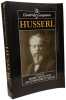
Cambridge Companion to Huss·l (Cambridge Companions to Philosophy)
Cambridge University Press 2008 532 pages 15 24x22 86x3 3782cm. 2008. Broché. 532 pages. The Cambridge Companion to Husserl est un ouvrage collectif édité par Barry Smith et David Woodruff Smith publié par Cambridge University Press. Il rassemble des essais de spécialistes visant à explorer et à démontrer la pertinence contemporaine des idées d'Edmund Husserl dans des domaines comme la phénoménologie l'intentionnalité la philosophie de l'esprit l'épistémologie la philosophie du langage l'ontologie et les mathématiques
Bon état

