 Write to the booksellers
3993 books for « smith d e »Edit
-
Type
Book (3937)
Disk (6)
Engraving (1)
Maps (2)
Music sheets (38)
New book (3)
Photographs (6)
-
Latest
Last month (28)
Last week (239)
-
Language
Dutch (2)
English (54)
French (3933)
Italian (1)
Japanese (1)
Russian (1)
Spanish (1)
-
Century
16th (9)
17th (9)
18th (49)
19th (203)
20th (1784)
21st (596)
-
Countries
Belgium (188)
Canada (22)
China (9)
Côte d'Ivoire (1)
Denmark (70)
France (3308)
Germany (2)
Greece (8)
Netherlands (11)
Switzerland (359)
United Kingdom (14)
United States of America (1)
-
Syndicate
ALAC (18)
CLAM (16)
CLAQ (6)
CNE (4)
ILAB (1857)
NVVA (39)
SLACES (36)
SLAM (1677)
SNCAO (5)
Topics
- Adam (63)
- Africa (20)
- Animals (11)
- Arabic (13)
- Archaeology (25)
- Architecture (49)
- Atlas (21)
- Biography (22)
- Biology (10)
- Birds (9)
- Botany (25)
- Bradley (53)
- Children’s books (71)
- China (13)
- Christianity (10)
- Comic strip (26)
- Cooking (30)
- Culinary art (12)
- Decoration (12)
- Detective novels (22)
- Dictionaries (23)
- Drawings (18)
- Earth (9)
- Economics (17)
- Economics (58)
- Egypt (12)
- Egyptology (9)
- England (23)
- English (163)
- Entomology (49)
- Ethic (13)
- Ethnology (11)
- Europe (10)
- Fantastic (32)
- Fine arts (40)
- First edition (52)
- Flora (27)
- Gastronomy (16)
- Geography (18)
- Germanic languages (9)
- Guide books (15)
- History (140)
- Holland (16)
- Industrial arts & crafts - fine arts (23)
- Islam muslim (9)
- Jazz (28)
- Law (21)
- Literature (349)
- Lovatt smith lisa (13)
- Lucie-smith edward (31)
- Mathematics (10)
- Medicine (24)
- Middle east (12)
- Mitchell margaret (20)
- Music (12)
- Navy (25)
- Painters (15)
- Painting (21)
- Palaeontology (12)
- Paris (12)
- Philosophy (41)
- Photography (45)
- Poetry (9)
- Policy (20)
- Psychology (10)
- Religions (21)
- Reptiles (10)
- Review (9)
- Reviews (9)
- Rock (28)
- Rock (27)
- Russia (10)
- Ruth (10)
- Science fiction (28)
- Sciences (31)
- Sciences & technique (10)
- Scores (49)
- Shelley (24)
- Smith adam (23)
- Smith anthony (14)
- Smith betty (12)
- Smith hedrick (18)
- Smith sydney (14)
- Smith thorne (12)
- Smith william (43)
- Songs (37)
- Spying (13)
- Tea (22)
- Theology (12)
- Translation (25)
- Travel (26)
- United kingdom (21)
- United states (19)
- Ussr (17)
- Various (27)
- War (34)
- Woodham-smith cecil (9)
- Youth (17)
- Zoology (19)
Relation Historique de l’Expédition, contre les Indiens de l'Ohio en MDCCLXIV. Commandée par le Chevalier Henry Bouquet, Colonel d'Infanterie, & ensuite Brigadier- Général en Amérique ; contenant ses Transactions avec les Indiens, relativement à la délivrance des Prisonniers & aux Préliminaires de la Paix ; avec un Récit introductoire de la Campagne précédente de l’an 1763, & de la Bataille, de Bushy-Run. On y a joint des Mémoires Militaires contenant des Réflexions sur la guerre avec les Sauvages : une Méthode de former des établissemens sur la Frontiere : quelques détails concernant la contrée des Indiens : avec une liste de nations, combattans, villes, distances, & diverses routes. Le tout enrichi de Cartes & Tailles-douces. Traduit de l'Anglois, Par C. G. F. Dumas. « D’intéressantes ‘Réflexions sur la Guerre avec les Sauvages de l’Amérique Septentrionale’ occupent les pp. 89-147 : on y trouve notamment le nom des différentes nations indiennes qui vivaient en Amérique du Nord, avec le nombre approximatif de leurs combattants ».
De la bibliothèque de Louis de Monteynard, secrétaire d’Etat à la guerre de 1771 à 1774. Amsterdam, chez Marc-Michel Rey, 1769. In-8 de xvi pp., 147 pp., (9), 3 planches hors-texte dont 1 dépliante, 3 cartes dépliantes. Plein veau marbré, filet à froid encadrant les plats, dos à nerfs orné, pièce de titre rouge, tranches rouges. Reliure de l'époque. 200 x 120 mm.


Première édition en français, traduite par le philologue Charles-Guillaume Dumas d'après l'édition donnée à Londres trois ans plus tôt. 2 jolies figures gravées d'après Benjamin West, représentant la conférence entre les Indiens et le colonel Bouquet en octobre 1764, et la reddition des captifs anglais en novembre de la même année, et 4 cartes et plans dépliants, dont un plan de la bataille de Bushy Run et une carte du cours de l'Ohio & du Muskingum. Le colonel Henry Bouquet (1719-1765) s'illustra durant la guerre de Pontiac (du nom d'un chef indien allié des Français), conflit opposant de 1763 à 1766 les Anglais aux tribus indiennes de la région des Grands Lacs, de l'Illinois et de l'Ohio. Rédigé par le révérend William Smith d'après les papiers de cet officier et publié pour la première fois à Philadelphie en 1765, le récit raconte l'expédition victorieuse de Bouquet à la bataille de Bushy Run (1763) qui mit fin au siège de Fort Pitt. Selon Field, il s'agit de la première victoire des Anglais sur des Indiens armés de fusils. L'édition contient une courte biographie de Bouquet par Dumas. D'intéressantes Réflexions sur la Guerre avec les Sauvages de l'Amérique Septentrionale occupent les pp. 89-147: on y trouve notamment le nom des différentes nations indiennes qui vivaient en Amérique du Nord, avec le nombre approximatif de leurs combattants. (Field, An Essay towards an Indian bibliography, n°1443). A translation of Smith's "Historical Account," taken from the London, 1766 edition. For another issue of the same sheets, see below "Voyage Historique." The maps and plates are re-engraved from the London edition of 1766, the two parts of the map appearing separately. West's two plates are re-engraved by "P. V. S." An adaptation of the "Marche du Colonel Bouquet," or "topographical plan," is in Avery, vol. 4/1908, p. 374. The preface includes a biographical sketch of Bouquet by Dumas. It is translated, into English in "The Olden Time," vol. I, pp. 203-207, May, 1846, and pp x—xvi of it are translated in the Cincinnati 1868 edition of the "Historical Account." Sabin, n°84647. Très bel exemplaire de cet Americana illustré de 2 gravures de l'éminent peintre Benjamin West (1738-1820), le père de l'école américaine. De la bibliothèque Louis-François de Monteynard (1713-1791), secrétaire d'Etat à la guerre de 1771 à 1774, avec son ex-libris armorié gravé.

Getijdenboek voor Farnese, inleiding en toelichting van Webster Smith
Utrecht/Antwerpen 1976 Het Spectrum Hardcover Fine 1st Edition
Langue: néerlandais. Livre des heures pour Farnese, introduction et commentaire de Webster Smith 180 x 110 mm, 168 pages, couverture rigide en lin beige, avec impression dorée sur le dos et le devant du livre, en cassette, en bon état 173 pages avec de nombreuses photos en couleur et en noir et blanc 300 x 230 mm, couverture souple [Cette description peut avoir été traduite par une IA.]
psychic messages from Oscar Wilde
London 1924 T. Werner Laurie Ltd. Hardcover 1st Edition
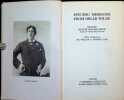
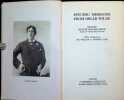
Couverture rigide (imperfections sur les couvertures), 22 x 14 cm, 179 pp., Anglais, 1ère édition, état du livre : Très bon, seulement des taches sur la page de titre Hester Travers Smith (également connue sous le nom de Hester Dowden), une médium spiritualiste irlandaise de premier plan, a publié Psychic Messages from Oscar Wilde en 1923 (ou 1924). L'ouvrage détaille les communications présumées avec l'esprit du dramaturge décédé Oscar Wilde, réalisées par l'écriture automatique et des séances de planche Ouija. Contenu et Contexte Clés La Voix ""Wilde"" : Les messages sont remarqués pour leur tentative d'imiter l'esprit caustique et le style aphoristique de Wilde. Dans ces écrits, l'esprit de Wilde offre des critiques littéraires acerbes sur ses contemporains, tels que Ulysses de James Joyce et George Meredith. Structure : Le livre, parfois intitulé Oscar Wilde from Purgatory, comprend des chapitres sur des phénomènes psychiques comme la cryptesthésie et l'influence subconsciente, ainsi que des transcriptions des ""conversations"". Contributeurs : Il présente une préface de Sir William F. Barrett, un physicien et co-fondateur de la Society for Psychical Research, qui a analysé la validité des scripts tout en se distanciant des opinions littéraires de l'esprit. Réception : Bien que les spiritualistes aient pris les messages au sérieux, les critiques les considéraient souvent comme un ""pastiche inconfortable"" de la voix de Wilde ou une fan fiction littéraire élaborée. [Cette description peut avoir été traduite par une IA.]

(CLAM, )
Phone number : +32(0)496 80 81 92
The Burghs of Scotland, a Critical List
London 1965 OXFORD UNIVERITY PRESS Original Cloth Very Good 1° Edition
Les Burghs d'Écosse, une Liste Critique par George Smith Pride, (XVII) 88 p, 22 x 14,5 cm, très bon état
[James Sowerby] - Sir Jalmes Edward Smith M.D. F.R.S. , Charles Johnson
Reference : 025739
(1842)
English Botany ; or, Coloured Figures of British Plants , with Their Essential Characters , Synonyms , and Places of Growth the second edition vol. IX complet
London 1842 C. E. Sowerby Cloth
Langue: anglais. Botanique anglaise; ou, Figures en couleur des plantes britanniques, avec leurs caractères essentiels, synonymes et lieux de croissance, deuxième édition vol. IX, couverture en toile, 22,5 x 15 cm, 110 pp + 262 gravures en taille-douce entièrement coloriées, seulement des taches sur les 4 premières pages et les 4 dernières pages, en très bon état général. [Cette description peut avoir été traduite par une IA.]
(CLAM, )
Phone number : +32(0)496 80 81 92
Chinese Characteristics
New York 1894 Fleming H. Revell Company Hardcover
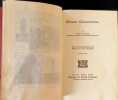
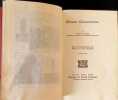
Reliure en toile rouge avec impression en blanc et or, 21 x 15 cm, 342 pp., Anglais, Illustrations, état du livre : Très Bon, avec des pages non coupées, coupe inégale. [Cette description peut avoir été traduite par une IA.]
(CLAM, )
Phone number : +32(0)496 80 81 92
Chinese Characteristics
Edinburgh 1900 Oliphant Anderson and Ferrier Hardcover
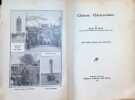
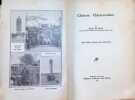
Reliure originale en toile de l'éditeur, 21 x 16 cm, 342 pp., Anglais, Illustrations [Cette description peut avoir été traduite par une IA.]
(CLAM, )
Phone number : +32(0)496 80 81 92
RARA Arithmetica A catalogue of the arithmetics written before the year MDCI with a description of those in the library of George Arthus Plimpton of New York
New York 1970 Chelsea publishing company Hardcover 1st Edition
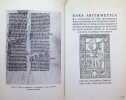
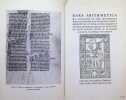
Relié, 21 x 15 cm, XVIII + 725 pp., Anglais, 1ère édition, Illustrations, état du livre : Très Bon [Cette description peut avoir été traduite par une IA.]
Stories from Wagner
London Hardcover
Langue: anglais. Histoires de Wagner, racontées aux enfants série, 15 x 12 cm, 115 pp, avec 8 images en couleur, très bon état [Cette description peut avoir été traduite par une IA.]
Beeldende kunst in de twintigste eeuw
Hong Kong 1999 KONEMANN VERLAGGESELLSCHAFT Soft cover Fine
Langue: néerlandais. L'art visuel au XXe siècle 400 pages avec de nombreuses illustrations et photos en noir et blanc et en couleur couverture souple, 280 x 215 mm, en bon état
The psychology of the criminal
1922 Methuen & Co Soft cover
La psychologie du criminel couverture rigide en tissu bleu : 19,5 x 145 cm, 182 pages, en bon état
Les Drapeaux à travers les âges et dans le monde entier
1976 Laterza Hardcover As New 1st Edition
Langue: français. Les Drapeaux à travers les âges et dans le monde entier 290 x 225 mm, couverture rigide, reliure en lin bleu avec couverture anti-poussière, 360 pp en bon état
Catalogue of English furniture and woodwork, Vol I Gothic and Early Tudor
London 1923 Victoria and Albert Museum Hardcover
Langue: anglais. Catalogue de meubles et de bois anglais, Vol I Gothique et Tudor précoce catalogue Relié, 250 x 185 mm, 68 pp. + 56 pl., illustrations en noir et blanc, en bon état [Cette description peut avoir été traduite par une IA.]
Catalogue of English furniture and woodwork, Vol II Late Tudor and Early Stuart
London 1930 Victoria and Albert Museum Hardcover
Langue: anglais. Catalogue de meubles et de bois anglais, Vol II Catalogue de la fin des Tudor et du début des Stuart Relié, 250 x 185 mm, 56 pp. + 52 pl., illustrations en noir et blanc, en bon état [Cette description peut avoir été traduite par une IA.]
Stronge, Susan; Smith, Nima; Harle, J. C.
Reference : 017309
(1999)
ISBN : 0944142168
A Golden Treasury: Jewellery from the Indian Subcontinent
1999 Victoria and Albert Museum/Mapin Hardcover 1st Edition
Langue: anglais. Un Trésor d'Or : Bijoux du Sous-continent Indien Reliure rigide, couverture verte avec jaquette, 280 x 220 mm, 144 pp. illustré, état excellent
Royal Navy ships' badges
1974 Balfour Publications Hardcover 1st Edition
Langue: anglais. Badges des navires de la Royal Navy Reliure rigide, en toile bleue avec jaquette, 240 x 185 mm, 96 pp, avec illustrations en couleur, en excellent état
Untersuchung der Natur und Ursachen von Nationalreichthümern, Aus dem Englischen. 2 Bände. - [THE SEMINAL FIRST TRANSLATION OF 'WEALTH OF NATIONS']
Leipzig, Weidmann, 1776-78. 8vo. Bound in two nice uniform contemporary half calf bindings with five raised bands and gilt lettering to spine. Ex-libris pasted on to pasted down front free end-papers and a small embossed stamp to front free end paper on volume 1 (""Buchhändler u. Antiquar Carl Helf""). Stamp to p. 1 of both volumes. Spines with light soiling and capital on volume 1 lacking a small part of the leather. A few light brown spots throught. A fine set. VIII, 632 pp"" XII, 740 pp.
First German edition, also being the very first overall translation, of Adam Smith's ground-breaking main work, the ""Inquiry into the Nature and Causes of the Wealth of Nations"". This seminal first translation of the work was undertaken by J.F. Schiller, who finished the first part of the translation in time for it to appear as soon as 1776, the same year as the original English edition. The second part appeared in 1778, the same year as the exceedingly scarce first French translation. This first German translation has been of the utmost importance to the spreading of Smith's ideas throughout Europe, and, after the true first, this must count as the most important edition of the work.""The influence of the Wealth of Nations [...] in Germany [...] was so great that 'the whole of political economy might be divided into two parts - before and since Adam Smith"" the first part being a prelude, and the second a sequel."" (Backhouse, Roger E., The Methodology of Economics: Nineteenth-Century British Contributions, Routledge, 1997.)""The first review of the translation, which appeared in the Göttingische gelehrte Anzeigen for March 10, 1777, by J. G. H. Feder, professor of Philosophy at the University of Göttingen, was very favorable. In the words of the reviewer: ""It is a classic"" very estimable both for its thorough, not too limited, often far-sighted political philosophy, and for the numerous, frequently discursive historical notes,"" but the exposition suffers from too much repetition."" (Lai, Cheng-chung. Adam Smith Across Nations: Translations and Receptions of The Wealth of Nations, Clarendon Press, UK, 2000).Until 1797, [...], the work of Adam Smith received scant attention in Germany. While Frederick II was living, Cameralism held undisputed sway in Prussia, and the economic change which began with the outbreak of the French Revolution had still not gained sufficient momentum to awake the economic theorists from their dogmatic slumber."" (Lai, Cheng-chung. Adam Smith Across Nations: Translations and Receptions of The Wealth of Nations, Clarendon Press, UK, 2000).Various German economist read the german translations and was inspired by it.""Christian Garve, [...], must be considered as among the important contributors to the spread of Smith's views. Himself a popularizer of philosophical doctrines, he was early attracted by the Scotch writers and became one of their foremost exponents in Germany."" In 1791 Garve began a second translation of the Smith's work and in the introduction to the the translation he wrote: ""It (Smith's work) attracted me as only few books have in the course of my studies through the number of new views which it gave me not only concerning the actual abject of his investigations, but concerning all related material from the philosophy of civil and social life"". Georg Sartorius, August Ferdinand Lueder and, perhaps the most important economist of the period, Christian Jacob Kraus, were all important figures in the spread of Smith's thought. ""The most significant of Kraus' works and that also which shows his conception of economic science most clearly is the five-volume work entitled State Economy. The first four volumes of this work are little more than a free paraphrase of the Wealth of Nations"". Kraus was: ""to a large extent responsible for the economic changes which took place in Prussia after 1807, in so far as they can be ascribed to Smithan influence."" (Lai, Cheng-chung. Adam Smith Across Nations: Translations and Receptions of The Wealth of Nations, Clarendon Press, UK, 2000).Kraus wrote of the present volume: ""[T]he world has seen no more important book than that of Adam Smith.... [C]ertainly since the times of the New Testament no writing has had more beneficial results than this will have.... [Smith's doctrines form] the only true, great, beautiful, just and beneficial system."" (Fleischacker, Samuel , A Third Concept of Liberty, Princeton University Press, 1999.)_____________Hailed as the ""first and greatest classic of modern thought"" (PMM 221), Adam Smith's tremendously influential main work has had a profound impact on thought and politics, and is considered the main foundation of the era of liberal free trade that dominated the nineteenth century. Adam Smith (1723-1790) is considered the founder of Political Economy in Britain, mainly due to his groundbreaking work, the ""Wealth of Nations"" from 1776. The work took him 12 years to write and was probably in contemplation 12 years before that. It was originally published in two volumes in 4to, and was published later the same year in Dublin in three volumes in 8vo. The book sold well, and the first edition, the number of which is unknown, sold out within six months, which came as a surprise to the publisher, and probably also to Smith himself, partly because the work ""requires much thought and reflection (qualities that do not abound among modern readers) to peruse to any purpose."" (Letter from David Hume, In: Rae, Life of Adam Smith, 1895, p. 286), partly because it was hardly reviewed or noticed by magazines or annuals. In spite of this, it did evoke immense interest in the learned and the political world, and Buckle's words that the work is ""in its ultimate results probably the most important book that has ever been written"", and that it has ""done more towards the happiness of man than has been effected by the united abilities of all the statesmen and legislators of whom history has preserved an authentic account"" (History of Civilisation, 1869, I:214) well describes the opinion of a great part of important thinkers then as well as now. Kress S. 2567Goldsmith 11394Menger 521Not in Einaudi
Untersuchung der Natur und Ursachen von Nationalreichthümern, Aus dem Englischen. 2 Bände. - [THE SEMINAL FIRST TRANSLATION OF 'WEALTH OF NATIONS']
Leipzig, Weidmann, 1776-78. 8vo. Bound in two nice uniform contemporary half calf bindings with five raised bands, black title-label and gilt lettering to spine. Small paper-label to upper compartment (Catalogue-number from an estate-library). Light wear to extremities, otherwise a very nice set. VIII, 632 pp" XII, 740 pp.
First German edition, also being the very first overall translation, of Adam Smith's ground-breaking main work, the ""Inquiry into the Nature and Causes of the Wealth of Nations"". This seminal first translation of the work was undertaken by J.F. Schiller, who finished the first part of the translation in time for it to appear as soon as 1776, the same year as the original English edition. The second part appeared in 1778, the same year as the exceedingly scarce first French translation. This first German translation has been of the utmost importance to the spreading of Smith's ideas throughout Europe, and, after the true first, this must count as the most important edition of the work.""The influence of the Wealth of Nations [...] in Germany [...] was so great that 'the whole of political economy might be divided into two parts - before and since Adam Smith"" the first part being a prelude, and the second a sequel."" (Backhouse, Roger E., The Methodology of Economics: Nineteenth-Century British Contributions, Routledge, 1997.)""The first review of the translation, which appeared in the Göttingische gelehrte Anzeigen for March 10, 1777, by J. G. H. Feder, professor of Philosophy at the University of Göttingen, was very favorable. In the words of the reviewer: ""It is a classic"" very estimable both for its thorough, not too limited, often far-sighted political philosophy, and for the numerous, frequently discursive historical notes,"" but the exposition suffers from too much repetition."" (Lai, Cheng-chung. Adam Smith Across Nations: Translations and Receptions of The Wealth of Nations, Clarendon Press, UK, 2000).Until 1797, [...], the work of Adam Smith received scant attention in Germany. While Frederick II was living, Cameralism held undisputed sway in Prussia, and the economic change which began with the outbreak of the French Revolution had still not gained sufficient momentum to awake the economic theorists from their dogmatic slumber."" (Lai, Cheng-chung. Adam Smith Across Nations: Translations and Receptions of The Wealth of Nations, Clarendon Press, UK, 2000).Various German economist read the german translations and was inspired by it.""Christian Garve, [...], must be considered as among the important contributors to the spread of Smith's views. Himself a popularizer of philosophical doctrines, he was early attracted by the Scotch writers and became one of their foremost exponents in Germany."" In 1791 Garve began a second translation of the Smith's work and in the introduction to the the translation he wrote: ""It (Smith's work) attracted me as only few books have in the course of my studies through the number of new views which it gave me not only concerning the actual abject of his investigations, but concerning all related material from the philosophy of civil and social life"". Georg Sartorius, August Ferdinand Lueder and, perhaps the most important economist of the period, Christian Jacob Kraus, were all important figures in the spread of Smith's thought. ""The most significant of Kraus' works and that also which shows his conception of economic science most clearly is the five-volume work entitled State Economy. The first four volumes of this work are little more than a free paraphrase of the Wealth of Nations"". Kraus was: ""to a large extent responsible for the economic changes which took place in Prussia after 1807, in so far as they can be ascribed to Smithan influence."" (Lai, Cheng-chung. Adam Smith Across Nations: Translations and Receptions of The Wealth of Nations, Clarendon Press, UK, 2000).Kraus wrote of the present volume: ""[T]he world has seen no more important book than that of Adam Smith.... [C]ertainly since the times of the New Testament no writing has had more beneficial results than this will have.... [Smith's doctrines form] the only true, great, beautiful, just and beneficial system."" (Fleischacker, Samuel , A Third Concept of Liberty, Princeton University Press, 1999.)_____________Hailed as the ""first and greatest classic of modern thought"" (PMM 221), Adam Smith's tremendously influential main work has had a profound impact on thought and politics, and is considered the main foundation of the era of liberal free trade that dominated the nineteenth century. Adam Smith (1723-1790) is considered the founder of Political Economy in Britain, mainly due to his groundbreaking work, the ""Wealth of Nations"" from 1776. The work took him 12 years to write and was probably in contemplation 12 years before that. It was originally published in two volumes in 4to, and was published later the same year in Dublin in three volumes in 8vo. The book sold well, and the first edition, the number of which is unknown, sold out within six months, which came as a surprise to the publisher, and probably also to Smith himself, partly because the work ""requires much thought and reflection (qualities that do not abound among modern readers) to peruse to any purpose."" (Letter from David Hume, In: Rae, Life of Adam Smith, 1895, p. 286), partly because it was hardly reviewed or noticed by magazines or annuals. In spite of this, it did evoke immense interest in the learned and the political world, and Buckle's words that the work is ""in its ultimate results probably the most important book that has ever been written"", and that it has ""done more towards the happiness of man than has been effected by the united abilities of all the statesmen and legislators of whom history has preserved an authentic account"" (History of Civilisation, 1869, I:214) well describes the opinion of a great part of important thinkers then as well as now. Kress S. 2567Goldsmith 11394Menger 521Not in Einaudi
Undersøgelse om National-Velstands Natur og Aarsag. Af det Engelske oversat og med nogle Anmærkninger oplyst af Dræbye. 2 Deele. [Anden Deel:] Hertil er føiet Gourvenør Pownals Brev til Forfatteren i hvilket nogle af de i dette Værk fremsatte Læresætn... - [FIRST DANISH EDITION OF ""THE WEALTH OF NATIONS""]
Kiøbenhavn [Copenhagen], 1779-80. 8vo. Two very nice contemporary brown half calf bindings with raised bands, gilt ornamentations and gilt leather title- and tome-labels. Volume two with a bit of wear to upper capital. Corners slightly bumped. Pencil annotations to verso of title-page in volume one" title-page in volume two mounted to cover up a small hole caused by the removal of an old owner's name. Internally very clean and bright. All in all a very nice, clean, fresh, and tight copy. Engraved (by Weise, 1784) armorial book plate to inside of front boards (Gregorius Christianus Comes ab Haxthausen). (12), 575" (8), 775, (3, - errata) pp.
The extremely scarce first Danish edition of Adam Smith's seminal main work, ""the first and greatest classic of modern economic thought"" (PMM 221), the main foundational work of the era of liberal free trade. This publication constitutes the first Danish work worth mentioning in the history of economic thought - in spite of the great interest in political economy that dominated Danish political thought in the last quarter of the 18th century. The value of Smith's work was not immediately recognized in Denmark at the time of its appearance and a quarter of a century had to go by for its importance to be acknowledged and for Danish political economy to adapt the revolutionizing theories of Adam Smith. Few copies of the translation were published and sold, and the book is now a great scarcity. As opposed to for instance the German translation of the work, Smith concerned himself a great deal with this Danish translation. As is evident from preserved correspondence about it, he reacted passionately to it and was deeply concerned with the reaction to his work in Scandinavia (see ""Correspondence of Adam Smith"", Oxford University Press, 1977).- As an example, Smith writes in a letter to Andreas Holt on Oct. 26th, 1780: ""It gives me the greatest pleasure to hear that Mr. Dreby has done me the distinguished honour of translating my Book into the Danish language. I beg you will present to him my most sincere thanks and most respectful Compliments. I am much concerned that I cannot have the pleasure of reading it in his translation, as I am so unfortunate as not to understand the Danish language."" The translation was made by Frants Dræby (1740-1814), the son a whiskey distiller in Copenhagen, who mastered as a theologian and was then hired by the great Norwegian merchant James Collett as tutor to his son. There can be no doubt that Dræbye's relation to the Collett house had a great impact upon his interest in economics. In the middle of the 1770'ies, Dræbye accompanied Collett's son on travels throughout Europe, which took them to England in the year 1776, the same year that the ""Wealth of Nations"" was published for the first time. Through the Colletts, Dræbye was introduced to the mercantile environment in England and here became thoroughly acquainted with English economics and politics at the time. It is presumably here that he gets acquainted with Adam Smith's freshly published revolutionary work. When Dræbye returned to Denmark at the end of 1776, he was appointed chief of the Norwegian secretariat of the Board of Economics and Trade. He began the translation of the ""Wealth of Nations"" that he brought back with him from England immediately after his return.""WN [i.e. Wealth of Nations] was translated into Danish by Frants Dræbye and published in 1779 (three years after the first English edition). The translation was initiated by Andreas Holt and Peter Anker, who were acquainted with Smith. Dræbye was a Dane who lived mainly in Norway, reflecting the fact that Norway was much more British-oriented than Denmark proper (Denmark and Norway were united until 1814, when Sweden took Norway away from the Danes"" in 1905 Norway became an independent state). Norwegian merchants lived from exporting timber to Britain and tended on the whole to be adherents of a liberal economic policy, whereas the absolutist government in Copenhagen was more German-oriented and had economic views similar to those in contemporary Prussia."" (Cheng-chung Lai (edt.): ""Adam Smith Across Nations"", p. (37)). The last quarter of the eighteenth century in Denmark was dominated by a lively discussion of monetary policy and the institutional framework best suited to realize that policy. There was a vital interest in questions of economic concern, and contemporary Danish sources refer to the period as ""this economic age"" and state things such as ""never was the world more economically minded"" (both from ""Denmark and Norway's Economic Magazine""). During this period, Smith's revolutionary ideas did not play a major role, however, and only at the beginning of the 19th century did Danish politicians and economists come to realize the meaning of Smith's views. ""Without exaggeration it can essentially be said that a quarter of a century was to pass from the time of the publication of the book in Denmark before Danish political economy fully made Adam Smith's theories and points of view its own. It took so long a time because the economic conditions as a whole in the years from 1780-1800 did not make desirable or necessary the changing of their concepts. That glorious commercial period had to pass before it was understood that we had altogether too little help in our own natural resources and that a different course was, therefore, necessary. Only when one had come so far could the new thinking find a nourishing soil so that it could develop strength with which to push aside the old ideas.""(Hans Degen: ""On the Danish Translation of Adam Smith and Contemporary Opinion Concerning It."" Translated by Henrietta M. Larson. In: Adam Smith Across Nations, p. 51). This first Danish translation is one of the very earliest translations of ""Wealth of Nations"""" it is only preceded by the German (1776-78) and the extremely scarce French (1778-79). As a comparison, the Italian translation does not appear until 1790-91, the Spanish 1792, the Swedish 1800-1804, the Russian 1802, etc.Adam Smith Across Nations: A4 - nr. 1. ""All five books were translated"" appears to be a complete translation. The long letter from Governor Pownall to Adam Smith (25 Sept. 1776) is added as the Appendix (vol. 2, pp. 683 ff.).""(PMM 221 - first edition)
Undersøgelse om National-Velstands Natur og Aarsag. Af det Engelske oversat og med nogle Anmærkninger oplyst af Dræbye. 2 Deele. [Anden Deel:] Hertil er føiet Gourvenør Pownals Brev til Forfatteren i hvilket nogle af de i dette Værk fremsatte Læresætn... - [FIRST DANISH EDITION OF ""THE WEALTH OF NATIONS""]
Kiøbenhavn [Copenhagen], 1779-80. 8vo. Two nice contemporary half calf bindings with four raised bands and gilt leather title label to spines. Volume one lacking one cm of upper part of spine. Volume two with a small tear to lower part of spine. Both volumes with light brown spotting throughout, however, mainly affecting first and last five leaves of both volumes. A fine set. (12), 575"" (8), 775, (3, - errata) pp.
![Undersøgelse om National-Velstands Natur og Aarsag. Af det Engelske oversat og med nogle Anmærkninger oplyst af Dræbye. 2 Deele. [Anden Deel:] Hertil ...](https://static.livre-rare-book.com/pictures/LLX/50523_1_thumb.jpg)
![Undersøgelse om National-Velstands Natur og Aarsag. Af det Engelske oversat og med nogle Anmærkninger oplyst af Dræbye. 2 Deele. [Anden Deel:] Hertil ...](https://static.livre-rare-book.com/pictures/LLX/50523_2_thumb.jpg)
![Undersøgelse om National-Velstands Natur og Aarsag. Af det Engelske oversat og med nogle Anmærkninger oplyst af Dræbye. 2 Deele. [Anden Deel:] Hertil ...](https://static.livre-rare-book.com/pictures/LLX/50523_3_thumb.jpg)
The extremely scarce first Danish edition of Adam Smith's seminal main work, ""the first and greatest classic of modern economic thought"" (PMM 221), the main foundational work of the era of liberal free trade. This publication constitutes the first Danish work worth mentioning in the history of economic thought - in spite of the great interest in political economy that dominated Danish political thought in the last quarter of the 18th century. The value of Smith's work was not immediately recognized in Denmark at the time of its appearance and a quarter of a century had to go by for its importance to be acknowledged and for Danish political economy to adapt the revolutionizing theories of Adam Smith. Few copies of the translation were published and sold, and the book is now a great scarcity. As opposed to for instance the German translation of the work, Smith concerned himself a great deal with this Danish translation. As is evident from preserved correspondence about it, he reacted passionately to it and was deeply concerned with the reaction to his work in Scandinavia (see ""Correspondence of Adam Smith"", Oxford University Press, 1977).- As an example, Smith writes in a letter to Andreas Holt on Oct. 26th, 1780: ""It gives me the greatest pleasure to hear that Mr. Dreby has done me the distinguished honour of translating my Book into the Danish language. I beg you will present to him my most sincere thanks and most respectful Compliments. I am much concerned that I cannot have the pleasure of reading it in his translation, as I am so unfortunate as not to understand the Danish language."" The translation was made by Frants Dræby (1740-1814), the son a whiskey distiller in Copenhagen, who mastered as a theologian and was then hired by the great Norwegian merchant James Collett as tutor to his son. There can be no doubt that Dræbye's relation to the Collett house had a great impact upon his interest in economics. In the middle of the 1770'ies, Dræbye accompanied Collett's son on travels throughout Europe, which took them to England in the year 1776, the same year that the ""Wealth of Nations"" was published for the first time. Through the Colletts, Dræbye was introduced to the mercantile environment in England and here became thoroughly acquainted with English economics and politics at the time. It is presumably here that he gets acquainted with Adam Smith's freshly published revolutionary work. When Dræbye returned to Denmark at the end of 1776, he was appointed chief of the Norwegian secretariat of the Board of Economics and Trade. He began the translation of the ""Wealth of Nations"" that he brought back with him from England immediately after his return.""WN [i.e. Wealth of Nations] was translated into Danish by Frants Dræbye and published in 1779 (three years after the first English edition). The translation was initiated by Andreas Holt and Peter Anker, who were acquainted with Smith. Dræbye was a Dane who lived mainly in Norway, reflecting the fact that Norway was much more British-oriented than Denmark proper (Denmark and Norway were united until 1814, when Sweden took Norway away from the Danes"" in 1905 Norway became an independent state). Norwegian merchants lived from exporting timber to Britain and tended on the whole to be adherents of a liberal economic policy, whereas the absolutist government in Copenhagen was more German-oriented and had economic views similar to those in contemporary Prussia."" (Cheng-chung Lai (edt.): ""Adam Smith Across Nations"", p. (37)). The last quarter of the eighteenth century in Denmark was dominated by a lively discussion of monetary policy and the institutional framework best suited to realize that policy. There was a vital interest in questions of economic concern, and contemporary Danish sources refer to the period as ""this economic age"" and state things such as ""never was the world more economically minded"" (both from ""Denmark and Norway's Economic Magazine""). During this period, Smith's revolutionary ideas did not play a major role, however, and only at the beginning of the 19th century did Danish politicians and economists come to realize the meaning of Smith's views. ""Without exaggeration it can essentially be said that a quarter of a century was to pass from the time of the publication of the book in Denmark before Danish political economy fully made Adam Smith's theories and points of view its own. It took so long a time because the economic conditions as a whole in the years from 1780-1800 did not make desirable or necessary the changing of their concepts. That glorious commercial period had to pass before it was understood that we had altogether too little help in our own natural resources and that a different course was, therefore, necessary. Only when one had come so far could the new thinking find a nourishing soil so that it could develop strength with which to push aside the old ideas.""(Hans Degen: ""On the Danish Translation of Adam Smith and Contemporary Opinion Concerning It."" Translated by Henrietta M. Larson. In: Adam Smith Across Nations, p. 51). This first Danish translation is one of the very earliest translations of ""Wealth of Nations"""" it is only preceded by the German (1776-78) and the extremely scarce French (1778-79). As a comparison, the Italian translation does not appear until 1790-91, the Spanish 1792, the Swedish 1800-1804, the Russian 1802, etc.Adam Smith Across Nations: A4 - nr. 1. ""All five books were translated"" appears to be a complete translation. The long letter from Governor Pownall to Adam Smith (25 Sept. 1776) is added as the Appendix (vol. 2, pp. 683 ff.).""
Recherches sur la Nature et les Causes de la Richesse des Nations. Traduit de l'Anglois de M. Smith [by Blavet]. 2 Tomes.
Londres, Pierre J. Duplain, 1788. 8vo, Two nice uniform contemporary full calf bindings with gilt spines. Some loss of leather to back hinge and lower capital of volume one and minor loos of leather to spine of volume two, all due to worming. Worming is not bad and does not affect anything but outer layer of small parts of the bindings. Apart from the worming a very nice, fresh and clean copy indeed. (8), IV, 503" (4), 496 pp. With both half-titles, the advertisment, both prefaces and the table of contents.
Rare early French translation of Adam Smith's political and economic classic, the ""Wealth of Nations"". Translated by Blavet. The present edition constitutes the third reprint of the second French translation. The second French translation was done by Blavet and is the first translation into French of which the translator and publisher are known. ""The reprint of Blavet's version appeared at Yverdon in 1781 in 6 volumes 12mo, and at Paris in the same year in 3 volumes 12mo, and again at London and Paris in 1788 in 2 volumes 8vo [the present edition], and revised and corrected, with Blavet's name as translator, at Paris An, ix (1800-01) in 4 volumes 8vo.He [Blavet] had no intention of publishing it until his friend M. Ameilhon happened to complain of scarcity of interesting articles for his Journal de l'Agriculture, du Commerce, des Arts et des Finances, which had just come under the control of the Mercantilist. It struck him that he might offer it to him which he did, with the explanation that it was far from perfect. It was accepted, and appeared in the issues of the Journal between January, 1779, and December 1780. He did not anticipate that it would go further. The edition of 1788 likewise appeared without his knowledge or consent, and was still more marred by errors than that of Yverdon"". (Lai, Cheng-chung. Adam Smith Across Nations: Translations and Receptions of The Wealth of Nations, Clarendon Press, UK, 2000). Hailed as the ""first and greatest classic of modern thought"" (PMM 221), Adam Smith's tremendously influential main work has had a profound impact on thought and politics, and is considered the main foundation of the era of liberal free trade that dominated the nineteenth century. Adam Smith (1723-1790) is considered the founder of Political Economy in Britain, mainly due to his groundbreaking work, the ""Wealth of Nations"" from 1776. The work took him 12 years to write and was probably in contemplation 12 years before that. It was originally published in two volumes in 4to, and was published later the same year in Dublin in three volumes in 8vo. The book sold well, and the first edition, the number of which is unknown, sold out within six months, which came as a surprise to the publisher, and probably also to Smith himself, partly because the work ""requires much thought and reflection (qualities that do not abound among modern readers) to peruse to any purpose."" (Letter from David Hume, In: Rae, Life of Adam Smith, 1895, p. 286), partly because it was hardly reviewed or noticed by magazines or annuals. In spite of this, it did evoke immense interest in the learned and the political world, and Buckle's words that the work is ""in its ultimate results probably the most important book that has ever been written"", and that it has ""done more towards the happiness of man than has been effected by the united abilities of all the statesmen and legislators of whom history has preserved an authentic account"" (History of Civilisation, 1869, I:214) well describes the opinion of a great part of important thinkers then as well as now. Considering the groundbreaking views presented in ""Wealth of Nations"", it comes as no surprise that the work was considered part of the revolutionary cultural development in France. As Adam Smith's friend, the Marquis of Lansdowne, said after quoting Smith's work: ""With respect to French principles, as they had been denominated, those principles had been exported from us to France, and could not be said to have originated among the population of the latter country."" (Quoted in: Rae, p. 291). The ideas of Adam Smith were often considered so dangerously closely connected with French ideas at the time that the term ""political economy"" almost became synonymous with questions concerning the constitution of governments. ""The French Revolution seems to have checked for a time the growing vogue of Smith's book and the advance of his principles in this country, just as it checked the progress of parliamentary and social reform, because it filled men's mind with a fear of change, with a suspicion of all novelty, with an unreasoning dislike of anything in the nature of general principle."" (Rae, p. 293). There can be no question that this seminal work greatly influenced French opinion at the time.
David Smith, A Centennial
, Guggenheim Museum, 2006 Hardcover with dusjacket, 447 pages, very richly illustrated with coloured illustrations, English text. ISBN 9780892073436.
Deemed the "foremost sculptor of his generation" by art critic Clement Greenberg, David Smith, who lived from 1906 to 1965, is about to be celebrated in his first retrospective since 1969--to be held at the Guggenheim Museum, New York, from February through May of 2006. David Smith: A Centennial features new photographs of nearly every selected sculpture--110 pieces dating from 1932 to 1965, including important examples from each period, many rarely seen in public. Essays from writers including David Anfam, Michael Brenson, Rosalind Krauss and Paul Hayes Tucker tackle key areas, such as Smith's relationship to the painters of the New York School, the dual development of his family life and series sculpture through the 1950s and 60s, and his use of the landscape outside his studio in formulating his late works. Perhaps most importantly, David Smith: A Centennial also features the most comprehensive research on Smith yet published, including a newly compiled and extended bibliography; a comprehensive exhibition history; a chronology; and an illustrated checklist tracking provenance, exhibition history, and bibliographic references for each featured sculpture, finally bringing scholarship on Smith to the level of that on other important American artists of his generation, such as Barnett Newman, Jackson Pollock and Mark Rothko. David Smith: A Centennial considers Smith's oeuvre as a totality, and offers readers the chance to understand the complexity of his aesthetic concerns as well as his impact on the course of American sculpture, and American art at large.
""Om Beskatning"" (+) ""Om Jordbrukets förfall i Europa, efter Romerska Väldets undergäng"" (+) ""Om Handelsbalancen"" (+) ""Om Jordbruks-systemet I en Rikshushållning, samt om Economisterne I Frankrike"" (+) ""Om Pappers-myntet I Norr-Amerika Kolonierne, före... - [""THE EARLIEST APPEARANCE IN SWEDISH OF A NUMBER OF TRANSLATIONS FROM ADAM SMITH""]
Stockholm, Henrik A. Nordström, 1797-1801. 8vo. Uncut, partly unopened in the original wrappers. In 22 volumes as issued. Last volume name written on title-page, otherwise an exceptionally fine, clean and untouched set rarely seen in this condition. (4),102 pp." (2),182 pp. (2),107 pp. (2),157,(1) pp. (2),176,(4) pp. (4),138,(2) pp. (2),205,(1) pp. + 1 folded table (2),188 pp (2),190 pp. (2),89,(4) pp. (4),135,(1) pp. (2),116,(1) pp. (2),157 pp. (2),120 pp. (2),151,(1 blank,10) pp. + 1 folded map (2),215 pp. + 1 folded table (2),131,(5) pp. (4),207 pp. (2),183,(1) pp. + 1 folded table (2),218 pp. (2),144,(4) pp." (6),449,(1) pp. + 5 folded plates.""Om Beskatning"", Part: 36, 37, 38:Pp. 145-177""Om Jordbrukets förfall i Europa, efter Romerska Väldets undergäng"", Part: 27, 28. Pp. 93-120""Om Handelsbalancen"", Part: 25,26. Pp. 92-114""Om Jordbruks-systemet I en Rikshushållning, samt om Economisterne I Frankrike"", Part: 25-26. Pp. 43-92""Om Pappers-myntet I Norr-Amerika Kolonierne, före Revolutionen"". Part: 27-28. Pp.57-62""Om Krono-jord"". Part: 29,30,31. Pp 139-146.""Theorien för statsskulder"". Part: 44, 45, 46, 47, 48, 49 & 50. Pp. 151-161.

First, however partial, translation of Adam Smith's Wealth of Nations in Swedish rarely seen in this condition, thus making it the very first opportunity for Swedish speakers to study Adam Smith. A more lengthy translation was made in 1909 - 1911 but to this day a full Swedish translation has not been made.""Von Schulzenheim [nobleman, physician, country squire and politician] also published shorter articles in the review 'Läsning I blandade ämnen', an organ of the opposition to the absolutist and obscurantist regime of Gustavus IV Adolphus. The editor of the review was count Georg Adlersparre, an army officer and a political writer who in 1809 was to become one of the prime-movers behind the dethronement of the king. Adlersparre to was an admirer of Adam Smith. In 1799-1800 he published in the 'Läsning' his own Swedish translation of several selections from Wealth of Nations. In some cases Adlersparre added footnotes, making it easier for the readers to apply Smith's ideas to Swedish conditions. Those translations, to the best of my knowledge, were the first ones of Wealth of Nations in Sweden. They were followed by translations of other parts of Wealth of Nations, published in 1800 amd 1808. This time the translator was Erik Erland Bodell, an official of the Swedish Customs and thus, if you like, a colleague of Adam Smith."" ( Cheng-chung, Adam Smith Across Nations). Despite the comparatively late translation into Swedish, it still had a profound influence, not on economists since they were well aware of the original work in English, but upon politics and public opinion in general: ""There are few things more striking to the modem student of the history of ideas in Sweden than the negative phenomenon that Sweden was almost entirely uninfluenced by this fact and thus remained almost unaffected by English economic thought during a period when its superiority was most evident. As far as I am acquainted with the Swedish economic discussion and our popular economic literature of the 1860's and 1870's, there is almost no trace of any influence from English writers. [...]Of Adam Smith we have still only one abbreviated translation of his famous work and that was published as late as during this century"" and, as far as I know, nothing of Ricardo's or Malthus' exists in Swedish, nor do any of the major economic works of J.S. Mill."" (Heckscher, A survey of economic thought in Sweden, 1875-1950).The journal was preceded by Adlersparre's ""Läsning för landtmän"" 1795-96. The content is a mixture of literature, agriculture, law, philosophy and politics. Apart from the many contributions by Swedish authors, ""Läsning i blandade ämnen"" also contains texts by Kant, Gibbon and De Lolme OCLC lists copies at Yale, Minnesota, and Texas.
Patti Smith: Before Easter After
, Rizzoli, 2024 Hardcover with dustjacket, 8-1/2 x 11-4/5, 287 pages. *As new. ISBN 9780847874088.
Hundreds of rarely seen images by legendary photographer Lynn Goldsmith offer an intimate portrait of rock ?n? roll icon Patti Smith during a transformative moment in her career. Images of Smith performing on stage combine with candid behind-the-scenes photographs and striking studio shoots to create a deeply personal look at the singer during her rise to fame. The photographs include Smith?s life-changing accident while on tour in 1977 and the aftermath, as well as closeup, empathetic portraits that reveal Smith?s self-assurance, her defiance of cultural norms, and her effortless poise. This poignant visual narrative is punctuated throughout by Smith?s original poetry and song lyrics. This book is both a glimpse into a fabled time in music history, documenting a young artist creating what turned out to be a revolutionary work, as well as a celebration of an enduring partnership between two close friends who continue to be creative collaborators to this day.
Before Easter After. Patti Smith. Art Edition No. 1-100 NYC, 1977 **Edition of 100 ** Collector's Edition ART A. NUMBERD No. 0058 - 1,500, each numbered and signed by Patti Smith and Lynn Goldsmith.
, Taschen, 2019 Edition of 100 ; Hardcover in clamshell box, 26.9 x 37.4 cm, 6.42 kg, 296 pages, numbered and signed by Patti Smith and Lynn Goldsmith; with the archival pigment print 'NYC, 1976' on Epson Legacy Baryta paper, 30.5 x 46 cm, signed by Goldsmith. ISBN 9783836573887.
An intimate visual survey of the unparalleled Patti Smith by Lynn Goldsmith, whose lens has immortalized a golden era of rock and roll history. With hundreds of unseen photographs and exclusive texts by Smith, this signed edition documents a transformative moment in the artist's career and celebrates two greats whose creative partnership continues to this day.

