 Write to the booksellers
3 books for « ryff walther »Edit
Der erst theyl der kleinen Apoteck oder Confectbuechlins (+) Der ander theyl der kleinen Teutschen Apoteck.
Strassburg, Balthassar Beck, 1552. 4to. In contemporary blindstamped half pigskin-binding over wooden boards with later marbled paper covering the boards. Endpapers renewed. Upper part of spine with title paper-label. Wear to extremities and front board partly detached. Last blank leaf with annotations in contemporary hand. Internally fine and clean. (6), XCVIII, (7), (blank), (4), CLV, (8) ff. One woodcut illustration in text.
Rare later edition of Ryff’s first part of “Kleinen Apoteck” and second part of “kleinen Teutschen Apoteck” - his highly popular manual of domestic medicine and cookery. Ryff in general wrote for a lay audience and his texts were all published in German, rather than Latin. “Ryff had no scruples in appropriating material wherever he could find it. Ryff is known to as one of the most notorious plagiarists who robbed the works of others, and therefore brought on himself the wrath of his contemporaries who showed no mercy for his short comings, either as a man or as an author” (Hagelin, Materia Medica, p. 58). Versalius even called him “the Strasbourg plagiarist.” What his contemporaries criticized him for eventually turned out to be the strength of his publications. He managed to popularize medical knowledge and make, what used to be an esoteric knowledge only available for the few, available to a broad audience. His ability to make medical knowledge available for the layman and the fact that he wrote in German later earned him flattering title of being the “Luther of Medicine”. “Walther Hermann Ryff (c.1500-c.1548) was a German surgeon and author. While little is known about his life, he probably studied pharmacy in Basel. He served as the city apothecary in the northern German town of Güstrow, then moved on to Strasbourg, where he served as city physician from 1532-1540. He left Strasbourg in 1544 following a legal suit involving plagiarism – one of the defining features of his literary career – and went on to Frankfurt, Mainz, Nuremberg, and Kulmbach. He died in Würzburg.” (Bernard Becker Medical Library). Durling 4018Not in Waller

Kurtzes Handtbüchlein, und Experiment, vieler Artzneyen, durch den gantzen Cörper deß Menschens, von dem Haupt biß auff die Füß - [1677]
Straßburg, Josias Städel, [1677], 1 vol. in-8 (16,6 x 11,4 cm), signé Cii-Ffvii. Composé de : 'Das erste Buch von allerhand Arknen', 'Das ander Buch von allerhand Arknen ', suivis de 'Experiment Büchlein von .....Tarquinium Ocyorum alias Schnellenbergium, Der Artzeney Doctorn von Dortmund angestellet', d'un texte court relatif aux conditions d'administration des remèdes, puis de trois registres alphabétiques des plantes détaillées dans ce traité. Ouvrage folioté en chiffres arabes en continu sur les trois premières parties du volume : 16-81 correspondant au premier livre dont les 15 premiers folios sont manquants, 85-89, 92-104, 106-112, 117-119, 121-143, 145-151, 153-173 correspondant au second livre dont 13 folios sont manquants et 174-184, 186-212 correspondant à l'expérience dont 1 folio manque. Viennent ensuite 3 folios non-foliotés intitulés 'Wann und zu welcher Zeit.... ?', puis 13 folios non-foliotés de registres alphabétiques. Très nombreux feuillets blancs interfoliés, portant parfois des mentions manuscrites à la plume. Texte en allemand vernaculaire, imprimé en lettres gothiques. Grandes initiales. Innombrables gravures sur bois in-texte, fines et descriptives, certaines (un tiers environ), réhaussées de couleurs franches. Il s'agit en très grande majorité de plantes herbacées, à bulbes ou à fleurs ; Chaque plante ayant sa gravure. L'Allemagne et l'Alsace actuelle sont particulièrement actives dès le XVIième siècle en matière de médecine et de botanique, deux disciplines intimement liées à cette époque. Plusieurs ouvrages sont produits visant à compiler les connaissances et à les organiser selon des nomenclatures nouvelles. Ici, vaste répertoire de plantes se présentant comme un guide de poche d'identification des végétaux avec leurs usages médicinaux et la posologie à observer. Ouvrage pratique où l'auteur livre ses conseils personnels et connaissances encyclopédiques en s'adressant directement au lecteur au moyen du 'Ich...'. Josias Städel (1627-1700) : imprimeur-libraire strasbourgeois. Rachète l'imprimerie des héritiers de Wendel Rihel, imprimeur de l'édition originale de cet ouvrage en 1583. Walter Hermann Ryff (1500?-1548/9) : apothicaire, médecin, mathématicien et architecte. Auteur. Tarquinius Schnellenberg : contributeur. Mentions manuscrites à la plume en regard des folios 26 et 89 pouvant correspondre à des ex-libris.
![Kurtzes Handtbüchlein, und Experiment, vieler Artzneyen, durch den gantzen Cörper deß Menschens, von dem Haupt biß auff die Füß - [1677] . RYFF, ...](https://static.livre-rare-book.com/pictures/KQE/170_1_thumb.jpg)
![Kurtzes Handtbüchlein, und Experiment, vieler Artzneyen, durch den gantzen Cörper deß Menschens, von dem Haupt biß auff die Füß - [1677] . RYFF, ...](https://static.livre-rare-book.com/pictures/KQE/170_2_thumb.jpg)
![Kurtzes Handtbüchlein, und Experiment, vieler Artzneyen, durch den gantzen Cörper deß Menschens, von dem Haupt biß auff die Füß - [1677] . RYFF, ...](https://static.livre-rare-book.com/pictures/KQE/170_3_thumb.jpg)
Plein parchemin muet d'époque, à plats rigides, sans lacunes. Dos lisse, traces de lacets. Deux tranchefiles main écrues, complètes, trois tranches bleues. Couture sur trois nerfs de parchemin. 29 feuillets sont manquants dont les pages de titre des deux livres. Belle conservation par ailleurs : tenue de la couture, reliure, qualité du papier, de l'impression et des couleurs. Traité de médecine par les plantes, incomplet, cependant bien conservé et abondamment illustré de bois, parfois en couleur.
Der Architectur furnembsten, notwendigsten, angehörigen Mathematischen und Mechanischen künst, eygentlicher bericht, und verstendliche unterrichtung, zu rechtem verstandt der lehz Vitruvii, in drey fürneme Bücher abgetheilet. Als Der newen Perspectiua... - [RENAISSANCE MATHEMATICS AND MECHANICS]
Nürmberg, Gabriel Heyn, 1558. Folio. Bound in a nice later (around 1840) hcalf. Raised double bands. Gilt spine. Gilt lettering. Marbled endpapers. Stamps on foot of title-page. A sort of frontispiece (full-page) is printed on the verso of the title-page, depicting the Putto as the spirit of architecture.Title-page printed in red and black. Dedication and content (4 unnumb.lvs.) - Geometry & Perspective (Ff I-C ) - Geometrischen Büchsenmeisterei (Ff I-XLVIII.) - Befestigung (Ff I-XLIIII ) - Geometrischen Messung (Ff (4),I-XLVI,(3)) - Wag und Gewicht (Ff I-XVII) - Schnelwagen (Ff I-X) ending with colophon and woodcut printer's device. Having more than 300 (many full- and half page) fine wood-engravings executed by V. Solis, G. Pencz, H. Brosamer and Peter Floetner. Internally in extraordinary fine clean condition with only a few minor scattered brownspots. 3 leaves with a minor repair to upper right corner.
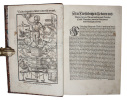
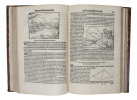
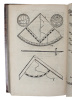
Scarce second edition (the first 1547) of this profusely illustrated encyclopedia of applied Renaissance mathematics and mechanics.""This rare work, which unknown to Poggendorff, Brunet, Ebert and other bibliographers...is remarkable for its numerous fine woodcuts, is full of suggestions, and would well deserve the attention of the historian of physics, who seems to have quite neglected it, owing probably to its great rarity. In the section on ballistics it is of interest to find that the author assigns a curve to the path of a projectile against the hitherto accepted Aristotelian opinion that the latter travels in a straight line and falls vertically after its energy is expended."" (Sotheran). - In the work many measuring- and surveying instruments are described and depicted. Ryff is well-known for his medical books and the first German translation of Vitruvius.Wellcome I: 5670 (Ed. 1547). - Adams R,606 (same collation) - Cockle, 661 (Ed. 1547)

