 Write to the booksellers
20 books for « roemer f »Edit
-
Century
18th (2)
19th (3)
20th (6)
-
Topics
Alsace (4)
Astronomy (4)
Economics (1)
Greek (1)
Humour anecdotes (2)
Latin (1)
Palaeontology (2)
Physics (2)
Tea (1)
Theatre (1)
Youth (2)
-
Countries
Belgium (3)
Denmark (7)
France (9)
Netherlands (1)
-
Syndicate
ILAB (8)
SLAM (1)
"ROEMER (RÖMER), OLE - THE PLAN FOR ""OBSERVATORIUM TUSCULANUM""
Reference : 59045
(1727)
Olai Roemeri ad G.G. Leibnitium Epistola de Instrumento Astronomicis Observationibus serviente à se inventa. (Dated Hafniæ 15. Dec. 1700).
Berlin, Ambrosius Haude, 1727. 4to. Contemp. full calf. Raised bands. Tome- and titlelabels with gilt lettering. Minor repairs at upper joint. In: ""Miscellanea Berolinensia, ad Incrementium scientiarum ex Scriptis Societati Regiæ Scientiarum exhibitis editia, Continuatio II."" (6),346,(4) pp., 11, partly folded engraved plates. Scattered brownspots. Roemer's letter to Leibniz: pp. 276-78, 2 textillustrations. The entire volume offered.
First printing of Roemer's letter to Leibniz in which he describes his plan for a new observatory and the circle-instrument.""In a letter written to Leibniz, dated December 15, 1700, - (the offered item) - in reply to Leibniz's request for the most suitable plan for an observatory, Roemer describes his plans for the ""Observatorium Tusculanum"". He has an excellent discussion of the need of building the observatory so that it can best serve the function for which it is intended, namely, observation. He probably was thinking of the construction of the Paris Observatory, a beautiful building, but impractical as far as actual observational needs were concerned. He also describes the prime vertical transit and states his preference for the circle as compared to quadrants and sextants, saying that he would have confidence in a circle of four feet in diameter than a quadrant of ten."" (I. Bernard Cohen in ""Roemer and the first determination of the Velocity of Light"", p. 48).

Anonymous review-paper of Horrebow's ""Basis Astronomia"" in ""Nova Acta Eruditorum"".
Leipzig, Gleditsch & Grossius, 1736. 4to. No wrappers. In: ""Nova Acta Eruditorum"", Anno 1736, No. III (September March issue). Pp. 97-144 (entire issue ofefred). The review-paper: pp. 123-127 and 1 engraved plate showing Ole Roemer observing with one of his large instruments. Wide-margines. Some brownspots.
Roemers astronomical instruments were the best of his time. In the work by Peder Horrebow, Roemer's pupil and successor as professor in astronomy in Copenhagen, here reviewed, describes the instruments in detail as well as Roemer's observational methods.
Die silurische Fauna des westlichen Tennessee. Eine paläontologische Monographie.
1860 [8], 100 p., 5 lithographed pls, 4to, new cloth. Library stamps (one perforated) and numbers on title-page, Small black stain on title-page, plates foxed. Important early palaeontological work on the invertebrate fauna of Tennessee. Ferdinand Roemer is also regarded as the father of Texas Geology.
Adversaria. Udgivet af Det kgl. danske Videnskabernes Selskab ved Thyra Eibe og Kirstine Meyer.
København, Bianco Luno, 1910. Lex8vo. Solid private hcloth. Interleaved. 271 pp., textillustrations. Gennemstukket med hvide blade.
First edition of Roemer's astronomical notes. The notes tells systematically how to correct the errors of reading his famous construction of the meridian instrument when placed in position. Adversaria also records another of his outstanding achievements, being the construction of the thermometer.
Philologie und Afterphilologie im griechischen Altertum. Parodien und Didymus bei Aristophanes.
Tübingen, H. Laupp jr., 1908.
41;45 p. Wrappers. 21 cm (Offprint Philologus 67,2/3) (Cover worn and spotted. Back repaired with a strip of brown paper. Occasional scholarly pencil marginalia)
Lethaea Erratica oder Aufzählung und Beschreibung der in der norddeutschen Ebene vorkommenden Diluvial-Geschiebe nordischer Sedimentär-Gesteine.
1885 173 p., 3 figs, 11 lithographed pls, roy. 4to, later cloth.
Der Aberglaube bei den Dramatikern des 16. Jahrhunderts in Frankreich
München, 1903 x + 52pp., 26cm., Doctoral Dissertation (Inaugural-Dissertation zur Erlangung der Doktorwürde der philosophischen Fakultät zu Rostock), bound in modern hardcover, stamp at verso of title page, text is clean and bright, T112811
autre monument alsacien la knack.
Strasbourg, Editions coprur, 2009 ; in-8, 78 pp., cartonnage de l'éditeur.
.
Tout ce qu'il faut savoir sur l'Alsace.
Strasbourg, Editions coprur, 2009 ; in-8, 70 pp., cartonnage de l'éditeur.
.
Tout ce qu'il faut savoir sur l'Alsace.
Strasbourg, Editions coprur, 2009 ; in-8, 70 pp., cartonnage de l'éditeur.
.
Atlas zu H.G. Bronn's Lethaea Geognostica oder Abbildung und Beschreibung der für die Gebirgs-Formationen bezeichnendsten Versteinungen. Dritte, stark ver. Auflage.
Stuttgart, E. Schweizerbart'sche Verlagshandlung, 1850-56. Folio. Unbound and not sewn. 123 pp. and 124 lithographed plates (1 in colour). Title-page brownspotted and with tears in margins all aroun. Part of orig. printed frontwrapper preserved. Most of the plates partly brownspotted, some with minor dampstains in corners and margins. A few plates (most heavely the first and last) with tears reaching the illustrations.

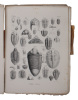
BMC I: 256. Pritzel 1178. This is only the atlasvolume to Bronn's great work. ""The first attempt at a Chronological Succession of fossil organisms is to be found in H.G. Bronn's Lethaea Geognostica. This work is a masterpiece of scholarship"" it summarises all that was previously known abot Stratigraphy and Paleontology. The most importent fossils types of all geological formation are shown ion the folio plates..."" (Zittel p. 364 ff.).
Adversaria. Udgivet af Det Kgl. Danske Videnskabernes Selskab ved Thyra Eibe og Kirstine Meyer.
København, Bianco Luno, 1910. Royal8vo. Publishers full calf. Richly gilt back and gilt border on covers. All edges gilt. (Bound by Petersen & Petersen). (8),271 pp. many textdiagrams.
First edition of Roemers astronomical notes. The notes tells systematically how to correct the errorrs of reading his famous construction of the meridian instrument when placed in postion. Adversaria also records another of his outstanding achievements, being his construction of the thermometer.
Adversaria. Udgivet af Det Kgl. Danske Videnskabernes Selskab ved Thyra Eibe og Kirstine Meyer.
København, Bianco Luno, 1910 Royal8vo. Orig. printed wrappers. Wrappers and sewing loose. (8),271 pp., textdiagrams. Internally fine and clean.
First edition of Roemers astronomical notes. The notes tells systematically how to correct the errors of reading his famous construction of the meridian instrument when placed in position. Adversaria also records another of his outstanding achievements, being the construction of the thermometer.
Adversaria. Udgivet af Det Kgl. Danske Videnskabernes Selskab ved Thyra Eibe og Kirstine Meyer.
København, Bianco Luno, 1910 Royal8vo. Contemp. hcalf. Gilt spine.(8),271 pp., textdiagrams. Fine and clean.
First edition of Roemers astronomical notes. The notes tells systematically how to correct the errors of reading his famous construction of the meridian instrument when placed in position. Adversaria also records another of his outstanding achievements, being the construction of the thermometer.
THEORIES OF DISTRIBUTIVE JUSTICE
Harvard University Press. 1996. In-8. Broché. Bon état, Couv. convenable, Dos satisfaisant, Intérieur frais. 342 pages. Annotation en 1re page. Quelques annotations au crayon dans le texte.. . . . Classification Dewey : 420-Langue anglaise. Anglo-saxon
The measurement of utility and Arrow's theorem. Axiomatic bargaining theory. Utilitarianism... Classification Dewey : 420-Langue anglaise. Anglo-saxon

GILLIS Malcolm, PERKINS Dwight H., ROEMER Michael et SNODGRASS Donald R.
Reference : 55025
ISBN : 2804127583
Economie du développement. Ouvertures économiques balises.
Bruxelles, De Boeck Université, 1998. 16 x 24, 784 + xi pp., très nombreux tableaux, figures, broché, très bon état.
traduction de la 4e édition américaine par Bruno Baron-Renault.
autre monument alsacien la knack.
Strasbourg, Editions coprur, s.d. ; in-8, cartonnage de l'éditeur. Sous blister.
Sous blister.
Petite histoire de l'eau.
Strasbourg, Coprur, 2006 ; petit in-4, 52 pp., cartonnage de l'éditeur.
.
Petite histoire de l'eau.
Strasbourg, Coprur, 2006 ; petit in-4, 52 pp., cartonnage de l'éditeur.
.
BEKAERT Geert - Wouter DAVIDTS - Kristiaan BORRET - Roemer van TOORN - Dave WENDT :
Reference : 47092
Xaveer De Geyter architecten 12 projecten.
2. Gent-Amsterdam, Ludion, 2001, in-4°, 143 pp, gekartonneerde uitgeversband met stofwikkel. ISBN 9055443301 . Één hoekje licht opgestuikt, maar verder goed exemplaar.

