 Write to the booksellers
22 books for « rhodius j »Edit
-
Century
17th (4)
18th (1)
19th (1)
-
Topics
Apollonius of rhodes (2)
Congo (1)
Greek (14)
Latin (14)
Medicine (4)
Mythology (1)
Poetry (1)
-
Countries
Belgium (1)
Denmark (5)
Greece (1)
Netherlands (14)
Switzerland (1)
-
Syndicate
ILAB (7)
NVVA (1)
SLACES (1)
The Argonautica of Apollonius Rhodius, book III. Ed. with introduction & commentary by Marshall M. Gillies.
Cambrdige, CUP, 1928.
XLVIII,160 p. Cloth. 22.5 cm (Some foxing)
A commentary on Apollonius Rhodius Argonautica III 1-471.
Leiden etc., E.J. Brill, 1994.
XXI,424 p. Cloth. 24 cm (Mnemosyne Supplement 141) (Including dustjacket)
Echoes and imitations of early epic in Apollonius Rhodius.
Leiden, E.J. Brill, 1981.
(VIII),123 p. Wrappers. 24 cm (Mnemosyne Supplement 72) (Cover plasticized)
A companion to Apollonius Rhodius.
Leiden etc., Brill, 2001.
XIII,362 p. Hardback. 24 cm (Mnemosyne Supplement 217)
Index verborum in Apollonium Rhodium. Edidit Malcolm Campbell.
Hildesheim etc., Olms, 1983.
VII,292 p. Cloth 21 cm (Alpha-Omega)
Die Argonauten. Verdeutscht von Th. VON SCHEFFER.
Wiesbaden, Dieterich, (1947).
XVI,237 p. Cloth. 18 cm (Cover plasticized)
The Argonautica, book III. Edited with introduction & commentary by M.M. GILLIES.
Hildesheim, etc., Olms, 1989.
XLVIII,160 p. Wrappers. (Reprint Cambridge, CUP, 1928)
The Argonautica, book III. Ed. with intr. & commentary by M.M. GILLIES.
Hildesheim, etc., Olms, 1989.
XLVIII,160 p. Wrs. (Repr. Cambr., CUP, 1928)
Studi di poesia ellenistica. (Apollonio Rodio, Callimaco)
Napoli, Luigi Loffredo, 1940.
52 p. Cloth. 25.5 cm (Rebound) (Contains: 'Eracle e Teodamante (father of Hylas) in Callimaco e in Apollonio Rodio'. And: 'L'Eracle 'Semnós' nel poema di Apollonio')
The best of the Argonauts. The redefinition of the epic hero in book 1 of Apollonius's Argonautica.
Berkeley etc., University of California Press, 1993.
XVIII,238 p. Cloth. 24 cm (Including dustjacket)
Apollonius' Argonautica. A Callimachean epic.
Leiden etc., E.J. Brill, 1994.
VIII,160 p. Cloth. 24 cm (Mnemosyne Supplement 142) (Including dustjacket)
Einleitung zur kritischen Ausgabe der Argonautika des Apollonios.
Göttingen, Vandenhoeck & Ruprecht, 1964.
VI,163 p. Boards. 24.5 cm (Rebound)
Noten zu den Argonautika des Apollonios.
Darmstadt, Wissenschaftliche Buchgesellschaft, 1968.
IX,665 p. Cloth. 23 cm
The Argonautica of Apollonius. Literary studies.
Cambridge, CUP, 1993.
X,206 p. Hardbound 24 cm (Including dustjacket; pencil underlinings and marginalia in the first 3 chapters)
Apollonii Rhodii Argonautica. Recognovit bervique adnotatione critica instruxit R.C. Seaton. 'Scriptorum Classicorum - Bibliotheca Oxoniensis'.
Oxonii, Typograph. Clarendoniano, 1929, in-8vo, ca. 200 p., orig. cloth, spine gilt. (fine copy).

(SLACES, NVVA)
Phone number : 41 (0)26 3223808
De Acia Dissertatio Ad Cornelii Celsi mentem qva simul universa Fibulæ ratio explicantur, secunda Curis Ex autographo Autoris auctior & emandatior...á Th. Bartholino Accedit De Ponderibus et Mensuris Ejusdem Autoris Dissertatio, & Vita celsi. 2 Parts.
Hafniæ, M. Godiche, 1672. 4to. Uncut in cont. blank wrappers. (26),218,(24),71 pp. Title in red/black. Engraved portrait and 4 engraved plates, showing fibulas etc., many woodcut-illustr. in the text. Throughout lightly browned.
The work deals with chirurgical instruments, fibulas, bandages in historical perpective.
De acia dissertatio, ad C. Celsi mentem, qua simul universa fibulae ratio explicatur. Secunda curis ex autographo autoris auctior & emendatior, cum judiciis doctorum edita à Th. Bartholino. Accedit de ponderibus et mensuris ejusdem autoris dissertatio...
Hafniae (Copenhagen), M. Godicchen, 1672. 4to. In contemporary full vellum binding with two clasps with title in contemporary hand to spine. Title-page in red and black. Vellum on spine cracked, otherwise a fine copy. (24), 218, (24), 71 pp. + Engraved portrait and 4 engraved plates.
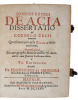
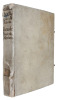
The work deals with chirurgical instruments, fibulas, bandages in historical perpective.Osler 3795 Waller 14722.
Analecta et Notæ in Ludovici Septalii Animadversiones et Cavtiones Medicas.
Patavi, Pauli Frambotti, 1652. Cont.full calf. Gilt back a.gilt borders on covers. Back a little rubbed. Coat of arms of Charron Marquis de Menors on both covers. (46),703 pp. + Index. Waller 7929. First edition.
De Acacia Dissertatio Ad Cornelli Celsi mentem qva simul universa Fibulæ ratio explicantur secundis Curis Ex Autographo Autoris auctior (et) De Ponderibus et Mensuris vetrum medicorum...á Th.Bartholino. 2 vols.
Hafniæ, 1672. 4to. Cont.full calf. First hinge broken. Engr.portr. (26),218,(24),76 pp., 4 engr. plts.a.many wood-cut-illustr.in the text. Waller 14722. The work deals with chirurgical instruments and bandages in historical perspective.
Argonautica. Ad fidem librorum manuscriptorum et Editionem antiquarum recensuit, integram Lectionis varietatem et annotationes adiecit, Scholia aucta et emendata indicesque locupletissimos addidit Augustus Wellauer. Volumen Prius-Secundum. (2 Bde.).
Leipzig, B.G. teubner, 1828. Bound in one contemp. hcalf. Gilt spine. Spine somewhat worn, loosing a bit of leather at top and a crack to lower part of firast hinge. Internally fine and clean. Stamps to titlepage. XIII,293318 pp.
Congo 1959 ou cinquante ans de civilisation. Série : La nation, N° 57.
Bruxelles, Ministère de la Défense Nationale, 1959. 14 x 22, 114 pp., nombreuses illustrations en N/B, une grande carte dépliante en couleurs, broché, bon état (couverture défraîchie).
Argonautica. Αργοναυτικά. E scriptis octo veteribus libris quorum plerique nondum colati fuerant, Nunc primum emendate editit Rich.Fr. Phil. Brunck.
Argentorati, Bauer et Treuttel 1780. In-12o, XIV+214 TEXTE GREC et 244 pp. Variae lectiones, notae et emendationes latin. Rel. plein maroquin XIXe, dos a faux nerfs et tranches dores, Plats avec roulette et ex-libris aux armes du comte J. de Lagondie, petit manque en bas du dos restaure.

