 Write to the booksellers
632 books for « poincare h »Edit
-
Type
Autograph (2)
Book (620)
Photographs (12)
-
Latest
Last 24h (1)
Last 3 days (1)
Last month (7)
-
Language
French (611)
Russian (23)
-
Century
19th (46)
20th (304)
21st (3)
-
Countries
Belgium (25)
Canada (3)
Côte d'Ivoire (1)
Denmark (37)
France (526)
Germany (1)
Switzerland (17)
United States of America (24)
-
Syndicate
ALAC (2)
CLAM (1)
ILAB (311)
NVVA (5)
SLACES (5)
SLAM (264)
SNCAO (5)
Topics
- Alps (2)
- Alsace (4)
- Astronomy (2)
- Autographs (7)
- Balkan (5)
- Barres maurice (2)
- Biography (8)
- Boutroux emile (2)
- Carpenter (2)
- Chagny andré (4)
- Champagne (5)
- Courteline georges (2)
- Diplomacy (11)
- Discovery (2)
- Earth (2)
- Economics (17)
- Education (3)
- Education - morals (2)
- Electricity (10)
- Epistemology (2)
- Essays (2)
- Europe (5)
- Finances (3)
- First edition (9)
- Flammarion camille (2)
- Geography (2)
- Gérin rené (2)
- Hachette (2)
- Inter war period (3)
- Joffre (2)
- Lapaire hugues (4)
- Law (3)
- Literature (19)
- Lorrain (9)
- Manuscripts (3)
- Mathematics (46)
- Mechanics (5)
- Medicine (4)
- Memories (9)
- Memories (5)
- Military arts (12)
- Nationalism (2)
- Newspapers press (2)
- Paris (4)
- Philosophy (32)
- Photographic documentation (1)
- Photography (11)
- Physics (37)
- Poincaré raymond (472)
- Policy (26)
- Portraits (3)
- Psychology (6)
- Pyrenees (2)
- Reboux paul (2)
- Renan ernest (2)
- Review (2)
- Reviews (2)
- Russia (2)
- Sciences (61)
- Sciences & technique (3)
- Social sciences (2)
- Speeches (10)
- Tea (3)
- Trade unionism (2)
- Various (21)
- Verdun (4)
- Vito (2)
- Wagner richard (2)
- War (89)
- War 14/18 (4)
Au service de la France, neuf années de souvenirs.
1926 Paris. Librairie Plon. (1926-1933). 10 volumes in-8, demi-maroquin rouge, dos à nerfs titrés dorés, têtes dorées, couvertures et dos conservés. Reliures signées Franz.
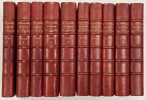
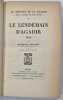
Mémoires et témoignage chronologique unique d’une des personnalités politiques les plus influentes de la IIIème république, illustré de nombreuses planches photographiques. Président du conseil et ministre des affaires étrangères en 1912, Poincaré apporte un éclairage central sur les conséquences du coup d’Agadir et sur les conflits aux Balkans. C’est ensuite en temps que président de la République française qu’il aborde sa vision personnelle des événements jalonnant la première guerre mondiale. Sa politique fut dominée par le souci d'organiser la défense contre l'Allemagne et de renforcer l'alliance russe. Fortement marqué durant sa jeunesse par l'invasion de 1870 (il avait alors 10 ans), il fut animé toute sa vie par la volonté de retrouver les provinces perdues au traité de Francfort. Ces "Souvenirs", qui prennent parfois l'aspect d'un journal, commencent en 1912 et se terminent à l'Armistice en 1918, point culminant de sa carrière politique. (Laffont-Bompiani)Un 11ème tome intitulé « A la recherche de la paix », basé sur des notes personnelle, paraitra en 1974.Bel exemplaire. Ex-libris Marcel Prot.


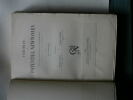
Théorie du Potentiel newtonien. Leçons professées à la Sorbonne pendant le permier semestre 1894-1895. Rédigées par Ed. Le Roy et G. Vincent.
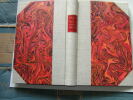
Paris, Gauthier-Villars, 1899. 165 X 260 mm. relié demi-toile grise à coins, pièce de titre rouge au dos, non rogné (rel. récente). 366 pp. Avec 88 figures. Edition originale.
Phone number : 41 021 964 60 10
Mémoire sur les Fonctions fuchsiennes.
[Berlin, Stockholm, Paris, F. & G. Beijer, 1882]. Large4to. As extracted from ""Acta Mathematica"", In ""Acta Mathematica"", volume 1. Clean and fine. Pp. 193-294.
First printing of Poincaré's famous paper which conjectured the uniformization theorem for (the Riemann surfaces of) algebraic curves. It also constitute the second paper in Poincaré's exceedingly important series of six paper's which together represent the discovery of Automorphic Functions. ""Before he was thirty years of age, Poincaré became world famous with his epoch-making discovery of the ""automorphic functions"" of one complex variable (or, as he called them, the ""fuchsian"" and ""kleinean"" functions)."" (DSB).These manuscripts, written between 28 June and 20 December 1880, show in detail how Poincaré exploited a series of insights to arrive at his first major contribution to mathematics: the discovery of the automorphic functions. In particular, the manuscripts corroborate Poincaré's introspective account of this discovery (1908), in which the real key to his discovery is given to be the recognition that the transformations he had used to define Fuchsian functions are identical with those of non-Euclidean geometry.The idea was to come in an indirect way from the work of his doctoral thesis on differential equations. His results applied only to restricted classes of functions and Poincaré wanted to generalize these results but, as a route towards this, he looked for a class functions where solutions did not exist. This led him to functions he named Fuchsian functions after Lazarus Fuchs but were later named automorphic functions. First editions and first publications of these epochmaking papers representing the discovery of ""automorphic functions"", or as Poincaré himself called them, the ""Fuchsian"" and ""Kleinian"" functions.""By 1884 Poincaré published five major papers on automorphic functions in the first five volumes of the new Acta Mathematica. When the first of these was published in the first volume of the new Acta Mathematica, Kronecker warned the editor, Mittag-Leffler, that this immature and obscure article would kill the journal. Guided by the theory of elliptic functions, Poincarë invented a new class of automorphic functions. This class was obtained by considering the inverse function of the ratio of two linear independent solutions of an equation. Thus this entire class of linear diffrential equations is solved by the use of these new transcendental functions of Poincaré."" (Morris Kline).Poincaré explains how he discovered the Automorphic Functions: ""For fifteen days I strove to prove that there could not be any functions like those I have since called Fuchsian functions, I was then very ignorant" every day I seated myself at my work table, stayed an hour or two, tried a great number of combinations and reached no results. One evening, contrary to my custom, I drank black coffee and could not sleep. Ideas rose in crowds I felt them collide until pairs interlocked, so to speak, making a stable combination. By the next morning I had established the existence of a Class of Fuchsian functions, those which come from hypergeometric series" i had only to write out the results, which took but a few hours...the transformations that I had used to define the Fuchsian functions were identical with those of Non-Euclidean geometry...""
Sur la dynamique de l'electron. (Séance du Lundi 5 Juin 1905).
Paris, Gauthier-Villars, 1905. 4to. No wrappers. In: ""Comptes Rendus Hebdomadaires des Séances de L'Academie des Sciences"", Tome 140, No 23. Titlepage to vol. 140. Pp. (1497-) 1572. (Entire issue offered). Poincaré's paper: pp. 1504-1508. Titlepage with a stamp on verso. A bit of upper right corner gone. Leaves a bit fragile, caused by the poor paperquality. Clean.
First printing of this famous paper delivered to the Academy of Paris on its session of June 1905, as the first Poincaré relativistic text ""On the dynamic of electron"", where Poincaré set forth the essential element of relativity and the ""Lorentz Transformation"". Poincaré concludes ""It seems that this impossibility of demonstrating absolute motion is a general law of nature"" !! and that Newton's law need modification and that there should exist gravitational waves which propagate with the velocity of light !! - This famous paper gave rice to the controversy about priority around the discovery of special relativity as Poincaré's paper is from June 5 and Einstein's first paper on relativity was received by the ""Annalen"" on June 30, both 1905.""The official history tells us that Einstein, without having read the works of Lorentz and Poincaré past 1895 and without any prior publication on the subject, had written alone in Bern the ""founder paper"" of the Relativity in the last days of June 1905. For that reason, and a few other of less importance, the biographers of Einstein have called that year 1905 ""Annus mirabilis"" and its centenial is celebrated in 2005. However on June 5, 1905, after many other papers on this subject, Poincaré had presenteda note at the French Academy of Science, a text that contains the essential elements of Einstein paper: the relativity principle and the ""Lorentz transformation"". This coincidence involves the suspicion of a possible plagiarism of Poincaré by Einstein."" (C. Marchal ""Poincaré, Einstein and the Relativity: the Surprising Secret.""
Mémoire sur les fonctions zétafuchsiennes. (In: Acta Mathematica 5, 1884/1885). - [THE DISCOVERY OF AUTOMORPHIC FUNCTIONS]
Berlin, Stockholm, Paris, F. & G. Beijer, 1884. 4to. In contemporary half cloth. Stamps to title-page and last leaf. In ""Acta Mathematica"", no 5, 1884/1885. Entire issue offered. Pp. 209-278. [Entire issue: (4) 408 pp.].
First publication of this groundbreaking paper which together with his three other papers on the pubject (not offered here) constitute the discovery of Automorphic Functions. ""Before he was thirty years of age, Poincaré became world famous with his epoch-making discovery of the ""automorphic functions"" of one complex variable (or, as he called them, the ""fuchsian"" and ""kleinean"" functions)."" (DSB).These manuscripts, written between 28 June and 20 December 1880, show in detail how Poincaré exploited a series of insights to arrive at his first major contribution to mathematics: the discovery of the automorphic functions. In particular, the manuscripts corroborate Poincaré's introspective account of this discovery (1908), in which the real key to his discovery is given to be the recognition that the transformations he had used to define Fuchsian functions are identical with those of non-Euclidean geometry. (See Walter, Poincaré, Jules Henri French mathematician and scientist).The idea was to come in an indirect way from the work of his doctoral thesis on differential equations. His results applied only to restricted classes of functions and Poincaré wanted to generalize these results but, as a route towards this, he looked for a class functions where solutions did not exist. This led him to functions he named Fuchsian functions after Lazarus Fuchs but were later named automorphic functions. First editions and first publications of these epochmaking papers representing the discovery of ""automorphic functions"", or as Poincaré himself called them, the ""Fuchsian"" and ""Kleinian"" functions.""By 1884 Poincaré published five major papers on automorphic functions in the first five volumes of the new Acta Mathematica. When the first of these was published in the first volume of the new Acta Mathematica, Kronecker warned the editor, Mittag-Leffler, that this immature and obscure article would kill the journal. Guided by the theory of elliptic functions, Poincarë invented a new class of automorphic functions. This class was obtained by considering the inverse function of the ratio of two linear independent solutions of an equation. Thus this entire class of linear diffrential equations is solved by the use of these new transcendental functions of Poincaré."" (Morris Kline).Poincaré explains how he discovered the Automorphic Functions: ""For fifteen days I strove to prove that there could not be any functions like those I have since called Fuchsian functions, I was then very ignorant" every day I seated myself at my work table, stayed an hour or two, tried a great number of combinations and reached no results. One evening, contrary to my custom, I drank black coffee and could not sleep. Ideas rose in crowds I felt them collide until pairs interlocked, so to speak, making a stable combination. By the next morning I had established the existence of a Class of Fuchsian functions, those which come from hypergeometric series" i had only to write out the results, which took but a few hours...the transformations that I had used to define the Fuchsian functions were identical with those of Non-Euclidean geometry...""
Theorie des Groupes fuchsiens (+) Mémoire sur les Fonctions fuchsiennes (+) Sur les Fonctions de deux Variables (+) Mémoire sur les groupes kleinéens (+) Sur les groupes des équations linéaires (+) Mémoire sur les fonctions zétafuchsiennes. - [THE DISCOVERY OF AUTOMORPHIC FUNCTIONS]
Berlin, Stockholm, Paris, F. & G. Beijer, 1882-84. Large4to (272 x 230 mm). Three volumes uniformly bound in contemporary half calf with gilt lettering to spine. In ""Acta Mathematica"", volume 1-5. Light wear to extremities, boards and spines with scratches. Stamp to verso of front board in all volumes. First three leaves in first volume detached, otherwise internally fine and clean. Vol. I, pp. 1-62" Pp. 193-294 Vol. II, pp. 97-113 Vol. III. pp. 49-92 Vol. IV pp. 201-312" Vol. V pp. 209-278.
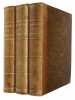
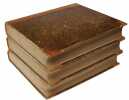
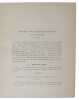
First publication of these groundbreaking papers which together constitute the discovery of Automorphic Functions. ""Before he was thirty years of age, Poincaré became world famous with his epoch-making discovery of the ""automorphic functions"" of one complex variable (or, as he called them, the ""fuchsian"" and ""kleinean"" functions)."" (DSB).These manuscripts, written between 28 June and 20 December 1880, show in detail how Poincaré exploited a series of insights to arrive at his first major contribution to mathematics: the discovery of the automorphic functions. In particular, the manuscripts corroborate Poincaré's introspective account of this discovery (1908), in which the real key to his discovery is given to be the recognition that the transformations he had used to define Fuchsian functions are identical with those of non-Euclidean geometry. (See Walter, Poincaré, Jules Henri French mathematician and scientist).The idea was to come in an indirect way from the work of his doctoral thesis on differential equations. His results applied only to restricted classes of functions and Poincaré wanted to generalize these results but, as a route towards this, he looked for a class functions where solutions did not exist. This led him to functions he named Fuchsian functions after Lazarus Fuchs but were later named automorphic functions. First editions and first publications of these epochmaking papers representing the discovery of ""automorphic functions"", or as Poincaré himself called them, the ""Fuchsian"" and ""Kleinian"" functions.""By 1884 Poincaré published five major papers on automorphic functions in the first five volumes of the new Acta Mathematica. When the first of these was published in the first volume of the new Acta Mathematica, Kronecker warned the editor, Mittag-Leffler, that this immature and obscure article would kill the journal. Guided by the theory of elliptic functions, Poincarë invented a new class of automorphic functions. This class was obtained by considering the inverse function of the ratio of two linear independent solutions of an equation. Thus this entire class of linear diffrential equations is solved by the use of these new transcendental functions of Poincaré."" (Morris Kline).Poincaré explains how he discovered the Automorphic Functions: ""For fifteen days I strove to prove that there could not be any functions like those I have since called Fuchsian functions, I was then very ignorant" every day I seated myself at my work table, stayed an hour or two, tried a great number of combinations and reached no results. One evening, contrary to my custom, I drank black coffee and could not sleep. Ideas rose in crowds I felt them collide until pairs interlocked, so to speak, making a stable combination. By the next morning I had established the existence of a Class of Fuchsian functions, those which come from hypergeometric series" i had only to write out the results, which took but a few hours...the transformations that I had used to define the Fuchsian functions were identical with those of Non-Euclidean geometry...""
Theorie des Groupes fuchsiens (+) Mémoire sur les Fonctions fuchsiennes (+) Sur les Fonctions de deux Variables (+) Mémoire sur les groupes kleinéens (+) Sur les groupes des équations linéaires (+) Mémoire sur les fonctions zétafuchsiennes. - [THE DISCOVERY OF AUTOMORPHIC FUNCTIONS]
Berlin, Stockholm, Paris, F. & G. Beijer, 1882-84. Large4to. As extracted from ""Acta Mathematica"", no backstrip. With title-page and the original wrappers. (except for paper no. 3 and 5 which only has the title page). In ""Acta Mathematica"", volume 1-5. Title pages with library stamp. Internally clean and fine. Vol. I, pp. 1-62" Pp. 193-294 Vol. II, pp. 97-113 Vol. III. pp. 49-92 Vol. IV pp. 201-312" Vol. V pp. 209-278.
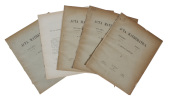
First publication of these groundbreaking papers which together constitute the discovery of Automorphic Functions. ""Before he was thirty years of age, Poincaré became world famous with his epoch-making discovery of the ""automorphic functions"" of one complex variable (or, as he called them, the ""fuchsian"" and ""kleinean"" functions)."" (DSB).These manuscripts, written between 28 June and 20 December 1880, show in detail how Poincaré exploited a series of insights to arrive at his first major contribution to mathematics: the discovery of the automorphic functions. In particular, the manuscripts corroborate Poincaré's introspective account of this discovery (1908), in which the real key to his discovery is given to be the recognition that the transformations he had used to define Fuchsian functions are identical with those of non-Euclidean geometry. (See Walter, Poincaré, Jules Henri French mathematician and scientist).The idea was to come in an indirect way from the work of his doctoral thesis on differential equations. His results applied only to restricted classes of functions and Poincaré wanted to generalize these results but, as a route towards this, he looked for a class functions where solutions did not exist. This led him to functions he named Fuchsian functions after Lazarus Fuchs but were later named automorphic functions. First editions and first publications of these epochmaking papers representing the discovery of ""automorphic functions"", or as Poincaré himself called them, the ""Fuchsian"" and ""Kleinian"" functions.""By 1884 Poincaré published five major papers on automorphic functions in the first five volumes of the new Acta Mathematica. When the first of these was published in the first volume of the new Acta Mathematica, Kronecker warned the editor, Mittag-Leffler, that this immature and obscure article would kill the journal. Guided by the theory of elliptic functions, Poincarë invented a new class of automorphic functions. This class was obtained by considering the inverse function of the ratio of two linear independent solutions of an equation. Thus this entire class of linear diffrential equations is solved by the use of these new transcendental functions of Poincaré."" (Morris Kline).Poincaré explains how he discovered the Automorphic Functions: ""For fifteen days I strove to prove that there could not be any functions like those I have since called Fuchsian functions, I was then very ignorant" every day I seated myself at my work table, stayed an hour or two, tried a great number of combinations and reached no results. One evening, contrary to my custom, I drank black coffee and could not sleep. Ideas rose in crowds I felt them collide until pairs interlocked, so to speak, making a stable combination. By the next morning I had established the existence of a Class of Fuchsian functions, those which come from hypergeometric series" i had only to write out the results, which took but a few hours...the transformations that I had used to define the Fuchsian functions were identical with those of Non-Euclidean geometry...""
Theorie des Groupes fuchsiens. - [THE DISCOVERY OF AUTOMORPHIC FUNCTIONS]
Berlin, Stockholm, Paris, F. & G. Beijer, 1882. Large4to. As extracted from ""Acta Mathematica"", no backstrip. With title-page and front free end-paper. In ""Acta Mathematica"", volume 1. Title pages with library stamp. A fine and clean copy. Pp. (6), 62.
First publication of this groundbreaking paper which became Poincaré first paper in his much celebrated and famous six-paper series which together constitute the discovery of Automorphic Functions. ""Before he was thirty years of age, Poincaré became world famous with his epoch-making discovery of the ""automorphic functions"" of one complex variable (or, as he called them, the ""fuchsian"" and ""kleinean"" functions)."" (DSB).These manuscripts, written between 28 June and 20 December 1880, show in detail how Poincaré exploited a series of insights to arrive at his first major contribution to mathematics: the discovery of the automorphic functions. In particular, the manuscripts corroborate Poincaré's introspective account of this discovery (1908), in which the real key to his discovery is given to be the recognition that the transformations he had used to define Fuchsian functions are identical with those of non-Euclidean geometry.The idea was to come in an indirect way from the work of his doctoral thesis on differential equations. His results applied only to restricted classes of functions and Poincaré wanted to generalize these results but, as a route towards this, he looked for a class functions where solutions did not exist. This led him to functions he named Fuchsian functions after Lazarus Fuchs but were later named automorphic functions. First editions and first publications of these epochmaking papers representing the discovery of ""automorphic functions"", or as Poincaré himself called them, the ""Fuchsian"" and ""Kleinian"" functions.""By 1884 Poincaré published five major papers on automorphic functions in the first five volumes of the new Acta Mathematica. When the first of these was published in the first volume of the new Acta Mathematica, Kronecker warned the editor, Mittag-Leffler, that this immature and obscure article would kill the journal. Guided by the theory of elliptic functions, Poincarë invented a new class of automorphic functions. This class was obtained by considering the inverse function of the ratio of two linear independent solutions of an equation. Thus this entire class of linear diffrential equations is solved by the use of these new transcendental functions of Poincaré."" (Morris Kline).Poincaré explains how he discovered the Automorphic Functions: ""For fifteen days I strove to prove that there could not be any functions like those I have since called Fuchsian functions, I was then very ignorant" every day I seated myself at my work table, stayed an hour or two, tried a great number of combinations and reached no results. One evening, contrary to my custom, I drank black coffee and could not sleep. Ideas rose in crowds I felt them collide until pairs interlocked, so to speak, making a stable combination. By the next morning I had established the existence of a Class of Fuchsian functions, those which come from hypergeometric series" i had only to write out the results, which took but a few hours...the transformations that I had used to define the Fuchsian functions were identical with those of Non-Euclidean geometry...""
Sur les Fonctions Uniformes qui se reproduisent par des Substitutions Linéaires (+) [Klein's introduction to the present paper].
Leipzig, B.G. Teubner, 1882. 8vo. Original printed wrappers, no backstrip. In ""Mathematische Annalen. Begründet 1882 durch Rudolf Friedrich Alfred Clebsch. XIX. [19] Band. 4. Heft."" Entire issue offered. [Poincaré:] Pp. 553-64. [Entire issue: Pp. 435-594].
First printing of Poincaré's paper on his comprehensive theory of complex-valued functions which remain invariant under the infinite, discontinuous group of linear transformations. In 1881 Poincaré had published a few short papers with some initial work on the topic, and in the 1881, Klein invited Poincaré to write a longer exposition of his results to Mathematische Annalen which became the present paper. This, however, turned out to be an invitation to at mathematical dispute:""Before the article went to press, Klein forewarned Poincaré that he had appended a note to it in which he registered his objections to the terminology employed therein. In particular, Klein disputed Poincaré's decision to name the important class of functions possessing a natural boundary circle after Fuch's, a leading exponent of the Berlin school. The importance he attached to this matter, however, went far beyond the bounds of conventional priority dispute. True, Klein was concerned that his own work received sufficient acclaim, but the overriding issue hinged on whether the mathematical community would regard the burgeoning research in this field as an outgrowth of Weierstrassian analysis or the Riemannian tradition."" Parshall. The Emergence of the American Mathematical Research Community. Pp. 184-5.The issue contains the following important contributions by seminal mathematicians:1. Klein, Felix. Ueber eindeutige Functionen mit linearen Transformationen in sich. Pp. 565-68.2. Picard, Emile. Sur un théorème relatif aux surfaces pour lesquelles les coordnnées d´un point quelconque s´experiment par des fonctions abéliennes de deux paramètres. Pp. 578-87.3. Cantor, Georg. Ueber ein neues und allgemeines Condensationsprincip der Singularitäten von Functionen. Pp. 588-94.
Les Balkans en feu. 1912.
Plon, 1926, in-8°, 429 pp, 2 pl. de photos hors texte, notes, reliure demi-percaline verte, dos lisse orné d'un fleuron et d'un double filet dorés en queue, pièce de titre basane noire (rel. de l'époque), bon état. Edition originale sur papier d'édition
Tome II des mémoires de l'auteur (“Au Service de la France. Neuf années de Souvenirs”). — "Un volume plein de vie et de dramatique intérêt qui nous fait revivre l'année 1912, durant la première guerre balkanique, c'est-à-dire aux origines de la grande guerre. Dès le printemps de 1912, on voit poindre la guerre balkanique. M. Poincaré, le premier, aperçoit le péril, s'en alarme, travaille à le prévenir. M. Sazonof se croit assuré de pouvoir, à son gré, retenir les États balkaniques qui lui ont promis de ne rien précipiter sans son agrément; c'est M. Poincaré qui, durant sa visite à Pélersbourg, lui montre, dans l'alliance serbo-bulgare, la pointe offensive. L'intrigue autrichienne, dans les Balkans, s'entrecroise avec l'intrigue russe ; M. Poincaré voit nettement que la résolution des petits États, poussés à bout par la maladresse des Jeunes-Turcs à l'égard des chrétiens de Macédoine, peut, à un moment donné, déclencher la guerre, en dépit des recommandations des Puissances. Comment la victoire des Bulgares, et surtout celle des Serbes et des Grecs, fut une surprise pour tous les gouvernements et apparut à quelques-uns comme une catastrophe, des documents précis nous le montrent. La crise de 1912, conséquence de celle de 1909, est comme la répétition générale de celle de 1914 où, délibérément, l'Allemagne et l'Autriche voulurent ou l'humiliation de la Russie et son abdication dans les Balkans, ou la guerre. Ces conséquences, M. Poincaré les prévoit dès 1912. Il se montre, à la lumière des documents, le défenseur résolu des intérêts de la France, fidèle à ses engagements sans les dépasser jamais, et le meilleur ouvrier de la paix européenne." (René Pinon, Revue des Deux Mondes, 1926) — "M. Raymond Poincaré rassemble et publie les souvenirs de sa vie politique de 1911 à 1920 en une série de volumes dont chacun porte un titre spécial. Le récit suit strictement l'ordre chronologique, il contient de nombreuses pièces inédites (memoranda, dépêches, lettres privées, etc.). Ce deuxième volume est un témoignage de tout premier ordre, en particulier sur les affaires d'Orient de 1912-1913 et les relations avec la Russie pendant la guerre balkanique." (Raymond Guyot, Revue Historique) — "Grâce aux copies de documents qu'il avait en sa possession, M. Poincaré a été à même de livrer à la publicité quantité de pièces inédites de grande valeur. Il va de soi que ces souvenirs ont provoqué de vives polémiques. Mais personne, je crois, n'a contesté la largeur de vues, la fermeté de pensée, la vigueur de certaines démonstrations, qui font de ces volumes de fortes pages d'histoire." (Pierre Renouvin, Revue Historique) Désormais les frais d'envoi sont de 6 € seulement pour les livres jusqu'à 1 kg (colissimo suivi), pour la France métropolitaine.
Poincare Henri. / Poincare A. Lecons sur les hypotheses cosmogoniques. / Lessons
Poincare Henri. / Poincare A. Lecons sur les hypotheses cosmogoniques. / Lessons on cosmogonic hypotheses. In French (ask us if in doubt)/Poincare Henri./ Puankare A. Lecons sur les hypotheses cosmogoniques./ Uroki po kosmogonicheskim gipotezam. Cosmogonic Hypotheses. In French. Second Edition. Paris. 1913. 294s. We have thousands of titles and often several copies of each title may be available. Please feel free to contact us for a detailed description of the copies available. SKUalb6c19b6df96d09e6c
Notice sur la distribution et marche des pluies dans la département de la Meuse, le bassin supérieur de la rivière Meuse et une zone avoisinante du bassin de la Seine
Paris, Dunod, 1873, in-8, 43, (1) pages et (2) cartes depl, broché, couverture imprimée de l'éditeur, Rare tiré à part non coupé. A travers cette brochure, Poincaré traite des trois modes de représentation (isoombres, suivies et horaires) des phénomènes météorologiques, modes employés avec beaucoup de réticence à l'époque. Il explique notamment les légendes des deux cartes qu'il a réalisées pour représenter les pluies tombées sur la Meuse et le bassin de la Seine durant l'hiver 1868-1869. En 1871, Poincaré présente à la Commission de l'Association Scientifique de France une étude en 7 parties intitulée "études sur la distribution et la marche des pluies dans la région". Un résumé sera publié peu après dans le n° 211 de la revue hebdomadaire de l'institution. Antoine Poincaré, polytechnicien et ingénieur en chef à Bar-le-Duc fut l'oncle du mathématicien et physicien Henri Poincaré et le père de Raymond Poincaré, président de la France de 1913 à 1920. Malgré la présence minime de rousseurs et de taches sur les couvertures, bel exemplaire. Couverture rigide
Bon 43, (1) pages et (2) cartes
Sur les Fonctions Uniformes qui se reproduisent par des Substitutions Linéaires (+) Ueber ein neues und allgemeines Condensationsprincip der Singularitäten von Functionen.
Leipzig, B.G. Teubner, 1882. 8vo. Bound in recent full black cloth with gilt lettering to spine. In ""Mathematische Annalen"", Volume 37, 1890. Entire volume offered. Library label pasted on to pasted down front free end-paper. Small library stamp to lower part of title title page and verso of title page. Fine and clean. Pp. 182-228. [Entire volume: IV, 604 pp.].
First printing of Poincaré's paper on his comprehensive theory of complex-valued functions which remain invariant under the infinite, discontinuous group of linear transformations. In 1881 Poincaré had published a few short papers with some initial work on the topic, and in the 1881, Klein invited Poincaré to write a longer exposition of his results to Mathematische Annalen which became the present paper. This, however, turned out to be an invitation to at mathematical dispute:""Before the article went to press, Klein forewarned Poincaré that he had appended a note to it in which he registered his objections to the terminology employed therein. In particular, Klein disputed Poincaré's decision to name the important class of functions possessing a natural boundary circle after Fuch's, a leading exponent of the Berlin school. The importance he attached to this matter, however, went far beyond the bounds of conventional priority dispute. True, Klein was concerned that his own work received sufficient acclaim, but the overriding issue hinged on whether the mathematical community would regard the burgeoning research in this field as an outgrowth of Weierstrassian analysis or the Riemannian tradition."" Parshall. The Emergence of the American Mathematical Research Community. Pp. 184-5.The issue contains the following important contributions by seminal mathematicians:1. Klein, Felix. Ueber eindeutige Functionen mit linearen Transformationen in sich. Pp. 565-68.2. Picard, Emile. Sur un théorème relatif aux surfaces pour lesquelles les coordnnées d´un point quelconque s´experiment par des fonctions abéliennes de deux paramètres. Pp. 578-87.
L'oeuvre mathématique de Weierstrass (+) Sur les Propriétes du potentiel et sur les Fonctions Abéliennes [Poincaré] (+) Sur la Théorie des Variations des Latitudes [Poincaré].
Berlin, Stockholm, Paris, Beijer, 1899. 4to. Bound in contemporary half cloth with gilt lettering to spine. In ""Acta Mathematica"", Vol, 22, 1899. Entire volume offered. Stamps to title page, otherwise a fine and clean copy. pp. 1-18" Pp. 89-178" Pp. 201-358.[Entire volume: (4), 388, 2 pp].
First printing of these important papers: POINCARÉ: First edition. ""As soon as he came into contact with the work of Riemann and Weierstrass on Abelian Functions and algebraic geometry, Poincaré was very much attracted by those fields. His papers on these subjects occupy in his complete works as much space as those on automorphic functions, their dates ranging from 1881 to 1911. One of his main ideas in these papers is that of ""reduction"" of Abelian functions. Generalizing particular cases studied b Jacobi, Weierstrass, and Picard, Poincaré proved the general ""complete reducibility"" theorem...""(DSB).VOLTERRA: First edition. As the north and south poles, instead of being fixed points on the earth's surface, wander round within a circle of ab. 5o ft. in diameter, the result is a variability of terrestial latitudes generally. Volterra gives an elaborate mathematical analysis of these yearly fluxtuations.
"POINCARE, H. (HENRI). - THE DISCOVERY OF AUTOMORPHIC FORMS.
Reference : 49173
(1882)
Sur les fonctions fuchsiennes. (+) Sur les fonctions.... Note. (+) Sur les fonctions.... Note.
(Paris: Gauthier-Villars), 1882. 4to. No wrappers. In: ""Comptes Rendus Hebdomadaires des Seances de l'Academie des Sciences"", Vol 94, No 4 + 15 + 17. Pp. (149-) 184, pp. (997--) 1068 a. pp. (1139-) 1214. (3 entire issues offered). Poincare's papers: pp. 163-168, 1038-1042 a. 1166-67.
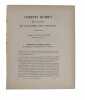
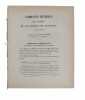
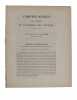
First appearance in print of the discovery of the automorphic forms, which Poincaré named Fuchsian functions.""One of Poincaré's first discoveries in mathematics, dating to the 1880s, was automorphic forms. He named them Fuchsian functions, after the mathematician Lazarus Fuchs, because Fuchs was known for being a good teacher and had researched on differential equations and the theory of functions. Poincaré actually developed the concept of these functions as part of his doctoral thesis. Under Poincaré's definition, an automorphic function is one which is analytic in its domain and is invariant under a discrete infinite group of linear fractional transformations. Automorphic functions then generalize both trigonometric and elliptic functions."" (Wikipedia).
LES TRAITS ÉTERNELS DE LA FRANCE
Paris Emile-Paul Frères, éditeurs 1916 in 12 (18x14,5) 1 volume reliure demi maroquin marron à coins de l'époque, tête dorée, couverture conservée, 55 pages. Reliure signée Henry-John?. Exemplaire sur Hollande van Gelder, N°3 tiré spécialement pour l'auteur. Raymond Poincaré, Bar-le-Duc 1860 - Paris 1934, avocat et homme d'Etat français, président de la République française du 18 février 1913 au 18 février 1920. Henriette Poincaré, née Henriette Adeline Benucci, Passy 1858 - Paris 1943, épouse de Raymond Poincaré, président de la République. Envoi autographe signé par Maurice Barrés à Mme Raymond Poincaré. Bel exemplaire
Bon Couverture rigide Signé par l'auteur Ed. numérotée
La Physique Moderne. Son évolution.
Paris, Flammarion, Bibliothèque de Philosophie Scientifique, 1909 ; in-12,311 pp dont 3 pages de préface, demi-chagrin rouge, dos à nerfs, fleurons dorés, auteur et titre en lettres dorées.
Lucien Antoine Poincaré, né le 22 juillet 1862 à Bar-le-Duc et mort le 9 mars 1920 à Paris, est un physicien et homme politique français. Il est le frère cadet du président de la République Raymond Poincaré, et cousin germain du mathématicien Henri Poincaré. Bel exemplaire.
Sur les Intégrales irrégulieres des Equations linéaires. - [THE FORMAL THEORY OF ASYMPTOTIC SERIES]
(Berlin, Uppsala & Stockholm, Paris, 1886). 4to. Without wrappers as extracted from ""Acta Mathematica. Hrsg. von G. Mittag-Leffler."", Bd. 8, pp. 295-344.
First edition. ""The full recognition of the nature of those divergent series that are useful in the representation and calculation of functions and a formal definition of those series wer achieved by Poincaré and Stieltjes independently in 1886. Poincaré called these series asymptotic while Stieltjes continued to use the term semiconvergent. Poincaré took up the subject in order to further the solution of linear differential equations. Impressed by the usefulness of divergent series in astronomy, he sought to determine which were useful and why. he succededed in islolating and formulating the essential property...Poincaré applied his theory of asymptotic series to diffrential equations, and theree are many such uses in his treatise on celestical mechanics, 'Les Methodes nouvelles de la mechanique céleste"". (Morris Kline).
Sur l'équilibre d'une masse fluide animée d'un mouvement de rotation. - [POINCARÉ'S PEAR-SHAPE]
(Stockholm, Beijer), 1885. 4to. As extracted from ""Acta Mathematica, 21. Band]. No backstrip. Fine and clean. Pp. 259-380.
First printing of Poincaré's famous paper in which he proved that a rotating fluid such as a star changed its shape from a sphere to an ellipsoid to a pear-shape before breaking into two unequal portions. ""This work, which contained the discovery of new, pear-shaped figures of equilibrium, aroused considerable attention because of its important implications for cosmogony in relation to the evolution of binary stars and other celestial bodies."" (The Princeton Companion to Mathematics, P. 786)Another famous paper of Poincaré in celestial mechanics is the one he wrote in 1885 on the shape of a rotating fluid mass submitted only to the forces of gravitation. Maclaurin had found as possible shapes some ellipsoids of revolution to which Jacobi had added other types of ellipsoids with unequal axes, and P. G. Tait and W. Thomson some annular shapes. By a penetrating analysis of the problem, Poincaré showed that still other ""pyriform"" shapes existed. One of the features of his interesting argument is that, apparently for the first time, he was confronted with the problem of minimizing a quadratic form in ""infinitely"" many variables."" (DSB)
Sur les résidus des intégrales doubles. - [POINCARÉ'S LEMMA]
Stockholm, Beijer, 1887. 4to. With the original wrappers in ""Acta Mathematica, 9:4. Band]. No backstrip. Fine and clean. Pp. 321-380. [Entire issue: Pp. 321-400]
First printing of Poincaré important - but partly unrecognized - paper which coined the term 'Poincaré lemma'. Even though it is named after Poincaré the discovery has by attributed to the Italian mathematician Vito Volterra who published a series of papers in 1889 on this subject.
Rapport sur le Prix Bolyai. - [POINCARÉ APPRAISAL OF HILBERT]
Berlin, G. Reimer, 1912. 4to. Bound in contemporary half cloth with gilt lettering to spine. In ""Acta Mathematica"", Vol, 35, 1912. Entire volume offered. Stamps to title page, otherwise a fine and clean copy. Pp. 1-28. [Entire volume: (4), 398, (1), 27, 19 pp].
First appearance of Poincaré's report on 1910 Bolyai Prize which was awarded to David Hilbert in recognition of his work in fields of invariant theory, transcendent number (e constant after Lindemann), arithmetic, the (Hilbert-)Waring theorem, geometry, integral equations and the Dirichlet’s principle.In 1910, Hilbert became only the second winner of the Bolyai Prize of the Hungarian Academy of Sciences. It was the recognition of the fact that Hilbert was one of the leading mathematicians of his time. The first winner of the prize in 1905 was Henri Poincare, the most prolific mathematician of the 19th century.Poincaré about the works and achievements of David Hilbert in fields of invariant theory, transcendent number (e constant after Lindemann), arithmetic, the (Hilbert-)Waring theorem, geometry, integral equations and the Dirichlet’s principle.
Sur L'Uniformisation des Fonctions Analytiques. - [THE UNIFORMIZATION THEOREM]
Berlin, Stockholm, Paris, Almqvist & Wiksell, 1908. 4to. Bound in contemporary half cloth with gilt lettering to spine. In ""Acta Mathematica"", Vol, 31, 1908. Entire volume offered. Stamps to title page, otherwise a fine and clean copy. Pp. 1-64. [Entire volume: (8), 408, (2), 12 pp].
First appearance of Poincaré's important paper in which he presented the first solution to the problem of the uniformization of curves - now know as The Uniformization Theorem. Clebsch and Riemann tried to solve the problem of the uniformization for curves. ""In 1882 Klein gave a general uniformization theorem, but the proof was not complete. In 1883 Poincaré announced his general uniformization theorem but he too had no complete proof. Both Klein and Poincaré continued to work hard to prove this theorem but no decisive result was obtained for twent-five years. In 1907 Poincare (in the offered paper) and Paul Koebe independently gave a proof of this uniformization theorem...With the theorem on uniformization now rigorously established an improved treatment of algebraic functions and their integrals has become possible."" (Morris Kline).
Poincare A. Vortex Theory. In Russian /Puankare A. Teoriya vikhrey.
Poincare A. Vortex Theory. In Russian /Puankare A. Teoriya vikhrey. (ISBN: 5-93972-038-2 5939720382) The book is a lecture by A. Poincare, which is an integral part of the course of mathematical physics. The lectures develop Helmholtzs ideas and contain the authors own results. Useful to a wide range of readers - physicists, mathematicians, historians of science. You are welcome to reach out to us for a detailed description of the copies currently available. Delivery of this book may take longer than usual including extended processing and pre-shipping time, no expedited shipping is available. Please advise us if you have a set date or a deadline to receive your order.SKUalb304813ad15435df8
Poincare A. Recent works by A. Poincare. In Russian /Puankare A. Poslednie rabo
Poincare A. Recent works by A. Poincare. In Russian /Puankare A. Poslednie raboty A. Puankare. M.-Izhevsk. SRC RCD 2001.Contact us for details or to request photos of available books. Delivery of this book could take longer than normal due to additional handling time before shipping, and no rush delivery options are available. Please let us know if you have a specific date by which you need to receive your order.SKUalbf10b9a00fc773754
# TITRE: Au service de la France, neuf années de souvenirs. (dédicacés par Poincaré)
# AUTEUR: Poincaré Raymond # ÉDITEUR: Plon - Paris. # ANNÉE ÉDITION: 1926 – 1933 # COUVERTURE: Impr. illust. bleue titre noir # DÉTAILS: 10 volumes in 8° brochés. Tome I: Le lendemain d'Agadir 1912, 391pp. 2gravures ht. Tome II: Les Balkans en feu 1912, 429pp. 2gravures ht. Tome III: L'Europe sous les armes 1913, 367pp. 11 gravures ht. Tome IV: L'union sacrée 1914, 551pp. 14 gravures ht. Tome V: L'invasion 1914, 543pp.24 gravures ht. Tome VI: Les tranchées 1915, 357pp. 12 gravures ht. Tome VII: Guerre de siège1915, 378pp.12 gravures ht. Tome VIII: Verdun 1916, 355pp. 13 gravures ht. Tome IX: L'année trouble 1917, 448pp. 13 gravures ht. Tome X: Victoire et armistice 1918, 467pp. 10 gravures ht. Envoi autographe de R. Poincaré à H. Bordeaux sur la page de faux-titre des 9 premiers volumes, le tome X comporte un envoi sur une carte de visite de l'auteur, et le prière d'insérer. Complet. # PHOTOS visibles sur www.latourinfernal.com
# ÉTAT: Très bon état, les 7 premiers tomes non coupés, légers manques au 1er plat des tomes 2, 4, 8

