 Write to the booksellers
134 books for « plautus »Edit
-
Language
French (133)
Latin (1)
-
Century
16th (1)
17th (1)
18th (2)
19th (12)
20th (8)
-
Countries
Belgium (7)
Denmark (5)
France (23)
Netherlands (93)
Switzerland (6)
-
Syndicate
ILAB (21)
NVVA (1)
SLACES (1)
SLAM (14)
M. Acci Plauti Comoediae. Accedit commentarius ex Variorum notis & observationibus. Quarum plurimae nunc primum eduntur. Ex recensione Ioh. Frederici Gronovii.
Leiden (Lugd. Batavorum), Ex officina Hackiana, 1664.
8vo. (XVI),1154,(52 index) p. Calf 20.5 cm (Ref: STCN ppn 840013841; Schweiger 2,766; Dibdin 2,312: 'Gronovius by the assistance of 6 ancient MSS. and his own sagacious conjectures, has improved the text in many places, and given some ingenious and successful explanations of difficult passages'; Moss 2,461/2; Fabricius/Ernesti 1,21; Neue Pauly, Supplement Band 2, Geschichte der antiken Texte, Darmstadt 2007, p. 477; Graesse 5,329; Ebert 17202) (Details: Gilt back with 5 raised bands. Engraved title. Commentary in 2 columns beneath the text) (Condition: Binding scuffed and scratched. Shield on the back gone. Paper of the front pastdown wrinkled. Titlepage cut out, and mounted on blank flyleaf expertly, with removal of the blank margins. Small hole in blank lower margin of the second leaf. Lower margin of the second half partly and very faintly waterstained) (Note: The 21 surviving comedies of the Roman playwright Titus Maccius Plautus, ca. 254-184 B.C., have never been out of fashion since the publication of the 'editio princeps' in 1472. Plautus' influence on world literature is huge. The comedies feature stock situations and characters from everyday life. 'Plautine comedy is inventive, exuberant, varied, full of rollicking eavesdropping scenes, lyrical meters, slapstick, and verbal fireworks.' Early editors, commentators and translators ransacked the plays for rhetorical and moral examples. Ever since the first post-classical performances at the end of the 15th century Plautus never left the stage. The Italian 'commedia erudita' and the popular improvisatory 'commedia dell'arte' developed through imitations of the Roman New Comedy. Probably best known is Carlo Goldoni's adaptation of the Menaechmi (1748) 'I duo gemelli veneziani' (The Venetian Twins). Spain saw the development of 'comedias elegíacas', Latin verse that incorporated Plautine passages into dialogue. Authors like Calderón adopted many New Comedy stage conventions to Spanish taste. In Germany the great dramatist Andreas Gryphius adapted the Miles Gloriosus. And in France Molière, the greatest comic playwright of his age, imitated Plautus in his Amphitryon and in l'Avare. English playwrights like Ben Johnson and Shakespeare reworked plays of Plautus. 'Plautine comedy provided Shakespeare with character and action throughout his career, beginning with direct imitation of the Menaechmi with the Comedy of Errors'. A Midsummer Night's Dream, The Taming of the Shrew, The Merry Wives of Windsor, The Tempest, they all adapt themes, situations and persons of Plautus. During the Golden Age of the Netherlands P.C. Hooft wrote Warenar (1617), an adaptation of Plautus' Aulularia. Plautus enjoyes also a new modern life on the screen. Rodgers and Hart created the music for the Boys from Syracuse (1938). Big Business (1988), inspired by the Menaechmi, tells the story of 2 sets of female twins (Bette Midler & Lily Tomlin) separated at birth. Pseudolus and Miles Gloriosus can be found in the hilarious musical and film A funny thing happened on the way to the Forum (1962) (Source of the quotations: The Classical Tradition, Cambr. Mass., 2010, s.v. Plautus) At school Plautus was never in fashion. The plays were full of immorality, and Plautus' language was too indecent, and too difficult for young boys. Plautus was studied however widely in the 17th century at universities throughout Europe. Schweiger lists 37 editions of the Opera of Plautus for this (17th)century, 15 were published in Germany, 13 in the Netherlands, 5 in Geneva and 4 in France. Popular among scholars and students were the socalled 'Variorum editions'. They offered the 'textus receptus' which was widely accepted, accompanied with the commentary and the annotations of specialists, taken from earlier useful, normative or renewing editions. This Plautus edition was produced by the Dutch classicist of German origin Johann Friedrich Gronov, or Gronovius, 1611-1671. He was the successor of Heinsius at the University of Leiden, and was influenced by Vossius, Grotius, Heinsius & Scriverius. 'His editions mark an epoch in the study of Livy, of Seneca, Tacitus & Gellius. (...) His interest to the textual criticism of Latin poetry was due to the discovery of the Florentine MS of the tragedies of Seneca. (...) In his riper years the acumen exhibited in his handling of prose is also exemplified in his treatment of the text of poets such as Phaedrus and Martial, Seneca and Statius'. (Sandys, History of Classical Scholarship, 2,321) With regard to his Plautus Sandys shows less enthousiasm. 'His edition of Plautus is marred by an imperfect knowledge of metre, which has been noticed by Bentley'. The work on Plautus by Gronovius is however highly valued by modern scholarship. Wolfgang de Melo, the editor of the new Loeb edition of 2011, places him among the great Plautus-scholars. He calls him 'an important editor of Plautus' (...) who particularly valued meter as the basis of emendations; his edition was published in 1664'. (Plautus, Vol. 1, Loeb Classical Library no. 60, Cambr. Mass. 2011, p. CXIV/CXV) Further proof of its importance for the history of Plautine scholarship is its listing in 'Supplement Band 2: Geschichte der antiken Texte' of the Neue Pauly. There seven important pre-1848 Plautus editions are mentioned, among which this edition of Gronovius) (Provenance: On the title the name of 'K.H.E. Schutter'. The owner once was Klaas Herman Eltjo Schutter, who wrote a dissertation 'Quibus annis comoediae Plautinae primum actae sint quaeritur', Groningen, 1952) (Collation: *8, A-4F8, 4G4 (minus blank leaf 4G4)) (Photographs on request) (Heavy book, may require extra shipping costs)
M. Accius Plautus ex fide, atque auctoritate complurium librorum manuscriptorum opera Dionys. Lambini Monstroliensis emendatus; ab eodemque commentariis explicatus. Nunc denuo plurimis, quae in praecedentibus editionibus irrepserant, mendis, repurgatus; multisque in locis in gratiam antiquariorum illustratus.
Geneva (Coloniae Allobrogum), Apud Petrum & Iacobum Chouët, 1622.
4to. (VIII),920,(51 index),(1 blank) p. Overlapping vellum. 24 cm (Ref: Schweiger 2,765; Fabricius/Ernesti 1,18; Moss 2,461; Ebert 17188: 'Bloss Nachdruck der Lambinischen Ausgabe'; cf. GLN-3810) (Details: 6 thongs laced through both joints. Title with broad woodcut architectural borders. Woodcut headpieces. Woodcut initials. At the end 2 indices, one 'verborum, locutionum & sententiarum', the other on the commentary of Lambinus) (Condition: Vellum age-toned & soiled. On the titlepage the place of printing: 'Coloniae Allobrogum' (Latin name of Geneva) has been made illegible with ink, and was replaced by 'Genevae', 'at Geneva'. Why this was done is not clear. Some slight foxing. Right lower corner faintly waterstained. Some old ink underlinings) (Note: The 21 surviving comedies of the Roman playwright Titus Maccius Plautus, ca. 254-184 B.C., have never been out of fashion since the publication of the 'editio princeps' in 1472. Plautus' influence on world literature is huge. The comedies feature stock situations and characters from everyday life. 'Plautine comedy is inventive, exuberant, varied, full of rollicking eavesdropping scenes, lyrical meters, slapstick, and verbal fireworks.' Early editors, commentators and translators ransacked the plays for rhetorical and moral examples. Ever since the first post-classical performances at the end of the 15th century Plautus never left the stage. The Italian 'commedia erudita' and the popular improvisatory 'commedia dell'arte' developed through imitations of the Roman New Comedy. Probably best known is Carlo Goldoni's adaptation of the Menaechmi (1748) 'I duo gemelli veneziani' (The Venetian Twins). Spain saw the development of 'comedias elegíacas', Latin verse that incorporated Plautine passages into dialogue. Authors like Calderón adopted many New Comedy stage conventions to Spanish taste. In Germany the great dramatist Andreas Gryphius adapted the Miles Gloriosus. And in France Molière, the greatest comic playwright of his age, imitated Plautus in his Amphitryon and in l'Avare. English playwrights like Ben Johnson and Shakespeare reworked plays of Plautus. 'Plautine comedy provided Shakespeare with character and action throughout his career, beginning with direct imitation of the Menaechmi with the Comedy of Errors'. A Midsummer Night's Dream, The Taming of the Shrew, The Merry Wives of Windsor, The Tempest, they all adapt themes, situations and persons of Plautus. During the Golden Age of the Netherlands P.C. Hooft wrote Warenar (1617), an adaptation of Plautus' Aulularia. Plautus enjoyes also a new modern life on the screen. Rodgers and Hart created the music for the Boys from Syracuse (1938). Big Business (1988), inspired by the Menaechmi, tells the story of 2 sets of female twins (Bette Midler & Lily Tomlin) separated at birth. Pseudolus and Miles Gloriosus can be found in the hilarious musical and film A funny thing happened on the way to the Forum (1962) (Source of the quotations: The Classical Tradition, Cambr. Mass., 2010, s.v. Plautus) The French scholar Dionysius Lambinus, 1520-1572, earned his fame in the field of Latin scholarship with his masterly editions of Horace (1561), Lucretius (1564) and Cicero (1566). He was Professor Regius of Greek at the Collège de France from 1561 till his death. The 19th century English editor and commentator of Lucretius H.A.J. Munro ranks him as one of the best scholars of his time. He says that 'The quickness of his intellect united with his exquisite knowledge of the language gave him great power in the field of conjecture, and for nearly 3 centuries his remained the standard text'. (Munro, DRN, 4th ed., vol. 1 p.14/15). Lambinus' 'reading was as vast as accurate, and its results are given in a style of unsurpassed clearness and beauty', Munro adds. In 1576/77, 4/5 years after his death appeared at last his edition of the comedies written by the Roman playwright Plautus, 250-184 B.C. It is his last great work, in which he showed great critical learning and ability to discover hidden meanings and innuendo. Lambinus fell ill, exhausted by the weight of his studies, and had only time to complete 13 of the 21 plays. This is told in an address to the reader by Iacobus Helias, or Jacques Hélias, or Jacques Hélie, who was the successor of Lambinus as Regius professor of Greek literature from 1572 till 1590, and who completed the work of his colleague. The difficulties, Helias says, in collating manuscripts, mending the text of Plautus, and writing a commentary are enormous. The text is corrupt, and deformed by mistakes and there is a host of different readings, caused by the ignorance and negligence of later generations. Helias lists the humanist scholars who shared with Lambinus their observations on difficult places, not forgetting himself. Lambinus had not left his work on Plautus ready to print. Helias completed the work partly by transcribing what remained of the observations of Lambinus on the subsequent comedies. He complemented what was left open, and supplied and corrected many quotations. Sometimes he had to work out what Lambinus had only sketched. Finally Helias added 2 indices, one for the text of Plautus, and the other for the commentary. Lambinus collated for his edition a number of manuscripts and collected many passages from the ancient grammarians. This is how Lambinus' Plautus is valued in modern scholarship: 'Many valuable emendations go back to Denis Lambin (...); his later comments reveal that he had lost energy and acumen due to his ailments'. (Plautus, Vol. 1, Loeb Classical Library no. 60, Cambr. Mass. 2011, p. CXIV) Lambinus' successor Helias left no trace in the history of scholarship, except for completing the Plautus edition of his colleague. Our edition of 1622, produced by Chouët, is a reissue of the important edition of 1576/77) (Collation: 4, A-Z8; Aa-Zz8, AA-KK8, LL4, MM-PP8, QQ2 (leaf QQ2 verso blank)) (Photographs on request) (Heavy book, may require extra shipping costs)
M. Accius Plautus, ex fide, atque auctoritate complurium librorum manuscriptorum opera Dionys. Lambini Monstroliensis emendatus; ab eodemque commentariis explicatus. Nunc denuo plurimis, quae in praecedentibus editionibus irrepserant, mendis, repurgatus; multisque in locis in gratiam antiquariorum illustratus. Additi quoque sunt duo indices copiosissimi. Prior, verborum, locutionum & sententiarum; posterior, eorum quae commentariis D. Lambini continentur.
Geneva (Coloniae Allobrogum), Apud Petrum & Iacobum Chouët, 1622.
4to. (VIII),920,(51 index)(1 blank) p. Calf 25 cm (Ref: Schweiger 2,765; Fabricius/Ernesti 1,18; Moss 2,461; Ebert 17188; cf. GLN 15-16 no. 3810; cf. Dibdin 2,310/11; Graesse 5,328; Ebert 17188) (Details: Back with 4 raised bands. Gilt letterpiece in the second compartment. Boards blindtooled. Title with woodcut architectural borders. Occasional woodcut headpieces and initials) (Condition: Binding very scuffed, that is: hinges cracked, head & tail of the spine chafed, back rubbed, boards scratched, corners bumped, outer edge of upper board abraded. Paper age-toned, occasionally foxed. Small inscription on the front flyleaf) (Note: The French scholar Denys Lambin, Dionysius Lambinus in Latin, 1520-1572, earned his fame in the field of Latin scholarship with his great editions of Horace (1561), Lucretius (1564) and Cicero (1566). He was 'Professor Regius' of Greek at the 'Collège de France' from 1561 till his death. The 19th century English editor and commentator of Lucretius H.A.J. Munro ranks him as one of the best scholars of his time. He says that 'The quickness of his intellect united with his exquisite knowledge of the language gave him great power in the field of conjecture, and for nearly 3 centuries his remained the standard text'. (Munro, DRN, 4th ed., vol. 1 p.14/15). Lambinus' 'reading was as vast as accurate, and its results are given in a style of unsurpassed clearness and beauty', Munro adds. In 1576/77, 4/5 years after his death appeared at last his edition of the comedies written by the Roman playwright Plautus, 250-184 B.C. It is his last great work, in which he showed great critical learning and ability to discover hidden meanings and innuendo. He fell ill, exhausted by the weight of his studies, and had only time to complete 13 of the 21 plays. This is told in an address to the reader by Iacobus Helias, or Jacques Hélias, or Jacques Hélie, who was the successor of Lambinus as 'Regius professor' of Greek literature from 1572 till 1590, and who completed the work of his colleague. The difficulties, Helias says, in collating manuscripts, mending the text of Plautus, and writing a commentary are enormous. The text is corrupt, and deformed by mistakes and there is a host of different readings, caused by the ignorance and negligence of later generations. Helias lists the humanist scholars who shared with Lambinus their observations on difficult places, not forgetting himself. Lambinus had not left his work on Plautus ready to print. Helias completed the work partly by transcribing what remained of the observations of Lambinus on the subsequent comedies. He complemented what was left open, and supplied and corrected many quotations. Sometimes he had to work out what Lambinus had only sketched. Finally Helias added 2 indices, one for the text of Plautus, and the other for the commentary. Lambinus collated for his edition a number of manuscripts and collected many passages from the ancient grammarians. This is how Lambinus' Plautus is valued in modern scholarship: 'Many valuable emendations go back to Denis Lambin (...); his later comments reveal that he had lost energy and acumen due to his ailments'. (Plautus, Vol. 1, Loeb Classical Library no. 60, Cambr. Mass. 2011, p. CXIV). Lambinus' successor Helias left no trace in the history of scholarship, except for completing the work of his colleague. This edition of 1622, produced by Chouët, is a reissue of this important edition of 1576/77. (Provenance: Written on the front flyleaf: 'Sum H. S....s J.U. doctoris, anno 1642'. Who the 'juris utriusque doctor' was who acquired this book in 1642 we cannot decipher; he was probably a Dutchman or someone from the Rhine valley, for the same hand wrote at the top of the same page: 'Emptus quatuor florinos'. In another hand: 'Ex Biblioth. V. Ampl. J. van Buuren') (Collation: q4, A-Z8, Aa-Zz8, AA-KK8, LL4, MM-PP8, QQ2 (leaf QQ2 verso blank)) (Photographs on request)
M. Acci Plauti Comoediae XX. superstites, nunc denuo post omnium editiones, ad fidem meliorem codd. & inprimis vetustissimis MSS. Camerarii, seu Camerario-Palatinorum, ut & doctissimis virorum curas accuratius exactae, & novis commentariis illustratae. (...) Plautina item fragmenta ad similem faciem concinnata, & Plauto denique supposita omnia studio & industria Frid. Taubmanni, Franci.
(Wittenberg), Apud Zachariam Schurerum (typis Johannis Gormanni), 1612.
4to. 2 volumes: (XVI,XXIV),1320,(122 index),(1 printer's mark)(1 blank) p. 19th cent. boards. 24 cm (Ref: VD17 1:043513Q. Schweiger p. 764/5: 'Gänzliche Umarbeitung seiner Ausg. (...) T.'s Commentar ist höchst schätzbar'. Dibdin 2,311: Taubmann 'has greatly contributed towards the restoration of the true text of Plautus'. Fabricius/Ernesti, Bibl. Lat. 1773, I,19/20: 'Praestantissimae ad intelligendum hunc Comicum sunt editiones Taubmannianae, (...) contextum pluribus locis exhibent meliorem, ac praeter luculentos commentarios, omnium, quique ante Plauto manus admoverant, industriam delibantes ac vincentes'; Brunet 4,708/09; Graesse 5,328; Ebert 17191) (Details: 19th cent. uniform black boards with red morocco letterpiece on the back. Printer's mark on the title, which depicts an intertwined snake, feather & laurel, with a soaring bird, a pigeon? on top, and is repeated at the end, with the addition 'Wittenbergae, typis Johannis Gormanni'. The motto reads: 'Simplicitas astu bene fermentata triumphat') (Condition: Binding very scuffed, worn at extremities. Paper on the boards & the backs partly worn away. Joints of the second volume cracking. Small inkstain on the upper edge of the first 100 pages. Title browned. Regularly old ink underlinings, occasional ink annotations by a German hand. Ownership entries on the front endpapers) (Note: The German humanist Friedrich Taubmann, 1565-1613, a man of humble origin, was 'Professor Poeseos' (Latin) at the University of Wittenberg from 1595. He was also an accomplished Neolatin poet. His favorite author (meum poeticum cor) was the Roman playwright Plautus, ca. 250-184 B.C. He considered his much critized first edition of Plautus of 1605 a disaster, and asked the publisher to destroy the remainder (2/3) of the copies printed, and to replace it by a revised second edition, which was indeed published in 1612. Taubmann was above all a compiler of the commentaries of others. He employed the Plautus text of Camerarius for his edition, and new material provided by the Flemish classical scholar Janus Gruterus, or in Dutch Jan Gruter, since 1602 Keeper of the Bibliotheca Palatina at Heidelberg. Gruter had bought from the sons of Joachim Camerarius (1500-1574) for his library 2 manuscripts, the 'codex vetus' and 'codex decurtatus', because he realized more than Camerarius himself the exceptional worth of both manuscripts. Taubmann received valuable help from the Keeper, who collated the Palatine manuscripts, and made good use of them in his second edition. 'In der That beruht der Werth der Taubmann'schen Edition in dem ausserordentlichen Reichthume der commentatorischen Parallelen; nach dieser Hinsicht mag sie heute noch mehr als geschichtliche Aufmerksamkeit beanspruchen. Die zweite Ausgabe war textlich viel sorgsamer und übertraf in Correctheit, Typenwahl und Ausstattung die über alle Maassen liederliche erste erklecklich' (ADB 37,433-440). This second edition of 1612 receives also much praise from Schweiger, Dibdin and Fabricius/Ernesti. At the end are added 2 treatises, the first by J. Camerarius 'De Fabulis Plautinis' and the second by J.C. Scaliger 'De carminibus Comicis'. Taubmann died the year after the appearance of this great edition, leaving a wife and 5 young children. His edition's fame survived him) (Provenance: On the front flyleaf: 'Laurenz Lersch, 1835'. Johann Heinrich Laurenz Lersch, 1811-1849, was a German archaeologist and classical philologist. He has a lemma in Wikipedia Also the name of 'Paul Weiland stud. phil. 1883') (Collation: a-b4, 2)(-4)(4; A-4Z4; a-4t4, 4u2) (Photographs on request) (Heavy set, may require extra shipping costs)
Ex fide atque auctoritate complurum librorum manuscriptorum opera Dionys. Lambini. Monstroliensis emendatus: ab eodémque commentariis explicatus. Adiecta sunt Plautina loca ex antiquis grammaticis collecta: & ex commentario antiquarum lectionum lusti ... - [THE EXCELLENT LAMBINUS-EDITION]
Lugduni (Lyon), Expensis Gulielmi Hertman, 1577. Folio. Nice later (ab. 1800) half calf w. gilt title-label to back. Corners a bit worn. Title-page repaired from verso, no loss. Marginal annotations in cont. hand, some shaved. A nice copy w. only occasional minor brownspotting and a damp stain to top of first four, and a few later, leaves, not affecting text. Also a damp stain to lower margin of about 30 leaves, mostly towards end, barely affecting text. Last leaf soiled and w. repair to bottom, not affecting text. Owner's inscription to title-page stating that Stephanus Johannes from Copenhagen, Denmark, bought the book in Wittenberg in June 1622, inscription shaved. (8), 792 pp., ff. (28, -Index).
The rare counterfeit-edition of the excellent Lambinus-edition of Plautus' works, which originally appeared in 1576. A counterfeit-edition also appeared in Cologne in 1577, and they are both of as great value to Plautus-scholarship as the 1576-edition, all three being of about equal scarcity.The work is especially esteemed for its commentaries, emendations and notes by Lambinus. ""The celebrity of Lambinus in almost every classical work which he edited, has already been frequently noticed. Of this admirable edition, Lambinus lived to finish only the first twelve comedies"" but his colleague, Helius, professor of Greek, completed the work, partly by transcribing what remained in Lambinus's hand-writing on the subsequent comedies, and partly by the insertion of his own notes, and emendations of the text. In forming the edition, many MSS. And ancient publications were consulted. ""In this excellent edition of Plautus"", says Harwood, ""Lambinus hath manifested great learning and critical sagacity""."" (Dibdin II:310).According to Greasse, this edition is a ""Contrefacon très correcte de l'éd. De Lambin"", and Graesse also states that another edition appeared in Geneva in 1595. Grasse 5:328.

Plautus ved Frederik Høegh Guldberg. 4 Bd.
København., A. Seidelin, 1812-13. 8vo. 4 ensartede samtidige hldrbd., rygforgyldning. Forreste fals på bind 1 itu, taperepareret. 4 kobberstukne titelblade. Lidt spredte brunpletter.
Høegh Guldbergs højt værdsatte Plautus-oversættelse er samtidig den første danske oversættelse af Plautus. - Bibl. Danica IV:130.
Römische Komödien. Deutsch von C. Bardt. Zweiter Band: Plautus: die Gefangenen, der Bramarbas, der Schiffbruch, Vater und Sohn. Terentius: der Selbsquäler. 2. Auflage.
Berlin, Weidmann, 1913.
XV,328 p. Cloth. 19 cm (Translation of Plautus' Capt., Mil., Rud., Merc. And Terentius' Heaut.) (Volume 2 of 2)
Handboek der latijnsche letterkunde, van de oudste tijden tot het optreden van Cicero. 2e deel: het tijdvak van letterkundige ontwikkeling onder invloed van het hellenisme: de dichters Livius Andronicus, Naevius en Plautus. Tweede helft.
Zutphen, W.J. Thieme, 1928.
320 p. Cloth. 22 cm (This volume is completely dedicated to Plautus' plays Mercator, Miles Gloriosus, Mostellaria, Persa, Poenulus, Pseudolus, Rudens, Stichus, Trinummus, Truculentus, Vidularia) (Cover plasticized. Paper slightly foxed. Bookblock slightly stained at the upper edge).
Comedies of Plautus translated into familiar blank verse by Bonnell Thornton [Vol.1-2 including the Merchant by G.Colman & the Captives by R.Warner; vol.3-5 continued by R.Warner, with the life of Plautus translated from P.Crinitus by R.Warner]
London, Printed for T. Becket and P.A. de Hondt 1769-1774 5 volumes: xxx,350 + 386 + viii,400 + 400 + 416pp., full leather bindings (hinges bit used, few corners bit bumped), 22cm., [vols.1-2: Second edition revised and corrected, vols.3-5: 1st edition], text very clean, good set, former ownership and with ex-libris of "Royal College of Physicians. Coll. Reg. Med. Lond."
Plautus ved Frederik Høeg Guldberg. 4 Bd. Kbhvn., Seidelin, 1812-13.
Ubeskåret i samt. kartonnerede bind. Rygetiketter tilstede, men det ydre med brugsspor. 4 kobberstukne titelblade. Her og der lidt brunplettet.
Høeg Guldbergs danske oversættelse af Plautus' skrifter.
Plauti Comoediae superst : XX. Ad doctissimo virorum editiones repreasentatae. Ex. Museo Ich, Isaci Pontani.
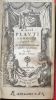
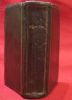
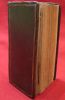
Amstelodami, Apud Ioann Ianssonium [Joan Jansonium], 1630, 1 volume in-18 de 115x60x30 mm environ, 1f.blanc, 1 frontispice, 692 pages, 2ff. blancs, reliure janséniste, plein veau brun d'époque, plats et dos encadrés d'un double filet dorés, tranches finement mouchetées de rouge. Reliure restaurée, quelques notes manuscrites sur la première garde blanche. Texte en latin, contient : Amphitruo - Asinaria - Aulularia - Bacchides - Captivi - Casina - Cistellaria - Curculio - Epidicus - Menaechmi - Mercator - Miles Gloriosus - Mostellaria - Persa - Poenulus - Pseudolus - Rudens - Stichus - Trinummus - Truculentus.
Plaute, en latin Titus Maccius Plautus, né vers 254 av. J.-C. à Sarsina dans l'ancienne Ombrie, maintenant située en Émilie-Romagne et mort en 184 av. J.-C. à Rome, est un auteur comique latin, le premier des grands écrivains de la littérature latine, d'autres comme Naevius ou Ennius n'ayant guère laissé qu'un nom et quelques fragments. Il s'est essentiellement inspiré d'auteurs grecs de la comédie nouvelle tels que Ménandre, Philémon et Diphile auxquels il a donné une saveur typiquement romaine. Il a également connu un grand succès de son vivant, et nombreux sont les écrivains romains qui l'ont loué. Merci de nous contacter à l'avance si vous souhaitez consulter une référence au sein de notre librairie.
Rome and the mysterious Orient. Three plays by Plautus. Translated with introductions and notes by A. RICHLIN.
Berkeley, Univ. of Cal. Press, 2005.
XIV,288 p. Pb. 23 cm (Curculio, Persa, Poenulus)
Het kabeltouw. (Rudens). Blijspel van Plautus in vijf bedrijven en een proloog. Uit het Latijn vertaald en voor hedendaagsch toneel bewerkt door L.A.J. Burgersdijk.
Middelburg, Altorffer, 1940.
128 p. Wrappers. 19 cm (OiN 302) (Somewhat worn. Right edge of the first 14 p. and the frontcover frayed)
Het kabeltouw. (Rudens). Blijspel van Plautus in vijf bedrijven en een proloog. Uit het Latijn vertaald en voor hedendaagsch toneel bewerkt door L.A.J. Burgersdijk.
Middelburg, Altorffer, 1940.
128 p. Wrappers. 19 cm (OiN 302)
Barbarian play: Plautus' Roman comedy.
Toronto etc., University of Toronto Press, 1996.
X,184 p. Paperback 23 cm (Robson Classical Lectures 1)
Scenae suppositiciae oder Der falsche Plautus. Eingel. hrsg., übers. & kommentiert.
Göttingen, Vandenhoeck & Ruprecht, (1980).
208 p. Wrs. 23 cm (Hypomnemata 64)(Habilitationsschr., Frankfurt)
Woordspeling bij Plautus.
Nijmegen, Berkhout, 1935.
(X),216 p. Stiff wrappers 24 cm (Dissertation, Nijmegen)
Woordspeling bij Plautus.
Nijmegen, Berkhout, 1935.
(X),216 p. Wrappers. 24 cm (Dissertation) (Cover spotted and slightly worn)
Pseudolus, ein Lustspiel des Plautus in alten Sylbenmaassen verdeutscht. Zur Anhörung feyerlicher Reden bey der öffentlichen Entlassung einiger Schüler von der Thomasschule auf die Universität am 17. April 1823 früh um 9 Uhr, laded die hohen Patrone und theilnehmenden Freunde der Schule gehorsamst und ergebenst ein Prof. Friedrich Wilhelm Ehrenfried Rost, Rector.
Leipzig, Gedruckt bey Wilhelm Staritz, 1823.
60 p. Plain wrappers 21.5 cm (On the last 3 pages: 'Kurze Nachrichten zur Geschichte der Thomasschule'. Cover worn. Frontcover faded and with some small spots. Title dustsoiled) (The Thomasschule, the 'Schola Thomana Lipsiensis', is a public boarding school in Leipzig, Saxony. It was founded in 1212 and is one of the oldest schools in the world. Cultivating classical languages is an old tradition at St. Thomas School. (See Wikipedia: 'Thomasschule zu Leipzig')

