 Write to the booksellers
76 books for « planck max »Edit
-
Language
French (63)
Russian (13)
-
Century
19th (10)
20th (43)
-
Countries
Belgium (7)
Côte d'Ivoire (1)
Denmark (28)
France (23)
Switzerland (4)
United States of America (13)
-
Syndicate
CLAM (1)
ILAB (48)
NVVA (1)
SLACES (1)
SLAM (17)
Über irreversible Strahlungsvorgänge. Erste Mittheilung. (Vorgetragen am 4 Februar: - gedruckt im Bericht vom gleichen Tage [St. VI]" - ausgegeben am 11 Februar.). [In: Mathematische und naturwissenschaftliche Mittheilungen aus den Sitzungsberichten d...
Berlin, 1897. 4to. Uncut and unopened in original printed wrappers. Fresh copy, fine and clean. Near mint. The entire ""Heft"" II: Pp. 35-81. Planck's paper pp.35-46.
Max Planck is considered to be the founder of the quantum theory and was awarded the Nobel Prize in Physics in 1918. ""Über irreversible Strahlungsvorgänge"" is a mathematical description of the electromagnetic radiation emitted from a black-body.""Über irreversible Strahlungsvorgänge was published in five parts in the period 1897-1901, the present volume being number 1.""With the Kirchhoff-Wien-Boltzmann work as a background, Max Planck began his attack on the black-body problem in 1897. He labored under the erroneous impression for some time that Wien's formula was the only one which harmonized with the second law of thermodynamics. The experiments on black-bodies due to Lummer and Pringsheim, Rubens and Kurlbaum forced him from that position."" (Planck, Max. Catalogue 258, Interlibrum Vaduz) ""I had already been struggling with the problem of the equilibrium of matter and radiation for some years without success"" I knew the problem is of fundamental significance for Physics."" The significance was unparallelled, when he in December 1900 delivered a paper entitled ""On the Theory of the Energy Distribution Law in the Normal Spectrum"" before the German Physical Society, which today is considered the birth of quantum physics. The present volume constitutes a precursor to this work. - Akademie No 33

Die Energieschwankungen bei der Superposition periodischer Schwingungen. (With Planck:) Bemerkung zur Quantenstatistik der Energieschwankungen. (With Einstein:) Bietet die Feldtheorie Möglichkeiten für die Lösung des Quantenproblems ? (With Max von La...
Berlin, Verlag der Akademie der Wissenschaften, 1923. 4to. Uncut and partly unopened in orig. wrappers to issue XXVIII-XXIV of ""Sitzungsberichte der Preussischen Akademie der Wissenschaften"". Wrappers with nicks and tears, especilly frontwrapper with marginal loss. Die Energieschwankungen...pp. 350-354. - Bemerkung zu Quantenstatistik...pp. 355-58.- Bietet die Feldtheorie...pp. 359-364. - Zur Theorie der von glühende...pp. 334-348.
All four papers first edition. - Planck: Akademie both :145. - Eionstein: Weil No 137.
Max Planck zur Feier seines 60. Geburtstages.
Berlin, Julius Springer, 1918. 4to. Original printed yellow wrappers. In: ""Die Naturwissenschaften"", Sechster Jahrgang. Heft 17. 26. April 1918.Portrait of Max Planck. Pp. (193-) 263. The complete issue offered.
With first printings of importent papers by A. Sommerfeld ""MaxPlanck zum sechzigsten Geburtstage"", Max v. laue ""Thermodynamik und Kohärenz"", W. Nerst ""Quantentheorie und neuer Wärmesatz"", Smoluchowski ""Über den begriff des Zufalls und den Ursprung der Wahrscheinlichkeitsgesetze in der Physik"" and also papers by Paul S. Epstein, Fritz Reiche, W. Wien.
Max Planck zur Feier seines 60. Geburtstages.
Berlin, Julius Springer, 1918. 4to. Original printed yellow wrappers. In: ""Die Naturwissenschaften"", Sechster Jahrgang. Heft 17. 26. April 1918.Portrait of Max Planck. Small piece of paper lacking (2 cm2) of left margin of front wrapper and first 3 leaves, not affecting text. Pp. (193-) 263. The complete issue offered.
With first printings of importent papers by A. Sommerfeld ""MaxPlanck zum sechzigsten Geburtstage"", Max v. laue ""Thermodynamik und Kohärenz"", W. Nerst ""Quantentheorie und neuer Wärmesatz"", Smoluchowski ""Über den begriff des Zufalls und den Ursprung der Wahrscheinlichkeitsgesetze in der Physik"" and also papers by Paul S. Epstein, Fritz Reiche, W. Wien.
"PLANCK, MAX. - ""PLANCK'S FIRST GREAT SCIENTIFIC ACCOMPLISHMENT"" (EINSTEIN)
Reference : 48810
(1887)
Ueber das Princip der Vermehrung der Entropie. Erste-Vierte Abhandlung (alles).
Leipzig, Barth, 1887-91. 8vo. No wrappers. 4 papers. In: ""Annalen der Physik und Chemie. Hrsg. von G. Wiedemann"", Neue Folge, Bd. XXX, No. 4, XXXI, No 6, XXXII, No. 11, XLIV, No. 11. - Pp. 545-704 a. 1 plate, pp. 145-336 a. 1 plate, pp. 337-528 a. 1 plate, pp. 385-576 a. 1 plate. With titlepge to vol. XXX, htitlepage to vol. XXXI, titlepage to vol. XXXII and titlepage to vol. XLIV. Titlepages with a stamp and on verso. Planck's papers: pp. 562-582, pp. 189-203, pp. 462-503 and pp. 385-428. Clean copies.
First appearance of all 4 papers constituting Planck's seminal papers on entropy carrying the general title ""On the principles of Increase of Entropy"" in which he applied the second law of thermodynamics to chemical problems.""His goal was, as he said in the first paper of the series, to carry further the ""grand generalization"" of Helmholtz, Josiah Willard Gibbs, and others: like the first principle of the mechanical heat theory, the second, the ""Carnot-Clausius"", principle applies not only to heat phenomena but to all kinds of physical and chemical phenomena"" and because the second principle applies not only to reversible processes but also to irreversible, or ""natural"", processes, it applies to all processes whatsoever...""(Jungnickel and McCormach ""Intellectual Mastery of Nature, vol. 2, pp. 52 ff.)What Einstein admired and called Planck's ""first great scientific discovery"" was the generality of its formulas which contain all that can be derived from pure thermodynamic principles. Einstein referred to the third paper in this series with the title ""Gesetze des Eintritts beliebiger thermodynamischer und chemischer Reactionen""Akademie Nos. 8,9,10 and 20.
Planck Max, Nobel laureate. Introduction to theoretical physics. IV. Optics. In
Planck Max, Nobel laureate. Introduction to theoretical physics. IV. Optics. In Russian /Plank Maks, Nobelevskiy laureat. Vvedenie v teoreticheskuyu fiziku. IV. Optika. Translation from German by S.I. Leitmann. Second edition, amended by M. KomBook 2006. You are welcome to reach out to us for a detailed description of the copies currently available. Delivery of this book may take longer than usual including extended processing and pre-shipping time, no expedited shipping is available. Please advise us if you have a set date or a deadline to receive your order. SKUalb077cac4fcb5e9a3d
Planck Max. The attitude of modern physics to mechanical worldview. In Russian (
Planck Max. The attitude of modern physics to mechanical worldview. In Russian (ask us if in doubt)/Plank Maks. Otnoshenie noveyshey fiziki k mekhanicheskomu mirovozzreniyu. Report read on September 10 (23) 1910 at the 82nd season of German natural scientists and doctors in Kenigsberg. Authors authorized translation from German E.G. Feigelson. Edited by S.O. Meisel. St. Petersburg Physics 1911. 44 p. We have thousands of titles and often several copies of each title may be available. Please feel free to contact us for a detailed description of the copies available. SKUalb0d3dc5aa834e3c8f
Ueber irreversible Strahlungsvorgänge. (+) Nachtrag. (Beide:) (Für die Annalen bearbeitet vom Verfasser). (+) Bemerkungen zu einer Abhandlung über Thermodynamik des Hrn. K. Wesendonck.
Berlin, Johann Ambrosius Barth, 1900. Contemp. hcloth. over marbled boards, gilt title to spine. Housed in a fine black morocco slicase, gilt borders on sides, spine with raised bands and gilt lettering. In: ""Annalen der Physik"", Vierte Folge, Band 1. VIII, 792 pp. + 3 folded engraved plates.(Entire volume offered). Planck's papers: pp. 69-122" 621-624"719-737. A very fine and clean copy. With the bookplate of Andras Gedeon on inside frontcover.
First edition of these fundamental and highly influential Planck-papers in which he defines his concept of entropy and heat radiation and hereby ANTICIPATES HIS FAMOUS SEMINAL PAPER OF 1900 which redefined physics and took it to the 20th century. - The first two papers ""Ueber irreversible Strahlungsvorgänge"" were rewritten for the ""Annalen"" and was first introduced in ""Sitzungsberichte d.k. Akad. Wissensch. zu Berlin"".""By invoking the hypothesis of natural radiation Planck not only succeeded in obtaining a relation between the energy of the resonator and the intensity of radiation for a given wavelength or frequency, but also in defining the entropy of radiation by a proper expression such that the change of the total entropy was always a positive quantity"". (Mehra, Jagdish. The historical development of quantum theory, 2001, p. 36). These results found in the period 1894-00 culminated in the present paper ""Ueber irreversible Strahlungsvorgänge"" and for the first time incorporates the concept of natural radiation and made a purely electromagnetic definition of entropy and of temperature.
Zur Theorie der Wärmestrahlung.
Leipzig, Barth, 1910. 8vo. Contemp. hcalf. Gilt spine, titlelabel with gilt lettering. Spine a bit rubbed and lower part of hinge weakening. In: ""Annalen der Physik und Chemie. Hrsg. von G. Wiedemann"", Vierte Folge, Bd. 31.. VIII,1064 pp. and 6 plates. (Entire volume offered). Planck's paper: pp. 758-768. Internally clean and fine.
First printing of an importent paper in which Planck tries to ecplains some of the difficulties with the quantum theory by pointing to the central exchange of energy between matter and radient energy and criticising Jean's theory.""Planck explained his point of view in some detail in an article which he submitted (the paper offered) in January 1910... There he reviewed the main progress in radiation theory that had taken place since 1900, and also indicated his own attitude towards it. Two extreme points of view, he said, could be assumed. The most conservative way was raken by Jans, who had derived from the equations of classical mechanics and electrodynamics the classical radiation equation. Since the equation obviously disagreed with experiments, the necessity arose to find a way of modifying the equations of dynamics so as to include the existence of the quantum of action 'h'."" (Mehra & Rechenberg Vol. I:1, pp. 123 ff.).
Ueber irreversible Strahlungsvorgänge. (+) Nachtrag. (Beide:) (Für die Annalen bearbeitet vom Verfasser). (+) Bemerkungen zu einer Abhandlung über Thermodynamik des Hrn. K. Wesendonck.
Berlin, Johann Ambrosius Barth, 1900. Later full buckram. Stamp on verso of titlepage. Narrow inner margins (binding style with cords in margin). In: ""Annalen der Physik"", Vierte Folge, Band 1. VIII, 792 pp. + 3 folded engraved plates.(Entire volume offered). Planck's papers: pp. 69-122" 621-624"719-737. Internally fine and clean.
First edition of these fundamental and highly influential Planck-papers in which he defines his concept of entropy and heat radiation and hereby ANTICIPATES HIS FAMOUS SEMINAL PAPER OF 1900 which redefined physics and took it to the 20th century. - The first two papers ""Ueber irreversible Strahlungsvorgänge"" were rewritten for the ""Annalen"" and was first introduced in ""Sitzungsberichte d.k. Akad. Wissensch. zu Berlin"".""By invoking the hypothesis of natural radiation Planck not only succeeded in obtaining a relation between the energy of the resonator and the intensity of radiation for a given wavelength or frequency, but also in defining the entropy of radiation by a proper expression such that the change of the total entropy was always a positive quantity"". (Mehra, Jagdish. The historical development of quantum theory, 2001, p. 36). These results found in the period 1894-00 culminated in the present paper ""Ueber irreversible Strahlungsvorgänge"" and for the first time incorporates the concept of natural radiation and made a purely electromagnetic definition of entropy and of temperature.
Ueber das Princip der Vermehrung der Entropie. - [""PLANCK'S FIRST GREAT SCIENTIFIC ACCOMPLISHMENT"" (EINSTEIN)]
Leipzig, Barth, 1887. 8vo. Bound in contemporary half cloth with gilt lettering to spine. In ""Annalen der Physik und Chemie. Hrsg. von G. Wiedemann"", Neue Folge, Bd. XXXII"". Entire volume offered. Title page and first leaf of content page detached and with marginal tears. Otherwise a fine copy. Pp. 462-503. [Entire volume: VIII, 704 pp. + 5 folded plates].
First appearance of Planck's seminal paper on entropy carrying the general title ""On the principles of Increase of Entropy"" in which he applied the second law of thermodynamics to chemical problems. The paper is part of the 4 paper series on the subject.""His goal was, as he said in the first paper of the series, to carry further the ""grand generalization"" of Helmholtz, Josiah Willard Gibbs, and others: like the first principle of the mechanical heat theory, the second, the ""Carnot-Clausius"", principle applies not only to heat phenomena but to all kinds of physical and chemical phenomena"" and because the second principle applies not only to reversible processes but also to irreversible, or ""natural"", processes, it applies to all processes whatsoever...""(Jungnickel and McCormach ""Intellectual Mastery of Nature, vol. 2, pp. 52 ff.)What Einstein admired and called Planck's ""first great scientific discovery"" was the generality of its formulas which contain all that can be derived from pure thermodynamic principles. Einstein referred to the third paper in this series with the title ""Gesetze des Eintritts beliebiger thermodynamischer und chemischer Reactionen""
EINSTEIN, ALBERT und W.J. de HAAS - MAX PLANCK - MAX von LAUE.
Reference : 38835
(1915)
Experimenteller Nachweis der Ampèreschen Molekularströme" (Withbound:) Berichtigung zu meiner Gemeinsam mit Herrn J.W. de Haas veröffentlichen Arbeit ""Experimenteller Nachweis der Ampèreschen Molekularströme"" (Withbound:) Notiz zu unserer Arbeit ""Expe...
Braunschweig, Vieweg & Sohn, 1915. Contemp. hcalf, gilt. Spine with a few scratches and light wear to spine ends. ""Verhandlungen der Deutschen Physikalischen Gesellschaft im Jahre 1915. 17. Jahrgang. Im Auftrage der Gesellschaft herausgegeben von Karl Scheel."" VI,489 pp. textillustr. Einstein/Haas papers: pp. 152-170 a. p. 203 a. p. 420. - Planck paper: pp. 407-418 a. 418-19 a. 438-51. - Laue paper: pp. 198-202. Internally clean and fine. The whole volume offered.
All papers first edition. - In the papers by Einstein and Haas prooved the Ampere hypothesis that permanent magnetism is caused by the microscopic circular motions of electric charges. The experimental results was very close to the theoretical value and as such they gave a brilliant proof of the soundness of the hypothesis.
M. Planck Introduction to Theoretical Physics. Mechanics of Deformable Bodies I
M. Planck Introduction to Theoretical Physics. Mechanics of Deformable Bodies In Russian /Plank M. Vvedenie v teoreticheskuyu fiziku. Mekhanika deformiruemykh tel 1932. 184 p.We have thousands of titles and often several copies of each title may be available. Please feel free to contact us for a detailed description of the copies available.SKUalb19d1afa2cb220ca4.
Die Theorie des Sättigungsgesetzes.
Leipzig, Barth, 1881. 8vo. No wrappers. In: ""Annalen der Physik und Chemie. Hrsg. von G. Wiedemann"", Neue Folge, Bd. XIII. No. 7. With titlepage to Bd. XIII. Pp. (385-) 544 a. 1 plate. (Entire issue offered). Planck's paper: pp. 535-543. Stamp to titlepage and verso of. Clean and fine.
First apperance of Planck's first scientific paper, not to mention his dissertation and his habilitationsschrift (1880).Akademie No. 3.
Über die Grundlage der Lösungstheorie.
Leipzig, Barth, 1903. No wrappers. Punched in inner margins after cords. In: ""Annalen der Physik und Chemie. Hrsg. von G. Wiedemann"", Vierte Folge, Bd. 10., No. 2. Pp. 225-456 a. 1 folded plate. (Entire issue offered). Planck's paper: pp. 436-445.
First printing. Planck answers the critique of his thermodynamical theory set forewardby Mathias Cantor.Akademie No. 57.Also with Ferdinand Braun ""Einige versuche über Magnetisierung durch schnelle Schwingungen"", pp., 326-333, an importent paper in the development of radio communication.
Ueber die von einem elliptisch schwingenden Ion emmittirte und absorbirte Energie. (Aus dem Jubelband für H.A. Lorentz, Arch. Néerl. p. 164. 1900, mitgetheilt vom Verfasser). (+) Ueber die Verteilung der Energie zwischen Aether und Materie. (Aus dem J...
(Leipzig, Barth), 1902. No wrappers. Punched in inner margins after cords. In: ""Annalen der Physik und Chemie. Hrsg. von G. Wiedemann"", Vierte Folge, Bd. 9., No. 11. Pp. 497-728. a. (Entire issue offered). Planck's papers: pp. 619-628 a. 629-641. Clean and fine.
First appearance in ""Annalen"" to which Planck submitted them in order to reach a wider audience. Here importent contributions to the clarification of the relation between entropy and probability, revising Boltzmann's distribution law of a given amount of energy.Akademie No 54 a. 56.
Verdampfen, Schmeltzen und Sublimiren.
Leipzig, Barth, 1882. 8vo. Contemp. hcalf. Raised bands gilt spine with gilt lettering. Spine a bit rubbed. In: ""Annalen der Physik und Chemie. Hrsg. von G. Wiedemann"", Neue Folge, Bd. XV. VIII,680 pp. and 8 plates. (Entire volume offered). Planck's paper: pp. 446-475. Internally clean and fine. Stamp to titlepage and verso of.
First apperance of Planck's second scientific paper, not to mention his dissertation and his habilitationsschrift (1880).Akademie No. 4.The volume contains further importent papers by E. Goldstein (4 papers on Cathode-Rays), by Ångström, Kohlrausch etc.
Ueber das thermodynamische Gleichgewicht von Gasmengen.
Leipzig, Barth, 1883. 8vo. Contemp. hcalf. Raised bands gilt spine with gilt lettering. Spine a bit rubbed. In: ""Annalen der Physik und Chemie. Hrsg. von G. Wiedemann"", Neue Folge, Bd. XIX. VIII,956 pp. and 10 plates. (Entire volume offered). Planck's paper: pp. 358-378. Internally clean and fine. Stamp to titlepage and verso of.
First apperance of Planck's third scientific paper, not to mention his dissertation and his habilitationsschrift (1880). The paper deals with thermo-dynamic equilibrium of gas-mixtures.Akademie No. 5.The volume contains further importent papers by Heinrich Hertz, W.C. Röntgen, Kohlrausch, Elster & Geitel etc.
Izbrannye trudy. In Russian /Selected Works
Short description: In Russian. Planck, Max. Selected Works. Moscow: Science, 1975. You are welcome to reach out to us for a detailed description of the copies currently available. Delivery of this book may take longer than usual including extended processing and pre-shipping time, no expedited shipping is available. Please advise us if you have a set date or a deadline to receive your order.SKU7011559
Edinstvo fizicheskoy kartiny mira. In Russian /Unity of the physical world
Short description: In Russian. Planck, Max. Unity of the physical world. Moscow: Science, 1966. You are welcome to reach out to us for a detailed description of the copies currently available. Delivery of this book may take longer than usual including extended processing and pre-shipping time, no expedited shipping is available. Please advise us if you have a set date or a deadline to receive your order.SKU6470900
Das Weltbild der neuen Physik.
Leipzig, Johann Ambrosius Barth. 1929. Klein-4°. 52 S., 1 S.Anzeigen. Originalbroschur mit schwarzem Papierrückenstriefen.
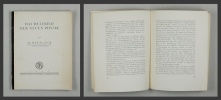
Erste Ausgabe. - Zusammengetragen aus Vortràg von Planck, gehalten in Leiden, Prag und Wien. - Broschurrückseite mit kleinem Besitzerstempel. Umschlag leicht gewellt.
Ueber die Erregung von Electricität und Wärme in Elektrolyten.
Leipzig, Barth, 1910. 8vo. Contemp. hcalf. Gilt spine with gilt lettering. Spine slightly rubbed. A stamp to htitle and titlepage. In: ""Annalen der Physik und Chemie. Hrsg. von G. Wiedemann"", Vierte Folge, Bd. 39.. VIII,648 pp. (Entire volume offered). Planck's paper: pp. 161-187. Clean and fine.
First printing. - Akademie No. 17.Also with Röntgen ""Electrische Eigenschaften des Quarzes"", pp. 16-24, papers by Paschen, Ångström, Elster & Geitel. Drude ""Bestimmung der optischen Constanten der Metalle, pp. 481-554, Lenard etc.
Über die Natur der Wärmestrahlung.
Leipzig, Barth, 1924. 8vo. In full black cloth with gilt lettering to spine. In ""Annalen der Physik"", Vol. 73, 1924. Entire volume offered. Library labels pasted on to front free end papers, small stamp to first page of contents. Otherwise fine and clean. Pp. 272-288. [Entire volume: VIII, 650 pp. + 4 plates.].
First appearance of Planck's paper on the Nature of thermal radiation.
Ueber die Natur des weissen Lichtes.
Leipzig, Johann Ambrosius Barth, 1902. 8vo. In contemporary half calf with gilt lettering and red title label to spine. In ""Annalen der Physik, Vierte Volge"", Band. 7. Entire volume offered. Spine lacking the upper 1 cm of spine. Pp. 390-400. [Entire volume: VIII, 948, (1) pp. + 3 plates].
First printing of Planck's paper on the nature of white light.
Ueber die Natur des weissen Lichtes.
Leipzig, Johann Ambrosius Barth, 1902. 8vo. In later black cloth with gilt lettering to spine. In ""Annalen der Physik, Vierte Volge"", Band. 7. Library plates pasted on to front free end paper and small library stamp to title page. Pp. 390-400. [Entire volume: VIII, 948, (1) pp. + 3 plates].
First printing of Planck's paper on the nature of white light.

