 Write to the booksellers
12 books for « photius »Edit
-
Language
French (11)
Greek (1)
-
Century
17th (1)
21st (5)
-
Topics
Antwerp (1)
Byzantium, (1)
Christianity (1)
Dictionaries (1)
Greek (2)
Humanism (1)
Language (1)
Latin (1)
Literature (2)
Orthodox (1)
Reform (1)
Religions (1)
-
Countries
Belgium (1)
Brazil (1)
France (8)
Netherlands (2)
-
Syndicate
ILAB (7)
SLAM (7)
Bibliotheca / Myriobiblios. Βιβλιοθηκη τοῦ Φωτίου, Librorum quos legit Photius, Patriarca excerpta et censurae
Augsbourg, Augustae Vindelicorum Ad Insigne Pinus, 1601. Édition princeps de l’œuvre de Photios Ier de Constantinople par l'humaniste allemand David Hœschel, portant mention de primus edidit sur la page de titre. Fort volume (338 x 234 mm pour 105 mm d'épaisseur) en sexternions, (xi) 985 pp. Relié plein vélin, plats muets, dos lisse, mention calligraphiée "Photius Bibliotheca" en partie effacée près de la coiffe, cinq coutures apparentes aux charnières en plus des coutures de tête et de queue. Toutes tranches teintes en rouge. Un signet bicolore en tissu épais est fourni. Mention à la plume sur la première garde blanche datée de 1777. Page de titre, dédicace en latin à Marco Velsero, une page en grec, liste "Eruditorum Aliquot de Photio" en latin, élégie en vers latins à Janus Gruter ("Ianus Gruteri"), page dédiée à Isaac Casaubon ("Isaacus Casaubonus"), l'ensemble formant 11 pages non paginées. Commence ensuite le texte grec de l’œuvre de Photius, bien paginé, avec de nombreuses notes aux marges. Page de note en latin de David Hœschel à la p. 919, la suite étant consacrée aux notes de bas de page en grec jusqu'au colophon, en latin, qui clôt le livre p. 985. Gravures sur bois à la page de titre et au colophon. Nombreux bandeaux, lettrines et culs-de-lampe à travers l'ouvrage. "La Bibliothèque (Βιβλιοθήκη) ou Myriobiblos (Μυριόβιβλος), œuvre de Photios, patriarche de Constantinople de 858 à 886, est une collection de 280 notices (appelées traditionnellement « codex », parfois au pluriel « codices ») sur des textes littéraires de genres variés lus par le recenseur. L'ouvrage fut commencé vers 843. Les « codices », de longueur très variable, vont de la simple mention d'un nom d'auteur avec un titre à une analyse de plusieurs dizaines de pages. Ils traitent des auteurs, du contenu des textes, du jugement porté par Photios sur eux, et comprennent souvent des citations plus ou moins longues. Selon Karl Krumbacher (Die griechische Lit., 1905, p. 274.), il s'agit du « plus important ouvrage d'histoire littéraire du Moyen Âge »" (Wikipédia) Si Hœschel publia de nombreux textes de Pères de l'église en grec et latin, dont plusieurs furent des éditions princeps, le Myriobiblios reste considéré comme sa plus importante contribution à la philologie. Il fit l'objet d'une traduction en latin, publiée par le jésuite André Schott également à Augsbourg en 1606, ainsi que de plusieurs rééditions du vivant même d'Hœschel. Ouvrage rarissime et d'une grande valeur historique. Taches et frottements aux plats, légères craquelures en certains points du dos juste avant les charnières, coin inférieur avant frotté et émoussé, coiffes baillant légèrement avec débuts de craquelure au milieu, extrémités haute et basse des charnières avant craquelées. Trous de mite importants sur la marge intérieure des 9 premières et des 16 dernières pages, avec très légers manques au milieu de la colonne gauche de la p.969 au colophon p.985, quelques petits trous épars, rousseurs éparses surtout marginales sans perte. ************************************************** Augsburg, Augustae Vindelicorum Ad Insigne Pinus, 1601. Editio Princeps of the work of Photius I of Constantinople by the German humanist David Hœschel, with mention of primus edidit on the title page. Large volume (338 x 234 mm for 105 mm thickness) in sexternions, (xi) 985 pp. Bound in full vellum, blank covers, flat spine, calligraphic mention "Photius Bibliotheca" partly erased at the top of the spine, five visible stitches at the hinges in addition to the head and tail stitches. All edges dyed red. A two-tone bookmark in thick cloth is provided. Pen note on the first white guard dated 1777. Title page, dedication in Latin to Marco Velsero, one page in Greek, list "Eruditorum Aliquot de Photio" in Latin, elegy in Latin verse to Janus Gruter ("Ianus Gruteri"), page dedicated to Isaac Casaubon ("Isaacus Casaubonus"), this being 11 unpaginated pages. Then begins the (paginated) Greek text of Photius' work, with numerous notes in the margins. Page of note in Latin by David Hœschel on p. 919, the rest being devoted to footnotes in Greek until the colophon, in Latin, which closes the book on p. 985. Woodcuts on the title page and colophon. Numerous headpieces, initials and tailpieces throughout. "The Bibliotheca (Βιβλιοθήκη) or Myriobiblos (Μυριόβιβλος), the work of Photios, patriarch of Constantinople from 858 to 886, is a collection of 280 notices (traditionally called "codex", sometimes in the plural "codices") on literary texts of various genres read by the census taker. The work was begun around 843. The "codices", of very variable length, range from the simple mention of an author's name with a title to an analysis of several dozen pages. They deal with the authors, the content of the texts, the judgment made by Photios on them, and often include more or less long quotations. According to Karl Krumbacher (Die griechische Lit., 1905, p. 274.), it is the "most important work of literary history of the Middle Ages"." (Wikipedia) While Hoeschel published many texts by the Fathers of the Church in Greek and Latin, several of which were first editions, the Myriobiblios remains considered his most important contribution to philology. It was translated into Latin, published by the Jesuit André Schott also in Augsburg in 1606, as well as several reissues during Hoeschel's own lifetime. A very rare work of great historical value. Stains and rubbing on the covers, slight cracking in some places on the spine just before the hinges, lower front corner rubbed with a slight defect, spine extremities slightly gaping with the beginnings of cracking in the middle. Upper and lower ends of the front hinges crackled. Significant moth holes on the inside margin of the first 9 and last 16 pages, with very slight losses in the middle of the left column from p.969 to the colophon p.985), some small scattered holes, scattered foxing mainly marginal without loss.
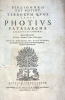
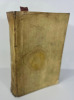
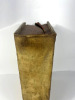
Bon état au vu de l'âge, reliure solide. Texte complet à l'exception du petit manque au colophon. Plus de photos sur demande. ****** In good condition considering its age, solid binding. Text complete except for the small loss to the colophon. More photos on request.
Phôtiou Patriarchou Kônstantinou-poleôs Epistolai. Photii Sanctissimi Patriarchae Constantinopolitani Epistolae. Per Reverendum Virum Richardum Montacutium, Norvicensem nuper Episcopum, latine redditae, & notis subinde illustratae.
London (Londoni), Ex officina Rogeri Danielis, 1651.
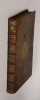
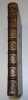
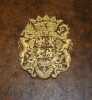
Folio. (8), 393,(1 blank),(10 index) p. Contemporary calf. 35 cm (Ref: ESTC R12714; Hoffmann 3,89; Brunet 4,624; Ebert 16779; Graesse 5,276) (Details: Editio princeps. Greek text of 248 letters, with parallel Latin translation. At the end have been added 5 letters 'ex veteri codice orientali'. Printed in 2 columns. Gilt back with 6 raised bands. Gilt coat of arms on both boards. Woodcut printer's device on the title, depicting a palm tree, the motto reads: ''Depressa resurgo'. 'Oppressed, higher I rise'.) (Condition: Binding somewhat rubbed. Upper & lower part of the front joint split over 4 and 6 cm. Tiny bump in front board. Small stamp on the title. Small hole in the text of leaf 2A2) (Note: This edition is the 'editio princeps' of 248 letters of the great Byzantine scholar Photius, ca. 810 - ca. 893, who was Patriarch of Constantinople from 858 to 867, and from 877 to 886. He was the leader of the Byzantine Renaissance, and left works of immense value. The most important is the 'Bibliotheka', a critical bibliography of 280 works with his comments. Gibbon said that it was a living monument of erudition and acute criticism. This work is often the best and only source of notable works now lost. Photius also compiled a 'Lexikon', a glossary drawing upon earlier lexicographic works. The 'Mystagogia' is a theological work treating the Trinity. The 'Amphilochia' or 'Quaestiones ad Amphilochium', concerns ca. 300 catechetical question-and-answer discussions of religion and philosophy. The surviving letters of Photius, 298 or 299, were written between 859 and 886, i.e. from the beginning till the end of his Patriachy. They show the same acute criticism and learning as his other works. It is thought that there were two collections of letters during Photius' lifetime. The first contained the letters 1-248, and was compiled ca. 875. The second corpus contained the letters 1-283 and it dated from ca. 886. The first collection, 1-248, was first published in 1651, with a Latin translation and notes, by the well known English Greek scholar Richard Montagu, bishop of Norwich, (1577-1641) from a manuscript in the Bodleian Library. At the end have been added 5 letters, with a translation, from a manuscript brought to England by Chr. Ravius. Montagu's first fruit was an edition of the Invectives of Gregorius Nazianzenus against the emperor Julianus Apostata, which was published in 1610) (Provenance: Coat of arms on boards: a shield with 2 eagles and 2 griffins in the quarters, flanked by 2 collared and lined greyhounds standing on the hindlegs. Above the shield a ducal coronet, left of the crown a bishop's mitre, on the right a crosier. Stamp on the title: 'Minderbroeders, Heerlen') (Collation: A-3D4, 3E6) (Photographs on request) (Heavy book, may require extra shipping costs)
[BIBLIOTHEQUE DE PHOTIUS, en GREC ET EN LATIN] PHOTII MYRIOBI / BLON, Sive Bibliotheca / librorum quos Photius / Patriarcha Constantinopo / litanus legit & censuit. /Graecè edidit David Hoeschelius Augustanus, / & notis illustrauit. / Latinè vero reddidit & schiloys auxit / ANDREAS SCHOTTUS ANTVERPIANUS./Opus insigne, e quo Theologi, Medici, Philosophi, Historici, Oratores & Philologi /uberrimum fructum & iucundisimum capere possunt./GENEVAE. / OLIVA PAULI STEPHANI. / M.D. CXI.
In folio, relié d'ép. pl. peau, rel à 5 nerfs, deux pièces de titre, un filet d'encadrement sur les plats, fleuron central repoussé sur chaque plat, coiffes bonnes, mors solides. Ouvrage peu manié, bien conservé, intérieur trés frais. 32 pp ; Impression du dictionnaire sur 2 col. (1 à 1624) ; Notes de David Hoeschel : 2 col. : 1 à 104 ; Index Rerum... 23 pp ; 2 p
Excellent exemplaire de la célèbre édition de Photius donnée par Andréas Schott à Genève en 1601. Ce livre devenu légendaire est d'une insigne rareté.Un ouvrage central de l'Humanisme de la Renaissance Européenne, de la Réforme et de la Contre-Réforme.
De brieven van Photius aan Nicephorus.
N.pl. 1995.
410 p. Stiff wrappers 24 cm (Dissertation, UvA)(Including Greek text and Dutch translations)
Bibliothèque - Tome VI Codices : 242-245 texte et traduction
2003 Paris, Belles -Lettres ,2003 , In huit ,230 pp, Comme neuf, pas coupé,
.
Histoire de Photius, patriarche de Constantinople auteur du schisme des grecs... accompagnée d'une introduction, de notes historiques et de pièces justificatives. 2e édition. Relié avec Richou (M. L.). Histoire de l'Eglise Tome troisième
P., Vaton, 1854, in 12, 2 textes en 1 volume in 12 relié demi basane cerise, XLIV-468 et 460 pages.
PHOTOS sur DEMANDE. Fermeture du 1er au 23 Août


Phone number : 04 77 32 63 69
Bibliothèque. [Tome II]. Codices 84-185. Texte établi et traduit par René Henry.
Paris, Les Belles Lettres, 1960. In-8 broché, 224pp,bibliographie, traduction en regard du texte grec. Tampon ex-libris.
Dos insolé avec petit manque, bonne condition par ailleurs. - Frais de port : -France 5,7 € -U.E. 8 € -Monde (z B : 12 €) (z C : 22 €)
Bibliothèque. Tome IX. Index.
P., Les Belles Lettres, 1991. In-8, cartonnage de l'éd. sous rhodoïd, 524 pp. (Coll. des universités de France - Budé).
Index des personnages, des noms géographiques, de varia potiora, table des oeuvres profanes, index des titres d'oeuvres patristiques cités, table des citations des auteurs profanes, index scriptuaire, tables des citations d'auteurs patristiques, choix des vocables et de locutions. Très bonne condition. - Frais de port : -France 7,15 € -U.E. 9 € -Monde (z B : 14 €) (z C : 24 €)
Bibliothèquecodices 84-185Tome II
Paris Les Belles Lettres 2003 1 in huit broché 223 pp texte et traduction, par René Henry, deuxième tirage
comme neuf
Bibliothèquecodices 186 - 222 Tome III
Paris Les Belles Lettres 2003 1 in huit broché 246 pp texte et traduction, par René Henry, deuxième tirage
comme neuf
Bibliothèquecodices 257-280tome VIII
Paris Les Belles Lettres 2003 1 in huit broché 232 pp texte et traduction, par René Henry, deuxième tirage
comme neuf
SCHAMP Jacques, KINDT Bastien, Cental (eds.) & PHOTIUS Constantinopolitanus
Reference : R78957
(2004)
Thesaurus Photii Constantinopolitani. Bibliotheca [in: Corpus Christianorum, Thesaurus Patrum Graecorum]
Turnhout, Brepols 2004 XCV + 227pp.+ 65 microfiches, in the series "Corpus Christianorum. Thesaurus Patrum Graecorum", hardcover (publisher's green cloth with gilt lettering), 32cm., fine condition, [editor's new price: 495 euro], ISBN 978-2-503-51406-5, R78957

