 Write to the booksellers
40 books for « persius »Edit
-
Language
French (38)
Latin (2)
-
Century
17th (3)
18th (7)
19th (3)
-
Countries
Belgium (1)
Denmark (1)
France (17)
Netherlands (18)
Switzerland (3)
-
Syndicate
ILAB (8)
NVVA (2)
SLACES (2)
SLAM (5)
Auli Persii Flacci Satirarum liber, cum ejus vita, vetere scholiaste, & Isaaci Casauboni notis, qui eum recensuit, & commentario libro illustravit, una cum ejusdem Persiana Horatii imitatione. Editio novissima, auctior & emendatior ex ipsius auctoris codice; cura & opera Merici Casauboni. Accessit & Graecorum, ubi opus erat, interpretatio, item index auctorum rerum verborum locupletissimus.
Leiden (Lugduni Batavorum), Excudit Petrus vander Aa, 1695.
4to. (XVI, including a portrait of Persius),214,(16 index) p., 2 engraved plates. Vellum 25 cm (Ref: STCN ppn 83225780X; Schweiger 2,711; Brunet 4,521; Dibdin 2,155; Fabricius/Ernesti 2,361/62; Ebert 11246; Graesse 3,520) (Details: 6 thongs laced through the joints. Portrait of Persius, engraved after a relief once owned by Fulvius Ursinus. Title printed in red & black. Engraved printer's device on the title, which shows a resting Athena, in the background a statue of Hercules; the motto is: 'Studio et Vigilantia'. 1 plate depicts a statuette of the god of silence and secrets 'Harpocrates Bullatus et Bulla', the other shows a 'thiasos' of a drunken Bacchus, carried by a bunch of satyrs, and accompanied by some revellers (Iaspis chorum Bacchi et originem satyrici poematis exhibens). (Condition: Vellum a bit age-toned and very slightly scratched and spotted) (Note: The well-born and well-to-do Roman poet Aulus Persius Flaccus, 34-62 A.D., produced during his short life one book (libellus) with 6 satires, together 650 hexameters. 'They are well described as Horatian diatribes transformed by Stoic rhetoric'. (OCD 2nd ed. p. 805) The first is 'on the decay of literary taste in his own time and the neglect of the manly Republican authors, the second on vanity of wealth and luxury, the third on idleness, the fourth on self-knowledge, the fifth on true liberty, the sixth on the proper use of riches'. (H.J. Rose, 'A History of Latin Literature', London, 1967, p. 377) The style is obscure, contorted and crammed with allusions to Horace and Lucilius. He was much read in antiquity and admired as a moralist in the Middle Ages, but now he is found dull, too difficult, cryptic, too far fetched, and too complicated. 'So fühlte sich zumal das 19. Jh. von seinem vielschichtigen Stil abgestossen, während sich erst neuerdings eine gerechtere Würdigung durchsetzen beginnt'. (Neue Pauly 9, 619) A specimen of this new appraisal is the following quote: 'The elements of composition in Persius' satires - words and ideas, images, steps in the argument, registers of speech and literary style, speeches in dramatic dialogue- are abruptly or peculiarly, even bizarrely, combined. One is faced by an unpredictable, surprising series of conceptions; continuous attention is necessary if one is to understand. However, the surprises and incongruities are often observably intelligent, apt and curiously artistic. From a literary point of view, the quality of continual surprise in Persius' style makes the Satires amusing to read'. (J.R. Bond, 'Persius, the Satires', Warminster 1980, p. 5) The year 1605 saw the start of modern Persian philology, with Isaac Casaubon's edition of the Satires, his 'Prolegomena in Persium', and his commentary. The edition and its extensive commentary were produced by the French protestant scholar Isaac Casaubon, 1559-1614, who is the first critical commentator of Persius. He deemed Persius the best of the Roman satirists. His preface, also adopted in this edition of 1695, is a vigorous defence of Persius' Stoic earnestness and philosophic constancy. A reissue of the first edition appeared in Paris in 1615. Casaubon's commentary on this Stoic satirist, of which Scaliger said that the sauce was better than the meat, was reprinted in Germany as late as 1833, and has been ultimately merged in Conington's edition (of 1872) (Sandys 2,209). The English classical scholar of French origin Meric (Méric) Casaubon, 1599-1671, son of Isaac Casaubon, who took his refuge in England after the asassination of Henry IV by a Catholic fanatic in 1610, published a revised and enlarged third edition of his father's Persius in London in 1647. The Leiden edition of 1695 is a reissue of that edition. It is found usually in one binding with the Juvenal edition of Henninius of 1695, but it was also published separately) (Collation: pi2 (portrait & title), *2, 2*4; A-V4, X3 (minus blank leaf X4, catchword on leaf X3, and pagination correct), Y-2F4) (Photographs on request)
Auli Persii Flacci Satirarum liber. Isaacus Casaubonus recensuit, & commentario libro illustravit. Ad virum amplisissmum D. Achillem Harlaeum senatus principem. (Volume 2: Isaaci Casauboni in Persii Satiras Liber commentarius. Eiusdem Persiana Horatii imitatio)
Paris (Parisiis), Apud Ambroisum et Hieronymum Drouart, sub scuto Solari, via Iacobaea, 1605.
8vo. 2 volumes in 1: (XVI),43,(4),(1 blank); (XXXII),558,(2 blank),(26 index),(1 errata),(1 blank) p. Modern calf antique style. 18 cm (Ref: Schweiger 2,710; Graesse 5,212; Ebert 16282; cf. Smitskamp, 'The Scaliger collection', no. 116; Fabricius/Ernesti 2,165/66: 'eruditissimus atque divinus commentarius') (Details: Back with 5 raised bands and gilt lettering. 2 title pages, the first shows an oval engraving of a 'thiasos': a drunken Bacchus is carried by a bunch of satyrs, accompanied by some revellers. The second title has an oval woodcut printer's mark; it depicts a thisle flanked by the initials A and D of Ambrosius (Ambroise) Drouart; there are 2 appropriate mottoes: 'Nul ne s'y frote', (let no one meddle) and 'patere aut abstine' (bear or forebear). The first volume contains a preface, the Latin text of the Satires and 18 pages with 'Glossae veteres in Persium'. The second volume contains the commentary of Casaubon) (Condition: Endpapers renewed. The slightly thumbed (first) title has been repaired expertly in the gutter. Small oval library stamp on the title. Old and small marginal ink notes, and underlinings on 2 pages) (Note: The well-born and well-to-do Roman poet Aulus Persius Flaccus, 34-62 A.D., produced during his short life one book (libellus) with 6 satires, together 650 hexameters. 'They are well described as Horatian diatribes transformed by Stoic rhetoric'. (OCD 2nd ed. p. 805) The first is 'on the decay of literary taste in his own time and the neglect of the manly Republican authors, the second on vanity of wealth and luxury, the third on idleness, the fourth on self-knowledge, the fifth on true liberty, the sixth on the proper use of riches'. (H.J. Rose, 'A History of Latin Literature', London, 1967, p. 377) The style is obscure, contorted and crammed with allusions to Horace and Lucilius. He was much read in antiquity and admired as a moralist in the Middle Ages, but now he is found dull, too difficult, cryptic, too far fetched, and too complicated. 'So fühlte sich zumal das 19. Jh. von seinem vielschichtigen Stil abgestossen, während sich erst neuerdings eine gerechtere Würdigung durchsetzen beginnt'. (Neue Pauly 9, 619) A specimen of this new appraisal is the following quote: 'The elements of composition in Persius' satires - words and ideas, images, steps in the argument, registers of speech and literary style, speeches in dramatic dialogue- are abruptly or peculiarly, even bizarrely, combined. One is faced by an unpredictable, surprising series of conceptions; continuous attention is necessary if one is to understand. However, the surprises and incongruities are often observably intelligent, apt and curiously artistic. From a literary point of view, the quality of continual surprise in Persius' style makes the Satires amusing to read'. (J.R. Bond, 'Persius, the Satires', Warminster 1980, p. 5) 1605 saw the start of modern Persian philology, with Isaac Casaubon's edition of the Satires, his 'Prolegomena in Persium', and his commentary. The Latin text of this edition was based on the edition that was edited by the French scholar Pithou in Paris in 1585. The edition and its extensive commentary were produced by the French protestant scholar Isaac Casaubon, 1559-1614, who is the first critical commentator of Persius. He deemed Persius the best of the Roman satirists. His preface is a vigorous defense of Persius' Stoic earnestness and philosophic constancy.'The ethical interest is strong in his Persius (1605), on which he had lectured at Geneva and Montpellier, and his commentary on the Stoic satirist, of which Scaliger said that the sauce was better than the meat, was reprinted in Germany as late as 1833, and has been ultimately merged in Conington's edition' (of 1872) (Sandys 2,209)) (Provenance: Stamp on the title of 'Repton School Library'. Repton School was founded in 1577 and is still thriving. The school stands on the site of a 12th century Priory, founded by Augustinian Canons, and adapted in Tudor times for use as a school. The beautiful Cloister Garth still forms the heart of this school) (Collation: a8, A-C8 (leaf C8 verso blank), â8, ê8, A-2N8, 2O6 (leaf 2O6 verso blank)) (Photographs on request)
Auli Persii Flacci Satirarum liber. Isaacus Casaubonus recensuit, & commentario libro illustravit. Ad virum amplisissmum D. Achillem Harlaeum senatus principem. (Volume 2: Isaaci Casauboni in Persii Satiras Liber commentarius. Eiusdem Persiana Horatii imitatio)
Paris (Parisiis), Apud Hieronymum Drouart, 1615.
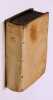
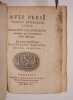
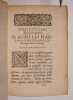
8vo. 2 volumes in 1: (XV),(1 blank),43,(4),(1 blank); (XXXII),558,(26 index) p. Vellum 17.5 cm (Ref: Schweiger 2,711; Graesse 5,212; Ebert 16282; Smitskamp, 'The Scaliger collection', no. 116) (Details: 5 thongs laced through the joints. The first title shows an engraving of a 'thiasos': a drunken Bacchus is carried off by a bunch of satyrs, accompanied by some revellers. The second title has an oval woodcut printer's mark; it depicts a thisle flank by the initials A and D. of Ambrosius (Ambroise) Drouart, the brother of Hieronymus (Jerôme). Hieronymus kept using his brother's printer's after his death in 1608; the motto, in fact 2 mottoes, reads: 'Nul ne s'y frote', 'patere aut abstine' ('let no one meddle', and 'bear of forebear'). The first volume contains a preface, the Latin text of the Satires and 18 pages with 'Glossae veteres in Persium'. The second volume contains the commentary of Casaubon) (Condition: Vellum age-tanned and somewhat soiled. All four ties gone. Endpapers worn and somewhat soiled. First title dustsoiled, and its right margin is very thumbed) (Note: The well-born and well-to-do Roman poet Aulus Persius Flaccus, 34-62 A.D., produced during his short life one book (libellus) with 6 satires, together 650 hexameters. 'They are well described as Horatian diatribes transformed by Stoic rhetoric'. (OCD 2nd ed. p. 805) The first is 'on the decay of literary taste in his own time and the neglect of the manly Republican authors, the second on vanity of wealth and luxury, the third on idleness, the fourth on self-knowledge, the fifth on true liberty, the sixth on the proper use of riches'. (H.J. Rose, 'A History of Latin Literature', London, 1967, p. 377) The style is obscure, contorted and crammed with allusions to Horace and Lucilius. He was much read in antiquity and admired as a moralist in the Middle Ages, but now he is found dull, too difficult, cryptic, too far fetched, and too complicated. 'So fühlte sich zumal das 19. Jh. von seinem vielschichtigen Stil abgestossen, während sich erst neuerdings eine gerechtere Würdigung durchsetzen beginnt'. (Neu Pauly, 9, 619) A specimen of this new appraisal is the following quote: 'The elements of composition in Persius' satires - words and ideas, images, steps in the argument, registers of speech and literary style, speeches in dramatic dialogue- are abruptly or peculiarly, even bizarrely, combined. One is faced by an unpredictable, surprising series of conceptions; continuous attention is necessary if one is to understand. However, the surprises and incongruities are often observably intelligent, apt and curiously artistic. From a literary point of view, the quality of continual surprise in Persius' style makes the Satires amusing to read'. (J.R. Bond, 'Persius, the Satires', Warminster 1980, p. 5) This 1615 Persius edition is a reissue of the edition previously published in 1605, also from the presses of the Drouart brothers. The Latin text was based on that which was edited by the French scholar Pithou in Paris in 1585. The edition of 1605 and its extensive commentary were produced by the French protestant scholar Isaac Casaubon, 1559-1614, the first critical commentator of Persius. His preface is a vigorous defense of Persius' Stoic earnestness end philosophic constancy. 'The ethical interest is strong in his Persius (1605), on which he had lectured at Geneva and Montpellier, and his commentary on the Stoic satirist, of which Scaliger said that the sauce was better than the meat, was reprinted in Germany as late as 1833, and has been ultimately merged in Conington's edition' (of 1872)) (Provenance: On the front pastedown the name: 'E.A. Groenman, 1839'. We found an Albertus Groenman, 1814-1861, member of the 'Provinciale Staten van Groningen' from 1851 till 1859, elected for Zuidhorn, profession manufacturer and merchant. He might have been the owner once) (Collation: a8, A8, b-c8, â8, ê8, A-Z8, 2A-2NO8, 2O4) (Photographs on request)
Auli Persi Flacci Satyrae - bernae ex officina hered. wagneri 1765
Sumpt. B. L. Walthardi 1765 184 pages in8. 1765. reliure editeur plein cuir dos à nerfs. 184 pages. Ce livre est une édition des 'Satyrae' (Satires) du poète romain Aulus Persius Flaccus (Perse) publiée à Berne en 1765 par l'héritier Wagner aux frais de B.L. Walthardi. L'œuvre comprend les six satires composées entre 52 et 62 apr. J.-C. et publiées après la mort de l'auteur qui mêlent une sagesse stoïcienne à une critique virulente des abus stylistiques de ses contemporains et de la société
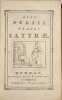
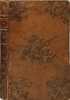

Etat correct coins émoussés coiffes aussi mors fendu complétement cependant l'ensemble est solide et l'intérieur remarquablement propre tranches marbrées
Traduction des Satyres de Perse, et de Juvénal, par le Révérend Pere Tarteron, de la Compagnie de Jésus. Nouvelle édition.
Paris, Par la Compagnie des Libraires, 1714.
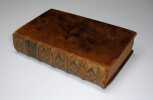
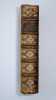
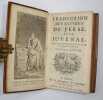
12mo in eights & fours. (XLVIII),591,(1 blank) p. Calf 17 cm Two poets exploring the limits of satiric free speech (Ref: Schweiger 2,517; cf. Graesse 3,522; Ebert 11273) (Details: Back gilt and with 5 raised bands, shield in the second compartment. The frontispiece depicts a poet/thinker in a robe, and seated on a stone bench; on the bench the inscription Facit indignation versum. Printer's mark, a beehive, on the title. The Latin text & French translation are printed side by side in different typefaces) (Condition: Wear to extremities of the binding: head & tail of the back slightly chafed. Back rubbed. Shield on the back vanishing. Wormhole near the gutter of the left lower corner of the first 64 p.) (Note: The stoic poet Aulus Persius Flaccus, 34-62 A.D., is a representative of the imperial Latin satire. His stoic satires form one 'libellus' of 6 satires, together 650 hexameters. 'They are well described as Horatian diatribes transformed by Stoic rhetoric'. 'He wrote in a bizarre mixture of cryptic allusions, brash colloquialisms, and forced imagery'. (OCD, 2nd ed. p. 805) The Stoic philosopher is in the work of Persius not a figure of fun, but a wise man. The Roman poet Juvenalis, ca. 55-140 AD, was the last and most influential of the Roman satirists. He 'uses names and examples from the past as protective covers for his exposés of contemporary vice and folly'. (The Classical Tradition, Cambr. Mass., 2010, p. 501) His main theme is the dissolution of the social fabric. He had a lasting influence on neolatin and vernacular writers of the Renaissance and later centuries. A striking feature of this book is, when one runs it through for the first time, is the discrepancy between the space occupied by the Latin text and the French translation. Take for instance the pages 2 and 3: on p. 2 we count 56 Latin words, on the opposing page 152 French words. Concise verses are transformed into long phrases in prose. The translator of these verses, the French Jesuit Jérôme, or Hieronymus Tarteron, 1644-1720, was professor of rhetoric. He translated also the Satires, Letters and the Ars Poetica of Horace. As usual with Jesuit editions, here also 'le pere Tarteron a eu soin de retrancher ce qui dans ces poëts pourroit nuire aux bonnes moers', so we read in the second volume of the Nouveau Supplement au Grand Dictionnaire Historique, de L. Moreri, Paris 1749. The edition was first published in 1689 and met with some success: it was reissued in 1695, 1706, 1714, 1729, 1737 and 1752) (Collation: pi1 (frontispiece), â8, ê4, î8, ô4; A8-3B4 (:gatherings A - 3B alternating), 3C8)) (Photographs on request)
THE SATIRES OF JUVENAL, PERSIUS, SULPICIA AND LUCILIUS
George Bell & Sons. 1877. In-8. Relié. Etat d'usage, Couv. convenable, Dos abîmé, Intérieur acceptable. 512 pages. Gravure en noir et blanc en frontispice (défraîchie et détachée). Couverture se détachant.. . . . Classification Dewey : 420-Langue anglaise. Anglo-saxon
Literally translated into English prose by the Rev. Lewis EVANS, M.A. To which is added the Metrical Version of Juvenal and Persius, by the late William GIFFORD, Esq. Classification Dewey : 420-Langue anglaise. Anglo-saxon


Satires de A. Perse, traduites en vers français par A.-V.-D.-P. Fabre,... [avec le texte latin] pour faire suite à la traduction de Juvénal. Notes au bas des textes et nouveau commentaire...
Paris : Berquet et Pétion, 1841;In-8 , broché ,VIII-438 p. (Morgan, 565.) ,édition originale
![Satires de A. Perse, traduites en vers français par A.-V.-D.-P. Fabre,... [avec le texte latin] pour faire suite à la traduction de Juvénal. Notes au ...](https://static.livre-rare-book.com/pictures/BRK/2957_1_thumb.jpg)
non rogné ,texte frais , complet de la liste des souscripteurs Remise de 20% pour toutes commandes supérieures à 200 €
Traduction des satyres de Perse, et de Juvenal, Par le Révérend Pere Tarteron, de la Compagnie de Jésus. Nouvelle édition
Paris, Par la Compagnie des Libraires, 1714. In-8 (166 x 93 mm), frontispice gravé, titre illustré d'une vignette, (19) ff. : Epistre d'un Traducteur à un Ami, (3) ff. : Avertissement, annonces de librairie, 591-(1) pp., (2) ff. dont Permission, Approbation, Privilège du Roi. Reliure basane, dos à nerfs orné de caissons dorés et d'une étiquette de titre rouge, tranches rouges, coiffe sup. absente, mors fendu sur 2 cm, manque de cuir au premier plat, aux coins et aux coupes.
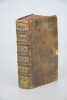
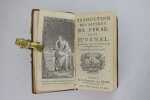
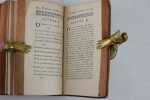
Perse (en latin Aulus Persius Flaccus), né en 34 apr. J.-C. à Volterra en Étrurie et mort en 62, est un auteur latin du Ier siècle apr. J.-C.
[Chez M.-P. Guyot] - PERSIUS FLACCUS, Aulus ; PERSE ; COURTAUD-DIVERNERESSE, J. J.
Reference : 60728
(1821)
Les Six Satires d'Aulus Persius Flaccus, avec commentaires. Satirae Sex Auli Persii Flacci, commentariis Illustratae
1 vol. in-12 reliure postérieure demi-vélin blanc, dos à 4 nerfs, Chez M.-P. Guyot, Paris, 1821, XVI-179 pp.
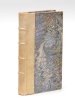
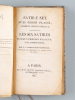
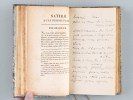
Exemplaire intégralement interfolié (lors de la reliure, avec un papier quadrillé). Le propriétaire a rédigé les premiers feuillets interfoliés (lexique latin français), tous les suivants sont restés vierges. Bon exemplaire de cette édition portant une dédicace imprimée à Maine de Biran (qq. annotations et qq. rouss.)
Juvenalis and Persius, literally translated. With copious explanatory notes; By M. Madan. A new edition, revised and corrected.
Oxford, London, printed by J. Vincent for Thomas Tegg, 1889.
2 volumes: 307;344 p. Cloth 23 cm (Bindings shabby, especially the backs; front fleaves removed; some pencil. Interior ok)
D. Junii Juvenalis et Auli Persii Flacci Satyrae: cum Veteris Scholiastae & Variorum Commentariis. Accurante Cornelio Schrevelio.
Leiden (Lugd. Bat.), Apud Franciscum Hackium, 1658.
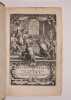
8vo. (XVI),638,(42 index) p. Overlapping vellum 20 cm (Ref: STCN ppn 840202245; Schweiger 2,511; Dibdin 2,154; Moss 2,158/9; Ebert 11242; Graesse 3,520) (Details: 6 thongs laced through both joints. Shorttitle in ink on the back. The engraved title, which is not signed, is used here for the second time. It was first used for the original edition of 1648, of which this 1658 edition is a reissue; The engraved title of 1648 still bears the name of the engraver, it is executed by the Dutch Golden Age engraver Reinier van Persijn; for this edition of 1658, the X before LVIII was simply filed away from the copper plate, and at the same time the name of Persijn, just beneath the X. The title depicts allegorical scenes: on the left a naked woman sitting on a crocodile, holding in her hand a parrot; then a Janus-headed woman, with bird feet and a tail, holding up in her left hand a Momus-mask, and in her right 2 flaming hearts; in the centre sits on a throne an old woman, holding in her left hand a sack of money (?), and in her right what seems a little flask; on the right in the foreground a king reaching for that sack; he is accompanied by a priest, a farmer (?) and a soldier; in a window central above the old woman we see the ascension of the poet) (Condition: Vellum age-toned and slightly worn. Oddly enough a previous owner has replaced the vanished X in the impressum for a new one in ink. Outer margin of the first 2 leaves sligthly thumbed) (Note: The Roman poet Juvenalis, ca. 55-140 AD, was the last and most influential of the Roman satirists. He 'uses names and examples from the past as protective covers for his exposés of contemporary vice and folly'. His main theme is the dissolution of the social fabric. (The Classical Tradition, Cambr. Mass., 2010, p. 501) The satires of the stoic poet Aulus Persius Flaccus form one 'libellus' of 6 satires, together 650 hexameters. 'They are well described as Horatian diatribes transformed by Stoic rhetoric'. 'He wrote in a bizarre mixture of cryptic allusions, brash colloquialisms, and forced imagery. (OCD, 2nd ed. p. 805) This edition of 1658 is a 'Variorum' edition. It offers the 'textus receptus' which is widely accepted, accompanied with the commentary and the annotations of specialists, taken from earlier useful, normative or renewing editions. Editions like these, 'cum notis Variorum', were useful, but never broke new ground. The production of this kind of editions was the specialty of Dutch scholars of the 17th and 18th century. The compilers seldom were great scholars, but often hard working schoolmasters. Their involvement in publishing a new edition was limited to the necessary, but ungrateful task of the beast of burden. Such a plodder was the Dutch editor Cornelius Schrevelius, who taught classics at the Schola Latina at Leiden, where he had been raised himself. In 1642 he succeeded his father, Theodorus Schrevelius, as the rector (Moderator) of the school. He raised at least 11 kids, and fell in 1664 victim to the then raging plague. His first Juvenal edition he published in 1648, and it was reissued by Hackius in 1658, 1664 and in 1671. Schrevelius' aim was to promote the studies of his young students and to instill in them a necessary fear (optatam metam), which will make them useful citizens and the pride of their parents. Juvenal is a suitable author for such an enterprise, for he flogs wrongdoers, and learns them to avoid the path of wickedness and to embrace honesty. (Dedicatio p. *2 verso). Especially in shameless times as ours, he continues, satyre is needed. Decent behaviour and faith have been replaced by deceit and swindle. In a short 'Benigno Lectori' (*4 verso and *5 recto) Schrevelius tells that he relies for the text on the earlier editions of Robertus Stephanus and Pithoeus, and that he excerpted the notes and commentaries of Lubinus, Farnabius and Casaubon. In addition he offers, he says, a complete and emendated edition of the old Scholiast. Schrevelius even used two excellent manuscripts which were lent to him by the Leiden professor Salmasius, which helped him to solve many difficult problems. The engraved title deserves some attention. The easiest description we found was 'an engraved title with many figures'. To us, it seems an allegorical scene based on the tenth satire, Juvenal's famous declamation on the folly of men in desiring in their prayers from the gods vane things as honor, fame, wealth, power, beauty, or a long life, instead of a sane spirit in a healthy body. 'Whole households have been destroyed by the compliant gods in answer to the masters' prayers. In camp (nocitura militia) and city (nocitura toga) alike we ask for things that will be our ruin'. (Vss. 7/9, in the Loeb-translation of Ramsay) Juvenal offers a list of pityful examples, such as the once powerful Sejanus, who like Libyan general Gadaffi many centuries later was 'being dragged along by a hook, as a show and joy to all'. (Vss. 66/67, translation Ramsay) Victims of their lust for power were Alexander the Great, Xerxes, or the Punic conqueror Hannibal, the man who was once about to destroy Rome. We assume that the royal figure who reaches out for the sack of money, or from whose hands it is being snatched, is Hannibal. The clue for this assumption is the woman on the crocodile. Such a woman was in 17th century iconography the common personification of Africa, for instance on maps. The fate of this scourge of Rome is treated by Juvenal in evocative language in 20 beautiful verses. It begins like this: 'Put Hannibal into the scales; how many pounds' weight will you find in that greatest of commanders? This is the man for whom Africa was all too small'. (Vss. 147/8) Together with the old woman he is the central figure on the title. The positioning of the three woman brings in mind a Triad, a triple diety, such as the Graces, the Moirai or Fates, or the Harpies. The Erinyes, the avenging spirits, sometimes form a trinity too. The standing woman seems to be a mixture of an Erinye and a Harpy. She has some features of such a Harpy, the personification of deamonic powers, and an agent of terrible punishment. She is bare breasted and stands on huge bird claws, with which she abducts the souls of the dead to their doom. In her right hands she holds, instead of the usual horrifying snake, a Momus mask, which personifies satire and mockery, the power to make a fool or ass of someone. In her left hand rest two flaming hearts, catholic imagery, distastful to the protestants, and therefore perhaps reprensenting idolatry. Her double faced Janushead, looking to the future and the past, might be an image of Time. The old woman on the throne is the central figure on the title. To her all movement on the picture is directed. She has the features of Atropos, the riged and inflexible one, the oldest of the 3 Moirai, or Fates, and in iconography often depicted as an old woman. She has power over life and death, and represents the fate that cannot be avoided. She holds Hannibal's fate in her hands. She withdraws the sack of money (power) and offers with her right hand the once mighty suppliant a little flask or a small beaker, with the invitation to poison himself. Juvenal on Hannibal's unglamorous bleak death: 'What then was his end? Alas for glory! A conquered man, he flees headlong into exile, and there he sits, a mighty and marvellous suppliant, in the Kings's antichamber, until it pleases his Bithynian Majesty to awake! No sword, no stone, no javelin shall end the life which once wrought havoc throughout the world: no, but that which shall avenge Cannae and all those seas of blood, a ring (containing poison)'. (Vss. 158/165, translation Ramsay) The engraver follows for this scene the better known version of the Roman historian Livy. In chapter 51 of the 39th book of his History of Rome, 'Ab Urbe Condita' Livy tells that Hannibal took his poison in an 'poculum', a cup/ goblet/ bowl/ beaker) (Provenance: The last owner was Lennart Håkanson, professor of Latin Literature of the University at Uppsala, 1980-1987) (Collation: *8, A-Z8 Aa-Tt8 Vv4) (Photographs on request)
D. Junii Juvenalis et Auli Persii Flacci Satyrae: cum Veteris Scholiastae & Variorum Commentariis. Accurante Cornelio Schrevelio.
Leiden (Lugd. Batav.), Ex officina Hackiana, 1671.
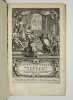
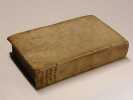
8vo. (XVI),604,(42 index) p. Vellum 20 cm (Ref: STCN ppn 840013876; Schweiger 2,511; Dibdin 2,154; Moss 2,158/9; Ebert 11242; Graesse 3,520) (Details: 5 thongs laced through both joints. Short title in ink on the back. The engraved title, which is not signed, is used here for the third time. It was first used for the original edition of 1648, for a repetition in 1658, and for this 1671 reissue. In 1648 the engraved title still bears the name of the engraver, it is executed by the Dutch Golden Age engraver Reinier van Persijn. The title depicts a complicated allegorical scene: on the left a naked woman sitting on a crocodile, holding in her hand a parrot; then a Janus-headed woman, with bird feet and a tail, holding up in her left hand a Momus-mask, and in her right 2 flaming hearts; in the centre sits on a throne an old woman, holding in her left hand a sack of money (?), and in her right what seems a little flask; on the right in the foreground a king reaching for that sack; he is accompanied by a priest, a farmer (?) and a soldier; in a window central above the old woman we see the ascension of the poet. See for an explanation of the allegory the note below) (Condition: Vellum age-toned and soiled. Boards worn at the extremities. Front hinge cracking but still strong. Front flyleaf loosening. Name on the front flyleaf. Small old inscription on the rear pastedown. Occasional small ink underlinings. Small wormhole in the right lower corner of the first 14 gatherings, never even coming near to the text) (Note: The Roman poet Juvenalis, ca. 55-140 AD, was the last and most influential of the Roman satirists. He 'uses names and examples from the After p. 65 has been added a plate showing a allegoric triumph scene with prince Frederik Hendrik of Orange. See for this plate: rkd.nl/nl/explore/portraits/record?filters[plaats][]=Den+Haag&filters[kunstenaar][] =Vinckboons%2C+David+%28I%29&query=&start=2)past as protective covers for his exposés of contemporary vice and folly'. His main theme is the dissolution of the social fabric. (The Classical Tradition, Cambr. Mass., 2010, p. 501) The satires of the stoic poet Aulus Persius Flaccus form one 'libellus' of 6 satires, together 650 hexameters. 'They are well described as Horatian diatribes transformed by Stoic rhetoric'. 'He wrote in a bizarre mixture of cryptic allusions, brash colloquialisms, and forced imagery'. (OCD, 2nd ed. p. 805) This edition of 1671 is a 'Variorum' edition. It offers the 'textus receptus' which is widely accepted, accompanied with the commentary and the annotations of specialists, taken from earlier useful, normative or renewing editions. Editions like these, 'cum notis Variorum', were useful, but never broke new ground. The production of this kind of editions was the specialty of Dutch scholars of the 17th and 18th century. The compilers seldom were great scholars, but often hard working schoolmasters. Their involvement in publishing a new edition was limited to the necessary, but ungrateful task of the beast of burden. Such a plodder was the Dutch editor Cornelius Schrevelius, who taught classics at the Schola Latina at Leiden, where he had been raised himself. In 1642 he succeeded his father, Theodorus Schrevelius, as the rector (Moderator) of the school. He raised at least 11 kids, and fell in 1664 victim to the then raging plague. His first Juvenal edition he published in 1648, and it was reissued by Hackius in 1658, 1664 and in 1671. Schrevelius' aim was to promote the studies of his young students and to instill in them a necessary fear (optatam metam), which would make them useful citizens and the pride of their parents. Juvenal is a suitable author for such an enterprise, for he flogs wrongdoers, and learns them to avoid the path of wickedness and to embrace honesty. (Dedicatio p. *2 verso) Especially in shameless times as ours, he continues, satyre is needed. Decent behaviour and faith have been replaced by deceit and swindle. In a short 'Benigno Lectori' (*4 verso and *5 recto) Schrevelius tells that he relies for the text on the earlier editions of Robertus Stephanus and Pithoeus, and that he excerpted the notes and commentaries of Lubinus, Farnabius and Casaubon. In addition he offers, he says, a complete and emendated edition of the old Scholiast. Schrevelius even used two excellent manuscripts which were lent to him by the Leiden professor Salmasius, which, he tells, helped him to solve many difficult problems. The engraved title deserves some attention. The easiest description we found was 'an engraved title with many figures'. To us, it seems an allegorical scene based on the tenth satire, Juvenal's famous declamation on the folly of men in desiring in their prayers from the gods vane things as honor, fame, wealth, power, beauty, or a long life, instead of a sane spirit in a healthy body. 'Whole households have been destroyed by the compliant gods in answer to the masters' prayers. In camp (nocitura militia) and city (nocitura toga) alike we ask for things that will be our ruin'. (Vss. 7/9, in the Loeb-translation of Ramsay) Juvenal offers a list of pityful examples, such as the once powerful Sejanus, who like the Libyan general Gadaffi many centuries later was 'being dragged along by a hook, as a show and joy to all'. (Vss. 66/67, translation Ramsay) Victims of their lust for power were Alexander the Great, Xerxes, or the punic conqueror Hannibal, the man who was once about to destroy Rome. We assume that the royal figure who reaches out for the sack of money, or from whose hands it is being snatched, is Hannibal. The clue for this assumption is the woman on the crocodile. Such a woman was in 17th century iconography the common personification of Africa, for instance on maps. The fate of this scourge of Rome is treated by Juvenal in evocative language in 20 beautiful verses. It begins like this: 'Put Hannibal into the scales; how many pounds' weight will you find in that greatest of commanders? This is the man for whom Africa was all too small'. (vs. 147/8). Together with the old woman he is the central figure on the title. The positioning of the three woman brings in mind a Triad, a triple diety, such as the Graces, the Moirai or Fates, or the Harpies. The Erinyes, the avenging spirits, also sometimes form a trinity. The standing woman seems to be a mixture of an Erinye and a Harpy. She has some features of such a Harpy, the personification of deamonic powers, and an agent of terrible punishment. She is bare breasted and stands on huge bird claws, with which she abducts the souls of the dead to their doom. In her right hands she holds, instead of the usual horrifying snake, a Momus mask, which personifies satire and mockery, the power to make a fool or ass of someone. In her left hand rest two flaming hearts, catholic imagery, distastful to the protestants, and therefore perhaps reprensenting idolatry. Her double faced Janushead, looking to the future and the past, might be an image of Time. The old woman on the throne is the central figure on the title. To her all movement on the picture is directed. She has the features of Atropos, the riged and inflexible one, the oldest of the 3 Moirai, or Fates, and in iconography often depicted as an old woman. She has power over life and death, and represents the fate that cannot be avoided. She holds Hannibal's fate in her hands. She withdraws the sack of money (power) and offers with her right hand the once mighty suppliant a little flask or small beaker, with the invitation to poison himself. Juvenal on Hannibal's unglamorous bleak death: 'What then was his end? Alas for glory! A conquered man, he flees headlong into exile, and there he sits, a mighty and marvelous suppliant, in the Kings's antichamber, until it pleases his Bithynian Majesty to awake! No sword, no stone, no javelin shall end the life which once wrought havoc throughout the world: no, but that which shall avenge Cannae and all those seas of blood, a ring (containing poison)'. (Vss 158/165, translation Ramsay) The engraver follows for this scene the better known version of the Roman historian Livy. In chapter 51 of the 39th book of his History of Rome, 'Ab Urbe Condita', Livy tells that Hannibal took his poison in an 'poculum' cup/goblet/bowl/beaker) (Provenance: Manuscript ownership entry of 'A.J. Enschedé' on the front flyleaf. Adriaan Justus Enschedé, 1829-1896, was a member of a famous Dutch dynasty of printers. His forefather Izaak Enschedé established himself in Haarlem in 1703, and there the firm remained for more than 300 years. The firm was, and still is famous for the quality of its printing of bonds and banknotes. In 1810 they printed the first Dutch banknotes. Adriaan Justus entered the firm and kept it flourishing. From 1857 onward he was also Keeper of the archives of the city of Haarlem. He wrote several books on the history of Haarlem, and on the history of the Wallon Church in the Netherlands) (Collation: *8, A-2R8 2S4 (2S4 blank)) (Photographs on request)
JUVENALIS Decimus Junius ( JUVENAL ) / PERSIUS FLACCUS ( PERSE ) / PULLMANUS Theodorus ( editeur )
Reference : 055924
D. IUNI JUVENALIS SATIRARUM LIBRI V. A. Persii Flacci Satyrarum liber I. Theod. Pulmanni in eosdem Annotationes.
Antverpiae ( Anvers ) Ex officina Christophori Plantini 1565 in 12 (17x11) 1 volume reliure demi veau havane, dos à nerfs orné de fleurons à froidl, pièces de titre de cuir vert et rouge, page de titre avec vignette gravée à la marque au compas de l'imprimeur Plantin (woodcut printer's device on title page), 160 pages. Rare première edition Plantinienne du livre V des satires de Juvénal (first Plantin edition of the preserved works by Juvenal and Persius edited by Theodor Poelman, 1512-1581). Bel exemplaire ( Photographies sur demande / We can send pictures of this book on simple request )
Bon Couverture rigide
Auli Persii Flacci SATYRAE VI. Cum posthumis commentariis IOANNIS BOND. Accessit Index verborum.
Amstelaedami apud Iohannem Blaeu, MDCXLV (1645), in-12, 126pp.-3ff., relié plein basane époque, dos à nerfs avec titre, supra-libris aux plats, ex-libris en dernière page de garde, coins usés, coiffe sup. absente.
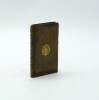
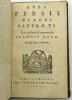
Recueil de six satires du poète romain Aulus Persius Flaccus, connu pour ses thèmes moralistes et philosophiques et publié en 1645 par Johannes Blaeu à Amsterdam. Il comprend des commentaires posthumes de John Bond, (1550 –1612), médecin anglais et érudit classique, connu pour les commentaires qu'il publia sur la littérature classique, notamment ceux sur Horace et Persius, Ex-libris imprimé de François-Michel de Verthamon, marquis de Breau. M4-Et2
JUVENALIS Decimus Junius - Aulus PERSIUS FLACCUS - Theodorus PULLMANUS ( editor ) :
Reference : 48279
"Juvenalis : Satyrarum libri V ; Persius : Satyrarum liber I [ ed. Theodorus Pulmannus ]."
Antverpiae, Ex officina Christophori Plantini, 1565, in-8, 170 x 115 mm, 160 pp, complete, collation identical with Voet n° 1493. Bound in contemporary full vellum, , sometime restiched and endpapers renewed with old paper, spine lettered i n ink, somewhat soiled but good. Inside with some foxing, a small marginal dampmark to 15 leaves, one page with a faint but large splashmark, early ownership inscriptions of Marcus and Gio. Carlo Maciagas. This is the first Plantin edition of the preserved works by Juvenal and Persius edited by Theodor Poelman (1512 - 1581). It was the best 16th c. edition before the discovery of the Montpellier manuscript which was first used by Pithou in 1585. USTC 401187. Voet 1493..
A. PERSIUS FLACCUS CUM INTERPRETATIONE LATINA LECTIONUM VARIETATE ADNOTATIONIBUSQUE NOVIS, ITEM LUCILII FRAGMENTA, SATIRA SULPICIAE
Colligebat Nicolaus Eligius Lemaire, Parisiis. 1830. In-8. Relié demi-cuir. Etat d'usage, Couv. légèrement passée, Dos frotté, Quelques rousseurs. 727 pages. Gravure en noir et blanc en frontispice (portrait). Titre et fleurons dorés sur le dos. Etiquette de code sur la couverture. Quelques tampons de bibliothèque. Fortes épidermures sur le dos.. . . . Classification Dewey : 470-Langues italiques. Latin
Cum Notis, Excursibus et Indicibus Curante A. Perreau. Quod est Satiricorum Latinorum Cum Juvenale Volumen Tertium et Ultimum. Classification Dewey : 470-Langues italiques. Latin
LES SATIRES DE PERSE. Texte latin publié avec un commentaire critique et explicatif et une introduction par François Villeneuve
Paris, librairie Hachette et Cie, 1918 0 un volume grand in-8°, LXVIII 181 pp. (4) pp. Bel exemplaire en partie non coupé.
A. Persii Flacci et Dec. Jun. Juvenalis Satirae. Ad optimas editiones collatae. Accedit Sulpiciae satira. C. Lucilii satirographorum principis fragmenta. Editio accurata.
Biponti, ex typographia Societatis, 1785.
67,286;69 p. Hardb. 20 cm (Cover worn at extremities; small piece of paper on the back gone)
Perzius. Hekeldichten, vrij en in toepassing op onzen tijd nagevolgd door W. BILDERDIJK.
Rotterdam, Immerzeel, 1820.
VIII,88 p. Contemp. wrs. 22 cm (Disbound) (Geereb. 123,5,III; OiN 288)
Satires. Texte établi et traduit par A. CARTAULT.
Paris, Les Belles Lettres, 1951.
Wrs. 20 cm (Budé)
Satires. Texte établi et traduit par A. CARTAULT.
Paris, Les Belles Lettres, 1966.
Wrs. 20 cm (Budé)
Satirarum liber. Ex rec. C.F. HERMANNi.
Lpz., Tbn., 1881.
XVI,21 p. Wrs. (BT) (Back rep. with paper tape; cover frayed)
Satires. Texte établi et traduit par L. HERRMANN.
Bruxelles, Revue d'Ét. Latines, 1962.
XIV,41 p. Wrs. (Coll. Latomus, 59)
The satires. Text with translation and notes by J.R. JENKINSON.
Warminster, Aris & Phillips, 1980.
VII,131 p. Pb. 21 cm

