 Write to the booksellers
6 books for « perizonius j »Edit
-
Topics
History (2)
Military arts (1)
Paris (1)
-
Countries
France (1)
Netherlands (4)
Switzerland (1)
-
Syndicate
ILAB (1)
SLAM (1)
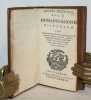
Jacobi Perizonii Ant. Fil. Orationes XII, varii et praestantioris argumenti in gratiam cultorum elegantiorum litterarum collectae,
Leiden (Lugdini Batavorum), Apud Joh. Arnold Langerak, 1740.
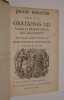
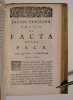
8vo. XXXVIII,592 p. Vellum 17 cm (Details: 5 thongs laced through the joints. Engraved printer's mark on the title, it depicts a man who is busy climing a steep hill; a winged diety, Father Time (Tempus), who sways his scythe and has an hourglass on his head, helps him to ascend; at the top of the hill rests a huge cornucopia; this scene is flanked Athena and the Muse Clio (?), whose head is winged and who has scroll and quill at hand; the motto reads: 'Dum audes, ardua vinces', 'You will be succesful daring') (Condition: Vellum age-toned. Both pastedowns slightly stained. Small paper label on the back) (Note: The Dutch ancient historian Jacobus Perizonius, 1651-1715, was professor of History at the University of Franeker from 1682, and from 1693 of Leiden. His historical work broke new ground, and may be said to have laid the foundations of historical criticism. It anticipates Niebuhr's method of dealing with the early history of Rome. He made his name with his 'Animadversiones historicae' (1685), which work is recognised as a masterpiece of historical criticism. 'In his 'Origines Babylonicae et Aegypticae (1711), he was the first to suggest the spuriousness of the royal list of Manetho, and he defended the chronology of Scaliger'. (J.E. Sandys, 'A history of classical scholarship', New York 1964, volume 2, p. 331) Perizonius wrote also a learned dissertation on Dictys (1702). His merit as a philologist is demonstrated in his commentary on the 'Minerva' of Sanctius, which became a standard (1687, 1693, 1702, 1704, 1714, 1733, 1752, 1754, 1789, 1793, 1795 & 1809), and his edition of the 'Variae Historiae' , a miscellany of the late antique author Aelianus (1701). From the dedication at the beginning of this book, dated Zaltbommel 1739, we learn that F.G. Westerhovius is the editor of this collection of speeches of Jacob Perizonius, 'praeceptoris quondam mei amantissimi'. Westerhovius studied probably under Perizonius at the University of Leiden, where Perizonius lectured from 1693. Frederik Wilhelm Westerhovius, was born in 1675, and was appointed rector of the Schola Latina at Gorichem, and later (still alive in 1742) Zaltbommel. Westerhovius added after the 'dedicatio' a 7 page biographical sketch (Viri Clarissimi Jacobi Perizonii vita) of his admired professor, and a list of 12 pages (Codices quos Bibliothecae legavit Clarissimus Jacobus Perizonius) listing the 38 manuscripts, among which one of the 10th century, and 59 valuable (post)incunabula Perizonius bequaethed to the Library of the University of Leiden. The collection of orations opens with Perizonius's inaugural lecture held at Franeker 'De Ciceronis industria' (1682), and his inaugural lecture of Leiden 'De usu Graecae Romanaeque linguae' (1693). Follow 'De Pyrrhonismo historico', 'De doctrinae studiis nuper cultis', 'De origine et natura Imperii', 'De bello contra Gallos et Hispanos', 'De Aethere Britannis & Batavis militante', 'De facta nuper pace', 'Cum Vilhelmus & Maria coronarentur', 'Funebris Mariae Reginae', 'In obitum Abrahami Gravii') (Provenance: From the library of Caspar Reuvens and with his library ticket on the spine. Caspar Jacob Christiaan Reuvens, 1793-1835, was a Dutch historian and archaeologist. He was the founding director of the Rijksmuseum van Oudheden (Dutch National Museum of Antiquities) in Leiden, the world's first ever professor of archaeology at Leiden University, and conducted the first excavations at the Roman provincial site Forum Hadriani in the Netherlands'. (See English Wikipedia, with his portrait) On the verso of the front flyleaf has been attached a small leaflet, format visiting card, with the text: 'Jacob Perizonius wenscht mijn geachte Buurman in de Veenlaan te 's Gravenhage, een gelukzalig jaar van 1867'. On the backside of this: 'Dr. Wap en echtgenoot, 1 januari 1867 (met een boekgeschenk)'. Perizonius is here used as the messenger of the New Year's wishes of Doctor Johannes Jacobus Franciscus Wap to one of his neighbours. The Dutchman Jan Wap, 1806-1880, was in the 19th century a wellknown man of letters. The city of The Hague honoured him by naming a street after him, the Jan Wapstraat. Wap was living at the time at the Veenkade number 14. The Veenkade (nowadays Toussaintkade), a row of houses for well to do citizens, was part of the canal system (singel) which went round the city untill the end of the 19th century) (Collation: *-2*8, 3*4 (minus leaf 3*4), A-2O8) (leaf L5 signed M5; leaf 2H6 signed 2H5) (Photographs on request)
Jacobi Perisonii, Ant. F. Animadversiones historicae, in quibus quamplurima in priscis Romanarum rerum, sed utriusque Linguae autoribus notantur, multa etiam illustrantur atque emendantur, varia denique antiquorum rituum eruunter, & uberius explicantur.
Amsterdam (Amstelaedami), Ex officina Henrici & Viduae Theodori Boom, 1685.
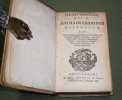
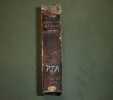
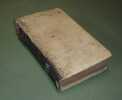
8vo. (XXXII),470,(16 index),(2 blank) p. Vellum 16.5 cm A masterpiece of historical criticism. (Sandys) (Details: Woodcut printer's mark on the title, it depicts a gardener who waters a shoot that arises from a tree (Boom is Dutch for tree); the motto reads: 'Tandem fit surculus arbor', (A shoot at length becomes a tree) a popular motto in the Netherlands ever since the war of independence against the Spaniards, which lasted 80-years) (Condition: The spine was problably once exposed to a fire, it is blackish, and the gilt is almost invisible; part of the shield pasted on the spine. Head of the spine is gone. Both boards age-toned and somewhat soiled. Faint ownership entry on the title. Title slightly soiled. Paper slightly yellowing) (Note: The historian of classical scholarship J.E. Sandys observes that this collections of 'Animadversiones' of Jacobus Perizonius is recognised as a masterpiece of historical criticism, and as an anticipation of Niebuhr's method of dealing with the early history of Rome. (J.E. Sandys, 'A history of classical scholarship', New York 1964, volume 2, p. 331) Jacob Perizonius, 1651-1715, is the Grecian form of the Dutch name Voorbroek. He was from 1682 professor of History at the University of Franeker, and from 1693 of Leiden. His 'Animadversiones historicae' of 1685 made his name. The basic principle of Perizonius is simply that human knowledge is limited and liable to error. This idea he applies to ancient authors. Scribes of later centuries are not always to be blamed for the mistakes and contradictions in the surviving texts, he argues. In this way Perizonius unmasks the ancient authors, and demystifies their 'sacrosanctity'. 'Homines fuerunt veteres illi', the ancients were humans after all, who erred and made mistakes; and consequently they are open to criticism. Ancient historians like Livy, Sueton, Florus, Plutarch et alii, he states, regularly mix up names, confuse dates and make all kind of errors. Their works do not offer indisputable thruths, as many contemporaries thought. The task of the critic is to purge the ancient texts of mistakes. The principle aim of Perizonius is not to bowdlerize the style and expurgate the language, but to investigate the historic contents of the texts. He tries to reconstruct Roman history, investigating with a critical eye the historical data which have come down to us. The fallability of ancient historians was proven already by earlier generations of scholars, that is true, but historical truth can only be attained with a critical research methodology, shifting through evidence and comparing the facts which passed down through the centuries. Perizonius's 'Animadversiones historicae' laid the foundations of historical criticism in modern time) (Provenance: On the front flyleaf: 'Bib. Theol. Ohly') (Collation: *-2*8; A-Z8, Aa-Gg8, Hh4 (leaf Hh4 blank)) (Photographs on request)
Kritiek als herwaardering. Het levenswerk van Jacob Perizonius (1651-1715).
Leiden, 1971.
(VIII),252 p.; fold. table, portr. Wrs. 24 cm (Diss.) (Calder/Smith no. 2005b: 'A fundamental reevaluation of the life and work of the great Leiden scholar. His discovery of the meaning of oral tradition in historiography and his early awareness of the importance of universal history make him an important predecessor of Milman Parry and Eduard Meyer')
Kritiek als herwaardering. Het levenswerk van Jacob Perizonius (1651-1715).
Leiden, Universitaire Pers Leiden, 1971.
(VIII),252 p.; folding table; portrait. Stiff wrappers. 24 cm (Dissertation, University Leiden) (Calder/Smith no. 2005b: 'A fundamental reevaluation of the life and work of the great Leiden scholar. His discovery of the meaning of oral tradition in historiography and his early awareness of the importance of universal history make him an important predecessor of Milman Parry and Eduard Meyer')
Jacobi Perisonii, Ant. F. Animadversiones historicae In quibus Quamplurima in priscis Romanarum rerum, sed utriusque Linguae Autoribus notantur, multa etiam illustrantur atque emendantur, varia denique antiquorum rituum ernuntur, & uberius explicantur. De la bibliothèque de Nicolas Lambert de Thorigny.
Amstelaedami, Ex Officina Henrici & Viduae Theodori Boom, 1685. In-12 de XVI ( titre, adresse etc), 470 pages et VII feuillets (index). Edition originale. Bon état intérieur malgré quelques fines piqûres et légères brunissures à certains cahiers. Belle reliure très attractive en plein veau blond, double filet d'encadrement sur les plats aux armes de Nicolas Lambert de Thorigny, dos à nerfs très orné, roulette sur les coupes et sur les chasses, tranches mouchetées. Une charnière un peu fragile et marge supérieure légèrement plus courte. Ancienne et habile restauration à la coiffe supérieure.
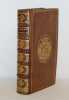
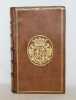
Jacobus Perizonius (nom hollandais : Jacques Woorbroek) né en 1651, mort en 1715) fut successivement recteur du Gymnase de Delft (1674), puis professeur d'éloquence et d'histoire à Francker (1681) et professeur d'histoire et de littérature grecque à Leyde. Il fut, après Bentley, l'érudit classique le plus remarquable de son temps et joignait à la connaissance précise des langues savantes, le sens historique le plus pénétrant. Dans son ouvrage, il a jeté les bases de la critique historique des temps modernes. "Animadversiones historicae" fut considéré comme le chef d'oeuvre de la critique historique et comme une anticipation de la méthode de Niebuhr pour traiter de l'histoire ancienne de Rome. Bayle considéra cet ouvrage comme "l'errata des historiens". Né en 1666, Nicolas Lambert de Thorigny fut reçu conseiller au Parlement de Paris en la deuxième des requêtes du Palais le 1er septembre 1687 : il devint président en la même chambre le 6 août 1697 et fut élu prévôt des marchands de Paris le 27 avril 1725. Il mourut dans cette ville le 10 juillet. Il avait, comme son père, lesprit porté à la culture des beaux-arts et de la littérature et enrichit constamment sa bibliothèque.


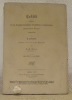
Taktik nach der für die Königlich Preussischen Kriegsschulen vorgeschriebenen “genetichen Skizze” ausgearbeitet von H. Perizonuis. Fünfte, neu redigirte Auslage von F. A. Paris. Zwei Theile in einem Bande.
Berlin, Ernst Siegfried Mittler und Sohn 1872, 230x165mm, VII - 272 + 299Seiten, broschiert. Kleiner Riss an der Unterseite des Deckels und den ersten Seiten.
Pour un paiement via PayPal, veuillez nous en faire la demande et nous vous enverrons une facture PayPal

