 Write to the booksellers
50000 books for « paul m ch »Edit
-
Latest
Last 24h (13)
Last 3 days (89)
Last month (801)
Last week (917)
-
Language
Albanian (1)
Czech (1)
Dutch (110)
English (153)
French (96066)
German (32)
Italian (4)
Latin (7)
Polish (1)
Portuguese (1)
Romanian (2)
Russian (125)
Spanish (3)
-
Century
16th (14)
17th (82)
18th (273)
19th (6670)
20th (45323)
21st (4605)
-
Countries
Belgium (5754)
Brazil (18)
Canada (726)
China (111)
Côte d'Ivoire (199)
Denmark (226)
France (83498)
Germany (229)
Greece (47)
Italy (2)
Netherlands (2)
Switzerland (5535)
United Kingdom (31)
United States of America (128)
-
Syndicate
ALAC (608)
CLAM (281)
CLAQ (237)
CNE (109)
ILAB (44004)
NVVA (891)
SLACES (891)
SLAM (41259)
SNCAO (317)
Type
- Any type (2)
- Art print (5)
- Artists book (10)
- Autograph (164)
- Book (93916)
- Disk (2)
- Drawings (14)
- Engraving (21)
- Magazine (179)
- Manuscript (10)
- Maps (13)
- Music sheets (2029)
- New book (14)
- Old papers (13)
- Photographs (102)
- Postcards (2)
- Posters (8)
- Reprint (2)
Topics
- Adam (510)
- Alps (218)
- Alsace (482)
- Aquitaine (251)
- Archaeology (589)
- Architecture (759)
- Army (251)
- Autographs (881)
- Belgium (606)
- Bibliography (208)
- Bibliophilism (435)
- Biography (968)
- Botany (248)
- Bourget paul (840)
- Brittany (345)
- Catholicism (257)
- Children’s books (618)
- Christianity (423)
- Cinema (229)
- Claudel paul (2128)
- Comic strip (346)
- Cooking (337)
- Dedication (631)
- Detective novels (674)
- Dictionaries (209)
- Drawings (300)
- Early printed books (405)
- Economics (441)
- Education (313)
- Eluard paul (1002)
- Esotericism (231)
- Ethic (219)
- Eydoux henri-paul (236)
- Feval paul (533)
- Fine arts (738)
- First edition (1974)
- French literature (357)
- Genealogy (264)
- Geography (811)
- Geraldy paul (255)
- Germanic languages (379)
- Guide books (278)
- Guth paul (540)
- Helvética (758)
- History (4167)
- Illustrated books (356)
- Industrial arts & crafts - fine arts (373)
- Jacob (282)
- John-paul ii (980)
- Journalism (205)
- Lacroix paul jacob (754)
- Law (532)
- Léautaud paul (484)
- Léon paul (397)
- Literature (9068)
- Magazine (645)
- Manuscripts (332)
- Medicine (977)
- Middle ages (209)
- Military arts (321)
- Morand paul (613)
- Music (278)
- Navy (577)
- Newspapers press (1353)
- Painters (241)
- Painting (404)
- Paris (878)
- Paul vi (265)
- Philosophy (1310)
- Photography (642)
- Poetry (2565)
- Policy (634)
- Provence (338)
- Psychology (656)
- Reboux paul (459)
- Regionalism (783)
- Religions (882)
- Reliure (292)
- Review (1062)
- Reviews (878)
- Saint paul (390)
- Sartre jean paul (1227)
- Sciences (483)
- Scores (2565)
- Sociology (264)
- Songs (1906)
- Spying (296)
- Surrealism (235)
- Switzerland (859)
- Theatre (1265)
- Theology (474)
- Travel (446)
- Valery paul (539)
- Various (645)
- Vialar paul (523)
- War (1227)
- Youth (299)
Histoire de l'imprimerie en France au XVe et au XVIe siècle
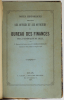
Paris, Imprimerie Nationale, 1900-1914. 29550 g 4 volumes in-folio, en feuilles sous portefeuilles, [1] fb., [5] ff., xxiv-490 pp.; [2] ff., 572 pp.; [3] ffb., [3] ff., 550 pp., [3] ffb.; [1] fb., xxvii-528 pp.. Illustré de 36 planches hors-texte dont 35 en couleurs et une sur double-page en noir; et d'innombrables fac-similés in-texte. Exemplaire dont les trois premiers volumes sont imprimés sur vélin et le dernier sur japon; et qui contient de plus un fascicule de présentation de [6] ff. et une carte de visite d'Arthur Christian, directeur de l'Imprimerie Nationale. Le quatrième tome, est paru en 1914, après la mort d'Anatole Claudin, et a été achevé sous la direction de Léopold Delisle et de Paul Lacombe. La publication de cet ouvrage fondamental et monumental est restée inachevée. Rare ensemble. Des rousseurs, salissures et restaurations aux portefeuilles. . (Catégories : Imprimerie, Bibliographie, )
Poésies diverses de M. Desforges-Maillard, ..., dédiées à M. de Machault, ministre d'état
Paris, Huart et Moreau, 1750. 175 g Deux parties en un volume in-16, plein veau, dos lisse orné, [1] f., 308-[3] pp.. Un vignette gravée par Fessard d'après Clavareau en tête de la première partie. Le poète Paul Desforges-Maillard (1699-1772), originaire du Croisic, avait peu de succès et s'était fâché avec le Mercure de France qui ne voulait plus le publier. Desforges-Maillard eut alors l'idée d'écrire sous le pseudonyme d'une femme ''Mlle Malcrais de La Vigne'' et obtint un assez grand succès avec son poème des ''Tourterelles''. Mais cette fausse identité l'entraîna dans des mésaventures, ce qui inspira à Piron sa pièce de la Métromanie. Notre receuil contient de nombreux poèmes, dont les tourterelles (p. 216), mais aussi quelques fables. Ancienne étiquette de classement sur le dos, frottements. . (Catégories : Littérature, Poésie, )
Scènes et paysages dans les Andes
Paris, Librairie de L. Hachette et Cie, 1861. 890 g 2 volumes in-12, demi percaline rouge, [2] ff., 423 pp., [2] ff.; [2] ff., 331 pp., [2] ff.. Tome I: Le dernier fils du Soleil; Une nuit de Noël à Tiabaya; Une cérémonie nautique au bord du lac de Titicaca; Les sources de l'Apurimac; Les ruines d'Ollantaytampu. Tome II :Une expédition malheureuse; La première ascension de l'Urusayhua. Paul Marcoy est le pseudonyme de Laurent Saint-Cricq (1815-1887) qui a fait plusieurs voyages en Amérique du Sud. Reliure signée de A. Poilleux. Quelques petits points de rousseurs. . (Catégories : Voyages, Amérique du Sud, Pérou, )
![Scènes et paysages dans les Andes. MARCOY (Paul) [pseudonyme de Laurent Saint-Cricq ]](https://static.livre-rare-book.com/pictures/CHH/10182_1_thumb.jpg)
![Scènes et paysages dans les Andes. MARCOY (Paul) [pseudonyme de Laurent Saint-Cricq ]](https://static.livre-rare-book.com/pictures/CHH/10182_2_thumb.jpg)
![Scènes et paysages dans les Andes. MARCOY (Paul) [pseudonyme de Laurent Saint-Cricq ]](https://static.livre-rare-book.com/pictures/CHH/10182_3_thumb.jpg)
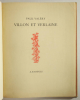
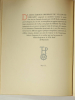
Villon et Verlaine
Maestricht, A. A. M. Stols, 1937 (30 octobre). 700 g Grand in-4, plein parchemin, tranches dorées, couvertures et dos conservés, 34 pp., [1] ff.. Edition originale du texte d'une conférence prononcée par Paul Valéry le 12 janvier 1937 à l'Université des Annales (Karaïskakis, 280). Lettrines dessinées par Stols et imprimées en rouge et bleu. Un des exemplaires sur vergé antique dont il a été 500 exemplaires numérotés et quelques hors-commerce comme celui-ci. In fine a été relié un spécimen d'annonce de l'ouvrage, composé de 2 feuillets. . (Catégories : Littérature, )
Mélanges généalogiques. Cinquième série et tables
Lille, Société d'Etudes de la Province de Cambrai, Société Saint-Augustin, Desclée de Brouwer, 1927. 685 g In-8, demi maroquin fauve, [2] ff., 303-[1] pp., illustré d'armories dans le texte.. Volume contenant l'importante table générale des cinq séries des Mélanges généalogiques de Paul Denis du Péage; ainsi que les généalogies des familles Taverne Palisot, Domessent, de Croix, Imbert, Kien, Foulon, Le Gillon, Boucquel, de Lelès, Pillot, Cuvelier, Pollet, Del Villar, Doncker et Donquer, d'Emeric, Légier, Mienson, Moreel, Lefèbvre, Galhaut, Flandryn, Herwyn. Publié dans le 22e recueil de la Société d'Etudes de la Province de Cambrai. Saffroy, 22329. . (Catégories : Généalogie, Nord, )
Pierre Nozière
Paris, René Kieffer éditeur, 1925. 1150 g In-8 broché, couvertures rempliées, [3] ff., 284 pp., [2] ff.. Illustré par Paul-Maurice Vigoureux de 20 eaux fortes hors-texte en couleurs avec remarques, et tirées par Nourisson. Un des 400 exemplaires numérotés sur vélin blanc à la forme. Mahé, Bibliographie des livres de luxe, II, 126. Petits points de rousseurs sur le dos. . (Catégories : Littérature, Livres illustrés, )
![Pierre Nozière. [Paul-Maurice Vigoureux] FRANCE (Anatole)](https://static.livre-rare-book.com/pictures/CHH/8806_1_thumb.jpg)
![Pierre Nozière. [Paul-Maurice Vigoureux] FRANCE (Anatole)](https://static.livre-rare-book.com/pictures/CHH/8806_2_thumb.jpg)
![Pierre Nozière. [Paul-Maurice Vigoureux] FRANCE (Anatole)](https://static.livre-rare-book.com/pictures/CHH/8806_3_thumb.jpg)
Analecta ex mss. Pauli Ambrosii Valerii ad usum amicorum ejus qui a septemrione habitant. Tomus I
Maestricht, Editum Apud Alexandrum Stols, 1926. 165 g In-8 broché, couverture rempliée, 61-[1] pp., [1] ff.. Edition en partie originale, un des 400 exemplaires sur vergé de Hollande seul grand papier après trois Japons. Exemplaire imprimé nominativement pour Auguste-Pierre Garnier. Karaïskakis, 73. . (Catégories : Littérature, )
Pinget dans la cage aux lions et autres histoires pour dérider ces vaudois
Lausanne, Gonin, 1925. 165 g Petit in-8 broché, 112 pp., [1] f.. Illustré par Ch. Clément. Un des 50 exemplaires numérotés sur papier Fabriano. Edition originale. Exemplaire non coupé. . (Catégories : Littérature, Humour, Suisse, )
Air indien
Paris, Bernard Grasset, 1932. 285 g In-12 broché, 268 pp., [2] ff.. Edition originale. Un des 2380 exemplaires numérotés sur Alfax Navarre. Petits plis. . (Catégories : Littérature, )
Les meubles cauchois. Souvenirs et dessins d'un artisan recueillis par ''goust d'antiquaille''
Fécamp, Banse, 1920. 160 g In-8 broché, [1] f., ii-[1]-64 pp., [2] ff., illustrations in et hors-texte. Deuxième édition ''revue, corrigée, augmentée mise en meilleur ordre et enrichie de figures''. . (Catégories : Normandie, Mobilier, Pays de Caux, )
Au pays de Maupassant. Nouvelles normandes
Paris, Librairie Ernest Dumont (Imprimerie Lecerf fils à Rouen), 1910. 335 g In-12 broché, [4] ff., 289 pp., [2] ff.. Préface de Jean Richepin. Envoi de l'auteur à Mr Georges Normandy. Légers défauts. . (Catégories : Normandie, )
La bibliothèque de Jules Janin
Paris, Jouaust, 1877. 180 g In-16, demi chagrin noir, couvertures conservées, [2] ff., 51-[1] pp.. Illustré d'un frontispice par Lalauze. Ouvrage tiré à 520 exemplaires. . (Catégories : Bibliographie, )
Ultime voyage pour la Mecque. Les inventaires après décès de pèlerins morts à Damas vers 1700
Damas, Institut Français de Damas, 1998. 420 g In-8 broché, 222 pp., [1] f.. . (Catégories : Histoire, Syrie, )
Reliures du dix-septième siècle
Troyes, Atelier de reporgraphie de la ville de Troyes, 1980. 235 g In-4 broché, 55 pp.. Illustré de 10 planches en noir et d'une planche de photographies en couleurs. Catalogue de l'exposition du 14 juin au 15 juillet 1980, 116 reliures décrites et en partie reproduites provenant de la bibliothèque de Troyes Ouvrage tiré à 300 exemplaires numérotés. Il existe peu d'études sur les reliures du 17e siècle. Ouvrage assez rare. Trace d'adhésif sur le dos. . (Catégories : Reliures anciennes, )
De Prelis Inventoribus
Angers, Edition du Martinet, 2002. 330 g In-8 broché, 222-[2] pp., illustrations.. Seconde édition corrigée et augmentée. Il s'agit d'une histoire du matériel d'imprimerie. Cachet ex-libris Dominique Messager. . (Catégories : Imprimerie, )
Traité de l'usure et des intérêts. Augmenté d'une défense du traité et de diverses observations sur les écrits qui l'ont combattu
Lyon, Pierre Bruyset Ponthus, 1776. 290 g In-12, pleine basane, dos ornés à nerfs, [2] ff., x-[2]-342-98 pp.. Barbier IV, 342. L'auteur était curé de Sainte-Croix de Lyon. Ouvrage peu courant. Quelques défauts. . (Catégories : Droit, Economie politique, Finance, )
Essai sur les oeuvres et la doctrine de Machiavel, avec la traduction littérale du Prince et de quelques fragments historiques et littéraires
Paris, C. Reinwald, 1867. 545 g In-8 broché, [3] ff., 517-[1] pp., [1] f.. Légers défauts. . (Catégories : Philosophie, )
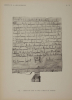
Les archives de Normandie et de la Seine-Inférieure. Etat général des fonds. Recueil de fac-similés d'écritures du XIe au XVIIIe siècle accompagnés de transcriptions
Rouen, Imprimerie Lecerf fils, 1911. 2070 g Grand in-4, en feuilles sous chemise à lacets, xvi-47 pp., [1] ff., 60 planches dont deux sur double page et [63] feuillets de transcriptions.. Texte non coupé. . (Catégories : Paléographie, Normandie, Seine Maritime, )
Notes historiques relatives aux offices et aux officiers du bureau des finances de la généralité de Lille
Lille, L. Leleu, 1855. 455 g In-8, demi basane brune, dos à faux-nerfs, couvertures conservées, [1] ff., 165 pp.. Illustré en frontispice, d'un portait de Charles Eubert du Chambge de Liessart. Ouvrage rare, Saffroy, II, 21880. Notes généalogiques et coupures de presse ajoutées in-fine. Ex-libris Léon Duchesne de la Sicotère. Cachet héraldique en cire ajouté sur une garde. Dos frotté, petite mouillure angulaire au portrait. . (Catégories : Noblesse, Généalogie, Ancien régime, Nord, Flandre, )
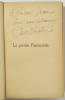
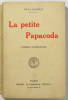
La petite Papacoda. Roman napolitain
Paris, Ernest Flammarion, 1923. 245 g In-12 broché, [3] ff., 365 pp.. Envoi de l'auteur au docteur Lucien Graux. . (Catégories : Littérature, )
La cantate à trois voix, suivie de Sous le rempart d'Athènes et de traductions diverses
Paris, Librairie Gallimard, Editions de la Nouvelle Revue française, 1931. 171 g In-12 broché, 176 pp., [3] ff.. Nouvelle édition. Un des 122 exemplaires numérotés sur pur fil Lafuma. Quelques petits points de rousseurs. . (Catégories : Théâtre, )
Pour l'histoire de Bordeaux et du Sud-Ouest. Leçons, conférences et discours
Bordeaux et Paris, Mounastre-Picamilh et Auguste Picard, 1914. 505 g Petit in-8 broché, 1 ff., viii-352 pp., 3 ff.. Table des matières : - L'enseignement de l'histoire locale et régionale à L'université de Bordeaux de 1886 à 1905 - Les fouilles du cimetère Gallo-Romain de Saint-Seurin. - Les portes de Bordeaux. - Le rôle du Château-Trompette dans l'histoire de Bordeaux. - Le rôle et l'oeuvre de l'académie de Bordeaux. - Le rôle du port dans l'histoire de Bordeaux. - L'aménagement de la place des Quinconces. - Les expéditions maritimes des Basques, des Gascons et des Rochelais au XVIe siècle. - Elie Vinet. - Les Ecossais en Gascogne, les gascons en Ecosse. - Les châteaux gascons à travers l'histoire. - Jacques de Romas. - Le musée-bibliothèque du Béarn. - Une famille de cadets de Gascogne : les ancêtres d'Henri IV. Petites usures sur la couverture. . (Catégories : Bordelais, Gironde, )
[REVUE] Antoine Adam, Jean Aicard, Marc Alyn, Jean Babelon, Yvette Barre-Barteaux, Camille Barthélémy, Jacques Baudou, Pierre Béarn, Camille Belliard, Louise Bellocq, Luc Bérimont, Charles Bertin, Jeannette Besançon-Flot, Paul Bialais, Jean Biès, Maurice Blin, Françoise Blond, Georges Bouillon, Maurice Bourg, Charles Braibant, Benoit Braun, Thomas Braun, André Breton, Suzanne Briet, Carlo Bronne, Roger Brucher, Charles Bruneau, Jean-Paul Brunet, Pierre Brunon, Roger Caminade, Albert Caquot, Jules Carrez, Carzou, Jean Cazenobe, Robert Cecconello, Elise Champagne, J. Charlet, Suzette Clément-Bodart, (Colette), Hubert Collin, Colonel Compagnon, Pierre Congar, Yves Congar, René Constant, Roger Cordier, Raymond Creuze, (Vera Cuningham), André Danjon, (Dante), Marcel Dardoise, Paul Dauchy, René Daumal, L.R. Dauven, Gabriel Delattre, Marie Delcourt, Bernard Delmas-Payer, Paul Denis, Victor Demanet, Patrick Demouy, Marcel Derwa, André Dhôtel, Marie-Thérèse Donnay, Gustave Doré, Michel Doury, Paul Dresse, Blaise Druart, Henri Druart, René Druart, Jean Ducasse, (Charles Duits), André Dulière, René Dumesnil, René Dürrbach, M. Failly, Lionello Fiumi, (Flaubert), Yves Florennes, Jean Follain, Paul Fort, Maud Frère, Raymond Gailly, André Galland, Yves Gandon, Jean-Pierre Gehin, Maurice Genevoix, Pierre Gentil, Gabriel Germain, Giacomelli, Yves Gibeau, R. Gillard, Michel Gillet, Willy Gilson, (Godefroy de Bouillon), Robert Goffin, E. Golfouse, Armand Got, Grandville, (Grévisse), Henri Guillemin, Guillevic, Paul Guth, François Héber-Suffrin, Jean Héber-Suffrin, Maurice Henry, (François de Herain), Jean Héraux, Dominique Hoizey, Robert Hossein, Houdon, Marie Howet, Lucien Hubert, Georges Jacquemin, Adrien Jans, Raymond Jubert, Hubert Juin, Anne-Marie Kegels, Frédéric Kiesel, Françoise Korganov, Maurice Kunel, Elisabeth de La Mauvinière, Henry de La Tour, Denise Laborde, Marcel Lallemand, Armand Lanoux, Georges Laurent, Jean L'Herbault, France Lambert, Armand Lanoux, Georges Laurent, Paul Leclers, Camille Lecrique, Suzette Lefèvre, Jean Leflon, Fernand Léger, Jeannine Lelièvre, Jules Leroux, Jean Levy, Jacques-Gérard Linze, J.K. Longuet, Gérard Macé, (André Malraux), Pierre Manil, Jean Marchal, Maugis, André Maurois, Jean Mazeraud, Mehul, P. Michel, (Albert Mockel), Arsène Muzerelle, (Agnès Nanquette), Général Nerot, Alphonse de Neuville, Etienne Noiret, Général Noiret, (Marcel Noppeney), Pierre Nothomb, Christine Orbey, Michel Pakenham, (Paul Palgen) (Georges Paulet), Jean Paulhan, Joséphin Péladan, Louis Pergaud, Patrick Perin, Régine Pernoud, Pierre Petitfils, Pierre-Luc Petitjean, André Pézard, Jean Piaubert, Gaston Picard, Michel Picard, Marie-Pierre Pinard, Maurice Piron, Charles Plisnier, Henri Pourrat, J.-M. Poussart, Michel Prince, Jean Renac, Paul Renaudin, Patrick Reumaux, Graham Reynolds, Pierre Richard, Arthur Rimbaud, René Robinet, Jeanne Roge, Jean Rogissart, Pierre Rogissart, Elyane Ronnet, Félicien Rops, Elisabeth Rouy, Noël Ruet, Christophe Ryelandt, Saint-Pol-Roux, Jacques Saunier, Michel-Paul Sécheret, Pierre Seghers, Jean Servais, Arsène Soreil, Michel Taillandier, Roger Taillardant, Stéphane Taute, André Theuriet, Marcel Thiry, Charles Thomas, Jacques Thomas, Eva Thomé, Gaston Titaux, Suzanne Tourte, Marc-Edo Tralbaut, Noël Tuot, Jacques Vadon, (Roger Vailland), Jean-Paul Vaillant, Philippe Vaillant, Edmond Vandercammen, Jacques Vaucherot, (Verlaine), Max Vilain, Y. Vineuil, René Violaines, Robert Vivier, Patrick Vloebergh, Jean-Claude Vuaroqueaux, Louise Weiss, Elie Willaime.
Reference : 5194
LA GRIVE, 1958-1972. 33 fascicules in-8, agrafés ou brochés.
Manquent les numéros 101-106, 108, 127, 130, 133-137, 139, 143, 146, 154. [5194]


LES MEILLEURS POÈMES DE 1818 À 1918. Anthologie composée et préfacée par Paul Eluard.
Club Français du Livre. 1953. 3 tomes en 3 volumes in-8°, reliure pleine toile noire. 173 & 190 & 191 pages. Tirage numéroté hors commerce. Très propre.
Tome I : " De Chateaubriand à Rimbaud " : Chateaubriand, Marceline Desbordes-Valmore, Alfred de Vigny, Victor Hugo, Aloysius Bertrand, Xavier Forneret, Gérard de Nerval, Charles Baudelaire, Lautréamont, Arthur Rimbaud. Tome II : " de Verlaine à Jammes " : Paul Verlaine, Germain Nouveau, Charles Cros, Tristan Corbière, Stéphane Mallarmé, Jules Laforgue, Saint-Pol-Roux, Maurice Maeterlinck, Marcel Schwob, René Ghil, Alfred Jarry, Francis Vielé Griffin, Francis Jammes, Max Elskamp, Henri Bataille. Tome III : " De Valéry à Apollinaire " : Paul Valéry, Léon-Paul Fargue, Henry-J.-M. Levey, Paul Claudel, Valery Larbaud, André Spire, Charles Vildrac, Jules Romain, Guillaume Apollinaire, Max Jacob, C.-F. Ramuz, Luc Durtain, Blaise Cendrars, Raymond Roussel, Pierre Reverdy.
[REVUE]. COMMERCE. " Cahiers trimestriels publiés par les soins de Paul Valéry, Léon-Paul Fargue, Valery Larbaud ".
Reference : 10833
COMMERCE. " Cahiers trimestriels publiés par les soins de Paul Valéry, Léon-Paul Fargue, Valery Larbaud ". (7, rue de l'Odéon, Paris VIe, puis 160, rue du Faubourg Saint-Honoré, Paris VIIIe). Grand in-8° broché. 29 numéros trimestriels ont paru en 29 livraisons, de l'été 1924 au printemps 1932.
Collection complète, du n° 1 (été 1924) au n° 29 (printemps 1932). Nous joignons l'Index des années 1924-1928, paru sous forme de tiré-à-part joint au n° 22 (Hiver 1929). TOUS LES NUMEROS FONT PARTIE DU TIRAGE SUR VELIN PUR FIL LAFUMA (2e papier dont le nombre d'exemplaires est compris entre 150 et 300) et sont tous en bon ou très bon état. // Le n° 1 porte la mention manuscrite " Exemplaire sur Lafuma ", apposée par Auguste Morel qui a également signé cet exemplaire de ses initiales ; ce détail fait de cet exemplaire une belle pièce joycienne puisque dans ce premier numéro de " Commerce " paraît la première traduction en français d'un extrait d'ULYSSE de Joyce - traduction justement due au même Auguste Morel et à Valery Larbaud. // Rare et belle collection sur grand papier.
Textes de : Louis Aragon, Antonin Artaud, Bruno Barilli, André Beucler, Henri Bosco, Joë Bousquet, Louis Brauquier, André Breton, Georg Büchner, Emilio Cecchi, Paul Claudel, S. T. Coleridge, René Daumal, André Delons, Robert Desnos, Pierre Drieu La Rochelle, Maître Eckhart, T. S. Eliot, Max Elskamp, Léon-Paul Fargue, William Faulkner, Jean Follain, Benjamin Fondane, Roger Fry, Morven le Gaëlique [Max Jacob], Georges Garampon, Federico Garcia Lorca, André Gide, Jean Giono, Bernard Groethuysen, Thomas Hardy, Nathaniel Hawthorne, Franz Hellens, Hugo von Hofmannsthal, Friedrich Hölderlin, Henri Hoppenot, Max Jacob, Francis Jammes, Marcel Jouhandeau, Pierre Jean Jouve, James Joyce, Franz Kafka, Rudolf Kassner, Sören Kierkegaard, Pierre de Lanux, Valery Larbaud, Archibald MacLeish, Giacomo Leopardi, Georges Limbour, Louis Massignon, André Malraux, Ossip Mandelstam, Louis Massignon, Charles Mauron, George Meredith, Henry [et Henri] Michaux, D.-S. Mirsky, John-Antoine Nau, Georges Neveux, Friedrich Nietzsche, Liam O'Flaherty, Max Oehler, José Ortega y Gasset, Boris Pasternak, Jean Paulhan, Benjamin Péret, Edgar Allan Poe, Francis Ponge, A. S. Pouchkine, T.-F. Powys, Jacques Prévert, Jean Prévost, Michel Psellos, Alfonso Reyes, Georges Ribemont-Dessaignes, Rainer Maria Rilke, Jacques Rivière, Georges Roditi, Vasily Vasílievich Rózanov, Saint-John Perse, Georges Schéhadé, Maurice Scève, Edith Sitwell, André Suarès, Jules Supervielle, T'au Yuan-Ming, Jean-Baptiste Tavernier, Giuseppe Ungaretti, Paul Valéry, Roger Vitrac, Sir Thomas Wyatt, Virginia Woolf, Michel Yell, etc.

