 Write to the booksellers
11 books for « paley william »Edit
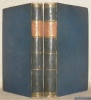
The Works of William Paley, D. D. In Five Volumes. With Notes and Illustrations by James Paxton. 5 vols.
London, Thomas Tegg, 1845. 8vo. Uniformly bound in five contemporary blue full calf bindings with five raised bands and gilt lettering to spine. Edges of boards with gilt ornamentation. All edges marbled. With dedication from Money Wigram (1790 – 1873) - English shipbuilder and ship owner, and a director of the Bank of England - to Woolmore Wigram (1831 - 1907), Church of England clergyman and campanologist, to front free end-paper. Bindings with light wear and some scratches, internally fine and clean. XXIV, 428 pp. XIX, (1), 531 pp. VI, 442 pp. XIX, 441 pp. + 39 plates IV, 407 pp.
A nice set of Paley's collected works. William Paley (1743-1805) ”wrote several books on philosophy and Christianity, which proved extremely influential. (…) His most influential contribution to biological thought, however, was his book Natural Theology: or, Evidences of the Existence and Attributes of the Deity, Collected from the Appearances of Nature, first published in 1802. In this book, Paley laid out a full exposition of natural theology, the belief that the nature of God could be understood by reference to His creation, the natural world. He introduced one of the most famous metaphors in the philosophy of science, the image of the watchmaker: . . . when we come to inspect the watch, we perceive. . . that its several parts are framed and put together for a purpose, e.g. that they are so formed and adjusted as to produce motion, and that motion so regulated as to point out the hour of the day" that if the different parts had been differently shaped from what they are, or placed after any other manner or in any other order than that in which they are placed, either no motion at all would have been carried on in the machine, or none which would have answered the use that is now served by it. . . . the inference we think is inevitable, that the watch must have had a maker -- that there must have existed, at some time and at some place or other, an artificer or artificers who formed it for the purpose which we find it actually to answer, who comprehended its construction and designed its use. Living organisms, Paley argued, are even more complicated than watches, ""in a degree which exceeds all computation."" How else to account for the often amazing adaptations of animals and plants? Only an intelligent Designer could have created them, just as only an intelligent watchmaker can make a watch: The marks of design are too strong to be got over. Design must have had a designer. That designer must have been a person. That person is GOD.” (University of California Museum of Paleontology)

Natural theology ; or, evidences of existence and attributes of the deity collected from the appearances of nature -- BON EXEMPLAIRE
London, Faulder and son, 1807, un volume in 8 relié en plein veau glacé, dos orné de fers dorés, filets dorés sur les plats, tranches jaspées (reliure de l'époque), 11pp., 595pp.
---- BON EXEMPLAIRE ---- "Paley's significance in the history of science is twofold. His writings on natural theology clearly reveal the changed framework of the late eighteenth and early nineteenth centuries as opposed to the late seventeenth century. The purely physical universe no longer could suffice to furnish proof for God's existence, but emphasis had turned to biological evidence to show the beneficence of the deity's workings... As an undergraduate at Cambridge, Charles Darwin read much of Paley's writings : "The logic of this book and of his Natural theology gave me as much delight as did Euclid. The careful study of these works, without attempting to learn any part by rote, was the only part of the academical course which, as I then feld and as I still believe, was of the least use to me in the education of my mind... I was charmed and convinced by the long line of argumentation (Charles Darwin's autobiography)...". (DSB X pp. 277/280)**8564/A3
A view of the evidences of christianity in three parts. Part I : of the direct historical evidence of christianity and wherein it is distinguished from the evidence alleged for other miracles. Part II : Of the auxiliary evidences of christianity. Part III : A brief consideration of some popular objections -- LONDON, 1811 -- 2 VOLUMES -- COMPLETE SET -- BON EXEMPLAIRE
London, Faulder, 1811, 2 VOLUMES in - reliés en pleine basane marbrée, dos orné de fers et filets dorés (reliure de l'époque), T.1 : 12pp., 362pp., T.2 : 7pp., 396pp.
---- BON EXEMPLAIRE ---- Ex- LIBRIS James Robert DALTON contrecollé au verso des premiers plats de couvertureS ---- "PALEY's significance in the history of science is twofold. His writings on natural theology clearly reveal the changed framework of the late eighteenth and early nineteenth centuries as opposed to the late seventeenth century. The purely physical universe no longer could suffice to furnish proof for God's existence, but emphasis had turned to biological evidence to show the beneficence of the deity's workings... As an undergraduate at Cambridge, Charles DARWIN read much of PALEY's writings : "The logic of this book and of his Natural theology gave me as much delight as did Euclid. The careful study of these works, without attempting to learn any part by rote, was the only part of the academical course which, as I then feld and as I still believe, was of the least use to me in the education of my mind... I was charmed and convinced by the long line of argumentation (Charles Darwin's autobiography)...". (DSB X pp. 277/280)**8563/P2
TABLEAU DES PREUVES EVIDENTES DU CHRISTIANISME en trois parties / 1 VOLUME : TOME 1 ET 2
CHEZ ANDRE FISCHER ET LUC VINCENT. 1806. In-8. Relié demi-cuir. Bon état, Coins frottés, Dos frotté, Intérieur frais. 391 + 417 pages - plats jaspés - titre , filets dorés au dos . coin du 1 er plat en bas à droite manquant.. . . . Classification Dewey : 230-Christianisme. Théologie chrétienne
Part. I: De l'évidence historique et directe du Christianisme, distinguée de celle qu'on allégue en faveur d'autres miracles. Part. II: Des preuves auxiliaires en faveur du Christianisme. Part. III: Examen abrégé de quelques objections rebattues. Par William Paley, archidiacre de Carlisle. Traduit de l'Anglais par Dd. Levade. Classification Dewey : 230-Christianisme. Théologie chrétienne

The principes of moral and political philosophy. New edition.
1819 London, Baldwin, 1819. In-8 XVI-512 pages. Cartonnage d'attente de l'époque, exemplaire non rogné.
The principles of moral and political philosophy
Indianapolis, Liberty Fund 2002 xlix + 581pp.+ portrait, softcover, 23cm., VG
The Horae Paulinae. Carried out and illustrated in a continous History of the Apostolic Labours and Writings of St. Paul,....Occasional Dissertations by James Tate.
London, Longman, Orme, etc., 1840. Cont. full calf. Richly gilt. (Colleg.Reg. Lond. 1829). All edges gilt. XIX,202,220 pp. Large folded engraved map. 1 leaf with tear, repaired with tape.
HORAE PAULINAE: OR THE TRUTH OF THE SCRIPTURE HISTORY OF ST. PAUL EVINCED, BY COMPARISON OF THE EPISTLES WHICH BEAR HIS NAME WITH THE ACTS OF THE APOSTLES AND WITH ONE ANOTHER
The Religious Tract Society, London. Non daté. In-12. Relié. Etat d'usage, Couv. convenable, Mors fendus, Intérieur acceptable. 412 pages. Illustré d'une carte dépliable colorée. Titre doré sur le dos. Etiquette de code sur la couverture. Quelques tampons de bibliothèque. Couverture se détachant. Annotations en page de garde. Quelques cahiers détachés.. . . . Classification Dewey : 420-Langue anglaise. Anglo-saxon
With Notes and Supplementary Treatise entitled Horae Apostolicae, by the Rev. T.R. BIRKS. Classification Dewey : 420-Langue anglaise. Anglo-saxon
Tableau des preuves évidentes du Christianisme. En trois parties. Traduit de l’anlgais par Dd. Levade, en deux volumes Tome I et tome II.
Lausanne, André Fischer et Luc Vincent 1806, 205x130mm, VIII - 391 + 417pages, cartonnage. Pièce de titre et d’auteur dorés au dos. Bon état.
Cachet de possesseur. Pour un paiement via PayPal, veuillez nous en faire la demande et nous vous enverrons une facture PayPal
Revue Américana : Grace Paley ( Thomas Cousineau - Elizabeth Dutertre - Colette Gerbaud - Pierre-Yves Pétillon) - Mark Twain ( Jean Roubérol - Paggy Castex) William Faulkner( Alain Geoffroy - Patrick Hubner - Giliane Morell-Czermak - Béatrice Rossi-Bouchrara - Jeanne-Marie Santraud - Marc Saporta)
Reference : 21457
Revue Américana : Grace Paley ( Thomas Cousineau - Elizabeth Dutertre - Colette Gerbaud - Pierre-Yves Pétillon) - Mark Twain ( Jean Roubérol - Paggy Castex) William Faulkner( Alain Geoffroy - Patrick Hubner - Giliane Morell-Czermak - Béatrice Rossi-Bouchrara - Jeanne-Marie Santraud - Marc Saporta)
N° 1 - broché - 1988 - 215p - Ed. Presses de l'Université Paris-Sorbonne
bon état
SERMONS, ON SEVERAL SUBJECTS
Longman, Hurst, Rees, And Orme, London. 1810. In-8. Relié plein cuir. A restaurer, Tâchée, Dos abîmé, Mouillures. 527 pages. Tranche marbrée. Dos détaché, en 2 parties. Plats se détachant. Annotations d'époque en pages de garde et de titre. Quelques rousseurs.. . . . Classification Dewey : 420-Langue anglaise. Anglo-saxon
5th Edition. Rev. W. Paley D.D., Subdean of Lincoln, Prebendary of St. Paul's and Rector of Bishop-Wearmouth. Classification Dewey : 420-Langue anglaise. Anglo-saxon

