Write to the booksellers
906 books for « p adams »Edit
-
Type
Book (891)
Magazine (1)
Music sheets (14)
Photographs (1)
-
Latest
Last 24h (2)
Last 3 days (2)
Last month (44)
Last week (1)
-
Language
English (8)
French (882)
Russian (17)
-
Century
17th (2)
18th (6)
19th (23)
20th (407)
21st (79)
-
Countries
Belgium (36)
Canada (4)
China (1)
Côte d'Ivoire (3)
Denmark (14)
France (721)
Netherlands (2)
Switzerland (104)
United Kingdom (3)
United States of America (19)
-
Syndicate
ALAC (4)
CLAQ (2)
ILAB (423)
NVVA (6)
SLACES (6)
SLAM (391)
Topics
- Abraham (2)
- Adams ansel (5)
- Adams clifton (24)
- Adams gerry (4)
- Adams john (5)
- Africa (2)
- Archaeology (3)
- Architecture (8)
- Astrology (24)
- Astronomy (3)
- Berlin (2)
- Bible (4)
- Bibliography (3)
- Biography (5)
- Boston (2)
- Botany (2)
- Canada (4)
- Chartres (2)
- Children’s books (8)
- Cinema (7)
- Comic strip (25)
- Decoration (2)
- Detective novels (37)
- Dictionaries (3)
- Drama (3)
- Drawings (2)
- Earth (3)
- Ecology (2)
- Economics (3)
- Education (4)
- Engines (2)
- England (4)
- English (29)
- Esotericism (6)
- Ethic (2)
- Ethics (2)
- Fantastic (4)
- Fine arts (4)
- First edition (18)
- Fox (3)
- Furniture (2)
- Gardens (3)
- Geography (6)
- Geology (2)
- Georgia (3)
- Germanic languages (2)
- Hackney (8)
- Helvética (2)
- History (19)
- Humour anecdotes (3)
- Industrial arts & crafts - fine arts (4)
- Italian (2)
- Japan (5)
- Jeanjean marcel (11)
- Language (3)
- Linguistics (3)
- Literature (59)
- Marilyn (5)
- Medicine (2)
- Middle ages (2)
- Mines & miners (3)
- Navy (3)
- New-york (2)
- Oceania (2)
- Painters (3)
- Palaeontology (2)
- Paris (3)
- Philology (5)
- Philosophy (9)
- Photography (11)
- Poetry (4)
- Policy (3)
- Posters (2)
- Psychology (2)
- Religions (5)
- Review (4)
- Reviews (2)
- Rock (2)
- Rock (2)
- Ruth (7)
- Science fiction (3)
- Sciences (3)
- Scores (16)
- Simons (2)
- Sociology (3)
- Songs (12)
- Sports (2)
- Spying (4)
- Switzerland (4)
- Tea (4)
- Theology (5)
- Travel (3)
- United kingdom (4)
- United states (8)
- Various (5)
- War (7)
- Western (4)
- Yoga (6)
The Action of Light on Selenium. Received May 18, - Read June 15, 1876. - [INVENTING THE SOLAR CELL]
(London, Harrison and Sons, 1878). 4to. No wrappers as extracted from ""Philosophical Transactions"" 1877 - Vol. 167. Pp. 313-349.
First appearance of Adams and Day's landmark paper, in which they demonstrated that electricity could be produced from light without moving parts, eventually leading to the modern solar cell. It is here that Adams shows for the first time that the discovery of Willoughby Smith - that the conductivity of selenium is due only to the effect of light - is correct and furthermore that light has an effect on the resistance of selenium and that light generates electrical currents in selenium. Two years later Adams expanded the work and published 'Solar Heat'. Here he described his ""Power Tower Concept"", which to this day remains the basis of solar plants.William Grylls Adams (1836 - 1915), professor of Natural Philosophy at King's College, London, and brother of the famous astronomer John Couch Adams (1819-1892), was President of the Physical Society of London from 1878 to 1880. In 1872 he was elected a Fellow of the Royal Society and in 1875 delivered their Bakerian Lecture. He was president of the Institute of Electrical Engineers and of the mathematical and physical section of the British Association.His greatest achievement lies in demonstrating the seminal discovery that electricity could be produced from light without moving parts. The road to this discovery was begun in 1839 when Becquerel discovered that illumination of one of two metal plates in a dilute acid changed the electromotive force. Another French scientist, Auguste Mouchout, followed up on Becquerel's discovery, but it was not until 1876, when Adams and Richard Evans Day discovered that illuminating a junction between selenium and platinum has a photovoltaic effect, that the foundation for the documented use of solar thermal power was laid [with the publication of the present paper]. ""From a historical viewpoint, it is of interest to note that the first experiments on the generation of solar thermal power in India were conducted by an Englishman, William Adams, about one hundred years ago. Adams stayed in Coloba, Mumbai and performed his experiments in the compound of his bungalow. He used a sphecical reflector 12 m in diameter, made from sheets of glass mirror. The sun's rays were focussed on a boiler having a capacity of about 60 litres and the steam generated was used to drive a 2.5 HP steam pump. Adams's work is described in a book written by him entitled ""Solar Heat - A Substitute for Fuel in Tropical Countries for Heating Steam Boilers and Other Purposes"" (Education Society's Press, Byculla, Bombay, 1878)."" (Sukhatme & Neyak, ""Solar Energy. Principles of Thermal Collection and Storage"", p. 48)""William Grylls Adams was and English scientist who taught as a professor in the department of Natural Philosophy at King's College. He is notable for his contribution to the discovery of the photoelectric effect, on which all solar energy applications are based. He was inspired by Auguste Mouchout's invention of the solar steam engine. With the intent of making improvements to Mouchot's design, Adams began to experiment with different materials and designs. In 1876, working in conjunction with his student, Richard Day, he discovered that selenium produced electricity when exposed to sunlight. Using the selenium, he then added mirrors to the design to concentrate sunlight on the engine. This design came to be known as the power tower concept and is still in use today."" (Smith & Taylor, ""Renewable and Alternative Energy resources: A Reference Handbook"", 2008, pp. 1556-56).Wheeler Gift, No. 3856. - Shiers ""Early Televison"", no. 73.

The Action of Light on Selenium. Received May 18, - Read June 15, 1876. - [INVENTING THE SOLAR CELL]
(London, Harrison and Sons, 1878). 4to. In the original wrappers. Offprint from ""Philosophical Transactions"" 1877 - Vol. 167. Author and title written in light pencil to front wrapper. Wrappers with a bit of soiling and part of spine is missing. Corners bended. Internally fine and clean. Pp. 313-349.
First edition, in the extremely rare offprint, of Adams and Day's landmark paper, in which they demonstrated that electricity could be produced from light without moving parts, eventually leading to the modern solar cell. It is here that Adams shows for the first time that the discovery of Willoughby Smith - that the conductivity of selenium is due only to the effect of light - is correct and furthermore that light has an effect on the resistance of selenium and that light generates electrical currents in selenium. Two years later Adams expanded the work and published 'Solar Heat'. Here he described his ""Power Tower Concept"", which to this day remains the basis of solar plants.William Grylls Adams (1836 - 1915), professor of Natural Philosophy at King's College, London, and brother of the famous astronomer John Couch Adams (1819-1892), was President of the Physical Society of London from 1878 to 1880. In 1872 he was elected a Fellow of the Royal Society and in 1875 delivered their Bakerian Lecture. He was president of the Institute of Electrical Engineers and of the mathematical and physical section of the British Association.His greatest achievement lies in demonstrating the seminal discovery that electricity could be produced from light without moving parts. The road to this discovery was begun in 1839 when Becquerel discovered that illumination of one of two metal plates in a dilute acid changed the electromotive force. Another French scientist, Auguste Mouchout, followed up on Becquerel's discovery, but it was not until 1876, when Adams and Richard Evans Day discovered that illuminating a junction between selenium and platinum has a photovoltaic effect, that the foundation for the documented use of solar thermal power was laid [with the publication of the present paper]. ""From a historical viewpoint, it is of interest to note that the first experiments on the generation of solar thermal power in India were conducted by an Englishman, William Adams, about one hundred years ago. Adams stayed in Coloba, Mumbai and performed his experiments in the compound of his bungalow. He used a sphecical reflector 12 m in diameter, made from sheets of glass mirror. The sun's rays were focussed on a boiler having a capacity of about 60 litres and the steam generated was used to drive a 2.5 HP steam pump. Adams's work is described in a book written by him entitled ""Solar Heat - A Substitute for Fuel in Tropical Countries for Heating Steam Boilers and Other Purposes"" (Education Society's Press, Byculla, Bombay, 1878)."" (Sukhatme & Neyak, ""Solar Energy. Principles of Thermal Collection and Storage"", p. 48)""William Grylls Adams was and English scientist who taught as a professor in the department of Natural Philosophy at King's College. He is notable for his contribution to the discovery of the photoelectric effect, on which all solar energy applications are based. He was inspired by Auguste Mouchout's invention of the solar steam engine. With the intent of making improvements to Mouchot's design, Adams began to experiment with different materials and designs. In 1876, working in conjunction with his student, Richard Day, he discovered that selenium produced electricity when exposed to sunlight. Using the selenium, he then added mirrors to the design to concentrate sunlight on the engine. This design came to be known as the power tower concept and is still in use today."" (Smith & Taylor, ""Renewable and Alternative Energy resources: A Reference Handbook"", 2008, pp. 1556-56).Wheeler Gift, No. 3856. Shiers ""Early Televison"", no. 73.
A commentary or, exposition upon the divine second epistle generall, written by the blessed apostle St. Peter. 2 vols. - [""THE SHAKESPEARE OF THE PURITANS""]
London, Richard Badger (Vol. 1) & Felix Kyngston (Vol. 2) for Jacom Bloome, 1633. Folio (338 x 230). Two volumes uniformly bound in contemporary full calf with six raised bands. Small paper-label pasted on to top of spines. Soiling to extremities, small wormholes to boards and wear to capitals. Endpapers miscoloured and with tears but internally generally fine and clean. Text within simple lined border. (6), 764 pp."" (2), 801-1634, (28) pp.
First edition of Adams' great commentary on the Second Epistle of Peter in which he combines exegesis with pastoral and practical applications. ""Adams published no other sermons after the appearance of his folio Workes until the appearance of Gods Anger and Mans Comfort (1652), his final two sermons. The only intervening work is his Commentary on Second Peter, a massive folio edition of 1634 pages on which Adams worked between 1620 and 1633. A learned and elegant capstone of his career, the Commentary reaches a more sophisticated level of scriptural exegesis and theological analysis than possible in the sermon form. In it, as in his sermons, he uses both the older Euphuistic style, with its sound devices or schemata, and the newer Senecan style, with its emphasis on brevity and point. It is difficult to explain Adams' abrupt disappearance from public view. Much about his ministry would have been distasteful to William Laud, Bishop of London in 1628 and Archbishop of Canterbury in 1633, whose increasingly repressive episcopacy silenced many suspected of Puritan leanings. Adams' staunch defense of the monarchy and ecclesiastical hierarchy notwithstanding, much about his career could have raised suspicions about his conformity. His strongly Calvinist doctrines, his bitter anti-papal sentiments, his wish that matters of ceremony be left ""indifferent"" rather than enforced, his criticism of the popish ""idolatry"" that threatened to creep into the Church, and his popularity as a lecturer: any one of these characteristics could have laid him open to attack by Laud and his followers."" (Dictionary of Literary Biography)Thomas Adams (1583-1653), an English clergyman and preacher - often referred to as ""The Shakespeare of the Puritans"" - known for his eloquent and vivid preaching, and his commentaries reflected his deep engagement with biblical texts. His works, including commentaries on various books of the Bible, were well-regarded in his time for their literary style and spiritual insight.
Adams D. Hitchhiking the Galaxy. In Russian /Adams D. Avtostopom po Galaktike.
Adams D. Hitchhiking the Galaxy. In Russian /Adams D. Avtostopom po Galaktike. Series: M. ACTs Golden Library of Science Fiction 2002. With a sarcastic grin and a melancholy smile, Adams reflects on the Meaning of Life, the Universe, and Everything. Content: Hitchhikers Guide to the Galaxy, The Restaurant at the End of the Universe, Life, the Universe and Everything, All Good, and Thanks for the Fish, Mostly harmless. We have thousands of titles and often several copies of each title may be available. Please feel free to contact us for a detailed description of the copies available. SKUalb29ce57a64c34a0dc.
PUBLIC DIFFERENCE : Architecture, Shame, Photography. [Bristol calligraphié de l'artiste]
New York : Christine Burgin Gallery, 1989. Broché 18x13cm, couverture illustrée recto-verso de la même photographie en noir de la Guerre d'Algérie, 95 pages de texte (conversation entre la journaliste-cinéaste Adèle Duval et l'artiste américain Dennis Adams), photos en noir de Dennis Adams, Michel Jaget et Gérard Rondeau. Bristol calligraphié de Dennis Adams. [Traces du trombone tenant la carte au livre en premières pages]
![PUBLIC DIFFERENCE : Architecture, Shame, Photography. [Bristol calligraphié de l'artiste]. ADAMS (Dennis) / DUVAL (Adèle)](https://static.livre-rare-book.com/pictures/SPN/spn-698_1_thumb.jpg)
![PUBLIC DIFFERENCE : Architecture, Shame, Photography. [Bristol calligraphié de l'artiste]. ADAMS (Dennis) / DUVAL (Adèle)](https://static.livre-rare-book.com/pictures/SPN/spn-698_2_thumb.jpg)
L'artiste Dennis Adams, qui vit et travaille à New York, est mondialement reconnu pour ses interventions publiques et ses installations en musée qui abordent les processus de mémoire collective et de contrôle social dans la conception et l’usage de l’architecture et de l’espace public. Il a réalisé des projets publics dans plusieurs pays européens, au Canada, en Israël et aux États-Unis. Son travail a fait l’objet de plus de 50 expositions en solo dans des musées et des galeries. En 1994, deux rétrospectives différentes étaient consacrées à son travail, l’une au Museum van Hedendaagse Kunst Antwerpen, l’autre au Contemporary Arts Museum de Houston. Adams faisait partie de la Biennale 2000 du Whitney. Il enseigne à la Cooper Union School of Art à New York.

"ADAMS, J.C. (JOHN COUCH). - A NEW METHOD IN LUNAR THEORY INTRODUCED.
Reference : 42763
(1853)
On the Secular Variation of the Moon's Mean Motion. Received and Read June 16, 1853.
(London, Richard Taylor and William Francis, 1853) 4to. No wrappers as extracted from ""Philosophical Transactions"" 1853, Vol. 143 - Part III. Pp. 397-406. Clean and fine.
First appearance of this importent paper by Adams, - famous for his co-discovery with Le Verrier, of Neptune in 1846 - in which he introduces new mathematical methods in dealing with the pertubations of the Moon, raising a sharp scientific controversy, and correcting Laplace's great memoir of 1788.""He (Adams) was elected fellow of Pembroke College in 1853, and shortly afterwards he presented to the Royal Society a remarkable paper (the paper offered) on the secular accleration of the moon's mean motion. This quantity was thought to have been definitively investigated by Pierre Simon de Laplace in 1788, but Adams showed that Laplace's solution was incorrect. In particular, Laplace had ignored a variation in solar eccentricity that introduces into the diffrential equations for the moon's motion a series of additional terms. Adams calculated the second term of series, on which the secular acceleartion depends....This paper caused a sharp scientific controversy, marked by angry chauvinism on the part of several French astronomers. Their attack stimulated a number of independent investigations of the subject, all of which confirmed Adams' results. The matter was definitely settles in his favor by 1861, but not without hard feelings.""(DSB I, p. 54b).
"ADAMS, J.C. (JOHN COUCH). - A NEW METHOD IN LUNAR THEORY INTRODUCED.
Reference : 50167
(1853)
On the Secular Variation of the Moon's Mean Motion. Received and Read June 16, 1853.
(London, Richard Taylor and William Francis, 1853) 4to. No wrappers as extracted from ""Philosophical Transactions"" 1853, Vol. 143. Pp. 397-406.
First appearance of this importent paper by Adams, - famous for his co-discovery with Le Verrier, of Neptune in 1846 - in which he introduces new mathematical methods in dealing with the pertubations of the Moon, raising a sharp scientific controversy, and correcting Laplace's great memoir of 1788.""He (Adams) was elected a fellow of Pembroke College in 1853, and shortly afterward he presented to the Royal Society a remarkable paper on the secular acceleration of the moon’s mean motion. This quantity was thought to have been definitively investigated by Pierre Simon de Laplace in 1788, but Adams showed that Laplace’s solution was incorrect. In particular, Laplace had ignored a variation in solar eccentricity that introduces into the differential equations for the moon’s motion a series of additional terms. Adams calculated the second term of the series, on which the secular acceleration depends, as 3771/64m4 the value computed from Laplace’s work was 2187/128 m4. The effect of the correction was to reduce the figure for the moon’s secular acceleration by about half, from 10?.58 to 5?.70.This paper caused a sharp scientific controversy, marked by angry chauvinism on the part of several French astronomers. Their attacks stimulated a number of independent investigations of the subject, all of which confirmed Adams’ result. The matter was definitely settled in his favor by 1861, but not without hard feelings.""(DSB).
Estelle John Legend Cee-Lo Green Kanye West Kardinal Offishall Keith Harr Keith Moore L Roberts M Adams M Hicks P Simon R Turner S Arrington S Young T Lockett W Adams Webster Will Adams
Reference : 30207
(2008)
ISBN : 0075678995422
Shine
Atlantic 2008 14x12x1cm. 2008. CD.

Expédié soigneusement dans une enveloppe à bulles depuis la France
Familiar Letters of John Adams and His Wife Abigail Adams During the R
NOVA SCIENCE PUBLISHERS INC
LIVRE A L’ETAT DE NEUF. EXPEDIE SOUS 3 JOURS OUVRES. NUMERO DE SUIVI COMMUNIQUE AVANT ENVOI, EMBALLAGE RENFORCE. EAN:9781536157413
Adams D. Mostly harmless. In Russian /Adams D. V osnovnom bezvredna.
Adams D. Mostly harmless. In Russian /Adams D. V osnovnom bezvredna. Series: AST Gold Library of Mini-Science Fiction 2003. We have thousands of titles and often several copies of each title may be available. Please feel free to contact us for a detailed description of the copies available. The delivery of this book might be delayed beyond the usual timeframe due to extended processing and preparation before shipment, and faster shipping options are not offered. Please inform us if you need the order by a certain date or have a deadline. SKUalbb12b9b85a0d7d3ac

Adams D. Salmon. In Russian /Adams D. Losos somneniy.
Adams D. Salmon. In Russian /Adams D. Losos somneniy. Coordinates of miracles (series), pen from English M AST 2003 379c. You are welcome to reach out to us for a detailed description of the copies currently available. Delivery of this book may take longer than usual including extended processing and pre-shipping time, no expedited shipping is available. Please advise us if you have a set date or a deadline to receive your order.SKUalb5829a126656dfb18
Adams Bryan - Adams Bryan,Lange R.J. - Adams Bryan,Lange R.J.
Reference : 112951
(1991)
Partition de la chanson : Can't stop this we started
Rondor Music London 1991
Bon état Grand format Piano
Adams Bryan - Kamen Michael,Adams Bryan,Lange R.J. - Kamen Michael,Adams Bryan,Lange R.J.
Reference : 112952
(1991)
Partition de la chanson : ( Everything i do ) i do it for you
Rondor Music London 1991
Très bon état Grand format Piano
Adams D. DirectX: Advanced Animation. In Russian /Adams D. DirectX: prodvinutay
Adams D. DirectX: Advanced Animation. In Russian /Adams D. DirectX: prodvinutaya animatsiya. I. KUDITS - OBJECT 2004. We have thousands of titles and often several copies of each title may be available. Please feel free to contact us for a detailed description of the copies available. The delivery of this book might be delayed beyond the usual timeframe due to extended processing and preparation before shipment, and faster shipping options are not offered. Please inform us if you need the order by a certain date or have a deadline.SKUalb1562c3a9703f79e9
L'édication de henry Adams
Editions de l'Imprimerie Nationale , 2007 - In-8, br, élégante couverture souple cernée d'un encadrement et rehaussé d'une illustration bigarrée, 413 pages, index in fine, très bel exemplaire.
édition de Pierre-Yves Pétillon Bel Exemplaire - Petit choc en pied ( sans gravité ) Mise à jour du Samedi 27 Juin 2026. Paiement PayPal immédiat, Mondial Relay pour : France, Allemagne, Autriche, Belgique, Espagne, Italie, Portugal, Luxembourg, Pays-Bas, Pologne (Communiquer votre point ou locker si connu). Une participation supplémentaire peut être demandée pour les colis lourds hors France où les envois compris entre 5 et 25 kg sont dégressifs : 2 à 4 kilogrammes - 7.99 / 5 à 10 kg - 15.99 / 15 -25 kg - 25.99. Certaines de nos collections ( Vian, Céline, Camus (...) peuvent être expédiées en Franco de port. Pour linternational hors Europe (Suisse, Canada, Japon, Etats-Unis, les frais dexpéditions peuvent varier selon le poids (mise à jour : 1 juin 2026).
Adams D. Hitchhikers Guide to the Galaxy. In Russian /Adams D. Avtostopom po Ga
Adams D. Hitchhikers Guide to the Galaxy. In Russian /Adams D. Avtostopom po Galaktike. Putevoditel tuda. Series: Coordinators of Miracles. Modern Fiction. Translation from English. Moscow, 1997. 544 p. We have thousands of titles and often several copies of each title may be available. Please feel free to contact us for a detailed description of the copies available. SKUalb6d1881b6859cc9a8.
Adams D. Hitchhiker's Guide to the Galaxy. In Russian /Adams D. Putevoditel' dly
Short description: Adams D. Hitchhiker's Guide to the Galaxy. In Russian /Adams D. Putevoditel' dlya puteshestvuyushchikh avtostopom po Galaktike.In Russian.Fortunately, the fish translates from any language and the book is called The Guide to Hitchhiking the Galaxies. Arthur Dent's house is being demolished to build a new track. Arthur tries to stop the demolition, but then finds out that his friend is an alien from another planet and the Earth is about to be destroyed to build a hyperspatial highway. We have thousands of titles and often several copies of each title may be available. Please feel free to contact us for a detailed description of the copies available. SKUalb83dc729cd2b00b59
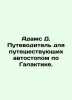
Adams D. The Art of Hair Coloring. In Russian (ask us if in doubt)/Adams D. Isku
Adams D. The Art of Hair Coloring. In Russian (ask us if in doubt)/Adams D. Iskusstvo okrashivaniya volos. Translation of Humanova N. G. Moscow. Niola of the 21st Century 2007. 152 p. We have thousands of titles and often several copies of each title may be available. Please feel free to contact us for a detailed description of the copies available. SKUalbca360471aa10a0a7
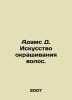
( Bandes Dessinées - Conan le Barbare ) - Neal Adams - Roy Thomas - Len Wein - Marv Wolfman.
Reference : 22204
(1980)
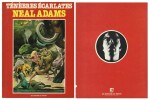
Ténèbres écarlates.
Les éditions du Triton 1980. In-4 broché, non paginé, au format 28,5 x 22 cm. Couverture illustrée par une illustration en couleurs de Ka-Zar. 4ème plat avec photographie de Neal Adams. Dos carré, muet, insolé. Plats et intérieur frais, malgré un petit éclat au bord gauche du 4ème plat. Dessins en noir par Neal Adams sur scénarios de Neal Adams, Roy Thomas, Len Wein et Marv Wolfman. Deux illustrations en fin d'ouvrage. Contient la mythique aventure de Conan : La Malédiction du Crâne d'Or. Très bel état général. Edition originale. Rare.
Vente exclusivement par correspondance. Le libraire ne reçoit, exceptionnellement que sur rendez-vous. Il est préférable de téléphoner avant tout déplacement.Forfait de port pour un livre 10 € sauf si épaisseur supérieure à 3 cm ou valeur supérieure ou égale à 100 €, dans ce cas expédition obligatoire au tarif Colissimo en vigueur. A partir de 2 livres envoi en colissimo obligatoire. Port à la charge de l'acheteur pour le reste du monde.Les Chèques ne sont plus acceptés.Pour destinations extra-planétaire s'adresser à la NASA.Membre du Syndicat Lusitanien Amateurs Morues
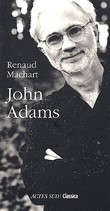
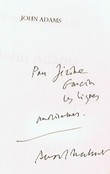
John Adams. ( Avec cordiale dédicace de Renaud Machart à Jérôme Garcin ).
Actes Sud / Classica 2004. In-12 broché oblong de 157 pages au format 19 x 10 cm. Couverture avec portrait photographique de John Adams. Dos carré. Plats et intérieur frais. Etude sur John Adams par Renaud Machart. Edition originale ornée d'une cordiale dédicace autographe, signée, de Renaud Machart au journaliste et écrivain français, Jérôme Garcin.
Vente exclusivement par correspondance. Le libraire ne reçoit, exceptionnellement que sur rendez-vous. Il est préférable de téléphoner avant tout déplacement.Forfait de port pour un livre 10 € sauf si épaisseur supérieure à 3 cm ou valeur supérieure ou égale à 100 €, dans ce cas expédition obligatoire au tarif Colissimo en vigueur. A partir de 2 livres envoi en colissimo obligatoire. Port à la charge de l'acheteur pour le reste du monde.Les Chèques ne sont plus acceptés.Pour destinations extra-planétaire s'adresser à la NASA.Membre du Syndicat Lusitanien Amateurs Morues
Dictionary Of American History.
6 volumes in-4 (252 x 175 mm), toile éditeur, xi, (1), 444 p. ; (6), 430 p. ; (6), 432 p. ; (6), 512 p. ; (6), 515 et viii, 258 pages. New York, Charles Scribner's Sons, [1940].
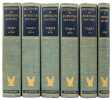
Seconde édition, revue et corrigée.Important dictionnaire historique consacré aux États-Unis, couvrant lhistoire politique, économique, sociale et culturelle du pays depuis la période coloniale jusquau début du XXe siècle. Rédigé par de nombreux spécialistes, louvrage rassemble des milliers de notices classées par ordre alphabétique, consacrées aux personnages, événements, institutions et notions majeures de lhistoire américaine. Il constitue lun des premiers grands dictionnaires historiques américains de caractère encyclopédique et demeure un instrument de référence pour létude de lhistoire des États-Unis.Dos légèrement insolés.Bon exemplaire.--------------Important historical dictionary devoted to the United States, covering the political, economic, social, and cultural history of the country from the colonial period to the early twentieth century. Written by numerous specialists, it gathers thousands of alphabetically arranged entries on major figures, events, institutions, and concepts in American history. One of the earliest large-scale encyclopedic historical dictionaries devoted to the United States, it remains a valuable reference work for the study of American history.Spines slightly sunned.A good copy.
Adams D. Hitchhiking the Galaxy. Restaurant At the End of the Universe. In Russ
Adams D. Hitchhiking the Galaxy. Restaurant At the End of the Universe. In Russian /Adams D. Avtostopom po Galaktike.Restoran U kontsa Vselennoy. ACT M 2011. We have thousands of titles and often several copies of each title may be available. Please feel free to contact us for a detailed description of the copies available. The delivery of this book might be delayed beyond the usual timeframe due to extended processing and preparation before shipment, and faster shipping options are not offered. Please inform us if you need the order by a certain date or have a deadline. SKUalb3829e2fc52156e4c
Adams D. Hitchhikers Guide to the Galaxy. Restaurant At the End of the Universe
Adams D. Hitchhikers Guide to the Galaxy. Restaurant At the End of the Universe In Russian /Adams D. Avtostopom po galaktike.Restoran U kontsa Vselenoy Series: M ACTs 2005 Bestseller. We have thousands of titles and often several copies of each title may be available. Please feel free to contact us for a detailed description of the copies available. The delivery of this book might be delayed beyond the usual timeframe due to extended processing and preparation before shipment, and faster shipping options are not offered. Please inform us if you need the order by a certain date or have a deadline. SKUalb39be7bb1937be9c9
Adams D. Hitchhiking the Galaxy. Back on the Road. Life, the Universe and every
Adams D. Hitchhiking the Galaxy. Back on the Road. Life, the Universe and everything else. Good luck and thanks for the fish Mostly harmless. In Russian /Adams D. Avtostopom po Galaktike. Opyat v put. Zhizn, Vselennaya i vse ostalnoe. Vsego khoroshego, i spasibo za rybu V osnovnom bezvredna M. ACT 2016. We have thousands of titles and often several copies of each title may be available. Please feel free to contact us for a detailed description of the copies available. The delivery of this book might be delayed beyond the usual timeframe due to extended processing and preparation before shipment, and faster shipping options are not offered. Please inform us if you need the order by a certain date or have a deadline. SKUalba699c31737d35554

Adams D. Hitchhiking the Galaxy. Back on the Road In Russian /Adams D. Avtostop
Adams D. Hitchhiking the Galaxy. Back on the Road In Russian /Adams D. Avtostopom po Galaktike. Opyat v put Exclusive Classics M ACT 2015. Contact us for details or to request photos of available books. Delivery of this book could take longer than normal due to additional handling time before shipping, and no rush delivery options are available. Please let us know if you have a specific date by which you need to receive your order. SKUalba069bbb28d811516