Write to the booksellers
13096 books for « nicolas j »Edit
-
Type
Art prints (2)
Artists' books (1)
Autographs (5)
Books (12788)
Engravings (71)
Magazines (7)
Manuscripts (4)
Maps (334)
Music sheets (80)
New books (6)
Old papers (4)
Photographs (15)
Records (1)
-
Latest
Last 24h (22)
Last 3 days (7)
Last month (141)
Last week (32)
-
Language
English (12)
French (13275)
German (6)
Italian (2)
Latin (4)
Russian (2)
Spanish (17)
-
Century
16th (39)
17th (311)
18th (1166)
19th (856)
20th (3326)
21st (2252)
-
Countries
Belgium (542)
Brazil (2)
Canada (73)
China (11)
Côte d'Ivoire (30)
Denmark (92)
France (11086)
Germany (49)
Greece (17)
Italy (2)
Switzerland (1392)
United Kingdom (4)
United States of America (18)
-
Syndicate
ALAC (67)
CLAM (58)
CLAQ (14)
CNE (28)
ILAB (5553)
NVVA (163)
SLACES (163)
SLAM (5075)
SNCAO (37)
Topics
- Alsace (49)
- Ampelography - wines (239)
- Archaeology (54)
- Architecture (79)
- Army (40)
- Autographs (68)
- Bibliophilism (44)
- Biography (118)
- Boileau - narcejac (156)
- Books from the xviiith (51)
- Borge jacques (105)
- Bouvier nicolas (75)
- Brittany (53)
- Catholicism (64)
- Children’s books (84)
- China (39)
- Christianity (79)
- Cinema (40)
- Comic strip (145)
- Cooking (80)
- Costumes (42)
- Curiosa (66)
- Customs (49)
- Drawings (46)
- Early printed books (148)
- Economics (101)
- Education (72)
- Education - morals (42)
- Engraving (books about) (57)
- Europe (81)
- Fine arts (118)
- First edition (288)
- Gastronomy (78)
- Genealogy (45)
- Geography (117)
- Gogol nicolas (157)
- Guide books (53)
- Helvética (148)
- History (722)
- Hulot nicolas (107)
- Humour anecdotes (54)
- Iron (129)
- Italy (47)
- Law (152)
- Literature (1202)
- Lorrain (47)
- Magazine (80)
- Malebranche nicolas de (62)
- Maps (409)
- Mathematics (52)
- Medicine (133)
- Memories (49)
- Military arts (82)
- Navy (86)
- Newspapers press (137)
- Niccolo machiavelli (75)
- North america (62)
- Oenology (107)
- Painting (50)
- Paris (192)
- Philosophy (252)
- Photography (144)
- Poetry (137)
- Policy (163)
- Portraits (55)
- Portugal (43)
- Poussin nicolas (42)
- Psychology (50)
- Regionalism (170)
- Religions (200)
- Reliure (56)
- Review (44)
- Reviews (91)
- Revolution 1789 (74)
- Russia (125)
- Samson (125)
- Sanson (124)
- Sciences (90)
- Scores (79)
- Short stories (42)
- Songs (77)
- Switzerland (193)
- Theatre (80)
- Theology (120)
- Translation (61)
- Travel (83)
- Turkey - ottoman empire (45)
- Ussr (53)
- Vanier nicolas (81)
- Various (85)
- Viasnoff nicolas (108)
- Viticulture (68)
- War (81)
- West indies (67)
- Wine (120)
- Youth (42)
Du Coin de l'œil. Ecrits sur la photographie.
<p>Le présent recueil réunit les textes que Nicolas Bouvier a écrit sur la photographie entre 1965 et 1996, issus de préfaces, articles de presse, introductions à des catalogues d’exposition, etc. Parmi eux, certains relatent également son activité de «chercheur-traqueur d’images, qui aura été son gagne-pain durant près de trente ans. Photographe à ses débuts (par nécessité), portraitiste (par accident), chroniqueur («aliboron): la photographie est une constante dans le parcours de l’écrivain voyageur. Nicolas Bouvier s’intéresse à la photographie parce qu’il entretient un rapport passionnel à l’histoire de l’estampe. Les images qu’il affectionne n’appartiennent jamais à la «grande peinture classique mais toujours à l’art populaire. Dans les textes qui composent ce recueil, il est beaucoup question de ses tâtonnements: l’important pour l’écrivain étant d’élaborer une esthétique de l’effacement puis de se «forger une mémoire iconographique. Il tirera son enseignement de ses nombreux voyages et des recherches infatigables dans les bibliothèques du monde entier. Outre son propre travail photographique, Nicolas Bouvier a par ailleurs observé et relaté sans cesse les images de ses contemporains et de ses pairs. Il est l’ami de Jean Mohr, John Berger, Nicolas Faure, Jacques Thévoz… et l’admirateur de Paul Strand, Edward Weston, Ansel Adams, Gustave Roud.</p> Genève, 2019 Héros-Limite 218 p., broché. 11,5 x 18
Neuf
Première monographie de l'artiste Nicolas Daubanes.
Reference : 26782
ISBN : 9782363062932
Nicolas Daubanes. À bout touchant.
<div class="description-short" id="product-description-short-789" itemprop="description"><p data-mce-fragment="1"><em data-mce-fragment="1">À bout touchant</em> de Nicolas Daubanes présente les travaux significatifs de l’artiste depuis 2010 ainsi que ses expositions les plus importantes réalisées depuis 2017 et cherche, avant tout, à donner à voir sa façon de travailler.</p></div><p data-mce-fragment="1">Nicolas Daubanes élabore un langage personnel qui se traduit par l'utilisation de certains matériaux et gestes tels que la poudre de fer (aimantée ou incrustée dans du verre ou de la porcelaine), le béton chargé de sucre, la représentation d'un toit de prison en temps de mutinerie, l’utilisation de la céramique dentaire, celle du scotch retenant du verre brisé, ou encore la fabrication d'alcool en prison, etc. Autant de gestes et de matières qui semblent éloignés les uns des autres mais qui tendent tous vers le même propos : le dégagement de la contrainte, la recherche d'un espace de liberté.</p> Paris, 2022 Bernard Chauveau 272 p., nombreuses illustrations couleur, cartonnage éditeur. 22 x 30
Neuf
Edouard Caupeil : Illusion.
<p data-mce-fragment="1">Ce livre est une traversée dans le sud des États-Unis, le long de la route 61, une question suspendue… À la découverte de Mound Bayou s’ajoute une enquête sur les traces de James Baldwin, de Birmingham à Tallahassee. Dans ce travail au long cours sur les stigmates du racisme se révèlent les espoirs déçus, les multiples illusions de solutions, mais aussi la résistance sourde du Sud à tout changement, un arrêt sur image à contre-temps dans l’Amérique d’Obama.</p><p data-mce-fragment="1">Les trois reportages réalisés entre 2008 et 2016 ont fait l’objet d’une publication en trois épisodes dans Le Monde qui mettaient en regard les photographies d’Édouard Caupeil et les textes de Nicolas Bourcier. Les articles en intégralité sont à retrouver dans l’ouvrage, ainsi que le journal de voyage d’Édouard Caupeil.</p><p data-mce-fragment="1">Édouard Caupeil, né en 1971, est photographe indépendant depuis 1999. Il travaille pour la presse nationale et internationale (Libération, Télérama, le Monde). Son travail de portraitiste et sa démarche documentaire réunissent deux approches complémentaires d’une même réflexion sur la condition humaine.</p><p data-mce-fragment="1">Nicolas Bourcier, né en 1968 à Stuttgart, a suivi un enseignement d’histoire et de relations internationales. Il a étudié l’Allemagne contemporaine et les opposants à Hitler ayant fui le régime nazi. Journaliste depuis une quinzaine d’années, il travaille pour Le Monde, service International.</p> Biarritz, 2024 Contrejour 128 p., photographies en couleur, relié. 20,5 X 25,5
Neuf
Nicolas de Staël: Le Voyage au Maroc.
<meta charset="utf-8"><span data-mce-fragment="1">Nicolas de Staël a vingt-trois ans quand il découvre le Maroc, où il voyagera de 1936 à 1937. Sont ici réunis pour la première fois un texte écrit pour une revue,</span><i data-mce-fragment="1">Les Gueux de l’Atlas</i><span data-mce-fragment="1">, diverses lettres à ses proches où se lisent les espoirs et errances d’un tout jeune homme et son cahier aux notes et dessins vibrants.</span><br class="autobr" data-mce-fragment="1"><span data-mce-fragment="1">A Marrakech, Fès ou Télouet, il s’éprend de la population berbère, salue «leur grâce naturelle», leurs habits bleus qui «semblent faire partie du ciel».</span><br class="autobr" data-mce-fragment="1"><span data-mce-fragment="1">Ainsi que le souligne Marie du Bouchet dans sa présentation, «c’est un profond sentiment de la vie qui est exprimé dans ces pages, un œil qui perçoit déjà toutes les profondeurs de la lumière».</span> Paris, 2023 Arléa 192 p., illustré, broché. 12 x 20,5
Neuf
"BERNOULLI, (JOHANN). (+) NICOLAS (NIKOLAUS) BERNOULLI. - VIS-VIVA CONTROVERSY
Reference : 44748
(1714)
Extrait D'une Lettre de M. Bernoulli, écrite de Basle 10. Janvier 1711, touchant la maniere de trouver les forces centrales dans des milieux resistans en raisons composée de leurs densites & des puissances quelques des vitesses du mobile. (+) Addition...
(Paris, L'Imprimerie Royale, 1714). 4to. Without wrappers. Extracted from ""Mémoires de l'Academie des Sciences. Année 1711"". Pp. 47-53 a. pp. 53-56 (Nicolas).
First appearance of an importent paper in mathematical physics. Bernoulli had shown that the principle of virtual velocities could be shown in analytical form. The principle can be derived from the energy principle and he applied this principle several times to mechanical systems of central forces. For these forces he applied the vis viva equation to the inverse two-body problem. For the corresponding problem of centrally accelerated motion in resisting medium he solved the differential equations and determined the central force in accordance with the Huygens formula(in the paper offered). - The Addenda by his his nephew, Nicolas Bernoulli, best known for the fundamental work ""Ars Conjectandi"" from 1713.

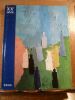
XX Siècle. Nouvelle Série. N°39. Décembre 1972. Panorama 72**. Cahiers d'Art publiés sous la direction de G. Di San Lazzaro. Un homme libre : Nicolas de Stael.
Société Internationale d'Art XX Siècle, Paris, 1972. Un volume relié (24,5x31 cm) de 156 pp. et 8 pp. de catalogue in fine. Reliure cartonnage d'éditeur illustrée par Nicolas de Stael. Ouvrage en très bon état.Une lithographie originale de Sonia Delaunay. Une lithographie originale de Maurice Estève.

Anatole France Anecdotique.
1929 Paris, Albin Michel, 1929. Un volume broché de format petit in 8° de 254 pp.; couverture jaune imprimée.

Bon état. Affiches.
Plaisir de myope
Cornélius Raoul Album souple 1999 In-12 (16,7 x 11 cm), format à l'italienne, album souple dos carré collé, non paginé, avec l'ex-libris signé par Nicolas de Crécy à 150 exemplaires, ouvrage épuisé ; très bel état. Livraison a domicile (La Poste) ou en Mondial Relay sur simple demande.


Le cousin de Mahomet (2 volumes)
A Constantinople Relié 1781 Deux volumes in-16 reliés plein veau dos lisses, triple liserets sur les plats et sur les tranches, tranches dorées, papier bleu, 198 pages et 240 pages, faux-titre et titre dans chaque volume, signets, les figures sont absentes de ces deux tomes ; faux titre du premier volume collé à la garde, ouvrage anonyme mais attribué à Nicolas Fromaget, ami ou simple fréquentation de Lesage. Le Cousin de Mahomet est un roman exotique, orientaliste, picaresque et libertin ; quelques petits défauts d'usage, beaux exemplaires. Livraison a domicile (La Poste) ou en Mondial Relay sur simple demande.
Tarass Boulba.
1890 Paris, Lecène, Oudin et Cie, 1890. Nouvelle Bibliothèque de Vulgarisation. Un volume de format in 8° de 240 pp.; nombreuses illustrations en noir par Gilles Baer. Reliure de l'éditeur en pleine percaline rouge. Riche décor style "Art Déco" de guirlandes florales, encadrements d'entrelacs en rose, gris, vert noir et or. Au dos mention "Lycée de Montluçon". Etiquette de prix sur une garde.


Exemplaire bien frais. Affiches.
Grandeurs Imaginaires. Traduit du russe.
1959 Paris, Gallimard, 1959. Collection "Du Monde Entier" CCV. Un volume broché de format in 8° de 384 pp.
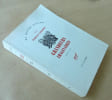
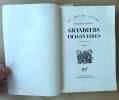
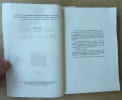
N°2 de 41 exemplaires sur vélin pur fil Lafuma-Navarre. Parfait état. Affiches.
Drôkle de chapeau
Editions la Farandole Cartonnage d'éditeur 1969 In-8 (20.5x25.5 cm), cartonnage d'éditeur, plats illustrés, ouvrage non paginé, texte de Nicolas Nossov, dessins de I. Semionov, traduit du russe par Paul Gil ; coiffes et coins un peu frottés, quelques rousseurs aux tranches et à l'intérieur, plats à peine salis, bon état. Livraison a domicile (La Poste) ou en Mondial Relay sur simple demande.
Les petites choses de la vie
Treize étrange Noirs desseins Broché 1998 In-12, (15x10.5 cm), broché, couverture illustrée, dessins en noir et blanc de Nicolas Poupon, dédicace illustrée ; très bon état. Livraison a domicile (La Poste) ou en Mondial Relay sur simple demande.

Un corsaire de l'Eglise. Du Patronat chrétien au Secours catholique
Fayard Dos carré collé 1996 In-8, (23.5x15.5 cm), broché, 336 pages, introduction de Jean-Nicolas Moreau et Bernard Vivier, index ; plats légèrement jaunis, bon état. Livraison a domicile (La Poste) ou en Mondial Relay sur simple demande.

Bourgeois Caroline, Coccia Emanuele, Cousseau Henry-Claude, Gausserand Nicolas, Le Gall Loïc, Malanda Guslagie, Pigeat Anaël.
Reference : 31626
ISBN : 9782373722208
Nathanaëlle Herbelin.
<p>Nouvelle édition augmentée de la première monographie de Nathanaëlle Herbelin.</p><p>Six textes – de Caroline Bourgeois, Emanuele Coccia, Henry-Claude Cousseau, Nicolas Gausserand, Loïc Le Gall et Anaël Pigeat – et un entretien de Guslagie Malanda avec l’artiste ponctuent le livre.</p> Paris, 2025 Dilecta 176 p., broché 22 x 27
Neuf
Monsieur Nicolas ou Le Coeur Humain Dévoilé. Préface de Marc Chadourne.
Paris Cercle du Livre Précieux 1959 6 Ensemble de 6 volumes de format in 8° de : T.I, LVI pp.; 546 pp. ; T.II 658 pp.; T.III 672 pp.; T. IV 658 pp.; T. V 586 pp.; T. VI 628 pp.. Ouvrage illustré de 72 reproductions de gravures de l'époque et de 24 fac-similés. Reliure de l'éditeur en plein simili maroquin vert-empire; décors et titres dorés.


Tirage total à 500 exemplaires; celui-ci N°374. Bel état. Voir les photographies. Affiches.
Le Riche Mecontent, ou le Noble Imaginaire. Comedie. Representee sur le Theatre Royal de l'Hotel de Bourgogne (+) Les Engagement du Hazard, Comedie (+) Les Yvrongnes, comédie satiribulesque. - [THREE RARE FRENCH PLAYS]
Paris, Baptiste Loyson, 1662 (+) Paris, Coube, 1657 (+) Cologne, Pierre Marteau, 1687. 8vo. In contemporary ful calf with four raised bands and gilt ornamentation to spine. Super ex-libris to boards. Small paper-label pasted on to top of spine. Light wear to extremities, parts of gilting on spine worn off. Internally lightly browned and closely trimmed, occassionally touching letters. (10), 82, (12), 94, (4), 52 pp.
Three early French plays, all first editions, from what is widely regarded as being the golden age of French playwriting. All are of the utmost scarcity and we have only been able to trace one auction-record, namely that of “Le Riche Mecontent” (Sold at “Early English Literature and Americana duplicates and selections from the Library of Henry E. Huntington”, 1920 - described as ""Very scarce""). These plays are all examples of French comedy from the 17th century, a period marked by the flourishing of theater in France, particularly in Paris. This era witnessed the development of a distinct French theatrical tradition with an emphasis on comedic works. These plays incorporate satire, using humor, irony, or ridicule to criticize and mock societal norms, behaviors or specific social groups “Le Riche Mecontent” was written for Hôtel de Bourgogne, a theatre, built in 1548 for the first authorized theatre troupe in Paris, the Confrérie de la Passion. It was considered the most important French theatre until the 1630s, it continued to be used until 1783. Nicolas de Péchantré (1638 – 1708), author of 'Les Engagement' and 'Les Yvrongnes' obtained three times the laurel at the Academy of Floral Games, and acquired great popularity by his tragedy of Greta. Georges Vicaire, French bibliophile and bibliographer, attributed “Les Yvrongnes” to Péchantré. Brunet 1, 1800 (Le Riche Mecontent). Not in Graesse, Barbier or Tchemerzine.
Entretiens avec Nicolas Schöffer
Editions Pierre Belfond Broché 1971 In-8 (13,5 x 21 cm), broché, 189 pages ; couverture jaunie, pliure au dos, frottements et traces de mouillures sur les bords des plats, coin corné, rousseurs aux tranches, par ailleurs intérieur frais, état moyen. Livraison a domicile (La Poste) ou en Mondial Relay sur simple demande.
Les Contes d'un Buveur de Bière. Dessins originaux.
Éditions Guy Le Prat ( Paris ) / Les Auteurs Associés ( Bruxelles ) 1944. 20 x 14 cm, 214 pp. Broché couverture rempliée, en feuilles non coupé. Sous étui et emboîtage, l'étui est cassé sinon très bel exemplaire. Contes illustrés de 8 magnifiques hors texte en couleurs par Nicolas Eekman, dont le frontispice. Un des 10 exemplaires numérotés hors-commerce sur Nippon Mosmé, réservés aux collaborateurs, avec une suite de décomposition des couleurs soit 80 planches, avec trois dessins originaux et deux "clichés".
Memoires des deux dernieres campagnes de Monsieur de Turenne en Allemagne.
Strasbourg, Jean Renauld Doulssecker, 1734. 8vo. In a nice contemporary Cambridge-style mirror binding with four raised bands and richly gilt spine. Small paper-label pasted on to top of spine. A very nice and clean copy. 250 pp.
Uncommon first edition of this account of the campaigns of The Battle of Mulhouse in 1674 and The Battle of Turckheim 1675 in Alsace and Germany, written immediately after the events. Nicolas Deschamps, future tutor to the Duke of Bourbon, served under Marshal de Turenne.
Oeuvres avec des eclaircissemens historiques, donnez par lui-meme. Nouvelle edition revue, corrigee & augmentee de diverses remarques. 2 vols.
Amsterdam, D. Mortier, 1718. 4to. 2 parts bound in 1 full calf binding with five raised bands and coloured frames to boards. Wear and soiling to extremities. A few worm holes to spine. Title-page to vol. 2 with a few lines in red pencil in margin. Last few leaves brownpostted. Internally generally fine and clean. (2), XXIV, (2), 454" (4), VII, (1), 424, (24) pp. + frontispiece, large folded portrait (Wilhelmina Charlotte Princess of Wales by F. Gunst after Kneller), and 6 plates.
The uncommon 4to-edition of Boileau-Despreaux’s Oeuvres. Nicolas Boileau (1636-1711), often simply known as Boileau, achieved acclaim as a distinguished French poet and critic in the 17th century. Initially educated at the College of Beauvais with intentions of pursuing a clerical path, he eventually shifted his focus from theology to law to fulfill his father's wishes. Boileau's literary journey commenced with the publication of his first satirical poem, ""Adieux d'un poète à la ville de Paris,"" at the age of 25. Subsequently, he released six more satires, including notable works like ""Les embarras de Paris,"" ""La satire à Molière,"" and ""Le repas ridicule."" In these satires, Boileau not only parodied and critiqued figures such as Cotin, Chapelain, and Le Voyer but also played a pivotal role in refining the practical aspects of the French language. Notably, these satires marked the introduction of systematic literary criticism in France, focusing on art's merits rather than being driven by envy or anger. Tchemerzine II, 293Brunet 1, 1058
Notions élémentaires du nouveau droit civil ou exposé méthodique des dispositions du Code civil pour en faciliter l'intelligence.
A Paris, chez Rodonneau, au Dépôt des Lois, An XII, 1803, An XIII, 1805. 20 x 13 cm, 280-196-304- et xvj-304 pp. Quatre tomes en un volume relié plein veau d'époque, dos lisse, pièce de titre rouge. Reliure usée, épidermures, coins émoussés, une mouillure claire sans gravité sur les premières pages. Sinon bon exemplaire. Ex-libris contrecollé sur le contre plat, de Pierre Culot. Rare.
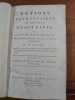
Eustache-Nicolas Pigeau, né le 16 juillet 1750 à Mont-l'Évêque (Oise) et mort le 22 décembre 1818 à Paris, est un jurisconsulte français.Fils d'un artisan, il travaille comme clerc chez un procureur avant de devenir en 1774, avocat au Parlement de Paris. Il devient secrétaire de Marie-Jean Hérault de Séchelles. Il ouvre après la Révolution des cours de droit. Il est nommé par Napoléon Bonaparte membre de la commission chargée de rédiger le Code de procédure civile. En 1805 il est nommé professeur de procédure à l'École de Droit de Paris, poste qu'il conserve jusqu'à sa mort.
Histoire florentine de Nicolas Machiavel citoien et Secretaire de Florence. Nouvellement traduicte d'Italien en Francois, Par le Seigneur de Brinon Gentil-homme ordinaire de la chambre du Roy. - [FIRST FRENCH TRANSLATION OF MACHIAVELLI'S 'FLORENTINE HISTORIES']
Paris, Guillaume de la Noue, 1577. 8vo. In recent full limp vellum with yapp edges. Woodcut printer's device on title, woodcut headpieces and initials. Small closed tear to upper inner margin of title-page. First 33 ff. with small worm tract in inner margin, with minor loss of text. Light dampstaining to first and last leaves. A good copy. (36), 294, (6) pp.
The exceedingly rare first French, and presumably very first overall, translation, of Machiavelli's Florentine Histories" his famous account of the political events and power struggles in Florence during the Renaissance. Essentially being a panegyric to the house of Medici, Machiavelli's work offers valuable insights into the rise and fall of political factions, the challenges faced by republican governments, and the dynamics of power in a city-state. Although often overshadowed by his more famous 'The Prince', the present work is important in understanding Machiavelli's broader political philosophy and is an indispensable document in understanding renaissance politics in general. The Histories constitute an essential work for understanding the political development of the late Machiavelli, and is “also an important item in modern historiography because for the first time the issue of conflict, and more precisely of urban conflict, finds itself at the heart of historical narrative (…).Infact, the Histories constitute the first attempt in modern historiography to analyze the totality of individual and collective agents and factors that allow a community to sustain itself or to founder. This analytical quality was certainly at the basis of the interest in the work outside Florence and the fact of its being translated. As Yves de Brinon explains in dedicating his ‘Histoire Florentine [the present work] to Cathrine de Medici, the case of Florence is a model for the dangers that threaten the integrity of every state and the Kingdom of France in Particular.” (Landi, A re-reading of Machiavelli). Machiavelli visited France, representing the Republic of Florence, where he - and later his writings - exercised great influence. The Huguenot, Innocent Gentillet, whose work commonly referred to as 'Discourse against Machiavelli' or 'Anti Machiavel', accused Machiavelli of being an atheist and accused politicians of his time by saying that his works were the ""Koran of the courtiers"", that ""he is of no reputation in the court of France which hath not Machiavel's writings at the fingers ends"" (Birely, The Counter Reformation, 1990). “Although Machiavelli became the embodiment of a real ""devil theory of history,"" there was nothing supernatural or even suspicious about his journey across the Alps. As the French translator remarked to his customers in 1544, ""This Florentine merchant has voluntarily left his own country to be received into yours.... Do not be so ungracious as to refuse him citizenship. From all appearances he was welcomed with open arms, or at least open minds. Within a few years, one of his admirers declared that he was a prophet honored more in France than in his own country."" (Kelley, Murd'rous Machiavel in France: A Post Mortem). Following the crisis of 1513, which involved arrests for conspiracy and torture, Machiavelli's relationship with the Medici family gradually improved. Despite the dedication of his book ""Il Principe"" to Lorenzo II de' Medici having little effect, Machiavelli found favor with a faction in Florence that was not opposed to him and was granted an appointment. In a letter Machiavelli expressed his dissatisfaction with his idle state and offered his valuable political experience to the new ruler. To further solidify his position, Machiavelli, adopting a somewhat courtier-like attitude, arranged for the staging of his play ""Mandragola"" at the wedding of Lorenzino de' Medici in 1518. In 1520, he received an invitation to Lucca for a semi-private mission, indicating that his ostracism was coming to an end. Later that year, Giulio Cardinal de Medici commissioned him to write a history of Florence. Although this was not exactly the role he desired, Machiavelli accepted it as the only way to regain the favor of the Medicis. The purpose of the work, although unofficial, was to restore the city's official historical standing. The salary for this appointment was not substantial, starting at 57 florins per year and later increased to 100. In May 1526, Machiavelli formally presented the finished work to Giulio de' Medici, who had become Pope Clement VII. The Pope appreciated the work and rewarded Machiavelli, though only moderately, and sought his support in creating a national army based on his theoretical work ""The Art of War,"" in preparation for the War of the League of Cognac. However, Machiavelli's hopes were shattered following the Sack of Rome in 1527 and the fall of the Medici government in Florence. Soon after, Machiavelli passed away. This exceedingly scarce first French edition was issued with two variant title-pages, the present referred to as variant-b. (see Gerber, Niccolo Machiavelli). Bibliopgraphia Machiavelliana, p. 60, no. 160. Gerber, dritter teil, p. 37, D-b. Brunet 1279.
Soirées bruxelloises. Histoire littéraire de l'année : études critiques et biographiques sur Weustenraad, Walef, Lainez, M. Clesse.
Bruxelles, Libr. Polytechnique d'Aug. Decq, 1854. 16,5 x 11,5 cm, 228 pp. Relié bradel plein papier, étiquette de titre manuscrite. Reliure usée, coins émoussés, petits manques de papier. Provenance : bibliothèque de l'architecte A. Fritz, ex-libris et numéro d'inventaire.
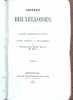
Cet ouvrage est l'oeuvre de quatre jeunes écrivains liégeois, Eugène GOFFART, Hyacinthe KUBORN, Nicolas PEETERMANS et A. GILMAN. Pourquoi est-il intitulé Soirées bruxelloises? On ne nous l'apprend pas. Mais en voici le but et le dessein. Les quatre amis se réunissant souvent le soir et causant entr'eux de l'une ou l'autre nouveauté littéraire du pays, regrettoient, disentils, que sa destinée fût de mourir le lendemain. «Ils auroient voulu voir consigner comme dans un registre domestique les succès et les mécomptes de la phalange toujours croissante de nos écrivains, inscrire dans un livre durable les espérances qu'on fondoit sur eux, les conseils ou les cris d'alarme que la critique, sentinelle avancée, leur jetoit de temps à autre au profit de l'art... Alors leur vint l'idée d'analyser le drame, le poème, le roman, que l'année avoit vus éclore, de faire entre eux l'inventaire de toutes ces productions, et d'en dresser comme un bilan à leur usage. » Cependant ils ne vouloient pas se borner au présent; le passé devoit entrer dans cet examen, et il leur sembloit qu'il falloit comparer les productions nouvelles avec celles des temps antérieurs. En conséquence, deux de ces messieurs se chargèrent de faire en quelque sorte revivre le baron de Walef et Lainez, poètes belges du 17° siècle; et les deux autres résolurent de s'occuper des poésies de feu M. Weustenraad et de M. Clesse.
Les Campagnes de Duguay-Trouin
Editions l'Ancre de Marine Cartonné 1991 In-folio (30,5 x 41 cm), cartonné, la présente édition est la reproduction exacte de l'édition de 1774 de Nicolas et Marie-Jeanne Ozanne chez Le Gouaz à Paris, 15 planches + 12 pages de texte ; quelques traces et incidents sur les plats, par ailleurs bon état général. Livraison a domicile (La Poste) ou en Mondial Relay sur simple demande.