 Write to the booksellers
5 books for « maundrell h »Edit
-
Topics
First edition (2)
Jerusalem (2)
Travel (2)
Xviii th century (1)
-
Countries
Denmark (1)
France (3)
Netherlands (1)
-
Syndicate
ILAB (3)
SLAM (2)
A journey from Aleppo to Jerusalem at Easter, A.D. 1697. The sixth edtion, to which is now added an account of the author's journey to the banks of Euphrates at Beer, and to the country of Mesopotamia. With an index to the whole work, not in any former edition. By Hen. Maundrell, M.A. late fellow of Exeter Coll. and Chaplain to the factory of Aleppo.
Oxford, Printed at the Theatre, for A. Peisley bookseller in Oxford, and W. Meadows bookseller in Cornhill, 1740.
8vo. (XI),(I),171,(1 blank) p., 9 folding plates, 6 full page plates, 3 text illustrations. Modern cloth 22 cm (Ref: ESTC Citation No. T100587; 'The library of Henry M. Blackmer II', London 1989, no, 214; Brunet 3,1542) (Details: Tasteful and simple modern binding with an gilt red morocco shield on the back. Engraving of the Sheldonian Theater on the title, executed by M. Cole. The first plate is a view on Aleppo. There are engravings of Mount Carmel and Tabor; 7 folding plates with the monuments of Baalbeck. 2 texts engravings of an inscription) (Condition: 2 small letters stamped on the title; paper very slightly yellowing; some foxing) (Note: The Holy Land has been a site for Christian pilgrimage since the 3rd century A.D. Throughout the Middle Ages christians visited Palestine, and during the Crusades even tried to conquer it. A great number of travelogues were written by pilgrims about the marvels of well known and venerated cities as Jerusalem, Bethlehem, Nazareth etc. Ever since medieval times also English travellers have recorded their impressions of their visits to the Orient. One of the earliest was the 'Voiage' of the Anglo-Frenchman Sir John Mandeville. An outstanding and interesting travel story is Henry Maundrell's. It illustrates the emergence of a new genry of travel writing, and the shift in European minds concerning its relationship with the Holy Land. 'Where medieval pilgrims had often wept or gone into trances upon their arrival in Jerusalem, modern European visitors observed with curiosity what was before their eyes. They are travelling for pleasure and for cultural experiences; tourism was gradually replacing pilgrimage as a motive for visiting Palestine. By the end of the 17th century quite a few European tourists had already been to Jerusalem. The most famous among them was Henry Maundrell, the author of the book 'A journey from Aleppo to Jerusalem'. It was first published in 1703 in Oxford, and it would prove to be one of the most popular books about the East for years to come. The 18th century saw 8 English editions, and by 1749 seven editions in different languages had appeared, and sections of the book continued to appear in collections of travel writings published in the 18th and 19th centuries' ('Maundrell in Jerusalem, Reflections on the writing of an early European tourist' by I. Nassar, in 'Jerusalem Quarterly', 2000,9); Maundrell's record is not a guide to the holy sites, or an anthropological study, but it is a diary in which he reflects upon the sights worth seeing, and things worth doing. It is organized chronologically. Henry Maundrell, an Oxford academic and clergyman, born in 1655, made the trip shortly after his arrival in Aleppo in 1696, where he was elected to the post of chaplaincy of the British Levant Company. It paid him £100 per year. He travelled 'in Company with 14 others of our Factory. We went by the coast; and having visited the several places consecrated by the Life and Death of our Blessed Lord, we returned by the way of Damascus'. (p. (VII). The fellowhip started on the 26th of february, and returned on the 11th of May. On Eastern they were in Jerusalem, where they were bewildered by the behaviour of the local fellow christians in the Holy Sepulcher Church. Maundrell describes them as hystical rabble, who 'very much discredited the Miracle. (...) a scandal to the Christian Religion'. (p. 97) Maundrell's account of biblical sites reflects his fascination with science and biblical history at the same time. He shows little interest in the indigenous Christians, Arabs, and Jews, and he loathes the Turkish administration and the Turks. Maundrell died in Aleppo in 1701. His record is important for historians of Palestine, the Near East, and of the Ottoman empire) (Provenance: On the title a stamp of 2 letters: 'G.U.') (Collation: a2, b4, A-U4, X2, Y4) (Photographs on request)
Voyage d'Alep à Jerusalem, à Pâques en l'année 1697
Chez Guillaume van Poolsum | à Utrecht 1705 | 9 x 15 cm | relié
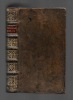
Réimpression de l'édition originale française parue en 1704, rare, illustrée de 9 figures dont 5 planches dépliantes du Mont Thabor, de Baalbek, des citernes de Salomon... Une édition parisienne sera également publiée en 1705. L'édition originale anglaise date de 1703 à Oxford. Reliure en pleine basane blonde racinée postérieure (c. 1790). Dos lisse orné de 5 fers et d'une roulette répétée. Coiffe de tête arrachée. Deux coins émoussés. Aumônier de la Compagnie anglaise du Levant à Alep, Maundrell accomplit un pèlerinage à Jérusalem en 1696 en compagnie de 14 coreligionnaires. La narration suit la forme d'un journal quotidien. Les voyageurs passent par le Liban et la Syrie, et Maundrell rapporte la première description de Baalbek connue par les anglais et donne d'autres descriptions de sites célèbres : Sidon, Palmyre, Tyr. L'auteur s'attarde particulièrement sur les lieux de l'Ancien Testament autour de Jérusalem, Samarie, la mer morte, Nazareth... - Photographies et détails sur www.Edition-Originale.com -


Phone number : 01 56 08 08 85
Voyage d'Alep à Jérusalem
Edition en langue française, sans page de titre ( datant ss doute de 1705 chez Pierre Ribou.). In-12 en reliure d'époque, dos à 5 nerfs, orné. Pièce de titre. 252 pages. Frontispice avec dessin de la contrée. 5 planches dont 1 dépliante. BE.Dos à 5 nerfs avec fleurons dorés et pièce de titre.
A Journey from Aleppo to Jerusalem At Easter, A.D. 1697. The seventh Edition To which is now added and Account of the Author's Journey to the Banks of Euphrates at Beer, and to the Country of Mesopotamia.
Oxford, Printed at the Theater, 1749. Hcalf. Covers detached and gone. Block intact. Engraved titlevignet. (12),171 pp. and 15 engraved plates (of which 9 are folded). Light browning.
Voyage d'Alep à Jérusalem, à Pâques en l'année 1697.
Éditon originale française, bien complet des 9 planches dont 5 dépliantes et du frontispice. Intéressante description de Balbeck, de Palmyre. Pleine basane brune, dos à nerfs orné, pièce de titre rouge. Très bon Paris Ribou 1706 1 volume in-12
édition originale

