 Write to the booksellers
4 books for « malus etienne »Edit
-
Topics
Egypt (1)
History (1)
Mathematics (1)
Physics (2)
Tea (1)
-
Countries
Belgium (1)
Denmark (1)
France (2)
-
Syndicate
ILAB (3)
SLAM (2)
Théorie de la double réfraction de la lumière dans les substances cristallisées, mémoire couronné par l'Institut, dans la séance publique du 2 janvier 1810
Paris, Garnery & Baudouin 1810 302pp. + 3 planches dépliantes hors-texte (in fine), Edition originale de 1810, 26cm., reliure solide du 19e s. (plats marbrés, dos en cuir brun avec titre et nerfs dorés), feuilles de garde marbrées, quelques pages avec légères mouillures et rousseurs, ancien ex-dono sur la fausse page de titre, bon état, [Cette publication de 1810 par Étienne-Louis Malus (1775-1812) revêt une importance capitale dans l'histoire de l'optique, car elle a contribué à établir la science de la polarisation et a fait progresser la compréhension de la double réfraction dans les cristaux. En 1808, Malus découvrit que la lumière réfléchie par des surfaces devient polarisée. Dans cette étude de 1810, il développa une théorie mathématique et physique expliquant comment la polarisation est liée à la double réfraction. Ces travaux s'avéreront essentiels pour le développement ultérieur de la théorie ondulatoire de Fresnel et de la théorie électromagnétique de Maxwell. Sa théorie, connue sous le nom de "loi de Malus", demeure aujourd'hui fondamentale dans des domaines tels que l'optique, la physique des lasers et la photographie. Son nom est l'un des 72 noms gravés dans la tour Eiffel // This 1810 publication by Etienne Louis Malus is highly important in the history of optics since it helped establish the science of polarization and advanced the understanding of double refraction in crystals. In 1808 Malus discovered that light reflected from surfaces becomes polarized. In this 1810 study he developed a mathematical and physical theory explaining how polarization relates to double refraction. It would turn out to be imporant for the development of the later wave theory by Fresnel and the electromagnetic theory by Maxwell. His theory known as "Malus's Law" remains fundamental up till now in fields such as optics, laser physics and photography. Malus' name is one of the 72 names engraved on the Eiffel tower], W121006
Théorie de la double réfraction de la lumière dans les substances cristallisées.
Paris, Garnery, Baudoin, 1810.
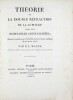
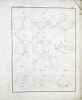
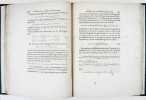
Première édition de cet important mémoire qui contient la découverte par Malus de la polarisation de la lumière par réflexion. Malus était major du corps des ingénieurs et membre de l'Expédition d'Egypte. Il a été parmi les premiers étudiants à recevoir une éducation scientifique à l'École Polytechnique où il a été initié à l'optique. Il a ensuite enseigné dans cette Ecole. Rare. Le dos a été refait en conservant une partie d'origine, les papiers de garde renouvelés. Ex libris doré sur le premier plat : Maxime de Brane. Bel exemplaire, grand de marges. /// In-4 de 302 pp., 3 planches h.-t. Demi-chagrin vert, dos orné. (Reliure de l'époque.) //// First edition of this important memoir which contains the author's discovery of polarization of light by reflection. On 4 January 1808, the French Institute "proposed a prize which required an experimental and theoretical explanation of double refraction. The French 'Newtonian' scientists hoped that Malus would find a precise and general law for double refraction within the framework of an emission theory of light. Malus was a skilled mathematician and during 1807 he had carried out experiments on double refraction. By December 1808 Malus had finished his experimental investigations, which verified the Huygenian law. What remained was a theoretical deduction of the law. In January 1809, Laplace published a memoir in which he deduced Huygens' law within the framework of Newtonian mechanics, using the principle of least action, and Malus considered this an insolence which deprived him of the priority. In 1810 Malus won the prize for his 'Théorie de la double réfraction'. Here he deduced the law following the same method as Laplace, by means of the principle of least action. Malus won the prize therefore mainly because of his original experimental researches and his discussion of the short-range forces that produce double refraction. Also of great importance was his law for the relative intensities of the ordinary and extraordinary rays." -D.S.B., IX, p. 73. Schuhs Annotated Bio-Bibliography : "Scarce." Malus was a major of the engineers corp that served under Napolean in his expedition to Egypt and Syria. He was among the first students to recieve a scientific education at the École Polytechnique where he was first introduced to optics. He later taught at the Ecole. Spine has been rebacked conserving a part of the original, the endpapers renewed. Ex libris gilt on the first board: Maxime de Brane. A fine copy, with large margins.


"MALUS, ETIENNE LOUIS & LAPLACE, PIERRE-SIMONE & WOLLASTON, WILLIAM HYDE. - THE LAWS OF DOUBLE REFRACTION ESTABLISHED.
Reference : 44061
(1809)
Ueber die Messung des Brechungsvermögens der undurchsichtigen Körper. (+) Ueber eine Eigenthümlichkeit des von durchsichtigen Körpern zurückgeworfenen Lichtes. Uebersetzt von Erman, mit einigen Erleuterungen von Tralles. (+ WOLLASTON:) eue Methode die...
Leipzig, Johann Ambrosius Barth, 1809. Without wrappers as issued in ""Annalen der Physik und der Physikalischen Chemie. Hrsg. Ludwig Wilhelm Gilbert"", Bd. 31, Drittes Stück. Titlepage to vol. 31. Pp. 225-336 a. 1 engraved plate. (Entire issue offered). Malus's papers: pp. 225-234 a. pp. 286-294. Wollaston's papers: pp. 235-251 a. pp. 252-262 a. Erläuterungen von Gilbert pp. 263-273. Laplace's paper: pp. 274-285.
First apperance in German of these importent papers on the refraction and double refraction of light. The papers by Malus is his first two papers on the refraction of light and Laplace's paper is the memoir in which he commented Malus' paper and Huygen's refraction law. ""In 1788 Haüy found experimentally that Huygen's law was true only in certain special cases, but in 1802 Wollaston found experimental evidence for the Huygenian construction (the second Wollaston paper offered). In ´""Mémoire sur la mesure du pouvoir réfringent"" (the first paper offered) Malus showed that Wollaston's experiments were incomplete, and so the French corpuscularian physicists did not trust Wollaston's results. They thought, moreover, that Wollaston was associated with Tmomas Young and therfore with the new wave hypothesis. In this situation the Institute on January 1808 proposed a prize which required an experimental and theoretical explanation of double refraction. The French ""Newtonian"" scientists hoped that Malus would find a precise and general law for double refraction within the framework of an emission theory of light. Malus was a skilled mathematician and during 1807 he had carried out experiments on double refraction. By december 1808 Malus had finished his experimental investigations, which verified the Huygenian law. What remained was a theoretical deduction of the law. In January 1809, Laplace published a memoir in which he deduced Huygen's law law within the framework of Newtonian mechanics, using the principle of least action, and Malus considered this an insolence which deprived him of the priority. In 1810 Malus von the prize for his ""Théorie sur la double réfraction"", published in 1811.""(DSB IX, p. 73).
L' Agenda de Malus. Souvenirs de l'expédition d'Egypte (1798-1801). Publié et annoté par le général Thoumas
Paris, Champion, 1892 in-12 carré, 224 pp., broché. Couverture défraîchie, dos factice.
Exemplaire sur grand papier, sans justification.Tulard, 949 : "Cet officier du génie a laissé un récit très vivant de l'expédition d'Egypte : prise de Malte, d'Alexandrie, bataille des Pyramides, entrée au Caire et révolte de la ville, El Arich, Jaffa, Saint-Jean d'Acre, mort de Kléber, bref toute l'expédition jusqu'au rapatriement en France en 1801.""Arrivé en Egypte, il fut attaché à l'avant-garde de l'armée. Lors de la création de l'Institut d'Egypte, il fut nommé dans la classe des mathématiques. Il assista à la révolte du Caire, après quoi il fut chargé de reconnaissances dans le Delta et au canal de Moës, au cours desquelles il visita les ruines de Bubaste. Les antiquités l'intéressent, et en général il ne manque pas de les décrire (…)" (De Meulenaere, p. 141). - - VENTE PAR CORRESPONDANCE UNIQUEMENT - LIEN DE PAIEMENT, NOUS CONSULTER.

