 Write to the booksellers
6 books for « macrobius aurelius th... »Edit
-
Century
16th (1)
17th (2)
18th (1)
-
Topics
History (2)
Latin (1)
Philosophy (1)
Saturnalia (1)
Venice (1)
-
Countries
Belgium (1)
Denmark (3)
France (1)
Switzerland (1)
-
Syndicate
ILAB (4)
SLAM (1)
In Somnium Scipionis, Lib. II. Saturnaliorum, Lib. VII.
Lugduni (Lyon), Seb. Gryphium, 1556. 8vo. Cont. full calf. Raised bands, gilt borders on covers. A gilt centerpiece on both covers. Leather at upper compartment of back gone and a nick to lower compartment. Corners bumped and worn, somewhat rubbed. 567,(71) pp. Old repair to foot of title, no loss of text. Some old ownership inscriptions on endpapers and title, 2 old engraved bookplates pasted on front-and endpapers. Internally with a few mainly marginal brownspopts and a faint dampstain in lower corners of the first leaves. Woodcut initials. ""Somnium"" pp. 3-178 having geographical woodcuts in the text and a woodcut map of the old world. Printers woodcut-device on title.
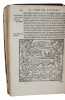
Fourth Lyon-edition of Macrobius's 2 main works. In the ""Somnium"" he uses passages of Cicero's work as mere suggestions to construct a treatise on Neoplatonic philosophy - the most satisfactory and widely read Latin compendium on Neoplatonism that existed during the Middle Ages. Macrobius was one of the leading popularizers of science in the Latin West, and his conception of the world geography as an equatorial and meridional ocean (depicted in the book) dividing the earth into four quarters, dominated scientific thinking on world geography in the Middle Ages. - His ""Saturnalia"" deals with Roman feasts in form of table-talk at a banquet in Rome, giving information of food and drink and their preparation (Vicaire 986 (ed.1492, Simon p. 547 (ed. 1492)). and is fascinatingly rich in philological, historical, antiquarian and scientific lore, throwing a clear light on the interests and taste of the period. - Adams vol. II: M 68.

Opera. Accedunt integrae Isacii Pontani, Joh. Meursii, Jacobi Gronovii Notae & Animadversiones. Editio novissima cum Indice Rerum & Vocum locupletissimo
London, C. Drin (et) C. Harper, 1694. 8vo. Contemp. full calf. Raised bands, gilt spine (faint). Light wear to top of spine. Spine a bit rubbed.Engraved frontispiece. (28),491,(38) pp., a few textillustrations.
Macrobius was one of the leading popularizers of science in the Latin West, and his conception of the world geography as an equatorial and meridional ocean (depicted in the book) dividing the earth into four quarters, dominated scientific thinking on world geography in the Middle Ages. - His ""Saturnalia"" deals with Roman feasts in form of table-talk at a banquet in Rome, giving information of food and drink and their preparation.and is fascinatingly rich in philological, historical, antiquarian and scientific lore, throwing a clear light on the interests and taste of the period.
Opera ad optimas Editiones collata. Praemottitur Notitia literaria accedunt Indices Studiis Societatis Bipontinae. Editio Accurata. 2 Vols.
Biponti (Zweibrücken), Typographia Societatis, 1788. 8vo. 2 contemp. full calf. Richly gilt spines with title-and tomelabels. Some scratches to covers. 2 engraved titlevignettes. XIV,381"(2),343 pp. + Indexes. 2 folded engraved plates. Internally clean.
Dibdin II:221 ""Destitute of Notes"" but with a very correct text. The Notitia Literaria prefixed is also very useful.""
MACROBII AMBROSII AURELII THEODOSII, UIRI CONSULARIS, & ILLUSTRIS In Somnium Scipionis (Lib II) , Saturnaliorum Lib VI Ex varijs ac vetustissimis codicibus recogniti, & aucti. (Traduction: De Macrobe, Ambroise, Aurélien,Théodose, Consul éminent, les Saturnales (livre II) , le SONGE DE SCIPION , Les SATURNALES (livre IV) , révisés et augmentés à partir de codex divers et anciens.)
Apud Ioan. Gryphium, VENETIIS, 1575.
Un volume petit in-12° (15, 4 x 11cm), reliure ancienne velin souple ivoire d’aspect irrégulier, dos à trois nerfs, reste d’attaches. Nom de l’auteur (MACROBE) manuscrit sur le dos. 567 pages imprimées en italiques, 32 feuilles d'index , caractères tous en italique (texte en latin et partiellement en grec, soit in-texte soit en notes marginales), 4 illustrations (p. 101, 109, 137 et 144). La dernière d’entre elles étant particulièrement connue (p.144) car il s’agit d’une cartes du monde qui fut une des premières à représenter la terre sous forme d’une globe et à séparer les deux hemisphères. L’ouvrage date en principe de 1575. C’est ce que l’on peut lire sur la page de titre mais on notera qu’un des chiffres romains X a été inscrit à la main... Quoi qu’il en soit ce volume contient 2 textes, comme quasiment chaque édition des oeuvres de MACROBE, lequel en a écrit une troisième, moins connue, un traité de grammaire sur les différences et ressemblances entre le grec et le latin.Ses deux oeuvres majeures donc auraient été composées vers 430. MACROBE, né en Numidie vers 370 fut un haut fonctionnaire de l’Empire romain et ses oeuvres semblent avoir été lues tout long du moyen âge. On peut dire aussi qu’Il fut un philosophe et un philologue néoplatonicien (doctrine de l’antiquité tardive, inspirée non seulement de PLATON mais de plusieurs courants de la spiritualité orientale et grecque. Le COMMENTAIRE DU SONGE DE SCIPION (pp. 3-177 )permit entre autres richesses de retrouver un texte de CICERON (De Republica) qui avait, complètement disparu et qui en occupait les paragraphes 9 à 29 du livre VI . MACROBE en avait extrait ce texte pour le traiter comme une sorte de fable autonome (SCIPION rêve qu’il s’elève jusqu’au ciel pour y retrouver ses aieux , lesquels lui expliquent le mécanisme du cosmos, la place de la Terre et de l'homme au sein de l'univers et le principe de l’immortalité). Dans ce texte MACROBE s’appuie sur une carte du monde.Dans le 2ème texte, LES SATURNALES (pp.178-267), MACROBE nous décrit une sorte de colloque littéraire où au milieu des trois jours des fêtes des Saturnales de l'an 384 douze savants romains, dont un grammairien serbe, décident de s'enfermer pour parler de divers sujets, Virgile, les antiquités et les traditions romaines, la philosophie, la grammaire, l’astrologie, divers citations d’auteurs souvent disparus, des curiosités des anecdotes etc... On peut dire qu’il s’agit avec ce texte, d’un hommage à l'ancienne Rome païenne. Exemplaire compact dans sa reliure d’époque en vélin, et en BON ÉTAT. [50276]

[MACROBE] MACROBIUS Ambrosius Aurelius Theodosius; PONTANUS Joannes Isacius; VAN MEURS Joannes; GRONOVIUS Jacobus:
Reference : 9747
(1670)
Aur. Theodosii Macrobii, v. cl. & inlustris, Opera. Acceduntnotae integrae Isacii Pontani, Joh. Meursii, Jacobi Gronovii.
Lugduni Batavorum, Ex officina Arnoldi Doude / Cornelii Driehvysen, 1670. In-8 de [34]-704-[64] pages, plein vélin blanc (un peu sali), titre au dos. Première garde déchirée, ex-libris de Basseville.
![Aur. Theodosii Macrobii, v. cl. & inlustris, Opera. Acceduntnotae integrae Isacii Pontani, Joh. Meursii, Jacobi Gronovii.. [MACROBE] MACROBIUS ...](https://static.livre-rare-book.com/pictures/KUA/9747_1_thumb.jpg)
![Aur. Theodosii Macrobii, v. cl. & inlustris, Opera. Acceduntnotae integrae Isacii Pontani, Joh. Meursii, Jacobi Gronovii.. [MACROBE] MACROBIUS ...](https://static.livre-rare-book.com/pictures/KUA/9747_2_thumb.jpg)
![Aur. Theodosii Macrobii, v. cl. & inlustris, Opera. Acceduntnotae integrae Isacii Pontani, Joh. Meursii, Jacobi Gronovii.. [MACROBE] MACROBIUS ...](https://static.livre-rare-book.com/pictures/KUA/9747_3_thumb.jpg)
Avec un beau titre gravé. Contient entre autres Le commentaire sur le songe de Scipion, de Cicéron ainsi que les Saturnales, les deux oeuvres qui ont rendu le philosophe célèbre jusqu'à nos jours. Du 26 septembre au 5 octobre, le libraire est absent il prendra connaissance de vos commandes dès le 6 octobre au matin. Et durant cette période, l'horaire de fermeture sera 17h30 du lundi au vendredi. – From September 26 to October 5, the bookseller is absent; he will take note of your orders as early as the morning of October 6. And during this period, the closing time will be 5:30 p.m. from Monday to Friday.
Hoc volumine continentur. Macrobii Interpretatio in Somnium Scipionis a Cicerone confictum. Eiusdem Saternaliorum libri septem. Accuratius recogniti. In quibus Graeca suis cum acentibus suo nitori restituta reperiuntur. Haec omnia Nicolaus Angelius vir ...correxit... (bound with) Auli Gelii Noctium Atticarum commentaria per Bonfinem Asculanum.....
" Venezia, [ Giovanni Tacuino ], Impressum Venaetiis ; in aedibus Ioannis Tacuini de Tridino, 1521, Die XVIII Iulii , in-folio, 30 x 21 cm, (8)nn pp + 110 pp (numbered 1-105) + (2)(blank) (complete collation identical with USTC 839412). Title page printed in red & black, with printer's device ''St. John the Baptist'' with motto '' Ecce agnus''. Several woodcuts in the text, on pp. 26verso a large worldmap showing the ''Alveus Oceani''. Bound in 16th century vellum, edges painted blue, gilt title on smooth spine. Very nice copy notwithstanding a very few minor perpendicular worm galleries (not in the text) and a clear very faint waterstain at a few pages. With the manuscript ex-libris of '' Francisci Pontij Placentini'' in the upper margin of the title page. BOUND WITH Aulus GELLIUS , Auli Gelii Noctium Atticarum commentaria per Bonfinem Asculanum..., Venezia, [ Giovanni Tacuino ], Impressum Venetiis ; per Ioannem de Tridino alias Tacuinum, 1517 die primo Decemb. (44)nn pp + 270 pp (numbered 1-135) , complete but for the last blank leaf. (USTC 832153). Copy with some darker marginal stains at the first 10 leaves, some faint clear waterstains at some pages and marginal stains at the last pages, still a fine/good copy. Convolute containing two postincunables printed by Giovanni Tacuino. This printer is represented with 28 imprints in Adams (not the Macrobius)."

