 Write to the booksellers
88 books for « luxemburg r »Edit
-
Type
Book (87)
Magazine (1)
-
Century
19th (1)
20th (39)
21st (3)
-
Countries
Belgium (4)
Canada (1)
Denmark (3)
France (72)
Netherlands (2)
Switzerland (6)
-
Syndicate
ALAC (1)
ILAB (40)
NVVA (2)
SLACES (2)
SLAM (34)
Topics
- Archaeology (1)
- Biography (1)
- Communism (5)
- Communism (6)
- Correspondences (2)
- Economics (7)
- Economics (2)
- German history (1)
- Germanic languages (6)
- Germany (4)
- Germany pc (1)
- History (4)
- Iraq (1)
- Liechtenstein (1)
- Literary review (1)
- Literature (2)
- Luxembourg (3)
- Man ray (1)
- Mathematics (1)
- Military arts (1)
- Nietzsche frédéric (1)
- Philosophy (1)
- Policy (27)
- Political economy (1)
- Repression (1)
- Review (1)
- Reviews (1)
- Russia (1)
- Social sciences (1)
- Socialism (7)
- Strike (1)
- Trade unionism (1)
- Various (2)
- Wilde oscar (1)
- Woods & woods’ price lists (1)
Die Akkumulation des Kapitals. Enin Beitrag zur Ökonomischen Erklärung des Imperialismus. [The Accumulation of Capital]. - [THE NEAREST TO ""CAPITAL"" OF ANY MARXIST WORK]
Berlin, 1913. Royal 8vo. Uncut and partly unopened in original printed wrappers. A bit of spotting to original printed spine, but overall in magnificent condition. Completely original and as fresh as can be wished for. (8), 446, (2).
![Die Akkumulation des Kapitals. Enin Beitrag zur Ökonomischen Erklärung des Imperialismus. [The Accumulation of Capital]. - [THE NEAREST TO ""CAPITAL"" ...](https://static.livre-rare-book.com/pictures/LLX/53712_1_thumb.jpg)
The very rare first edition of Rosa Luxemburg's magnum opus - ""without doubt, one of the most original contributions to Marxist economic doctrine since ""Capital"". In its wealth of knowledge, brilliance of style, trenchancy of analysis and intellectual independence, this book, as Mehring, Marx's biographer, stated, was the nearest to ""Capital"" of any Marxist work. The central problem it studies is of tremendous theoretical and political importance: namely, what effects the extension of capitalism into new, backward territories has on the internal contradictions rending capitalism and on the stability of the system."" (Tony Cliff). Rosa Luxemburg (1871-1919) was one of the most influential Marxists of the late 19th century. In her youth, she joined the socialist movement and went to Switzerland in exile in 1889. Here she studied law and economics and developed close connections to the leading members of the Russian socialist party. As opposed to Lenin, she was in complete favour of internationalism and therefore in opposition to the established Russian and Polish socialist parties that supported Polish independence. In 1893, she co-founded what was to be the forerunner of the Polish Communist Party, namely the Socialdemocratic Labour Party of Poland.In 1899, Rosa Luxemburg settled in Berlin and joined the German Socildemocratic Party, SPD and represented the revolutionary wing. She believed strongly in revolutionary mass action, but as opposed to Lenin, she was not completely bound to the revolutionary party and spoke out against movements like the reform union in Germany. ""Rosa Luxemburg was born in the small Polish town of Zamosc on 5 March 1871. From early youth she was active in the socialist movement. She joined a revolutionary party called Proletariat, founded in 1882, some 21 years before the Russian Social Democratic Party (Bolsheviks and Mensheviks) came into being. From the beginning Proletariat was, in principles and programme, many steps ahead of the revolutionary movement in Russia. While the Russian revolutionary movement was still restricted to acts of individual terrorism carried out by a few heroic intellectuals, Proletariat was organising and leading thousands of workers on strike. In 1886, however, Proletariat was practically decapitated by the execution of four of its leaders, the imprisonment of 23 others for long terms of hard labour, and the banishment of about 200 more. Only small circles were saved from the wreck, and it was one of these that Rosa Luxemburg joined at the age of 16. By 1889 the police had caught up with her, and she had to leave Poland, her comrades thinking she could do more useful work abroad than in prison. She went to Switzerland, to Zurich, which was the most important centre of Polish and Russian emigration. There she entered the university where she studied natural sciences, mathematics and economics. She took an active part in the local labour movement and in the intense intellectual life of the revolutionary emigrants.Hardly more than a couple of years later Rosa Luxemburg was already recognised as the theoretical leader of the revolutionary socialist party of Poland. She became the main contributor to the party paper, Sprawa Rabotnicza, published in Paris. In 1894 the name of the party, Proletariat, was changed to become the Social Democratic Party of the Kingdom of Poland" shortly afterwards Lithuania was added to the title. Rosa continued to be the theoretical leader of the party (the SDKPL) till the end of her life.In August 1893 she represented the party at the Congress of the Socialist International. There, a young woman of 22, she had to contend with well-known veterans of another Polish party, the Polish Socialist Party (PPS), whose main plank was the independence of Poland and which claimed the recognition of all the experienced elders of international socialism. Support for the national movement in Poland had the weight of long tradition behind it: Marx and Engels, too, had made it an important plank in their policies. Undaunted by all this, Rosa Luxemburg struck out at the PPS, accusing it of clear nationalistic tendencies and a proneness to diverting the workers from the path of class struggle" and she dared to take a different position to the old masters and oppose the slogan of independence for Poland. (For elaboration on this, see Rosa Luxemburg and the national question below.) Her adversaries heaped abuse on her, some of them, like the veteran disciple and friend of Marx and Engels, Wilhelm Liebknecht, going so far as to accuse her of being an agent of the Tsarist secret police. But she stuck to her point.Intellectually she grew by leaps and bounds. She was drawn irresistibly to the centre of the international labour movement, Germany, where she made her way in 1898."" (Tony Cliff, Rosa Luxemburg Biography).In 1919, she was captured and murdered by reactionary freetroop officers, but her theoretical works remained highly influential throughout almost a century. As late as the 1960'ies and 70'ies, she was still seen as somewhat of a revolutionary hero and champion of communism. ""When the First World War broke out, practically all the leaders of the Socialist Party [SPD] were swept into the patriotic tide. On 3 August 1914 the parliamentary group of German Social Democracy decided to vote in favour of war credits for the Kaiser’s government. Of the 111 deputies only 15 showed any desire to vote against. However, after their request for permission to do so had been rejected, they submitted to party discipline, and on 4 August the whole Social Democratic group unanimously voted in favour of the credits. A few months later, on 2 December, Karl Liebknecht flouted party discipline to vote with his conscience. His was the sole vote against war credits.This decision of the party leadership was a cruel blow to Rosa Luxemburg. However, she did not give way to despair. On the same day, 4 August, on which the Social Democratic deputies rallied to the Kaiser’s banner, a small group of socialists met in her apartment and decided to take up the struggle against the war. This group, led by Luxemburg, Karl Liebknecht, Franz Mehring and Clara Zetkin, ultimately became the Spartakus League. For four years, mainly from prison, Rosa continued to lead, inspire and organise the revolutionaries, keeping high the banner of international socialism...The revolution in Russia of February 1917 was a realisation of Rosa Luxemburg’s policy of revolutionary opposition to the war and struggle for the overthrow of imperialist governments. Feverishly she followed the events from prison, studying them closely in order to draw lessons for the future. Unhesitatingly she stated that the February victory was not the end of the struggle but only its beginning, that only workers’ power could assure peace. From prison she issued call after call to the German workers and soldiers to emulate their Russian brethren, overthrow the Junkers and capitalists and thus, while serving the Russian Revolution, at the same time prevent themselves from bleeding to death under the ruins of capitalist barbarism.When the October Revolution broke out, Rosa Luxemburg welcomed it enthusiastically, praising it in the highest terms. At the same time she did not believe that uncritical acceptance of everything the Bolsheviks did would be of service to the labour movement. She clearly foresaw that if the Russian Revolution remained in isolation a number of distortions would cripple its development" and quite early in the development of Soviet Russia she pointed out such distortions, particularly on the question of democracy.On 8 November 1918 the German Revolution freed Rosa Luxemburg from prison. With all her energy and enthusiasm she threw herself into the revolution. Unfortunately the forces of reaction were strong. Right-wing Social Democratic leaders and generals of the old Kaiser’s army joined forces to suppress the revolutionary working class. Thousands of workers were murdered on 15 January 1919 Karl Liebknecht was killed" on the same day a soldier’s rifle butt smashed into Rosa Luxemburg’s skull.With her death the international workers’ movement lost one of its noblest souls. ""The finest brain amongst the scientific successors of Marx and Engels"", as Mehring said, was no more. In her life, as in her death, she gave everything for the liberation of humanity."" (Tony Cliff, Biography of Rosa Luxemburg).Sraffa 3560Social Liberation 4066
Die Akkumulation des Kapitals. Enin Beitrag zur Ökonomischen Erklärung des Imperialismus. [The Accumulation of Capital]. - [THE NEAREST TO ""CAPITAL"" OF ANY MARXIST WORK]
Berlin, 1913. Royal 8vo. Uncut and partly unopened in original printed wrappers. Soiling to spine, vaguely affecting first and last leaf. Overall in a very fine condition. (8), 446, (2) pp.
![Die Akkumulation des Kapitals. Enin Beitrag zur Ökonomischen Erklärung des Imperialismus. [The Accumulation of Capital]. - [THE NEAREST TO ""CAPITAL"" ...](https://static.livre-rare-book.com/pictures/LLX/56002_1_thumb.jpg)
![Die Akkumulation des Kapitals. Enin Beitrag zur Ökonomischen Erklärung des Imperialismus. [The Accumulation of Capital]. - [THE NEAREST TO ""CAPITAL"" ...](https://static.livre-rare-book.com/pictures/LLX/56002_2_thumb.jpg)
The very rare first edition of Rosa Luxemburg's magnum opus - ""without doubt, one of the most original contributions to Marxist economic doctrine since ""Capital"". In its wealth of knowledge, brilliance of style, trenchancy of analysis and intellectual independence, this book, as Mehring, Marx's biographer, stated, was the nearest to ""Capital"" of any Marxist work. The central problem it studies is of tremendous theoretical and political importance: namely, what effects the extension of capitalism into new, backward territories has on the internal contradictions rending capitalism and on the stability of the system."" (Tony Cliff). Rosa Luxemburg (1871-1919) was one of the most influential Marxists of the late 19th century. In her youth, she joined the socialist movement and went to Switzerland in exile in 1889. Here she studied law and economics and developed close connections to the leading members of the Russian socialist party. As opposed to Lenin, she was in complete favour of internationalism and therefore in opposition to the established Russian and Polish socialist parties that supported Polish independence. In 1893, she co-founded what was to be the forerunner of the Polish Communist Party, namely the Socialdemocratic Labour Party of Poland.In 1899, Rosa Luxemburg settled in Berlin and joined the German Socildemocratic Party, SPD and represented the revolutionary wing. She believed strongly in revolutionary mass action, but as opposed to Lenin, she was not completely bound to the revolutionary party and spoke out against movements like the reform union in Germany. ""Rosa Luxemburg was born in the small Polish town of Zamosc on 5 March 1871. From early youth she was active in the socialist movement. She joined a revolutionary party called Proletariat, founded in 1882, some 21 years before the Russian Social Democratic Party (Bolsheviks and Mensheviks) came into being. From the beginning Proletariat was, in principles and programme, many steps ahead of the revolutionary movement in Russia. While the Russian revolutionary movement was still restricted to acts of individual terrorism carried out by a few heroic intellectuals, Proletariat was organising and leading thousands of workers on strike. In 1886, however, Proletariat was practically decapitated by the execution of four of its leaders, the imprisonment of 23 others for long terms of hard labour, and the banishment of about 200 more. Only small circles were saved from the wreck, and it was one of these that Rosa Luxemburg joined at the age of 16. By 1889 the police had caught up with her, and she had to leave Poland, her comrades thinking she could do more useful work abroad than in prison. She went to Switzerland, to Zurich, which was the most important centre of Polish and Russian emigration. There she entered the university where she studied natural sciences, mathematics and economics. She took an active part in the local labour movement and in the intense intellectual life of the revolutionary emigrants.Hardly more than a couple of years later Rosa Luxemburg was already recognised as the theoretical leader of the revolutionary socialist party of Poland. She became the main contributor to the party paper, Sprawa Rabotnicza, published in Paris. In 1894 the name of the party, Proletariat, was changed to become the Social Democratic Party of the Kingdom of Poland" shortly afterwards Lithuania was added to the title. Rosa continued to be the theoretical leader of the party (the SDKPL) till the end of her life.In August 1893 she represented the party at the Congress of the Socialist International. There, a young woman of 22, she had to contend with well-known veterans of another Polish party, the Polish Socialist Party (PPS), whose main plank was the independence of Poland and which claimed the recognition of all the experienced elders of international socialism. Support for the national movement in Poland had the weight of long tradition behind it: Marx and Engels, too, had made it an important plank in their policies. Undaunted by all this, Rosa Luxemburg struck out at the PPS, accusing it of clear nationalistic tendencies and a proneness to diverting the workers from the path of class struggle" and she dared to take a different position to the old masters and oppose the slogan of independence for Poland. (For elaboration on this, see Rosa Luxemburg and the national question below.) Her adversaries heaped abuse on her, some of them, like the veteran disciple and friend of Marx and Engels, Wilhelm Liebknecht, going so far as to accuse her of being an agent of the Tsarist secret police. But she stuck to her point.Intellectually she grew by leaps and bounds. She was drawn irresistibly to the centre of the international labour movement, Germany, where she made her way in 1898."" (Tony Cliff, Rosa Luxemburg Biography).In 1919, she was captured and murdered by reactionary freetroop officers, but her theoretical works remained highly influential throughout almost a century. As late as the 1960'ies and 70'ies, she was still seen as somewhat of a revolutionary hero and champion of communism. ""When the First World War broke out, practically all the leaders of the Socialist Party [SPD] were swept into the patriotic tide. On 3 August 1914 the parliamentary group of German Social Democracy decided to vote in favour of war credits for the Kaiser’s government. Of the 111 deputies only 15 showed any desire to vote against. However, after their request for permission to do so had been rejected, they submitted to party discipline, and on 4 August the whole Social Democratic group unanimously voted in favour of the credits. A few months later, on 2 December, Karl Liebknecht flouted party discipline to vote with his conscience. His was the sole vote against war credits.This decision of the party leadership was a cruel blow to Rosa Luxemburg. However, she did not give way to despair. On the same day, 4 August, on which the Social Democratic deputies rallied to the Kaiser’s banner, a small group of socialists met in her apartment and decided to take up the struggle against the war. This group, led by Luxemburg, Karl Liebknecht, Franz Mehring and Clara Zetkin, ultimately became the Spartakus League. For four years, mainly from prison, Rosa continued to lead, inspire and organise the revolutionaries, keeping high the banner of international socialism...The revolution in Russia of February 1917 was a realisation of Rosa Luxemburg’s policy of revolutionary opposition to the war and struggle for the overthrow of imperialist governments. Feverishly she followed the events from prison, studying them closely in order to draw lessons for the future. Unhesitatingly she stated that the February victory was not the end of the struggle but only its beginning, that only workers’ power could assure peace. From prison she issued call after call to the German workers and soldiers to emulate their Russian brethren, overthrow the Junkers and capitalists and thus, while serving the Russian Revolution, at the same time prevent themselves from bleeding to death under the ruins of capitalist barbarism.When the October Revolution broke out, Rosa Luxemburg welcomed it enthusiastically, praising it in the highest terms. At the same time she did not believe that uncritical acceptance of everything the Bolsheviks did would be of service to the labour movement. She clearly foresaw that if the Russian Revolution remained in isolation a number of distortions would cripple its development" and quite early in the development of Soviet Russia she pointed out such distortions, particularly on the question of democracy.On 8 November 1918 the German Revolution freed Rosa Luxemburg from prison. With all her energy and enthusiasm she threw herself into the revolution. Unfortunately the forces of reaction were strong. Right-wing Social Democratic leaders and generals of the old Kaiser’s army joined forces to suppress the revolutionary working class. Thousands of workers were murdered on 15 January 1919 Karl Liebknecht was killed" on the same day a soldier’s rifle butt smashed into Rosa Luxemburg’s skull.With her death the international workers’ movement lost one of its noblest souls. ""The finest brain amongst the scientific successors of Marx and Engels"", as Mehring said, was no more. In her life, as in her death, she gave everything for the liberation of humanity."" (Tony Cliff, Biography of Rosa Luxemburg).Sraffa 3560Social Liberation 4066
Rosa Luxemburg (1871-1919), militante socialiste et communiste, théoricienne marxiste, assassinée lors de la répression spartakiste.
Reference : 019595
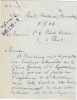
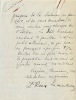
Lettre autographe signée à Pierre-Victor Stock
Rosa Luxemburg (1871-1919), militante socialiste et communiste, théoricienne marxiste, assassinée lors de la répression spartakiste. L.A.S. « Dr Rosa Luxemburg », Berlin, 5 octobre 1906, 2p in-8. A l'éditeur Pierre-Victor Stock (1861-1943), qui édita notamment de nombreux auteurs anarchistes : « Monsieur, A Hambourg vient de paraître une brochure allemande sur la Grève Générale et le Syndicalisme, écrite par moi et fondée sur l'expérience de la Révolution russe. Cette brochure sera traduite prochainement en russe et en hollandais. Mr Victor Mayer me propose de la traduire en français et de vous demander si vous voulez vous charger de l'édition. La dite brochure contient 4 feuilles (à 16) en petit allemand, ce qui fera en français à peu près 7 œ. Veuillez bien me faire savoir si la proposition vous convient et quelles seraient vos conditions. Agréez, Monsieur, mes salutations empressées. Dr Rosa Luxemburg ». Victor Mayer est un juif russe, né le 11 novembre 1878 à Irkoutsk, étudiant à Kiev en 1900, qui émigra avec sa famille, probablement pour fuir l'antisémitisme. Il prit le nom de Victor Remay, fut un orateur remarqué et devint l'orateur de la fédération socialiste de la Seine. Il était donc en lien avec Rosa Luxemburg, qui était elle aussi une juive ayant quitté le territoire russe (elle est né à Zamosc, Pologne actuelle mais alors en Russie). Toutefois Mayer semble n'avoir jamais traduit l'ouvrage et Victor Stock refusa dès réception de la lettre comme l'indique la note « refusé le 8 octobre 1906 ». L'ouvrage fut toutefois traduit en 1910 sous le titre La Grève en Masse, le Parti et les Syndicats (Gand, Société coopérative « Volksdrujjerij », 1910). Cette traduction est l'oeuvre d'Alexandre Bracke-Desrousseaux (1861-1955) qui devient ainsi le premier traducteur de Rosa Luxemburg en français. Ils s'étaient rencontrés lors de congrès socialistes internationaux. Une nouvelle édition eut lieu en 1964 sous le titre Grève de masses, parti et syndicats (Paris, Marpéro, 1964). Intéressant courrier autour de son oeuvre. Les lettres de Rosa Luxemburg sont d'une grande rareté. [353-2]


Phone number : +33 6 30 94 80 72
Luxembourg (Rosa) - Luxemburg - Spartacus - Berthe Fouchère - Louise Kautsky - sur Sonia Leibknecht
Reference : 85670
(1948)
La vie héroique de Rosa Luxembourg - La Révolution russe , dans les Cahiers mensuels Spartacus, n° 5 de Mai 1948 (Luxemburg)
Spartacus Malicorne sur Sarthe, 72, Pays de la Loire, France 1948 Book condition, Etat : Bon broché, sous couverture imprimée éditeur blanche et rouge In-8 1 vol. - 48 pages
1 portrait de Rosa Luxembourg en frontispice, dessin en noir et blanc 1ere édition, 1948 Contents, Chapitres : Berthe Fouchère : La vie héroïque de Rosa Luxembourg - Louise Kautsky : Les lettres de Rosa Luxembourg - Rosa Luxembourg : Lettres à Louise Kautsky - Lettres à Sonia Leibknecht - La responsabilité politique, texte inédit en français, traduit par Bracke - Rosa Luxemburg, souvent retranscrit en français Rosa Luxembourg, en polonais Róza Luksemburg, née le 5 mars 1871 à Zamosc dans l'Empire russe (actuelle Pologne) et morte assassinée le 15 janvier 1919 à Berlin en Allemagne, est une militante socialiste et communiste, et une théoricienne marxiste. Née sujette polonaise de l'Empire russe, elle s'exile en Suisse pour suivre des études, puis prend la nationalité allemande afin de poursuivre en Allemagne son militantisme socialiste. Figure de l'aile gauche de l'Internationale ouvrière, révolutionnaire et partisane de l'internationalisme, elle s'oppose à la Première Guerre mondiale, ce qui lui vaut d'être exclue du Parti social-démocrate d'Allemagne (SPD). Elle cofonde la Ligue spartakiste, puis le Parti communiste d'Allemagne. Deux semaines après la fondation de ce dernier, elle meurt assassinée à Berlin le 15 janvier 1919 pendant la révolution allemande, lors de la répression de la révolte spartakiste. Ses idées ont inspiré des tendances de la gauche communiste et donné naissance, a posteriori, au courant intellectuel connu sous le nom de luxemburgisme. L'héritage de Rosa Luxemburg a cependant été revendiqué, de manière contradictoire, par des mouvances politiques très diverses. - Rosa Luxemburg a laissé une correspondance importante dune qualité littéraire reconnue. Le satiriste Karl Kraus évoque notamment une lettre écrite à Sonia Liebknecht, depuis la prison pour femmes de Breslau, en ces termes : « ce document dhumanité et de poésie unique en son genre » devrait selon lui figurer dans les manuels scolaires de toute république, entre Goethe et Claudius. En 2006, la comédienne Anouk Grinberg lit des lettres de Rosa Luxemburg à ses amies (Luise Kautsky, Sonia Liebknecht, notamment) pendant ses détentions. (source : Wikipedia) couverture à peine jaunie, sinon bon état, intérieur frais et propre, papier à peine jauni, cela reste un bon exemplaire
Réforme sociale ou révolution ? et autres textes politiques.
Les Amis de Spartacus, 1997, in-8°, 192 pp, avant-propos par Jean-Michel Kay, “La vie héroïque de Rosa Luxemburg” par Berthe Fouchère, une photo de R. Luxemburg, broché, couv. illustrée, bon état
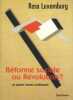
Ces textes ne sont pas des recettes : ils sont des leçons, tirées à chaud du combat militant, sur ce qui a conduit le socialisme dans l’impasse. Sans la sécheresse de la théorie, mais riches d’une compréhension profonde des mécanismes de notre société, les analyses de Rosa Luxemburg ont l'immense mérite d'avoir été confirmées par l'histoire du 20e siècle. Désormais les frais d'envoi sont de 6 € seulement pour les livres jusqu'à 1 kg (colissimo suivi), pour la France métropolitaine.
Herbier de prison.
<meta charset="utf-8"><span data-mce-fragment="1">Quoi de plus iconoclaste qu'un herbier composé entre quatre murs, sans l'étendue de la nature ? Comme une contradiction dans les termes. L'herbier de prison de Rosa Luxemburg est une archive sans équivalent. Troublante et attachante, sa fragilité et son histoire en font un témoignage de résistance et</span><span id="js-showResume" class="showResume" data-mce-fragment="1">d'évasion, une fabrique de formes et de joie, un document sur le sentiment politique de la nature, fondement de toute écologie.<br data-mce-fragment="1">Composé de sept cahiers datés d'avril 1915 à octobre 1918, l'herbier a pu être réalisé par la révolutionnaire emprisonnée grâce à l'amitié sans faille de quelques femmes, ses amies intimes dont la féministe Clara Zetkin. Au-delà des quelques fleurs et mauvaises herbes de la cour de la prison que Rosa glane lorsqu'elle sort sous surveillance, ce sont ses proches qui lui envoyèrent par lettres des spécimens séchés ou des bouquets fleurs fraîches qu'elle-même pressait. Aux planches de l'herbier répondent ainsi tout une correspondance où il est question de botanique, de nature, de romantisme allemand, d'amour de toutes créatures, et cela, « en dépit de l'humanité ». Rosa Luxemburg ne cesse d'encourager ses proches à garder leur joie de vivre et leur gaieté alors que les nuages qu'elle entraperçoit par une fenêtre à barreaux se chargent des couleurs de la guerre et de l'acier.<br data-mce-fragment="1">L'herbier et le rossignol est constitué de 133 planches botaniques accompagnées de la traduction des légendes manuscrites de celles-ci. Cet ouvrage recueille également une soixantaine de lettres, dans lesquelles la révolutionnaire évoque sa passion pour les plantes, ainsi que pour les animaux. Des documents inédits en français complètent le volume, notamment un journal où Rosa Luxemburg consigne les faits et gestes de sa vie d'incarcérée. De part sa richesse, cette édition est complètement originale et n'a pas d'égale ni en allemand ni en polonais</span> Paris, 2023 Héros-Limite 360 p., nombreuses photographies, broché. 14,8 x 21
Neuf
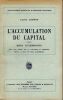
L'accumulation du capital d'après Rosa Luxemburg suivi d'un aperçu sur la discussion du problème depuis la mort de Rosa Luxemburg
Bibliothèque générale d'économie politique / Librairie des sciences politiques et sociales Marcel Rivière (1930) - In-8 broché de 200 pages - Exemplaire en excellent état
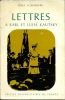
Lettres à Karl et Luise Kautsky précédées de Loeuvre et la vie de Rosa Luxemburg par Dominique Desanti
" Collection Hier " / Presses Universitaires de France (1970) - In-8 broché de 148 pages - Couverture à rabat illustrée d'une photo de Rosa Luxemburg - Traduites de lallemand par Nadine Stchoupak et A. M. Bracke-Desrousseaux - Exemplaire en bon état
, .
ROSA LUXEMBURG VIVANTE. Numéro spécial de la revue " PARTISANS ".
" PARTISANS ", N° 45, janvier 1969. In-4° broché. 141 pages.
Bon état.
Geschichte der Stadt und Festung Luxemburg, seit ihrer ersten Entstehung bis auf unsere Tage. Mit besonderer Rücksicht auf die kriegsgeschichtlichen Ereignisse. Nebst Plan der Stadt und statistischer Einleitung.
Luxemburg, F. Rehm, B. Bück, 1850. Contemp. modest hcloth. A stamp on title-page. XII,347,(1) pp., 1 large folded plan. Halftitle brownspotted.
First edition.
Lettres à Karl et Luise Kautsky précedées de " L'oeuvre et la vie de Rosa Luxemburg " par Dominique Desanti
" Collection Hier " / Presses Universitaires de France (1970) - In-8 broché de 148 pages - Couverture rempliée illustrée d'une photo de Rosa Luxemburg - Traduction de l'allemand par Nadine Stchoupak et A.M. Bracke-Desrousseaux - Préface et postface de Luise Kautsky - Exemplaire en excellent état
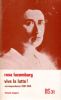
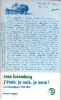
Lettres de Rosa Luxemburg : Vive la lutte ! (Correspondance 1891-1914) et J'étais, je suis, je serai ! (Correspondance 1914-1919)
" Bibliothèque Socialiste " n° 32 et 33 / François Maspero (1976) - Couvertures à rabats illustrées - Textes réunis, traduits et annotés sous la direction de Georges Haupt par Claudie Weill, Irène Petit et Gilbert Badia - Exemplaires en excellent état
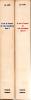
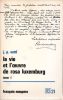
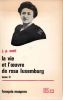
La vie et l'oeuvre de Rosa Luxemburg en 2 volumes
" Bibliothèque Socialiste " n° 21 et 22 / François Maspero (1972) - Couvertures à rabats illustrées - Traduit par Irène Petit et Marianne Racline - Exemplaires en excellent état
[SUISSE, BENELUX, BELGIEN, NIEDERLANDE, LIECHTENSTEIN, LUXEMBURG, OSTERREICH] - ZIEHR (Dr. Wilhelm), HERTIG (Dr. Louis) -
Reference : 200802105
Land und volker.
Luzern, Geographisch kulturelle gesellschaft im kunstreis AG, vers 1970 ; grand in-4, 298 pp., cartonnage d'éditeur avec jaquette. Geographie, geschichte, kunst, kultur, sitten und brauche (enzykoloadie fur geographie, geschichte, kunst, kultur, sitten und frauchen, BELGIEN, SCHWEIZ, NIEDERLANDE, LIECHTENSTEIN, LUXEMBURG, OSTERREICH.
Geographie, geschichte, kunst, kultur, sitten und brauche (enzykoloadie fur geographie, geschichte, kunst, kultur, sitten und frauchen, BELGIEN, SCHWEIZ, NIEDERLANDE, LIECHTENSTEIN, LUXEMBURG, OSTERREICH.
Introduction à l'économie politique
Anthropos, 1971, 276 p., in-8 br., coll. "Marxisme d'hier et d'aujourd'hui", préface par Ernest Mandel, 2ème édition, traces de mouillures bas de pages, assez bon état
La présente traduction a été effectuée par J. B. d'après le texte allemand publié sous le titre "Rosa Luxemburg : Einführung in die Nationalökonomie" dans "Ausgewählte reden und schriften" chez Dietz verlag. Berlin - 1951 (Vol. 1, pp. 411-741). Comprend en annexes : Rosa Luxemburg, enseignante - L'école du Parti 20 Economie Luxemburg 1324
Alexandre-Marie Desrousseaux dit Bracke (1861-1955), écrivain, helléniste, homme politique, militant socialiste, premier traducteur français de Rosa Luxemburg.
Reference : 019686
Manuscrit autographe signé
Alexandre-Marie Desrousseaux dit Bracke (1861-1955), écrivain, helléniste, homme politique, militant socialiste, premier traducteur français de Rosa Luxemburg. Manuscrit A.S., 26 juillet 1936, 1/4p in-folio. Réponse de Bracke à une grande enquête : Maximes de vie des grands écrivains contemporains. « Regarde : tu es l'un d'entre eux. Bracke ». Cette enquête était faite par l'écrivain Henri Corbière (1888-1980). [468]
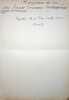

Alexandre-Marie Desrousseaux dit Bracke (1861-1955), écrivain, helléniste, homme politique, militant socialiste, premier traducteur français de Rosa Luxemburg.
Reference : 019693
Lettre autographe signée à Raymond de La Tailhède
Alexandre-Marie Desrousseaux dit Bracke (1861-1955), écrivain, helléniste, homme politique, militant socialiste, premier traducteur français de Rosa Luxemburg. L.A.S., Paris, sd [mercredi, 1898-1899], 6p in-8. Au poète Raymond de La Tailhède (1867-1938). Longue et intéressante lettre à propos d'une épître que La Tailhède souhaite envoyer à Austin de Croze (1866-1937) et que Desrousseaux critique pour l'améliorer. La Tailhède répondait en effet à une grande enquête sur « Les poètes, Mistral et le vers libre » publiée dans la Revue félibréenne. Sa réponse y est publiée dans le tome XIV (1898-1899), pages 94 à 96. Il est intéressant de noter que La Tailhède n'a pas tenu compte de toutes les remarques de Desrousseaux. Très beau document. [468]
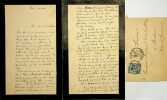
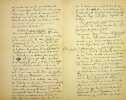
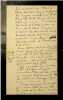
Alexandre-Marie Desrousseaux dit Bracke (1861-1955), écrivain, helléniste, homme politique, militant socialiste, premier traducteur français de Rosa Luxemburg.
Reference : 019695
Lettre autographe signée à Jean Moréas
Alexandre-Marie Desrousseaux dit Bracke (1861-1955), écrivain, helléniste, homme politique, militant socialiste, premier traducteur français de Rosa Luxemburg. L.A.S., Lille, sd [mercredi], 1p in-8. Au poète Jean Moréas (1856-1910). « Mon cher ami, J'ai pris plaisir à lire votre Préface dans la Volonté. C'est bien ce que j'attendais comme entrée de jeu. Vous allez, j'espère, nous parler de Médée la prochaine fois : les difficultés ne sont pas pour vous arrêter, au contraire, & d'ailleurs on vous attendra là. Nous en causerons plus amplement demain jeudi, car j'irai le soir dîner à la Côte d'Or, où je compte bien vous rencontrer. Auriez-vous l'obligeance de faire part de mon arrivée à Monsieur de la Tour du Villard, pour qu'il arrête son envoi quotidien de la Volonté dont je le remercie fort. Serrez la main de la Tailhède, et aimez-moi comme je vous aime. A.M. Desrousseaux ». [468]
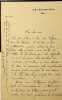
Alexandre-Marie Desrousseaux dit Bracke (1861-1955), écrivain, helléniste, homme politique, militant socialiste, premier traducteur français de Rosa Luxemburg.
Reference : 019696
Lettre autographe signée à Jean Moréas
Alexandre-Marie Desrousseaux dit Bracke (1861-1955), écrivain, helléniste, homme politique, militant socialiste, premier traducteur français de Rosa Luxemburg. L.A.S., Lille, 28 octobre 1896, 1p in-8. Entête du Cercle Artistique et Littéraire du Nord. Au poète Jean Moréas (1856-1910). « Mon cher ami, J'arrive demain à 5 heures à Paris. Mon intention est d'aller dîner à la Côte [d'Or] ; mais comme vos habitudes ont peut-être changé depuis mon départ, soyez assez bon, si je dois aller vous trouver ailleurs, pour m'en avertir par un petit mot déposé chez moi, 47 boulevard de Port Royal. Serrez la main de La Tailhède & croyez à mes sentiments de fidèle amitié. A.M. Desrousseaux ». [468]
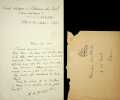
Alexandre-Marie Desrousseaux dit Bracke (1861-1955), écrivain, helléniste, homme politique, militant socialiste, premier traducteur français de Rosa Luxemburg.
Reference : 019698
Lettre autographe signée à Jean Moréas
Alexandre-Marie Desrousseaux dit Bracke (1861-1955), écrivain, helléniste, homme politique, militant socialiste, premier traducteur français de Rosa Luxemburg. L.A.S., Paris, sd [vendredi], 1p in-8. Peut-être au poète Jean Moréas (1856-1910). « Mon cher ami, Si votre lettre à M. Antony Réal n'est pas encore partie, pourriez-vous le prévenir que j'arriverai à Orange à 9h24 du soir dimanche ? Je ne puis arriver plus tôt, des raisons particulières m'empêchant de partir avant dimanche matin. Prévenu, il trouvera sans doute tout naturel que je me rende chez lui à cette heure-là. Merci d'avance et bien affectueusement à vous. A.M. Desrousseaux ». Antony Real (1821-1896) était un poète et écrivain provençal. [468]
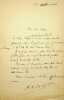
Alexandre-Marie Desrousseaux dit Bracke (1861-1955), écrivain, helléniste, homme politique, militant socialiste, premier traducteur français de Rosa Luxemburg.
Reference : 019700
Manuscrit autographe
Alexandre-Marie Desrousseaux dit Bracke (1861-1955), écrivain, helléniste, homme politique, militant socialiste, premier traducteur français de Rosa Luxemburg. Manuscrit autographe, sd, 2p in-4. Notes autographes tirées du Dictionnaire de l'ancienne langue française et de tous ses dialectes du 9e au 15e siècle (de Frédéric Godefroy). Ces notes concernent le mot meismement, meesmement, mesmement, meimement, avec de nombreux exemplaire. On joint une carte de visite avec son adresse écrite au crayon. [468]
Réforme ou révolution ? Marxisme contre dictature (Spartacus) [Paperback] Luxemburg, Rosa; Desrousseaux, Alexandre Marie and Rubak, Simon
Broché bon état.Contenu propre . Tranches piquées . 47 pages . 1972.PHOTOS SUR DEMANDE
Merci de nous contacter à l'avance si vous souhaitez consulter une référence dans notre boutique à Authon-du-Perche.
Leitfaden für den Zeichenunterricht in den Luxemburger Fortbildungschulen. Erstes Jahr.
Luxemburg, Druck und Verlag von M. Huss, 1908. Format in-8°, 25,5 x 17 cm, 24 pp + 15 lithographic plates. Bound in publisher's half cloth with a nice two-coloured title page tipped on to the front cover. Printed on satin paper. Very nice copy. Rare Luxemburg schoolbook on drawing (Zeichenkunst).
"Le miracle allemand de l'emploi, un modele pour l'europe ? - Changement de modele: le demantelement du capitalisme social, La precarité: concept et etendue, La perception subjective de l'insecurité, Conséquences des ""Réformes Hartz"" et de la severite...."
ROSA LUXEMBURG STIFTUNG, bureau de Bruxelles. 2014. In-8. Broché. Etat d'usage, Tâchée, Dos satisfaisant, Quelques rousseurs. 50 PAGES - Couverture défraîchie. . . . Classification Dewey : 330-Economie
Classification Dewey : 330-Economie
"Lettres à Karl et Luise Kautsky - Collection "" Hier ""."
Presses Universitaires de France. 1970. In-8. Broché. Etat d'usage, Couv. légèrement passée, Dos satisfaisant, Intérieur frais. LXIII+145 pages - couverture contrepliée - étiquette collée sur le 2eme plat - couverture jaunie - rousseurs sur les tranches - coins frottés.. . . . Classification Dewey : 830-Littératures des langues germaniques
"Collection "" Hier "" - Traduites de l'allemand par Nadine Stchoupak et A.M. Bracke-Desrousseaux précédées de l'oeuvre et la vie de Rosa Luxemburg par Dominique Desanti. Classification Dewey : 830-Littératures des langues germaniques"

