 Write to the booksellers
19 books for « lockyer k g »Edit
-
Century
19th (7)
20th (6)
-
Topics
Astronomy (5)
Discovery (1)
England (1)
Europe (1)
Fin de siècle (1)
Great britain (1)
Hebraic literature (2)
Helium (1)
History (2)
Logic (1)
Physics (3)
Tea (1)
United kingdom (1)
-
Countries
Belgium (3)
Côte d'Ivoire (1)
Denmark (7)
France (7)
Switzerland (1)
-
Syndicate
CLAM (1)
ILAB (14)
NVVA (1)
SLACES (1)
SLAM (5)
All the kings and Queens of the Bible. Tragedies and triumphs of Royalty in past ages.
In-8, pleine toile éditeur, (7) ff., 253 pp. Grand Rapides, Zondervan Publishing House, 1961.

Spectroscopic Observations of the Sun.- No. II. Received November 19,- Read November 19 and 26, 1868. (With additional notes Nov. 26, April 9, 1869, Oct. 10, 1869).
(London, Taylor and Sons, 1870). 4to. No wrappers as extracted from ""Philosophical Transactions"" 1869, Vol. 159 - Part I. Pp. 425-444 and 2 lithographed plates (1 with the spectrum of helium, 1 with his spectroscope (not requiring eclipses to function)). Clean and fine.
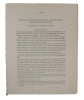
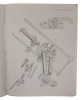
First appearance of this milestone paper in chemistry, physics and astronomy, announcing the discovery of helium in the sun and naming it 'helium' for Helios, the Greek God of the Sun. In the same paper he demonstrates his invention of the spectroscope by which the prominences of the sun could be observed and studied without an eclipse by leading the light from the very edge of the sun through a prism. - Helium was not discovered on the earth before 1895 by William Ramsay, and it was Crookes who established its identity with the helium Lockyer observed in the spectrum of the sun.""This (the last discovery) was announced on the same day by the French astronomer Janssen, who was in India observing a total eclipse. As a result, the French government some ten years later struck a medallion showing the heads of both scientists.By that time, the two men had made a much more dramatic discovery at the same time, this time in cooperation. Janssen, studying the spectrum ofthe sun during the eclipse, had noted a fine line he did not recognize. he send a report on this to Lockyer, an acknowledges expert on solar spectra. Lockyer compared the reported position of the line with lines of known elements, concluding that it must belong to a yeat unknown element, possibly not even existing on the earth. He named the element, from the Greek word for the sun.""(Asimov).
L'évolution inorganique étudiée par l'analyse spectrale traduit de l'anglais par Edouard D'Hoorghe
P., Alcan, 1905, un volume in 8 relié en pleine toile éditeur, 8pp., 305pp., 45 figures
---- PREMIERE EDITION FRANCAISE ---- BON EXEMPLAIRE ---- "One of Lockyer's major book which describes the most developed form of the hypothesis and its significance for celestial spectroscopy... Perhaps the most far-reaching of Lockyer's ideas was his meteoritic hypothesis, which is one of the most comprehensive schemes of inorganic evolution ever devises and which led him to conceptions far in advance of those prevalent in his day. It may be summed up in his own words : All self-luminous bodies in the celestial spaces are composed either of swarms of meteorites or of masses of meteoritic vapour produced by heat". (DSB VIII p. 441)**3344/L5DEP-CAV.F5
The Bakerian Lecture. - Recherches in Spectrum-Analysis in connection with the Spectrum of the Sun. No. III. Received November 20, - Read November 27, 1873.
(London, Taylor and Francis, 1874). 4to. No wrappers as extracted from ""Philosophical Transactions"", Vol. 164 - Part II, Pp. 479-494 a. 3 large folded plates in Heliotype of sun-spectra. Textillustr.
First printing of this paper in which Lockyer analyses the spectra of the sun, comparing them with the spectra obtained of elements on the earth in order to detect the elements in the solar layers. Lockyer was the first to detect Helium in the sun 1868 (printed 1870), and he was a pioneer in the study of spectrum analysis of the sun. ""Joseph Norman Lockeyer (1836-1920), pioneer English astrophysicist. He made importent advances in the field of solar and stellar physics, and is responsible for naming the element helium, for emphasizing the two-branch theory of stellar evolution, and (jointly with Janssen) for the method of observing solar prominences without an eclipsee."" (Source Book in Astronomy).
The Chemistry of the Sun.
London, Macmillan and Co., 1887. Royal8vo. Orig. full cloth. Gilt lettering to spine. A small paperlabel pasted to spine. XX,457,(1) pp., 133 textillustrations. Internally clean and fine.
First edition of a major work by Lockyer in which he presents his dissociation hypothesis and the evidence for it. (The theory states that the atoms of elements are groupings of smaller constituents, which he used to explain some simple facts of the spectra). Lockyer is also well known for his creation of the scientific journal ""Nature"" in 1869.""Joseph Norman Lockeyer (1836-1920), pioneer English astrophysicist. He made importent advances in the field of solar and stellar physics, and is responsible for naming the element helium, for emphasizing the two-branch theory of stellar evolution, and (jointly with Janssen) for the method of observing solar prominences without an eclipsee."" (Source Book in Astronomy).
On the Causes which Produce the Phenomena of New Stars.
(London, Harrison and Sons, 1892). 4to. No wrappers as extracted from ""Philosophical Transactions"" Year 1891, Volume 182 - Series A. Pp. 397-448. Textillustrations.
First appearance of one of Lockyer's importent papers on stellar evolution.""Lockyer's scheme of stellar development has been modified in many importent details, but its basic principle. of both rising and falling temperatures in the life history of a star, is the central idea of our present theory of stellar evolution.""""Joseph Norman Lockeyer (1836-1920), pioneer English astrophysicist. He made importent advances in the field of solar and stellar physics, and is responsible for naming the element helium, for emphasizing the two-branch theory of stellar evolution, and (jointly with Janssen) for the method of observing solar prominences without an eclipsee."" (Source Book in Astronomy).
On the Photographic Spectra of some of the Brighter Stars. Received November 3, - Read December 8, 1892.
(London, Harrison and Sons, 1893). 4to. No wrappers as extracted from ""Philosophical Transactions"" Year 1893, Volume 184 - Series A. Pp. 675-726 a. 5 large folded plates showing the spectra of different stars.
First appearance of an importent investigation on stellar physics in which he tries to classify stars according to their spectral differences, deducing differences in temperature etc.etc. ""Lockyer's scheme of stellar development has been modified in many impiortent details, but its basic principle, of both rising and falling temperatures in the life history of a star, is the central idea of our present theories of stellar evolution.""(A Source Book in Astronomy"", p.353).""Joseph Norman Lockeyer (1836-1920), pioneer English astrophysicist. He made importent advances in the field of solar and stellar physics, and is responsible for naming the element helium, for emphasizing the two-branch theory of stellar evolution, and (jointly with Janssen) for the method of observing solar prominences without an eclipsee."" (Source Book in Astronomy).
Researches in Spectrum-Analysis in connection with the Spectrum of the Sun.- No. V. Received April 20, - Read May 23, 1878.
(London, Harrison and Sons, 1881). 4to. No wrappers as extracted from ""Philosophical Transactions"" Year 1881, Volume 172. Pp. 561-576 a. 1 double page folded photographic plate of the spectrum of the sun (autotyped).
First appearance of this paper in which Lockyer explores the photographic technics in relation to the spectra of the sun and the photographic processes employed.""Joseph Norman Lockeyer (1836-1920), pioneer English astrophysicist. He made importent advances in the field of solar and stellar physics, and is responsible for naming the element helium, for emphasizing the two-branch theory of stellar evolution, and (jointly with Janssen) for the method of observing solar prominences without an eclipsee."" (Source Book in Astronomy).
The Transactions of the honourable society of Cymmrodorion, session 1908-1090
London: New Stone Buildings, 64, Chancery Lane Plaquette 1910 In-8, (15x22.5 cm), plaquette, 20 et XI pages, texte en anglais, ex-libris de Giot ; note au stylo sur la couverture, plats légèrement défraîchis, assez bon état. Livraison a domicile (La Poste) ou en Mondial Relay sur simple demande.
Scientific and medical instruments including a collection of apparatus from the Norman Lockyer Corporation. (Auction sale catalogue)
0. London, (Auction sale catalogue). in-4°, 25 x 20 cm, 52 pp, coloured & b/w ill., 433 lots, orig.wrapper, index.
Habsburg and Bourbon Europe 1470-1720
Longman 1989 606 pages 13 6x3 6x21 6cm. 1989. Broché. 606 pages.
Bon état rousseurs sur la tranche intérieur propre
Tudor and Stuart Britain, 1471-1714
New York, Longman 1985 xi + 482pp. with ills., 22cm., 2nd edition, softcover, good condition, G75593

(SLACES, NVVA)
Phone number : 41 (0)26 3223808
l' Evolution Inorganique
Paris 1905 Germer Baillière et Cie Decorative Cloth
Langue: français. L'évolution inorganique, reliure d'éditeur, bibliothèque scientifique internationale, 304b + 16 catalogue des livres de fonds, 22 x 16 cm, bon état [Cette description peut avoir été traduite par une IA.]
The Total Eclipse of the Sun, April 16th, 1893 - Report and Discussion of the Observations relating to Solar Physics.
(London, Harrison and Sons, 1897). 4to. No wrappers as extracted from ""Philosophical Transactions"" Year 1896, Volume 187. Pp. 551-618 a. 4 plates (2 double-page) reproductions of photographs taken. many textillustrations describing apparatus etc.
First edition. The paper interpretates the photographs and the spectra taken of the sun under the total eclipse in 1893.""Joseph Norman Lockeyer (1836-1920), pioneer English astrophysicist. He made importent advances in the field of solar and stellar physics, and is responsible for naming the element helium, for emphasizing the two-branch theory of stellar evolution, and (jointly with Janssen) for the method of observing solar prominences without an eclipsee."" (Source Book in Astronomy).
Introduction à l'analyse du chemin critique avec problèmes et solutions
Dunod. 1969. In-8. Broché. Bon état, Couv. convenable, Dos frotté, Intérieur frais. 225 p. - Légères salissures sur le 2nd plat - Plastique protecteur légèrement et très localement décollé sur environ 1 cm du 1er plat.. . . . Classification Dewey : 160-Logique
Classification Dewey : 160-Logique
GUIDE DE LA GESTION DES STOCKS
D'ORGANISATION. 1974. In-8. Broché. Etat d'usage, Couv. convenable, Dos plié, Intérieur frais. 138 pages. + carnet de commande avec annotations à l'encre sur toute les pages.. . . . Classification Dewey : 658-Gestion des entreprises privées et publiques
Classification Dewey : 658-Gestion des entreprises privées et publiques
Tudor and Stuart Britain 1471-1714.
London: Longman, 1971 8vo. xvi-484 pp., bibliography, index. Boards, d.w., spine faded, edges sl. foxed.
Tudor and Stuart Britain 1471-1714. (London: Longman, 1971). [M.C.: histoire, Grande Bretagne / History, Great Britain]

