 Write to the booksellers
302 books for « le verrier u »Edit
-
Type
Autograph (1)
Book (301)
-
Century
18th (3)
19th (24)
20th (140)
21st (19)
-
Countries
Belgium (13)
Canada (2)
Denmark (6)
France (271)
Germany (1)
Switzerland (9)
-
Syndicate
ALAC (2)
CLAM (2)
CLAQ (1)
ILAB (180)
SLAM (170)
Topics
- Africa pc (1)
- Age (2)
- Ampere andré - marie (1)
- Anthology (1)
- Aquitaine (1)
- Archaeology (6)
- Architecture (16)
- Architecture/ urban planning/ memorials (1)
- Arland marcel (2)
- Astronomy (9)
- Aubert marcel (3)
- Autographs (2)
- Berry (3)
- Biology (3)
- Black africa (1)
- Brittany (2)
- Buffon (1)
- Cathedrals (1)
- Ceramic (2)
- Chartres (1)
- Children’s books (1)
- Christianity (3)
- Civilisation (1)
- Comte auguste (1)
- Condorcet (1)
- Cynegetic (2)
- Descartes rené (1)
- Discovery (1)
- Dog (the) (3)
- Dupuy (2)
- Encyclopaedia (2)
- Engraving (books about) (5)
- Ethnography (2)
- Ethnology (6)
- Fine arts (3)
- First edition (2)
- Fishing (3)
- Forez (7)
- Geography (8)
- Germanic languages (1)
- Gothic (2)
- Grammar (2)
- History (13)
- Hitler (1)
- Hunting (16)
- India (5)
- Journalism (1)
- Law (5)
- Leibniz (1)
- Literature (15)
- Magazine (1)
- Marie louise (4)
- Mathematics (2)
- Mazenod (3)
- Menard alias colin de lafferierre (2)
- Metallurgy (4)
- Metals (2)
- Miller (1)
- Navigation (1)
- Neptune (4)
- Newspaper (1)
- Newspapers press (3)
- Newton (1)
- Normandy (2)
- obstetrics (1)
- Obstetrics gynaecology (1)
- Ophthalmology (1)
- Painters (2)
- Painting (1)
- Paris (3)
- Physiology (1)
- Planet (2)
- Poetry (3)
- Policy (1)
- Psychology (1)
- Reading vocabulary (1)
- Religions (6)
- Review (2)
- Reviews (1)
- Rome (5)
- Roubier jean (2)
- Sailor (1)
- Sciences (4)
- Sciences & technique (1)
- Secret societies (1)
- Social sciences (1)
- Sports (1)
- Stained-glass (6)
- Tea (5)
- Theology (32)
- Trade (3)
- Various (4)
- Verrier paul (10)
- War (4)
- Wilde oscar (1)
- Woods & woods’ price lists (1)
Le Verrier, sa vie et ses travaux - Lecture faite à l'Académie dans la séance du 6 décembre 1877 (Astronomie, Neptune, Urbain Le Verrier ou Leverrier)
Typ. Et Lith. Barlatier-Feissat, père et fils à Marseille Malicorne sur Sarthe, 72, Pays de la Loire, France 1877 Book condition, Etat : Bon relié, reliure simili-velin moderne, pièce de titre au dos In-8 1 vol. - 43 pages
1ere édition, 1877 Contents, Chapitres : Introduction - Combats de la science - La naissance de Le Verrier, premières luttes - Ses premières études en astronomie - Stabilité du système du monde - Son mariage - Sa présentation à l'Académie - Publication des tables de Mercure - Son entrée à l'Académie, Neptune - Première contestation sur la découverte de Neptune - Parallèle de Le Verrier et Adams - Comètes périodiques - Détermination des étoiles fondamentales - Deuxième contestation de la découverte de Neptune - Nomination à l'Observatoire national - Travail de réorganisation - Services des avertissements télégraphiques - Observatoire de Marseille - Théories des planètes voisines - Essaims d'astéroïdes - Révocation des fonctions de directeur de l'Observatoire - Théorie de Jupiter, théorie de Saturne - Théorie d'Uranus et de Neptune - Honneurs à ses travaux - Tables d'Uranus et de Neptune - Sa foi en l'existence de Dieu - Notes, 6 pages dont une lettre de Le Verrier - Urbain Le Verrier, né à Saint-Lô le 11 mars 1811, mort à Paris le 23 septembre 1877, est un astronome et mathématicien français spécialisé en mécanique céleste, découvreur de la planète Neptune et fondateur de la météorologie moderne française. - Urbain Le Verrier devient célèbre lorsque la planète dont il a calculé les caractéristiques comme cause hypothétique des anomalies des mouvements d'Uranus, est effectivement observée par l'astronome allemand Johann Galle à l'observatoire de Berlin, le 23 septembre 1846. On baptisera Neptune cette nouvelle planète, malgré la proposition par François Arago, sous le chantage de Le Verrier (une rumeur prétend qu'Arago a une liaison avec Madame Le Verrier), qui fut faite de la baptiser Le Verrier auprès de l'Académie des sciences, alors que les Anglais proposent Janus ou Oceanus. La planète Uranus, découverte par William Herschel en 1781, présentait en effet des irrégularités par rapport à l'orbite qu'elle aurait dû avoir suivant la loi de la gravitation universelle d'Isaac Newton. Le Verrier postule que ces irrégularités peuvent être provoquées par une autre planète, encore jamais observée. Encouragé par François Arago, Le Verrier se lance en 1844 dans le calcul des caractéristiques de cette nouvelle planète (masse, orbite, position actuelle), dont il communiquera les résultats à l'Académie des Sciences le 31 août 1846. Ces calculs seront confirmés (à peu de chose près) par Johann Galle, qui observa le nouvel astre le jour même où il reçut sa position par un courrier de Le Verrier. Devant l'Académie des Sciences, Arago prononcera la célèbre phrase : « M. Le Verrier vit le nouvel astre au bout de sa plume ». La Royal Society lui décerne la médaille Copley la même année avec pour éloge «un des plus grands triomphes de l'analyse moderne appliqué à la théorie de la gravitation ». Cette découverte sera le sujet de nombreuses polémiques à l'époque, puisque ces calculs ont été effectués en même temps par John Couch Adams, mais sans qu'aucun d'eux ne connaisse les travaux de l'autre. Les caractéristiques de la planète avaient été déterminées par Adams un an plus tôt mais n'avaient pas été publiées. En 1846, est créée pour Le Verrier une chaire de mécanique céleste à la Faculté des sciences de Paris. Pierre-Ossian Bonnet lui succédera en 1878. Plus tard, Le Verrier tenta de répéter le même exploit pour expliquer les perturbations de Mercure. Après plusieurs observations par d'autres astronomes de taches rondes passant devant le Soleil (dont celle, célèbre, du docteur Lescarbault en 1860), Le Verrier en déduit la présence d'une autre planète, Vulcain, dont il prédit le passage devant le Soleil en 1877. Ces prédictions se révéleront inexactes, et ces anomalies seront expliquées un demi-siècle plus tard par Albert Einstein avec la théorie de la relativité générale. (source : Wikipedia) - L'abbé Aoust, professeur à la faculté des sciences de Marseille et directeur de l'Académie des Sciences de cette même ville en 1866 reliure en simili-velin en très bon état, intérieur frais et propre, mais le bord gauche de la plupart des pages a été réparé proprement avec du papier relieur, le texte étant toujours très lisible, cela reste un bon exemplaire de lecture d'un texte assez peu courant sur Le Verrier
Rapport sur les travaux et découvertes de M. Leverrier, directeur de l'Observatoire de Paris-Marseille (Urbain Le Verrier, Neptune) , Académie Impériale des Sciences, Belles-Lettres et Arts de Marseille, séance du 2 février 1865
Typ. Et Lith. Barlatier-Feissat et Demonchy à Marseille Malicorne sur Sarthe, 72, Pays de la Loire, France 1865 Book condition, Etat : Bon relié, reliure papier relieur gris et blanc moderne, pièce de titre au dos In-8 1 vol. - 25 pages
1ere édition, 1865 Contents, Chapitres : Urbain Le Verrier, né à Saint-Lô le 11 mars 1811, mort à Paris le 23 septembre 1877, est un astronome et mathématicien français spécialisé en mécanique céleste, découvreur de la planète Neptune et fondateur de la météorologie moderne française. - Urbain Le Verrier devient célèbre lorsque la planète dont il a calculé les caractéristiques comme cause hypothétique des anomalies des mouvements d'Uranus, est effectivement observée par l'astronome allemand Johann Galle à l'observatoire de Berlin, le 23 septembre 1846. On baptisera Neptune cette nouvelle planète, malgré la proposition par François Arago, sous le chantage de Le Verrier (une rumeur prétend qu'Arago a une liaison avec Madame Le Verrier), qui fut faite de la baptiser Le Verrier auprès de l'Académie des sciences, alors que les Anglais proposent Janus ou Oceanus. La planète Uranus, découverte par William Herschel en 1781, présentait en effet des irrégularités par rapport à l'orbite qu'elle aurait dû avoir suivant la loi de la gravitation universelle d'Isaac Newton. Le Verrier postule que ces irrégularités peuvent être provoquées par une autre planète, encore jamais observée. Encouragé par François Arago, Le Verrier se lance en 1844 dans le calcul des caractéristiques de cette nouvelle planète (masse, orbite, position actuelle), dont il communiquera les résultats à l'Académie des Sciences le 31 août 1846. Ces calculs seront confirmés (à peu de chose près) par Johann Galle, qui observa le nouvel astre le jour même où il reçut sa position par un courrier de Le Verrier. Devant l'Académie des Sciences, Arago prononcera la célèbre phrase : « M. Le Verrier vit le nouvel astre au bout de sa plume ». La Royal Society lui décerne la médaille Copley la même année avec pour éloge «un des plus grands triomphes de l'analyse moderne appliqué à la théorie de la gravitation ». Cette découverte sera le sujet de nombreuses polémiques à l'époque, puisque ces calculs ont été effectués en même temps par John Couch Adams, mais sans qu'aucun d'eux ne connaisse les travaux de l'autre. Les caractéristiques de la planète avaient été déterminées par Adams un an plus tôt mais n'avaient pas été publiées. En 1846, est créée pour Le Verrier une chaire de mécanique céleste à la Faculté des sciences de Paris. Pierre-Ossian Bonnet lui succédera en 1878. Plus tard, Le Verrier tenta de répéter le même exploit pour expliquer les perturbations de Mercure. Après plusieurs observations par d'autres astronomes de taches rondes passant devant le Soleil (dont celle, célèbre, du docteur Lescarbault en 1860), Le Verrier en déduit la présence d'une autre planète, Vulcain, dont il prédit le passage devant le Soleil en 1877. Ces prédictions se révéleront inexactes, et ces anomalies seront expliquées un demi-siècle plus tard par Albert Einstein avec la théorie de la relativité générale. (source : Wikipedia) - L'abbé Aoust, professeur à la faculté des sciences de Marseille et directeur de l'Académie des Sciences de cette même ville en 1866 reliure moderne en bon état, à peine jaunie, intérieur frais et propre, trace de collant sur les pages de gardes, intérieur sinon frais et propre, papier à peine jauni
Recherches sur L'Orbite de Mercure et sur ses Pertubations. Détermination de la Masse de Vénus et du Diamètre du Soleil" - [A CONFIRMATION OF THE GENERAL THEORY OF RELATIVITY]
(Paris, Imprimerie de Bachelier), 1843. 4to. Recent blue boards. 87, (1) pp. Clean and fine. In ""Journal de Mathématiques pures et appliquées"", tome VIII.

Scarce first separate edition of Le Verrier's provisional theory on the motion of Mercury, his studies of which eventually did much to demonstrate the validity of Einstein's Theory of Relativity. The separate edition - as we have it here - is paginated 1-87, while the periodical version is paginated 273-359.The planetary orbits should agree with the predictions of the General Theory of relativity, but as Einstein pointed out in his ""Erklärung der Perihelbewegung des Merkurs aus der allgemeinen Relativitätstheorie"" from 1915, the divergences predicted were too small to be observed, except in the case of the nearest planet Mercury, where the perihelion advance, according to the formula, reaches the value of 43"""" per 100 years, being in full agreement with the calculations of Le Verrier, who found this unexplained rest in the perihelion advance of Mercury per century, if the perturbations due to the other planets are deduced.- Einstein tells in a letter to a friend that for several days he was in a 'state of delirious joy' by this wonderful astronomical confirmation of his theory.""Le Verrier first began to study Mercury on the suggestion of Arago in 1840. Astronomers realized that Mercury's perihelion (the point at which the orbit of a planet is closest to the sun) advanced along its orbit at a rate of 566 seconds per century. Le Verrier calculated that, even when taking into account the forces exerted by other planets in the solar system, there still existed a discrepancy between calculation and observation. Le verrier's accurate calculations showed that the planet's perihelion...did indeed advance forty seconds of an arc per century more than could be accounted for by Newton's theory of gravitation, even after the minor pertubing effects of the other planets had been allowed for."" (Asimov). - Le verrier published these findings in the present work, carefully as to the mass of the planet, comparison with other orbits of planets and their perihelia. At the time, Le Verrier put down the discrepancy to mis-observation or mis-calculation.- Sparrow, Milestones of Science No. 133.

LE VERRIER, URBAIN JEAN JOSEPH. - A CONFIRMATION OF THE GENERAL THEORY OF RELATIVITY.
Reference : 42922
(1843)
Recherches sur L'Orbite de Mercure et sur ses Pertubations. Détermination de la Masse de Vénus et du Diamètre du Soleil"
(Paris, Imprimerie de Bachelier), 1843. 4to. No wrappers as extracted from ""Journal de Mathématiques pures et appliquées...Publié par Joseph Liouville"", tome VIII. Pp. 273-360. Clean and fine.
First appearance of Le Verrier's provisional theory on the motion of Mercury, his studies of which eventually did much to demonstrate the validity of Einstein's Theory of Relativity. The planetary orbits should agree with the predictions of the General Theory of relativity, but as Einstein pointed out in his ""Erklärung der Perihelbewegung des Merkurs aus der allgemeinen Relativitätstheorie"" from 1915, the divergences predicted were too small to be observed, except in the case of the nearest planet Mercury, where the perihelion advance, according to the formula, reaches the value of 43"""" per 100 years, being in full agreement with the calculations of Le Verrier, who found this unexplained rest in the perihelion advance of Mercury per century, if the perturbations due to the other planets are deduced.- Einstein tells in a letter to a friend that for several days he was in a 'state of delirious joy' by this wonderful astronomical confirmation of his theory.""Le Verrier first began to study Mercury on the suggestion of Arago in 1840. Astronomers realized that Mercury's perihelion (the point at which the orbit of a planet is closest to the sun) advanced along its orbit at a rate of 566 seconds per century. Le Verrier calculated that, even when taking into account the forces exerted by other planets in the solar system, there still existed a discrepancy between calculation and observation. Le Verrier's accurate calculations showed that the planet's perihelion...did indeed advance forty seconds of an arc per century more than could be accounted for by Newton's theory of gravitation, even after the minor pertubing effects of the other planets had been allowed for."" (Asimov). - Le verrier published these findings in the present work, carefully as to the mass of the planet, comparison with other orbits of planets and their perihelia. At the time, Le Verrier put down the discrepancy to mis-observation or mis-calculation.- Sparrow, Milestones of Science No. 133.
Bulletin officiel de l’institution ethnographique Compte rendu des scéances, Notices scientifiques, Discours, Rapports et Instructions
Au siège de la société d’ethnographie, n° 1 1887 In-8 demi-chagrin bleu nuit, 332 pp.
N°1- au N°10 -Tome XI de la Collection, Seconde série - Tome premier ; Thèmes traités : “La Lèpre” par le Dr E. Verrier ; ”les dolmens dans la Russie Méridionale”, “Nationalité russe actuelle” par WL. de Youferow ; “Mariages entre les blancs et nègres”, législation Par A.T. Mondière ; “Les Aborigènes d’Australie” Par John Fraser ; “Ethnographie médicale des peuples de race jaune” par Dr E. Verrier ; “Monuments mégalithiques de Mascara” par P. Pallary ; “L’Ile de Kiou-Siou” par J. Dautremer ; “Les Bulgares” par Léon de Rosny ; “Religion du nègre” par Dr. E. Verrier ; L’Hygiène à Madagascar”; “Forteresses gauloises” par Alex Bertrand ; “La médecine dans l’Avesta” Pr Casartelli ; “Anthropologie des Néo-Calédonniens” par E. Verrier ; “Civilisation en Finlande” par Léon de Rosny ; ... Bon état d’occasion
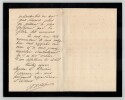
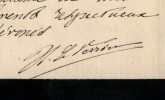
Urbain Le Verrier - Lettre autographe signée à Monsieur Risler
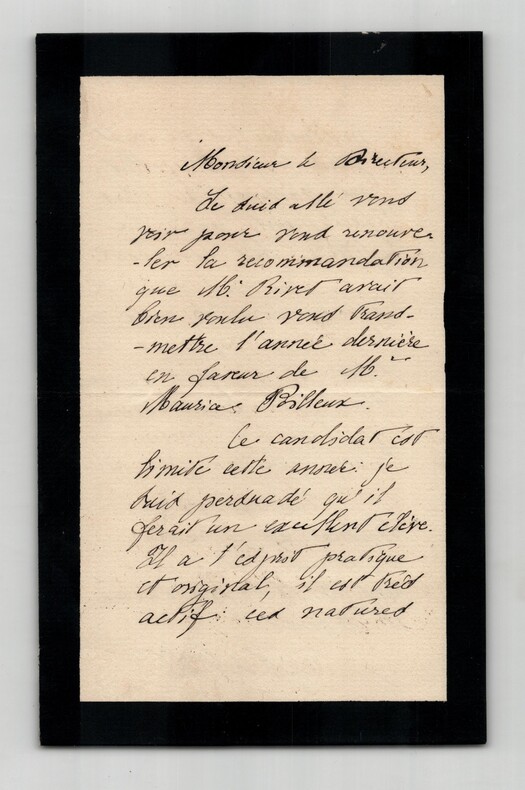
Urbain Le Verrier. Lettre autographe signée à Monsieur Risler Astronome, mathématicien français spécialisé en mécanique céleste et fondateur de la météorologie moderne française Lettre autographe signée d'Urbain Le Verrier, adressée à Monsieur Risler, non datée. Rédigée à l'encre noire sur un double feuillet de papier vergé à liseré de deuil de 1 cm. Dimensions : 11,3 x 17,9 cm État : Traces d'onglets au dos de la lettre. Nombre de pages : 2 pages Urbain Le Verrier Urbain Le Verrier, né à Saint-Lô le 11 mars 1811, mort à Paris le 23 septembre 1877, est un astronome, mathématicien français spécialisé en mécanique céleste et fondateur de la météorologie moderne française. Il est mondialement connu pour avoir découvert la planète Neptune par le calcul le 23 septembre 1846.
"LE VERRIER, URBAIN JEAN JOSEPH. - PREDICTING THE EXISTENCE OF THE PLANET NEPTUN.
Reference : 46890
(1846)
Paris, Bachelier, 1846. 4to. No wrappers. In: ""Comptes rendus hebdomadaires des séances de l’Académie des sciences"", Vol. 23, No 9 (entire issue offered). With htitle and titlepage to vol. 23. Pp. 425-484. Le Verrier's paper: pp. 428-438.
First printing of this important paper in the history of astronomy in which Le Verrier predicted the existence of a new planet, determining its orbit and the mass as well as its actual position, so that, by informing Dr. Galle the following month, where he should look for it in the sky. The same evning when Galle had received the letter, he found close to the position given by Le Verrier a strange body showing a small planetary disc, which was soon recognized as a new planet, known now as Neptune. Adams in England, independently made the same prediction.""Until 1846 there was no theory of Uranus that permitted its movements to be represented satisfactorily. In 1821 Bouvard had constructed tables that, abandoning the older positions, adhered very closely to recent observations. Yet twenty years later a discrepancy of two minutes had already been observed, and several astronomers suggested that it might result from the attraction of an unknown planet. In 1845 Arago presented the problem to Le Verrier, who began by establishing a precise theory of Uranus. He then demonstrated that its observed perturbations could not be explained as the effect of the actions of Jupiter and Saturn, whatever modifications might eventually be made in the values assigned to the masses of those planets. He began to search for signs of an unknown disturbing planet. Finally, in a third memoir on the subject, appearing on 31 August 1846, Le Verrier fixed the exact position of the unknown planet and gave its apparent diameter.""(DSB)
[Invitation à l’inauguration de la statue de Le Verrier]. Pièce imprimée, complétée à la main
S.l.n.d. [Paris, 1889] in-16 oblong sur papier fort
« Le Président du Comité de la Souscription Internationale et le Directeur de l’Observatoire ont l’honneur de prier Monsieur Henri Becquerel de vouloir bien assister à l’Inauguration de la Statue de U.J.J. Le Verrier, qui aura lieu à l’Observatoire de Paris, le Jeudi 27 juin, à 3 heures… ». Célèbre astronome, Urbain La Verrier (1811-1877) est connu pour avoir découvert, en 1846, la planète Neptune. Membre de l’Académie des sciences, il fut directeur de l’Observatoire de Paris de 1854 à 1870, puis de 1873 à sa mort. Il eut pour successeur le contre-amiral Ernest Mouchez (1821-1892), qui fut à l’origine de la réalisation de la carte photographique du ciel.Le destinataire de l’invitation, le physicien Henri Becquerel (1852-1908), découvrit la radioactivité en 1896 après avoir étudié les rayonnements émis par les sels d’uranium. En 1903, il obtint le prix Nobel de physique, partagé avec Pierre et Marie Curie. Réalisée en marbre par le sculpteur Chapu, la statue de Le Verrier fut inaugurée le 27 juin 1889. Située dans la cour d’honneur de l’Observatoire, elle représente l’astronome debout, s’appuyant sur une sphère céleste.Précieux et rare document

Mémoire sur la planète Neptune.
Paris, Bachelier, 1848.
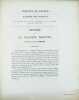
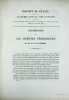
Tiré à part des Comptes rendus des séances de l'Académie des Sciences', tome XVII, séance du 2 octobre 1848. On joint 9 tirés à part des communications de Le Verrier à l'Académie des Sciences et un de Mouchez : - Recherches sur les comètes périodiques. ... , tome XXV, séance du 25 octobre, 1847. 11 pp. - Recherches sur les comètes périodiques. ..., tome XXV, séance du 20 décembre, 1847. 9 pp. - Nouvelle détermination de la différence de longitude entre les observatoires de Paris et de Greenwich. ..., tome XXXIX, séance du 25 septembre 1854. 14 pp. - Théorie et tables du mouvement de Vénus. ..., tome LI, séance du 26 novembre 1860. 7 pp. - Réponse de M. Le Verrier à M. Delaunay. [sur une modifications de nombres de la Théorie de Vénus et de la Terre.] ..., tome LI, séance du 26 novembre 1860. 4 pp. - Réponse de M. Le Verrier aux critiques [de Delaunay] dirigées à tort contre quelques-uns des derniers chiffres, des derniers coefficients des dernières séries dont dépendent les actions réciproques de Vénus et de la Terre. ..., tome LI, séance du 19 novembre 1860. 7 pp. - Travaux en voie d'exécution à l'Observatoire. ...tome LXXXX, séance du 28 juin 1875. 6 pp. - Eclipse totale du Soleil le 18 août 1868. ... tome LXVI, séance du 3 février 1868. 7 pp. - Exposé des opérations entreprises par l'Observatoire ... pour la détermination astronomique des longitudes et latitudes des points principaux du réseau géodésique français. ...tome LVI, séance du 5 janvier 1863. 20 pp. On joint : Catalogue [des étoiles] de l'Observatoire de Paris. Note de M. Mouchez. ...tome CV, séance du 17 octobre 1887. 4 pp. /// In-4 de Brochés, sans couverture. //// 10 off-prints by Le Verrier and one by Mouchez.
Lettre autographe signée
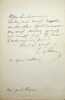
Urbain Le Verrier (1811-1877), astronome, mathématicien. L.A.S., sd, 1p in-8. Peut-être à Eugène de Rozière (1820-1896), Le Verrier n'indiquant que « Mr de la Rozières » ou « Rozeries ». « Mon cher camarade, Laissez-moi vous rappeler un peu plus régulièrement que vous m'avez promis vos mardis soirs. Il faut se retrouver un peu. Tout à Vous. Le Verrier ». [427]
Le Verrier et son temps. Catalogue d'exposition du 18 au 27 octobre 1946.
Paris, éd. Observation de Paris, imprimeur Gauthier-Villars, 15 octobre 1946, EDITION ORIGINALE, aucune réédition postérieure, gd. in-8, cartonnage souple, couv. ill. en noir et texte en noir et rouge sur fond blanc éd., VII - 75 - (5) pp., ill. de 6 planches de lettres et textes manuscrits de l'auteur hors-texte, portrait de Le Verrier en frontispice, "la découverte de Neptune à travers les journaux et les périodiques contemporaains", Urbain Le Verrier (1811 - 1877) fut astronome et mathématicien français, spécialiste en mécanique céleste, fondateur de la météorologie moderne française et "inventeur" de la planète Neptune en 1846. Il fut élu à l'Académie des Sciences pour ses travaux sur la stabilité du système solaire. RARE Très bon état
L'Observatoire impérial de Paris, sa situation et son avenir
[Paris Gauthier-Villars 1868] in-4 de 40 pp. avec simple titre de départ br., couv. bleue impr., un peu effrangée, petites fentes au dos
Rare extrait des "Comptes rendus des séances de l'Académie des Sciences", tome LXV, séance du 23 décembre 1867.Rapport rédigé pendant une période cruciale de l'administration de l'Observatoire et de la carrière de l'astronome Le Verrier [1811-1877] dont la gestion, vivement contestée, devait prendre fin, une première fois, en 1870. Nommé à nouveau à la tête de l'Observatoire en 1873, il devait conserver ce poste jusqu'à sa mort.Le Verrier, un des fondateurs de la météorologie moderne, dirigeait l'Observatoire depuis 1854 ; il avait succédé à Arago. Lors de son retour en 1873, après la mort de son successeur et ennemi Charles-Eugène Delaunay, il se fit assister par un étudiant, J.B. Gaillot, qui compléta les théories de Jupiter et de Saturne, sujets que Le Verrier n'avait pu traiter entièrement. Cf. D.S.B., VIII, 276-279
Des déformations ethniques du crâne, chez les Caraïbes. (Extrait de la Tribune médicale.)
Paris, Imp. V. Goupy et Jourdan, [1890], in-8, 11 pp, 6 fig, broché,sous couverture d'attente, Opuscule daté du 17 avril 1890, consacré aux déformations du crâne observés Par Eugène Verrier (1824-1910), membre de la Société d'anthropologie de Paris et président honoraire de la Société africaine, est autrement connu en tant que membre fondateur de la Société de gynécologie de Paris. Ses conférences sur les sociétés africaines étaient très suivies. Les figures représentent 5 crânes étudiés par le Docteur Verrier et un appareil employé à Bornéo. Couverture salie. Couverture rigide
Bon 11 pp., 6 fig.
L'Architecture franºaise des origines á la fin de l'poque romane par Marcel Aubert ... et Jean Verrier
ëditions d'art et d'histoire Broch D'occasion tat correct 01/01/1941 89 pages
"LE VERRIER (LEVERRIER), URBAIN JEAN JOSEPH. - THE EXISTANCE OF NEPTUNE PREDICTED.
Reference : 47206
(1846)
Recherches sur les mouvements d'Uranus. (Séance du Lundi 1er Juin 1846).
Paris, Bachelier, 1846. 4to. No wrappers. In: ""Comptes Rendu hebdomadaires des Séances de l’Académie des Sciences"", Vol. 22, No 22. Pp. (893-) 928. (Entire issue offered). Le Verrier's paper: pp. 907-018.
First appearance of Le Verrier's paper in which he postulated the existance of a new planet on mathematical premises from the gravitational disturbencies of Uranus.""In 1846 John Cauch Adams... and Urban J. Leverrier... simultaneously and independently determined the location of a possible new planet... In 1845 he wrote of his findings of the mathematical location of a new planet to Sir George Bidell Airy,,, Because Adams was unknown, his letter was put aside. Meanwhile the same perturbations of Uranus had become of interest to Leverrier. On July 1(should be June !), 1846 he presented a paper ""Recherches sur les mouvements d'Uranus"" (the paper offered) to the Academie des Sciences inParis. When Airy realized that Leverrier and Adams had reached the same conclusions, he hastened to suggest that a search be made for the newplanert. Shortly hereafter it was seen bur not recognized. About a week before it was found in England, it was discovered by Galle in Berlin on information supplied by Leverrier. Thus, the honour of the discovery, or even co-discovery of the new planet, Neptune, was lost to Adams and credited to Leverrier.... Adams paper was reade before the Royal Astronomical Society, November 13, 1846, and was published in 1847. (Milestones p. 40).Milestones of Science No 132. - Dibner No. 16.
"LE VERRIER, URBAIN JEAN JOSEPH. - THE FIRST STEPS TOWARDS DISCOVERING NEPTUNE.
Reference : 48802
(1845)
Premier Mémoire sur la théorie d'Uranus.
(Paris, Bachelier), 1845. 4to. No wrappers. In: ""Comptes rendus hebdomadaires des séances de l’Académie des sciences"", Vol. 21, No 19. Pp. (1009-) 1082 (entire issue offered). With titlepage to vol. 21. Le Verrier's paper: pp. 1050-1055. Stamp to top of titlepage.
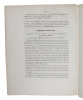
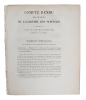
First appearance of Le Verrier's first paper on the anomalities in the orbit of Uranus, the calculations on which eventually leading to his prediction and discovery of a new planet, Neptune the following year, 1846.
"LE VERRIER (LEVERRIER), URBAIN JEAN JOSEPH. - PREPARING FOR, PREDICTING AND CONFIRMING THE EXISTENCE OF NEPTUNE.
Reference : 49635
(1845)
Premier Mémoire sur la théorie d'Uranus. (Séance 10 Novembre 1845). (+) Recherches sur les mouvements d'Uranus. (Séance du Lundi 1er Juin 1846). (+) Sur la planète qui produit les anomalies observées dans le mouvement d'Uranus. Détermination de ...
Paris, Bachelier, 1845 a. 1846. 4to. No wrappers. In: ""Comptes rendus hebdomadaires des séances de l’Académie des sciences"", Vol. 21, No 19, Vol. 22, No 22, Vol. 23, Nos 9, 14, 16 a. 17. (6 entire issues offered). Le verrier's papers: pp. 1050-1055 (No 19), pp. 907-919 (no 22), pp. 428-438 (No 9), pp. 657-659, 659-643, 676 (No 14), pp. 741, 741-754, 754 (No 16), pp. 798-799, 799-800 (No 17). With title-pages to vol. 21,22 a. 23. Titlepages with a small stamp in upper corner and a perforated stamp to lower margin. Light yellowing to title-pages, otherwise clean and fine on good paper.
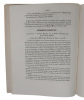
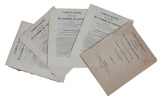
First printing of Le Verrier's importent and famous papers, predicting and confirming the discovery of the Planet Neptune, including the ""preparatory"" paper, the first paper on the anomalities in the orbit of Uranus, the calculations on which eventually leading to his prediction and discovery of a new planet, Neptune the following year, 1846.""In 1846 John Cauch Adams... and Urban J. Leverrier... simultaneously and independently determined the location of a possible new planet... In 1845 he wrote of his findings of the mathematical location of a new planet to Sir George Bidell Airy,,, Because Adams was unknown, his letter was put aside. Meanwhile the same perturbations of Uranus had become of interest to Leverrier. On July 1(should be June !), 1846 he presented a paper ""Recherches sur les mouvements d'Uranus"" to the Academie des Sciences inParis. When Airy realized that Leverrier and Adams had reached the same conclusions, he hastened to suggest that a search be made for the newplanert. Shortly hereafter it was seen bur not recognized. About a week before it was found in England, it was discovered by Galle in Berlin on information supplied by Leverrier. Thus, the honour of the discovery, or even co-discovery of the new planet, Neptune, was lost to Adams and credited to Leverrier.... Adams paper was reade before the Royal Astronomical Society, November 13, 1846, and was published in 1847. (Milestones p. 40).Milestones of Science No 132. - Dibner No. 16.
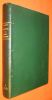
Contes de Basse-Bretagne.
Paris, Editions Erasme, 1955, in-8 de 222 pages, reliure plein skyvertex, titre et filets dorés sur dos lisse, couverture et illustrations de Claude Verrier. 1ère de couverture de l'édition brochée conservée. Corps frais, reliure solide et en bon état, 1 tampon en tête de la 1ère page de garde. C700g. Bel exemplaire.

Tous nos ouvrages sont collationnés et complets, sauf mention particulière.
[ Société du Mercure de France] - QUERLON, Pierre de ; VERRIER, Charles
Reference : 61346
(1904)
Les Amours de Leucippe et de Clitophon. Roman d'aventures d'après Achille Tatius [ Livre dédicacé par les auteurs ]
1 vol. in-12 reliure de l'époque bradel demi-percaline verte, Société du Mercure de France, Paris, 1904, 217 pp.
![Les Amours de Leucippe et de Clitophon. Roman d'aventures d'après Achille Tatius [ Livre dédicacé par les auteurs ]. QUERLON, Pierre de ; VERRIER, ...](https://static.livre-rare-book.com/pictures/CDL/61346_thumb.jpg)
![Les Amours de Leucippe et de Clitophon. Roman d'aventures d'après Achille Tatius [ Livre dédicacé par les auteurs ]. QUERLON, Pierre de ; VERRIER, ...](https://static.livre-rare-book.com/pictures/CDL/61346_2_thumb.jpg)
![Les Amours de Leucippe et de Clitophon. Roman d'aventures d'après Achille Tatius [ Livre dédicacé par les auteurs ]. QUERLON, Pierre de ; VERRIER, ...](https://static.livre-rare-book.com/pictures/CDL/61346_3_thumb.jpg)
Envoi des deux auteurs, "à Gustave Binet Valmer, son ami qui voudrait bien le voir", signé Querlon, et "Hommage de Charles Verrier". Bon état.
Jean Chaudeurge (1908-1968), graveur, peintre verrier, second prix de Rome 1936 en gravure.
Reference : 018902
Lettre autographe signée au peintre Paul-Adrien Bouroux
Jean Chaudeurge (1908-1968), graveur, peintre verrier, second prix de Rome 1936 en gravure. L.A.S., vendredi 25 février 1949, 1p in-12. Au peintre Paul-Adrien Bouroux (1878-1967). Il a fait tirer trois planches par « maître Quesneville » i.e. Camille Quesneville (1901-1971) mais une seule lui « paraît mûre pour ce 1er état ». Il demande donc une « visite immédiate » pour « reprendre et améliorer » ces planches suivant les souhaits de Bouroux. Le côté illustré de la carte postale a des petits dessins de Chaudeurge en plus. Peu commun. [440]
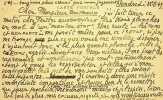

Jean Chaudeurge (1908-1968), graveur, peintre verrier, second prix de Rome 1936 en gravure.
Reference : 018903
Lettre autographe signée au peintre Paul-Adrien Bouroux
Jean Chaudeurge (1908-1968), graveur, peintre verrier, second prix de Rome 1936 en gravure. L.A.S. avec dessin + enveloppe, mardi 24 janvier 1950, 1p in-4. Au peintre Paul-Adrien Bouroux (1878-1967). Il est en retard sur son travail pour les Petites villes de France. Belle signature avec un petit dessin : un escargot surmonté d'une croix. Peu commun. [440]
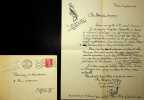
Jean Chaudeurge (1908-1968), graveur, peintre verrier, second prix de Rome 1936 en gravure.
Reference : 018904
Lettre autographe signée au peintre Paul-Adrien Bouroux
Jean Chaudeurge (1908-1968), graveur, peintre verrier, second prix de Rome 1936 en gravure. L.A.S. avec dessin, Paris, 4 octobre 1948, 4p in-8. Au peintre Paul-Adrien Bouroux (1878-1967). Petit dessin en tête de la première page. Belle lettre après la mort de son frère, il a eu du mal à terminer deux vitraux pour le salon d'automne, souhaite avoir ses impressions, mentionne le projet des Petites villes de France dont le tome III est en cours. Peu commun. [441]
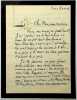
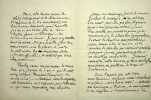
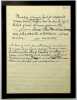
Jean Chaudeurge (1908-1968), graveur, peintre verrier, second prix de Rome 1936 en gravure.
Reference : 018905
Lettre autographe signée au peintre Paul-Adrien Bouroux
Jean Chaudeurge (1908-1968), graveur, peintre verrier, second prix de Rome 1936 en gravure. L.A.S. avec dessin, Paris, 5 septembre 1949, 2p in-4. Au peintre Paul-Adrien Bouroux (1878-1967). En raison de sa santé, son travail pour les Petites villes de France (il s'occupe d'illustrer Thouars) n'est pas fini. Il promet d'accélérer son travail. Il précise qu'à l'avenir, il démissionnera pour lui éviter ce type de problème. Peu commun. [441]
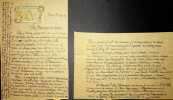
Jean Chaudeurge (1908-1968), graveur, peintre verrier, second prix de Rome 1936 en gravure.
Reference : 018908
Lettre autographe signée au peintre Paul-Adrien Bouroux
Jean Chaudeurge (1908-1968), graveur, peintre verrier, second prix de Rome 1936 en gravure. L.A.S., mercredi 26 octobre 1949, 1p in-4. Au peintre Paul-Adrien Bouroux (1878-1967). Camille Quesneville va tirer un « état quintuple » d'une gravure « de notre pauvre et chère petite ville » pour une inauguration. Il viendra le voir le samedi avec les épreuves. Peu commun. [441]
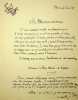
Théorie du mouvement de Mercure
Paris, Bachelier, imprimeur-libraire, 1845, in-8, 165 pp, Broché, couverture bleue imprimée, Par le découvreur de la planète Neptune. Dés 1837, Le Verrier (1811-1877) travailla sur la stabilité du système solaire, sur les problèmes généraux de mécanique céleste et sur les perturbations des axes principaux des orbites des planètes. En 1839 et 1840, il parvient à préciser les excentricités et inclinations de sept planètes, développant ainsi des méthodes inédites et une théorie sans précédent des perturbations orbitales. Il se tourna ensuite vers l'étude théorique de Mercure, dont les tables existantes ne correspondaient pas bien aux observations, puis vers l'identification des comètes périodiques. Ses avancées dans la théorie analytique des perturbations furent reconnues par l'Académie des sciences ; il en devint membre en janvier 1846, alors qu'il était engagé dans les travaux qui le menèrent à la découverte de Neptune. Étiquettes et tampons de l'Institut catholique de Paris. Dos restauré. Petites rousseurs couverture et gardes empoussiérées. DSB IX, p. 277.0 Couverture rigide
Bon 165 pp.

