 Write to the booksellers
6 books for « lauremberg p »Edit
-
Century
17th (4)
19th (1)
-
Topics
Denmark (2)
Literature (1)
Scandinavian literature (1)
Teaching (2)
-
Countries
Denmark (4)
Netherlands (1)
Switzerland (1)
Het hernieuwde en verbeterde Acerra Philologica van P. Lauremberg. Dat is: zes honderd nutte en gedenkwaardige geschiedenissen, als ook zeer vermakelyke reden-kavelingen. Tot nut der lees-gierige jeugd, en een noodzakelyk onderwys tot bevordering der geleerdheid. Uit de beroemste zo Grieksche als Latynsche geschigtschryvers by een gesteld, en nu in beter order geschikt en uitgegeven door Joh. Hajenius S.S. Th.C.
Amsterdam, By Nicolaas ten Hoorn, 1701.
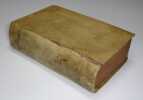
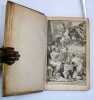
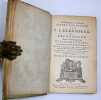
8vo. (XII),778 (recte 772),(28) p. Contemporary vellum 18 cm (Ref: STCN ppn 180126784; cf. Graesse 4,122) (Details: A frontispiece, designed by I. Goeree and executed by C. Huibertz, depicting some mythological figures. Woodcut printer's mark on the title, depicting a pedestal loaded with all kinds of symbols of the arts and sciences) (Condition: Vellum soiled, front joint partly split. Paper yellowing) (Note: 'Medieval education drew heavily from classical authors, for pagan learning was necessary for understanding the Scripture. The focus often was on memorizing sententiae and offering exempla and anecdotes that exemplified virtues.' (The Classical Tradition, Cambr. Mass. 2010, p. 294) Formal education in the classical tradition unfolded in the 16th/18th century 'on three levels. Instruction began in the elementary school, where boys at the age of 6 or 7 began to study reading, writing, arithmetic, and basic Christian doctrine. Latin was supposed to predominate, although the vernacular regularly crept in. Students remained here for 3 or 4 years, after which most quit to become servants, day laborers, or agricultural workers. The others went to the secondary school, whose curriculum was based on Latin grammar and the humanistic doctrines, (...) With this Latin base, students could proceed to a university'. (Op. cit. 295/95) A widely read and popular schoolbook for the secondary school in Germany and The Netherlands of that period was this 'Acerra Philologica'. An 'acerra' is an incense box, and this 'treasure box' contained a great variety of useful, funny, memorable and moralizing stories from ancient authorities. The German scholar Petrus Lauremberg is the excerptor of this encyclopedic collection of morally educating short stories. Peter Lauremberg, born in 1585, was since 1614 'Professor der Physik und Mathematik' at the newly established academic Gymnasium at Hamburg. In 1624 he went to Rostock to lecture as 'Professor der Poesie'. He died there in 1639. He wrote a great number of small works on medicin, mathematics, astronomy, but also on music, and rhetoric. (Allgemeine Deutsche Biographie 18,59) His 'Acerra Philologica' was first published in Rostock in 1635, and it started with 200 stories. It was a great commercial and educational success, for dozens of editions appeared until deep into the 18th century. The work gradually was expanded to 300 (1640), 400 (1646), 500 (1658), 600 (1658), and finally 700 (1688). The 'Acerra' was translated into Dutch in the 17th century by J.L. Blasius, and published in 1661 & 1682. In 1701 the Rector of the 'Schola Latina' at Nijmegen, Johannes Hajenius published a new, augmented and revised Dutch translation. It was repeated in 1717, 1734 and 1756. The 'exempla' and 'anecdotes' are concluded by 'Sententiae', where Hajenius packages the morale in a few catchy, sometimes rhyming, phrases. In the preface Hajenius does not use the metaphor of the incense box, he rather wants to present a tasty and appetizing meal, from which every one could take what he fancied. Hajenius published the collection not only for schoolboys, he says, but also for the illiterate, i.e. those who cannot read Latin. In this way they could learn in one hour a day, what a student learned on the university in many a year. Without knowledge of literature and history one could be considered to be an educated person. (p. *1 recto & verso of the preface) So the aim of this collections was also to spread a body of classical thought among the less educated, those who didnot visit or finish the 'Schola Latina'. Hajenius also inserted a chapter on tabacco. (No. 72) This is a funny chapter for more than one reason. It is not only anchronistic, but every educated Dutchman of a certain age associates the name Hajenius with the famous tobacco shop of P.G.C. Hajenius, 'the old master' of Dutch cigar stores since 1826. Since 1914, the store has been housed in a fine Art Déco building on the Amsterdam Rokin) (Collation: *6 (irregularly signed), A-3D8 (some irregular pagination)) (Photographs on request)
"LAUREMBERG, JOANNE (HANS WILLUMSEN). - TEACHING MATHEMATICS IN DENMARK.
Reference : 56014
(1634)
Lusus et Recreationes ex Fundamentis Arithmeticis depromptæ.
Hafniæ (Copenhagen), Melchior Martzan, 1634. Lille 8vo. Lidt senere hldrbd. Let rygforgyldning. Rester af titeletiket. Ryg lidt slidt. (4),54,(2) pp., 1 kobberstukket planche. De første blade løse. Mangler blad A8 (Pp. 11-12).
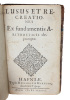
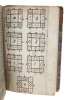
Originaludgaven af en af de allerførste lærebøger udgivet i Danmark vedrørende læren om de hele tal og regnearterne i matematikken. Bogen var tiltænkt som lærebog i elementær aritmetik for de studerende på Christian den IV's Akademi i Sorø og indøvelsen skete ved hjælp af en række opgaver som stilles i bogen. Lauremberg (1590-1658) var både mathematiker, filolog og digter. Han blev af Chr. IV indkaldt til professoratet i matematik ved det adelige Akademi i Sorø, hvor han forlod sin stilling i Rostock som det Filosofiske Fakultets dekan. I Sorø virkede han som professor i matematik og ingeniørvidenskab fra 1623 til sin død i 1658. Han var en ikke ubetydelig matematiker og foregangsmand, særlig kendt er han for sin indførelse af logaritmerne i Danmark. Det er oså velkendt, at Chr. IV havde udset Lauremberg til at udføre det første danske kartografiske værk ved opmåling af landet. Hans virksomhed som korttegner var allerede begyndt i Mecklenburg og det ses, at han i en del år var optaget af denne virksomhed i Danmark. Kortværket blev imidlertid aldrig til noget til kongens store fortrydelse. Herefter overtog Johannes Meyer kortlægningen. Lauremberg er yderligere kendt som en af tidens mest fremragende latinske poeter, således indeholder hans ""Satyra"" fra 1636 spirene til de senere plattyske ""Skjæmtedigte"".The very scarce first edition of one of the first elementary textbooks in arithmetics published in Denmark. The work should be used teaching mathematcs at the University in Sorø founded by the king Chr. IV in 1623.Bibl. Danica II,18. - Niels Nielsen. Matematikken i Danmark 1528-1800, p. 127 No. 3.

LAUREMBERG, JOANNE (HANS WILLUMSEN). - TEACHING MATHEMATICS IN DENMARK.
Reference : 48600
(1640)
Ocium Soranum, sive Epigrammata, Continentia varias Historias, & res scitu jucundas, ex Graecis Latinisq" Scriptoribus depromptas, & exercitationibus ARITHMETICIS accomodatas, à Joanne Laurenbergio, In Regiâ Academiâ Sorana Mathematcum Interprete.
Hafniae, Joachim Moltken, 1640. 4to. Contemp. full calf. Gil t spine. Wear to top of spine. Blindtooled lineborder on covers. Some wear to spine, corners and along edges. Engraved bookmark on inside frontcover ""North Library... (1860"". (8),111,(1) pp. and 1 engraved plate with 6 illustrations. A bit of browning to one quire. A few annotations in a contemporary hand. Otherwise internally clean.
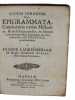
Originaludgaven af en af de allerførste lærebøger udgivet i Danmark vedrørende læren om de hele tal i mathematikken. Bogen var tiltænkt som lærebog i aritmetik for de studerende på Christian den IV's Akademi i Sorø. Bogen er på latin og indeholder 61 opgaver, som han indpakker - for at være pædagogisk og fastholde studenternes interesse - i latinske hexametre med historisk, mytologisk og anekdotisk indhold. De her indeholdte historier giver L. anledning til at fremsætte opgaver som studenterne skulle løse aritmetisk. I forordet fortæller han selv, at han har bestræbt sig på at gøre sin matematik smagelig for den adelige ungdom ved praktiske opgaver og ved anekdoterLauremberg (1590-1658) var både mathematiker, filolog og digter. Han blev af Chr. IV indkaldt til professoratet i matematik ved det adelige Akademi i Sorø, hvor han forlod sin stilling i Rostock som det Filosofiske Fakultets dekan. I Sorø virkede han som professor i matematik og ingeniørvidenskab fra 1623 til sin død i 1658. Han var en ikke ubetydelig matematiker og foregangsmand, særlig kendt er han for sin indførelse af logaritmerne i Danmark. Det er oså velkendt, at Chr. IV havde udset Lauremberg til at udføre det første danske kartografiske værk ved opmåling af landet. Hans virksomhed som korttegner var allerede begyndt i Mecklenburg og det ses, at han i en del år var optaget af denne virksomhed i Danmark. Kortværket blev imidlertid aldrig til noget til kongens store fortrydelse. Herefter overtog Johannes Meyer kortlægningen. Lauremberg er yderligere kendt som en af tidens mest fremragende latinske poeter, således indeholder hans ""Satyra"" fra 1636 spirene til de senere plattyske ""Skjæmtedigte"".The very scarce first edition of one of the first textbooks in number theory published in Denmark The work should be used teaching mathematcs at the University in Sorø founded by the king Chr. IV in 1623. In 61 cases, using latin epigrams of historical and mythological content, he proposed 61 mathematical problems to be solved, thus introducing pedagogical means in the teaching of mathemtics in Denmark.Bibl. Danica Supplement spalte 195. - Niels Nielsen. Matematikken i Danmark 1528-1800, p. 127 No. 5.
Acerra Philologica. Det er: Tre Hundrede udlæste, nyttelige, lystige oc tænckværdige Historier oc Discurser, Tilsammenbracte aff de berømteste Grædske oc Latinske Scribentere. Huor vdi Indholdis Poeternis fleeste Dicter, de gamle Romeris oc Grækers fo...
Kiøbenhaffn, Salomon Sartor og Jørgen Holst, 1639. Lille 8vo. Noget senere hldrbd. Ryg med stregforgyldninger. Forgyldt rygtitel. Noget slid langs kanter.Titelbladet trykt i rød/sort. (16),208,86),214,(10),192,(8) pp. Sidste blad i faksimile (=sidste side af register til 3. afdeling). Indvendig med brugsspor og spredte pletter.
Første danske oversættelse. Originalen udkom første gang i Rostock 1633 med 200 historier. Peter Lauremberg var broder til den kendte professor i matematik i Sorø Hans Lauremberg. Han blev i 1624 professor i poesi og medicin ved Rostock universitetet og her blev han rektor i 1635. Han forblev i Rostock til sin død i 1639.Bibl. Danica II,464.
Hellas seu Graecia Universa. Autore J. Laurenbergio.
Amsterdam, Janson (?). (Ca. 1650 47x57 cm. Kupferstichkarte mit gestochener Titelkartusche unten links, Massstabskartusche unten rechts. Mit Grenzkolorit und kolorierten Kartouchen. auf altes Papier aufgezogen. Mit Mittelfalz.
Sammlung Ryhnier 6507 16. - Seltene Karte von Griechenland, der Aegäis und der türkischen Westküste die auch im "Atlas major" von Janson gedruckt wurde, jedoch in kleinerem Format (55 x 45 cm). - Mit 2 kleinen Einrissen auf dem Unterlagenpapier ausserhalb der Darstellung. Ursprünglich bis an den Plattenrand beschnitten.
Fire Skjæmtedigte i Dansk Oversættelse fra 1652. Mede Indledning og Noter udgivne af J. Paludan.
Kjøbenhavn, Thiele, 1889. Lex8vo. Samtidigt hldrbd. med rygforgyldning og skindtitel. LVII,136 pp. Indvendig ren.

