 Write to the booksellers
2956 books for « lambert j m »Edit
-
Type
Autograph (3)
Book (2929)
Magazine (18)
Music sheets (48)
New book (1)
Old papers (1)
Photographs (3)
Posters (1)
-
Latest
Last 24h (2)
Last 3 days (3)
Last month (19)
Last week (4)
-
Language
Dutch (3)
English (2)
French (2998)
Italian (1)
-
Century
17th (3)
18th (80)
19th (169)
20th (1300)
21st (279)
-
Countries
Belgium (211)
Brazil (1)
Canada (20)
China (1)
Côte d'Ivoire (10)
Denmark (28)
France (2539)
Germany (11)
Greece (1)
Netherlands (1)
Switzerland (180)
United Kingdom (1)
-
Syndicate
ALAC (20)
CLAM (8)
CLAQ (1)
CNE (3)
ILAB (1322)
NVVA (19)
SLACES (19)
SLAM (1237)
SNCAO (30)
Topics
- Adam (32)
- Archaeology (25)
- Architecture (29)
- Army (10)
- Autographs (43)
- Belgium (22)
- Bibliography (13)
- Biography (21)
- Brittany (20)
- Brussels (14)
- Catholicism (11)
- Children’s books (54)
- China (15)
- Christianity (17)
- Collaboration (16)
- Comic strip (18)
- Cooking (34)
- Culinary art (13)
- Dedication (26)
- Early printed books (17)
- Economics (19)
- Education (27)
- Education - morals (17)
- Egypt (11)
- Ethnology (13)
- Fine arts (40)
- First edition (27)
- Fishing (11)
- Genealogy (10)
- Geography (17)
- Geology (10)
- Hackney (10)
- Helvética (12)
- History (126)
- Lambert alain (13)
- Lambert andré (29)
- Lambert bernard (17)
- Lambert christophe (40)
- Lambert david (13)
- Lambert elie (31)
- Lambert fernand (19)
- Lambert gilles (30)
- Lambert gustave (10)
- Lambert jacques (13)
- Lambert jean (44)
- Lambert jean-clarence (36)
- Lambert lucien (10)
- Lambert marc (27)
- Lambert michel (11)
- Lambert paul (16)
- Law (23)
- Linguistics (10)
- Literature (198)
- Magazine (30)
- Manuscripts (15)
- Medicine (22)
- Motor vehicle (10)
- Mountaineering climbing (15)
- Music (10)
- Navy (11)
- Newspapers press (55)
- Painters (13)
- Painting (19)
- Paris (30)
- Philosophy (23)
- Photography (13)
- Poetry (57)
- Policy (14)
- Provence (27)
- Psychology (12)
- Reading vocabulary (17)
- Regionalism (21)
- Religions (34)
- Review (35)
- Reviews (36)
- Saint lambert (97)
- Sciences (17)
- Sciences & technique (10)
- Scores (59)
- Sociology (12)
- Songs (48)
- Sports (11)
- Swerts lambert (15)
- Switzerland (17)
- Tales (13)
- Tea (11)
- Teaching (14)
- Theatre (30)
- Theology (14)
- Travel (21)
- Various (18)
- Wallonia (11)
- War (29)
- Women (the) (24)
- Youth (15)
Gravure de Gilbert d'après Lambert : A boire !
Imprimerie Chardon-Wittmann Gravure "Gravure XIXe en noir (13,3 x 17,3 cm sur support 22 x 31 cm) gravée par Gilbert, d'après L.E. Lambert, intitulée ""A boire !"" ; quelques légères rousseurs dans la marge, par ailleurs très bon état. Livraison a domicile (La Poste) ou en Mondial Relay sur simple demande."


Roulière-Lambert Marie-Jeanne, Cohën Anne-Sophie de, Lambert Rachel, Vuillemey Marcel
Reference : lu2388
Préhistoire dans le Jura - Les Grottes de Gigny et d'Arlay
Cercle Girardot Broché In-8 broché, 24x20 cm., 63 pages, sans date (circa 1990), importante iconographie ; couverture à peine frottée, un tampon sur la page de titre, très bon état. Livraison a domicile (La Poste) ou en Mondial Relay sur simple demande.
ETUDES MEDIEVALES.
Toulouse, Privat - Didier, 1956-1957 4 vol. petit in-4 brochés, XIX-271+ 297+ 310 + 73-IXpp, dont 64 ill. photogr. et 8 plans), 77 fig. in-texte, biblio des oeuvres de E. Lambert.
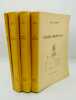
TI. Histoire de l'art et histoire - TII. Le Sud-Ouest français. - III. La Péninsule ibérique. - IV. Planches et tables. Bonne condition. - Frais de port : -France 7,15 € -U.E. 9 € -Monde (z B : 14 €) (z C : 24 €)
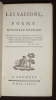
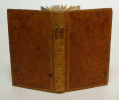
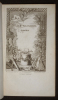
Les Saisons, poëme
A Londres Relié 1782 In-12 (8 x 12,7 cm), reliure pleine peau, dos lisse orné de fleurs dorées, tranches dorées, gardes couleur, xxj-187 pages, sans mention d'auteur (Saint-Lambert) ni d'éditeur ; petit manque dans le coin supérieur de la première garde, par ailleurs bel état. Livraison a domicile (La Poste) ou en Mondial Relay sur simple demande.
Contes de Saint-Lambert
Jouaust librairie des bibliophiles Les chefs d'oeuvre inconnus Broché 1883 In-12 (11x18 cm), broché, (XI)-74 pages, tirage à petit nombre, une eau-forte par Ad. Lalauze, préface du bibliophile Jacob, bandeaux, lettrines et culs-de-lampe ; légères pliures au dos, coiffes légèrement frottées, plats un peu salis, très bel état. Livraison a domicile (La Poste) ou en Mondial Relay sur simple demande.
Allemagne 1938 (Reportage)
Oran, Imprimerie F. Plaza Broché 1938 In-8 broché, (14.5 * 23 cm), 169 pages, rare témoignage publié à Oran en 1938 après un séjour en Allemagne qui dura deux mois, février et mars. L'auteur Abbé Gabriel Lambert était Maire d'Oran, dernier cahier non coupé ; bords supérieurs et inférieurs de la couverture jauni, bon état. Livraison a domicile (La Poste) ou en Mondial Relay sur simple demande.
Les Saisons, poëme par Saint-Lambert, précédé d'une notice sur sa vie
Henri Servier Relié 1828 In-12 (9 x 13,8 cm), reliure plein veau, dos lisse orné de dorures et d'une pièce de titre, tranches marbrées, gardes couleur, XXXV-212 pages ; quelques légers frottements aux coupes, par ailleurs bon état. Livraison a domicile (La Poste) ou en Mondial Relay sur simple demande.
Champfort,Dorat,Grécourt,La Monnoye,Neufchateau François de,Piron,Saint-Lambert
Reference : zt669
(1862)
Contes et nouvelles en vers, par Grécourt, Saint-Lambert, Champfort, Piron, Dorat, La Monnoye, et François de Neufchateau (Tome 2)
Leclere fils Relié 1862 In-12 (12,3 x 19,6 cm), reliure demi-maroquin vert à coins, dos à 5 nerfs, gardes couleurs, 207 pages, vignettes en noir ; dos bruni, coin inférieur du quatrième plat usé, assez bon état. Livraison a domicile (La Poste) ou en Mondial Relay sur simple demande.
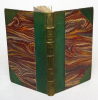
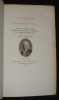
Oeuvres complètes de Madame la Marquise de Lambert, suivies de ses lettres
A Paris, Chez Leopold Collin, Libraire, rue Gît-le-Coeur, n° 4 Relié 1808 In-8 (12,5 x 20 cm), reliure plein veau, dos à 4 nerfs orné de dorures, filet d'encadrement doré et décor à froid aux plats, tranches marbrées, viij-408 pages ; petit manque de cuir au mors supérieur en queue, mouillure au corps d'ouvrage en tête, visible en début et fin de volume, par ailleurs assez bel état. Livraison a domicile (La Poste) ou en Mondial Relay sur simple demande.
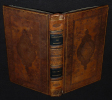
Fraternelle Amazonie
Paris, Robert Laffont, 1964 – Gd in 8°, 299 pp, broché, cartonnage souple illustré de l’éditeur (petits défauts)Illustrations Hors-Texte
Envoi Autographe signé sur le fx-titre: à mon vieux Phi-Phi / qui m’a toujours fait / confiance, en souvenir/ de notre Genève d’Espoir./ Sincèrement / Paul Lambert / Genève le 5-6-64
Observations sur quelques dimensions du monde intellectual.
(Berlin, Haude et Spencer, 1770). 4to. No wrappers, as issued in ""Memoires de l'Academie Royale des Sciences et Belles Lettres"", tome XIX. Pp. 421-438. Very nice and clean.
The rare first printing of one of the few of Lambert's philosophical works that appeared within his life-time. This is one of the three philosophical papers that he published in ""Nova acta Eruditorum"", which are of varying philosophical content.The present work played a significant role in the rediscovery within philosophy of the concept of the ""sublime"", the foundational concept which was so famously treated by Kant in his third Critique (of Judgment). Neither the idea of the beautiful nor of the sublime was novel in the 18th century, as the distinction between the two had already been made in ancient philosophy. However, for several centuries, aesthetics had been dominated by the question of the beautiful, and it was only around Kant's and Lambert's time that the sublime had become a topic of interest again - this time primarily as the sublime in nature. When Lambert thus discusses the sublime in the present article, it is probable that his conception of it can have influenced Kant and his exposition in the ""Critique of Judgment"", which appeared a couple of decades later. ""Kant himself recognized Lambert as a philosopher of the highest qualities"" and he expected much from his critical attitude. He had drafted a dedication of the ""Critique of Pure Reason"" to Lambert, but Lambert's untimely death prevented its inclusion.Lambert's place in the history of philosophy, however, should not be seen only in its relation to Kant. The genesis of his philosophical ideas dates from a time when Kant's major works had yet to be conceived. It was the philosophical doctrines of Leibniz, Christian Wolff, and Locke that exerted the more important influence - insofar as one can speak of influence with a self-taught and wayward man such as Lambert... The two main aspects of Lambert's philosophy, the analytic and the constructive were both strongly shaped by mathematical notions"" hence logic played an important part in his philosophical writing. Following Leibnitz' ideas, Lambert early tried to create and ""ars characteristic conbinatoria"", or a logical or conceptual calculus. He investigated the conditions to which scientific knowledge must be subjected if it is to enjoy the same degree of exactness and evidence as mathematical knowledge..."" (D.S.B. VII:597).
Neues Organon oder Gedanken über die Erforschung und Bezeichnung des Wahren und dessen Unterscheidung vom Irrtum und Schein. 2 Bde. - [COINING ""PHENOMENOLOGY""]
Leipzig, Johann Wendler, 1764. 8vo. Non-uniformely bound. Vol 1: Completely uncut in the original cardboard-binding. Some wear to capitals and hinges. Internally a bit of minor occasional brownspotting. (18), 592 pp. Vol 2: 19th century marbled paper-binding with red gilt title-label to spine. Wear to extremities. Only light occasional brownspotting. (2), 435, (1).
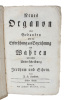
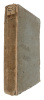
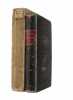
The very rare first edition of Lambert's seminal main philosophical work, the work which coined the term ""phenomenology"". ""Neues Organon"" is a work of breakthrough that came to, directly or indirectly, influence almost all later philosophy, also that of Kant.Today, Johann Heinrich Lambert arguably mostly remembered as one of the greatest mathematicians and logicians of his time. However, a true polymath, he also played a dominant role in the development of 18th century philosophy, primarily with his philosophical magnum opus ""Neues Organon"", in which he set out to provide a better methodology for philosophy, with the aid of mathematics. As such, he is considered a path-breaker of Rationalism and one of the most important predecessors of Kant, who knew him well and admired him greatly"" the two corresponded frequently. ""Kant himself recognized Lambert as a philosopher of the highest qualities"" and he expected much from his critical attitude. He had drafted a dedication of the ""Critique of Pure Reason"" to Lambert, but Lambert's untimely death prevented its inclusion.Lambert's place in the history of philosophy, however, should not be seen only in its relation to Kant. The genesis of his philosophical ideas dates from a time when Kant's major works had yet to be conceived. It was the philosophical doctrines of Leibniz, Christian Wolff, and Locke that exerted the more important influence - insofar as one can speak of influence with a self-taught and wayward man such as Lambert... The two main aspects of Lambert's philosophy, the analytic and the constructive were both strongly shaped by mathematical notions"" hence logic played an important part in his philosophical writing. Following Leibnitz' ideas, Lambert early tried to create an ""ars characteristic conbinatoria"", or a logical or conceptual calculus. He investigated the conditions to which scientific knowledge must be subjected if it is to enjoy the same degree of exactness and evidence as mathematical knowledge... In ""Neues Organon"" he next developed the idea of a characteristic language of symbols to avoid ambiguities of everyday language"" and finally, in the most original part of his work called """"Phänomenologie,"" he discussed appearance and gave rules for distinguishing false (or subjective) appearance from a true (or objective) one that is not susceptible to sensory illusions."" (D.S.B. VII:597).
Cosmologische Briefe über die Einrichtung des Weltbaues. - [PRE-ESTABLISHING THE BASIC FEATURES OF THE UNIVERSE]
Augspurg, Eberhard Kletts Wittib., 1761. Contemporary white-dyed sheepskin. Spine with a bit of surface wear, old hand-written paper-label to spine. XXVIII, 317 pp. A stamp inside front free end-paper. Light browning, scattered marginal brownspots, but in general a fine copy. A few leaves in ""Vorrede"" misbound.
The scarce first edition of Lambert's sensational ""Cosmological Letters"", his most important astronomical work, in which he to a large extent fore-shadowed the documentation of the basic features of the universe that Hershel later carried out.The work became very popular and was translated into French, Russian, and English, and it was later re-written and published as ""Systeme du Monde"" in Berlin, 1770. ""Of special interest among Lambert's astronomical writings - apart from applications of his physical doctrines - are his famous Cosmologische Briefe über die Einrichtung des Weltbaues"" (Augsburg, 1761).Not familiar with the similar ideas of Thomas Wright (1750) and with Kant's ""Allgemeine Naturgeschichte und Theorie des Himmels"" (1755), Lambert had the idea that what appears as the Milky Way might be the visual effect of a lens-shaped universe. On this basis he elaborated a theory according to which the thousand of stars surrounding the sun constituted a system. Moreover he considered the Milky Way as a large number of such systems, that is, a system of higher order…"" the ""Cosmologische Briefe was a great sensation and was translated into French, Russian, and English. Only when William Hershel systematically examined the heavens telescopically and discovered numerous nebulae and ""telescopic milky-ways"" did it become obvious that Lambert's description was not mere science fiction but to a large extent a bold vision of the basic features of the universe"" (Scriba in D.S.B. VII:598). Kant's mentor (Martin Knutzen) died in 1755, three years before the pre-critical project unfolded. But Kant still had the chance of meeting kindred spirits. One of these was the great philosopher and mathematician Johann Heinrich Lambert, whom he admired a great deal. Finally he had encountered a thinker who appreciated both the scientific and metaphysical perspective, who worried about their tensions, and who was searching for a truce. In his ""Cosmologische Briefe…"" (Cosmological Letters on the establishment of the universe), Lambert worked on the same topic as Kant had worked on in his earlier Universal Natural History. The tasks and results of both works resemble each other, in so far as they were both proposals of integrating Newtonian physics into a larger framework, and they both contained a theory of the dynamic constitution of the universe. Furthermore, as Kant's scientific works should be viewed under the perspective of his general philosophical outlook, so must Lambert's work in physics and astronomy be seen in relation to his general philosophical outlook and his perpetual quest for introducing mathematical exactness into the sciences. ""Lambert's efforts to improve communication and collaboration in astronomy were noteworthy. He promoted the publication of astronomical journals and founded ""Berliner astronomisches Jahrbuch oder Ephemeriden"". Many of the articles that he contributed to it were not published until after his death... He also favored the founding of the Berlin observatory. These suggestions, in line with Leibniz' far-reaching plans for international cooperation of scientific societies, inaugurated a new period of scientific teamwork."" (D.S.B., VII:598).
ÂME D'ENFANT
paris GEDALGE 1951 in-8 cartonnage illustré un volume, reliure bradel cartonnage monochrome grand in-octavo Editeur (18,6 x 26 cm), dos long décoré or, titre frappé or, dessin or (plaque spéciale Editeur) au centre du plat par Ray Lambert, recouvert d'une jaquette illustrée en couleurs par Ray Lambert (Jaquette renforcée au scotch au dos de la jaquette sans déchirure), orné d'un frontispice en couleur par Ray Lambert + 5 PLANCHES hors-texte EN COULEURS par Ray Lambert + 8 planches hors-texte en noir par Ray Lambert + 12 gravures in-texte en noir par Ray Lambert, 238 pages, 1951 Paris LIBRAIRIE GEDALGE Editeur,
Bel Exemplaire..... RARE.........en bon état (good condition). bon état
POUM, AVENTURES D'UN PETIT GARCON
paris GEDALGE 1950 in-8 cartonnage illustré un volume, reliure bradel cartonnage monochrome grand in-octavo Editeur (18,6 x 26 cm), dos long décoré or, titre frappé or, dessin or (plaque spéciale Editeur) au centre du plat par Ray Lambert, recouvert d'une jaquette illustrée en couleurs par Ray Lambert, orné de 4 PLANCHES hors-texte EN COULEURS par Ray Lambert + 7 planches hors-texte en noir par Ray Lambert + 14 gravures in-texte en noir par Ray Lambert, 237 pages, sans date (1950) Paris ANCIENNE LIBRAIRIE GEDALGE Editeur,
Bel Exemplaire..... RARE.........en trés bon état (very good condition). en trés bon état
CONTES DES CENT UN MATINS. Livre de Lecture destiné au cours élémentaire et au cours moyen (1er degré), illustrations de Raylambert (1936)
Paris DELAGRAVE 1936 1 in-12 demi-toile un volume, reliure demi-toile marron cartonnage illustré in-douze Editeur (hard-back editor in-12)(18,3 x 12 cm), dos long (spine without raised bands) avec étiquette de titre Editeur imprimée en bordeaux, 1er plat imprimé en bordeaux sur fond jaune et en jaune sur fond bordeaux et illustré en bordeaux par RAY-LAMBERT, toutes tranches lisses, Ex-Libris : cachet rond violet de l'Ecole Communale du 27 rue du Pré Saint-Gervais à Paris 19ème, en haut de la page de faux-titre, abondamment illustré (plentifully illustrated) de dessins in-texte en noir par RAY-LAMBERT, 271 pages, 1936 Paris Librairie DELAGRAVE Editeur,
Raylambert (ou Ray-Lambert à ses débuts) était un grand artiste normand hélas resté trop méconnu y compris par tous ceux qui l'ont tant apprécié alors qu'ils étaient sur les bancs de la petite école, ses merveilleux dessins si poétiques .....SUPERBES BOIS de Ray-Lambert. ........ RARE ............. en trés bon état (very good condition). bon état
LES YEUX CLAIRS - Livre de Lecture Courante pour le Cours Moyen (C.E.P.)
Paris DELAGRAVE 1933 1 in-12 demi-toile un volume, reliure demi-toile bleue cartonnée in-douze éditeur (hard-back editor in-12)(12 x 18,2 c cm), dos long (spine without raised bands) titre imprimé en bleu clair sur etiquette crème, 1ère de couverture illustrée en couleurs par RAY-LAMBERT, toutes tranches lisses, abondamment illustré (plentifully illustrated) de trés nombreuses illustrations in-texte en noir par RAY-LAMBERT, 277 pages, 1933 Paris Librairie DELAGRAVE Editeur,
Raylambert (ou Ray-Lambert à ses débuts) était un grand artiste normand hélas resté trop méconnu y compris par tous ceux qui ont tant apprécié alors qu'ils étaient sur les bancs de la petite école, ses merveilleux dessins si poétiques .....SUPERBES BOIS de Ray-Lambert (Raylambert) ........RARE.............en trés bon état (very good condition). en trés bon état
Résumé des meilleures méthodes d'éducation des vers à soie.
Grenoble, Chez Baratier frères et fils, 1852. Petit in-12 broché (14x9), 144 pp.
Résumé "rappelant jour par jour, les soins à leur donner ; Indiquant les moyens d'employer pour magnanerie des locaux servant à d'autres usages, et d'y produire, à peu de frais, une bonne ventilation. Ouvrage utile aux éducateurs qui, n'ayant pas réussi, voudraient en rechercher la cause, et réformer, pour l'avenir, leurs procédés ou leur magnanerie. Mouillure claire angulaire, puis marginale en pied des ff., bonne condition. - Frais de port : -France 4,9 € -U.E. 7 € -Monde (z B : 11 €) (z C : 21 €)
De dialecto aeolica quaestiones selectae ad grammaticam pertinentes.
Divione, Rey, 1903. In-8 broché, 120 pp., index.
Dos fendillé et usé en queue, qq. rouss. éparses, bonne condition. - Frais de port : -France 4,9 € -U.E. 7 € -Monde (z B : 11 €) (z C : 21 €)
Toponymie du département de l'Oise. Préface de M. L. Rousseau.
Amiens, Musée de Picardie, 1963. Fort in-8 broché, XX-540 pp., [4] ff., 9 cartes dans le texte, index. (Coll. Société de Linguistique régionale de la Picardie historique, 1).
Envoi de l'auteur, nom du destinataire gratté. Couv. et dos passés, marges lég. jaunies mais bonne condition. - Frais de port : -France 7,15 € -U.E. 9 € -Monde (z B : 14 €) (z C : 24 €)
L'art gothique en Espagne aux XIIe et XIIIe siècles.
P., Henri Laurens, 1931. In-4, relié pleine toile moderne brune, dos lisse, étiquette de titre, couverture conservée, 314pp., 8 planches d'ill. phot. en noir, 125 figures dans le texte, bibliogr., index.
Bel ex. -
Etude sur le dialecte éolien. Sa place dans l'ensemble des dialectes grecs.
Dijon, Imp. Barbier-Marilier, 1903. In-8, reliure moderne demi-basane bordeaux à coins, dos à nerfs muet, papier peigné sur les plats ; IX-278 pp., biblio., index. Couvertures conservée. Annotations au crayon mine sur la page de faux-titre.
Quelques rousseurs sporadiques, bon état du volume, bien relié. - Frais de port : -France 6,8 € -U.E. 9 € -Monde (z B : 14 €) (z C : 24 €)
A Bibliography of Algeria, from the Expedition of Charles V. in 1541 to 1887.
Sans nom d'éditeur et sans date, (1887). In-8, rel. bradel demi-toile bleu, pièce de titre de cuir rouge, titre, fleuron et doubles filets dorés, papier granité sur les plats ; 304 pp., 4745 numéros décrits, index. Ex-libris.
Dos passé, manque la partie supérieure de la page de titre, bon état pour le reste. - Frais de port : -France 6,8 € -U.E. 9 € -Monde (z B : 14 €) (z C : 24 €)
Le mariage de madame Roland. Trois années de correspondance amoureuse, 1777-1780.
P., Plon, 1896. In-8 reliure post. demi-percaline gris perle, 2 pièces de titre basane vert bronze et grenat, couv. conservées, [3] ff., LXXX-335 pp., [1] f., 2 portraits h.-t.
Dos lég. sali. Petites auréoles sur la légende du 2e portrait, le reste frais, relié avec toutes ses marges et en partie non coupé, bonne cond. - Frais de port : -France 7,15 € -U.E. 9 € -Monde (z B : 14 €) (z C : 24 €)
Onze mois au Mexique et au Centre-Amérique.
P., Plon, 1897. Petit in-8, broché, VIII-292 pp., ill. photogr. h.-t., carte dépliante in fine.
Précédé d'une lettre-préface de Gustave Schlumberger. Couverture usagée. - Frais de port : -France 5,7 € -U.E. 8 € -Monde (z B : 12 €) (z C : 22 €)

