 Write to the booksellers
3013 books for « lambert j h »Edit
-
Type
Autograph (3)
Book (2938)
Magazine (17)
Music sheets (48)
New book (1)
Old papers (1)
Photographs (3)
Posters (2)
-
Latest
Last 24h (3)
Last 3 days (3)
Last month (20)
Last week (3)
-
Language
Dutch (3)
English (2)
French (3008)
-
Century
17th (4)
18th (80)
19th (168)
20th (1307)
21st (286)
-
Countries
Belgium (214)
Brazil (1)
Canada (19)
China (1)
Côte d'Ivoire (11)
Denmark (28)
France (2528)
Germany (11)
Greece (1)
Netherlands (1)
Switzerland (197)
United Kingdom (1)
-
Syndicate
ALAC (19)
CLAM (10)
CLAQ (1)
CNE (3)
ILAB (1261)
NVVA (19)
SLACES (19)
SLAM (1178)
SNCAO (30)
Topics
- Adam (32)
- Archaeology (22)
- Architecture (28)
- Army (10)
- Autographs (43)
- Belgium (23)
- Bibliography (12)
- Biography (21)
- Brittany (20)
- Brussels (14)
- Catholicism (10)
- Children’s books (54)
- China (13)
- Christianity (16)
- Collaboration (17)
- Comic strip (17)
- Cooking (35)
- Culinary art (13)
- Dedication (26)
- Early printed books (20)
- Economics (21)
- Education (25)
- Education - morals (17)
- Egypt (10)
- Ethnology (12)
- Fine arts (39)
- First edition (29)
- Fishing (11)
- Genealogy (10)
- Geography (17)
- Geology (9)
- Hackney (10)
- Helvética (12)
- History (123)
- Lambert alain (12)
- Lambert andré (29)
- Lambert bernard (17)
- Lambert christophe (41)
- Lambert david (14)
- Lambert denis-clair (10)
- Lambert dominique (11)
- Lambert elie (31)
- Lambert fernand (19)
- Lambert gilles (30)
- Lambert gustave (11)
- Lambert jacques (13)
- Lambert jean (44)
- Lambert jean-clarence (38)
- Lambert lucien (10)
- Lambert marc (28)
- Lambert michel (16)
- Lambert paul (17)
- Languedoc (10)
- Law (23)
- Literature (206)
- Magazine (29)
- Manuscripts (15)
- Maria theresa (11)
- Medicine (21)
- Mountaineering climbing (17)
- Navy (12)
- Newspapers press (53)
- Painters (13)
- Painting (18)
- Paris (33)
- Philosophy (22)
- Photography (11)
- Poetry (56)
- Policy (15)
- Provence (27)
- Psychology (12)
- Reading vocabulary (16)
- Regionalism (22)
- Religions (33)
- Review (32)
- Reviews (33)
- Saint lambert (96)
- Sciences (17)
- Scores (59)
- Sociology (10)
- Songs (49)
- Sports (10)
- Swerts lambert (15)
- Switzerland (17)
- Tales (11)
- Tea (11)
- Teaching (12)
- Theatre (30)
- Theology (16)
- Travel (18)
- Various (26)
- Wallonia (11)
- War (30)
- Women (the) (24)
- Youth (17)
Caribbean Cookery
Penguin books 1977 in8. 1977. Broché. Caribbean Cookery d'Elisabeth Lambert Ortiz est un livre de cuisine complet présentant des recettes faciles à suivre et testées provenant de diverses îles des Caraïbes comme la Jamaïque Cuba Haïti et la Barbade. L'auteure veille à ce que les ingrédients plus exotiques restent facilement disponibles pour les cuisiniers
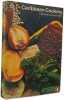
Bon état pages jaunies intérieur propre
Défauts dans le miroir: Un autoportrait
GALLIMARD 1985 336 pages in8. 1985. Broché. 336 pages. Il s'agit d'une œuvre autobiographique de l'écrivain australien Patrick White publiée en 1981 qui se présente davantage comme un autoportrait que comme une autobiographie traditionnelle. Le récit ne suit pas une chronologie stricte mais adopte une grande liberté narrative évoquant des personnes rencontrées et des paysages parcourus qui resurgissent selon l'humeur composant ainsi un portrait vivant et sans complaisance de l'auteur
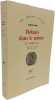
Bon Etat intérieur propre
Observations sur quelques dimensions du monde intellectual.
(Berlin, Haude et Spencer, 1770). 4to. No wrappers, as issued in ""Memoires de l'Academie Royale des Sciences et Belles Lettres"", tome XIX. Pp. 421-438. Very nice and clean.
The rare first printing of one of the few of Lambert's philosophical works that appeared within his life-time. This is one of the three philosophical papers that he published in ""Nova acta Eruditorum"", which are of varying philosophical content.The present work played a significant role in the rediscovery within philosophy of the concept of the ""sublime"", the foundational concept which was so famously treated by Kant in his third Critique (of Judgment). Neither the idea of the beautiful nor of the sublime was novel in the 18th century, as the distinction between the two had already been made in ancient philosophy. However, for several centuries, aesthetics had been dominated by the question of the beautiful, and it was only around Kant's and Lambert's time that the sublime had become a topic of interest again - this time primarily as the sublime in nature. When Lambert thus discusses the sublime in the present article, it is probable that his conception of it can have influenced Kant and his exposition in the ""Critique of Judgment"", which appeared a couple of decades later. ""Kant himself recognized Lambert as a philosopher of the highest qualities"" and he expected much from his critical attitude. He had drafted a dedication of the ""Critique of Pure Reason"" to Lambert, but Lambert's untimely death prevented its inclusion.Lambert's place in the history of philosophy, however, should not be seen only in its relation to Kant. The genesis of his philosophical ideas dates from a time when Kant's major works had yet to be conceived. It was the philosophical doctrines of Leibniz, Christian Wolff, and Locke that exerted the more important influence - insofar as one can speak of influence with a self-taught and wayward man such as Lambert... The two main aspects of Lambert's philosophy, the analytic and the constructive were both strongly shaped by mathematical notions"" hence logic played an important part in his philosophical writing. Following Leibnitz' ideas, Lambert early tried to create and ""ars characteristic conbinatoria"", or a logical or conceptual calculus. He investigated the conditions to which scientific knowledge must be subjected if it is to enjoy the same degree of exactness and evidence as mathematical knowledge..."" (D.S.B. VII:597).

Neues Organon oder Gedanken über die Erforschung und Bezeichnung des Wahren und dessen Unterscheidung vom Irrtum und Schein. 2 Bde. - [COINING ""PHENOMENOLOGY""]
Leipzig, Johann Wendler, 1764. 8vo. Non-uniformely bound. Vol 1: Completely uncut in the original cardboard-binding. Some wear to capitals and hinges. Internally a bit of minor occasional brownspotting. (18), 592 pp. Vol 2: 19th century marbled paper-binding with red gilt title-label to spine. Wear to extremities. Only light occasional brownspotting. (2), 435, (1).
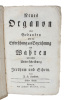
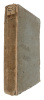
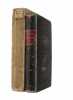
The very rare first edition of Lambert's seminal main philosophical work, the work which coined the term ""phenomenology"". ""Neues Organon"" is a work of breakthrough that came to, directly or indirectly, influence almost all later philosophy, also that of Kant.Today, Johann Heinrich Lambert arguably mostly remembered as one of the greatest mathematicians and logicians of his time. However, a true polymath, he also played a dominant role in the development of 18th century philosophy, primarily with his philosophical magnum opus ""Neues Organon"", in which he set out to provide a better methodology for philosophy, with the aid of mathematics. As such, he is considered a path-breaker of Rationalism and one of the most important predecessors of Kant, who knew him well and admired him greatly"" the two corresponded frequently. ""Kant himself recognized Lambert as a philosopher of the highest qualities"" and he expected much from his critical attitude. He had drafted a dedication of the ""Critique of Pure Reason"" to Lambert, but Lambert's untimely death prevented its inclusion.Lambert's place in the history of philosophy, however, should not be seen only in its relation to Kant. The genesis of his philosophical ideas dates from a time when Kant's major works had yet to be conceived. It was the philosophical doctrines of Leibniz, Christian Wolff, and Locke that exerted the more important influence - insofar as one can speak of influence with a self-taught and wayward man such as Lambert... The two main aspects of Lambert's philosophy, the analytic and the constructive were both strongly shaped by mathematical notions"" hence logic played an important part in his philosophical writing. Following Leibnitz' ideas, Lambert early tried to create an ""ars characteristic conbinatoria"", or a logical or conceptual calculus. He investigated the conditions to which scientific knowledge must be subjected if it is to enjoy the same degree of exactness and evidence as mathematical knowledge... In ""Neues Organon"" he next developed the idea of a characteristic language of symbols to avoid ambiguities of everyday language"" and finally, in the most original part of his work called """"Phänomenologie,"" he discussed appearance and gave rules for distinguishing false (or subjective) appearance from a true (or objective) one that is not susceptible to sensory illusions."" (D.S.B. VII:597).
Cosmologische Briefe über die Einrichtung des Weltbaues. - [PRE-ESTABLISHING THE BASIC FEATURES OF THE UNIVERSE]
Augspurg, Eberhard Kletts Wittib., 1761. Contemporary white-dyed sheepskin. Spine with a bit of surface wear, old hand-written paper-label to spine. XXVIII, 317 pp. A stamp inside front free end-paper. Light browning, scattered marginal brownspots, but in general a fine copy. A few leaves in ""Vorrede"" misbound.
The scarce first edition of Lambert's sensational ""Cosmological Letters"", his most important astronomical work, in which he to a large extent fore-shadowed the documentation of the basic features of the universe that Hershel later carried out.The work became very popular and was translated into French, Russian, and English, and it was later re-written and published as ""Systeme du Monde"" in Berlin, 1770. ""Of special interest among Lambert's astronomical writings - apart from applications of his physical doctrines - are his famous Cosmologische Briefe über die Einrichtung des Weltbaues"" (Augsburg, 1761).Not familiar with the similar ideas of Thomas Wright (1750) and with Kant's ""Allgemeine Naturgeschichte und Theorie des Himmels"" (1755), Lambert had the idea that what appears as the Milky Way might be the visual effect of a lens-shaped universe. On this basis he elaborated a theory according to which the thousand of stars surrounding the sun constituted a system. Moreover he considered the Milky Way as a large number of such systems, that is, a system of higher order…"" the ""Cosmologische Briefe was a great sensation and was translated into French, Russian, and English. Only when William Hershel systematically examined the heavens telescopically and discovered numerous nebulae and ""telescopic milky-ways"" did it become obvious that Lambert's description was not mere science fiction but to a large extent a bold vision of the basic features of the universe"" (Scriba in D.S.B. VII:598). Kant's mentor (Martin Knutzen) died in 1755, three years before the pre-critical project unfolded. But Kant still had the chance of meeting kindred spirits. One of these was the great philosopher and mathematician Johann Heinrich Lambert, whom he admired a great deal. Finally he had encountered a thinker who appreciated both the scientific and metaphysical perspective, who worried about their tensions, and who was searching for a truce. In his ""Cosmologische Briefe…"" (Cosmological Letters on the establishment of the universe), Lambert worked on the same topic as Kant had worked on in his earlier Universal Natural History. The tasks and results of both works resemble each other, in so far as they were both proposals of integrating Newtonian physics into a larger framework, and they both contained a theory of the dynamic constitution of the universe. Furthermore, as Kant's scientific works should be viewed under the perspective of his general philosophical outlook, so must Lambert's work in physics and astronomy be seen in relation to his general philosophical outlook and his perpetual quest for introducing mathematical exactness into the sciences. ""Lambert's efforts to improve communication and collaboration in astronomy were noteworthy. He promoted the publication of astronomical journals and founded ""Berliner astronomisches Jahrbuch oder Ephemeriden"". Many of the articles that he contributed to it were not published until after his death... He also favored the founding of the Berlin observatory. These suggestions, in line with Leibniz' far-reaching plans for international cooperation of scientific societies, inaugurated a new period of scientific teamwork."" (D.S.B., VII:598).
ÂME D'ENFANT
paris GEDALGE 1951 in-8 cartonnage illustré un volume, reliure bradel cartonnage monochrome grand in-octavo Editeur (18,6 x 26 cm), dos long décoré or, titre frappé or, dessin or (plaque spéciale Editeur) au centre du plat par Ray Lambert, recouvert d'une jaquette illustrée en couleurs par Ray Lambert (Jaquette renforcée au scotch au dos de la jaquette sans déchirure), orné d'un frontispice en couleur par Ray Lambert + 5 PLANCHES hors-texte EN COULEURS par Ray Lambert + 8 planches hors-texte en noir par Ray Lambert + 12 gravures in-texte en noir par Ray Lambert, 238 pages, 1951 Paris LIBRAIRIE GEDALGE Editeur,
Bel Exemplaire..... RARE.........en bon état (good condition). bon état
Fluctuations Boursières et Influences Cosmiques
EDITIONS DE L'INSTITUT DE RECHERCHES ASTRO-DYNAMIQUES in8. Sans date. Cartonné.
Etat correct bords frottés charnière du premier plat abîmée intérieur propre non daté

Faits divers
Editions du Rouergue 2000 141 pages 11x15x1cm. 2000. Poche. 141 pages.
proche très bon état intérieur frais
La légende des gènes : Anatomie d'un mythe moderne
Dunod 2006 307 pages 15x23x2cm. 2006. Broché. 307 pages.
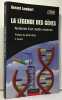
Comme neuf
Lambert Thomas A. McDonald Wallace Watt Isabella Kingdon Robert M
Reference : 100071170
(2001)
ISBN : 2600006389
Registres du consistoire de Genève au temps de calvin t2
Librairie Droz 2001 418 pages 18x25x4cm. 2001. Cartonné. 418 pages.
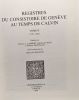
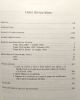
Très Bon Etat de conservation intérieur très frais
Lambert Thomas A. Watt Isabella Kingdon Robert Watt Jeffrey
Reference : 100075100
(2000)
ISBN : 2600001670
Registres du Consistoire de Genève au temps de Calvin tome 1
Librairie Droz 2000 441 pages 18x26x4cm. 2000. Relié. 441 pages.
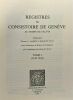
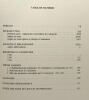
Très Bon Etat de conservation intérieur frais bonne tenue
L'Encyclique "Humani Generis" --- cahiers de la nouvele revue théologique VIII
Casterman 1951 in8. 1951. Broché.
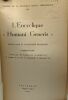
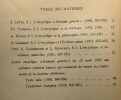
Bon Etat sous papier de soie intérieur propre rares annotations légères au crayon à papier
Les veines du temps - lectures de bois en Bourgogne
Typoffset impressions (imp.) 1992 in8. 1992. Broché.
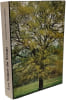
proche du très bon état intérieur propre
Record à l'Himalaya
EDITIONS FRANCE EMPIRE 1955 in8. 1955. Broché.
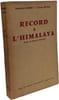
Très bon état de conservation bords un peu frottés intérieur propre pages non-coupées sans jaquette
Agriculture en Hollande: L'intelligence efficace
Tud Ha Bro 1989 in8. 1989. Broché.


Bon état premier plat un peu marqué intérieur propre
When Victoria Began to Reign: A Coronation Year Scrapbook made by
Faber & Faber Ltd in8. Sans date. Cartonné.
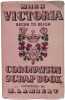
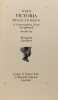
Bon Etat intérieur propre
Avant-premières à l'Everest
Arthaud 1953 in8. 1953. Broché.
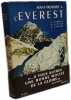
Bon état avec son bandeau commercial
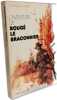
Le Gardien du Seuil
Les Editions de la Revue Demain in12. Sans date. Broché.
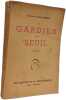
Etat correct Couverture et pages jaunies tranche de couverture frottée intérieur propre
The Crimean War: British Grand Strategy 1853-56 (War Armed Forces and Society)
Manchester university press 1991 360 pages 14 86x21 41x1 85cm. 1991. Broché. 360 pages.
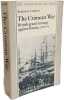
Très bon état de conservation intérieur propre
Chants lyriques des aztèques
Seghers 1958 in12. 1958. Cartonné.
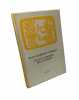
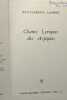
Bon état couverture un peu ternie intérieur propre
Manuel de législation algérienne
Librairie des facultés 1952 380 pages in8. 1952. Broché. 380 pages. Couverture un peu usagée intérieur très bon dos qui commence a se décoller
Etat Correct
Soyez vous aussi astrologue ! / methode logique et intuitive
Dervy-livres La roue céleste 1978 204 pages in8. 1978. Broché. 204 pages.
Bon Etat
L'articulation base de la diction - méthode pratique d diction française - 5e édition
Duculot-Roulin 1953 in8. 1953. Broché.
Bon état de conservation couverture défraîchie intérieur propre

