Write to the booksellers
125 books for « kraft h »Edit
-
Type
Book (124)
Music sheets (1)
-
Language
French (123)
German (1)
Russian (1)
-
Century
16th (1)
18th (12)
19th (16)
20th (31)
-
Countries
Belgium (5)
Denmark (17)
France (78)
Netherlands (7)
Switzerland (16)
United States of America (2)
-
Syndicate
ILAB (77)
NVVA (4)
SLACES (4)
SLAM (54)
Topics
- Adam (2)
- Africa (1)
- Agriculture (1)
- Anthropology (1)
- Arboriculture (1)
- Archaeology (1)
- Architecture (3)
- Artillery (11)
- Asia - orient (1)
- Biography (3)
- Biology (1)
- Cavalry (1)
- Collections (1)
- Comic strip (2)
- Dictionaries (1)
- Earth (1)
- Ethnography (1)
- Ethnology (1)
- Fine arts (1)
- Folklore (1)
- Geology (1)
- Germanic languages (2)
- Helvética (3)
- History (7)
- Horticulture (1)
- Infantry (2)
- Kierkégaard (1)
- Kraft zdenko von (2)
- Latin (1)
- Le tour du monde (1)
- Leroy marcel (1)
- Linguistics (2)
- Literature (4)
- Mammals (1)
- Mathematics (2)
- Medicine (1)
- Military arts (2)
- Mushrooms mycology (3)
- Music (2)
- Numismatic (1)
- Painting (1)
- Philosophy (5)
- Physics (5)
- Poitou (1)
- Policy (1)
- Portraits (1)
- Psychology (2)
- Raphael (1)
- Review (1)
- Scandinavian (1)
- Scores (1)
- Sculpture (1)
- Sociology (1)
- Songs (1)
- Speleology (1)
- Spying (1)
- Switzerland (3)
- Tea (3)
- Testimonies / stories (1)
- Theology (2)
- Touraine (1)
- Wagner richard (2)
- War 70/71 (10)
- Woods & woods’ price lists (1)
- Zoology (1)
- Zurich (1)
Kort Fortælning af de Vilde Folks fornemmeste Indretninger, Skikke og Meninger, til Oplysning af det menneskeliges Oprindelse og Fremgang i Almindelighed. (Brief Account of the Principal Institutions, Customs and Ideas of the Savage peoples, to Inform... - [ FOUNDING THE SCIENCE OF ETHNOLOGY AND ANTHROPOLOGY]
Sorøe, Jonas Lindgren, 1760. 8vo. In contemporary full calf with five raised bands and gilt lettering and ornanamentation to spine. Light wear to extremities, especially spine and hinges. A few stains to back board. A few annotations to front free end-paper (Nygårds Katalog 1913 / Nr. 1042). Internally nice and clean. (8), 383, (1) pp. + 2 folded plates.
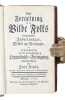
Scarce first edition of this pioneering work considered true beginning of scientific ethnology and anthropology: “Kraft's book is the first general ethnology containing a description of the origin and development of society, economic life, religion, and arts” (Birket-Smith, The History of Ethnology in Denmark). “Actually, the first ethnologist in a modern sense was Jens Kraft (1720-65), who deserves a place of honour among the pioneers of cultural research by virtue of his little book (i.e. the present). Kraft was born in Norway, which at that time was united politically with Denmark, but after his father's untimely death he was educated in his uncle's house in Denmark, and here he was appointed professor of philosophy and mathematics at the early age of twenty-six. Urged by Rousseau's glorification of primitive man, Kraft wanted to depict the true history of humanity, and disregarding the nations of antiquity he started with the most ""savage"" peoples he knew, two tribes of South American Indians, the Lule and the Caigua. It makes no difference that his choice is not very fortunate, since these tribes are far from being on an especially low stage" the main thing is that his principle is indisputable. The more you become absorbed in his queer little book, the more will the amazingly far-sighted and unbiassed view of the author compel your respect. Referring to the natives of America, he maintains, for instance, that among some peoples agriculture must be older than cattle breeding" usually it is Alexander von Humboldt who gets the credit for this discovery. In order to refute the idea that primeval man lived in a state of promiscuity Kraft mentions the fact that even among the higher animals we find something like married life, thus upholding the view of Westermarck 130 years later. He points out the authority of the women in certain societies and concludes "" that the children have for the most part followed their mothers and considered themselves their natural possessions,"" and from this circumstance he derives matrilineal succession, in other words he anticipates Bachofen's famous discovery by a century. Kraft's book is the first general ethnology containing a description of the origin and development of society, economic life, religion, and arts. It was translated into German, and if it had been known to wider circles it might have been epoch-making. This did not happen. It is doubtful whether Kraft himself was aware of the importance of his work, and anyhow he died soon after in the prime of his life. Kraft was actually a hundred years ahead of his time. In Europe generally as well as in Denmark, physical anthropology and, later, archaeology nearly killed the tiny ethnological germ, and it was not till the middle of the 19th century that it grew to be an independent science. (Birket-Smith, The History of Ethnology in Denmark).

Om Sielens Udødelighed. - [KRAFT ON THE IMMORTALITY OF THE SOUL]
(Copenhagen, 1754). 4to. In recently blue paper covered card board binding with white paper-label title-label to front board. Previous owner's name to pasted down front end-paper. Ex-libris pasted on to verso of front free end-paper. Without wrappers as issued in ""Videnskabernes Selskabs Skrifter"", internally a nice and clean copy. Pp. 189-216.
![Om Sielens Udødelighed. - [KRAFT ON THE IMMORTALITY OF THE SOUL]. "KRAFT, JENS.](https://static.livre-rare-book.com/pictures/LLX/61839_thumb.jpg)
![Om Sielens Udødelighed. - [KRAFT ON THE IMMORTALITY OF THE SOUL]. "KRAFT, JENS.](https://static.livre-rare-book.com/pictures/LLX/61839_2_thumb.jpg)
![Om Sielens Udødelighed. - [KRAFT ON THE IMMORTALITY OF THE SOUL]. "KRAFT, JENS.](https://static.livre-rare-book.com/pictures/LLX/61839_3_thumb.jpg)
Uncommon first edition of Kraft’s work on the immortality of the Soul is part of his philosophical engagement with the materialist debates of the 18th century. Here Kraft argues against materialist conceptions of the soul, particularly those put forth by La Mettrie in his “L'Homme Machine”. Kraft disputes La Mettrie's claim that the connection between thought and the body implies a causal relationship. He acknowledges that rational beings have larger brains than irrational ones and that thought is influenced by bodily conditions, illnesses, and emotions. However, he maintains that these observations only demonstrate a connection, not causation. Kraft distinguishes between time and eternity, arguing that while the finite can never attain eternity, it can achieve an infinite time with a beginning but no end. He contrasts this with the permanence of the infinite. Jens Kraft (1720–1765) was a Dano-Norwegian mathematician and philosopher. He was born in Frederikshald in Norway. While still a student in Copenhagen, he was influenced by Christian Wolff, having attended one of Wolff’s lectures during a visit to Halle. Later he was appointed professor of philosophy at the Sorø Academy, where he responded to Baumgarten’s Metaphysica with his own work, Metaphysik. Both philosophers structured their works into four divisions: Cosmologie, Ontologie, Psykologie, and Naturlig Theologie.
Menneskets Ufornøielighed i sin Stand af Horat. Lib. 1. Sat. 1.
Soröe, Lindgren, 1759. 8vo. In contemporary marbled wrappers. Wear to extremities and small paper-label pasted on to top of spine. Internally nice and clean. 24 pp.
Rare first edition of Kraft’s philosophical poem exploring man’s potential discontent with his social station. First composed in 1738 but only published by the author in 1759 after being overlooked by Holberg’s prize committee, the work stands as a fine example of Enlightenment moral literature in Denmark. Reflecting on the universal human tendency to envy others’ positions Kraft’s verse offers a sharp and elegant critique of ambition and restlessness. Jens Kraft (1720–1765) was a Dano-Norwegian mathematician and philosopher. He was born in Frederikshald in Norway.While still a student in Copenhagen, he was influenced by Christian Wolff, having attended one of Wolff’s lectures during a visit to Halle. Later he was appointed professor of philosophy at the Sorø Academy, where he responded to Baumgarten’s Metaphysica with his own work, Metaphysik. Both philosophers structured their works into four divisions: Cosmologie, Ontologie, Psykologie, and Naturlig Theologie.
Forelæsninger over Mekanik med hosføiede Tillæg (+) Forelæsninger over Statik og Hydrodynamik med Maskin=Væsenets Theorier som Anden Deel af Forelæsningerne over Mekaniken. 2 vols.
Sorøe, Jonas Lindgren, 1763 - 1764. 4to. Uniformly bound in two contemporary full sprinkled calf bindings with five raised bands. ""Söe Cadet Accadem:"" embossed to front boards. Wear to extremities, head of spines chipped and parts of the gilting worn off. A few annotations to front free end-paper in both volumes. Small stamp to upper outer corner on title-page in both volumes. Internally very nice and clean. (28), 656, (4) pp. + 14 folded engraved plate"" (16),1000 pp. + 47 folded engraved plates.
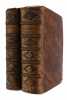
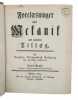
First edition of the most significant Danish physics work of the 18th century, being the first systematic exposition of Newtonian physics and mathematics in Denmark. Here he provides a systematic presentation of Newtonian physics and calculus. ""Kraft’s best-known work is a textbook on theoretical and technical mechanics (1763-1764). The book, written in an easy and fluent style, contains a series of lectures baied on Newtonian principle. Each lecture is provided with a supplement giving a more advanced mathematical exposition of the subject matter. In Denmark this work gave theoretical physics a firm basis as an academic subject, while its large section on machines stimulated the expansion of industry. The book was favorably received abroad and was trans. lated into Latin and German."" (DSB) Jens Kraft (1720–1765) was a Dano-Norwegian mathematician and philosopher. He was born in Frederikshald in Norway.While still a student in Copenhagen, he was influenced by Christian Wolff, having attended one of Wolff’s lectures during a visit to Halle. Later he was appointed professor of philosophy at the Sorø Academy, where he responded to Baumgarten’s Metaphysica with his own work, Metaphysik. Both philosophers structured their works into four divisions: Cosmologie, Ontologie, Psykologie, and Naturlig Theologie. Kraft distinguished between time and eternity asserting that “the finite can never attain eternity, but it can attain infinite time (Aevum), a time with a beginning but without an end.” In contrast, the infinite possesses true permanence. Biblioteca Danica II, 53.
Essays for the 150th Anniversary of the Birth of Victor D. Brenner
, Brepols - American Numismatic Society, 2026 Hardback, Pages: viii + 268, Size:152 x 229 mm, Illustrations:178 b/w, Language: English. ISBN 9780897227469.
Summary This volume brings together a collection of research papers first presented at the 2021 Coinage of the Americas Conference. Organized to commemorate the 150th anniversary of Victor David Brenner's birth, this assembly of scholarship honors one of the most influential figures in American numismatic history. Best known as the sculptor of the 1909 Lincoln Wheat cent-the longest-running design in U.S. coinage history-Brenner was a master of the "Beaux-Arts" style. The papers within this volume offer a multifaceted look at his career, including: ? Deep-Dive Analysis: Detailed examinations of specific, lesser-known medals and commemorative pieces. ? Artistic Evolution: An exploration of how Brenner's Lithuanian roots and European training influenced his American works. ? Lasting Impact: A critical look at his role in the "Golden Age" of American numismatics and his mentorship within the medallic arts community. TABLE OF CONTENTS Preface Introduction Jesse Kraft Victor D. Brenner's Society of the Cincinnati Medal in Context Patrick McMahon Railroad-Themed Medals by Victor D. Brenner George S. Cuhaj Victor D. Brenner and the 1902 Prince Henry of Prussia Medal Peter van Alfen The Path to the Penny: A Study in Victor D. Brenner's Patronage Jonathan Kagan A Song to Brenner: Victor D. Brenner's A Song to Nature, Public Art, and Sculpture in the Round Taylor Ruth Hartley A Trial List of Non-Medallic Sculpture by Victor D. Brenner Scott H. Miller "Mr. Brenner Has Made So Many Commemorative Medals": Collective Memory, Iconography, and Historical Legacy in the Medallic Arts Jesse Kraft
Kraft, H. Geometric methods in invariant theory. In Russian
In Russian. Short description: Kraft, H., Geometric methods in invariant theory [Geometricheskie metody v teorii invariantov]. Moscow: World, 1987 / . . : , 1987. Please feel free to contact us for a detailed description of the copies available. SKU lom-SK000782
Afhandling om en Deel Contradictioner, som findes i det sædvanlige Systema over Materien og de sammensatte Ting.
(København, 1754). 4to. In recently blue paper covered card board binding with white paper-label title-label to front board. Previous owner's name to pasted down front end-paper. Annotations to front free end-paper. Without wrappers as issued in ""Videnskabernes Selskabs Skrifter"", nice and clean copy. Pp. 189-216.
First edition of Kraft’s paper on contradictions in traditional theories of matter and composite substances. Kraft argues that the traditional physics and metaphysics is filled with contradictions, particularly regarding the divisibility of matter, the nature of space and time and the structure of reality. He suggests that Leibniz’s theory of monads or a similar concept of fundamental indivisible units provides a more consistent framework for understanding the physical world. The present paper is a fine example of 18th-century Enlightenment debates on the nature of matter, space and time,
Betænkninger over Neutons og Cartesii Systemata, tilligemed nye Anmærkninger over Lyset.
(København, 1747). 4to. In a later half calf binding with gilt lettering to spine. Previous owner's name to pasted down front end-paper. Without wrappers as issued in ""Videnskabernes Selskabs Skrifter, III. Del, 1747"". A nice and clean copy. Pp. 213-296. + 3 engraved plates.
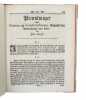
First edition of one of Kraft's earliest and most important works, being a preliminary study to his seminal ""Forelæsninger over Mekanik"" (1763). It also constitute one of the earliest introductions to Newton in Danish.In 1747, he became a member of the Academy of Sciences, same year as the present thesis was published. Here, he takes a stand in favor of Newton against Descartes, in contrast to his admired teacher C. v. Wolff. Kraft concluded that while the Cartesian system was unreasonable and even inconsistent, Newton's physics perfectly aligned with the most reliable experiences, including the best astronomical observations. Furthermore, the Newtonian system was superior from a methodological standpoint, as it contained fewer hypotheses and was more simple and well-ordered than the Cartesian alternative.
Methode at bevise, hvorledes man i alle Tilfælde kand bestemme den ene Ubekiendte ved en u-endelig Følge af Terminis, som gives ved den anden, i de Algebraiske Liigheder, som indeholde to Ubekiendte.
(Copenhagen, 1751). 4to. In recently blue paper covered card board binding with white paper-label title-label to front board. Previous owner's name to pasted down front end-paper. Without wrappers as issued in ""Videnskabernes Selskabs Skrifter"", a nice and clean copy. Pp. 323-354.

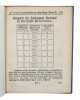
First edition of Kraft’s paper on algebra and infinite series, placing him among the most significant Danish mathematicians of his time. The work presents a method for determining an unknown variable in an algebraic equation using an infinite sequence of terms relating to series expansion techniques later formalized in Puiseux series, which play a role in modern algebraic geometry and analysis. This work is important in understanding Kraft’s ability as both a mathematician and a philosopher. It show his mathematical talent in algebra and infinite series while also aligning with his Newtonian physics and Leibnizian philosophy.
Zwei Jahre Wehrmachtbetreuung in Belgien und Frankreich im Auftrage des Oberkommandos der Wehrmacht durch die Deutsche Arbeitsfront NSG - "Kraft durch Freude"
Gau Köln-Aachen, Verlag Die Deutsche Arbeitsfront NS-Gemeinschaft “Kraft durch Freude” 1942 In-4 à l’italienne 22 x 28 cm. Cartonnage éditeur ivoire, dos muet, emblème polychrome du KdF sur le premier plat, 60 pp., illustrations en noir & blanc, certaines contrecollées, dessins en bistre dans le texte, serpentes légendées. Bon exemplaire d’un ouvrage peu courant.
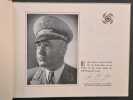
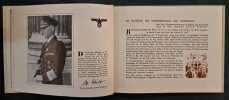
Texte en allemand. Album présentant les activités du KdF dans la Belgique et la France occupées. Bon état d’occasion
Jusqu'au dernier sursaut
CRIME PARFAIT ? n° 2 - Editions de L'ARABESQUE (1957) - Broché de 192 pages - Couverture noir et blanc de RILER - Bon état
Forensic Psychopathology In Russian/Sudebnaya psikhopatologiya
In Russian. Kraft-Ebing, Richard. Forensic Psychopathology. St. Petersburg: 1895, K.L. Ricker The image is provided for reference only. It may reflect condition of one of the available copies or only help in identifying the edition. You are welcome to reach out to us for a detailed description of the copies currently available. Delivery of this book may take longer than usual including extended processing and pre-shipping time, no expedited shipping is available. Please advise us if you have a set date or a deadline to receive your order.SKU5229988
Tel fut wagner. une vie dramatique. gros livre. reliure editeur. 400 pages. ill n b. [Hardcover] Kraft Zdenko Von
Jaquette illustrée d'origine effritée sur les bors notamment en tête de livre. 405 pages.
Merci de nous contacter à l'avance si vous souhaitez consulter une référence dans notre boutique à Authon-du-Perche.
Clavis Patrum Apostolicorum. Catalogum vocum in libris Patrum qui dicuntur Apostolici non raro occurrentium ... congessit contulit conscripsit H. Kraft.
Darmstadt, WB, 1963.
VIII,501 p. Cloth 23 cm
Clavis Patrum Apostolicorum. Catalogum vocum in libris Patrum qui dicuntur Apostolici non raro occurrentium (...) congessit, contulit, conscripsit Henricus Kraft.
Darmstadt, Wissenschaftliche Buchgesellschaft, 1963.
VIII,501 p. Cloth. 23 cm
Logik eller Den Videnskab at tænke. Skrevet til Sorøe Ridder=Academies Nytte.
Kjøbenhavn, Kongelige Wäysenhuses Bogtrykkerie, 1751. 8vo. In contemporary half calf with five raised bands. Light wear to extremities, leather on spine cracked. Head of spine with loss of leather. First leaves with marginal browning. Previous owner's name and annotations in contemporary hand to pasted down front end-paper. Inner front hinge split. Last quire detached, otherwise internally nice and clean. (10), 340, (1) pp. + 1 folded plate.
The uncommon first edition of Kraft’s Logic which was made for the 1750 re-established Sorø Academy. Danish writer and academian Ludvig Holberg bequested most of his fortune to re-establishing the academy in 1750 after a devastating fire.Bibliotehca Danica I, 907.
Rigernes u-skatterlige Lyksalighed under den høypriselige Oldenburgiske Stammes Regiering, bragt til Fuldkommenhed under Voris Stormægtigste. Allernaadigste Monarch Friderich den Femte, blev bevist ved en Jubel Tale holden paa Sorøe Ridderlige Academi...
Kiøbenhavn, Gabriel Christian Rothe, (1749). 4to. In contemporary half calf with gilt lettering and ornamentation to spine. Wear to boards. Internally nice and clean. 20 pp.
Second edition, published same year as the original, of Kraft's work in which he praises the immense prosperity of the Danish realms under the rule of the Oldenburg dynasty, particularly emphasizing the reign of King Frederick V of Denmark. Biblioteca Danica III, 392.
Grossdeutschland die städte.
Adam Kraft Verlag. non daté. In-4. Relié. Etat d'usage, Tâchée, Dos frotté, Mouillures. XIV + 256 pages - nombreuses photos en noir et blanc hors texte - quelques photos en couleurs hors texte contre collées dont une en frontispice - fortes mouillures sur les plats - coins frottés - légères mouillures sur les premières pages ne gênant en rien la lecture - photos légendées en néerlandais, français,allemand,anglais et espagnol.. . . . Classification Dewey : 430-Langues germaniques. Allemand
Mit einem geleitwort von Bruno Brehm - livre en allemand gothique. Classification Dewey : 430-Langues germaniques. Allemand

"HELMHOLTZ, HERMANN von. - THE PRELUDE TO ""ÜBER DIE ERHALTUNG DER KRAFT"" AND HIS FIRST PAPER ON FORCE CONSERVATION
Reference : 45604
(1847)
Physiologische Wärmeerscheinungen. Bericht ""über die Theorie der physiologischen Wärmeerscheinungen für 1845"" (Report on the Work done on the Theory of Animal Heat in 1845).
Berlin, G. Reimer, 1847. Contemp. hcalf, profusely gilt spine. Light wear along edges. XXXII,622 pp. In: ""Fortschritte der Physik im Jahre 1845. Dargestellt von der physikalischen Gesellschaft zu Berlin"". I. Jahrgang. Redigirt von G. Karsten. XXXII,622 pp. A stamp on titlepage. Helmholtz's paper: pp. 346-355. Clean and fine.
First appearance of this milestone paper which represents the first, and most importent, step towards his great work laid down in ""Über die Erhaltung der Kraft"", 1847. This is Helmholtz' FIRST PAPER ON THE CONSERVATION OF FORCE""At the beginning of October, 1846, Helnmholtz sent a 'Report on Work done on the Theory of Animal Heat for 1845', at du Bois' request, to the ""Fortschritte der Physik"", issued by the Physical Society. (the paper offered). This was merely an abstract from the article in the Encyclopaedic Dictionary.....BUT IT ANTICIPATES MORE DEFINITELY THE CONDCLUSIONS OF HIS GREAT WORK. He states without hesitation that the material theory of heat is no longer tenable, and that a kinetic theory must be substituted for it, since heat originates in mechanical forces, either directly by friction, or indirectly from an electrical current produced by themotion of magnets. This conception of heat as a motion involves the conclusion that mechanical, electrical and chemical forces must always be the definite equivalent of one and the same energy, whatever the mode by which one force is transformed into another. The empirical confirmation of this law must be the imperative duty of physicists and physiologists.""(Leo Koenigsberger in ""Hermann von Helmholtz"", pp. 34-35).""In the ""Fortschritte der Physik"" for 1845, which appeared in 1847, Helmholtz published a report on theories of physiological heat which he later acknowledged as belonging to his work on the conversation of force.""(Jungnickel & McCormach ""Intellectual Masteryof Nature, Vol. 1, p. 157).
LE BONHEUR EN 30 JOURS Se transformer pour gagner
Jouvence Broch D'occasion bon tat 01/01/1989 150 pages
BULLETIN MONUMENTAL TOME 146 N°1 - TOME 146 N°1 - TABLE DES MATIÈRESArticlesLa maison urbaine et son évolution dans la ville basse de Viviers (Ardèche), xne-xve siècles, par Marie-Christine Grasse..Le vitrail gothique, par Eva Frodl-Kraft
SOCIETE FRANCAISE D'ARCHEOLOGIE. 1988. In-12. Broché. Bon état, Couv. convenable, Dos satisfaisant, Intérieur frais. Paginé de 1 à 72. Nombreuses photos et plans en noir et blanc dans et hors texte.. . . . Classification Dewey : 930.1-Archéologie
Publication trimestrielle. TABLE DES MATIÈRES : Articles La maison urbaine et son évolution dans la ville basse de Viviers (Ardèche), xne-xve siècles, par Marie-Christine Grasse..Le vitrail gothique, par Eva Frodl-KraftActualitéArdèche. Viviers, découverte d’une sculpture romane (Y. Esquieu). — Cantal. Mauriac, Le monastère Saint-Pierre (J. Missonnier). — Essonne. Bouville, Le château de Farcheville (J. Fritsch). — Jura. Cathédrale de Saint-Claude, deux panneaux peints du xve siècle et le thème du credo apostolique (P. Lacroix). — Val-de-Marne. Santeny, découverte et restitution de la verrière gothique de Saint-Nicolas (vers 1220-1225) (C. Brisac, M.-A. Férault).ChroniqueArchitecture médiévale : Le Palais épiscopal de Gérone (Marcel Durliat). — La Commanderie de Ja lès (Jean Mesqui). — Fortifications urbaines médiévales en Roussillon (Jean Mesqui). — Lchâteau de Peyrepertuse (Jean Mesqui)Architecture moderne : L’hôtel de Vigny (Josiane Sartre). — Le quai Malaquais au XVIIe siècle(Josiane Sartre).Sculpture romane : Les chapiteaux de Rucqueville et de Bayeux (Éliane Vergnolle). — La tribune deSaint-Michel-de-Cuxa (Marcel Durliat)'.Peinture murale : Les peintures carolingiennes de Saint-Pierre-les-Églises (Éliane Vergnolle). . . . Iconographie : Une iconographie ancienne de Saint-Jacques (Marcel Durliat)..BibliographieHistoire : Christian Lauranson-Rosaz, L’Auvergne et ses marges (Velay, Gévaudan) du VIIIe auXIe siècle. La fin du monde antique? (Dominique Barthélémy)..Architecture de l’Antiquité tardive et du haut Moyen Age : Jean-François Reynaud, Lyon aux premiers temps chrétiens; M. Jeannet-Vallat, R. Lauxerois, J.-F. Reynaud, Vienne aux premiers temps chrétiens ; René Colardelle, Grenoble aux premiers temps chrétiens (Jean-Pierre Caillet). — Christian Sapin, La Bourgogne préromane. Construction, décor et fonction des édifices religieux(Jean-Pierre Caillet)Architecture médiévale : E. Mannier, Ordre de Malte. Les commanderies du grand prieuré de France(Jean-Bernard de Vaivre)CaStellologie : Denys Pringle, The Red Tower. Seulement in the Plain of Sharon at the Time of the Cru-saders and Mamluks. A. D. 1099-1516 (Jean Mesqui). — Châteaux de terre : de la motte à la maison-forte. Histoire et archéologie médiévale dans la région Rhône-Alpes (Jean Mesqui). . . Études urbaines : Le château près de la ville (Jean Mesqui). — Georges Clause, Jean-Pierre Ra-vaux, Châlons en Champagne. Panorama monumental et architectural (Geneviève Douillard). — Toulouse, Les délices de l’imitation, sous la dir. de M. Culot (Marie-Félicie Perez). — François Loyer, Paris XIXe siècle, l’immeuble et la rue (Évelyne Saint-Paul)Art de la Renaissance : Bertrand Jestaz, La chapelle Zen à Saint-Marc de Venise. D’Antonio à TullioLombardo (Yves Bruand).Vitrail : Catherina Pirina, Le vetrate del Duomo di Milano dai Visconti agli Sforza (Catherine Brisac). . Enluminure : Le Codex Guta-Sintram, manuscrit 37 de la Bibliothèque du Grand-Séminaire de Strasbourg (Yolanta Zaluska). — Regensburger Buchmalerei von frühkarolingischer Zeit bis zum Ausgang des Mittelalters. Ausstellung der Bayerischen Staatsbibliothelk München und derMuseen der Stadt Regensburg (catalogue) (Claudia Rabel-Jullien).Orfèvrerie : Solange Brault-Lerch, Les Orfèvres de Troyes en Champagne (Catherine Arminjon et Francis Muel).Broderie : P. de Palol, El Tapis de la Creaciô de la Catedral de Girona (Françoise Baritei). .. .Généalogie : Patrick van Kerrebrouck, Nouvelle histoire généalogique de l’Auguste Maison de France. La Maison de Bourbon 1256-1987 (Jean-Bernard de Vaivre)Résumés analytiques.English Summaries (traduction par Patricia Stirnemann)..Deutsch Zusammenfassungen (traduction par Mariane Barrucand).Éditions du C. N. R. S. Classification Dewey : 930.1-Archéologie
Souvenirs du Notre Tour du Monde par Hugues Kraft. Deuxième édition. Ouvrage illustré de 24 phototypies et contenant 5 cartes.
1886 Paris, Hachette et Cie, 1886; in-4°, plein cartonnage crème illustré et imprimé en rouge et or; (6), 399pp. Illustré hors texte de phototypies d'après les photographies l'auteur et de Bourne et Shepherd à Calcutta, et 5 cartes hors texte en 2 tons ( dont 2 à double page).
Cartonnage un peu sali, quelques rousseurs, petit manque de papier à une serpente protégeant une phototypie, déchirure à la carte de l'Ile de Java sans manque, petit manque de papier en marge supérieure de 2 feuillets sans aucune atteinte au texte. (GrG)
Passeur
Libretto
LIVRE A L’ETAT DE NEUF. EXPEDIE SOUS 3 JOURS OUVRES. NUMERO DE SUIVI COMMUNIQUE AVANT ENVOI, EMBALLAGE RENFORCE. EAN:9782369148296
Tanière Edmond,Lionel J.J. - Heeren M.,Kraft J. - Leroy Marcel,Vassiliu Michel
Reference : 24691
(1981)
Partition de la chanson : Danse des petits chats (La) Théorie danse au dos
Benelux 1981

Etat moyen Format Coquille
Spectator. Vol. 1.
Kiøbenhavn, Trykt paa Oversætterens Bekostning, 1742. 8vo. In contemporary half calf. Binding with wear, boards with loss of paper. Internally with occassional browning, last leaves with dampstain. (12), 495,(8)