 Write to the booksellers
1851 books for « klein w c »Edit
-
Type
Book (1834)
Engraving (1)
Magazine (3)
Music sheets (12)
New book (1)
-
Latest
Last 24h (1)
Last month (9)
Last week (6)
-
Language
English (9)
French (1819)
German (4)
Russian (19)
-
Century
16th (1)
18th (2)
19th (50)
20th (753)
21st (238)
-
Countries
Belgium (108)
Canada (9)
Côte d'Ivoire (3)
Denmark (29)
France (1549)
Germany (1)
Greece (1)
Netherlands (8)
Switzerland (122)
United Kingdom (2)
United States of America (19)
-
Syndicate
ALAC (8)
CLAM (9)
CLAQ (3)
CNE (2)
ILAB (726)
NVVA (17)
SLACES (17)
SLAM (652)
SNCAO (1)
Topics
- Abraham (6)
- Agriculture (4)
- Alsace (142)
- Anticipation (10)
- Architecture (22)
- Architecture/ urban planning/ memorials (5)
- Arman - armand pierre fernandez aka (5)
- Army (15)
- Asia - orient (10)
- Austria (4)
- Autographs (7)
- Bible (4)
- Biography (21)
- Catholicism (6)
- Ceramic (6)
- Children’s books (12)
- Christianity (9)
- Christmas (11)
- Cinema (7)
- Colette (5)
- Collections (6)
- Colson jean (6)
- Comic strip (8)
- Contemporary look (7)
- Cooking (5)
- Dedication (10)
- Dog (the) (12)
- Early printed books (5)
- Economics (10)
- Education (8)
- Education - morals (7)
- English (13)
- Esotericism (10)
- Essays (5)
- Europe (5)
- Fantastic (6)
- Fine arts (26)
- Furniture (13)
- Furniture (12)
- Geography (16)
- Germanic languages (17)
- Germany (13)
- Gudmundur gudmundsson (7)
- History (84)
- Industrial arts & crafts - fine arts (19)
- Iron (10)
- Ironwork (4)
- Israel (5)
- Japan (5)
- Judaism (judaica) (8)
- Klein charles armand (17)
- Klein félix abbott (6)
- Klein gérard (68)
- Klein jean (8)
- Klein robert (19)
- Literature (132)
- Lorrain (11)
- Magazine (10)
- Malacology (6)
- Mathematics (21)
- Medicine (11)
- Military arts (5)
- Monographs (5)
- Music (5)
- Navy (7)
- Newspapers press (16)
- Painting (8)
- Palaeontology (5)
- Paris (8)
- Philology (6)
- Philosophy (20)
- Photography (40)
- Physics (34)
- Poetry (7)
- Policy (7)
- Provence (5)
- Psychiatry neurology (8)
- Psychoanalysis (27)
- Psychology (39)
- Religions (21)
- Review (15)
- Reviews (12)
- River (20)
- Road (6)
- Science fiction (21)
- Sciences (28)
- Sciences & technique (8)
- Scores (30)
- Shapes & colours (6)
- Shelley (10)
- Simone (5)
- Sociology (7)
- Songs (17)
- Theatre (7)
- Theology (8)
- Travel (10)
- United states (13)
- Various (12)
- War (31)
- Youth (9)
Rome.
Paris Editions du Seuil - Album Petite planète 3 1959 In-4 Cartonnage toilé éditeur Edition originale Dédicacé par l'auteur
EDITION ORIGINALE. Préface et textes de Pasolini, Belli, Klein,. 153 photographies de Klein, mises en page par le photographe. Sans la jaquette mais ENVOI AUTOGRAPHE signé de Klein, agrémenté d'un petit coeur " To Serge ROME SWEET ROME Klein Paris 13 Nov 08". Très bon Cartonnage toilé et jaquette illustrés éditeur 0
Le programme d'Erlangen - Considérations comparatives sur les recherches géométriques modernes - Préface de Jean Dieudonné, postface du P. François Russo, Groupes et géométrie, la genèse du programme d'Erlangen de Félix Klein , dans la collection Discours de la Méthode (Théorie des groupes, Espaces de Riemann, Spineurs)
Gauthier-Villars Malicorne sur Sarthe, 72, Pays de la Loire, France 1974 Book condition, Etat : Bon broché, sous couverture imprimée éditeur blanche et orange, illustrée d'une figure blanche sur fond marron In-8 1 vol. - 86 pages
1ere édition française, édition originale princeps, 1974 Contents, Chapitres : Table, préface de Jean Dieudonné (6 pages), xiv, Texte, 72 pages - Félix Klein : Considérations comparatives sur les recherches géométriques modernes - François Russo : Groupes et géométrie, la genèse du programme d'Erlangen de Félix Klein (conférence donnée au Palais de la Découverte le 4 mai 1968 - Felix Christian Klein (25 avril 1849 à Düsseldorf 22 juin 1925 à Göttingen) est un mathématicien allemand, connu pour ses travaux en théorie des groupes, en géométrie non euclidienne, et en analyse. Il a aussi énoncé le très influent programme d'Erlangen, qui ramène l'étude des différentes géométries à celle de leurs groupes de symétrie respectifs. - La synthèse de Klein de la géométrie comme étude des invariants sous un groupe de transformations donné, connue sous le nom de programme d'Erlangen (1872), influença profondément l'évolution de la géométrie et des mathématiques dans leur ensemble. Ce programme était le cours inaugural de Klein comme professeur à Erlangen. Il propose une vision unifiée de la géométrie. Klein décrit en détail comment les propriétés centrales d'une géométrie donnée se traduisent par l'action d'un groupe de transformations. Aujourd'hui, cette vision est devenue tellement banale dans l'esprit des mathématiciens qu'il est difficile de juger de son importance, d'apprécier sa nouveauté et de comprendre l'opposition à laquelle elle a dû faire face. (source : Wikipedia) - En 1872, à l'âge de 23 ans, Klein obtient une chaire à l'Université d'Erlangen9 grâce à l'aide providentielle de Clebsch, qui voit en lui l'un des futurs plus grands mathématiciens de son temps. Selon la coutume, il doit donner une conférence inaugurale. Il prépare un texte qui circule initialement entre un nombre restreint de lecteurs, sous le titre de Vergleichende Betrachtungen über neuere geometrische Forschungenn. Il s'agit du fameux Programme d'Erlangen dans lequel il propose un point de vue révolutionnaire sur la géométrie. Bien que ses qualités d'enseignant soient appréciées à Erlangen, il n'a au début que deux élèves dans sa classe. Dans un premier temps, le Programme d'Erlangen n'est pas bien accueilli, sans doute parce que le manuscrit n'a pas bénéficié d'une large diffusionn. Félix Klein ne reste que trois ans à Erlangen il n'a pas beaucoup d'élèves , mais a assez de temps à consacrer à la recherche. En 1872, Clebsch succombe à la diphtérie à l'âge de 39 ans. Klein s'occupe alors de la publication de la revue Mathematische Annalen responsabilité qu'il assumera presque jusqu'à la fin de sa vie et parvient à en faire la plus importante publication mathématique de l'époque, ce qui contribue à renforcer son aura scientifique à l'échelle internationale. En 1875, une nouvelle chaire lui est proposée à Munich (source : Wikipedia) couverture à peine jaunie sinon propre, intérieur frais et propre, signature de l'ancien propriétaire sur la page de titres, cela reste un bon exemplaire
Yves Klein
Paris Centre Georges Pompidou, Musée national d'art moderne 1983 In-4 carré Broché Ed. originale
Catalogue de l'exposition rétrospective Yves Klein au Centre Georges Pompidou du 3 mars au 23 mai 1983. Nombreuses illustrations in et hors-texte, liste des oeuvres exposées. 424 pp. Bon 0
Zum Mehrkörperproblem der Quantentheorie (+) Über Wellen und Korpuskeln in der Quantenmechanik. - [JORDAN-KLEIN MATRICES]
Berlin, Julius Springer, 1927. 8vo. Entire volume 45 of ""Zeitschrift für Physik"" bound in contemporary half cloth with gilt title to spine. Library stamp to title-page. Corners and lower capital bumped, hinges a bit weak. An overall fine and clean copy. Pp. 751-765"" 766-775. [Entire volume: VII, (1), 910 pp.].
First publication of Jordan and Klein's influential paper (the first mentioned) which contributed to the close connection between quantum fields and quantum statistics, today known as Jordan-Klein matrices. ""Born, Heisenberg, and Jordan had indicated, and Dirac had demonstrated, the close connection between quantum fields and quantum statistics. Second quantization guarantees that photons obey Bose-Einstein statistics. What about other particles which obey Bose-Einstein statistics? The year 1927 was not over before Jordan and Klein addressed this question [in the present paper]."" (Pais, Inward bound. p. 338). ""Jordan and Klein found that ""one can quantize just as well the non-relativistic Schroedinger equation. In honor of these contributions the matrices have been named Jordan-Klein matrices."" (ibid. p. 339). ""Convinced that the many-body problem in quantum mechanics can be stated correctly only in the context of quantized matter waves (""repeated"" or ""second"" quantization. as it was called later by Léon Rosenfeld), Jordan started working out his ideas together with Wolfgang Pauli. Oskar Klein, and Eugene Wigner. During his stay in Copenhagen in the summer 1927 Jordan established, together with Klein, the first nonrelativistic formalism of second quantization for a system of interacting Bose particles."" (DSB).The second paper, ""Über Wellen und Korpuskeln in der Quantenmechanik"", ""contained several other formal and mathematical generalizations, but its main practical value is that, in the newly established theory of the 'quantized wave field', the fluctuations in the Bose case now satisfied all requirements following from Einstein's light-quantum treatment of 1924 and 1925."" (Mehra, The historical development of quantum theory, 2000, p. 231.

Ordre Naturel des Oursins de Mer et Fossiles.
Paris, Bauche, 1754. 1754 1 vol. in-8° (200 x 128 mm) bilingue latin-français de : [3] ff. (faux-titre, portrait gravé de lauteur, titre avec vignette) ; 233 pp. (dont préface, tables, avertissement, erreur de pagination sans incidence) ; [3] pp. (dont errata et catalogue du libraire) ; 28 gravures hors-texte. Culs-de-lampe. Veau fauve marbré de l'époque, dos lisse orné, pièce de titre rouge, filet à froid en encadrement des plats, roulette dorée sur coupes, tranches rouges. (Petites traces de mouillures au coin supérieur sur une dizaine de ff.).
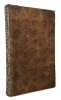
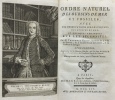
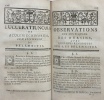
Première traduction française, avec texte en latin en regard, due à François-Alexandre Aubert de la Chesnaye des Bois de cet ouvrage traitant des oursins publié pour la première fois en 1734 sous le titre latin Naturalis Disposito Echinodermatum et dû à Jacob Theodor Klein. François-Alexandre Aubert de la Chesnaye des Bois (1699-1784) est écrivain, généalogiste et compilateur français. La Chenaye des Bois est principalement connu pour ses publications sur la généalogie des familles nobles et notamment son Dictionnaire de la Noblesse. Jacob Theodor Klein (1685-1759) est zoologiste marin, naturaliste, juriste, botaniste allemand et membre de la Royal Society. Il possédait lun des plus riches cabinets d'histoire naturelle dEurope. Sa collection d'oursins, dont certaines parties sont conservées dans la collection zoologique d'État de Munich, est considérée comme une source précieuse de matériel scientifique pour les zoologistes et les paléontologues. Klein est connu notamment pour avoir bâti un système de classification se voulant être le rival de celui de Carl von Linné (1707-1778 ; naturaliste suédois) et pour avoir fondé le jardin botanique de Ogród Botaniczny w Oliwie à Gdansk. Il "avait des intérêts nombreux et variés en histoire naturelle en plus des oursins. Il développa un jardin botanique à Danzig, y fonda et dirigea une société de naturalistes, fit de vastes collections et publia environ deux douzaines de monographies, y compris des études sur les oiseaux, les poissons, les reptiles et les invertébrés autres que les oursins, en particulier les mollusques" (D.S.B.) Son traité précurseur sur les oursins, reconnu comme lun des principaux ouvrages sur le sujet jusquau XIXe siècle, résume les sentiments de lauteur sur les méthodes taxonomiques. Sa méthode est entièrement basée sur des caractéristiques externes, telles que le nombre et la position des membres et de la bouche et il s'oppose vigoureusement à toute méthode, y compris le système linnéen, basée sur des caractères non visibles extérieurement. Son ouvrage contient également une table générale dune méthode zoologique classifiant les animaux qui ont des pieds et ceux qui nen possèdent pas. Lillustration se compose dun attrayant portrait représentant Klein debout devant son cabinet d'histoire naturelle et de 28 planches gravées par Maisonneuve représentant diverses espèces doursins. Les 6 dernières planches sont gravées daprès les dessins originaux de Humblot doursins qui se trouvaient dans le cabinet de René-Antoine Ferchault de Réaumur (1683-1757 ; physicien, mathématicien, météorologue, naturaliste français et directeur de lAcadémie des Sciences). Bel exemplaire conservé dans sa reliure dépoque. 1 vol. 8vo (200 x 128 mm) bilingual Latin-French of : [3] ff. (false title, engraved portrait of the author, title with vignette); 233 pp. (including preface, tables, disclaimer, inconsequential pagination error); [3] pp. (including errata and bookseller's catalog); 28 off-text engravings. Endpapers. Contemporary marbled calf, smooth spine gilt, red label, cold fillet framing the boards, gilt roulette on the edges. (Small traces of damp-staining on the upper margin on about ten pages). First French translation, with Latin text opposite, by François-Alexandre Aubert de la Chesnaye des Bois of this work on sea urchins first published in 1734 under the Latin title "Naturalis Disposito Echinodermatum" by Jacob Theodor Klein. François-Alexandre Aubert de la Chesnaye des Bois (1699-1784) is a French writer, genealogist and compiler. La Chenaye des Bois is mainly known for his publications on the genealogy of noble families and especially his "Dictionnaire de la Noblesse". Jacob Theodor Klein (1685-1759) is a German marine zoologist, naturalist, lawyer, botanist and member of the Royal Society. He had one of the richest natural history cabinets in Europe. His collection of sea urchins, parts of which are kept in the State Zoological Collection in Munich, is considered a valuable source of scientific material for zoologists and paleontologists. Klein is known, among other things, for having built a classification system intended to rival that of Carl von Linné (1707-1778; Swedish naturalist) and for having founded the botanical garden of Ogród Botaniczny w Oliwie in Gdansk. He "had many and varied interests in natural history besides sea urchins. He developed a botanical garden in Danzig, founded and directed a society of naturalists there, made extensive collections, and published about two dozen monographs, including studies of birds, fishes, reptiles, and invertebrates other than sea urchins, especially mollusks" (D.S.B.) His seminal treatise on sea urchins, recognized as one of the major works on the subject until the 19th century, summarizes the author's feelings on taxonomic methods. His method is based entirely on external characteristics, such as the number and position of the limbs and mouth, and he vigorously opposes any method, including the Linnaean system, based on characters that are not externally visible. His work also contains a "general table of a zoological method" [translated from French] classifying animals that have feet and those that do not. The illustration consists of an attractive portrait of Klein standing in front of his natural history cabinet and 28 plates engraved by Maisonneuve representing various species of sea urchins. The last 6 plates are engraved after Humblot's original drawings of sea urchins that were in the cabinet of René-Antoine Ferchault de Réaumur (1683-1757; French physicist, mathematician, meteorologist, naturalist and director of the Académie des Sciences). A fine copy preserved in its original binding.

New York.
Envoi de William Klein à Lucien Clergue Paris, Marval, 1996. 1 vol. (255 x 350 mm) de 254 p. et [1] f. Cartonnage et jaquette illustrée de l'éditeur. Nouvelle édition française, publiée à l'occasion de l'exposition New York 1954-55 présentée à la Maison Européenne de la Photographie du 24 septembre au 17 novembre 1996, dans le cadre du Mois de la Photo à Paris. Illustrée de 188 photographies Envoi signé : « à Lucien Clergue, un très très Happy New York ! William (Bill). »
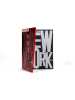
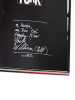

Publié pour la première fois en 1956, New York reste l'oeuvre phare de William Klein, qui a bouleversé les conventions de la photographie. Mélange des règles de composition, prises de vue en plongée et en contre-plongée, flou artistique, contrastes violents, cadrages accidentels : tout ce qui était auparavant considéré comme une « erreur » devient ici esthétique, au service d'une vision brutale et poétique de la ville. Klein, qui venait de quitter New York pour Paris, est revenu photographier sa ville natale et en a tiré un portrait chaotique, ironique et éblouissant, mettant en scène des enfants des rues, des foules anonymes, des graffitis, des publicités et des visages en gros plan. Ce livre « atomique », selon les termes des critiques, marque une rupture décisive dans l'histoire de la photographie du XXe siècle et influencera toute une génération d'artistes. Cette édition comprend de nombreuses images inédites. C'est après avoir vu New York que Federico Fellini demanda à Klein d'être son assistant réalisateur sur Les Noces de Cabiria. Armé de son appareil photo, Klein explora tous les recoins de la ville : " L'un de mes guides était le rédacteur en chef de l'équivalent italien des Temps Modernes (le journal de Sartre), dirigé par l'écrivain Alberto Moravia ; son principal sujet de préoccupation était de travailler sur les apparitions de la Vierge Marie ! Moravia, quant à lui, était masochiste. Il adorait s'emmerder. Il m'emmenait donc à 30 kilomètres de Rome, dans des restaurants bruyants où les gens venaient écouter les matchs de football. Cette aventure a conduit à la publication de Roma : « Rome est un film, et Klein l'a réalisé : c'est la plus belle Rome qui soit, et Klein est le meilleur photographe qui existe. Il connaît Rome comme un livre, et voilà... »" (Federico Fellini). Précieux exemplaire avec envoi à Lucien Clergue (1934-2014), fondateur des Rencontres d'Arles, qui témoigne du lien entre deux explorateurs de l'image : l'un révolutionnant la photographie urbaine, l'autre travaillant sur le corps, le sable, les ruines et les mythes méditerranéens. Auer, p. 365 ; The Book of 101 Books, pp. 140-142 ; Hasselblad Center, pp. 164-165 ; Parr & Badger, I, p. 243.
Weitere Untersuchungen über das Ikosaeder. - [FELIX KLEIN ON THE ICOSAHEDRON]
Leipzig, B.G. Teubner, 1877. 8vo. Original printed wrappers, no backstrip and a small nick to front wrapper. In ""Mathematische Annalen. Begründet durch Rudolf Friedrich Alfred Clebsch. XII. [12]. Band. 4. Heft."" Entire issue offered. Internally very fine and clean. [Klein:] Pp. 503-60. [Entire issue: Pp. pp. 433-576].
Frist printing of Klein's paper on the icosahedron.""A problem that greatly interested Klein was the solution of fifth-degree equations, for its treatment involved the simultaneous consideration of algebraic group theory, geometry, differential equations, and function theory. Hermite, Kronecker, and Brioschi had already employed transcendental methods in the solution of the general algebraic equation of the fifth degree. Klein succeeded in deriving the complete theory of this equation from a consideration of the icosahedron, one of the regular polyhedra known since antiquity. These bodies sometimes can be transformed into themselves through a finite group of rotations. The icosahedron in particular allows sixty such rotations into itself. If one circumscribes a sphere about a regular polyhedron and maps it onto a plane by stereographic projection, then to the group of rotations of the polyhedron into itself there corresponds a group of linear transformations of the plane into itself. Klein demonstrated that in this way all finite groups of linear transformations are obtained, if the so-called dihedral group is added. By a dihedron Klein meant a regular polygon with n sides, considered as rigid body of null volume."" (DSB VII, p. 400).The icosahedron is a regular polyhedron with 20 identical equilateral triangular faces, 30 edges and 12 vertices. It is one of the five Platonic solids.
Über die Streuung von Strahlung durch freie Elektronen nach der neuen relativistischen Quantendynamik von Dirac. - [KLEIN-NISHINA FORMULA]
Berlin, Springer, 1929. 8vo. Bound in contemporary half cloth with gilt lettering, In ""Zeitschrift für Physik"", Band 52, 1929. Entire issue offered. Two stamps to title page, otherwise fine. Pp. 853-68. [Entire volume: VIII, 894 pp].
First appearance of the important paper which constitutes one of the first results obtained from the study of quantum electrodynamics and ""played an important role in discussions of the applicable limits of quantum mechanics to studies of cosmic rays and nuclear physics."" (DSB).""In early 1928 Nishina returned to Copenhagen and worked with Oskar Klein. As a result of their cooperation, the Klein-Nishina formula was completed in October of the same year, before Nishina's return to Japan. In 1923 the quantum (particle) nature of X rays was discovered by Arthur Compton. Nishina had once made an experimental approach to this phenomena at the Cavendish Laboratory. The relation among the increased wavelength of the scattered X rays, the energy of recoiled electrons, and the scattering angle was accounted for by the quantum nature. In 1928 Nishina and Klein calculated the cross section and intensity of the Compton scattered radiation by the use of Dirac's new relativistic quantum mechanics of electrons. They succeeded in a complicated calculation by doing this separately and checking it together. (Nishina also brought this method of calculation with a team back to Japan.)Nishina and Klein searched for the solution of Dirac's wave equation in the case of a free electron (initially at rest) in the field of a plane electromagnetic wave."" (DSB).The Klein-Nishina was one of the first results obtained from the study of quantum electrodynamics. Consideration of relativistic and quantum mechanical effects allowed the development of an accurate equation for the scattering of radiation from a target electron. Before this derivation, the electron cross section had been classically derived by the British physicist and discoverer of the electron, J.J. Thomson. However, scattering experiments showed significant deviations from the results predicted by the Thomson cross section. Further scattering experiments agreed perfectly with the predictions of the Klein-Nishina formula.
Über die Streuung von Strahlung durch freie Elektronen nach der neuen relativistischen Quantendynamik von Dirac. - [KLEIN-NISHINA FORMULA]
Berlin, Springer, 1929. 8vo. Bound in contemporary half cloth with gilt lettering, In ""Zeitschrift für Physik"", Band 52, 1929. Entire volume offered. Two stamps to title page, otherwise fine. Pp. 853-68. [Entire volume: VIII, 894 pp].
First appearance of the important paper which constitutes one of the first results obtained from the study of quantum electrodynamics and ""played an important role in discussions of the applicable limits of quantum mechanics to studies of cosmic rays and nuclear physics."" (DSB).""In early 1928 Nishina returned to Copenhagen and worked with Oskar Klein. As a result of their cooperation, the Klein-Nishina formula was completed in October of the same year, before Nishina's return to Japan. In 1923 the quantum (particle) nature of X rays was discovered by Arthur Compton. Nishina had once made an experimental approach to this phenomena at the Cavendish Laboratory. The relation among the increased wavelength of the scattered X rays, the energy of recoiled electrons, and the scattering angle was accounted for by the quantum nature. In 1928 Nishina and Klein calculated the cross section and intensity of the Compton scattered radiation by the use of Dirac's new relativistic quantum mechanics of electrons. They succeeded in a complicated calculation by doing this separately and checking it together. (Nishina also brought this method of calculation with a team back to Japan.)Nishina and Klein searched for the solution of Dirac's wave equation in the case of a free electron (initially at rest) in the field of a plane electromagnetic wave."" (DSB).The Klein-Nishina was one of the first results obtained from the study of quantum electrodynamics. Consideration of relativistic and quantum mechanical effects allowed the development of an accurate equation for the scattering of radiation from a target electron. Before this derivation, the electron cross section had been classically derived by the British physicist and discoverer of the electron, J.J. Thomson. However, scattering experiments showed significant deviations from the results predicted by the Thomson cross section. Further scattering experiments agreed perfectly with the predictions of the Klein-Nishina formula.
GENEVRIER-TAUTSI Terhi, RIOUT Denys, KLEIN Yves.
Reference : 23060
ISBN : 9782373720853
Yves Klein. Japon.
<p>Avant de devenir Yves le Monochrome, Yves Klein, l’homme du bleu devenu aujourd’hui un mythe, se passionne pour le judo. C’est ce qui le pousse en 1952 à aller jusqu’au Japon, où il obtient sa ceinture noire 4e dan. Quelques mois après son retour en France, à la fin de l’année 1954, Yves Klein publiera d’ailleurs quasi simultanément Les Fondements du judo et Yves Peintures, considéré comme son premier geste d’artiste. Ce long séjour au Japon, nourri de rencontres et de découvertes, marque assurément Yves Klein qui y fait souvent allusion, et continue d’alimenter les interrogations de tous ceux qui s’intéressent à son oeuvre. Celle-ci y puiserait-elle sa source ? À la suite d’Yves Klein USA et Yves Klein Germany, ce livre, préparé en collaboration avec les Archives Yves Klein, retrace ce voyage fondateur à travers plus de 150 documents d’archives dont beaucoup sont inédits – photographies, correspondances et reproductions d’oeuvres – éclairés par les textes de Terhi Génévrier-Tausti et de Denys Riout. </p> Paris, 2020 Dilecta 240 p., cartonnage éditeur. 17 x 24
Neuf
[KLEIN] Dominique Bozo, Dominique de Ménil, Pontus Hulten, Jean-Yves Mock, Pierre Restany, Thomas McEvilley, Remo Guidieri, Shinichi Segi, Catherine Millet, Helmut Heissenbüttel, Yves Klein, Jean Tinguely, André Arnaud, Nan Rosenthal, Carol mancusi-Ungaro, Michel Conil-Lacoste, Claude Parent, Iris Clert, Arman, Raysse, Pierre Henry, Yuki tatsura, Christo, Larry Rivers, Jean Laffont, Sidney Janis, Virginia Dwan, Gottfried Honegger, Fred Klein, Rotraut Klein Moquay.
Reference : 6461
YVES KLEIN.
Paris, Centre Georges Pompidou, 1983. In-4 carré, broché.
A l'état de neuf. [6461]
Conférences à la Sorbonne 3 juin 1959
Paris 1962 1 Paris, RPM, sans date (1962) ; double microsillon présenté dans une pochette bleue Klein monochrome à l’extérieur, les étiquettes sur les disques étant dorées ; tirage annoncé de 500 exemplaires numérotés à la main en bleu. Yves Klein fit deux conférences à la Sorbonne les 3 et 5 Juin 1959 sur « L’évolution de l’art vers l’immatériel » et « L ‘architecture de l ‘air », juste avant sa première exposition chez Iris Clerc. C’est l’année ou il rencontre Hains,Villéglé, Dufrène, Restany et Tinguely, et la naissance du groupe des Nouveaux Réalistes. Ce disque fut réalisé par sa femme Rotraut après la mort de Klein.Yves Klein a retrospective Institute for the Arts, Rice University n°45 p335 ; p197 n°97. Pierre Restany, Yves Klein Chêne 1982 p 70, 244. Yves Klein : Vers l’Immatériel, préface de Denys Riout, Delecta 2006, p.11. (100322)
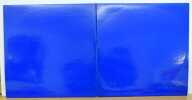
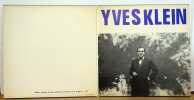
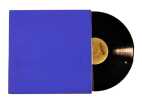
Très bel exemplaire.
Rome. (signé par William Klein)
Paris Editions du Seuil - Album Petite planète 3 1959 In-4 Cartonnage toile éditeur EDITION ORIGINALE. Préface et textes de Pasolini, Belli, Klein,. 153 photographies de Klein, mises en page par le photographe. Sans la jaquette mais avec ENVOI AUTOGRAPHE signé de Klein
Leçons sur certaines questions de géométrie élémentaire - Possibilité des constructions géométriques, Les polygones réguliers, Transcendance des nombres e et pi, démonstration élémentaire , Rédaction française autorisée par l'auteur par J. Griess (1ere édition française, 1896)
Librairie Nony et Cie à Paris Malicorne sur Sarthe, 72, Pays de la Loire, France 1896 Book condition, Etat : Bon relié, demi-toile noire ordinaire, pièce de titre manuelle au dos In-8 1 vol. - 99 pages
17 figures dans le texte en noir et blanc 1ere édition française, édition originale princeps, 1896 "Contents, Chapitres : Texte, 96 pages et 3 pages de tables - Préface du traducteur (Alger, septembre 1895), préface de F. Klein, Goettingue, Pâques 1895 - Introduction : Constructions théoriques et pratiques - Forme algébrique du problème - 1. Possibilité de la construction des expressions algébriques : Equations algébriques résolubles par radicaux carrés - Le problème de Delos et la trisection d'un angle quelconque - La division du cercle en parties égales - La construction du polygone régulier de 17 côtés - Généralités sur les constructions d'expressions algébriques - 2. Les nombres transcendants et la quadrature du cercle : Existence des nombres transcendants, démonstration de M. Cantor - Revue historique des essais de calcul et de construction de Pi - La transcendance du nombre ""e"" - La transcendance du nombre Pi - L'intégrale et la construction géométrique de Pi - Felix Christian Klein (25 avril 1849 à Düsseldorf 22 juin 1925 à Göttingen) est un mathématicien allemand, connu pour ses travaux en théorie des groupes, en géométrie non euclidienne, et en analyse. Il a aussi énoncé le très influent programme d'Erlangen, qui ramène l'étude des différentes géométries à celle de leurs groupes de symétrie respectifs. - La synthèse de Klein de la géométrie comme étude des invariants sous un groupe de transformations donné, connue sous le nom de programme d'Erlangen (1872), influença profondément l'évolution de la géométrie et des mathématiques dans leur ensemble. Ce programme était le cours inaugural de Klein comme professeur à Erlangen. Il propose une vision unifiée de la géométrie. Klein décrit en détail comment les propriétés centrales d'une géométrie donnée se traduisent par l'action d'un groupe de transformations. Aujourd'hui, cette vision est devenue tellement banale dans l'esprit des mathématiciens qu'il est difficile de juger de son importance, d'apprécier sa nouveauté et de comprendre l'opposition à laquelle elle a dû faire face. (source : Wikipedia)" reliure modeste mais en bon état, petit manque de carton sur le bas du plat supérieur (2 cms de haut, 1 mm de large) sans gravité, pièce de titre manuelle au dos, intérieur sinon frais et propre, le papier n'est qu'à peine jauni, cela reste un bon exemplaire de la 1ere édition française de ce texte essentiel de Félix Klein, peu courant en édition originale
Yves Klein Flip Flap’ Art. Ouvre les fenêtres et découvre l’Art d’Yves Klein.
Artissima Jeunesse 2006 In-4, cartonné illustré, photographies pleines pages en couleurs, 37 pp. Très bon état d’occasion.
Par un système ingénieux de fenêtres dans chaque page pour ouvrir sur une oeuvre d’Yves Klein. Le tout est accompagné de citations de l’artiste. Bon état d’occasion
Über die sogenannte Nicht-Euclidische Geometri. (Erster-) Zweiter Aufsatz. - [THE NON-EUCLIDEAN GEOMETRY OF KLEIN]
(Leipzig, B.F. Teubner, 1871 a. 1873). Without wrappers, (wrappers blank to Second Part) as published in ""Mathematische Annalen. Hrsg. von Felix Klein, Walter Dyck, Adolph Mayer."" Vol. IV, pp. 573-625 and vol. VI, pp. 112-145. Kept in a cloth-portfolio.
First edition. In these groundbreaking papers Klein established that if Euclidean geometry is consistent then non-Euclidean geometry is consistent as well and he introduces the adjectives ""parabolic"", ""elliptic"", and ""hyperbolic"" for the respective geometries of Georg Riemann, of Nicolai Lobachevsky, of C.F. Gauss and Janos Bolyai. ""Cayley's idea (that metrical geometry is part of projective geometry) was taken over by Felix Klein (1849-1925) and generalized so as to include the non-Euclidan geometries. Klein, a professor at Göttingen, was one of the lading mathematicians in Germany during the last part of the nineeeeteenth and first part of the twentieth century. During the years 1869-70 he larned the work of Lobatchevsky, Bolyai, von Staudt, and Cayley"" however, even in 1871he did not know Laguerre's result. It seemed to him to be posible to subsume the non-Euclidean geometries, hyperbolic, and double elliptic geometry, under projective geometry byexploiting Cayley's idea. He gave a sketch og his thoughts in a paper of 1871, and then developed them in two papers (1871 a. 1873, the ppers offered here). Klein was the first to obtain models of non-Euclidean geometries."" (Morris Kline). - Sommerville, Bibliography of Non-Euclidean Geometry p.45 (1871) and p. 49 (1873).
Zum Mehrkörperproblem der Quantentheorie (+) Über Wellen und Korpuskeln in der Quantenmechanik. - [JORDAN-KLEIN MATRICES]
Berlin, Julius Springer, 1927. 8vo. Entire volume 45 of ""Zeitschrift für Physik"" bound in a red-brown contemporary half cloth with gilt title to spine. Library stamp to title-page. Corners and lower capital bumped, hinges a bit weak. An overall fine and clean copy. Pp. 751-765"" 766-775. [Entire volume: VII, (1), 910 pp.].
First publication of Jordan and Klein's influential paper (the first mentioned) which contributed to the close connection between quantum fields and quantum statistics, today known as Jordan-Klein matrices. ""Born, Heisenberg, and Jordan had indicated, and Dirac had demonstrated, the close connection between quantum fields and quantum statistics. Second quantization guarantees that photons obey Bose-Einstein statistics. What about other particles which obey Bose-Einstein statistics? The year 1927 was not over before Jordan and Klein addressed this question [in the present paper]."" (Pais, Inward bound. p. 338).Jordan and Klein found that ""one can quantize just as well the non-relativistic Schroedinger equation. In honor of these contributions the matrices have been named Jordan-Klein matrices."" (ibid. p. 339). The second paper, ""Über Wellen und Korpuskeln in der Quantenmechanik"", ""contained several other formal and mathematical generalizations, but its main practical value is that, in the newly established theory of the 'quantized wave field', the fluctuations in the Bose case now satisfied all requirements following from Einstein's light-quantum treatment of 1924 and 1925."" (Mehra, The historical development of quantum theory, 2000, p. 231.
Sur les Fonctions Uniformes qui se reproduisent par des Substitutions Linéaires (+) [Klein's introduction to the present paper].
Leipzig, B.G. Teubner, 1882. 8vo. Original printed wrappers, no backstrip. In ""Mathematische Annalen. Begründet 1882 durch Rudolf Friedrich Alfred Clebsch. XIX. [19] Band. 4. Heft."" Entire issue offered. [Poincaré:] Pp. 553-64. [Entire issue: Pp. 435-594].
First printing of Poincaré's paper on his comprehensive theory of complex-valued functions which remain invariant under the infinite, discontinuous group of linear transformations. In 1881 Poincaré had published a few short papers with some initial work on the topic, and in the 1881, Klein invited Poincaré to write a longer exposition of his results to Mathematische Annalen which became the present paper. This, however, turned out to be an invitation to at mathematical dispute:""Before the article went to press, Klein forewarned Poincaré that he had appended a note to it in which he registered his objections to the terminology employed therein. In particular, Klein disputed Poincaré's decision to name the important class of functions possessing a natural boundary circle after Fuch's, a leading exponent of the Berlin school. The importance he attached to this matter, however, went far beyond the bounds of conventional priority dispute. True, Klein was concerned that his own work received sufficient acclaim, but the overriding issue hinged on whether the mathematical community would regard the burgeoning research in this field as an outgrowth of Weierstrassian analysis or the Riemannian tradition."" Parshall. The Emergence of the American Mathematical Research Community. Pp. 184-5.The issue contains the following important contributions by seminal mathematicians:1. Klein, Felix. Ueber eindeutige Functionen mit linearen Transformationen in sich. Pp. 565-68.2. Picard, Emile. Sur un théorème relatif aux surfaces pour lesquelles les coordnnées d´un point quelconque s´experiment par des fonctions abéliennes de deux paramètres. Pp. 578-87.3. Cantor, Georg. Ueber ein neues und allgemeines Condensationsprincip der Singularitäten von Functionen. Pp. 588-94.
Zum Mehrkörperproblem der Quantentheorie (+) Über Wellen und Korpuskeln in der Quantenmechanik. - [JORDAN-KLEIN MATRICES]
Berlin, Julius Springer, 1927. 8vo. Entire volume 45 of ""Zeitschrift für Physik"" bound in a black contemporary half cloth with gilt lettering to spine. Library stamp to free front end-paper. An overall fine and clean copy. Pp. 751-765"" 766-775. [Entire volume: VII, (1), 910 pp.].
First publication of Jordan and Klein's influential paper (the first mentioned) which contributed to the close connection between quantum fields and quantum statistics, today known as Jordan-Klein matrices. ""Born, Heisenberg, and Jordan had indicated, and Dirac had demonstrated, the close connection between quantum fields and quantum statistics. Second quantization guarantees that photons obey Bose-Einstein statistics. What about other particles which obey Bose-Einstein statistics? The year 1927 was not over before Jordan and Klein addressed this question [in the present paper]."" (Pais, Inward bound. p. 338).Jordan and Klein found that ""one can quantize just as well the non-relativistic Schroedinger equation. In honor of these contributions the matrices have been named Jordan-Klein matrices."" (Ibid. p. 339). The second paper, ""Über Wellen und Korpuskeln in der Quantenmechanik"", ""contained several other formal and mathematical generalizations, but its main practical value is that, in the newly established theory of the 'quantized wave field', the fluctuations in the Bose case now satisfied all requirements following from Einstein's light-quantum treatment of 1924 and 1925."" (Mehra, The historical development of quantum theory, 2000, p. 231.
Ueber die sogenannte Nicht-Euklidische Geometrie (+) Ueber die sogenannte Nicht-Euklidische Geometrie. (Zweiter Aufsatz). - [TWO MAIN WORKS ON NON-EUCLIDEAN GEOMETRY]
Leipzig, B.G.Teubner, 1871 u. 1873. Bound in 2 later full cloth. Small stamp on foot of titlepages.In. ""Mathematische Annalen. In Verbindung mit C. Neumann begründet durch Rudolf Friedrich Alfred Clebsch"", IV. und VI. Band. (4),637 pp. a. (4),642 pp., 6 plates. Klein's papers: pp. 573-625 a. pp. 112-145. Both volumes offered.
First edition of these 2 papers which unifies the Euclidean and Non-Euclidean geometries, by reducing the differences to expressions of the ""distance function"", and introducing the concepts ""parabolic"", ""elliptic"" and ""hyperbolic"" for the geometries of Euclid, Riemann and of Lobatschewski, Gauss and Bolyai. He further eliminates Euclid's parallel-axiom from projective geometry, as he shows that the quality of being parallel, is not invariant under projections.Klein build his work on Cayley's ""distant measure"" saying, that ""Metrical properties are not properties of the figure per se but of the figure in relation to the absolute."" This is Cayley's idea of the general projective determination of metrics. The place of the metric concept in projective geometry and the greater generality of the latter were described by Cayley as ""Metrical geometry is part of projective geometry."" Cayley's idea was taken over by Felix Klein....It seemed to him to be possible to subsume the non-Euclidean geometries, hyperbolic and double elliptic geometry, under projective geometry by exploring Cayley's idea. He gave a sketch of his thoughts in a paper of 1871, and then developed them in two papers (the papers offered here).Klein was the first to recognize that we do not need surfaces to obtain models of non-Euclidean geometries....The import which gradually emerged from Klein's contributions was that projective geometry is really logically independent of Euclidean geometry....By making apparent the basic role of projective geometry Klein paved the way for an axiomatic development which could start with projective geometry and derive the several metric geometries from it.""(Morris Kline).The offred volumes cntains other importen mathematical papers by f.i. by Klebsch, Lipschitz, Neumann, Noether, Thomae, Gordan, Lie, Du Bois-Raymond, Cantor (Über trigonometrische Reihen),etc.(Sommerville: Bibliography of Non-Euclidean Geometry p. 45 a. 49.)
Zur Nicht-Euklidischen Geometrie (+) Ueber die Nullstellen der hypergeometrischen Reihe.
Leipzig, B.G. Teubner, 1890. 8vo. Original printed wrappers, no backstrip and a small nick to front wrapper. In ""Mathematische Annalen. Begründet durch Rudolf Friedrich Alfred Clebsch. XXXVII. [37]. Band. 4. Heft."" Entire issue offered. Internally very fine and clean. [Klein:] Pp. 544-72"" 573-90. [Entire issue: Pp. pp. 465-604].
First printing of Klein's important contribution to non-Euclidean geometry. Klein saw a fundamental unity in the subject of non-Euclidean geometry. Rather than a heterogeneous collection of abstruse mathematics, non-Euclidean geometry was in Klein's view a ""concrete discipline"".For over two millennia geometry had been the study of theorems which could be proved from Euclid's axioms. However, in the beginning of the 19th century it was proved that there exist other geometries than that of Euclid. Motivated by the emergence of the new geometries of Bolyai, Lobachevsky, and Riemann, Klein proposed to define a geometry, not by a set of axioms, but instead in terms of the transformations that leave it invariant" according to Klein, a geometric structure consists of a space together with a particular group of transformations of the space. A valid theorem in that particular geometry is one that holds under this group of transformations. This controversial idea did not only give a more systematic way of classifying the different geometries, but also gave birth to new geometric structures such as manifolds. Landmark Writtings in Western Mathematics 1640-1940, p.544-52.
Die Mechanik nach den Principien der Ausdehnungslehre. - [FELIX KLEIN ON THE ICOSAHEDRON]
Leipzig, B. G. Teubner, 1877. 8vo. Bound in recent full black cloth with gilt lettering to spine. In ""Mathematische Annalen"", Volume 12., 1877. Entire volume offered. Library label pasted on to pasted down front free end-paper. Small library stamp to lower part of title title page and verso of title page. Title page missing a small piece of paper to the right margin, not affecting text. Very fine and clean. Pp. 503-60. [Entire volume: IV, 576 pp.].
Frist printing of Klein's paper on the icosahedron.""A problem that greatly interested Klein was the solution of fifth-degree equations, for its treatment involved the simultaneous consideration of algebraic group theory, geometry, differential equations, and function theory. Hermite, Kronecker, and Brioschi had already employed transcendental methods in the solution of the general algebraic equation of the fifth degree. Klein succeeded in deriving the complete theory of this equation from a consideration of the icosahedron, one of the regular polyhedra known since antiquity. These bodies sometimes can be transformed into themselves through a finite group of rotations. The icosahedron in particular allows sixty such rotations into itself. If one circumscribes a sphere about a regular polyhedron and maps it onto a plane by stereographic projection, then to the group of rotations of the polyhedron into itself there corresponds a group of linear transformations of the plane into itself. Klein demonstrated that in this way all finite groups of linear transformations are obtained, if the so-called dihedral group is added. By a dihedron Klein meant a regular polygon with n sides, considered as rigid body of null volume."" (DSB VII, p. 400).The icosahedron is a regular polyhedron with 20 identical equilateral triangular faces, 30 edges and 12 vertices. It is one of the five Platonic solids.The volume contain many other papers by contemporary mathematicians.
UNANIMITE [CATALOGUE PUBLICITAIRE CITROËN - CITROËN DS 19]
Paris Société Anonyme André Citroën (Delpire Publicité)t fils 1965 -in-4 broché un catalogue PUBLICITAIRE [Le fameux catalogue du photographe William Klein sur la DS 19], broché (agraphé) in-quarto à l'italienne Editeur (paperback oblong in-4 Editor) (23 x 32,8 cm), dos muet (spine - no title), couverture en couleur d'aprés une Photographie de William Klein, toutes tranches lisses, orné de nombreuses photographies en couleurs par William Klein + des extraits de presse venus du monde entier concernant la nouvelle Citroën, 22 pages, sans date (1965) Paris Société Anonyme André Citroën (Delpire Publicité) Editeur,
Citroën - producteurs parmi les designs automobiles les plus avant-gardistes jamais commercialisés sur une base grand public - s'est toujours vanté de ses collaborations avec des artistes, qui au fil des ans ont inclus Cartier-Bresson, Doisneau, Jean-Paul Goude et Marc Riboud. Pour ce catalogue de la fin des années 60, William Klein s'est concentré sur les éléments de conception futuristes et aérodynamiques qui ont fait de la DS (prononcez 'De-esse', français pour la déesse) l'une des voitures les plus uniques jamais fabriquées. Un article fantastique!, trés légère Trace d'usure sur les bords........Bel Exemplaire.....en Bon état (good condition). en bon état
Yves Klein 1928-1962.
Paris Union Centrale Des Arts Decoratifs 1969 In-4 carré Broché
Catalogue de la rétrospective organisée conjointement avec le Centre National d'Art Contemporain. Textes de Pierre Restany, Paul Wember et d'Yves Klein : Quelques extraits de mon journal en 1957 - L'aventure monochrome - Théâtre du vide - Attendu que j'ai peint. Reproductions en noir et en couleurs. In fine, biographie et liste des oeuvres exposées. Titre en bleu sur la couverture dorée. Très bon 0
New-York
Paris Seuil 1956 Life is Good & Good for You in New York: Trance Witness RevelsParis, aux Editions du Seuil, Album Petite Planète n°1, septembre 1956, 285x230mm, 192 pp., pleine toile noire de l’éditeur titrée au dos, pages de gardes photographiques.Roth 140-142 ; William Klein Centre Georges Pompidou 1983 p.21 à 61; Parr & Badger 243; Auer 365.
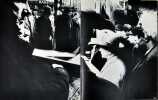
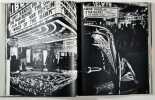
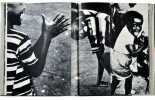
Premier livre de l’artiste dont il a exécuté entièrement la maquette.Installé à Paris en 1948, Klein se rend à New York en 1954 ou il réalise ces prises de vues, déclinant l’offre de directeur artistique du magazine Vogue qui lui était faite ; il retourne en France pour s’occuper de la publication de l’ouvrage dont il exécute entièrement la maquette; le livre sera publié en Italie et en Angleterre mais pas aux Etats Unis.« C’est par William Klein que le scandale arrive. En 1955, quand la photographie française demeurait confite dans un certain regard bienveillant et attendri, donnant l’image d’un réalité sociale, sinon déjà archéologique, du moins très largement anecdotique, William Klein fit voler en éclats les certitude des amateurs d’idées reçues. Les images brouillées, bougées, qu’il rapportait de New York révélèrent, à travers le désordre apparent de leur composition, une société pleine de mouvement, avenir probable et fascinant des nos sociétés européennes » (Alain Sayag: préface du catalogue William Klein Centre Georges Pompidou 1983). (104421) Manque la jaquette et le livret, dos un peu passé.

