 Write to the booksellers
63 books for « juvenalis »Edit
-
Language
French (64)
Latin (1)
-
Century
17th (6)
18th (4)
19th (5)
20th (1)
-
Topics
Books from the xviiith (1)
Classic literature (2)
Early printed books (1)
Greece (2)
Greek (27)
Iran - persia (8)
Jacob (2)
Latin (31)
Literature (8)
Mythology (2)
Philology (1)
Reliure (1)
Roman literature (1)
Rome (1)
Scandinavian literature (1)
-
Countries
Belgium (3)
Denmark (6)
France (18)
Netherlands (30)
Switzerland (8)
-
Syndicate
ILAB (16)
NVVA (2)
SLACES (2)
SLAM (7)
JUVENALIS (JUVENAL). - A. PERSII FLACCI (PERSE). - JUVENCIUS, Josephus.
Reference : 82657
Decii Junii Juvenalis et A. Persii Flacci satyrae. Notis novissimis ac perpetuâ interpretatione illustravit Josephus Juvencius. Cum appendice de Diis et Heroïbus poëticis, ad poëtarum intelligentiam necessaria. Nova editio prioribus linge emendatior.
Parisiis (Paris), H. Barbou 1805, 170x100mm, VIII - 446pages, reliure plein veau-marbré de l’époque. Dos richement orné: auteur, titre, fleurons, ornementations et filets dorés au dos. Double filets d’encadrement dorés sur les deux plats. Monograme doré des jésuites sur le plat supérieur, leitmotiv doré du Valais sur le plat inférieur. Très belle reliure d’époque. Intérieur trèspropre avec papier à la forme. Très bel exemplaire.
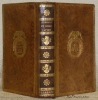
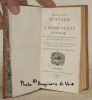
texte en latin, Pour un paiement via PayPal, veuillez nous en faire la demande et nous vous enverrons une facture PayPal
Satirae ad optimas editiones collatae accedit sulpiciae satira. C. Lucilli satirographorum principis fragmenta. Editio accurata.
Biponti - Zweybrücken, Ex Typographia Societatis 1785, 195x125mm, reliure cartonnage avec pièce d’auteurs dorés au dos. Reliure tachées par endroits, autrement bel exemplaire, intérieur très propre.
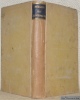
texte en latin, titre gravé (portrait de Persius), LXVII - 286 pages + 34 ff.(Index), Pour un paiement via PayPal, veuillez nous en faire la demande et nous vous enverrons une facture PayPal
D. Iunii Iuvenalis Satirarum libri V. Sulpiciae Satira. Nova editio, cura Nicolai Rigaltii.
Paris (Lutetiae), Ex officina Rob. Stephani, 1616.
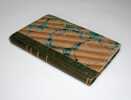
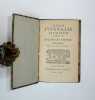
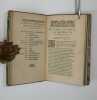
12mo. (XL),126,(2 blank) p. 19th century half cloth. 13.5 cm 'The most important, most widely read, most influential classical poet throughout the 17th and 18th centuries' (Ref: Schweiger 2,503/04: 'Neue Recension, nach Handschriften. Die Noten sind kurz und von Werth. Sauber und nicht häufig'; Dibdin 2,154, on the editions of 1613-1616: 'These editions especially the latter, are classical and correct, and the type is beautiful'; Renouard, Robertus tertius, p. 202; Moss 2,158; Graesse 3,520; Ebert 11236) (Details: Back ruled gilt, boards marbled. Woodcut printer's Olive tree device of the Stephanus family on the title, motto: 'Noli altum sapere, sed time', in English 'Donot be high-minded, but fear'. (Epistola Beati Pauli ad Romanos 11,20) The preliminaries of this book contain N. Rigaltius' treatise 'De satira Iuvenalis', and five pages testimonia; p. 1-105 contain the text of the satires, p. 106-126 the notes of Rigaltius, which are highly praised by the bibliographers; Ebert observes: 'The notes are short, but full of matter') (Condition: Corners slightly bumped. The last 6 pages, containing notes of Rigaltius, have been bound by mistake at the end of preliminary pages) (Note: The Roman poet Juvenalis, ca. 55-140 AD, was the last and the greatest of the Roman satirists. He left 16 hexametric satires, in five books, averaging 750-800 lines each, and apparantly arranged in the order of publication. He 'uses names and examples from the past as protective covers for his exposés of contemporary vice and folly'. (The Classical Tradition, Cambr. Mass., 2010, p. 501) In the first satire already Juvenal writes that he cannot help writing satire, seeing the corruption of Rome, and confesses that for safety reasons (he lived in an age of absolute monarchy), he would only attack the dead. His main theme is the dissolution of the social fabric in a city that was swelling like a tumor, where wealth was unevenly divided, and which was filled with the smell of decay. 'Something more like that age was born in the 17th century and lasted until revolutions destroyed it. Something like Juvenal's Rome appeared, in Venice and Paris and Madrid and London; men and women very like his (Juvenal's) courtiers and courtesans swaggered through Versailles and Blenheim and scores of petty palaces; men like Juvenal himself were flogged by the duke's footmen, or, after waiting in the earl's vestibule, were repulsed from his door. Much of what Juvenal says is permanently true and has been admired through many changing centuries. But when his poems are read in an age like that which produced them they acquire a double energy, an intenser truth. So throughout the 17th and 18th centuries he was one of the most important, most widely read, most influential, best understood classical poets'. (G. Highet, 'Juvenal the satirist', Oxford 1955, p. 213/14) Wikipedia offers very sketchy information about the French classical scholar Nicolaus Rigaltius, or in French Nicolas Rigault, 1577-1654. His Vicipaedia article is however perfect, it contains useful information, literature and links on this lawyer, scholar and libarian (after Casaubon) of Louis XIII. In 1599 he published the 'editio princeps' of the 'Strategicon' of Onosander, and later on he produced texts and commentaries of several classical and byzantine authors, e.g. 'Phaedrus' (1599), 'Nicolai Rigaltii Glossarium taktikon mixobarbaron' (1601), 'Martial' (1601), 'Oneirocritica' (1603), 'Rei accipitrariae scriptores', (editio princeps 1612), 'Menandri et Philistionis sententiae' (1613), 'Juvenal' (1616), 'Tertullian' (1628), 'Minucius Felix' (1643), 'Cyprianus' (1648). The French scholar Pierre Pithou, 1539-1596, published in 1585 a superior text of Juvenalis and Persius. This edition served in 1616 as a model to Rigaltius, whose edition in its turn served as a model to editors of Juvenalis for almost 200 years. (Housman 1931)) (Collation: a12, b8; A-E12, F4 (The last gathering, gathering F, p. 121/126, was bound erroneously between the leaves b4 and b5 of the preliminariary leaves; leaf F4 blank) (Photographs on request)
D .Junii Juvenalis satyrae omni objcoenitate expurgatae cum annotationibus .
Couverture rigide Turonibus, P Masson , 1685 , in12 plein veau, 274pp . . Relié avec: Perse - Auli Persii Flavi satyrae omni objcoenitate expurgatae cum annotationibus . .Turonibus, P Masson , 1686 , 82pp . Un joli titre gravé , abondantes annotations sur 2 colonnes . Une coiffe émoussée . Langue: Français
D. Junii Juvenalis et Auli Persii Flacci Satyrae: cum Veteris Scholiastae & Variorum Commentariis. Accurante Cornelio Schrevelio.
Leiden (Lugd. Bat.), Apud Franciscum Hackium, 1658.
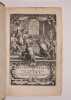
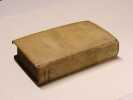
8vo. (XVI),638,(42 index) p. Overlapping vellum 20 cm (Ref: STCN ppn 840202245; Schweiger 2,511; Dibdin 2,154; Moss 2,158/9; Ebert 11242; Graesse 3,520) (Details: 6 thongs laced through both joints. Shorttitle in ink on the back. The engraved title, which is not signed, is used here for the second time. It was first used for the original edition of 1648, of which this 1658 edition is a reissue; The engraved title of 1648 still bears the name of the engraver, it is executed by the Dutch Golden Age engraver Reinier van Persijn; for this edition of 1658, the X before LVIII was simply filed away from the copper plate, and at the same time the name of Persijn, just beneath the X. The title depicts allegorical scenes: on the left a naked woman sitting on a crocodile, holding in her hand a parrot; then a Janus-headed woman, with bird feet and a tail, holding up in her left hand a Momus-mask, and in her right 2 flaming hearts; in the centre sits on a throne an old woman, holding in her left hand a sack of money (?), and in her right what seems a little flask; on the right in the foreground a king reaching for that sack; he is accompanied by a priest, a farmer (?) and a soldier; in a window central above the old woman we see the ascension of the poet) (Condition: Vellum age-toned and slightly worn. Oddly enough a previous owner has replaced the vanished X in the impressum for a new one in ink. Outer margin of the first 2 leaves sligthly thumbed) (Note: The Roman poet Juvenalis, ca. 55-140 AD, was the last and most influential of the Roman satirists. He 'uses names and examples from the past as protective covers for his exposés of contemporary vice and folly'. His main theme is the dissolution of the social fabric. (The Classical Tradition, Cambr. Mass., 2010, p. 501) The satires of the stoic poet Aulus Persius Flaccus form one 'libellus' of 6 satires, together 650 hexameters. 'They are well described as Horatian diatribes transformed by Stoic rhetoric'. 'He wrote in a bizarre mixture of cryptic allusions, brash colloquialisms, and forced imagery. (OCD, 2nd ed. p. 805) This edition of 1658 is a 'Variorum' edition. It offers the 'textus receptus' which is widely accepted, accompanied with the commentary and the annotations of specialists, taken from earlier useful, normative or renewing editions. Editions like these, 'cum notis Variorum', were useful, but never broke new ground. The production of this kind of editions was the specialty of Dutch scholars of the 17th and 18th century. The compilers seldom were great scholars, but often hard working schoolmasters. Their involvement in publishing a new edition was limited to the necessary, but ungrateful task of the beast of burden. Such a plodder was the Dutch editor Cornelius Schrevelius, who taught classics at the Schola Latina at Leiden, where he had been raised himself. In 1642 he succeeded his father, Theodorus Schrevelius, as the rector (Moderator) of the school. He raised at least 11 kids, and fell in 1664 victim to the then raging plague. His first Juvenal edition he published in 1648, and it was reissued by Hackius in 1658, 1664 and in 1671. Schrevelius' aim was to promote the studies of his young students and to instill in them a necessary fear (optatam metam), which will make them useful citizens and the pride of their parents. Juvenal is a suitable author for such an enterprise, for he flogs wrongdoers, and learns them to avoid the path of wickedness and to embrace honesty. (Dedicatio p. *2 verso). Especially in shameless times as ours, he continues, satyre is needed. Decent behaviour and faith have been replaced by deceit and swindle. In a short 'Benigno Lectori' (*4 verso and *5 recto) Schrevelius tells that he relies for the text on the earlier editions of Robertus Stephanus and Pithoeus, and that he excerpted the notes and commentaries of Lubinus, Farnabius and Casaubon. In addition he offers, he says, a complete and emendated edition of the old Scholiast. Schrevelius even used two excellent manuscripts which were lent to him by the Leiden professor Salmasius, which helped him to solve many difficult problems. The engraved title deserves some attention. The easiest description we found was 'an engraved title with many figures'. To us, it seems an allegorical scene based on the tenth satire, Juvenal's famous declamation on the folly of men in desiring in their prayers from the gods vane things as honor, fame, wealth, power, beauty, or a long life, instead of a sane spirit in a healthy body. 'Whole households have been destroyed by the compliant gods in answer to the masters' prayers. In camp (nocitura militia) and city (nocitura toga) alike we ask for things that will be our ruin'. (Vss. 7/9, in the Loeb-translation of Ramsay) Juvenal offers a list of pityful examples, such as the once powerful Sejanus, who like Libyan general Gadaffi many centuries later was 'being dragged along by a hook, as a show and joy to all'. (Vss. 66/67, translation Ramsay) Victims of their lust for power were Alexander the Great, Xerxes, or the Punic conqueror Hannibal, the man who was once about to destroy Rome. We assume that the royal figure who reaches out for the sack of money, or from whose hands it is being snatched, is Hannibal. The clue for this assumption is the woman on the crocodile. Such a woman was in 17th century iconography the common personification of Africa, for instance on maps. The fate of this scourge of Rome is treated by Juvenal in evocative language in 20 beautiful verses. It begins like this: 'Put Hannibal into the scales; how many pounds' weight will you find in that greatest of commanders? This is the man for whom Africa was all too small'. (Vss. 147/8) Together with the old woman he is the central figure on the title. The positioning of the three woman brings in mind a Triad, a triple diety, such as the Graces, the Moirai or Fates, or the Harpies. The Erinyes, the avenging spirits, sometimes form a trinity too. The standing woman seems to be a mixture of an Erinye and a Harpy. She has some features of such a Harpy, the personification of deamonic powers, and an agent of terrible punishment. She is bare breasted and stands on huge bird claws, with which she abducts the souls of the dead to their doom. In her right hands she holds, instead of the usual horrifying snake, a Momus mask, which personifies satire and mockery, the power to make a fool or ass of someone. In her left hand rest two flaming hearts, catholic imagery, distastful to the protestants, and therefore perhaps reprensenting idolatry. Her double faced Janushead, looking to the future and the past, might be an image of Time. The old woman on the throne is the central figure on the title. To her all movement on the picture is directed. She has the features of Atropos, the riged and inflexible one, the oldest of the 3 Moirai, or Fates, and in iconography often depicted as an old woman. She has power over life and death, and represents the fate that cannot be avoided. She holds Hannibal's fate in her hands. She withdraws the sack of money (power) and offers with her right hand the once mighty suppliant a little flask or a small beaker, with the invitation to poison himself. Juvenal on Hannibal's unglamorous bleak death: 'What then was his end? Alas for glory! A conquered man, he flees headlong into exile, and there he sits, a mighty and marvellous suppliant, in the Kings's antichamber, until it pleases his Bithynian Majesty to awake! No sword, no stone, no javelin shall end the life which once wrought havoc throughout the world: no, but that which shall avenge Cannae and all those seas of blood, a ring (containing poison)'. (Vss. 158/165, translation Ramsay) The engraver follows for this scene the better known version of the Roman historian Livy. In chapter 51 of the 39th book of his History of Rome, 'Ab Urbe Condita' Livy tells that Hannibal took his poison in an 'poculum', a cup/ goblet/ bowl/ beaker) (Provenance: The last owner was Lennart Håkanson, professor of Latin Literature of the University at Uppsala, 1980-1987) (Collation: *8, A-Z8 Aa-Tt8 Vv4) (Photographs on request)
D. Junii Juvenalis et Auli Persii Flacci Satyrae: cum Veteris Scholiastae & Variorum Commentariis. Accurante Cornelio Schrevelio.
Leiden (Lugd. Batav.), Ex officina Hackiana, 1671.
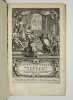
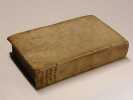
8vo. (XVI),604,(42 index) p. Vellum 20 cm (Ref: STCN ppn 840013876; Schweiger 2,511; Dibdin 2,154; Moss 2,158/9; Ebert 11242; Graesse 3,520) (Details: 5 thongs laced through both joints. Short title in ink on the back. The engraved title, which is not signed, is used here for the third time. It was first used for the original edition of 1648, for a repetition in 1658, and for this 1671 reissue. In 1648 the engraved title still bears the name of the engraver, it is executed by the Dutch Golden Age engraver Reinier van Persijn. The title depicts a complicated allegorical scene: on the left a naked woman sitting on a crocodile, holding in her hand a parrot; then a Janus-headed woman, with bird feet and a tail, holding up in her left hand a Momus-mask, and in her right 2 flaming hearts; in the centre sits on a throne an old woman, holding in her left hand a sack of money (?), and in her right what seems a little flask; on the right in the foreground a king reaching for that sack; he is accompanied by a priest, a farmer (?) and a soldier; in a window central above the old woman we see the ascension of the poet. See for an explanation of the allegory the note below) (Condition: Vellum age-toned and soiled. Boards worn at the extremities. Front hinge cracking but still strong. Front flyleaf loosening. Name on the front flyleaf. Small old inscription on the rear pastedown. Occasional small ink underlinings. Small wormhole in the right lower corner of the first 14 gatherings, never even coming near to the text) (Note: The Roman poet Juvenalis, ca. 55-140 AD, was the last and most influential of the Roman satirists. He 'uses names and examples from the After p. 65 has been added a plate showing a allegoric triumph scene with prince Frederik Hendrik of Orange. See for this plate: rkd.nl/nl/explore/portraits/record?filters[plaats][]=Den+Haag&filters[kunstenaar][] =Vinckboons%2C+David+%28I%29&query=&start=2)past as protective covers for his exposés of contemporary vice and folly'. His main theme is the dissolution of the social fabric. (The Classical Tradition, Cambr. Mass., 2010, p. 501) The satires of the stoic poet Aulus Persius Flaccus form one 'libellus' of 6 satires, together 650 hexameters. 'They are well described as Horatian diatribes transformed by Stoic rhetoric'. 'He wrote in a bizarre mixture of cryptic allusions, brash colloquialisms, and forced imagery'. (OCD, 2nd ed. p. 805) This edition of 1671 is a 'Variorum' edition. It offers the 'textus receptus' which is widely accepted, accompanied with the commentary and the annotations of specialists, taken from earlier useful, normative or renewing editions. Editions like these, 'cum notis Variorum', were useful, but never broke new ground. The production of this kind of editions was the specialty of Dutch scholars of the 17th and 18th century. The compilers seldom were great scholars, but often hard working schoolmasters. Their involvement in publishing a new edition was limited to the necessary, but ungrateful task of the beast of burden. Such a plodder was the Dutch editor Cornelius Schrevelius, who taught classics at the Schola Latina at Leiden, where he had been raised himself. In 1642 he succeeded his father, Theodorus Schrevelius, as the rector (Moderator) of the school. He raised at least 11 kids, and fell in 1664 victim to the then raging plague. His first Juvenal edition he published in 1648, and it was reissued by Hackius in 1658, 1664 and in 1671. Schrevelius' aim was to promote the studies of his young students and to instill in them a necessary fear (optatam metam), which would make them useful citizens and the pride of their parents. Juvenal is a suitable author for such an enterprise, for he flogs wrongdoers, and learns them to avoid the path of wickedness and to embrace honesty. (Dedicatio p. *2 verso) Especially in shameless times as ours, he continues, satyre is needed. Decent behaviour and faith have been replaced by deceit and swindle. In a short 'Benigno Lectori' (*4 verso and *5 recto) Schrevelius tells that he relies for the text on the earlier editions of Robertus Stephanus and Pithoeus, and that he excerpted the notes and commentaries of Lubinus, Farnabius and Casaubon. In addition he offers, he says, a complete and emendated edition of the old Scholiast. Schrevelius even used two excellent manuscripts which were lent to him by the Leiden professor Salmasius, which, he tells, helped him to solve many difficult problems. The engraved title deserves some attention. The easiest description we found was 'an engraved title with many figures'. To us, it seems an allegorical scene based on the tenth satire, Juvenal's famous declamation on the folly of men in desiring in their prayers from the gods vane things as honor, fame, wealth, power, beauty, or a long life, instead of a sane spirit in a healthy body. 'Whole households have been destroyed by the compliant gods in answer to the masters' prayers. In camp (nocitura militia) and city (nocitura toga) alike we ask for things that will be our ruin'. (Vss. 7/9, in the Loeb-translation of Ramsay) Juvenal offers a list of pityful examples, such as the once powerful Sejanus, who like the Libyan general Gadaffi many centuries later was 'being dragged along by a hook, as a show and joy to all'. (Vss. 66/67, translation Ramsay) Victims of their lust for power were Alexander the Great, Xerxes, or the punic conqueror Hannibal, the man who was once about to destroy Rome. We assume that the royal figure who reaches out for the sack of money, or from whose hands it is being snatched, is Hannibal. The clue for this assumption is the woman on the crocodile. Such a woman was in 17th century iconography the common personification of Africa, for instance on maps. The fate of this scourge of Rome is treated by Juvenal in evocative language in 20 beautiful verses. It begins like this: 'Put Hannibal into the scales; how many pounds' weight will you find in that greatest of commanders? This is the man for whom Africa was all too small'. (vs. 147/8). Together with the old woman he is the central figure on the title. The positioning of the three woman brings in mind a Triad, a triple diety, such as the Graces, the Moirai or Fates, or the Harpies. The Erinyes, the avenging spirits, also sometimes form a trinity. The standing woman seems to be a mixture of an Erinye and a Harpy. She has some features of such a Harpy, the personification of deamonic powers, and an agent of terrible punishment. She is bare breasted and stands on huge bird claws, with which she abducts the souls of the dead to their doom. In her right hands she holds, instead of the usual horrifying snake, a Momus mask, which personifies satire and mockery, the power to make a fool or ass of someone. In her left hand rest two flaming hearts, catholic imagery, distastful to the protestants, and therefore perhaps reprensenting idolatry. Her double faced Janushead, looking to the future and the past, might be an image of Time. The old woman on the throne is the central figure on the title. To her all movement on the picture is directed. She has the features of Atropos, the riged and inflexible one, the oldest of the 3 Moirai, or Fates, and in iconography often depicted as an old woman. She has power over life and death, and represents the fate that cannot be avoided. She holds Hannibal's fate in her hands. She withdraws the sack of money (power) and offers with her right hand the once mighty suppliant a little flask or small beaker, with the invitation to poison himself. Juvenal on Hannibal's unglamorous bleak death: 'What then was his end? Alas for glory! A conquered man, he flees headlong into exile, and there he sits, a mighty and marvelous suppliant, in the Kings's antichamber, until it pleases his Bithynian Majesty to awake! No sword, no stone, no javelin shall end the life which once wrought havoc throughout the world: no, but that which shall avenge Cannae and all those seas of blood, a ring (containing poison)'. (Vss 158/165, translation Ramsay) The engraver follows for this scene the better known version of the Roman historian Livy. In chapter 51 of the 39th book of his History of Rome, 'Ab Urbe Condita', Livy tells that Hannibal took his poison in an 'poculum' cup/goblet/bowl/beaker) (Provenance: Manuscript ownership entry of 'A.J. Enschedé' on the front flyleaf. Adriaan Justus Enschedé, 1829-1896, was a member of a famous Dutch dynasty of printers. His forefather Izaak Enschedé established himself in Haarlem in 1703, and there the firm remained for more than 300 years. The firm was, and still is famous for the quality of its printing of bonds and banknotes. In 1810 they printed the first Dutch banknotes. Adriaan Justus entered the firm and kept it flourishing. From 1857 onward he was also Keeper of the archives of the city of Haarlem. He wrote several books on the history of Haarlem, and on the history of the Wallon Church in the Netherlands) (Collation: *8, A-2R8 2S4 (2S4 blank)) (Photographs on request)
D. Iunii Iuvenalis Aquinatis Satirae XVI. Recensuit et annotationibus instruxit Ernestus Guilielmus Weber, Weissenseas, Philos. Dr. et Professor Gymnasii Wimariensis.
Weimar (Wimariae), In novo Bibliopolio, vulgo Landes-Industrie-Comptoir, 1825.
8vo. X,380,(2 corrigenda) p. Half calf 22 cm (Ref: Schweiger 2,505: 'Neue Recognition des Textes. Ruperti's Text liegt zum Grunde. Die Interpunktion ist vereinfacht. Die schwierigen Stellen sind trefflich erläutert'; Graesse 3,521; Not in Spoelder p. 554, Enkhuizen) (Details: Prize copy of the Gymnasium of Enkhuizen, including the prize, printed on thick paper. Spine divided by double gilt fillets. Gilt lettered shield in the 'second compartment') (Condition: Binding worn at the extremes. Owing to a binder's error the pages in the 23rd and 24th gathering (from p. 353 to 376) have been mixed up, and 4 of those leaves have been bound double) (Note: The Roman poet Juvenalis, ca. 55-140 AD, was the last and most influential of the Roman satirists. He 'uses names and examples from the past as protective covers for his exposés of contemporary vice and folly'. His main theme is the dissolution of the social fabric. (The Classical Tradition, Cambr. Mass., 2010, p. 501) This Juvenal edition of 1825 was produced by the German schoolmaster Ernst Christian Wilhelm Weber, born in 1796 in Wissensee. In 1815 he went to Leipzig to study classical philology under Gottfried Hermann. In 1819 he published in Jena a dissertation 'Animadversiones in Juvenalis Satiras'. In 1820 he was appointed rector of the Gymnasium of Weimar, and 3 years later he received the title of professor. In 1826 the firm of Teubner published his edition of Persius. Another contribution to classical scholarship is his edition of Demosthenes' 'Oratio in Aristocratem'. (ADB 41,287/89) (Provenance: The folding prize, 19x28 cm, with the coat of arms of Enkhuizen, has been printed for the greater part; names and the occasion have been added by hand; it reads: 'Ingenio Magnaeque Spei Adolescenti Christiano Cramer Hartman propter insignes in artibus humanioribus progressus praemium hoc litterarum, virtutis et diligentiae testimonium, Gymnasii Enchuisani Curatores donarunt cum in secundam classem transscriberetur, ad diem 6 Septembris 1830'. It is signed by 'R.J. Jungius, S. Muntendam, Duyvensz', and by 'Me Gymnasii Rectore' A. Hirschig. Spoelder does not mention this kind of prize copy, without the coat of arms on the boards, but with the coat of arms on the prize. Christiaan Cramer Hartman was born in Averhorn in 1817. He died in Utrecht in 1886. (See for him 'pondes.nl/detail/i_d.php?inum=14460294') This is about all that is to be found on Christiaan. His diligence and virtue brought him only a public notice of his marriage with Johanna Spruyt in Utrecht in the 'Opregte Haarlemsche Courant' of the 3rd of May 1862, in Utrecht) (Photographs on request)
Juvenalis and Persius, literally translated. With copious explanatory notes; By M. Madan. A new edition, revised and corrected.
Oxford, London, printed by J. Vincent for Thomas Tegg, 1889.
2 volumes: 307;344 p. Cloth 23 cm (Bindings shabby, especially the backs; front fleaves removed; some pencil. Interior ok)
Bloemlezing uit de hekeldichten van D. Junius Juvenalis door R. SCHOCKAERT.
Leuven, De Vlaamse drukkerij, 1949.
137 p. Wrs. 23 cm (OiN 237; t., tr., c. & notes)
A. Persii Flacci et Dec. Jun. Juvenalis Satirae. Ad optimas editiones collatae. Accedit Sulpiciae satira. C. Lucilii satirographorum principis fragmenta. Editio accurata.
Biponti, ex typographia Societatis, 1785.
67,286;69 p. Hardb. 20 cm (Cover worn at extremities; small piece of paper on the back gone)
Traduction des Satyres de Perse, et de Juvénal, par le Révérend Pere Tarteron, de la Compagnie de Jésus. Nouvelle édition.
Paris, Par la Compagnie des Libraires, 1714.
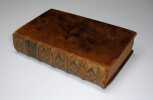
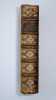
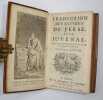
12mo in eights & fours. (XLVIII),591,(1 blank) p. Calf 17 cm Two poets exploring the limits of satiric free speech (Ref: Schweiger 2,517; cf. Graesse 3,522; Ebert 11273) (Details: Back gilt and with 5 raised bands, shield in the second compartment. The frontispiece depicts a poet/thinker in a robe, and seated on a stone bench; on the bench the inscription Facit indignation versum. Printer's mark, a beehive, on the title. The Latin text & French translation are printed side by side in different typefaces) (Condition: Wear to extremities of the binding: head & tail of the back slightly chafed. Back rubbed. Shield on the back vanishing. Wormhole near the gutter of the left lower corner of the first 64 p.) (Note: The stoic poet Aulus Persius Flaccus, 34-62 A.D., is a representative of the imperial Latin satire. His stoic satires form one 'libellus' of 6 satires, together 650 hexameters. 'They are well described as Horatian diatribes transformed by Stoic rhetoric'. 'He wrote in a bizarre mixture of cryptic allusions, brash colloquialisms, and forced imagery'. (OCD, 2nd ed. p. 805) The Stoic philosopher is in the work of Persius not a figure of fun, but a wise man. The Roman poet Juvenalis, ca. 55-140 AD, was the last and most influential of the Roman satirists. He 'uses names and examples from the past as protective covers for his exposés of contemporary vice and folly'. (The Classical Tradition, Cambr. Mass., 2010, p. 501) His main theme is the dissolution of the social fabric. He had a lasting influence on neolatin and vernacular writers of the Renaissance and later centuries. A striking feature of this book is, when one runs it through for the first time, is the discrepancy between the space occupied by the Latin text and the French translation. Take for instance the pages 2 and 3: on p. 2 we count 56 Latin words, on the opposing page 152 French words. Concise verses are transformed into long phrases in prose. The translator of these verses, the French Jesuit Jérôme, or Hieronymus Tarteron, 1644-1720, was professor of rhetoric. He translated also the Satires, Letters and the Ars Poetica of Horace. As usual with Jesuit editions, here also 'le pere Tarteron a eu soin de retrancher ce qui dans ces poëts pourroit nuire aux bonnes moers', so we read in the second volume of the Nouveau Supplement au Grand Dictionnaire Historique, de L. Moreri, Paris 1749. The edition was first published in 1689 and met with some success: it was reissued in 1695, 1706, 1714, 1729, 1737 and 1752) (Collation: pi1 (frontispiece), â8, ê4, î8, ô4; A8-3B4 (:gatherings A - 3B alternating), 3C8)) (Photographs on request)
JUVENALIS Decimus Junius ( JUVENAL ) / PERSIUS FLACCUS ( PERSE ) / PULLMANUS Theodorus ( editeur )
Reference : 055924
D. IUNI JUVENALIS SATIRARUM LIBRI V. A. Persii Flacci Satyrarum liber I. Theod. Pulmanni in eosdem Annotationes.
Antverpiae ( Anvers ) Ex officina Christophori Plantini 1565 in 12 (17x11) 1 volume reliure demi veau havane, dos à nerfs orné de fleurons à froidl, pièces de titre de cuir vert et rouge, page de titre avec vignette gravée à la marque au compas de l'imprimeur Plantin (woodcut printer's device on title page), 160 pages. Rare première edition Plantinienne du livre V des satires de Juvénal (first Plantin edition of the preserved works by Juvenal and Persius edited by Theodor Poelman, 1512-1581). Bel exemplaire ( Photographies sur demande / We can send pictures of this book on simple request )
Bon Couverture rigide
Forsøg til en Dansk Oversettelse af D. Junii Juvenalis tiende Satyra efter R. Falsters Maade ved Jacob Johan Lund.
Kjøbenhavn, Andreas Hartvig Godiche, 1754. 4to. I de originale stænkede omslag. En smule ubetydeligt slid ved ryg og kanter af foromslag. Trykt på skrivepapir. Særdeles ren indvendig.

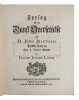
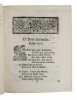
Det ualmindelige originaltryk af den første danske oversættelse af Juvenals 10. Satire. Nærværende oversættelse udgør tilmed den tredje danske oversættelse af Juvenal efter Christian Falsters oversættelse af den 14. Satire (1731) og Andreas Benjamin Poulsens af den 13. (1753).
Decii Junii Juvenalis Satirarum - Libre quinque ex Recognitione Steph. And. Philippe.
Lutetia Parisiorum [Paris], sumptibus Joan. August. Grangé, 1747. Un vol. au format in-12 (158 x 92 mm) de 2 ff. bl., lxviii - 224 pp. et 1 f. bl. Reliure de l'époque de plein maroquin olive triple filet doré terminé par des écoinçons dorés portés sur les plats, dos lisse orné d'un double filet d'encadrement doré, doubles filets dorés, fleurons dorés, semis de pointillés dorés, pièce de titre de maroquin vieux-rouge, titre doré, palette dorée en queue, filet doré sur les coupes, tranches dorées, dentelle intérieure dorée, gardes agrémentées d'un semis de fleurons et de cercles dorés.
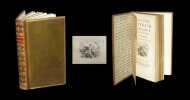
Exemplaire revêtu d'une délicate reliure du temps de plein maroquin. L'ouvrage s'ouvre sur une jolie vignette allégorique gravée en page de titre, recèle de larges bandeaux et culispices gravés ainsi que quelques lettrines. Détestant Rome, ou plutôt ce qu'elle est devenue, Juvénal fait de ses contemporains une peinture acerbe et sans pitié. faisant sans cesse fi du politiquement correct Le tableau (parodie d'une œuvre perdue) qu'il propose de la cour de Domitien, le «Néron chauve», s'il est riche de notations grotesques, rend très bien l'atmosphère cauchemardesque d'une époque qui exsudait la terreur. On ne saurait parler sans anachronisme de liberté d'expression quand il s'agit de la Rome impériale, et Juvénal se garde bien de s'en prendre aux empereurs régnants. Ce qui n'empêcha pas ses contemporains de lire dans ses propos des allusions à l'actualité de son temps. La langue de Juvénal permet de se faire une idée de la variété des parlers latins, selon les classes sociales et les régions. Elle est à la fois vigoureuse, voire crue, et savante. Juvénal aime jouer du contraste entre les mœurs des anciens Romains, frugaux et barbus, et celles de ses contemporains, perdus de luxe et efféminés. Avec Horace, Juvénal constituera un modèle au XVIIIème siècle pour les Satires de Nicolas Boileau (1666). Emmanuel Kant retiendra quant à lui de ses satires leur dimension morale, et citera Juvénal, à plusieurs reprises, dans sa Critique de la raison pratique. Angles et coiffes très légèrement élimés. Rares rousseurs dans le texte ; quoique davantage marquées aux feuillets liminaires. Petite déchirure en marge d'un feuillet. Du reste, belle condition.

Juvénal] - Decimus Junius Juvenalis / Achaintre, Louis-Nicolas (édt.)
Reference : 8357
(1810)
Decimi Junii Juvenalis Satirae Ad Codices Parisinos Recensitae Lectionum Varietate et Commentario Perpetuo Illustratae A Nic. Lud. Achaintre Accedunt Hadr. Et Valesiorum Notae Adhuc Ineditae
Sumptibus et Typis Firmini Didot 13 x 20,5 Parisiis 1810 Deux volumes in-8, reliure plein veau marbré de l'époque, dos lisse ornés de vases antiques, de frises et de décors en nid d'abeille dorés, pièce de titre de maroquin rouge, pièce de tomaison de cuir vert, titre et tomaison dorés, filets dorés sur les coupes, gardes marbrées, XVI-[2]-567-[7] et [4]-367-[1]-132 pp., frontispice sous serpente en tête du tome I signé "Lerouge aqua forti, termine par Pigeot", qui représente la scène du "Turbot de Domitien" que campe la satire IV. Edition critique réputée "cum notis variorum" des satires de Juvénal, par Nicolas-Louis Achaintre (1771-1836), savant latiniste et helléniste. Le premier volume, après une préface en latin, donne le texte latin original des XVI satires avec une abondance de notes, et en annexe six tableaux "De mensuris et ponderibus Romanorum". Le deuxième volume offre un important appareil critique composé de notices biographiques et bibliographiques de Juvénal (Suétone, Dodwell..), le catalogue raisonné des manuscrits, des éditions de Juvénal de 1470 à 1801 (celle de l'allemand Ruperti) et des traductions, de variantes philologiques, des notes inédites d' Adrien et Charles de Valois sur Juvénal, d'une nouvelle édition des commentaires antiques de Pierre Pithou (1685). Le volume se termine par un volumineux index vocabulorum. La lecture de Juvénal avait été favorisée en France par la traduction de Dusault (1770). Deux éditions critiques du texte latin dominent au début du XIXe siècle, celle de l'allemand Alexander Ruperti (Leipzig, 1801) et l'édition présente d'Achaintre. Rappelons que ce savant passa ses vingt ans dans les armées du Rhin en 1793-1795. Fait prisonnier, il est envoyé en Hongrie. Echangé en 1797, il rentra en France, travailla en librairie et se mit à la tâche...Reliure agréable en bon état, quelques rousseurs éparses. Très bon exemplaire. (Brunet, III, 631). (VerB74) PHOTOS NUMERIQUES DISPONIBLES PAR EMAIL SUR SIMPLE DEMANDE-DIGITAL PHOTOGRAPS MAY BE AVAILABLE ON REQUEST
D. Junii Juvenalis et Auli Persii Flacci Satyrae. Cum Veteris Scholiastae & Variorum Commentariis. Accurante Cornelio Schrevelio.
Lugd. Bat. [Leiden] apud Franciscum Hackium 1648 un volume in-8°, [8] ff. 641 pp. [22] ff. Reliure époque en basane marbrée, dos à nerfs orné, titre et caissons ornés, double filet doré sur les plats. (reliure frottée, coins émoussées, coiffe supérieure absente, petite fente aux charnières, plusieurs petites galeries de ver en bordure inférieure et en marge à partir du feuillet 535-536 jusqu'à la fin avec la perte de quelques lettres, fine cerne claire à quelques feuillets, exemplaire rogné, présence de quelques rousseurs pâles). Beau frontispice-titre gravé. Édition originale pour la traduction.
Decii Junii Juvenalis et A. Persii Flacci Satyrae. Notis novissimis ac perpetua interpretatione illustravit Josephus Juvencius,... Cum Appendice de diis et heroibus poeticis...
Barbou 1729 2 parties en 1 volume in-16 plein veau raciné, dos à nerfs, caissons ornés, 4- 502 pp - 58 pp. Coins lég. émoussés. Bon exemplaire.
Bonne édition classique des deux grands satiriques latins par Joseph de Jouvency. Bon état d’occasion Livres anciens
D. Junius Juvenalis et Aulii Persii Flacci Satyrae. Ad fidem optimorum librorum accurate recensitae.
Gottingae (Göttingen), ex officina academica A. Vandenhoeck, 1742, kl. in-8vo, 1 Titelbl. + 148 S., beide erste und letzte Bl. leicht stockfl., onst frisch, hs. Besitzeintrag auf Vorsatz ‘Gulielmi Fusslin 1820’, und Stempel „Hans Böniger“, späterer Pappband mit marbr. Buntpapier, rotes Titel-Schildchen und vergold. Ziermotive auf dem Rücken, Kapitel leicht beschabt, gesprenk. Schnitt.
Schweiger I,512. image disp.

(SLACES, NVVA)
Phone number : 41 (0)26 3223808
JUVENALIS (JUVENAL) - CHRISTIAN FALSTER, ANDREAS BENJAMIN POULSEN & JACOB JOHAN LUND.
Reference : 59900
D. Junii Juvenalis Fiortende Satyra, af det Latinske i det Danske Sprog, oversat af Christian Falster. + Trettende Satyra paa Danske Vers oversat af Andreas Benjamin Poulsen. + Forsøg til en Dansk Oversettelse af tiende Satyra efter R. Falsters Maade ...
Kjøbenhavn, Høpffner, Glassings Efterleverske & Hartvig Godiche (1731), 1753 & 1754. 4to 2 bind. 14. satire: Indbundet delvist ubeskåret i et senere halvpergamentsbind. Bladene brunede. 28 pp. 10. + 13. satire: Indbundet ubeskåret i et samtidigt stift papbind. En smule slid ved ryg og kapitæler. Biblioteksstempel (Aalborg Skole) på titelbladet til 10. satire. En smule brunet ellers ren og pæn indvendig. (8),40(8),30 pp.



Originaltrykkene af de første danske oversættelser af Juvenals 14., 10. & 13. Satyrae. Christian Falsters oversættelse af den 14. udgør den første danske oversættelse af Juvenal. Bibl. Dan. IV,124-25.
D. JUNI JUVENALIS SEXDECIM SATIRAE AD CODICES PARISINOS RECENSITAE, 2 VOL.
Colligebat Nicolaus Eligius Lemaire, Parisiis. 1823. In-8. Relié demi-cuir. Bon état, Couv. convenable, Dos frotté, Quelques rousseurs. 698 pages pour le tome I et 674 pages pour le tome II. Auteurs, titres, tomaisons et fleurons dorés sur les dos. Papier muet encollé sur le dos, le consolidant. Etiquette de code sur la couverture. Quelques tampons de bibliothèque. Quelques épidermures sur les dos.. . . . Classification Dewey : 470-Langues italiques. Latin
Ad Codices parisinos Recensitae cum Interpretatione Latina Lectionum Varietate Notis Rupertianis Excursibus et Indice Absoluto Quibus Plurima Subjunxit Additamenta N.E. LEMAIRE. Classification Dewey : 470-Langues italiques. Latin
JUNII JUVENALIS ET AULI PERSII FLACCI [nec non Sulpiciae] SATYRAE, ex doct. viror. emendatione. [Vita Persii per J. Britannicum.] [SATYRES DE JUVENAL, PERSE et SULPICIA ]
1626 2 livres reliés en un volume, reliure janséniste en plein vélin ivoire parcheminé in-32 (jansenist's binding full vellum with reduction 32mo - A book that is up to 5" tall.) (5,8 x 11 cm), dos et plats muets (cover without text), toutes tranches lisses (all smooth edges) jaspées rouge, orné d'une gravure-titre gravée sur bois (engraving-wood) en noir (Morgan, 253.) et orné d'un cul-de-lampe (illuminated of tailpiece) gravé sur bois (engraving-wood) en noir, 116 pages , 1626 Amsterodami : apud J. Janssonium Editeur,
EDITION RARE........... Contient les Satires de Juvénal, les Satires de Perse et une Satire de la poétesse Sulpicia contre Domitien (texte latin). Cette dernière pièce provient d'un manuscrit trouvé en 1493 à l'abbaye de Bobbio (Italie) et perdu depuis....Sulpicia (qu'il ne faut pas confondre avec une autre femme du même nom, auteur de poèmes élégiaques à l'époque d'Auguste) vécut sous le règne de Domitien (Ier s. ap. J.-C.). Martial fit son éloge. Avec son homonyme, c'est une des deux seules femmes poètes de la littératue latine antique dont nous ayons encore des textes.....texte en latin (in Latin language)................en bon état (good condition)..
Saturarum Libri V. Mit erklärenden Anmerkungen, von Ludwig Friedlander. Erster und zweiter band.
Darmstadt, Wissenschaftliche Buchgesellschaft, 1967. In-8, Editor Bindung, 612 S., Register 108 s.
Sehr guter Zustand. - Frais de port : -France 7,15 € -U.E. 9 € -Monde (z B : 14 €) (z C : 24 €)
Aquinatis satirae cum interpretatione latina, variis lectionivus, et selectissimis omnium commentariis. Sexdecim satirae ad codices parisinos recensitae cum interpretatione latina lectionum varietate notis repertrianis.
Parisiis, Colligebat N.E. Lemaire, 1825. 2 vol. in-12, rel. fin XIXe demi-chagrin marron, dos à nerfs ornés de filets dorés, titre doré, tête mouchetée, 696, 674 pp., texte en latin. De la Bibliothèque de Monsieur le Duc et Madame la Duchesse de Doudeauville (ex-libris armorié).
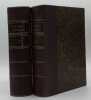
De la Collection Bibliotheca Classica Latina. Préface de l'éditeur N.E. Lemaire au T. 1 manquante. Bon ex. relié par ailleurs. - Frais de port : -France 9,65 € -U.E. 11 € -Monde (z B : 17 €) (z C : 42 €)
Opera omnia ex editione Rupertiana cum notis et interpretatione in usum Delphini, variis lectionibus excursibus Rupertianis, notis Variorum et Veteris Scholiastae, recensu editionum et codicum et indice locupletissimo accurate recensita.
London (Londoni), Curante et impensis A.J. Valpy, 1820.
2 volumes: VII;1276;169 p. Contemporary black morocco. 21.5 cm (Bindings worn at the extremes. Lower joint of the first volume partly split. Endpapers foxed. Stamp on the verso of the title) (Heavy set, may require extra shipping costs)
Satiren. Im Versmasse des Originals übers. und erläutert von A. BERG. 2. Aufl.
Bln., Langenscheidt, 1916.
320 p. H.calf 17 cm (Langensch. Bibl., 63) (Back gilt; foot of spine sl. rubbed)

