 Write to the booksellers
36 books for « josephus flavius »Edit
-
Language
French (33)
German (2)
Latin (1)
-
Century
16th (2)
17th (3)
18th (3)
19th (1)
20th (3)
-
Countries
Belgium (2)
Denmark (6)
France (6)
Netherlands (16)
Switzerland (6)
-
Syndicate
CLAM (1)
ILAB (10)
NVVA (2)
SLACES (2)
SLAM (1)
"FLAVIJ JOSEPHI (FLAVII, FLAVIUS, JOSEPHUS, FLAVIUS) (+) EGESIPPI (HEGESIPPUS THE NAZARENE)
Reference : 60564
(1630)
Dess Hochberühmbten Jüdischen Geschichtschreibers Historien vnd Bücher (+) des Hochberühmten Fürtrefflichen Christlichen Geschichtschreibers, v. Bücher: Vom Jüdischen Krieg...
Strasburg, Dietzel, 1630. Folio (34 x 215 mm). In contemporary full vellum with yapp edges. Title in contemporary hand to spine. Small paper label pasted on to spine indicating the volume's number in an estate library. Title-pages in red and black within historiated woodcut border. Binding soilied and with a few stains. Outer lower corner of title-page cut off, no loss of text. A fine copy. (12), 960, (36), (12), 214, (10) pp.
Fine copy of this later edition of two of Jesephus' most important works. The later work is a translation of a Latin christological version of Josephus' De bello Judaico, dating from ca. 367-374 A.D. It is of uncertain authorship but cited as the work of ""Hegesippus"" or ""Egesippus."" It was transmitted among the works of and sometimes attributed to Ambrose, Bishop of Milan Titus Flavius Josephus was a first-century Romano-Jewish historian who was born in Jerusalem. He fought against the Romans during the First Jewish–Roman War as head of Jewish forces in Galilee, but surrendered in 67 CE to Roman forces led by Vespasian. After Vespasian became Emperor in 69 CE, he granted Josephus his freedom, at which time Josephus assumed the emperor's family name of Flavius. Josephus recorded Jewish history, with special emphasis on the first century CE and the First Jewish–Roman War (66–70 CE), including the Siege of Masada. His most important works were The Jewish War (c. 75) and Antiquities of the Jews (c. 94). The Jewish War recounts the Jewish revolt against Roman occupation. Antiquities of the Jews recounts the history of the world from a Jewish perspective for an ostensibly Greek and Roman audience. These works provide valuable insight into first century Judaism and the background of Early Christianity, although not specifically mentioned by Josephus. Josephus' works are the chief source next to the Bible for the history and antiquity of ancient Palestine. For centuries Josephus' works were more widely read in Europe than any book other than the Bible. They are an invaluable eye-witness to a momentous turning point in Judaism, Christianity, and Western civilization. The present edition was first published in 1569. Graesse III, Pp. 481-482

Phlabiou Iosepou ta euriskomena. Flavii Josephi opera, quæ reperiri potuerunt, omnia. 2 vols.
Oxonii (Oxford) E Theatro Sheldoniano, 1720. Folio (425 x 280). Uniformly bound in two contemporary full calf bindings. Bindings with wear and scratches. Hinges reinforced with leather-strips. Ex-libris pasted on to verso of front board and previous owner's name to front free end-paper. First leaves in inner margin in vol. 1 with tear, not affecting text. Last leaf in vol. 1 with several closed tears, repaired with tape. First and last leaves with light brownspotting but internally generally very nice and clean. (40), 704 pp. (2), 705-1411, VI, (42) pp.
Early bilingual collected edition (Greek/Latin) of the Jewish historian Flavius Josephus. Titus Flavius Josephus was a first-century Romano-Jewish historian who was born in Jerusalem. He fought against the Romans during the First Jewish–Roman War as head of Jewish forces in Galilee, but surrendered in 67 CE to Roman forces led by Vespasian. After Vespasian became Emperor in 69 CE, he granted Josephus his freedom, at which time Josephus assumed the emperor's family name of Flavius. Josephus recorded Jewish history, with special emphasis on the first century CE and the First Jewish–Roman War (66–70 CE), including the Siege of Masada. His most important works were The Jewish War (c. 75) and Antiquities of the Jews (c. 94). The Jewish War recounts the Jewish revolt against Roman occupation. Antiquities of the Jews recounts the history of the world from a Jewish perspective for an ostensibly Greek and Roman audience. These works provide valuable insight into first century Judaism and the background of Early Christianity, although not specifically mentioned by Josephus. Josephus' works are the chief source next to the Bible for the history and antiquity of ancient Palestine.
Fl. Iosephi Omnia, quae extant, opera. (Tomus I & II:) Quorum hic tomus (I& II) continet Antiquitatum Iudaicarum libros (decem priores et libri X posteriores).
Lyon, (Lugduni), Apud Seb. Gryphium, 1546.
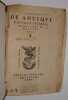
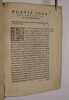
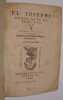
8vo. 2 volumes: (LXXII index),552,(1 blank),(1 printer's mark); 526,(1 blank),(1 printer's mark) p. 20th century leather 18 cm Omnia quae extant opera vol. 1 & 2: De antiquitatibus Iudaeorum libri XX (Ref: Schreckenberg p. 7, Schreckenberg Supplementband p. 167; Hoffmann 2,450; Graesse 3,481) (Details: These two volumes are the volumes 1 & 2 of a 3 volume set 'Omnia quae extant opera', and they contain the complete Latin translation of 'De antiquitatibus Iudaeorum libri XX'. Volume 3, with the remaining works of Josephus, is lacking. On the titles are the printer's mark of Sebastianus Gryphius, depicting a griffin, which mythological animal symbolizes courage, diligence, watchfulness, and rapidity of execution, used as a pun of his family name Gryph or Greif. From the claws of this creature hangs a big rectangular stone, symbolizing Constancy, beneath which is a winged globe, symbolizing Fortune. The motto is 'Virtute duce / comite fortuna', 'Virtue thy leader, fortune thy comrade', a quote from a letter of Cicero to Plancus (Epistulae ad Familiares, liber X,3). On the last page of both volumes a woodcut griffin. Latin translation only) (Condition: Old leather binding covered with untanned leather. Binding with traces of wear. Front hinge of volume 1 cracking. Flyleaves absent. Both pastedowns of volume 2 renewed. Titles somewhat soiled, and with a small inscription. A name on the first title neatly erased. Small paper label on the title of volume 2. Small tear in title of volume 2 because of overstretch in the margin. Occasional old and small ink underlinings. One old and small ink annotation in German) (Note: Flavius Josephus, born 37/38 A.D., 'was a Jewish priest of aristocratic descent and a Pharisee. Though a zealous defender of Jewish religion and culture, politically he was pro-Roman and without sympathy for extreme Jewish nationalism'. His first work was a history of the First war of Palestine Jews against the Romans, which raged from 66 till 70 A.D., and of which the author was an eyewitness. The war ended with the fall of Jerusalem, the walls and Temple were destroyed and most of its inhabitants were enslaved. Josephus, who tried to follow the objective methods of Thucydides and Polybius, wrote this history in Aramaic, 'of which a Greek translation, the extant 'Bellum Judaicum' in seven books, appeared between 75 and 79. (...) His next work, the 'Antiquitates Judaicae' in twenty books (published 93/94), is a history of the Jews from the Creation to immediately before the outbreak of the war, giving a fuller account of the period from the Maccabees to A.D. 66 than that in 'Bellum Judaicum' and showing a more hostile attitude to Herod the Great'. (OCD 2nd ed. p. 565) Josephus probably wrote this work, sometimes also called 'Judaica Archaeologia', to defend the sacred history of the Jews, and 'to show that Jewish tradition was as ancient and trustworthy as the Egyptian and Mesopotamian traditions and surely preceded Greek culture. (The Classical Tradition, Cambr. Mass., 2010, p. 497) The 'editio princeps' of the Greek text of the complete works of Josephus was published in Basel in 1544 by Frobenius, and was edited by Arnoldus Arlenius Peraxylus with the help of Sigismund Gelenius. The 'editio princeps' of the ancient Latin translation of 'De antiquitatibus Judaeorum' was published much earlier, in Augsburg in 1470. (See Schreckenberg p. 1) This translation is sometimes ascribed to the Roman statesman and author Cassiodorus, born ca. 485, died after 580, who served in the administration of Theoderic the Great, king of the Ostrogoths. He however didnot translate it, but he commissioned the translation. He mentions this explicitily in his Institutiones 1:17,1: 'Ut est Iosephus (...). Hunc tamen ab amicis nostris, quoniam est subtilis nimis et multiplex, magno labore in libris viginti duobus converti fecimus in Latinum'. 'Ich habe ihn aber dennoch von meinen Freunden unter viel Mühen- er gilt ja als ungemein scharfsinnig und vielschichtig- in 22 Büchern ins Lateinische übertragen lassen'. (Cassiodor, Institutiones Divinarum, übersetzt und eingeleitet von W. Bürsgens, Freiburg etc., 2003, p. 222/223) Our Gryphius edition of 1546 is a reissue of that translation of 1470) (Provenance: In the first title are faintly discernable traces of 6 blind stamped capitals: 'LDDAVH'. A name?) (Collation: alpha-epsilon8, zeta4; a-z8; A-L8, M4; aa-KK8) (Photographs on request)
L'histoire de Flave Josephe : Latin François, chacune version correspondante l'une à l'autre, verset à verset
Nicolas Chesneau Paris 1570 FLAVIUS JOSEPHE (37-100). L'histoire de Flave Josephe : Latin François, chacune version correspondante l'une à l'autre, verset à verset. Escrite premièrement par l'autheur en langue greque [sic]& nouvellement reveue et corrigée sur l'exemplaire Grec par Jean Le Frère, de Laval. enrichie d'un Abbrégé de la Guerre Iudaïque tiré de l'hébrieu par David Kiber et maintenant mis en françois avec additions extraites d'Egesippe par François de Belleforest. Divisé en deux tomes. Paris, Nicolas Chesneau 1570 (Achevé d'imprimer 22 août 1569) (A la suite :) Histoire de Flave Iosephe de la guerre, destruction et captivité des Iuifs ; des Machabées ou de la raison commenderesse, l'Apologie contre Apion Alexandrin Paris, Nicolas Chesneau, 1570. 2 parties avec titre et collation séparés en 1 fort volume in-folio. (8 ff), 812 pages, (16 ff) de table : 344 pages, (5 ff) 63 pages, (1 page). Plein veau fauve avec large olive d'arabesques au centre des plats (Epidermures sur les deux plats. Le dos a été très maladroitement refait ; les gardes ont été changées. Galerie de vers dans la marge de queue, touchant un peu le texte sur les derniers feuillets). Edition originale de la traduction du Lavalois Jean Le Frère, principal du Collège de Bayeux à Paris


De woordenkeuze in het Bellum Judaïcum van Flavius Josephus.
Amst., Paris, 1937.
XI,142 p. Wrs. 25 cm (Diss.)
Josephus-Studien. Untersuchungen zu Josephus, dem antiken Judentum und dem Neuen Testament. Otto Michel zum 70. Geburtstag gewidmet.
Göttingen, Vandenhoeck & Ruprecht, 1974.
414 p., portr. & bibliography. Cl. 24 cm (Festschrift)
Josephus-Studien. Untersuchungen zu Josephus, dem antiken Judentum und dem Neuen Testament. Otto Michel zum 70. Geburtstag gewidmet.
Göttingen, Vandenhoeck & Ruprecht, 1974.
414 p., portrait & bibliography. Cloth. 24 cm (Festschrift)
JOSEPHUS Flavius [JOSEPH] & ARNAULD D'ANDILLY Robert (trad.)
Reference : R96562
(1703)
Histoire de la guerre des Juifs, ecrite par Flavius Joseph, sous le titre "Antiquitez Judaiques", traduite sur l'original Grec revue sur divers manuscrits [5 volumes]
Amsterdam, chez Henri Schelte 1703 Complet en 5 tomes: [22],444,[10] + 458,[22] + 360[=362],[74] + [24],398,[14] + 508,[38] pp., avec frontispice gravé dans chacun des tomes, titre en rouge et noir, reliures en plein velin d'époque (peu tachés, intactes et en bon état), 17cm., texte frais et en bon état avec quelques rares rousseurs, ex-libris manuscrit sur la page de garde blanche, bon état, [Titre du TOME 4: Histoire de la guerre des Juifs contre les romains, et sa vie écrite par lui-même // TOME 5: Histoire de la guerre des Juifs contre les romains. Réponse à Appion, Martyre des Machabées, par Flavius Joseph, et sa vie écrite par lui-même, avec ce que Philon juif a écrit de son ambassade vers l'Empereur Caïus Caligula], R96562
L’Histoire de Flave Josephe: Latin François, chacune version correspondante l’une à l’autre, verset à verset. Escrite Premierement par l’Autheur en langue Grecque : & nouvellement revue & corrigee sur l’exemplaire Grec, par M. Jean Le Frere, de Laval. Enrichie d’un Abregé de la Guerre Judaique, tiré de l’Hebrieu par David Kiber, & maintenant mis en François avec additions extraictes d’Egessipe, par François de Belleforest Comingeois. Partie en deux Tomes, dont le Sommaire du contenu se void en la page suyvante. Avec une ample Table, tant des chapitres que des matieres principales.
Paris, Chez Claude Fremy en la rue sainct Jaques, à l’enseigne sainct Martin 1569, 350x220mm, reliure parchemin, dos à 6 nerfs entre lesquels à été collé du cuir orné de fleurons dorés. Quelques inscriptions anciennes en marge du texte et sur la page de titre du tome 1, ex libris moderne sur le plat intérieur, lettrines et culs-de-lampe, achevé d’imprimer à la fin du tome 1 “A Paris, De l’Imprimerie de Nicolas Bruslé, le 22. Aoust 1569” Exemplaire complet des 2 tomes reliés en 1 volume, dans une reliure simple mais solide, intérieur propre, sauf tache brune au bas de la pape de titre au tome 1.
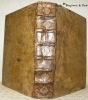
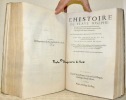
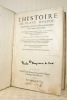
8 ff.,- 812 p. - 18 ff., - 6 ff., - 344 p. - 63 p. - 6 ff., Pour un paiement via PayPal, veuillez nous en faire la demande et nous vous enverrons une facture PayPal
JOSEPHUS FLAVIUS [FLAVIUS JOSEPHE] + Hegesippus, Palaestinus; Everardus Bommelius; Cloppenburgh, Jan Evertsz
Reference : 21415
(1641)
HOOGHBEROEMDE JOODSCHE HISTORIEN [HISTORY OF THE JEWS - HISTOIRE DES JUIFS], ende boecken. Noch Egesippus vande ellendighe verstoringe der stadt Ierusalem; Van nieus met schone figuren verciert, ende met nootwendighe anteikeningen en sûmarien verrijckt.
Amsterdam Jan Jacobs Bouman 1641 -in-folio plein vélin deux parties en un volume, reliure plein vélin ivoire parcheminé in-folio (binding full white vellum in-folio) (21 x 32,5 cm), RELIURE D'EPOQUE, dos muet (spine without title), filet à froid en place des nerfs avec un double filet perlé à froid de part et d'autre des nerfs, triple filet perlé à froid en tête et en pied, plats décorés or et à froid (gilt and blind stamping decoration on the covers) orné au centre d'un décor à entrelacs de filets larges et feuillages "or" (cartouche à fond azuré) dans un encadrement de deux filets à froid rejoint aux angles par un petit filet à froid(façon cadre), fermeture à cordonnet de cuir (sans les cordonnets), toutes tranches lisses jaspées marron rouge, texte en caractères gothiques sur deux colonnes, orné d'un titre-frontispice gravé sur bois en noir + 103 bois in-texte par C. VAN SICHEM (lettrines par Georges PENS), pagination au feuillets : [2], 338, [13], 77,[3] ff., 1641 Amsterdam Jan Jacobs Bouman Editeur,
EMOUVANTE RELIURE.......SUPERBES ILLUSTRATIONS......Rare Edition.........en trés bon état (very good condition). en trés bon état
The new complete works of Josephus. Translated by W. WHISTON. Commentary by P.L. MAIER. (Revised and expanded edition)
Grand Rapids, Kregel Publications, 1999.
1144 p. Paperback 23 cm
Prayer in Josephus.
Leiden, Boston, Brill, 2007.
XIII,315 p. Hardbound 24.5 cm (Ancient Judaism and Early Christianity 70)
Josephus and the politics of historiography. Apologetic and impression management in the Bellum Judaicum.
Leiden etc., Brill, 2000.
X;172 p. Cl. 24 cm (Mnem. Suppl. 205)
Josephus, Judea, and christian origins. Methods and categories.
Peabody, Hendrickson Publishers, 2010.
XX,443 p. Paperback 23 cm
Jødiske Historie, af det Grædske Sprog oversat og med nogle Anmærkninger oplyst af Andreas Reyersen. 3 vols.
Kjøbenhavn, Berling, 1750 - 1757. 4to. Uniformly bound in three contemporary half calf bindings with four raised bands. Wear to extremities, leather on spine cracked, spine-ends with loss of leather, boards with scratches and corners bumped. Brownspotted throughout and with occassional dampstaining. (16), 700 pp. (8), 584 pp." 24, 651, (76) pp.
The rare first Danish translation - incomplete but all that was published - of historian Josephus's "" Antiquities of the Jews"" originally written in Greek in the 1st century.
Jüdische Altertümer. Übers. und mit Einl. und Anmerk. versehen von H. CLEMENTZ.
Wiesbaden, Fourier, n.d. (prob. the eighties).
646;724 p. Hardb. 21 cm (Repr. ed. 1899)
Geschichte des Jüdischen Krieges. (Übersetzung und mit Anmerkungen von Heinrich Clementz)
Wiesbaden, Fourier, 1982.
558 p. Hardbound. 21 cm
Geschichte des Jüdischen Krieges. (Übersetzung und mit Anmerkungen von Heinrich Clementz)
Wiesbaden, Fourier, 1978.
558 p. Hardbound. 22 cm (Paper yellowing)
De Joodse oorlog, & Uit mijn leven. Vertaald, ingeleid en van aantekeningen voorzien door F.J.A.M. Meijer en M.A. Wes.
Baarn, Ambo, 1992.
646 p. Cloth. 22 cm (OiN 233; including dustjacket; small discount label on dustjacket)
De Joodse oorlog, & Uit mijn leven. Vertaald, ingeleid en van aantekeningen voorzien door F.J.A.M. Meijer en M.A. Wes.
Baarn, Ambo, 1992.
646 p. Cloth. 22 cm (OiN 233; including dustjacket; back of the dustjacket fading)
De bello judaico. Der Jüdische Krieg. Griechisch und Deutsch. Herausgegeben und mit einer Einleitung sowie mit Anmerkungen versehen von Otto Michel & Otto Bauernfeind. 3. Auflage.
Darmstadt, Wissenschaftliche Buchgesellschaft, 1982.
4 volumes: XXXVI,464;274; 287;XXVII,149 p. Cloth. 22 cm (Heavy book, may require extra shipping costs)
The Jewish war. Translated by G.A. WILLIAMSON. Revised with a new intr., notes & appendixes by E.M. SMALLWOOD.
New York, Dorset Press, 1970.
511 p. Half cloth. 21 cm. (With dustjacket)
Die jüdischen Alterthümer. Übersetzt und mit Anmerkungen versehen von K. Martin. 2 Bde.
Köln, 1852-53. 2 contemporary boards. Gilt backs. Light wear along hinges and spine ends. IV,668(4),640 pp.
Jødernes Krig mod Romerne. Oversat og forsynet med Noter af Alexander Rasmussen.
Kjøbenhavn, Lehman & Stage, 1905. Samtidigt hldrbd. med rygforgyldning. Ryg med lidt brugsspor. 416 pp.

