 Write to the booksellers
189 books for « josephus »Edit
-
Language
Dutch (1)
French (182)
German (2)
Latin (4)
-
Century
16th (2)
17th (5)
18th (17)
19th (37)
20th (51)
21st (2)
-
Countries
Belgium (67)
Denmark (6)
France (76)
Netherlands (27)
Switzerland (13)
-
Syndicate
CLAM (4)
ILAB (65)
NVVA (6)
SLACES (6)
SLAM (49)
Topics
- 1900 (2)
- Age (1)
- Antwerp (1)
- Archaeology (13)
- Architecture (1)
- Army (1)
- Belgium (3)
- Betrayal (1)
- Bible (7)
- Bibliophilism (1)
- Byzantium, (2)
- Cap (3)
- Carthage (1)
- Catholicism (2)
- China (1)
- China (1)
- Christianity (3)
- Christology (1)
- Churches (1)
- Dietetics (1)
- English (3)
- Engraving (books about) (1)
- Ethic (4)
- Ethics (1)
- Exegesis (7)
- Exhibition catalogue (1)
- Ferdinandus (1)
- Flavius josephe (1)
- Geneva (1)
- Gothic (1)
- Greece (2)
- Greek (16)
- Hebraic literature (5)
- History (22)
- Holland (1)
- Iran - persia (1)
- Italian (3)
- Jacob (1)
- Jerusalem (1)
- Jesuits (4)
- Judaism (judaica) (2)
- Latin (54)
- Latin greek (1)
- Law (6)
- Literature (9)
- Medicine (4)
- Military arts (1)
- Music (1)
- Mythology (1)
- Napoleon i (1)
- Nunnery (1)
- Painting (1)
- Paris (1)
- Penguin (1)
- Philosophy (6)
- Prague (1)
- Psychology (2)
- Public sale (1)
- Religions (12)
- Rome (3)
- Sciences (1)
- Spain (1)
- Ss (1)
- Statue (1)
- Surgery (1)
- Tea (1)
- Theatre (1)
- Theology (20)
- Trade (1)
- Vatican city (2)
- Vespasian (1)
- War (1)
- Xviii th century (1)
"FLAVIJ JOSEPHI (FLAVII, FLAVIUS, JOSEPHUS, FLAVIUS) (+) EGESIPPI (HEGESIPPUS THE NAZARENE)
Reference : 60564
(1630)
Dess Hochberühmbten Jüdischen Geschichtschreibers Historien vnd Bücher (+) des Hochberühmten Fürtrefflichen Christlichen Geschichtschreibers, v. Bücher: Vom Jüdischen Krieg...
Strasburg, Dietzel, 1630. Folio (34 x 215 mm). In contemporary full vellum with yapp edges. Title in contemporary hand to spine. Small paper label pasted on to spine indicating the volume's number in an estate library. Title-pages in red and black within historiated woodcut border. Binding soilied and with a few stains. Outer lower corner of title-page cut off, no loss of text. A fine copy. (12), 960, (36), (12), 214, (10) pp.
Fine copy of this later edition of two of Jesephus' most important works. The later work is a translation of a Latin christological version of Josephus' De bello Judaico, dating from ca. 367-374 A.D. It is of uncertain authorship but cited as the work of ""Hegesippus"" or ""Egesippus."" It was transmitted among the works of and sometimes attributed to Ambrose, Bishop of Milan Titus Flavius Josephus was a first-century Romano-Jewish historian who was born in Jerusalem. He fought against the Romans during the First Jewish–Roman War as head of Jewish forces in Galilee, but surrendered in 67 CE to Roman forces led by Vespasian. After Vespasian became Emperor in 69 CE, he granted Josephus his freedom, at which time Josephus assumed the emperor's family name of Flavius. Josephus recorded Jewish history, with special emphasis on the first century CE and the First Jewish–Roman War (66–70 CE), including the Siege of Masada. His most important works were The Jewish War (c. 75) and Antiquities of the Jews (c. 94). The Jewish War recounts the Jewish revolt against Roman occupation. Antiquities of the Jews recounts the history of the world from a Jewish perspective for an ostensibly Greek and Roman audience. These works provide valuable insight into first century Judaism and the background of Early Christianity, although not specifically mentioned by Josephus. Josephus' works are the chief source next to the Bible for the history and antiquity of ancient Palestine. For centuries Josephus' works were more widely read in Europe than any book other than the Bible. They are an invaluable eye-witness to a momentous turning point in Judaism, Christianity, and Western civilization. The present edition was first published in 1569. Graesse III, Pp. 481-482
Phlabiou Iosepou ta euriskomena. Flavii Josephi opera, quæ reperiri potuerunt, omnia. 2 vols.
Oxonii (Oxford) E Theatro Sheldoniano, 1720. Folio (425 x 280). Uniformly bound in two contemporary full calf bindings. Bindings with wear and scratches. Hinges reinforced with leather-strips. Ex-libris pasted on to verso of front board and previous owner's name to front free end-paper. First leaves in inner margin in vol. 1 with tear, not affecting text. Last leaf in vol. 1 with several closed tears, repaired with tape. First and last leaves with light brownspotting but internally generally very nice and clean. (40), 704 pp. (2), 705-1411, VI, (42) pp.
Early bilingual collected edition (Greek/Latin) of the Jewish historian Flavius Josephus. Titus Flavius Josephus was a first-century Romano-Jewish historian who was born in Jerusalem. He fought against the Romans during the First Jewish–Roman War as head of Jewish forces in Galilee, but surrendered in 67 CE to Roman forces led by Vespasian. After Vespasian became Emperor in 69 CE, he granted Josephus his freedom, at which time Josephus assumed the emperor's family name of Flavius. Josephus recorded Jewish history, with special emphasis on the first century CE and the First Jewish–Roman War (66–70 CE), including the Siege of Masada. His most important works were The Jewish War (c. 75) and Antiquities of the Jews (c. 94). The Jewish War recounts the Jewish revolt against Roman occupation. Antiquities of the Jews recounts the history of the world from a Jewish perspective for an ostensibly Greek and Roman audience. These works provide valuable insight into first century Judaism and the background of Early Christianity, although not specifically mentioned by Josephus. Josephus' works are the chief source next to the Bible for the history and antiquity of ancient Palestine.
Fl. Iosephi Omnia, quae extant, opera. (Tomus I & II:) Quorum hic tomus (I& II) continet Antiquitatum Iudaicarum libros (decem priores et libri X posteriores).
Lyon, (Lugduni), Apud Seb. Gryphium, 1546.
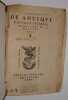
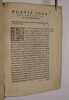
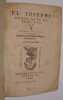
8vo. 2 volumes: (LXXII index),552,(1 blank),(1 printer's mark); 526,(1 blank),(1 printer's mark) p. 20th century leather 18 cm Omnia quae extant opera vol. 1 & 2: De antiquitatibus Iudaeorum libri XX (Ref: Schreckenberg p. 7, Schreckenberg Supplementband p. 167; Hoffmann 2,450; Graesse 3,481) (Details: These two volumes are the volumes 1 & 2 of a 3 volume set 'Omnia quae extant opera', and they contain the complete Latin translation of 'De antiquitatibus Iudaeorum libri XX'. Volume 3, with the remaining works of Josephus, is lacking. On the titles are the printer's mark of Sebastianus Gryphius, depicting a griffin, which mythological animal symbolizes courage, diligence, watchfulness, and rapidity of execution, used as a pun of his family name Gryph or Greif. From the claws of this creature hangs a big rectangular stone, symbolizing Constancy, beneath which is a winged globe, symbolizing Fortune. The motto is 'Virtute duce / comite fortuna', 'Virtue thy leader, fortune thy comrade', a quote from a letter of Cicero to Plancus (Epistulae ad Familiares, liber X,3). On the last page of both volumes a woodcut griffin. Latin translation only) (Condition: Old leather binding covered with untanned leather. Binding with traces of wear. Front hinge of volume 1 cracking. Flyleaves absent. Both pastedowns of volume 2 renewed. Titles somewhat soiled, and with a small inscription. A name on the first title neatly erased. Small paper label on the title of volume 2. Small tear in title of volume 2 because of overstretch in the margin. Occasional old and small ink underlinings. One old and small ink annotation in German) (Note: Flavius Josephus, born 37/38 A.D., 'was a Jewish priest of aristocratic descent and a Pharisee. Though a zealous defender of Jewish religion and culture, politically he was pro-Roman and without sympathy for extreme Jewish nationalism'. His first work was a history of the First war of Palestine Jews against the Romans, which raged from 66 till 70 A.D., and of which the author was an eyewitness. The war ended with the fall of Jerusalem, the walls and Temple were destroyed and most of its inhabitants were enslaved. Josephus, who tried to follow the objective methods of Thucydides and Polybius, wrote this history in Aramaic, 'of which a Greek translation, the extant 'Bellum Judaicum' in seven books, appeared between 75 and 79. (...) His next work, the 'Antiquitates Judaicae' in twenty books (published 93/94), is a history of the Jews from the Creation to immediately before the outbreak of the war, giving a fuller account of the period from the Maccabees to A.D. 66 than that in 'Bellum Judaicum' and showing a more hostile attitude to Herod the Great'. (OCD 2nd ed. p. 565) Josephus probably wrote this work, sometimes also called 'Judaica Archaeologia', to defend the sacred history of the Jews, and 'to show that Jewish tradition was as ancient and trustworthy as the Egyptian and Mesopotamian traditions and surely preceded Greek culture. (The Classical Tradition, Cambr. Mass., 2010, p. 497) The 'editio princeps' of the Greek text of the complete works of Josephus was published in Basel in 1544 by Frobenius, and was edited by Arnoldus Arlenius Peraxylus with the help of Sigismund Gelenius. The 'editio princeps' of the ancient Latin translation of 'De antiquitatibus Judaeorum' was published much earlier, in Augsburg in 1470. (See Schreckenberg p. 1) This translation is sometimes ascribed to the Roman statesman and author Cassiodorus, born ca. 485, died after 580, who served in the administration of Theoderic the Great, king of the Ostrogoths. He however didnot translate it, but he commissioned the translation. He mentions this explicitily in his Institutiones 1:17,1: 'Ut est Iosephus (...). Hunc tamen ab amicis nostris, quoniam est subtilis nimis et multiplex, magno labore in libris viginti duobus converti fecimus in Latinum'. 'Ich habe ihn aber dennoch von meinen Freunden unter viel Mühen- er gilt ja als ungemein scharfsinnig und vielschichtig- in 22 Büchern ins Lateinische übertragen lassen'. (Cassiodor, Institutiones Divinarum, übersetzt und eingeleitet von W. Bürsgens, Freiburg etc., 2003, p. 222/223) Our Gryphius edition of 1546 is a reissue of that translation of 1470) (Provenance: In the first title are faintly discernable traces of 6 blind stamped capitals: 'LDDAVH'. A name?) (Collation: alpha-epsilon8, zeta4; a-z8; A-L8, M4; aa-KK8) (Photographs on request)
Josephus de Backer Franciscus van Ortroy & Josephus van den Gheyn
Reference : 100089294
Analecta Bollandiana TOMUS VIII - Carolus de Smedt - ediderunt Josephus de Backer Franciscus van Ortroy & Josephus van den Gheyn
Société belge de librairie in8. Sans date. Broché. édition de 1889 en fac-simile circa 1980 éditeur non précisé --- document dépliant in-fine
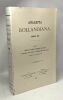
Bon état cependant couverture défraîchie ternissures sur la couverture tache d'eau sur le dos tranche de tête tachée intérieur propre bonne tenue
WELLENS, JACOBUS THOMAS JOSEPHUS. Jacobus Thomas Josephus Wellens; Spanoghe, Cornelius Martinus
Reference : 1723
Generalis collectionis, omnium operum ... Jacobi Thomae Josephi Wellens, episcopi Antverpiensis, pars ... = Der algemeyne verzaemelinge van de werken van ... Jacobus Thomas Josephus Wellens; bisschop van Antwerpen.
, Antwerpen, C.M. Spanoghe, 1784., Relie, gebonden, plats marbre/ gemarmerde platten, In een vernieuwde band, frontispice, 22x28,5cm, Tekst Nederlands/ francais.In-4?°, pp. genummerd i-vii en 33 tot 180. Geïllustreerd met 15 emblematische kopergravures, met Latijnse spreuken, in het Nederlands uitgelegd .2 delen in een volume. with 12 illustrations/gravuren.
Generalis collectionis, omnium operum ... Jacobi Thomae Josephi Wellens, episcopi Antverpiensis, pars ... = Der algemeyne verzaemelinge van de werken van ... Jacobus Thomas Josephus Wellens; bisschop van Antwerpen.
Josephus-Studien. Untersuchungen zu Josephus, dem antiken Judentum und dem Neuen Testament. Otto Michel zum 70. Geburtstag gewidmet.
Göttingen, Vandenhoeck & Ruprecht, 1974.
414 p., portr. & bibliography. Cl. 24 cm (Festschrift)
Josephus-Studien. Untersuchungen zu Josephus, dem antiken Judentum und dem Neuen Testament. Otto Michel zum 70. Geburtstag gewidmet.
Göttingen, Vandenhoeck & Ruprecht, 1974.
414 p., portrait & bibliography. Cloth. 24 cm (Festschrift)
[CLASSIQUE LATIN, QUINTILIEN] - QUINTILIANI (MARCI FABII), DUSSAULT (Joannes Josephus) -
Reference : 200613068
MARCI FABII QUITILIANI DECLAMATIONES majores et minores ITEM CALPURNII FLACCI ex recensione burmanniana.
Paris, Colligebat nicolaus eligius lemaire, 1829 ; in-8, 604 pp., demi basane rouge passé dos a nerfs. Cui nova lectiones et notas adjecit JOANNES JOSEPHUS DUSSAULT unus e tpraerectis servandae bibliothecae san-genovefanae. VOLUME SEXTUM - declamatones.
Cui nova lectiones et notas adjecit JOANNES JOSEPHUS DUSSAULT unus e tpraerectis servandae bibliothecae san-genovefanae. VOLUME SEXTUM - declamatones.
Karel Appel / Work on Paper
Haags Gemeeentemuseum, 1984. In-4, broché sous couverture illustrée en couleurs, 122 pp. Foreword, by dr. Th. van Velzen - Karel Appel : "I'm just messing around". Comments on a statement, by Mariette Josephus Jitta - Catalogue.
Nombreuses illustrations en noir et en couleurs.Catalogue en langue anglaise. --- Plus d'informations sur le site archivesdunord.com
Gemengd Bedrijf
, Haags Gemeentemuseum, 1990 Softcover, 36 pagina's, oblong, 29.5 x 23.5 cm, NL. *prima staat.
"Gemengd Bedrijf" is een publicatie uit 1990, uitgegeven door het Haags Gemeentemuseum (tegenwoordig Kunstmuseum Den Haag). Het betreft een oblong ingenaaide brochure van 36 pagina's, geschreven door onder anderen R.H. Fuchs en M. Josephus Jitta.
Dissertatio inauguralis de colica in genre et in specie, quam in antiquissima ac celeberrima universate vindonensi publicae disquisitioni submittit Josephus Nezbedan prostana moravus. disputabiture in Universitatis Palatio. Die Mensis augudti MDCCLXXV
Typis Joan. Thomae Nobilis de Tattnern 1775 In-12. Reliure de l’éoque, demi veau havane à petits coins, 61 pp. Reliure terni et frottée, intérieur assez frais. Ouvrage d’une relative rareté.
Texte en latin. Bon état d’occasion
The new complete works of Josephus. Translated by W. WHISTON. Commentary by P.L. MAIER. (Revised and expanded edition)
Grand Rapids, Kregel Publications, 1999.
1144 p. Paperback 23 cm
Prayer in Josephus.
Leiden, Boston, Brill, 2007.
XIII,315 p. Hardbound 24.5 cm (Ancient Judaism and Early Christianity 70)
Josephus and the politics of historiography. Apologetic and impression management in the Bellum Judaicum.
Leiden etc., Brill, 2000.
X;172 p. Cl. 24 cm (Mnem. Suppl. 205)
Josephus, Judea, and christian origins. Methods and categories.
Peabody, Hendrickson Publishers, 2010.
XX,443 p. Paperback 23 cm
De woordenkeuze in het Bellum Judaïcum van Flavius Josephus.
Amst., Paris, 1937.
XI,142 p. Wrs. 25 cm (Diss.)
Festoen. Opgedragen aan A.N. Zadoks-Josephus Jitta bij haar 70ste verjaardag.
Groningen, Bussum, Tj. Willink, Fibula-v.Dishoeck, n.d.
(After 1975). XV,700 p.; ills. Cl. 27 cm (Scripta Archaeologica Groningana 6) (Festschrift; most essays in English, German & French) (Heavy book, may require extra shipping costs)
Festoen. Opgedragen aan A.N. Zadoks-Josephus Jitta bij haar 70ste verjaardag.
Groningen, Bussum, Tj. Willink, Fibula-v.Dishoeck, n.d.
(After 1975). XV,700 p.; ills. Cl. 27 cm (Scripta Archaeologica Groningana 6) (Festschrift; most essays in English, German & French)(Traces of sellotape on both pastedowns) (Heavy book, may require extra shipping costs)
Hieronymi Lagomarsini e Societate Jesu Orationes, publice dictae Florentiae ab ipso auctore studiorum ibidem Praefecto. (And:) Orationes P. Josephi Ignatii Chiaberge, Societatis Jesu, addito Trivolsiensium litteratorum judicio. (Editio novissima)
Augsburg, Innsbruck, (Augustae Vindelicorum & Oeniponti), Sumptibus Josephi Wolff, 1763.
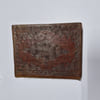
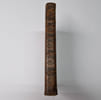
4to. 2 parts in 1: 255 p. Calf 21 cm (Ref: Not yet in VD18; cf. VD18 14485788 for the 1752 edition of the first part; Backer Sommervogel 4,1367 & 2,1120) (Details: Binding elaborately and richly blind stamped with floral ornaments, oriental style. All edges gilt. Part 1: Lagomarsini (p. 1-128), part 2: Chiaberge (p. 129-255). The parts with the orations of Chiaberge opens with a half title) (Condition: Binding worn at the extremities, especially at the foot of the spine. A few small hardly visible wormholes in the foot of the spine, not affecting the bookblock. Both free endpapers gone. Lightly foxed) (Note: This collection of orations of two famous Italian orators, delivered on solemn occasions in Italian and papal history, is a reissue of 2 works the were previously published separately by Joseph Wolff in 1752. It contains, Lagomarsini: 'Oratio in adventu Francisci III ... ad Florentinos (1739). Oratio coram Fabritio Serbellonio Romani Pontificis ad Magnum Etruriae ducem legato (1734). Pro grammaticis Italiae scholis (1735). Oratio pro lingua latina (1736). Pro scholis publicis oratio I & II' (1737 & 1738). Chiaberge: 'Clementi XI. Pontifici Maximo Oratio panegyrica (1703). Innocentii XII. Pontificis Maximi providentia, Oratio funebris (1700). Gregorius XIII. Pontifex Maximus saeculorum felicitas, Oratio funebris (1700). Ludovici XIV regis christiani Oratio funebris (1716). Mariae Joannae Baptistae ducissae Sabaudiae, Pedemontium principis, Cypri Reginae etc. Oratio funebris' (1724). The Italian Jesuit Girolamo (Hieronymus) Lagomarsini, 1698-1773, is among classicist especially known for his contribrution to the constitution of the text of De Oratore of Cicero. He devoted himself to the accumulation of critical material for a new and complete edition of Cicero. 'Al progetto, destinato a naufragare', because he collected far more than he could chew. The Jesuit College at Rome still holds his notes on more than 700 manuscripts, some of which are now lost. The discovery of his collations by Ellendt was at the time a most valuable contribution to the improvement of the text. ('De Oratore Libri Tres. With introduction and notes by A.S. WILKINS', Hildesheim, 1965, p. 67) From 1733 till 1744 he taught in Florence, and from 1751 he was professor of Greek in Roma at the papal 'Universitas Gregoriana'. (See for Lagomarsini 'Dizionario Biografico degli Italiani' - Volume 63 (2004). Giuseppe Ignazio (Josephus Ignatius) Chiaberge, 1670-1748, was in his time also a famous Jesuit orator. His orations are preceded by a 'judicium' (judgment) on him and his work by the 'litteratores Trivolsienses', published 'mense Julio 1725, p. 1325, articulo LXIII'. This is a reference to the 'Journal de Trévoux', formally the 'Mémoires pour l'Histoire des Sciences & des beaux-Arts', but often called the 'Mémoires de Trévoux', an influential academic journal that appeared monthly in France between January 1701 and December 1782. The journal published critical reviews of contemporary books and papers. Most of the authors were Jesuits. (Source Wikipedia: 'Journal de Trévoux') No wonder the orations of Chiaberge are recommended in the 'judicium'. His 'ars mira' is praised, and his 'concinnitas', and his 'iisdem mutuo nectendis, evolvendisque solertia'. 'Subtilis est, & splendidus Orationis ornatus. (...) Stylus sententiarum ponderi par, integer, robustus, varius, ad proborum exemplarium normam efformatus'. (p. 137)) (Collation: A-2I4) (Photographs on request)
Jødiske Historie, af det Grædske Sprog oversat og med nogle Anmærkninger oplyst af Andreas Reyersen. 3 vols.
Kjøbenhavn, Berling, 1750 - 1757. 4to. Uniformly bound in three contemporary half calf bindings with four raised bands. Wear to extremities, leather on spine cracked, spine-ends with loss of leather, boards with scratches and corners bumped. Brownspotted throughout and with occassional dampstaining. (16), 700 pp. (8), 584 pp." 24, 651, (76) pp.
The rare first Danish translation - incomplete but all that was published - of historian Josephus's "" Antiquities of the Jews"" originally written in Greek in the 1st century.
Devotie van negen dagen oft van negen woensdagen ter eere van den h. Joannes Nepomucenus
't Antwerpen, by Joannes Franciscus de Roveroy 1751 53pp.+ frontispice (beeltenis van Nepomucenus door Joannes Gillis gegraveerd door Bouttats) en vignetten in tekst, 16cm., 3e druk, "Uyt het Italiaens overgeset door p. Josephus Wielens", contemporaine lederen band met wat slijtage, stempeltje op verso van frontispice, cfr. De Backer-Sommervogel VIII col.1115 nr.4, goede staat, R90266
Iosephi Gibalini è Soc. Iesu Theologi, Disquisitiones canonicae de clausura regulari, ex veteri & novo Iure ; Operis de Scientia Canonica Specimen
Lugduni [Lyon], sumptib. Haer. Petri Prost, Philippi Borde & Laurentii Arnaud 1648 [2bl.],[28],457,[17],[1bl.] pp., with engraved vignette on title page (printer's device), 1st and only edition, 23cm., contemporary full vellum binding (bit soiled), text in Latin, text clean with some occasional foxing and few browning, 3 library stamps on title page, title in black and red, with engraved ex-libris "Ex Bibliotheca Patrum Congregationis Oratorii sancti Philippi Nerii Londinensis. Testamento legavit David Lewis a.s. 1895" and stamp "duplicate sold by authority", good condition, rare, [GIBALINUS Josephus, Joseph de Gibalin, born in Gévaudan (France) in 1592, died in Lyon in 1671. cfr. De Backer & Sommervogel III-1401-3. This work deals with different canonical aspects and rules about the enclousure of (regular) moniales], R95549
Des Herrn Jakobs Serenius der Gottesgelartheit Doctors ... gesammlete Zeugnisse der Heiden und vornämlich des Flavius Josephus von Jesu zur Bestätigung des Glaubens der Christen : Eine Übersetzung aus dem Schwedischen.
Göttingen, Daniel Friedrich Kübler, 1758, kl. in-8°, 8 Bl. + 278 S., 1 Kopfleiste, hs. Besitzvermerk ‘F. Milcher’ auf Titel, Ledereinband, der Zeit, Rückenschild, Rücken vergoldet, marmorierter Vorsatz. Rotschnitt, schönes Exemplar.
Image disp.

(SLACES, NVVA)
Phone number : 41 (0)26 3223808
Decii Junii Juvenalis et A. Persii flacci satyrae
Barbou Frères. 1805. In-12. Relié plein cuir. Bon état, Couv. convenable, Dos satisfaisant, Intérieur bon état. 444p , papier à la forme, relié cuir marron, dos décoré defilets dorés, titre sur pièce, tranche rouge .Relié cuir marron... . . . Classification Dewey : 470-Langues italiques. Latin
Nouvelle éditon augmentée, Notis novissimis ac perpetua interpretaione illustravit Josephus Juvencius, cum appendice de Diis et Heroibus poéticis, ad poétarum intelligentiam necessaria, ouvrage en latin. Classification Dewey : 470-Langues italiques. Latin


