 Write to the booksellers
59 books for « joseph lagrange »Edit
-
Type
Autograph (1)
Book (58)
-
Century
17th (1)
18th (18)
19th (6)
20th (9)
21st (1)
-
Countries
Belgium (3)
Denmark (18)
France (35)
Switzerland (3)
-
Syndicate
CLAM (1)
ILAB (30)
SLAM (11)
Topics
- Ampere andré - marie (1)
- Archaeology (1)
- Asia - orient (1)
- Astronomy (5)
- Autographs (1)
- Calculation (1)
- Camus albert (1)
- Chancel (1)
- Christianity (9)
- Earth (2)
- Equations (1)
- Franz joseph (3)
- Geography (1)
- Hachette (1)
- Hebraic literature (1)
- History (4)
- Israel (1)
- Jerusalem (3)
- Littérature 18ème (1)
- Mathematics (15)
- Maxims (1)
- Mechanics (2)
- Monk (1)
- Montgolfier (1)
- Palestine (2)
- Physics (3)
- Pilgrimage (1)
- Rabaut jean-paul aka saint-etienne (1)
- Saint simon (1)
- Sciences (6)
- Tea (4)
- Theatre (1)
- Theology (3)
- Theory (1)
Comte Joseph Lagrange - Lettre autographe signée à Monsieur [Chevrier], Notaire
Comte Joseph Lagrange - Lettre autographe signée à Monsieur [Chevrier], Notaire Général français de la Révolution et de l’Empire Lettre autographe signée, adressée à Monsieur [Chevrier], datée du 21 juillet 1834. Dimensions : 13,1 x 20,5 cm Nombre de pages : 1 page Joseph LAGRANGE Le comte Joseph Lagrange, né le 10 janvier 1763 à Sempesserre près de Lectoure dans le Gers et mort le 16 janvier 1836 à Paris, est un général français de la Révolution et de l’Empire, puis un homme politique.
![Comte Joseph Lagrange - Lettre autographe signée à Monsieur [Chevrier], Notaire. Joseph Lagrange](https://static.livre-rare-book.com/pictures/TBY/boz_002154_1.jpg)
![Comte Joseph Lagrange - Lettre autographe signée à Monsieur [Chevrier], Notaire. Joseph Lagrange](https://static.livre-rare-book.com/pictures/TBY/boz_002154_1_thumb.jpg)
![Comte Joseph Lagrange - Lettre autographe signée à Monsieur [Chevrier], Notaire. Joseph Lagrange](https://static.livre-rare-book.com/pictures/TBY/boz_002154_2_thumb.jpg)
![Comte Joseph Lagrange - Lettre autographe signée à Monsieur [Chevrier], Notaire. Joseph Lagrange](https://static.livre-rare-book.com/pictures/TBY/boz_002154_3_thumb.jpg)
Oeuvres de Lagrange : tome XIV seul
Paris, Gauthier-Villars, 1892. In-4, XII-346 pp., broché, couverture originale imprimée (insolation, 1er plat détaché, petits manques et déchirures au dos).
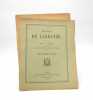
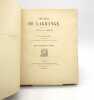
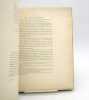
Première édition collective, posthume et complète du tome XIV des Oeuvres du mathématicien Joseph-Louis Lagrange, réunies par J.-A. Serret, tiré sur vergé. Il est composé des correspondances de Lagrange et Condorcet, ainsi que celles d'Euler et divers autres scientifiques. Il est illustré de 2 fac-similés d'une page de calcul et d'une lettre de Lagrange à Julia de Saint-Clair. Voir photographie(s) / See picture(s) * Membre du SLAM et de la LILA / ILAB Member. La librairie est ouverte du lundi au vendredi de 14h à 19h. Merci de nous prévenir avant de passer,certains de nos livres étant entreposés dans une réserve.
Oeuvres de Lagrange : tome XIII seul
Paris, Gauthier-Villars, 1882. In-4, 401 pp., broché, couverture originale imprimée (insolation, petites rousseurs).
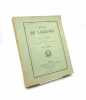
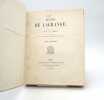
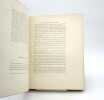
Première édition collective, posthume et complète du tome XIII des Oeuvres du mathématicien Joseph-Louis Lagrange, réunies par J.-A. Serret, tiré sur vergé. Il est composé de la correspondance inédite de Lagrange et d'Alembert. Voir photographie(s) / See picture(s) * Membre du SLAM et de la LILA / ILAB Member. La librairie est ouverte du lundi au vendredi de 14h à 19h. Merci de nous prévenir avant de passer,certains de nos livres étant entreposés dans une réserve.
Théorie des fonctions analytiques, contenant les principes du calcul différentiel, dégagés de toute considération d'infiniment petits ou d'évanouissans, de limites ou de fluxions et réduits à l'analyse algébrique des quantités finies. - [FOUNDATION OF ANALYSIS]
Paris, De L'Imprimerie de la République, An V (1797). 4to. Uncut and partially unopened. Contemporary manuscript-binding. Provenance: With the exlibris of Stillman Drake - one of the most renown Galileo scholars. Some light brown spotting through out. Otherwise a very good copy. (4),VIII,276 pp.
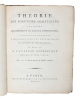
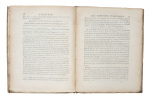
First edition, first printing. Several bibliographies mention that there are two issues of the first edition, with no priority established - one with 277 numbered pages and another with 276 numbered pages which compromises Vol. III of the ninth cahier of the 'Journal de l'Ecole Polytechnique' (see Norman 1258 for example). However, the second mentioned printing was first published in 1801 (See Prof. Craig G. Fraser's article in ""Landmark Writings in Western Mathematics 1640-1940"", pp. 258-276).Lagrange is the great formulizer of his time. In his masterpiece 'Méchanique Analytique' from 1788 he freed Newtonian mechanics from synthetic and geometrical reasoning by reducing the theory of mechanics and the art of solving problems in that field to the mere solution of general formulas. In this work, the 'Théorie des fonctions analytiques', Lagrange attempted to give calculus an algebraic foundation and avoid the employment of infinitely small quantities. In this work Lagrange developed a systematic foundation of the calculus. Throughout the eighteenth century a critical attitude had developed both within mathematics and within general scientific culture. Bishop George Berkeley had already in 1734 in his work 'The Analyst' called attention to what he perceived as logical weaknesses in the reasonings of the calculus arising from the employment of infinitely small quantities. And by the end of the century a growing interest in the foundations of analysis was reflected in the decisions of the academies of Berluin and Saint Petersburg to devote prize competitions to the metaphysics of the calculus and the nature of the infinite. In Original contributions: Lagrange's conception of theorem-proving in analysis" his derivation of what is today called the Lagrange remainder in the Taylor expansion of a function his formulation of the multipiler rule in the calculus of variations and his account of sufficiency questions in the calculus of variations.Barchas 1198. Riccardi I (2), 3. Norman 1258. Honeyman 1881, Stanitz ,
Sur la Force des ressorts pliés. (+) Sur le Probleme de Kepler. (2 Memoirs).
(Berlin, Haude et Spener, 1771). 4to. No wrappers, as issued in ""Mémoires des l'Academie Royale des Sciences et Belles-Lettres"", tome XXV, pp. 167-203 a. pp. 204-233 a. 1 folded engraved plate. With titlepage to ""Classe de Mathematique.""
First appearance of these two importent memoirs, dealing with ""elastic stress"" and the Two-Body problem. In the first paper ""On the Force of bent springs"" Lagrange became the first to investigate mathematically ""elastic stress"" - the physical principles of elasticity - a problem suggested by the design of the spiral spring of a watch.""Although Lagrange's contributions to the strenght of materials are of more theoretical than practical interest, his method of generalized coordinates and generalized forces later found applications in the strenghts of materials and proved a great value in solving problems of practical importence.""(Timoshenko ""History of Strength of Materials""p. 40).The second paper offered deals with the Two-Body problem and here he comes up with the solution later called the lagrangian solution. In 1770 Lagrange read before the Academy his famous paper ""Nouvelle méthode pour résoudre les équations littérales par le moyen des séries."", the discovery of the Lagrange-Series. In the paper offered - read to the Academy on November 1, 1770 - Lagrange applies his Series to ""Kepler's Problem"".Together with 2 other papers, Jean Bernoulli ""Sur les Suites ou Sequences dans la Laotterie de Genes"", pp. 234-253 and D'Alembert ""Extrait d'une Lettre ...à M. de La Grange"", pp. 254-264.
"LAGRANGE, (JOSEPH LOUIS). - THE INVENTION OF THE ""VARIATION OF PARAMETERS"" THE PRIZE WINNING MEMOIR OF 1782.
Reference : 44925
(1785)
Recherches sur la Theorie des Perturbations que les Comètes peuvent eprouver par L'Action des Planètes.
(Paris, Moutard, 1785). 4to. Extracted from ""Mémoires fe Mathematique et de Physique, Présentés à l'Academie des Sciences par divers Savans"", Tome X. Pp. 65-160. Wide-margined, clean and fine.
First appearance of this groundbreaking paper in which Lagrange presented his invention of the new method of solving differential equations as VARIATION OF PARAMETERS, and in which the method was completely developed for the first time. He applies the method to the determination of the orbit of a comet from three observations"" this formed the basis of subsequent recherches on the subject."" In the summer of 1779 Lagrange submitted ""Recherches sur la théorie des perturbations que les cométes peuvent éprouver par l’action des planétes"", which won the double prize of 4,000 livres. This was the last time that he participated in the competitions of the Paris Academy.""(DSB).""Lagrange, whose contributions to celestial mechanics were of the most brilliant characther, wrote his first memoir in 1766 on the perturbations of Jupiter and Saturn. In this work he developed still further the method of the variation of parameters, leaving his final equations still incorrect....their true form being that of the long period terms, as was shown by Laplace in 1784...The method of variatiobn of parameters was completely developed for the first time in 1782 by Lagrange in his prize memoir on the perturbations...(the paper offered).""
OEUVRES COMPLÈTES DE LAGRANGE, par les soins de M. J.-A. Serret. Tome septième
Paris Gauthier-Villars, Imprimeur-Libraire 1877 in 4 (29x23,5) 1 volume reliure cartonnée de l'éditeur, dos et plat supérieur titrés, 626 pages, petit cachet ex-libris bleu, reliure défraichie, manques de papier sur les coiffes (à restaurer). Comte Joseph Louis Lagrange, 1736-1813. Tome 7 seul: Cours donnés à l'Ecole Normale (sur 14). Bon exemplaire ( Photographies sur demande / We can send pictures of this book on simple request )
Bon Reliure
OEUVRES COMPLÈTES DE LAGRANGE, par les soins de M. J.-A. Serret. Tome huitième
Paris Gauthier-Villars, Imprimeur-Libraire 1879 in 4 (29x23,5) 1 volume reliure cartonnée de l'éditeur, dos et plat supérieur titrés, 370 pages, petit cachet ex-libris bleu, reliure défraichie, usures sur les coiffes. Comte Joseph Louis Lagrange, 1736-1813. Tome 8 seul: Traité de la résolution des équations numériques de tous les degrés (sur 14). Bon exemplaire ( Photographies sur demande / We can send pictures of this book on simple request )
Bon Reliure
Oeuvres de Lagrange : tomes I à IV seuls
Paris, Gauthier-Villars, 1867-1869. 4 vol. in-4, LI-733 pp. + 727 pp. + 797 pp. + 750 pp., broché, couverture originale imprimée (déchirures, petits manques marginaux aux couvertures, couverture muette au 2e tome, quelques rousseurs et taches).
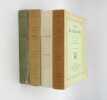
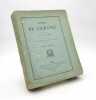
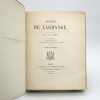
Première édition collective, posthume et complète des tomes I à IV des Oeuvres du mathématicien Joseph-Louis Lagrange, réunies par J.-A. Serret. Ils débutent sur une notice biographique rédigée par Delambre et réunit les publications parues dans les Recueils de l'Académie de Turin puis de Berlin. Voir photographie(s) / See picture(s) * Membre du SLAM et de la LILA / ILAB Member. La librairie est ouverte du lundi au vendredi de 14h à 19h. Merci de nous prévenir avant de passer,certains de nos livres étant entreposés dans une réserve.
Oeuvres de Lagrange : tome VI seul
Paris, Gauthier-Villars, 1873. In-4, 818 pp., broché, couverture originale imprimée (petits manques et déchirures dans les marges, dos fendu).
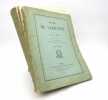
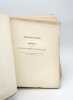
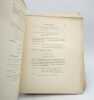
Première édition collective, posthume et complète du tome VI des Oeuvres du mathématicien Joseph-Louis Lagrange, réunies par J.-A. Serret. Il comporte des mémoires extrait des Recueils de l'Académie des sciences de Paris et de la classe de sciences mathématiques et physiques de l'Institut de France, principalement consacrés à la mécanique céleste. Voir photographie(s) / See picture(s) * Membre du SLAM et de la LILA / ILAB Member. La librairie est ouverte du lundi au vendredi de 14h à 19h. Merci de nous prévenir avant de passer,certains de nos livres étant entreposés dans une réserve.
Oeuvres de Lagrange : tome VII seul
Paris, Gauthier-Villars, 1877. In-4, 626 pp., broché, couverture originale imprimée (insolé, minuscules déchirures dans les marges).
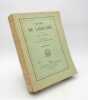
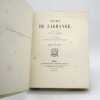
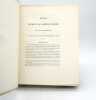
Première édition collective, posthume et complète du tome VI des Oeuvres du mathématicien Joseph-Louis Lagrange, réunies par J.-A. Serret. Il comporte des pièces diverses non comprises dans les recueils académiques. Voir photographie(s) / See picture(s) * Membre du SLAM et de la LILA / ILAB Member. La librairie est ouverte du lundi au vendredi de 14h à 19h. Merci de nous prévenir avant de passer,certains de nos livres étant entreposés dans une réserve.
Oeuvres de Lagrange : tome IX seul
Paris, Gauthier-Villars, 1881. In-4, 427-23 pp., cartonnage original imprimé (cartonnage légèrement défraîchi mais solide).
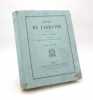
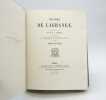
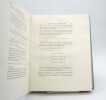
Première édition collective, posthume et complète du tome IX des Oeuvres du mathématicien Joseph-Louis Lagrange, réunies par J.-A. Serret, tiré sur vergé. Il comporte le texte de La Théorie des fonctions analytiques. Complet du catalogue de l'éditeur. Voir photographie(s) / See picture(s) * Membre du SLAM et de la LILA / ILAB Member. La librairie est ouverte du lundi au vendredi de 14h à 19h. Merci de nous prévenir avant de passer,certains de nos livres étant entreposés dans une réserve.
Sur La Solution des Problemes Indéterminés du Second Degré. - [A FUNDAMENTAL PAPER IN THE THEORY OF NUMBERS]
(Berlin, Haude et Spener, 1769). 4to. No wrappers as issued in ""Memoires de L'Academie Royale des Sciences et Belles Lettres"", tome XXIII, pp. 165-310.
First edition of a fundamental paper in the Theory of Numbers in which Lagrange gives a solution in integers of indeterminate equations of the second degree - a remarkable turning point in Diophantine analysis. - Fermat had asserted that he could determine when the more general equation x2-Ay2=B was solvable in integers and that he could solve it when solvable, but Lagrange solved it in this paper and furthermore he gives the complete solution to the problem of giving all integral solutions of a general equation where the coefficients are integers. - Cajori calls Lagrange ""One of the greatest mathematicians of all times."" - Poggendorff I:1344.
Sur les Courbes Tautochrones. (and ) Nouvelles Réflexions sur les Tautochrones. - [THE CALCULUS OF VARIATIONS]
(Berlin, Haude et Spener, 1767 and Berlin, Ch. Fr. Voss, 1774). 4to. Without wrappers as issued in ""Mémoires de l'Academie Royale des Sciences et Belles Lettres"" Tome XXI, pp. 364-380 and "" Nouveau Mémoires..."", pp. 97-122.
Both first edition in the journal form. Huygens proved Geometrically in 1659 that the tautochrone was a cycloid curve. This solution was later used to attack the problem of the Brachistochrone curve. Jacob Bernoulli solved the problem by using calculus in a paper from 1690, which for the first time used the term 'integral'. Both Lagrange and Euler loked for an analytical solution to the problem. Lagrange, in the papers offered here, developed a formal calculus based on the analogy between Newton's theorem and the successive differentiations of the product of two functions. He also communicated this to Eule in a letter written in Latin slightly before the Italian publication. In a letter to D'Alembert in 1769 Lagrange confirmed that this method of maxima and minima was the first fruit of his studies - he was only 19 when he divised it - and that he regarded it as his best work.A paper by Leonhard Euler:Éclaircissement plus détailles sur La generation et Propagation du Son et sur la Formation de L'Echo"" Berlin Academy Royale 1767"" in first edition withbound.
Sur L'Integration des Equations à differences partielle du premier ordre. - [A MASTERPIECE OF ANALYSIS]
(Berlin, C.F. Voss, 1774). 4to. Uncut with wide margins, without wrappers as issued in ""Nouveaux Memoires de L'Academie Royales des Sciences et Belles- Lettres"", Année MDCCLXXII, pp. 353-372.
First edition of a work which is a breakthrough in the theory of ""First Order Partial Differential Equations"", generalizing the method of variation of parameters for solving differential equations. "" The oldest theory of integration of partial differential equations of the first order are due to Lagrange"" it is based on the fundamental fact that the most general solution of such differential equations can be calculated with the help of differentiations and eliminations if a complete integral of the differential equationn is known"" - ""This problem (of partial differential equations) had only been lightly touched on by Clairaut, Euler, d'Alembert, and Condorcet. Lagrange wrote: ""Finally I have just read a memoir that Mr de Laplace presented recently.....This reading aweakened old ideas that I had on the same subject and resulted in the following investigations...(which constitute) a new and complete theory."" Laplace wrote on 3 February 1778 that he considered Lagrange's essay ""a masterpiece of analysis, by the importence of the subject, by the beauty of method, and by the elegant manner in which it is represented."" (DSB). - Parkinson, Breakthroughs 1774 M.
"LAGRANGE, (LA GRANGE), JOSEPH LOUIS. - LAGRANGE'S CONTINUED FRACTIONS.
Reference : 45924
(1770)
Additions au Mémoire Sur la Résolution des Équations Numériques.
(Berlin, Haude et Spener, 1770). 4to. Clean and fine without wrappers as issued in ""Mémoires de l'Academie Royale des Sciences et Belles-Lettres"", Tome XXIV, pp. 111-180. With titlepage to ""Classe de Mathematique"".
First appearance of Lagrange's importent paper in which he developed continous fraction solutions of equations.
"LAGRANGE, (LA GRANGE), JOSEPH LOUIS. - A FUNDAMENTAL MEMOIR IN THE THEORY OF NUMBERS
Reference : 49805
(1769)
Sur La Solution des Problemes Indéterminés du Second Degré.
(Berlin, Haude et Spener, 1769). 4to. No wrappers as issued in ""Memoires de L'Academie Royale des Sciences et Belles Lettres"", tome XXIII, pp. 165-310. Clean and fine.
First edition of a fundamental paper in the Theory of Numbers in which Lagrange gives a solution in integers of indeterminate equations of the second degree - a remarkable turning point in Diophantine analysis. - Fermat had asserted that he could determine when the more general equation x2-Ay2=B was solvable in integers and that he could solve it when solvable, but Lagrange solved it in this paper and furthermore he gives the complete solution to the problem of giving all integral solutions of a general equation where the coefficients are integers. - Cajori calls Lagrange ""One of the greatest mathematicians of all times."" - Poggendorff I:1344.
Théorie des fonctions analytiques, contenant les principes du calcul différentiel, dégagés de toute considération d'infiniment petits ou d'évanouissans, de limites ou de fluxions, et réduits à l'analyse algébrique des quantités finies
Paris, Imprimerie de la République, an V (1797), in-4, [4]-VIII, 276 pages, veau marbré de l'époque, dos lisse orné de fleurons Directoire, pièce de titre verte, tranches jonquille, Nouveau tirage, produit la même année que la première édition ; il ne comporte pas l'errata, les fautes ayant été corrigées dans le texte. Dans ce classique, Lagrange donne une nouvelle base aux principes de l'algèbre. L'ouvrage, basé sur les leçons de l'auteur sur le calcul différentiel, constitue le développement d'une idée contenue dans une note qu'il avait envoyée aux Mémoires de Berlin en 1772 : "son objet est de substituer au calcul différentiel un groupe de théorèmes basés sur le développement en série des fonctions algébriques (...). Lagrange pensait pourvoir ainsi éviter les difficultés que les philosophes croyaient voir dans l'exposition alors admise du calcul différentiel, et qui avaient trait à l'emploi des quantités infiniment grandes et infiniment petites" (Ball). L'ouvrage peut être considéré comme le point de départ pour les travaux de Cauchy, Weierstrass et Jacobi. Lagrange, "le plus grand mathématicien du XVIIIe siècle" est considéré comme le précurseur de la théorie des fonctions développée par Cauchy, Riemann et Weierstras. Ex-libris ancien manuscrit au faux-titre, cachet de prix décerné par l'École centrale. Rares rousseurs, quelques feuillets un peu brunis, trace d'un ex-libris arraché au contreplat, petit accroc au plat supérieur ; néanmoins, bel exemplaire en reliure d'époque. Rouse Ball II, p. 97. Riccardi I, 2¡-4 ; Poggendorff I, 1344 ; DSB VII, 567. Couverture rigide
Bon [4]-VIII, 276 pages
Saint Etienne et son Sanctuaire à Jérusalem par P. Marie-Joseph LAGRANGE des Frères Prêcheurs. Avec une introduction du P. Maire-Joseph OLLIVIER. Ouvrage orné de nombreuses illustrations.
1894 Paris, Picard, 1894, grand in 8° broché, XVI-189 pages ; figures dans le texte et planches hors-texte.
Fermeture du 1er au 23 Août


Phone number : 04 77 32 63 69
[Librairie Edouard Rouveyre, J. Chollet] - CHANCEL-LAGRANGE, François-Joseph de ; (DELPIT, Jules)
Reference : 54067
(1878)
Poésies inédites de F.-J. de Chancel-Lagrange [ Edition originale ] publiées par Jules Delpit
Portrait à l'eau-forte de P. Teyssonières, 1 vol. in-8 br., Librairie Edouard Rouveyre, Paris, J. Chollet, Sauveterre, 1878, frontispice, 79 pp.
![Poésies inédites de F.-J. de Chancel-Lagrange [ Edition originale ] publiées par Jules Delpit . CHANCEL-LAGRANGE, François-Joseph de ; (DELPIT, Jules)](https://static.livre-rare-book.com/pictures/CDL/54067_thumb.jpg)
![Poésies inédites de F.-J. de Chancel-Lagrange [ Edition originale ] publiées par Jules Delpit . CHANCEL-LAGRANGE, François-Joseph de ; (DELPIT, Jules)](https://static.livre-rare-book.com/pictures/CDL/54067_2_thumb.jpg)
![Poésies inédites de F.-J. de Chancel-Lagrange [ Edition originale ] publiées par Jules Delpit . CHANCEL-LAGRANGE, François-Joseph de ; (DELPIT, Jules)](https://static.livre-rare-book.com/pictures/CDL/54067_3_thumb.jpg)
Bon état (qq. rouss.) pour ce tirage imprimé sur beau vergé. Enfant prodige, le périgourdin de Lagrange-Chancel (1677-1758) écrivit de lui-même : "Je ne savais pas lire que je savais rimer". Monté à Brdeaux puis à Paris, il sera protégé par Louis XIV qui le confia à Racine. Opposé au Régent, il publia contre ce dernier des "Philippiques" qui firent scandale. Emprisonné aux Iles de Lérins, il s'en évada et gagna l'Espagne puis la Hollande.
Nouvelle Methode pour Résoudre les Équations littérales par les moyen des Séries.
(Berlin, Haude et Spener, 1770). 4to. No wrappers as issued in ""Mémoires de l'Academie Royale des Sciences et Belles-Lettres"", tome XXIV, pp. 251-326. Clean and fine.
First edition of an importent paper in algebraic analysis. The method used by Lagrange was probably suggested to him by Lambert, and both Euler, Lexell, d'Alembert and Condorcet all became highly intereste in this discovery as soon as they heard about it. ""Laplace later presented a better proof. Lagrange's formula occupied numerous other mathematicians, including Arbogast, Parceval, Servois, Hindenburg and Bürgman...."" and virtually every analyst of the nineteenth century considered the problem."" (Jean Itard in DSB). - Poggendorff I:1344.
Nouvelle Méthode pour Résoudre les Problemes indéterminés en Nombre entiers.
(Berlin, Haude & Spener, 1770). 4to. No wrappers, as issued in ""Memoires de l'Academie Royale des Sciences et Belles-Lettres"", tome XXIV, pp. 181-250. Clean and fine.
First edition. An importent paper in the Theory of Numbers. The year before Lagrange gave a complete solution to the problem of giving all integral solutions of a special general equation (Sur la Solution des Problemes Indéterminés du Second Degré). In this paper he sets up a simpler proof of the same problem. - Cajori calls Lagrange ""One of the greatest mathematicians of all times"". - Poggendorff I:1344.
"LAGRANGE, (JOSEPH LOUIS). - THE INTRODUCTION OF THE 'GRAVITATIONAL POTENTIAL' THE PRIZE-WINNING MEMOIR.
Reference : 44971
(1776)
Prix D'Astronomie Physique sur L'èquation séculaire de la Lune.
(Paris, Imprimerie Royale, 1776). 4to. Extracts from ""Mémoires de Mathematique et de Physique, Présentés à l'Academie des Sciences par divers Savans"", Année 1773. Pp. 1-61. A faint dampstain to right margin of the first leaves, otherwise fine and clean.
First printing of this importent memoir as it represents THE EARLIEST INTRODUCTION OF THE IDEA OF THE POTENTIAL, the ""Gravitational Potential"". The potential of a body at any point is the sum of the mass of every element of the body when divided by its distance from the point. Lagrange showed that if the potential of a body at an external point were known, the attraction in any direction could be at once found.""For the prize of 1774, the Academy asked whether it were possible to explain the secular equation of the moon by the attraction of all the celestial bodies, or by the effect of the nonsphericity of the earth and of the moon. Lagrange, who was equal to the scope of the subject, felt very stale and at the end of August 1773 withdrew from the contest. At d’Alembert’s request Condorcet persuaded him to persevere. He was granted an extension and thanked the jury for this favor in February 1774. He took the prize with ""Sur l’équation séculaire de la lune."" (DSB).Parkinson ""Breakthroughs"", 1773 P.
Analytische Mechanik aus dem Französischen mit einigen Anmerkungen und erläuternden Zusätzen von Friedrich Wilhelm August Murhard. - [A LANDMARK IN MATHEMATICS AND MECHANICS]
Götingen, Vandenhoeck und Ruprecht, 1797. 4to. Contemp. hcalf. Gilt spine. Titlelabel with gilt lettering. A paperlabel pasted on top of spine. Stamps on title-page. XX,573,(1) pp. Faint browning to a few leaves, otherwise clean and fine.
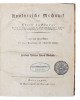
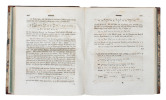
First German edition of this milestone work in applied mathematics (Mecanique Analitique, 1788) in which Lagrange regarded mechanics as a geometry of four dimensions and here set down the principle of virtual velocities as applied to mechanics. The work can lay claim today to be ""one of the outstanding landmarks in the history of both mathematics and mechanics"" (Sarton).""This is the first textbook to treat theoretical mechanics in a purely analytic way. Its mathematical importence stems mainly from the application of Lagrange's new formalization of the calculus of variations, and its significance for rational mechanics from the fact that it summarizes, for the first time in a logically coherent way, the conformity the newtonian and continental mechanics of the 18th century on the basis of general variational principles.""(Helmut Pulte in ""Landmark Writings in Western mathematics 1640-1940).Horblit, 61 (""Discovery of the general equations of motions of any system of bodies""). - Dibner, 112 (French edition)
Introduction à l'étude du Nouveau Testament. Première partie : Histoire ancienne du Canon du Nouveau Testament.
P., Librairie Lecoffre, J. Gabalda et Cie, éditeurs, 1933, gr. in-8°, ii-188 pp, biblio, index, reliure pleine toile bleue, dos lisse avec titres dorés (dos lég. passé), couv. conservée, bon état (Coll. Etudes Bibliques)
"L'histoire de la Constitution du Nouveau Testament présente des difficultés inextricables. Les témoignages patristiques qui semblent plutôt s'affronter que conduire aux mêmes conclusions ne sont pas faits pour encourager les étudiants : aussi l'histoire du Canon n'excite-t-elle pas leur intérêt, nous dit le R. P. Lagrange. Voici cet ouvrage donc qu'il leur présente et où il veut « découvrir les causes des opinions différentes et surtout les motifs qui ont prévalu et réalisé l'unité ». Les positions protestantes sont bien connues que représentent spécialement A. Harnack et Hans Lietzmann : entre plusieurs productions du christianisme primitif l'Eglise aurait, entre 170 et 200, choisi les plus accréditées pour les revêtir du caractère de canonicité. Erreur dogmatique mais aussi erreur historique. Sans rivaliser avec Th. Zahn, le P. Lagrange examine la question entière en six chapitres substantiels où il aborde, pour les résoudre, les points les plus sensibles et les plus significatifs du problème..." (Echos d'Orient, 1935) Désormais les frais d'envoi sont de 6 € seulement pour les livres jusqu'à 1 kg (colissimo suivi), pour la France métropolitaine.

