Write to the booksellers
130 books for « janus r e »Edit
-
Type
Book (127)
Magazine (3)
-
Language
French (127)
Italian (1)
Russian (2)
-
Century
16th (2)
17th (2)
18th (4)
19th (6)
20th (64)
-
Countries
Belgium (15)
Canada (1)
Denmark (7)
France (93)
Netherlands (6)
Switzerland (6)
United States of America (2)
-
Syndicate
ALAC (1)
CLAM (1)
ILAB (28)
NVVA (2)
SLACES (2)
SLAM (14)
Topics
- Amsterdam (1)
- Anthropology (1)
- Archaeology (2)
- Belgium (1)
- Bibliophilism (1)
- Children’s books (1)
- Christianity (1)
- Classic literature (1)
- Comic strip (10)
- Contemporary look (1)
- Drawings (1)
- Early printed books (4)
- Economics (1)
- Fashion (1)
- Figaro (2)
- Fine arts (2)
- First edition (3)
- Fishes (1)
- Flemish (1)
- Florence (1)
- Geography (1)
- Germanic languages (2)
- Hagiography (1)
- Hippocrates (1)
- History (8)
- Humour anecdotes (1)
- Industrial arts & crafts - fine arts (1)
- Italy (2)
- Janus (122)
- Journalism (1)
- Latin (3)
- Latin greek (2)
- Law (1)
- Leisure (1)
- Literature (18)
- Magazine (1)
- Man ray (2)
- Medicine (4)
- Michaux henri (1)
- Miller (1)
- Mind reading (1)
- Mirabeau (1)
- Old comics (1)
- Painting (1)
- Painting (2)
- Photography (1)
- Poetry (2)
- Prehistory (1)
- Psychology (1)
- Regionalism (1)
- Religions & spirituality (1)
- Reviews (5)
- Scandinavian literature (2)
- Sculpture (1)
- Sexuality (1)
- Shapes & colours (1)
- Sociology (5)
- Sports (1)
- Surrealism (2)
- Translation (1)
- Various (3)
- Wallonia (1)
- War (2)
Iohannis Secundi Opera. Accurate recognita, ex museo P. Scriverii.
Leiden (Lugduni Batavorum), Apud Franciscum Hegerum, 1631. (Colophon at the end: 'Impressa Lugduni Batavorum, in nova officina typographica Wilhelmi Christiani, 1631')
12mo. XXVIII,384 (recte 382),(1 colophon),(1 blank) p. Vellum. 13.5 cm 'The kissing poet' (Ref: STCN ppn 833698613; Brunet 5,257; Willems 1669; Graesse 6,339; Ebert 20786) (Details: 5 thongs laced through the joints. Short title in ink on the back. Engraved title with the portrait of the first love of the neolatin poet Janus Secundus, Julia, locked within a kind of medallion and surrounded by 2 cornucopiae; the text reads: 'Vatis amatoris Iulia sculpta manu', i.e. 'a portrait sculped by the hand of the author'. On p. *10 verso an almost full-page engraved portrait of Janus Secundus himself, holding in his hand the medal or medallion he made with the portrait of Julia; underneath the portrait a 4 line poem by his brother Hadrianus Marius) (Condition: Vellum age-tanned. Front pastedown detached. Some irregular pagination) (Note: The Dutch neolatin poet Janus Secundus Nicolai Hagiensis, was born on the 15th of november 1511, the day of the martyr Secundus, in The Hague. He died very young in 1536. In 1528 he moved to Mechelen where his father was appointed president of the 'High Council'. This town was the residence of the Austrian vicequeen Margaretha of Parma. The southern part of the Netherlands was in this time the center of a florishing urban civilization. In May 1530 Secundus met a young prostitute from Mechelen, called Julia, and fell in love with her. Julia became the subject of his first book of elegies, his 'Julia Monobiblos', in which he tells how he won and lost his love. During his studies in Bourges under the famous jurist Alciati he wrote his first 'Basia'. Alciati introduced Secundus there also to the newest Italian poetry. A humanist poet often started his career with erotic poetry, like Piccolomini and Beza. Secundus' 'kiss-poems' are a variation on two 'kiss-poems' of the Latin poet Catullus (ca. 84-54 B.C), who became during the Renaissance a model for love-poetry. Secundus wrote in his short live 6835 lines of poetry, of which only 425 lines were printed during his lifetime. He wrote 'with equal fluency all kinds of lyrical, heroic, and elegiac verse. Down to the present day Secundus lives in literary history as the kissing poet' (...) 'Until far in the 18th century Secundus is mentioned as one of the classics of love poetry' (IJsewijn, Companion to Neo-Latin studies I, Leuven, 1990, p. 152) The first edition of his collected works was posthumously published in 1541 in Utrecht, and was edited by Secundus brother Marius. All later editions are based on this edition. The manuscript with the collected works used for this edition came later in the possession of the Dutch classicist Petrus Scriverius, 1576-1660. He produced a new edition in 1612, in which he also incorporated poems of Secundus which had been omitted in the 1541 edition because they were thought to be disagreeable to the French and English king. In this second edition of 1631 Scriverius incorporated more material from other sources and manuscripts. (Best source for Secundus is J.P. Guépin, 'De kunst van Janus Secundus', Amst., 1991.) It opens with 18 page with 'testimoni'a and 'iudicia' on Secundus. After the poems of Secundus, Scriverius added some poems of his brother Marius: 'Cymba amoris et alia poemata'. (p. 249/266) This is followed by Secundus' prose letters, though with some poetry, that he wrote during his 3 voyages through France, and his trip to Spain. (p. 269/345) At the end have been added some letters and a treatise on the family of Secundus 'De Nicolao Patre, & gente Nicolaia') (Collation: *8,(between leaf *4 and *5 have been inserted the leaves pi*5 and pi*6), **4; A-Q12 (Between the gatherings C and D the pagination of 72/79 is skipped.Leaf H11, p. 195/96, misnumbered 159/196, is a cancel. Leaves K11 & K12 have also irregular pagination, the numbers of the pages 244/45 are doubly used. Leaf L8 is a blank leaf. Leaf Q12 verso blank)) (Photographs on request)
Joannis Secundi opera.
Paris (Parisiis), Sumtibus Societatis, 1748.
12mo. (II),382,(1 corrigenda) p., portrait. Vellum 14.5 cm (Ref: cf. Willems 1669) (Details: 5 thongs laced through the joints. An engraved portrait on the title of the first love of Janus Secundus, Julia, locked within a kind of medallion and surrounded by 2 cornucopiae; the text reads: Vatis amatoris Iulia sculpta manu, i.e. a portrait sculped by the hand of the author; opposite the title is a full-page engraved portrait of Janus Secundus himself, holding in his hand the medal or medallion he made with the portrait of Julia; underneath the portrait a 4 line poem by his brother Hadrianus Marius) (Condition: Binding soiled. Old ownership entry on the first flyleaf. Outer margin of the portrait & the title thumbed. Paper yellowing) (Note: The Dutch neolatin poet Janus Secundus Nicolai Hagiensis, was born on the 15th of november 1511, the day of the martyr Secundus, in The Hague. He died very young in 1536. In 1528 he moved to Mechelen where his father was appointed president of the High Council. This town was the residence of the Austrian vicequeen Margaretha of Parma. The southern part of the Netherlands was in this time the center of a florishing urban civilization. In May 1530 Secundus met a young prostitute from Mechelen, called Julia, and fell in love with her. Julia became the subject of his first book of elegies, his Julia Monobiblos, in which he tells how he won and lost his love. During his studies in Bourges under the famous jurist Alciati he wrote his first Basia. Alciati introduced Secundus there also to the newest Italian poetry. A humanist poet often started his career with erotic poetry, like Piccolomini and Beza. Secundus' kiss-poems are a variation on two kiss-poems of the Latin poet Catullus (ca. 84-54 B.C), who became during the Renaissance a model for love-poetry. Secundus wrote in his short live 6835 lines of poetry, of which only 425 lines were printed during his lifetime. He wrote 'with equal fluency all kinds of lyrical, heroic, and elegiac verse. Down to the present day Secundus lives in literary history als the kissing poet' (...) 'Until far in the 18th century Secundus is mentioned as one of the classics of love poetry' (IJsewijn, Companion to Neo-Latin studies I, Leuven, 1990, p. 152) The first edition of his collected works was posthumely published in 1541 in Utrecht, and was edited by Secundus' brother Marius. All later editions are based on this edition. The manuscript with the collected works used for this edition came later in the possession of the Dutch classicist Petrus Scriverius, 1576-1660. He produced a new edition in 1619, in which he also incorporated poems of Secundus which had been omitted in the 1541 edition because they were thought to be disagreeable to the French and English king. In his second edition of 1631 Scriverius incorporated more material from other sources and manuscripts. (Best source for Secundus is J.P. Guépin, De kunst van Janus Secundus, Amst., 1991) The book on offer here is a reissue of the third edition of 1651. Willems says about the edition of 1651: 'L'édition de 1651 reproduit textuellement la précédente', id est that of 1631. The book opens with 18 pages testimonia and iudicia on Secundus. After these preliminary pages and before Secundus' text we find on page 27 a kind of half title: Joannis Secundi poemata quae reperiri potuerunt omnia. Ex tertia editione Petri Scriverii anno 1650. The year 1650 seems to be a printing error of the French printer. At the end are added some letters and a treatise on the family of Secundus De gente Nicolaia) (Provenance: on front flyleaf the old ownership entry of 'Frid. Guil. von Knebel'. We found on the internet a Friedrich Wilhelm von Knebel, 1735-1799, who seems to have been a rigid and at the same time sloppy Prusian state official. On the front pastedown is written in a different hand 'Ostheide'. Ostheide might refer to the Samtgemeinde (collective municipality) in the district of Lüneburg, south of Hamburg, in Lower Saxony, Germany. Ostheide is also a German family name) (Collation: pi1 (= A12), A12 (minus leaf A12), B-Q12 (R1, corrigenda)) (Photographs on request)
JANUS. N° 4. Printemps-été 1951.
Henry Miller, René Fallet, Marcel Béalu, Jean Rousselot, Jean Sénac, Robert Sabatier, Gaston Criel, Jean Markale, etc Illustrations hors texte de Michèle Michaux, Joseph Fitzpatrick, J. Martin-Bontoux. Bon état.
/// JANUS. « Cahiers de la poésie française et américaine ». Paris VIe (91, rue de Seine) et New York (128 west, 21 St.). Directeurs : Elliott Stein et Daniel Mauroc, puis Pierre-Jean Oswald et Peter Ross. In-12 broché. Les poèmes paraissent dans la langue de leur écriture, français ou anglais. 5 numéros ont paru en 5 livraisons, de mars 1950 à lautomne 1951.
Janus. Poésie. 6 premiers numéros
Janus Janus, 1982 - 1983. 6 volumes In-8 carrés brochés du n°1 à 6. Mouillure en bord des couverture. Textes de Jean Roger Caussimon, Luc Béromint, Pierre Béarn, Denys-Paul Bouloc, etc
![Janus. Poésie. 6 premiers numéros. Janus. Poésie ] Pierre Jean Blazy](https://static.livre-rare-book.com/pictures/MAS/172939_1_thumb.jpg)
Toutes les expéditions sont faites en suivi au-dessus de 25 euros. Expédition quotidienne pour les envois simples, suivis, recommandés ou Colissimo.
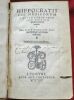
HIPPOCRATIS COI MEDICORUM Omnium Longe Principis, Opera Quae apud nos extant omnia. Per Ianu Cornarium Medicum Physicum Latina Lingua conscripta. Accssit index rerum copiosissimus.
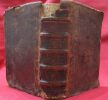
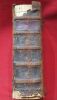
Lugduni (Lyon), Apud Ant. Vincentium, M.D.LIII (1553), 1 volume in-12 de 175x105x55 mm environ, 1f.blanc, 40 ff. (titre en rouge et noir avec vignette à la marque de l'imprimeur Antoine Vincent)-1f.blanc-539 feuillets, 2ff.blancs, (un numéro pour 2 pages), plein veau brun de l'époque, dos à nerfs, titres à peine visible sur pièce de titre grenat, orné de fleurons aux entrenerfs et un motifs en losange au centre des plats (dorure en effacée). Exemplaire entièrement réglé, avec colophon en dernière page : Lugduni Excudebat Petrus Fradin, M.D.LV. Avec la Marque de l'imprimeur Antoine Vincent gravée sur bois et des Lettrines gravées sur bois. Sig. |-|||||8, a-z, A-O8, P4, Q-Y8, Aa-Yy8, (Yy8 le dernier feuillet réglé est un feuillet blanc). Reliure abimée avec manque de cuir sur le dos les coupes et les coins, des annotations manuscrites par endroits dans les marges et sur la page de titre, rares manques de papier, petites taches et cernes dans les marges, galeries de ver marginales en début et fin de volume (sans atteinte au texte). Rare impression lyonnaise réalisée par FRADIN pour Antoine VINCENT; Janus Cornarius (Johann Hainpol ou Hagenbut), ami d'Erasme, professeur de Médecine qui donna plusieurs traductions d'Hippocrate.
Marque dAntoine Vincent : avant-bras et main sortant dun nuage, entourés dun serpent se mordant la queue. La main tient un sceptre fleuri et deux rameaux en rinceaux, mention à gauche du sceptre « Vin / cin / ti. » Merci de nous contacter à l'avance si vous souhaitez consulter une référence au sein de notre librairie.
Theodori Bezae Vezelii Poemata. (Bound with:) Marci Antonii Mureti Juvenilia. (And:) Johannis Secundi Hagiensis Juvenilia.
Leiden (Lugduni Batavorum), 1757.
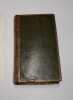
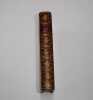
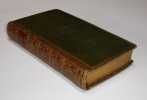
12mo in 8 & 4 sheets. 3 volumes in 1: (IV),IV,124 p., a portrait of Beza; X,106 p., a portrait of Muretus; IV,3-156 p. Green morocco 16 cm (Ref: Brunet 1,239; Graesse cf 1,359, where we find the imprint Paris 1757) (Details: Green morocco; red morocco shield on the back; gilt floral decoration on the back; boards with gilt triple fillet borders; inside dentelles gilt; marbled endpapers; edges of the bookblock gilt; woodcut printers' mark of Joseph Gérard Barbou on all three titles, depicting an old man who stands in the shade of a vine-entwined elmtree. The motto is 'Non solus'. The 2 portraits have been etched by Fiquet) (Condition: Some wear to the extremes. A small bump in the bottom edge of the front board. Two tiny and almost invisible wormholes in the front joint) (Note: All three titles in this book have a false imprint, 'Lugduni Batavorum', i.e. Leiden, in the Dutch Republic. It was according to Brunet actually published in Paris by Barbou. He does not explain, but the printer's mark, paper, printing and layout looks indeed very Barbou. The Short Title Catalogue Netherlands (STCN) is not sure either about Leiden, it adds 'printed in France?' In Latin elegiac and epigrammatic poetry, from Roman times to the Renaissance, there is constant reference to the 'poetry of youth', as 'standing in contrast to a kind of poetry suitable to be written in old age. The poets characterize the latter poetry as serious, moral, and austere, touching on wars and politics and patriotism. The former is filled with passion and exuberance, concerned not with weighty national issues, but with jokes and laughter and erotic affaires'. (K.M. Summers, 'The Iuvenilia of Marc-Antoine Muret', Columbus, 2006, p. XXV-XXVI) The first edition of 'poemata juvenilia' of the young Calvinist theologian Theodore de Bèze, or Theodorus Beza, 1519-1605, was published in Paris in 1548. 'It had certain rather free pieces printed, which were afterwards made a matter of bitter reproach against him. He therefore suppresed them in the following editions'. (Ebert) This first edition, including the erotic love poems which Beza later regretted having ever published, was clandestinely reprinted. Beza was considered to be among the best Neo-Latin poets of his time. He is however best known for his Latin translation of the New Testament, his critical Greek edition of the New Testament, and for being the founder of the University of Geneva. The Frenchman Marc Antoine Muret, latinized as Marcus Antonius Muretus, 1526-1585, 'exemplifies the essence of French Renaissance humanism. A master of Latin and student of Classical Antiquity, he not only engaged in the recovery and exposition of ancient texts, he also actively employed the old genres and skills in the contemporary ecclesiastical and public spheres. He wrote Latin poetry, both sacred and profane, delivered public orations in Latin and lectured in various schools throughout France and Italy on authors as diverse as Catullus and Tacitus and on topics as varied as Greek philosophy and Roman law'. (K.M. Summers, 'The Iuvenilia of Marc-Antoine Muret', Columbus, 2006, p. XIII) His 'Iuveninlia' were first published in 1552. The Dutch neolatin poet Janus Secundus Nicolai Hagiensis, was born on the 15th of november 1511, the day of the martyr Secundus, in The Hague. He died very young in 1536. In 1528 he moved to Mechelen, the residence of the Austrian vicequeen Margaretha of Parma. The southern part of the Netherlands was in this time the center of a florishing urban civilization. In May 1530 Secundus met a young prostitute from Mechelen, called Julia, and fell in love with her. Julia became the subject of his first book of elegies, his 'Julia Monobiblos', in which he tells how he won and lost his love. During his studies in Bourges under the famous jurist Alciati he wrote his first 'Basia'. Alciati introduced Secundus there also to the newest Italian poetry. A humanist poet often started his career with erotic poetry, like Piccolomini and Beza. Secundus' 'kiss-poems' are a variation on two 'kiss-poems' of the Latin poet Catullus (ca. 84-54 B.C), who became during the Renaissance a model for love-poetry. Secundus wrote in his short life 6835 lines of poetry, of which only 425 lines were printed during his lifetime. He wrote 'with equal fluency all kinds of lyrical, heroic, and elegiac verse. Down to the present day Secundus lives in literary history as the kissing poet' (...) 'Until far in the 18th century Secundus is mentioned as one of the classics of love poetry' (IJsewijn, Companion to Neo-Latin studies I, Leuven, 1990, p. 152) The first edition of his collected works was posthumely published in 1541 in Utrecht, and was edited by Secundus brother Marius. After the poems of Janus Secundus we find 46 pages with the 'Pancharis Joan. Bonefonii Averni ad Jacobum Guellium (p. 111-156)) (Provenance: On the verso of the front flyleaf: 'John Wordsworth, Edinburgh, 1827'. This is the English classical scholar John Wordsworth, 1805-1839, nephew of the Romantic poet William Wordsworth. 'In October 1824 he entered Trinity College, Cambridge. His university career was distinguished. In 1825 he obtained the Bell scholarship, in 1826 a scholarship at his own college, and was second for the Porson prize; in 1827 he obtained it. In 1828 he proceeded to the B.A. degree, but was disqualified for classical honours through distaste for mathematics. In 1830 he was elected fellow of his college. (...) In 1834 he was appointed a classical lecturer in Trinity College, and undertook to edit Richard Bentley's Correspondence (afterwards completed by his brother Christopher Wordsworth'. (Source Wikipedia)) (Collation: pi4 (plus portrait); A8, B4, C8, D4 etc., K4, L2; Portrait, A8 B4, etc. X8, Y4) (Photographs on request)
Janus N° 2. Pourquoi août 14?
Couverture rigide. Revue. 160 pages.
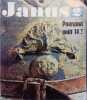
Livre. Janus, Juin septembre 1964.
Janus N° 7. La révolution du loisir. Numéro 7 de la revue.
Couverture rigide. Broché. 160 pages.

Livre. Maurice Clavel - Fourastié - Friedmann - Sullerot - Morvan Lebesque - Paul Lafargue … Janus, Juin Août 1965.
Revue " Janus " : L'homme, son histoire et son avenir - Le christianisme entre les poissons et le verseau
Broché petit in-8 - N° 1 / avril-mai 1964 - 160 pages
bel état
Revue " Janus " : L'Homme, son histoire et son avenir- L'histoire et la sexualité
Broché petit in-8 - N° 3 / octobre - novembre 1964 - 174 pages
bel état
Revue " Janus " : L'Homme, son histoire et son avenir- L'homme devant la richesse
Broché petit in-8 - N°10 / avril-mai 1966 - 160 pages
bel état
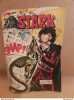
fantastique album n 61 1986
1986 1986. Fantastique Janus Stark album n° 61 / 1986
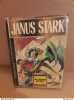
Etat correct
Magnitnaya defektoskopiya. In Russian /Magnetic flaw detection
"Short description: In Russian. Janus, Rudolf Ivanovich. Magnetic flaw detection. Moscow; Leningrad: Gostekhizdat (Moscow: Model Type., 1946). You are welcome to reach out to us for a detailed description of the copies currently available. Delivery of this book may take longer than usual including extended processing and pre-shipping time, no expedited shipping is available. Please advise us if you have a set date or a deadline to receive your order.SKU6069200"
Het boek der kusjes van Janus Secundus, in het Nederlandsch vertolkt door J.H. Scheltema.
Leiden, E.J. Brill, 1902.
LIX,76 p. Wrappers 21 cm (Text, translation, and a 76 page study on the work of Secundus) (Cover scuffed and chipped; back weak and almost broken; paper yellowing)
Janus Secundus (1511-1536). De tekstoverlevering van het tijdens zijn leven gepubliceerde werk.
Nieuwkoop, de Graaf, 1986.
323 p. Wrs. 24 cm (Diss.)
Petronii arbitri veri consularis Satyricon. Sulpiciae satyra de edicto domitiani. Omnia et ampliora et emendatiora, Ex recognitione Iani Dousae, additis eiusdem Praecidaneis cum auctario.Et : Iani Dousae nordovicis, pro Satyrico Petronii arbitri, viri consularis, Praecidancorum Libri tres.
Lugduni Batavorum, Ex Officina Iannis Paetsij. Anno M. D. Lxxxv (1585) et M. D. LXXXIII (1583) pour la deuxième partie.Un volume relié in-12 (10 x 15,5 cm) de 14-144 pages et 230 pages. Reliure plein vélin d'époque à rabats et à lacets. Reliure tachée, lacets un peu courts et un coupé à raz, hauts des pages roussis des pages 127 à 144 et des pages 1 à 113.Rare édition originale du SATYRICON donnée au XVIème siècle avec les commentaires de Johan van der Does en seconde partie (1545-1604) datés de 1583.
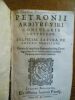
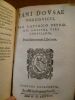
Johan van der Does, dit Janus Dousa, seigneur de Noordwijk, né le 5 décembre 1545 à Noordwijk où il est mort le 8 octobre 1604, est un magistrat, philologue, historien, poète et patriote néerlandais qui a puissamment contribué à lindépendance des Provinces-Unies.

Wenn ich das Wort überschreite. Gedichte. Aus dem Slowenischen von Peter Handke.
Salzburg und Wien. Residenz Verlag. 1988. 8°. 39 S. Originalpappband.
Slowenisch-deutsche Parallelausgabe. - . - Mit handschritlicher Widmung von Janus auf dem Vortitelblatt. - Einband leicht berieben udn fleckig.
Der Kreis ist jetzt mein Fenster. Gedichte.
Salzburg und Wien. Residenz Verlag. 1998. 8°. 113 S., 4 S. Inhalt, 1 Bl. Originalhalbleinwand.
Slowenisch-deutsche Parallelausgabe. - . - Mit handschritlicher Widmung von Janus für Erica Pedretti auf dem Vortitelblatt.
N°2 - Pourquoi Août 14 ? - La Guerre Toujours ?
Janus broché Bristol illustré Besançon 1964 157 pages en format 17 -20 cm - photographies en couleurs et en noir
Très Bon État
Gedenkschriften van Janus Droogstoppel uit den Duitschen Bezettingstijd 1914-1918 [3 volumes] I: Geschiedenis der "Droogstoppels" en der "Vrije Stem", II: Mijn proces voor het "Kriegsgericht" in de gevangenissen te Antwerpen, aken, Werden en Cassel-Wehlheiden, III: Mijne verdere lotgevallen te Antwerpen, Cassel en Straatsburg
, Antwerpen, Buerbaum-Van der Goten, s.d., Volledig in drie delen: 296 + 302 + 318pp., 20cm., originele omslagen, goede staat, B20807