 Write to the booksellers
13313 books for « james t g h »Edit
-
Type
Any type (1)
Artists book (1)
Autograph (5)
Book (13096)
Drawings (1)
Engraving (17)
Magazine (16)
Maps (16)
Music sheets (149)
New book (5)
Old papers (2)
Photographs (4)
-
Latest
Last 24h (8)
Last 3 days (3)
Last month (92)
Last week (8)
-
Language
English (189)
French (12980)
German (5)
Italian (3)
Russian (132)
Spanish (4)
-
Century
16th (1)
17th (7)
18th (164)
19th (563)
20th (6008)
21st (1385)
-
Countries
Belgium (866)
Brazil (2)
Canada (90)
China (9)
Côte d'Ivoire (20)
Denmark (161)
France (10854)
Germany (17)
Greece (15)
Netherlands (2)
Switzerland (1123)
United Kingdom (18)
United States of America (136)
-
Syndicate
ALAC (74)
CLAM (68)
CLAQ (34)
CNE (5)
ILAB (5670)
NVVA (89)
SLACES (89)
SLAM (5144)
SNCAO (8)
Topics
- American literature (37)
- Archaeology (45)
- Architecture (90)
- Army (55)
- Astronomy (39)
- Belgium (30)
- Bible (26)
- Biography (64)
- Blish james (49)
- Boswell (47)
- Canada (28)
- Chase james hadley (101)
- Children’s books (138)
- China (29)
- Christianity (26)
- Cinema (49)
- Clavell james (34)
- Comic strip (40)
- Crime (24)
- Decoration (23)
- Detective novels (250)
- Drawings (28)
- Early printed books (42)
- Economics (53)
- Education (32)
- Egypt (36)
- England (71)
- English (608)
- English literature (56)
- Esotericism (31)
- Ethnology (39)
- Fantastic (46)
- Fine arts (97)
- First edition (118)
- Fisher max & alex (24)
- Fox (67)
- Gallimard (23)
- Gastronomy (178)
- Geography (52)
- Germanic languages (42)
- Gold (26)
- Great britain (27)
- Hackney (23)
- Helvética (25)
- History (380)
- Industrial arts & crafts - fine arts (34)
- Italy (25)
- James henry (307)
- James william (39)
- Jones james (39)
- Joyce james (351)
- Language (39)
- Law (28)
- Leasor james (28)
- Literature (1497)
- Maps (37)
- Medicine (57)
- Melville herman (27)
- Miller (37)
- Monaco (27)
- Navy (64)
- Newspapers press (47)
- North america (24)
- Pacific (38)
- Painters (24)
- Painting (49)
- Paris (30)
- Philosophy (127)
- Photography (55)
- Physics (52)
- Poetry (64)
- Policy (39)
- Posters (23)
- Psychology (64)
- Quebec (29)
- Redfield james (32)
- Religions (155)
- Review (55)
- Reviews (46)
- Romance (38)
- Science fiction (71)
- Sciences (86)
- Sciences & technique (28)
- Scores (165)
- Songs (133)
- Spying (106)
- Switzerland (28)
- Tea (59)
- Theatre (30)
- Theology (47)
- Thriller (50)
- Translation (97)
- Travel (67)
- United kingdom (56)
- United states (84)
- Various (109)
- War (132)
- Youth (59)
James Joyce y Dublin.
Barcelona, Junio 1994.
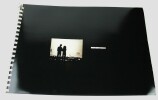
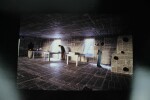
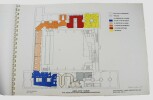
Projet et plans pour l'exposition "El Dublín de James Joyce / The Dublin of James Joyce" au Centre de cultura contemporania de Barcelona" en 1995 : "The way James Joyce saw Dublin turned that city into one of the most powerful metaphors of modernity." Travail de l'architecte Daniel Freixes. De nombreuses photos tirées sur "Ilfochrome classic". Document peut-être aujourd'hui unique. Provient de la bibliothèque du petit-fils de James Joyce, Stephen, mais sans marque de provenance. /// In-folio oblong (30 x 42 cm) de (50) ff. Relié par une spirale. //// Project and plans for the exhibition El Dublín de James Joyce / The Dublin of James Joyce at the Centre de Cultura Contemporània de Barcelona in 1995: The way James Joyce saw Dublin turned that city into one of the most powerful metaphors of modernity. Work by architect Daniel Freixes. Numerous photos printed on Ilfochrome Classic. This document may now be unique. It comes from the library of James Joyce's grandson, Stephen, but without mention of provenance.


History of the early part of the reign of James the Second
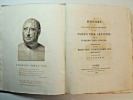
with and introductory chapter bythe right hon. Charles James Fox reliure cartonnée, 30x20, beau papier, bel état intérieur, complet de son frontispice, 273pp + fragments et appendice, dont correspondance entre Louis XIV et Barillon entre 1684 et 1685, etc.. London, printed for William Miller, 1808. Edition Originale. "History of the Early Part of the Reign of James the Second" is a historical work written by Charles James Fox, a prominent British statesman and politician of the late 18th century. The book was published posthumously in 1808 and focuses on the early years of the reign of James II of England, who ruled from 1685 to 1688. In this work, Fox provides a detailed account of the political and religious developments during James II's reign. He examines the policies and actions of the king, including his attempts to strengthen Catholicism in England and his clashes with Protestantism and Parliament. Fox also discusses the controversies surrounding James II's attempts to expand his royal prerogative and his strained relationship with the English nobility and the Church of England. Fox's "History of the Early Part of the Reign of James the Second" offers a critical perspective on the reign of James II and the events leading up to the Glorious Revolution of 1688. It provides insights into the political, religious, and constitutional issues of the time, as well as the broader implications for the balance of power between the monarchy and Parliament. The book is regarded as an important historical account and a valuable source for understanding the political and religious conflicts of 17th-century England.
Mexico and the Americans
New York Frederick A. Praeger 1963
First edition. In original dust jacket. Fascinating, both historically and in the present climate. In James' own words "a provocative analysis of the history of relations between Mexico and the United States on all levels - diplomatic, military, economic, and social - considered in terms of Mexico's developing nationalism and America's attitudes to it". 472 pp. 220 x 150 mm (8Ÿ x 6 inches). Dust jacket has some light bumping and a very small nick to the top edge on the front. Inside the book is in a very good / fine condition. Freelance American journalist, Daniel James (b. 1914), covered Latin America during the Cold War years. His writings reflect two themes: 1) that the region had become a primary target for Soviet aggression against interests of the United States; and 2) that American policies had failed to reflect the importance of the region to the United States. The author of hundreds of columns, articles and at least four books on these topics, including: "Red design for the Americas: Guatemala prelude" (1954), James first went to Latin America in 1953. He described Communist activity in Guatemala and in British Guiana in articles published in that year. James continued to publish articles reflecting his favorite themes in "Harper's," "The Saturday Evening Post," and the "London Observer." Later, he prepared a study of U.S. business activities in Mexico for the United States Embassy and the American Chamber of Commerce in Mexico (1956). From 1955 through 1967 Daniel James was a syndicated columnist for the Hearst Newspapers and SPADEA, publishing his views under the title: "Dateline Latin America." During the 1960s he published: "Cuba: the first Soviet satellite in the Americas" (1961); "Mexico and the Americas" (1963); and, "Che Guevara; A biography" (1969), the last written with the aid of diaries found when their Guevara was killed while trying to start a Communist revolution in Bolivia (1967). Subsequently, James was for four years a tourism director in Mexico City (1974-1978). After 1987 he operated the Mexico-United States Institute in Washington, D.C.
[Barbelle ] - - Hanley James,Dowling Eddie,Brockmans James - Hanley James,Brockmans James,Dowling Eddie
Reference : 109170
(1930)
Partition de la chanson : Put a little Salt On the Bluebird's Tail En photo de couverture Eddie Dowling
Shapiro 1930
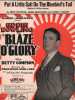
Bon état Format Américain Piano,Ukulélé
Zazzo (René) sur William James - Edward B. Titchener - James-Mark Baldwin - John B. Watson
Reference : 87850
(1942)
Psychologues et psychologies d'Amérique , dans la Nouvelle Encyclopédie Philosophique (Psychologues américains : William James - Edward B. Titchener - James-Mark Baldwin - John B. Watson - Psychologist - Psychology)
Presses Universitaires de France - P.U.F. , Nouvelle Encyclopédie Philosophique Malicorne sur Sarthe, 72, Pays de la Loire, France 1942 Book condition, Etat : Bon broché, sous couverture imprimée éditeur vert foncé In-8 1 vol. - 183 pages
1ere édition, 1941-1942 Contents, Chapitres : Avant-propos, xvi, Texte, 167 pages - Introduction - Les origines - William James - Edward B. Titchener - James-Mark Baldwin - John B. Watson - Psychologies d'hier et d'aujourd'hui - Notices bio-bibliographiques bel exemplaire, frais et propre, papier à peine jauni, exemplaire non coupé
A letter from the right honourable Charles James Fox, to the worthy and independent electors of the city and liberty of Westminster.
London J. Debrett 1793 Deuxième édition. Bel exemplaire de cette lettre ouverte adressée à ses électeurs par le radical Charles James Fox. Il y défend sa position radicale et son opposition à la guerre avec la France. Cette lettre est importante car la France déclara la guerre au Royaume-Uni six jours plus tard. Bien que cet exemplaire semble dépourvu de la moitié du titre et d'un blanc, puisqu'il commence par la page de titre, et que le feuillet suivant porte la signature B, notre exemplaire suit la pagination de l'OCLC 6595972. Nous supposons donc que la deuxième édition n'avait pas de demi-titre. La table des matières est complète. A la fin se trouve un seul feuillet de publicité de Debretts, avec un "the" suspendu indiquant qu'il devrait y avoir un deuxième feuillet (ici manquant). Cousu avec de la ficelle (comme pour tous les autres exemplaires que nous avons vus). Les couvertures ont un peu de marques et d'usure, mais à l'intérieur, le contenu est propre et bien rangé. [ii], 43, [1]. pages. Charles James Fox, un réformateur Whig radical, a été élu pour la première fois pour un borough pourri en 1768 alors qu'il était encore mineur. Il représenta pour la première fois l'important borough de Westminster en 1780, et resta leur membre du parlement jusqu'à sa mort en 1806. 20 cm x 11,5 cm. Conforme à WorldCat / OCLC : 6595972.
Second edition. A nice copy of this open letter to his constituents, from the political radical Charles James Fox. It argued his radical position and opposition to war with France. Significant here, as France declared war on the United Kingdom six days later. Although this copy seems to lack the half title and a blank, as it begins with the title page, and the next leaf has the signature B, our copy follows the pagination of OCLC 6595972. So we assume that the second edition had no half title. Contents themselves are complete. To the end is a single leaf of advertisements from Debretts, end with a hanging "the" indicating there should be a second leaf (here lacking). Sewn with twine (as with all other copies we have seen). The covers have a little marking and edgewear, but inside, the contents are clean and tidy throughout. [ii], 43, [1]. pages. Charles James Fox, a radical Whig reformer, was first elected for a rotten borough in 1768 whilst he was still underage. He first represented the significant borough of Westminster in 1780, and remained their member of parliament until his death in 1806. 20cm x 11.5cm. Conforms to WorldCat / OCLC: 6595972. .
The perfect Thought. Works by James Lee Byars.
Berkeley, University Art Museum. 1990. 27,5x20 cm. 154 S. Originalleinwand mit Schutzumschlag.
Originalausgabe. - Mit Texten von Jacquelynn Baas, James Elliott, Carter Ratcliff, Gianni Vattimo, Achille Bonito Oliva und den "Notes Towrd a Biogrphy" von James Elliott, der bisher umfangreichsten Biografie. - Schutzumschlag mit kleinen Läsuren.
Voyage aux sources du Nil par James Bruce. Traduit de l'anglais par P. F. Henry.
Paris, chez Lepetit, an vii-1798. 1798 8 vol. de texte et 1 atlas in-16° (138 x 86 mm) de : I. frontispice ; 237 pp. (dont avis, titre) ; II. 225 pp. ; III. 244 pp. (dont avis, titre) ; IV. 255 pp. (dont avis, titre) ; V. 255 pp. (dont avis, titre) ; VI. 223 pp. (dont avis, titre) ; VII. 213 pp. (dont avis, titre) ; VIII. 258 pp. (dont avis, titre) ; Atlas. 108 pp. (dont avis, titre) ; [1] p. (avis) ; 1 carte dépliante en frontispice ; 21 planches (numérotées de 2 à 22, la 1 étant le frontispice du premier volume). Ex-libris : Bibliothèque de E. & F. Girod. Demi basane dépoque, plats recouverts de papier à la colle rose à coins de velin vert, dos lisses ornés, titre et tomaison bleu marine, tranches mouchetées, gardes de papier marbré, signé de soie bleue (petits défauts d'usage et décolorations).
Première édition au format in-16° de cette célèbre relation du voyage de James Bruce (1730-1794) à la recherche des sources du Nil, traduite en français par P. F. Henry et finement illustrée par Tardieu. Ecossais dorigine, James Bruce est nommé ambassadeur à Alger en 1763. Il débute alors son exploration de l'Egypte, du Nil bleu, du désert de la mer Rouge, de l'Arabie heureuse et de l'Abyssinie. Son expédition Sur proposition de Lord Halifax, le but de son voyage était la découverte des Sources du Nil et l'observation du passage de Vénus devant le disque du soleil en 1769. L'importance des explorations de Bruce a été longtemps méconnue, et l'on a même douté de leur entière véracité, tant certaines des aventures qu'il raconte ont paru extraordinaires. Mais plusieurs voyageurs - Combes et Tamisier, Léon Delaborde (Revue française, 1838, VII, 424) ont confirmé par la suite l'exactitude de ses récits. Malgré quelque inexpérience scientifique, les travaux de Bruce ont contribué à faire mieux connaître la géographie et l'histoire naturelle d'une Afrique encore peu connue. Bien quil na atteint que les sources d'un affluent, le Nil bleu, son voyage est considéré comme le premier vraiment scientifique en Afrique qui fait entrer ce continent dans la géographie positive Ses aperçus sur l'Abyssinie, en particulier sur les moeurs esclavagistes et sur les religions de cette partie de l'Afrique sont dune grande richesse. Il rentre en Angleterre en 1773 et publie la relation de ses voyages (Edinburgh, 1790). La présente édition constitue, parue dans la collection de la « Bibliothèque portative des voyages », est la première de ce format. Son iconographie est constituée est constituée d1 portrait frontispice de lauteur, d1carte dépliante placée en tête de latlas et de 21 planches à pleine page dethnologie, de botanique et de zoologie, gravées par Tardieu lainé. Provenance : Bibliothèque de E. & F. Girod (Ex-libris). Très bel exemplaire, parfaitement conservé dans sa reliure dorigine. Gay, Bibliographie des ouvrages relatifs à l'Afrique et à l'Arabie, 1875, p. 5 ; Michaux, Bio universelle, V, pp. 666-667. 8 vols. of text and 1 in-16° atlas (138 x 86 mm) of: I. frontispiece; 237 pp. (including notice, title); II. 225 pp.; III. 244 pp. (including notice, title); IV. 255 pp. (including notice, title); V. 255 pp. (including notice, title); VI. 223 pp. (including notice, title); VII. 213 pp. (including notice, title); VIII. 258 pp. (including notice, title); Atlas. 108 pp. (including notice, title); [1] p. (notice); 1 folding map as frontispiece; 21 plates (numbered from 2 to 22, 1 being the frontispiece of the first volume). Bookplate: Library of E. & F. Girod. Contemporary half sheepskin, covers covered with pink glue paper with green vellum corners, decorated smooth spines, navy blue title and volume number, speckled edges, marbled paper endpapers, signed with blue silk (minor defects of use and discoloration). First edition in 16° format of this famous account of the voyage of James Bruce (1730-1794) in search of the sources of the Nile, translated into French by P. F. Henry and finely illustrated by Tardieu. Scottish by origin, James Bruce was appointed ambassador to Algiers in 1763. He then began his exploration of Egypt, the Blue Nile, the Red Sea desert, Arabia Felix and Abyssinia. His expedition On the proposal of Lord Halifax, the aim of his voyage was to discover the Sources of the Nile and to observe the passage of Venus across the disk of the sun in 1769. The importance of Bruce's explorations was long overlooked, and their entire veracity was even doubted, so extraordinary did some of the adventures he recounted seem. But several travellers - Combes and Tamisier, Léon Delaborde (Revue française, 1838, VII, 424) subsequently confirmed the accuracy of his accounts. Despite some scientific inexperience, Bruce's work contributed to a better understanding of the geography and natural history of a still little-known Africa. Although he only reached the sources of a tributary, the Blue Nile, his voyage is considered the first truly scientific one in Africa that brought this continent into positive geography. His insights into Abyssinia, in particular into the slave customs and religions of this part of Africa are of great richness. He returned to England in 1773 and published the account of his travels (Edinburgh, 1790). This edition, published in the collection of the "Portable Library of Travel", is the first of this format. Its iconography consists of 1 frontispiece portrait of the author, 1 folding map placed at the head of the atlas and 21 full-page plates of ethnology, botany and zoology, engraved by Tardieu the elder. Provenance: Library of E. & F. Girod (Ex-libris). A very fine copy, perfectly preserved in its original binding. Gay, Bibliography of works relating to Africa and Arabia, 1875, p. 5; Michaux, Bio universelle, V, pp. 666-667.
Wars and Rumours of Wars : A Memoir.
London, Leo Cooper, Secker & Warburg, 1984 in-8°, vi-257 pp, 24 photos sur 16 pl. hors texte, notes, index, reliure éditeur, jaquette illustrée, bon état
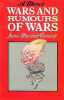
"Sir James est né en 1887 et est toujours en vie, ce qui fait de lui probablement le plus vieux général de l'armée britannique encore en vie [il est décédé le 25 décembre 1985]. Sa carrière militaire n'était pas non plus typique, car il aimait les langues étrangères et en a appris un nombre considérable au cours de sa vie. De plus, il était de la bonne génération pour passer par la Première Guerre mondiale, l'école d'état-major et les commandements, ainsi que pour vivre des expériences au sein de la Commission des frontières balkaniques et d'autres expériences exotiques, de sorte qu'en 1940, il s'est retrouvé un des commandant de division qui s'est sorti sain et sauf du pétrin en France, avant d'être transféré en Turquie, étant l'un des rares à parler turc, pour tenter de convaincre les réalistes de ce pays de se joindre aux Alliés. C'était, bien sûr, une tâche sans espoir en 1940-41, et il s'est retrouvé de nouveau en Grande-Bretagne en raison de son âge. Après la guerre, il a quitté l'armée, s'est essayé au commerce des armes et a finalement trouvé sa voie en tant qu'historien. “Wars and Rumours of Wars” est un livre agréable, rempli d'aperçus de personnes célèbres et d'autres moins connues, et de relations avec d'autres que l'on ne trouve pas dans la plupart des autobiographies de la Seconde Guerre mondiale, à l'exception peut-être de celles de Sir Edward Spears." (Military Affairs, 1986) — "L'auteur de ces souvenirs pleins d'entrain est né James Cornwall en 1887 et s'est engagé dans l'artillerie royale en 1907. On pourrait s'attendre à ce que l'autobiographie d'un auteur nonagénaire soit nostalgique et discursive ; au contraire, “Wars and Rumours of Wars” nous emmène rapidement, mais avec une clarté admirable, à travers deux guerres mondiales, une série de missions officielles et de voyages indépendants au Moyen-Orient et au-delà, des entreprises commerciales à la retraite et une dernière carrière d'auteur – le tout en 257 pages, notes et index compris ! En raison de ses remarquables capacités linguistiques, Sir James a passé une grande partie de sa carrière militaire dans l'Intelligence Service. Une aptitude pour les langues, un esprit curieux et un tempérament sociable l'ont amené à passer à l'étranger les longues permissions dès avant la Première Guerre mondiale et, comme "j'ai toujours détesté être dans un pays où je ne pouvais pas communiquer avec les indigènes", il est rapidement devenu polyglotte. En 1914, il est devenu interprète de première classe en allemand, français, norvégien et italien, et de deuxième classe en espagnol. Après la guerre, une mission diplomatique en Turquie lui donne l'occasion de maîtriser le turc et le grec moderne. Au cours des deux guerres mondiales, il a donc travaillé dans les services de renseignement plutôt qu'au combat, mais les chapitres les plus intéressants de son livre prouvent que Marshall-Cornwall pouvait être aussi efficace sur le terrain que derrière un bureau. Ceux-ci relatent son expérience dans le cadre de diverses missions difficiles au cours de la Seconde Guerre mondiale, en particulier la tâche de liaison avec la dixième armée française lors des retraites chaotiques de mai et juin 1940, qui ont abouti à la capitulation de la France. Il était responsable du retrait des troupes britanniques par Cherbourg, une opération moins médiatisée que Dunkerque mais tout aussi périlleuse. Le titre de l'ouvrage est on ne peut plus clair : il s'agit du récit d'une carrière et non d'une vie privée. Il y a cependant quelques anecdotes agréables, notamment celle de la redoutable Marjorie Marshall-Cornwall qui s'est cachée déguisée en musulmane lorsque les épouses des militaires ont reçu l'ordre de quitter Constantinople pendant la révolution d'Atatürk. Il y a aussi un chapitre hilarant décrivant un dîner à Chequers avec un Churchill fort capricieux. Sir James ne cache pas ses désaccords avec le grand homme à diverses occasions, notamment en ce qui concerne la "conduite en retrait" qui a tant entravé la guerre en Afrique du Nord. Il surmonte les revers professionnels et les chagrins privés avec le stoïcisme d'un soldat et est récompensé par une vieillesse sereine et active, qui l'a conduit en Espagne et en Mandchourie, en Israël et aux États-Unis, en Belgique, en Italie et, en fait, presque partout où des batailles ont été livrées. Ses biographies de Massena, Napoléon, Grant, Foch et Haig témoignent d'une connaissance particulière qui a fait de Sir James un membre précieux pendant tant d'années des conseils de la Royal Geographical Society." (Dorothy Middleton, The Geographical Journal, 1984) Désormais les frais d'envoi sont de 6 € seulement pour les livres jusqu'à 1 kg (colissimo suivi), pour la France métropolitaine.
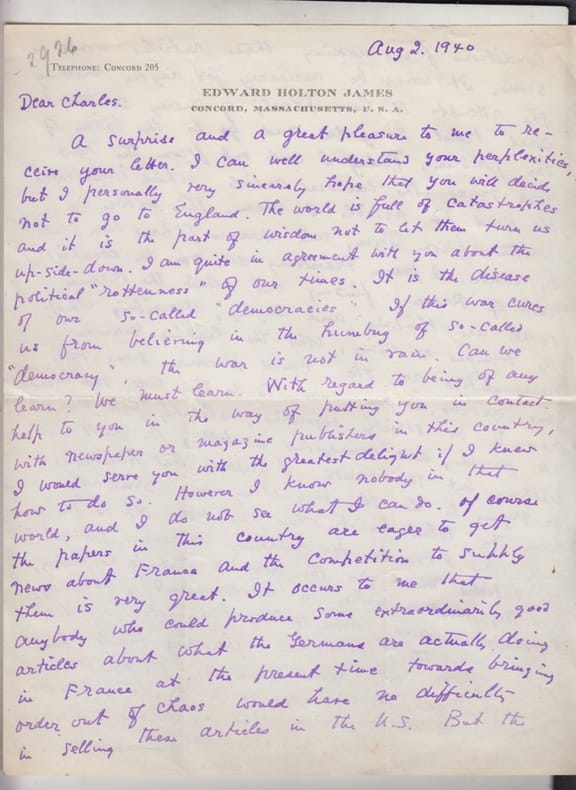
Lettre manuscrite de 2 pages, adressée à Charles de Richter (1887-1975).
1940 1940,bon état,rare- provenance archives Charles de Richter - RICHTER (Charles de).
Edward Holton James était un socialiste américain et, plus tard, un fasciste. Il était le neveu du philosophe William James et du romancier Henry James. Wikipédia (anglais) Remise de 20% pour toutes commandes supérieures à 200 €
The illustrated Bartsch 141 James Ensor. 2 vols
Elesh, James N.: The illustrated Bartsch 141 James Ensor. 2 vols. Abaris Books, 1982. Volume I: Commentary 267 pages and some black and white illustrations. Volume II: 260 black and white illustrations. Cloth.
English Botany or, coloured Figures of British Plants, with their essential Characters, Synonyms, and Places of Growth. To which will be added, occasional Remarks by James Sowerby (and) James Edward Smith. The Figures by james Sowerby. Vol. (I) - XXXI.
London, Taylor and Co./ J. Davies, 1790-1810 8vo. Bound in 31 contemp. uniform green hmorocco. Spines gilt. Binding a bit rubbed. Last volume loosening. A few inner hinges weakening. With 1950 fine handcoloured engraved plates (of 2232). The lacking plates distributed over the whole series. Each plate with descriptive text (3 plates with text in facsimile). A few plates with some brownspots, but nearly all plates fine and clean.
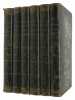
First edition, being the first 31 volumes of 36 published.Pritzel 8789 - Nissen, 2225.
Critique et Politique.
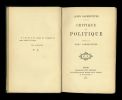
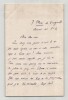
Paris, Calmann Lévy, 1895 1 volume in-18 (19 x 12,5 cm) de XXX-354 pages. Reliure pleine toile verte à la bradel (reliure de l'époque signée Paul Vié). Plats de couverture imprimées orange conservés en excellent état. Très bon état de l'ensemble. Edition originale posthume. 1 des 10 exemplaires de tête sur papier impérial du Japon. Celui-ci porte le n°1 (au composteur). Exemplaire de dédicace offert par Mary Damesteter à Monsieur et Madame Ludovic Halévy "affectueux souvenir" (envoi autographe en page de garde). Ce volume posthume (l'auteur est mort à peine un an auparavant) est un mélange de critique et de politique comme l'indique le titre, mis au jour et publié par son épouse Mary. Dans les Essais de critique on trouve des pages sur la vie et l'oeuvre d'Ernest Renan, la poésie au moyen-âge, la chevalerie. Au chapitre des Symboles on trouve : JAcob et l'Ange - Le petit aveugle de Pennenmaur - Lucia Galvani. Les pages d'histoire contemporaines contiennent : le premier bandit d'Europe (Bismarck) - Philologie et colonisation - Asie centrale - L'assassinat du Président Carnot - La guerre et la paix intérieures (1871 à 1893) - M. Clarétie ou l'optimisme. Au chapitre Conversations autrichiennes : Allemands et Hongrois. James Darmesteter était un érudit du judaïsme et linguiste français du XIX siècle, spécialiste du vieux-perse (né à Château-Salins, le 28 mars 1849 - mort à Maisons-Laffitte, le 19 octobre 1894). James Darmesteter naît dans une famille juive installée en Lorraine depuis le milieu du xviiie siècle et dont les ancêtres sont originaires du ghetto de Darmstadt. Calmann, le père, et Cerf, le grand-père, sont relieurs et libraires ; l’un des grands oncles Darmesteter était scientifique à la cour du tsar de Russie. La mère, Rosalie née Brandeis, est issue d’une famille juive polonaise qui compte des soldats, des scientifiques et des rabbins en nombres. La famille compte, outre James, deux fils, Arsène et Achille qui meurt en bas âge. À la mort du grand-père, toute la famille déménage en 1852 à Paris, dans le quartier du Marais. Le travail est rare et bien des privations se font sentir ; une sœur, Sarah, meurt apparemment peu après sa naissance et James lui-même en garde une constitution chétive ainsi qu’une santé fragile qui le font comparer par certains au poète Giacomo Leopardi. James Darmesteter étudie le sanskrit sous la direction de Hauvette-Besnault, l’un des derniers élèves d'Eugène Burnouf, et la grammaire comparée auprès de Michel Bréal, à l'École Pratique des Hautes Études. À la suite de ses nombreux travaux sur la mythologie zoroastrienne et le persan, il est choisi pour succéder à Renan au Secrétariat de la Société asiatique en 1882. Nommé professeur au Collège de France en 1885, il effectue un an plus tard un voyage en Inde à la suite duquel il fait paraître une traduction de chansons afghanes ainsi qu’un essai sur la langue et la littérature afghanes. Marié très brièvement avec Agnes Mary Francis Robinson en 1888, il devient directeur d'études de l’École Pratique des Hautes Études en 1892. Mary Darmesteter son épousé, née Mary Robinson (1857-1944) ) fut la biographe de son mari James Darmesteter. Elle fut également critique littéraire et poète. Ludovic Halévy était un ami intime du couple Damesteter. Très bon exemplaire du tirage de tête sur Japon tiré à 10 exemplaires seulement.
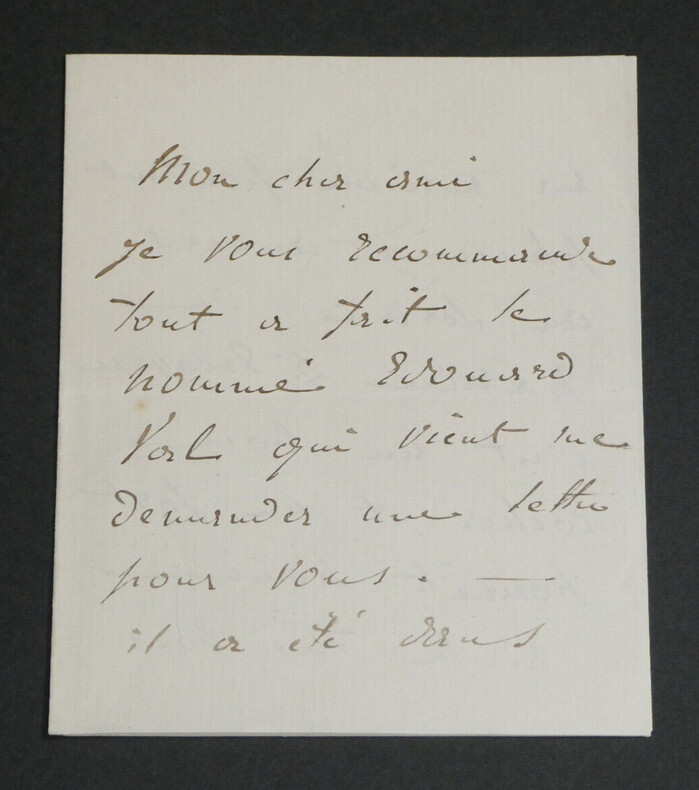
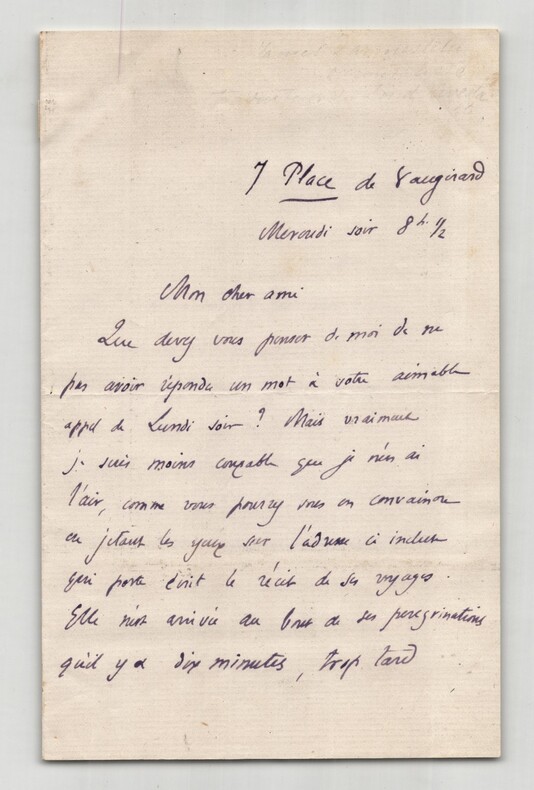
Édouard Antoine Sidoine de Fitz James - Lettre autographe signée - 1876
Édouard Antoine Sidoine de Fitz-James. Lettre autographe signée, 1876 Lettre autographe de recommandation signée d'Édouard Antoine Sidoine de Fitz-James, 8ème Duc de Fitz-James, datée du 1er juin 1876 à Paris. Dimensions : 10,2 x 12,7 cm Nombre de pages : 3 pages
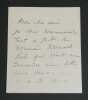
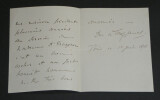
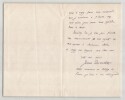
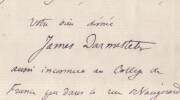
James Darmesteter - Lettre autographe signée "Inconnu au Collège de France"
James Darmesteter. Lettre autographe signée Philologue iranologue français Lettre autographe signée de James Darmesteter, non datée. Rédigée à l'encre bleue sur un double feuillet de papier vergé. Dimensions : 11,1 x 17,6 cm État : Traces d'onglet au dos, sinon bel état de conservation. Nombre de pages : 2 pages James Darmesteter, né le 28 mars 1849 à Château-Salins et mort le 19 octobre 1894 à Maisons-Laffitte, est un philologue iranologue français. Spécialiste du vieux perse, du zoroastrisme et de l’Avesta, il a été professeur au Collège de France et à l'École pratique des hautes études.
PD James Collection - Un certain goût pour la mort + Meurtre dans un fauteuil + La proie pour l' ombre + Mort d'un expert
Livre de poche 1989 572 pages 11x17x3cm. 1989. Poche. 4 volume(s). 572 pages. Le livre regroupe deux romans policiers de P.D. James : 'Meurtre dans un fauteuil' et 'Un certain goût pour la mort'. Dans 'Meurtre dans un fauteuil' l'enquêteur Dalgliesh se rend dans une institution pour handicapés Toynton Manor après la mort suspecte d'un ami et découvre une série de morts mystérieuses. L'ouvrage confirme la réputation de P.D. James comme 'reine du crime'

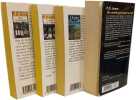
Bon Etat intérieur propre
Observations sur la fièvre des prisons sur les moyens de la prévenir en arrêtant les progrès de la contagion, à l'aide des fumigations de gaz nitrique... Traduites librement de l'anglais... par Louis Odier
À Genève, de l'imprimerie de la Bibliothèque britannique, an IX (1801), in-8, VIII-248 pp, broché, couverture d'attente de l'époque, Première édition en librairie de la traduction de A Description of the Jail Distemper as it Appeared amongst the Spanish Prisoners, du médecin écossais James Carmichael Smyth (1741-1821). La version française avait paru à l'origine dans le périodique conservateur de Marc-Auguste et Charles Pictet, la Bibliothèque britannique, voué à diffuser les nouveautés scientifiques et littéraires en provenance d'Angleterre et à donner un éclairage différent de la pensée diffusée en France par la Révolution française. Les observations de Carmichael Smyth sont suivies d'un extrait des Observations du Dr James Currie sur les bons effets des aspersions d'eau froide dans les fièvres, et d'Observations additionnelles sur les fumigations de gaz nitrique en réponse aux objections faites contre elles, par Guyton-Moreau. Cachet annulé de l'Institut catholique de Paris et étiquette en pied du dos. Wellcome V, p. 140. Couverture rigide
Bon VIII-248 pp
James Harry,Ellington Duke - Ellington Duke,George Don,James Harry,Hodges Johnny - James H.,George Don,Ellington Duke,Hodges Johnny
Reference : 99155
(1944)
Partition de la chanson : I’m beginning to see the light
Liberty Songs 1944
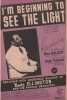
Bon état Petit format Accordéon,Guitare,Piano,Banjo
Robert Wakefield, Thomas Wakefield, James P. Carley (ed), Charles Burnett (ed)
Reference : 63140
Hebraism in Sixteenth-Century England: Robert and Thomas Wakefield
, Brepols- PIMS, 2024 Hardback, 348 pages, Size:152 x 229 mm, Language: English. ISBN 9780888442314.
Summary Robert Wakefield and his brother Thomas were pioneers in the study and teaching of Hebrew in early modern England. Robert was trained at Cambridge, acquired expertise in Aramaic, Hebrew, and Arabic, and obtained professorial status in Louvain, Cambridge, and Oxford. Thomas took possession of his brother's books and manuscripts upon his death; he enjoyed long tenure as praelector in Hebrew at Cambridge and was a compulsive annotator of his books. This volume draws together the political, linguistic, and bibliographical materials that shaped the careers of these two scholars, revising previous claims and producing a compelling analysis of Hebrew learning in sixteenth-century England. TABLE OF CONTENTS List of Figures Abbreviations Preface 1 James P. Carley and Charles Burnett Introduction 2 James P. Carley Robert and Thomas Wakefield: A Biographical Sketch 3 Jessica Crown Robert Wakefield's Inaugural Orations in Context 4 Joanna Weinberg The Remarkable Hebraism of Robert Wakefield 5 Charles Burnett Robert Wakefield and Arabic 6 Richard Rex Robert Wakefield and the King's Great Matter 7 Saverio Campanini The ?Ezra Scroll? of Bologna in the Crossfire of the Royal Divorce: John Fisher, Robert Wakefield and an Erased Text 8 Judith Olszowy-Schlanger ?My Silent Teachers?: Hebrew Manuscripts as the Source of Robert Wakefield's Hebraism 9 James P. Carley Robert Wakefield's Manuscript Collections and the English Monastic Libraries: A Parallel to John Leland's Mission 10 James P. Carley Books Owned or Annotated by the Wakefield Brothers 11 Benjamin Williams ?Great Mountains Suspended from Every Single Letter?: Thomas Wakefield and His Hebrew Bibles 12 Herbert L. Kessler Thomas Wakefield's ?Antiquissimus Codex? and San Marco's Musivum Novissimum Appendix 1 David R. Carlson Robert Wakefield, ?Oratio Oxonii habita in Collegio Regio? (1532) Appendix 2 Joanna Weinberg A Hebrew Responsum about Levirate Marriage (1530) Bibliography Contributors Index of Manuscripts Indexes of Printed Books General Index
James Harry - Ellington Duke,George Don,James Harry,Hodges Johnny - James H.,George Don,Ellington Duke,Hodges Johnny
Reference : 95514
(1944)
Partition de la chanson : I'm beginning to see the light
1944
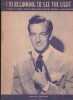
Bon état Format Américain Piano
Pour la Science - Hubert Curien - A. Cameron - George Wetherill - John Lewis - Anny Cazenave et André Brahic - Jean-François Minster - David Schramm et Robert Clayton - Gordon Pettengill, Donald Campbell et Harold Masursky - Gerald Schubert et Curt Covey - Claude Allègre - Raymond Arvidson, Alan Binder et Kenneth Jones - Norman Horowitz - Andrew Ingersoll - James Pollack et Jeffrey Cuzzi - Tobias Owen - Bruce Murray - John Wood - Joseph Veverka - Laurence Soderblom - Torrence Johnson - George Wetherill - E. Parker - J. Gosling et A. Hundhausen - Fred Whipple - James van Allen
Reference : 101271
(1982)
Le système solaire , (La genèse du système solaire - L'origine et l'évolution du système solaire - La formation de la terre par accrétion de planétoïdes - La chimie du système solaire - L'effet des marées dans le système solaire - L'âge du système solaire - Une supernova a-t-elle engendré le système solaire ? - Les planètes actives et les planètes géantes - La surface de Vénus - L'atmosphère de Vénus - Les premiers jours de la Terre - La surface de Mars -La vie sur Mars - Jupiter et Saturne - Les anneaux dans le système solaire - Titan - Les planètes mortes et les petits corps - Mercure - La lune - Phobos et Deimos - Les satellites Galiléens et Jupiter - Les satellites de Saturne - Les objets Apollo - Le soleil et l'espace interplanétaire - Le Soleil - Les ondes dans le vent solaire - La rotation des comètes - Champs et particules interplanétaires)
Belin , Bibliothèque Pour la Science Malicorne sur Sarthe, 72, Pays de la Loire, France 1982 Book condition, Etat : Bon relié, cartonnage éditeur blanc, illustré par la couronne solaire observée de l'espace ( photo NASA, Goddard Space Flight Center) In-4 1 vol. - 288 pages
très nombreuses illustrations dans le texte en noir et blanc, quelques-unes en couleurs nouvelle édition française, 1982 Contents, Chapitres : Hubert Curien : Préface - 1. La genèse du système solaire : A. Cameron : L'origine et l'évolution du système solaire - George Wetherill : La formation de la terre par accrétion de planétoïdes - John Lewis : La chimie du système solaire - Anny Cazenave et André Brahic : L'effet des marées dans le système solaire - Jean-François Minster : L'âge du système solaire - David Schramm et Robert Clayton : Une supernova a-t-elle engendré le système solaire ? - 2. Les planètes actives et les planètes géantes : Gordon Pettengill, Donald Campbell et Harold Masursky : La surface de Vénus - Gerald Schubert et Curt Covey : L'atmosphère de Vénus - Claude Allègre : Les premiers jours de la Terre - Raymond Arvidson, Alan Binder et Kenneth Jones : La surface de Mars - Norman Horowitz : La vie sur Mars - Andrew Ingersoll : Jupiter et Saturne - James Pollack et Jeffrey Cuzzi : Les anneaux dans le système solaire - Tobias Owen : Titan - 3. Les planètes mortes et les petits corps : Bruce Murray : Mercure - John Wood : La lune - Joseph Veverka : Phobos et Deimos - Laurence Soderblom : Les satellites Galiléens et Jupiter - Torrence Johnson : Les satellites de Saturne - George Wetherill : Les objets Apollo - 4. Le soleil et l'espace interplanétaire : E. Parker : Le Soleil - J. Gosling et A. Hundhausen : Les ondes dans le vent solaire - Fred Whipple : La rotation des comètes - James van Allen : Champs et particules interplanétaires - Index et Bibliographie cartonnage légèrement jauni, coin inférieur gauche du plat inférieur à peine émoussés, légères tâches de rousseurs sur les deux premières et dernières pages, sinon en bon état, intérieur propre, papier à peine jauni
Pour la Science - Jean-Claude Pecker - Ivan King - L. Botinelli et L. Gouguenheim - Richard Muller - Jay Pasachoff et William Fowler - Patrick Osmer - Stephen Gregory et Laird Thompson - Jack Burns - Edward Groth, James Peebles, Michael Seldner et Raymond Soneira - Stephen Hawking - John Barrow et Joseph Silk - Alan Guth et Paul Steinhardt - David Meier et Rashid Sunyaev - Lawrence Krauss - Richard Gott, James Gunn, David Schramm et Beatrice Tunsley - Frank Wilczek - Brice de Witt - George Gale - Duane Diens, John Letaw, Doris Teplitz et Vigor Teplitz
Reference : 101270
(1988)
L'Univers : Des faits aux théories , (Les faits cosmologiques - Le ciel est noir -Les amas globulaires - Les distances des galaxies - Le rayonnement thermique cosmologique - Le deutérium dans l'Univers - Les quasars : Des témoins du début de l'Univers - La distribution des galaxies - Les plus vastes structures de l'Univers - Le mode de groupement des galaxies - La théorie classique - La mécanique quantique des trous noirs - La structure primitive de l'Univers - L'Univers inflatoire - Des galaxies primitives - La matière sombre dans l'univers - L'expansion de l'Univers - Les grandes interrogations - L'asymétrie cosmique entre la matière et l'antimatière - La gravitation quantique - Le principe anthropique)
Belin , Bibliothèque Pour la Science Malicorne sur Sarthe, 72, Pays de la Loire, France 1988 Book condition, Etat : Bon relié, cartonnage éditeur blanc, illustré par de petites perturbations de la densité de matière et d'énergie dans l'univers In-4 1 vol. - 227 pages
très nombreuses illustrations dans le texte en noir et blanc, quelques-unes en couleurs nouvelle édition française, 1988 Contents, Chapitres : Jean-Claude Pecker : Préface - 1. Les faits cosmologiques : Le ciel est noir - Ivan King : Les amas globulaires - L. Botinelli et L. Gouguenheim : Les distances des galaxies - Richard Muller : Le rayonnement thermique cosmologique - Jay Pasachoff et William Fowler : Le deutérium dans l'Univers - Patrick Osmer : Les quasars : Des témoins du début de l'Univers - Stephen Gregory et Laird Thompson : La distribution des galaxies - Jack Burns : Les plus vastes structures de l'Univers - Edward Groth, James Peebles, Michael Seldner et Raymond Soneira : Le mode de groupement des galaxies - 2. La théorie classique : Stephen Hawking : La mécanique quantique des trous noirs - John Barrow et Joseph Silk : La structure primitive de l'Univers - Alan Guth et Paul Steinhardt : L'Univers inflatoire - David Meier et Rashid Sunyaev : Des galaxies primitives - Lawrence Krauss : La matière sombre dans l'univers - Richard Gott, James Gunn, David Schramm et Beatrice Tunsley : L'expansion de l'Univers -3. Les grandes interrogations : Frank Wilczek : L'asymétrie cosmique entre la matière et l'antimatière - Brice de Witt : La gravitation quantique - George Gale : Le principe anthropique - Duane Diens, John Letaw, Doris Teplitz et Vigor Teplitz - Auteurs et Bibliographie cartonnage très légèrement empoussiéré et à peine, jauni, coins du cartonnage à peine émoussés, sinon en bon état, intérieur frais et propre, papier à peine jauni
Garber (Elizabeth), Brush (Stephen G.) and Everitt (C.W.F.) - James Clerk Maxwell
Reference : 100203
(1986)
Maxwell on Molecules and Gases , (James Clerk Maxwell)
The MIT Press Malicorne sur Sarthe, 72, Pays de la Loire, France 1986 Book condition, Etat : Bon hardcover, editor's full black clothes binding, no dust-jacket grand In-8 1 vol. - 592 pages
few text-figures 1st edition, 1986 Contents, Chapitres : Contents, List of serial abbreviations, preface, xxvii, Text, 565 pages - Kinetic theory and the properties of gases : Maxwell's work in its Nineteenth-century context - Documents on atomic and statistical physics - Documents on the kinetic theory of gases (Letters, notes, postcard, various documents) - James Clerk Maxwell (13 juin 1831 à Édimbourg en Écosse - 5 novembre 1879 à Cambridge en Angleterre) est un physicien et mathématicien écossais. Il est principalement connu pour avoir unifié en un seul ensemble d'équations, les équations de Maxwell, l'électricité, le magnétisme et l'induction, en incluant une importante modification du théorème d'Ampère. Ce fut à l'époque le modèle le plus unifié de l'électromagnétisme. Il est également célèbre pour avoir interprété, dans un article en quatre parties publié dans Philosophical Magazine intitulé On Physical Lines of Force, la lumière comme étant un phénomène électromagnétique en s'appuyant sur les travaux de Michael Faraday. Il a notamment démontré que les champs électriques et magnétiques se propagent dans l'espace sous la forme d'une onde et à la vitesse de la lumière. Ces deux découvertes permirent d'importants travaux ultérieurs notamment en relativité restreinte et en mécanique quantique. Il a également développé la distribution de Maxwell, une méthode statistique de description de la théorie cinétique des gaz. Maxwell est considéré par de nombreux physiciens comme le scientifique du xixe siècle ayant eu le plus d'influence au xxe siècle. Ses contributions à la science sont considérées par certains comme aussi importantes que celles d'Isaac Newton ou d'Albert Einstein. En 1931, pour le centenaire de la naissance de Maxwell, Einstein lui-même décrivait les travaux de Maxwell comme les « plus profonds et fructueux que la physique ait connus depuis le temps de Newton ». Il est également connu pour avoir réalisé le 17 mai 1861 la première photographie en vraie couleur devant les membres de la Royal Institution de Londres. - Une des contributions les plus importantes de Maxwell est la théorie cinétique des gaz. Initiée par Daniel Bernoulli, cette théorie a ensuite été développée successivement par John Herapath, John James Waterston, James Joule et surtout Rudolf Clausius, jusqu'à être largement acceptée. Néanmoins elle reçut un développement important de la part de Maxwell. En 1866, il formule, indépendamment de Ludwig Boltzmann, la théorie cinétique des gaz dite de Maxwell-Boltzmann. Sa formule, appelée distribution de Maxwell, donne la proportion des molécules d'un gaz se développant à une certaine vitesse à une température donnée. Cette approche généralise les lois de la thermodynamique et permet d'expliquer statistiquement un certain nombre d'observations expérimentales. Les travaux de Maxwell en thermodynamique l'amènent également à formuler l'expérience de pensée appelée le démon de Maxwell. En 1871 il établit les relations thermodynamiques de Maxwell, qui expriment l'égalité entre certaines dérivées secondes des potentiels thermodynamiques par rapport à différentes variables thermodynamiques. En 1874, il construit un moulage en plâtre afin de visualiser les transitions de phase, modèle basé sur les méthodes graphiques de thermodynamique avancées par le chercheur américain Josiah Willard Gibbs. (source : Wikipedia) very good copy, the editor's binding is clean and unmarked, very lightly dusty on the borders, it remains clean, inside is fine no markings, no dust-jacket
Harrison Ford Rutger Hauer Sean Young Daryl Hannah Edward James Olmos M. Emmet Walsh William Sanderson Brion James Joanna Cassidy James Hong Ridley Scott Harrison Ford
Reference : 500027654
(2000)
ISBN : 7321950129058
![Blade Runner [Director's Cut]. Harrison Ford Rutger Hauer Sean Young Daryl Hannah Edward James Olmos M. Emmet Walsh William Sanderson Brion ...](https://static.livre-rare-book.com/pictures/IGE/500027654_thumb.jpg)
The Trial at Bar Between Campbell Craig, Lessee of James Annesley, Esq; Plaintiff, and the Right Honourable Richard Earl of Anglesey, Defendant, Before the Honourable the Barons of the Exchequer, at the King's Court, Dublin, in Trinity Term, in the 16th and 17th Year of the Reign of Our Sovereign Lord George the Second, King of Great-Britain, &c. in the Year of Our Lord 1743.
London, R. Walker, 1743. In-8 de 448 pages, plein veau brun, dos à nerfs muet, plats ornés de filets, fleurons et roulettes à froid.
Illustré d'un portrait de James Annesley gravé par Parr. James Annesley (1715 – 5 January 1760) was an Irishman with a claim to the title Earl of Anglesey, one of the wealthiest estates in Ireland. The dispute between Annesley and his uncle Richard Annesley was infamous in its time (wiki). Noms de propriétaires au premier feuillet: "Thomas Watson 1747" et "Elisabeth Watson". Mors fendu, épidermures, coins frottés, néanmoins, agréable exemplaire en reliure du temps.

