 Write to the booksellers
4181 books for « j m adam »Edit
-
Type
Art print (1)
Autograph (13)
Book (4113)
Drawings (2)
Engraving (16)
Magazine (3)
Manuscript (1)
Maps (2)
Music sheets (27)
New book (2)
Photographs (1)
-
Latest
Last 24h (1)
Last month (61)
Last week (12)
-
Language
Dutch (1)
English (4)
French (4100)
German (3)
Russian (73)
-
Century
16th (3)
17th (33)
18th (60)
19th (510)
20th (1536)
21st (270)
-
Countries
Belgium (167)
Canada (18)
China (1)
Côte d'Ivoire (6)
Denmark (99)
France (3442)
Germany (6)
Greece (3)
Netherlands (1)
Switzerland (362)
United Kingdom (3)
United States of America (73)
-
Syndicate
ALAC (16)
CLAM (14)
CLAQ (4)
CNE (2)
ILAB (2190)
NVVA (54)
SLACES (54)
SLAM (1957)
SNCAO (55)
Topics
- Adam (3312)
- Adam antoine (38)
- Adam jean pierre (16)
- Adam juliette (37)
- Adam michel (11)
- Age (10)
- Alsace (27)
- Archaeology (14)
- Architecture (13)
- Autographs (71)
- Bibliophilism (11)
- Biography (22)
- Buffon (15)
- Caricature (12)
- Children’s books (35)
- Christmas (10)
- Comic strip (39)
- Cooking (11)
- Dedication (13)
- Descartes rené (10)
- Detective novels (138)
- Dictionaries (12)
- Drawings (15)
- Early printed books (10)
- Economics (13)
- Economics (54)
- Education (20)
- Education - morals (13)
- English (13)
- Engraving (books about) (18)
- Ethic (11)
- Fantastic (17)
- Fine arts (16)
- First edition (151)
- French literature (13)
- Germanic languages (21)
- Germany (16)
- Hainaut (21)
- Helvética (25)
- History (130)
- Humour anecdotes (11)
- Illustrated books (21)
- Industrial arts & crafts - fine arts (18)
- Italy (11)
- Journalism (25)
- Latin (11)
- Law (20)
- Literature (508)
- Lithographs (14)
- Lorrain (13)
- Magazine (10)
- Malacology (10)
- Manuscripts (28)
- Maps (11)
- Mathematics (75)
- Medicine (13)
- Mickiewicz adam (10)
- Military arts (12)
- Music (22)
- Newspapers press (17)
- Opera ballet (10)
- Paris (46)
- Philosophy (60)
- Photography (26)
- Poetry (34)
- Poland (17)
- Police (20)
- Policy (18)
- Portraits (17)
- Psychology (16)
- Raphael (16)
- Regionalism (13)
- Reliure (19)
- Review (18)
- Reviews (22)
- Rops félicien (12)
- Russia (15)
- Scandinavian literature (53)
- Science fiction (13)
- Sciences (11)
- Scores (137)
- Short stories (10)
- Smith adam (22)
- Songs (33)
- Spying (34)
- Stendhal (10)
- Switzerland (18)
- Symbolism (15)
- Tales (45)
- Theatre (57)
- Trouvère (10)
- Various (20)
- War (57)
- Women (the) (25)
Le Villebrequin de Me Adam menuisier de Nevers, contenant toutes sortes de poësies gallantes tant en sonnets, epistres, epigrammes, élégies, madrigaux, que stances et autres pièces, autant curieuses que divertissantes sur toutes sortes de sujets
Chez Guillaume de Luyne | à Paris 1663 | 14 x 8.50 cm | relié
Seconde édition parue quelques mois après l'originale , cette seconde édition a pour mérite de contenir les hommages de Saint Aignan, Scudery, Bertault, Ménard. Reliure de l'époque en plein veau porphyre. Dos à quatre nerfs orné de caissons et flerons dorés, ainsi que d'une pièce de titre de maroquin rouge. Double filet doré en encadrement des plats. Toutes tranches marbrées. Adam Billaut (1602-1662) fut l'un des premiers poètes ouvriers ; Les chevilles de Maître Adam parurent en 1644 et eurent un grand succès critique. Billaut devint le protégé du prince de Condé, fut pensionné par Richelieu et admiré par ses pairs. Si sa poésie brille peu par l'élégance, dans un siècle qui en fut plein, sa langue est pleine de verve et d'originalité et ses recueils font de lui un des tous premiers poètes du XVIIe, l'un de ceux dont la langue est toujours appréciée, dénuée d'afféteries et d'ornements inutiles. - Photographies et détails sur www.Edition-Originale.com -


Phone number : 01 56 08 08 85
L'enfant d'Austerlitz
Paul Ollendorff | Paris 1902 | 12 x 18.50 cm | relié
Edition originale sur papier courant. Reliure en demi percaline rose, dos lisse passé orné d'un motif floral doré, double filet et date dorés en queue, plats de papier marbré, couvertures conservées, tête dorée, reliure signée de A. Mertens. Envoi autographe signé de Paul Adam au poète Jean Ott. Notre exemplaire est enrichi d'une carte postale autographe signée de l'auteur adressée au même. Nous joignons également le faire-part conviant à la messe funèbre pour le repos de Paul Adam. Ouvrage illustré de planches hors-texte. - Photographies et détails sur www.Edition-Originale.com -
Phone number : 01 56 08 08 85
Eclairez votre religion - Aux enfants rouges
Bureau d'Éditions et de Diffusion | Paris 1932 | 18 x 23.50 cm | agrafé
Édition originale. Brochure illustrée de 16 dessins de Georges Adam. Superbe exemplaire de cette rare plaquette de Louis Aragon, véritable catéchisme «anticlérical, anticapitaliste, anticolonialiste, antipatriotique» (Pierre Juquin) destiné aux enfants des masses laborieuses exploitées. * «Le 25 juin 1932, lImprimerie centrale achève dimprimer pour le Bureau des Éditions et de diffusion, 132, faubourg Saint-Denis, à Paris, une belle plaquette, aujourdhui devenue une rareté bibliophilique [...] Sur la couverture une grand étoile rouge image importante et récurrente chez Aragon simprime sur des cerveaux denfants. Seize quatrains, drolatiques et didactiques, ponctués pour faciliter la lecture, alternent avec des dessins de Georges Adam, qui chargés dune dérision quasi-expressionniste comme des peintures de Rouault, renversent tabous et mythes» (Aragon. Un destin français 1897-1939). Aragon sétait jeté corps et âme dans le journal de la Lutte antireligieuse après sa rupture avec les surréalistes, et écrit depuis Moscou une plaquette publiée sur les presses du Parti afin déveiller la ferveur de la jeunesse prolétaire. Jacques Prévert fera de même avec sa pièce Émasculée Conception. Lactivisme anticlérical au sein des associations communistes françaises battait alors son plein: tous les symboles et événements de la vie religieuse étaient réappropriés au prisme de la lutte des classes. On organisait alors des «baptêmes rouges» formant une communauté denfants «sans-Dieu» (daprès lAssociation des travailleurs sans Dieu) qui correspondaient avec les enfants «sans-Dieu» soviétiques. Aragon contribua à ces nouveaux rituels en fournissant ce livre pour enfants particulièrement radical jugé trop antipatriotique par Maurice Thorez quil désavouera à la fin de sa vie. - Photographies et détails sur www.Edition-Originale.com -
Phone number : 01 56 08 08 85
Untersuchung der Natur und Ursachen von Nationalreichthümern, Aus dem Englischen. 2 Bände. - [THE SEMINAL FIRST TRANSLATION OF 'WEALTH OF NATIONS']
Leipzig, Weidmann, 1776-78. 8vo. Bound in two nice uniform contemporary half calf bindings with five raised bands and gilt lettering to spine. Ex-libris pasted on to pasted down front free end-papers and a small embossed stamp to front free end paper on volume 1 (""Buchhändler u. Antiquar Carl Helf""). Stamp to p. 1 of both volumes. Spines with light soiling and capital on volume 1 lacking a small part of the leather. A few light brown spots throught. A fine set. VIII, 632 pp"" XII, 740 pp.
First German edition, also being the very first overall translation, of Adam Smith's ground-breaking main work, the ""Inquiry into the Nature and Causes of the Wealth of Nations"". This seminal first translation of the work was undertaken by J.F. Schiller, who finished the first part of the translation in time for it to appear as soon as 1776, the same year as the original English edition. The second part appeared in 1778, the same year as the exceedingly scarce first French translation. This first German translation has been of the utmost importance to the spreading of Smith's ideas throughout Europe, and, after the true first, this must count as the most important edition of the work.""The influence of the Wealth of Nations [...] in Germany [...] was so great that 'the whole of political economy might be divided into two parts - before and since Adam Smith"" the first part being a prelude, and the second a sequel."" (Backhouse, Roger E., The Methodology of Economics: Nineteenth-Century British Contributions, Routledge, 1997.)""The first review of the translation, which appeared in the Göttingische gelehrte Anzeigen for March 10, 1777, by J. G. H. Feder, professor of Philosophy at the University of Göttingen, was very favorable. In the words of the reviewer: ""It is a classic"" very estimable both for its thorough, not too limited, often far-sighted political philosophy, and for the numerous, frequently discursive historical notes,"" but the exposition suffers from too much repetition."" (Lai, Cheng-chung. Adam Smith Across Nations: Translations and Receptions of The Wealth of Nations, Clarendon Press, UK, 2000).Until 1797, [...], the work of Adam Smith received scant attention in Germany. While Frederick II was living, Cameralism held undisputed sway in Prussia, and the economic change which began with the outbreak of the French Revolution had still not gained sufficient momentum to awake the economic theorists from their dogmatic slumber."" (Lai, Cheng-chung. Adam Smith Across Nations: Translations and Receptions of The Wealth of Nations, Clarendon Press, UK, 2000).Various German economist read the german translations and was inspired by it.""Christian Garve, [...], must be considered as among the important contributors to the spread of Smith's views. Himself a popularizer of philosophical doctrines, he was early attracted by the Scotch writers and became one of their foremost exponents in Germany."" In 1791 Garve began a second translation of the Smith's work and in the introduction to the the translation he wrote: ""It (Smith's work) attracted me as only few books have in the course of my studies through the number of new views which it gave me not only concerning the actual abject of his investigations, but concerning all related material from the philosophy of civil and social life"". Georg Sartorius, August Ferdinand Lueder and, perhaps the most important economist of the period, Christian Jacob Kraus, were all important figures in the spread of Smith's thought. ""The most significant of Kraus' works and that also which shows his conception of economic science most clearly is the five-volume work entitled State Economy. The first four volumes of this work are little more than a free paraphrase of the Wealth of Nations"". Kraus was: ""to a large extent responsible for the economic changes which took place in Prussia after 1807, in so far as they can be ascribed to Smithan influence."" (Lai, Cheng-chung. Adam Smith Across Nations: Translations and Receptions of The Wealth of Nations, Clarendon Press, UK, 2000).Kraus wrote of the present volume: ""[T]he world has seen no more important book than that of Adam Smith.... [C]ertainly since the times of the New Testament no writing has had more beneficial results than this will have.... [Smith's doctrines form] the only true, great, beautiful, just and beneficial system."" (Fleischacker, Samuel , A Third Concept of Liberty, Princeton University Press, 1999.)_____________Hailed as the ""first and greatest classic of modern thought"" (PMM 221), Adam Smith's tremendously influential main work has had a profound impact on thought and politics, and is considered the main foundation of the era of liberal free trade that dominated the nineteenth century. Adam Smith (1723-1790) is considered the founder of Political Economy in Britain, mainly due to his groundbreaking work, the ""Wealth of Nations"" from 1776. The work took him 12 years to write and was probably in contemplation 12 years before that. It was originally published in two volumes in 4to, and was published later the same year in Dublin in three volumes in 8vo. The book sold well, and the first edition, the number of which is unknown, sold out within six months, which came as a surprise to the publisher, and probably also to Smith himself, partly because the work ""requires much thought and reflection (qualities that do not abound among modern readers) to peruse to any purpose."" (Letter from David Hume, In: Rae, Life of Adam Smith, 1895, p. 286), partly because it was hardly reviewed or noticed by magazines or annuals. In spite of this, it did evoke immense interest in the learned and the political world, and Buckle's words that the work is ""in its ultimate results probably the most important book that has ever been written"", and that it has ""done more towards the happiness of man than has been effected by the united abilities of all the statesmen and legislators of whom history has preserved an authentic account"" (History of Civilisation, 1869, I:214) well describes the opinion of a great part of important thinkers then as well as now. Kress S. 2567Goldsmith 11394Menger 521Not in Einaudi
Untersuchung der Natur und Ursachen von Nationalreichthümern, Aus dem Englischen. 2 Bände. - [THE SEMINAL FIRST TRANSLATION OF 'WEALTH OF NATIONS']
Leipzig, Weidmann, 1776-78. 8vo. Bound in two nice uniform contemporary half calf bindings with five raised bands, black title-label and gilt lettering to spine. Small paper-label to upper compartment (Catalogue-number from an estate-library). Light wear to extremities, otherwise a very nice set. VIII, 632 pp" XII, 740 pp.
First German edition, also being the very first overall translation, of Adam Smith's ground-breaking main work, the ""Inquiry into the Nature and Causes of the Wealth of Nations"". This seminal first translation of the work was undertaken by J.F. Schiller, who finished the first part of the translation in time for it to appear as soon as 1776, the same year as the original English edition. The second part appeared in 1778, the same year as the exceedingly scarce first French translation. This first German translation has been of the utmost importance to the spreading of Smith's ideas throughout Europe, and, after the true first, this must count as the most important edition of the work.""The influence of the Wealth of Nations [...] in Germany [...] was so great that 'the whole of political economy might be divided into two parts - before and since Adam Smith"" the first part being a prelude, and the second a sequel."" (Backhouse, Roger E., The Methodology of Economics: Nineteenth-Century British Contributions, Routledge, 1997.)""The first review of the translation, which appeared in the Göttingische gelehrte Anzeigen for March 10, 1777, by J. G. H. Feder, professor of Philosophy at the University of Göttingen, was very favorable. In the words of the reviewer: ""It is a classic"" very estimable both for its thorough, not too limited, often far-sighted political philosophy, and for the numerous, frequently discursive historical notes,"" but the exposition suffers from too much repetition."" (Lai, Cheng-chung. Adam Smith Across Nations: Translations and Receptions of The Wealth of Nations, Clarendon Press, UK, 2000).Until 1797, [...], the work of Adam Smith received scant attention in Germany. While Frederick II was living, Cameralism held undisputed sway in Prussia, and the economic change which began with the outbreak of the French Revolution had still not gained sufficient momentum to awake the economic theorists from their dogmatic slumber."" (Lai, Cheng-chung. Adam Smith Across Nations: Translations and Receptions of The Wealth of Nations, Clarendon Press, UK, 2000).Various German economist read the german translations and was inspired by it.""Christian Garve, [...], must be considered as among the important contributors to the spread of Smith's views. Himself a popularizer of philosophical doctrines, he was early attracted by the Scotch writers and became one of their foremost exponents in Germany."" In 1791 Garve began a second translation of the Smith's work and in the introduction to the the translation he wrote: ""It (Smith's work) attracted me as only few books have in the course of my studies through the number of new views which it gave me not only concerning the actual abject of his investigations, but concerning all related material from the philosophy of civil and social life"". Georg Sartorius, August Ferdinand Lueder and, perhaps the most important economist of the period, Christian Jacob Kraus, were all important figures in the spread of Smith's thought. ""The most significant of Kraus' works and that also which shows his conception of economic science most clearly is the five-volume work entitled State Economy. The first four volumes of this work are little more than a free paraphrase of the Wealth of Nations"". Kraus was: ""to a large extent responsible for the economic changes which took place in Prussia after 1807, in so far as they can be ascribed to Smithan influence."" (Lai, Cheng-chung. Adam Smith Across Nations: Translations and Receptions of The Wealth of Nations, Clarendon Press, UK, 2000).Kraus wrote of the present volume: ""[T]he world has seen no more important book than that of Adam Smith.... [C]ertainly since the times of the New Testament no writing has had more beneficial results than this will have.... [Smith's doctrines form] the only true, great, beautiful, just and beneficial system."" (Fleischacker, Samuel , A Third Concept of Liberty, Princeton University Press, 1999.)_____________Hailed as the ""first and greatest classic of modern thought"" (PMM 221), Adam Smith's tremendously influential main work has had a profound impact on thought and politics, and is considered the main foundation of the era of liberal free trade that dominated the nineteenth century. Adam Smith (1723-1790) is considered the founder of Political Economy in Britain, mainly due to his groundbreaking work, the ""Wealth of Nations"" from 1776. The work took him 12 years to write and was probably in contemplation 12 years before that. It was originally published in two volumes in 4to, and was published later the same year in Dublin in three volumes in 8vo. The book sold well, and the first edition, the number of which is unknown, sold out within six months, which came as a surprise to the publisher, and probably also to Smith himself, partly because the work ""requires much thought and reflection (qualities that do not abound among modern readers) to peruse to any purpose."" (Letter from David Hume, In: Rae, Life of Adam Smith, 1895, p. 286), partly because it was hardly reviewed or noticed by magazines or annuals. In spite of this, it did evoke immense interest in the learned and the political world, and Buckle's words that the work is ""in its ultimate results probably the most important book that has ever been written"", and that it has ""done more towards the happiness of man than has been effected by the united abilities of all the statesmen and legislators of whom history has preserved an authentic account"" (History of Civilisation, 1869, I:214) well describes the opinion of a great part of important thinkers then as well as now. Kress S. 2567Goldsmith 11394Menger 521Not in Einaudi
Undersøgelse om National-Velstands Natur og Aarsag. Af det Engelske oversat og med nogle Anmærkninger oplyst af Dræbye. 2 Deele. [Anden Deel:] Hertil er føiet Gourvenør Pownals Brev til Forfatteren i hvilket nogle af de i dette Værk fremsatte Læresætn... - [FIRST DANISH EDITION OF ""THE WEALTH OF NATIONS""]
Kiøbenhavn [Copenhagen], 1779-80. 8vo. Two very nice contemporary brown half calf bindings with raised bands, gilt ornamentations and gilt leather title- and tome-labels. Volume two with a bit of wear to upper capital. Corners slightly bumped. Pencil annotations to verso of title-page in volume one" title-page in volume two mounted to cover up a small hole caused by the removal of an old owner's name. Internally very clean and bright. All in all a very nice, clean, fresh, and tight copy. Engraved (by Weise, 1784) armorial book plate to inside of front boards (Gregorius Christianus Comes ab Haxthausen). (12), 575" (8), 775, (3, - errata) pp.
The extremely scarce first Danish edition of Adam Smith's seminal main work, ""the first and greatest classic of modern economic thought"" (PMM 221), the main foundational work of the era of liberal free trade. This publication constitutes the first Danish work worth mentioning in the history of economic thought - in spite of the great interest in political economy that dominated Danish political thought in the last quarter of the 18th century. The value of Smith's work was not immediately recognized in Denmark at the time of its appearance and a quarter of a century had to go by for its importance to be acknowledged and for Danish political economy to adapt the revolutionizing theories of Adam Smith. Few copies of the translation were published and sold, and the book is now a great scarcity. As opposed to for instance the German translation of the work, Smith concerned himself a great deal with this Danish translation. As is evident from preserved correspondence about it, he reacted passionately to it and was deeply concerned with the reaction to his work in Scandinavia (see ""Correspondence of Adam Smith"", Oxford University Press, 1977).- As an example, Smith writes in a letter to Andreas Holt on Oct. 26th, 1780: ""It gives me the greatest pleasure to hear that Mr. Dreby has done me the distinguished honour of translating my Book into the Danish language. I beg you will present to him my most sincere thanks and most respectful Compliments. I am much concerned that I cannot have the pleasure of reading it in his translation, as I am so unfortunate as not to understand the Danish language."" The translation was made by Frants Dræby (1740-1814), the son a whiskey distiller in Copenhagen, who mastered as a theologian and was then hired by the great Norwegian merchant James Collett as tutor to his son. There can be no doubt that Dræbye's relation to the Collett house had a great impact upon his interest in economics. In the middle of the 1770'ies, Dræbye accompanied Collett's son on travels throughout Europe, which took them to England in the year 1776, the same year that the ""Wealth of Nations"" was published for the first time. Through the Colletts, Dræbye was introduced to the mercantile environment in England and here became thoroughly acquainted with English economics and politics at the time. It is presumably here that he gets acquainted with Adam Smith's freshly published revolutionary work. When Dræbye returned to Denmark at the end of 1776, he was appointed chief of the Norwegian secretariat of the Board of Economics and Trade. He began the translation of the ""Wealth of Nations"" that he brought back with him from England immediately after his return.""WN [i.e. Wealth of Nations] was translated into Danish by Frants Dræbye and published in 1779 (three years after the first English edition). The translation was initiated by Andreas Holt and Peter Anker, who were acquainted with Smith. Dræbye was a Dane who lived mainly in Norway, reflecting the fact that Norway was much more British-oriented than Denmark proper (Denmark and Norway were united until 1814, when Sweden took Norway away from the Danes"" in 1905 Norway became an independent state). Norwegian merchants lived from exporting timber to Britain and tended on the whole to be adherents of a liberal economic policy, whereas the absolutist government in Copenhagen was more German-oriented and had economic views similar to those in contemporary Prussia."" (Cheng-chung Lai (edt.): ""Adam Smith Across Nations"", p. (37)). The last quarter of the eighteenth century in Denmark was dominated by a lively discussion of monetary policy and the institutional framework best suited to realize that policy. There was a vital interest in questions of economic concern, and contemporary Danish sources refer to the period as ""this economic age"" and state things such as ""never was the world more economically minded"" (both from ""Denmark and Norway's Economic Magazine""). During this period, Smith's revolutionary ideas did not play a major role, however, and only at the beginning of the 19th century did Danish politicians and economists come to realize the meaning of Smith's views. ""Without exaggeration it can essentially be said that a quarter of a century was to pass from the time of the publication of the book in Denmark before Danish political economy fully made Adam Smith's theories and points of view its own. It took so long a time because the economic conditions as a whole in the years from 1780-1800 did not make desirable or necessary the changing of their concepts. That glorious commercial period had to pass before it was understood that we had altogether too little help in our own natural resources and that a different course was, therefore, necessary. Only when one had come so far could the new thinking find a nourishing soil so that it could develop strength with which to push aside the old ideas.""(Hans Degen: ""On the Danish Translation of Adam Smith and Contemporary Opinion Concerning It."" Translated by Henrietta M. Larson. In: Adam Smith Across Nations, p. 51). This first Danish translation is one of the very earliest translations of ""Wealth of Nations"""" it is only preceded by the German (1776-78) and the extremely scarce French (1778-79). As a comparison, the Italian translation does not appear until 1790-91, the Spanish 1792, the Swedish 1800-1804, the Russian 1802, etc.Adam Smith Across Nations: A4 - nr. 1. ""All five books were translated"" appears to be a complete translation. The long letter from Governor Pownall to Adam Smith (25 Sept. 1776) is added as the Appendix (vol. 2, pp. 683 ff.).""(PMM 221 - first edition)
Undersøgelse om National-Velstands Natur og Aarsag. Af det Engelske oversat og med nogle Anmærkninger oplyst af Dræbye. 2 Deele. [Anden Deel:] Hertil er føiet Gourvenør Pownals Brev til Forfatteren i hvilket nogle af de i dette Værk fremsatte Læresætn... - [FIRST DANISH EDITION OF ""THE WEALTH OF NATIONS""]
Kiøbenhavn [Copenhagen], 1779-80. 8vo. Two nice contemporary half calf bindings with four raised bands and gilt leather title label to spines. Volume one lacking one cm of upper part of spine. Volume two with a small tear to lower part of spine. Both volumes with light brown spotting throughout, however, mainly affecting first and last five leaves of both volumes. A fine set. (12), 575"" (8), 775, (3, - errata) pp.
![Undersøgelse om National-Velstands Natur og Aarsag. Af det Engelske oversat og med nogle Anmærkninger oplyst af Dræbye. 2 Deele. [Anden Deel:] Hertil ...](https://static.livre-rare-book.com/pictures/LLX/50523_1_thumb.jpg)
![Undersøgelse om National-Velstands Natur og Aarsag. Af det Engelske oversat og med nogle Anmærkninger oplyst af Dræbye. 2 Deele. [Anden Deel:] Hertil ...](https://static.livre-rare-book.com/pictures/LLX/50523_2_thumb.jpg)
![Undersøgelse om National-Velstands Natur og Aarsag. Af det Engelske oversat og med nogle Anmærkninger oplyst af Dræbye. 2 Deele. [Anden Deel:] Hertil ...](https://static.livre-rare-book.com/pictures/LLX/50523_3_thumb.jpg)
The extremely scarce first Danish edition of Adam Smith's seminal main work, ""the first and greatest classic of modern economic thought"" (PMM 221), the main foundational work of the era of liberal free trade. This publication constitutes the first Danish work worth mentioning in the history of economic thought - in spite of the great interest in political economy that dominated Danish political thought in the last quarter of the 18th century. The value of Smith's work was not immediately recognized in Denmark at the time of its appearance and a quarter of a century had to go by for its importance to be acknowledged and for Danish political economy to adapt the revolutionizing theories of Adam Smith. Few copies of the translation were published and sold, and the book is now a great scarcity. As opposed to for instance the German translation of the work, Smith concerned himself a great deal with this Danish translation. As is evident from preserved correspondence about it, he reacted passionately to it and was deeply concerned with the reaction to his work in Scandinavia (see ""Correspondence of Adam Smith"", Oxford University Press, 1977).- As an example, Smith writes in a letter to Andreas Holt on Oct. 26th, 1780: ""It gives me the greatest pleasure to hear that Mr. Dreby has done me the distinguished honour of translating my Book into the Danish language. I beg you will present to him my most sincere thanks and most respectful Compliments. I am much concerned that I cannot have the pleasure of reading it in his translation, as I am so unfortunate as not to understand the Danish language."" The translation was made by Frants Dræby (1740-1814), the son a whiskey distiller in Copenhagen, who mastered as a theologian and was then hired by the great Norwegian merchant James Collett as tutor to his son. There can be no doubt that Dræbye's relation to the Collett house had a great impact upon his interest in economics. In the middle of the 1770'ies, Dræbye accompanied Collett's son on travels throughout Europe, which took them to England in the year 1776, the same year that the ""Wealth of Nations"" was published for the first time. Through the Colletts, Dræbye was introduced to the mercantile environment in England and here became thoroughly acquainted with English economics and politics at the time. It is presumably here that he gets acquainted with Adam Smith's freshly published revolutionary work. When Dræbye returned to Denmark at the end of 1776, he was appointed chief of the Norwegian secretariat of the Board of Economics and Trade. He began the translation of the ""Wealth of Nations"" that he brought back with him from England immediately after his return.""WN [i.e. Wealth of Nations] was translated into Danish by Frants Dræbye and published in 1779 (three years after the first English edition). The translation was initiated by Andreas Holt and Peter Anker, who were acquainted with Smith. Dræbye was a Dane who lived mainly in Norway, reflecting the fact that Norway was much more British-oriented than Denmark proper (Denmark and Norway were united until 1814, when Sweden took Norway away from the Danes"" in 1905 Norway became an independent state). Norwegian merchants lived from exporting timber to Britain and tended on the whole to be adherents of a liberal economic policy, whereas the absolutist government in Copenhagen was more German-oriented and had economic views similar to those in contemporary Prussia."" (Cheng-chung Lai (edt.): ""Adam Smith Across Nations"", p. (37)). The last quarter of the eighteenth century in Denmark was dominated by a lively discussion of monetary policy and the institutional framework best suited to realize that policy. There was a vital interest in questions of economic concern, and contemporary Danish sources refer to the period as ""this economic age"" and state things such as ""never was the world more economically minded"" (both from ""Denmark and Norway's Economic Magazine""). During this period, Smith's revolutionary ideas did not play a major role, however, and only at the beginning of the 19th century did Danish politicians and economists come to realize the meaning of Smith's views. ""Without exaggeration it can essentially be said that a quarter of a century was to pass from the time of the publication of the book in Denmark before Danish political economy fully made Adam Smith's theories and points of view its own. It took so long a time because the economic conditions as a whole in the years from 1780-1800 did not make desirable or necessary the changing of their concepts. That glorious commercial period had to pass before it was understood that we had altogether too little help in our own natural resources and that a different course was, therefore, necessary. Only when one had come so far could the new thinking find a nourishing soil so that it could develop strength with which to push aside the old ideas.""(Hans Degen: ""On the Danish Translation of Adam Smith and Contemporary Opinion Concerning It."" Translated by Henrietta M. Larson. In: Adam Smith Across Nations, p. 51). This first Danish translation is one of the very earliest translations of ""Wealth of Nations"""" it is only preceded by the German (1776-78) and the extremely scarce French (1778-79). As a comparison, the Italian translation does not appear until 1790-91, the Spanish 1792, the Swedish 1800-1804, the Russian 1802, etc.Adam Smith Across Nations: A4 - nr. 1. ""All five books were translated"" appears to be a complete translation. The long letter from Governor Pownall to Adam Smith (25 Sept. 1776) is added as the Appendix (vol. 2, pp. 683 ff.).""
""Om Beskatning"" (+) ""Om Jordbrukets förfall i Europa, efter Romerska Väldets undergäng"" (+) ""Om Handelsbalancen"" (+) ""Om Jordbruks-systemet I en Rikshushållning, samt om Economisterne I Frankrike"" (+) ""Om Pappers-myntet I Norr-Amerika Kolonierne, före... - [""THE EARLIEST APPEARANCE IN SWEDISH OF A NUMBER OF TRANSLATIONS FROM ADAM SMITH""]
Stockholm, Henrik A. Nordström, 1797-1801. 8vo. Uncut, partly unopened in the original wrappers. In 22 volumes as issued. Last volume name written on title-page, otherwise an exceptionally fine, clean and untouched set rarely seen in this condition. (4),102 pp." (2),182 pp. (2),107 pp. (2),157,(1) pp. (2),176,(4) pp. (4),138,(2) pp. (2),205,(1) pp. + 1 folded table (2),188 pp (2),190 pp. (2),89,(4) pp. (4),135,(1) pp. (2),116,(1) pp. (2),157 pp. (2),120 pp. (2),151,(1 blank,10) pp. + 1 folded map (2),215 pp. + 1 folded table (2),131,(5) pp. (4),207 pp. (2),183,(1) pp. + 1 folded table (2),218 pp. (2),144,(4) pp." (6),449,(1) pp. + 5 folded plates.""Om Beskatning"", Part: 36, 37, 38:Pp. 145-177""Om Jordbrukets förfall i Europa, efter Romerska Väldets undergäng"", Part: 27, 28. Pp. 93-120""Om Handelsbalancen"", Part: 25,26. Pp. 92-114""Om Jordbruks-systemet I en Rikshushållning, samt om Economisterne I Frankrike"", Part: 25-26. Pp. 43-92""Om Pappers-myntet I Norr-Amerika Kolonierne, före Revolutionen"". Part: 27-28. Pp.57-62""Om Krono-jord"". Part: 29,30,31. Pp 139-146.""Theorien för statsskulder"". Part: 44, 45, 46, 47, 48, 49 & 50. Pp. 151-161.
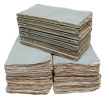
First, however partial, translation of Adam Smith's Wealth of Nations in Swedish rarely seen in this condition, thus making it the very first opportunity for Swedish speakers to study Adam Smith. A more lengthy translation was made in 1909 - 1911 but to this day a full Swedish translation has not been made.""Von Schulzenheim [nobleman, physician, country squire and politician] also published shorter articles in the review 'Läsning I blandade ämnen', an organ of the opposition to the absolutist and obscurantist regime of Gustavus IV Adolphus. The editor of the review was count Georg Adlersparre, an army officer and a political writer who in 1809 was to become one of the prime-movers behind the dethronement of the king. Adlersparre to was an admirer of Adam Smith. In 1799-1800 he published in the 'Läsning' his own Swedish translation of several selections from Wealth of Nations. In some cases Adlersparre added footnotes, making it easier for the readers to apply Smith's ideas to Swedish conditions. Those translations, to the best of my knowledge, were the first ones of Wealth of Nations in Sweden. They were followed by translations of other parts of Wealth of Nations, published in 1800 amd 1808. This time the translator was Erik Erland Bodell, an official of the Swedish Customs and thus, if you like, a colleague of Adam Smith."" ( Cheng-chung, Adam Smith Across Nations). Despite the comparatively late translation into Swedish, it still had a profound influence, not on economists since they were well aware of the original work in English, but upon politics and public opinion in general: ""There are few things more striking to the modem student of the history of ideas in Sweden than the negative phenomenon that Sweden was almost entirely uninfluenced by this fact and thus remained almost unaffected by English economic thought during a period when its superiority was most evident. As far as I am acquainted with the Swedish economic discussion and our popular economic literature of the 1860's and 1870's, there is almost no trace of any influence from English writers. [...]Of Adam Smith we have still only one abbreviated translation of his famous work and that was published as late as during this century"" and, as far as I know, nothing of Ricardo's or Malthus' exists in Swedish, nor do any of the major economic works of J.S. Mill."" (Heckscher, A survey of economic thought in Sweden, 1875-1950).The journal was preceded by Adlersparre's ""Läsning för landtmän"" 1795-96. The content is a mixture of literature, agriculture, law, philosophy and politics. Apart from the many contributions by Swedish authors, ""Läsning i blandade ämnen"" also contains texts by Kant, Gibbon and De Lolme OCLC lists copies at Yale, Minnesota, and Texas.
Recherches sur la Nature et les Causes de la Richesse des Nations. Traduit de l'Anglois de M. Smith [by Blavet]. 2 Tomes.
Londres, Pierre J. Duplain, 1788. 8vo, Two nice uniform contemporary full calf bindings with gilt spines. Some loss of leather to back hinge and lower capital of volume one and minor loos of leather to spine of volume two, all due to worming. Worming is not bad and does not affect anything but outer layer of small parts of the bindings. Apart from the worming a very nice, fresh and clean copy indeed. (8), IV, 503" (4), 496 pp. With both half-titles, the advertisment, both prefaces and the table of contents.
Rare early French translation of Adam Smith's political and economic classic, the ""Wealth of Nations"". Translated by Blavet. The present edition constitutes the third reprint of the second French translation. The second French translation was done by Blavet and is the first translation into French of which the translator and publisher are known. ""The reprint of Blavet's version appeared at Yverdon in 1781 in 6 volumes 12mo, and at Paris in the same year in 3 volumes 12mo, and again at London and Paris in 1788 in 2 volumes 8vo [the present edition], and revised and corrected, with Blavet's name as translator, at Paris An, ix (1800-01) in 4 volumes 8vo.He [Blavet] had no intention of publishing it until his friend M. Ameilhon happened to complain of scarcity of interesting articles for his Journal de l'Agriculture, du Commerce, des Arts et des Finances, which had just come under the control of the Mercantilist. It struck him that he might offer it to him which he did, with the explanation that it was far from perfect. It was accepted, and appeared in the issues of the Journal between January, 1779, and December 1780. He did not anticipate that it would go further. The edition of 1788 likewise appeared without his knowledge or consent, and was still more marred by errors than that of Yverdon"". (Lai, Cheng-chung. Adam Smith Across Nations: Translations and Receptions of The Wealth of Nations, Clarendon Press, UK, 2000). Hailed as the ""first and greatest classic of modern thought"" (PMM 221), Adam Smith's tremendously influential main work has had a profound impact on thought and politics, and is considered the main foundation of the era of liberal free trade that dominated the nineteenth century. Adam Smith (1723-1790) is considered the founder of Political Economy in Britain, mainly due to his groundbreaking work, the ""Wealth of Nations"" from 1776. The work took him 12 years to write and was probably in contemplation 12 years before that. It was originally published in two volumes in 4to, and was published later the same year in Dublin in three volumes in 8vo. The book sold well, and the first edition, the number of which is unknown, sold out within six months, which came as a surprise to the publisher, and probably also to Smith himself, partly because the work ""requires much thought and reflection (qualities that do not abound among modern readers) to peruse to any purpose."" (Letter from David Hume, In: Rae, Life of Adam Smith, 1895, p. 286), partly because it was hardly reviewed or noticed by magazines or annuals. In spite of this, it did evoke immense interest in the learned and the political world, and Buckle's words that the work is ""in its ultimate results probably the most important book that has ever been written"", and that it has ""done more towards the happiness of man than has been effected by the united abilities of all the statesmen and legislators of whom history has preserved an authentic account"" (History of Civilisation, 1869, I:214) well describes the opinion of a great part of important thinkers then as well as now. Considering the groundbreaking views presented in ""Wealth of Nations"", it comes as no surprise that the work was considered part of the revolutionary cultural development in France. As Adam Smith's friend, the Marquis of Lansdowne, said after quoting Smith's work: ""With respect to French principles, as they had been denominated, those principles had been exported from us to France, and could not be said to have originated among the population of the latter country."" (Quoted in: Rae, p. 291). The ideas of Adam Smith were often considered so dangerously closely connected with French ideas at the time that the term ""political economy"" almost became synonymous with questions concerning the constitution of governments. ""The French Revolution seems to have checked for a time the growing vogue of Smith's book and the advance of his principles in this country, just as it checked the progress of parliamentary and social reform, because it filled men's mind with a fear of change, with a suspicion of all novelty, with an unreasoning dislike of anything in the nature of general principle."" (Rae, p. 293). There can be no question that this seminal work greatly influenced French opinion at the time.
Adam-Fitx-Adam ou Fitz-Adam - [Edward Moore dit] - [1712 - 1757] - Journaliste et écrivain anglais
Reference : 34436
(1761)
Tableau critique des Moeurs angloises - Traduction de la Feuille périodique intitulée The World by Adam-Fitx-Adam -
1761 La Haye - Cuissard - 1761 - 1 volume in12 de 12 - 216 pages - Reliure pleine basane d'époque - dos cinq nerfs ornés de fleurons - tranches rouges - petits accrocs à la coiffe supérieure - coins un peu émoussés - Bon exemplaire -
Rare ouvrage -
Les Chevilles de Me Adam menuisier de Nevers. Rare édition originale de ce célèbre recueil composé par le premier poète-ouvrier français.
Précieux exemplaire conservé dans son authentique reliure en vélin souple de l’époque. Paris, chez Toussaint Quinet, 1644. In-4 de (28) pp. dont 1 portrait frontispice, (8) pp. de préface, 100 pp., (8) pp., 315 pp., (1) f.bl. Des rousseurs, qq. ff. brunis. Relié en plein vélin souple de l’époque, titre manuscrit au dos. Reliure de l’époque. 226 x 168 mm.
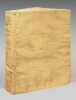
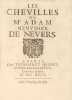
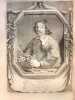
[video width="1920" height="1080" mp4="https://www.camillesourget.com/wp-content/uploads/2025/04/IMG_5332.mp4"][/video] Rare édition originale de ce célèbre recueil composé par le premier poète-ouvrier français. Cioranescu 12191; Graesse I, 18; Brunet, I, 46 («le portrait de Me Adam manque souvent»); De Backer, 755; Lachèvre, pp. 119 et 153. C'est le premier recueil donné par Billaut, qui jusqu'alors n'avait laissé imprimer que des plaquettes de circonstance. Les 28 premières pages sont une longue épitre en vers adressée au vicomte d'Arpajon. Les 100 pages qui suivent la préface de l'abbé de Marolles renferment 62 poésies françaises par 53 auteurs et 7 pièces grecques, latines, italiennes et espagnoles à la louange de l’auteur. Sous le titre Approbation du Parnasse, Saint-Amant, Scudéry, Scarron, Corneille, Colletet, Benserade, Boisrobert, Beys, Ragueneau, Desfontaines, Tristan l'Hermitte, Melle de Gournay témoignent du succès considérable des Chevilles. La seconde partie contient les épîtres, stances, rondeaux, sonnets, épigrammes, chansons et élégies de maître Adam. L'ouvrage constitue, avec Le Vilebrequin (1663, imprimé à titre posthume), et Le Rabot (jamais publié) l'un des trois titres composés par le simple menuisier de Nevers que demeura toute sa vie Adam Billaut (1602-1662), en dépit de ses attaches parisiennes et des protections qu'il trouva dans la capitale, auprès des milieux littéraires et les grands (Marie-Louise de Gonzague, Condé, Richelieu). Il est considéré aujourd’hui comme le premier poète prolétaire français. Adam Billaut voit le jour à Nevers en 1602. Sa jeunesse est mal connue. Il est menuisier et poète. Il est même le premier d’une grande tradition de poètes ouvriers qui se développera surtout au XIXe siècle. Il commence par des vers "d’atelier", une Muse des copeaux qui séduisit princesses et académiciens et deviendra la coqueluche des salons parisiens. Introduit par l’abbé Marolles dans la Bohème des Lettres ce "Virgile au rabot" fut surtout un poète courtisan. Il résista aux instances de ses amis qui voulaient l’attirer à Paris avec une pièce fameuse : Au loin l’ambition et ses folles chimères ! / Qu’un autre aille, orgueilleux, dans le palais des rois / Avec pompe étaler ses hautaines misères / Moi, j’aime mieux Nevers et l’ombre de ses bois ! Billaut meurt en 1662. Les chevilles de Maître Adam parurent en 1644 et eurent un grand succès critique. Si sa poésie brille peu par l'élégance, dans un siècle qui en fut plein, sa langue est pleine de verve et d'originalité et ses recueils font de lui un des tous premiers poètes du XVIIe, l'un de ceux dont la langue est toujours appréciée, dénuée d'afféteries et d'ornements inutiles.Celui qu'on surnomma "le Virgile du rabot" et que Voltaire tint pour l'un des grands écrivains du XVIIe, fut un poète et un chansonnier. Cette édition contient la préfacepar Michel de Marolles, qui l'avait rencontré par hasard dans les rues de Nevers, qui avait lu ses vers et considérait ce menuisier «comme une des plus rares choses du siècle». Dès lors, il fut introduit auprès des grands et, objet de curiosité, fut recherché de toute la bonne société.Billaut devint le protégé du prince de Condé, fut pensionné par Richelieu et admiré par ses pairs ; les 96 premières pages correspondent à des éloges en vers de poètes contemporains de celui qui fut un événement littéraire. Corneille le met dans un sonnet, Rotrou lui consacre une épigramme, Scarron et Scudéry lui dédient des odes. Le recueil contient une ode au cardinal de Richelieu qui l'avait pris sous sa protection. Impression en caractères italiques et romains, parfois grecs, avec ornements typographiques. Exemplaire bien complet du beau portrait de l'auteur dans son atelier de menuiserie en frontispice. Il manque à beaucoup d'exemplaires. Précieux exemplaire conservé dans son authentique reliure en vélin souple de l’époque.
LA VILLE INCONNUE.
1911 Paris, Ollendorff, 1911. In-12 (195 X 185 mm marges comprises) broché, couverture à rabats ; (3) ff., IX-446 pages, (1) f. Marge latérale du feuillet de titre et témoins en partie brunis, petite déchirure recollée en tête du feuillet de faux-titre.
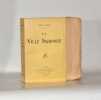

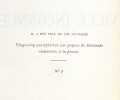
ÉDITION ORIGINALE de ce roman colonial dont l'action se déroule à la fin du XIXe siècle au Soudan français ou "Soudan occidental", dont la conquête par l'armée française commença dès 1880 et se déroula jusqu'à la fin du XIXe siècle. Paul ADAM (1862-1920), écrivain français qui s'intéressa d'abord au naturalisme avant de se tourner vers le symbolisme, collabora littérairement avec Jean Moréas, Paul Ajalbert, Félix Fénéon, etc. Proche du milieu occultiste et lui-même excellent cartomancien, il fut l'un des témoins de Jean Lorrain lors de son duel avec Marcel Proust le 6 février 1897. UN des 25 EXEMPLAIRES numérotés sur vergé de HOLLANDE (n°7), seul tirage de luxe. BEL EXEMPLAIRE broché de ce texte très rare en grand papier, conservé à toutes marges, tel que paru. NICE COPY. PICTURES AND MORE DETAILS ON REQUEST.
Phone number : 06 21 78 12 79
Ce mahouin - in La revue indépendante N°10 de la 4ème année
La Revue Indépendante | Paris Août 1887 | 12 x 19 cm | relié
Edition originale. Reliure à la bradel en plein cartonnage chocolat, dos lisse, une tache affectant marginalement le premier plat, couverture conservée, reliure de l'époque. Nous tenons à préciser que le précédent possesseur a fait uniquement conserver par le relieur l'article du comte Villiers de l'Isle Adam. Rare. - Photographies et détails sur www.Edition-Originale.com -
Phone number : 01 56 08 08 85
La révolte
Alphonse Lemerre | Paris 1870 | 12.50 x 18.50 cm | relié
Edition originale sur papier courant, il n'aurait été tiré que cinq rarissimes Chine en grands papiers. Reliure à la bradel en demi maroquin chocolat, dos lisse, date en queue, plats de papier marbré, couvertures (comportant d'habiles restaurations marginales) et dos conservés, tête dorée, reliure signée de Boichot. Envoi autographe signé de Villiers de l'Isle-Adam à Victor Wilder, traducteur poétique de l'oeuvre de Richard Wagner. L'envoi dépeint l'amitié des deux hommes, qui se poursuit notamment lors de leur collaboration dans la revue wagnérienne jusqu'en 1888. Bel exemplaire agréablement établi. - Photographies et détails sur www.Edition-Originale.com -
Phone number : 01 56 08 08 85
Premières poésies 1856-1858
N. Scheuring & Cie | Paris 1888 | 10 x 16 cm | relié
Edition originale publiée à compte d'auteur et à petit nombre. Quelques petites rousseurs. Reliure à la bradel en plein papier rappelant la couverture quadrillée or de l'ouvrage, dos lisse, pièce de titre de maroquin rouge, fragiles couvertures conservées, tête dorée, reliure signée Thomas Boichot. Rare envoi autographe signé d'Auguste Villiers de l'Isle-Adam au marquis de Monthec. - Photographies et détails sur www.Edition-Originale.com -
Phone number : 01 56 08 08 85
Château de Saint-Cloud - Paris et ses ruines, Lithographie originale
Charpentier | Nantes Paris 1874 | 48.80 x 33.50 cm | une feuille
Lithographie originale en couleurs gravée par Albert Adam d'après un dessin de Léon Jean-Baptiste Sabatier et ayant servi d'illustration àParis et ses ruinesdeVictor Fournel, ouvrage témoignant des ravages de la Commune de Paris. Quelques salissures marginales, sinon bel exemplaire. - Photographies et détails sur www.Edition-Originale.com -
Phone number : 01 56 08 08 85
Docks de la Villette - Paris et ses ruines, Lithographie originale
Charpentier | Nantes Paris 1874 | 48.80 x 33.50 cm | une feuille
Lithographie originale en couleurs gravée par Albert Adam d'après un dessin de Léon Jean-Baptiste Sabatier et ayant servi d'illustration àParis et ses ruinesdeVictor Fournel, ouvrage témoignant des ravages de la Commune de Paris. Quelques salissures marginales, sinon bel exemplaire. - Photographies et détails sur www.Edition-Originale.com -
Phone number : 01 56 08 08 85
Colonne de la Place Vendôme - Paris et ses ruines, Lithographie originale
Charpentier | Nantes Paris 1874 | 48.80 x 33.50 cm | une feuille
Lithographie originale en noir et blanc gravée par Albert Adam d'après un dessin de Léon Jean-Baptiste Sabatier et ayant servi d'illustration àParis et ses ruinesdeVictor Fournel, ouvrage témoignant des ravages de la Commune de Paris. Quelques salissures marginales, sinon bel exemplaire. - Photographies et détails sur www.Edition-Originale.com -
Phone number : 01 56 08 08 85
La Sainte Chapelle - Paris et ses ruines, Lithographie originale
Charpentier | Nantes Paris 1874 | 33.50 x 48.80 cm | une feuille
Lithographie originale en couleurs gravée par Albert Adam d'après un dessin de Léon Jean-Baptiste Sabatier et ayant servi d'illustration àParis et ses ruinesdeVictor Fournel, ouvrage témoignant des ravages de la Commune de Paris. Quelques piqûres marginales et une petite déchirure sans manque en marge basse, sans atteinte à l'image. - Photographies et détails sur www.Edition-Originale.com -
Phone number : 01 56 08 08 85
Hôtel de Ville - Paris et ses ruines, Lithographie originale
Charpentier | Nantes Paris 1874 | 48.80 x 33.50 cm | une feuille
Lithographie originale en couleurs gravée par Albert Adam d'après un dessin de Léon Jean-Baptiste Sabatier et ayant servi d'illustration àParis et ses ruinesdeVictor Fournel, ouvrage témoignant des ravages de la Commune de Paris. Quelques piqûres marginales, sinon bel exemplaire. - Photographies et détails sur www.Edition-Originale.com -
Phone number : 01 56 08 08 85
Exposition universelle de 1867 - Paris et ses ruines, Lithographie originale
Charpentier | Nantes Paris 1874 | 48.80 x 33.50 cm | une feuille
Lithographie originale en couleurs réalisée par Albert Adam, Léon Jean-Baptiste Sabatier et Félix Benoist et ayant servi d'illustration àParis et ses ruinesdeVictor Fournel, ouvrage témoignant des ravages de la Commune de Paris. Quelques piqûres marginales, sinon bel exemplaire. - Photographies et détails sur www.Edition-Originale.com -
Phone number : 01 56 08 08 85
Le jeu de Robin et Marion
Jean Jobert | Paris s. d. [circa 1923] | 12.50 x 18.50 cm | broché
Edition originale de l'adaptation par Emile Blémont de cet opéra-comique du XIIIème siècle du trouvère Adam de La Halle. Agréable exemplaire complet de son prière d'insérer. Adaptation musicale de Julien Tiersot. Précieux envoi autographe signé d'Emile Blémont à l'hydropathe Joseph Uzanne. - Photographies et détails sur www.Edition-Originale.com -
Phone number : 01 56 08 08 85
Richard WAGNER - Catulle MENDÈS - Auguste de VILLIERS DE L'ISLE-ADAM
Reference : 84667
(1885)
Revue wagnérienne, collection complète
Imprimeries Morellet Boyer & Cie | Paris 1885-1888 | 16.80 x 24.60 cm | 3 volumes reliés
Collection complète en 36 numéros (dont trois numéros doubles) reliée en trois volumes - Première année : 12 numéros, du 8 février 1885 au 6 janvier 1886 - Deuxième année : 12 numéros, du 8 février 1886 au 15 janvier 1887 - Troisième année : 12 numéros, de février 1887 à janvier 1888. Illustrée de 4 lithographies hors-texte de Fantin-Latour :L'Évocation d'Erda- Odilon Redon :Brünnhilde- Jacques-Emile Blanche :Tristan et IsoldeetLe pur-simple. Reliure en demi-maroquin chocolat, dos lisse, titres dorés, plats de papier à la cuve, gardes et contreplats de papier marbré, couvertures conservées, reliure signée Dupré. Contributions nombreuses d'écrivains, critiques, poètes et musiciens parmi les plus représentatifs de la fin du XIXe siècle, incluant celle du maître Wagner lui-même : Charles et Pierre Bonnier, Jules de Brayer, Alfred Ernst, Joris-Karl Huysmans, Fourcaud, René Ghil, Stuart Merrill, Stéphane Mallarmé, Catulle Mendès, Éphraïm Mikhael, Pierre Quillard, Jean Richepin, Émile Hennequin, Charles Vignier, Charles Morice, Paul Verlaine, Villiers de l'Ilse Adam, Teodor de Wyzewa, Stewart Chamberlain, Gerard de Nerval (Souvenirs sur Lohengrin), Jean Ajalbert, Gabriel Mourey, Adolphe Jullien, Tola Dorian, Swinburne, Evenepoel, Franz Liszt... Très précieuse collection complète de cette revue avant-gardiste à la fois littéraire et consacrée, à travers une nouvelle esthétique, à la diffusion de l'uvre de Richard Wagner. - Photographies et détails sur www.Edition-Originale.com -
Phone number : 01 56 08 08 85
La force
Paul Ollendorff | Paris 1899 | 13.50 x 20 cm | broché
Edition originale, un des rares exemplaires d'auteur sur Hollande, il n'est pas fait mention de grands papiers. Envoi autographe signé de Paul Adam à Gustave Larroumet. Bel exemplaire à toutes marges. - Photographies et détails sur www.Edition-Originale.com -
Phone number : 01 56 08 08 85
Morgane
Imp. & Lib. Francisque Guyon | Saint-Brieuc 1866 | 16.50 x 25 cm | broché
Edition originale hors commerce imprimée à petit nombre et pour laquelle il n'a pas été tiré de grands papiers. Dos factice habilement refait à l'identique des plats, petites déchirures angulaires et manques marginaux restaurés sur les plats, rares piqûres intérieures. Envoi autographe signé de Auguste Comte de Villiers de l'Isle-Adam. - Photographies et détails sur www.Edition-Originale.com -
Phone number : 01 56 08 08 85

