 Write to the booksellers
4682 books for « j j rousseau j j ... »Edit
-
Type
Artists book (2)
Autograph (2)
Book (4750)
Disk (1)
Magazine (6)
Manuscript (1)
Maps (1)
Music sheets (27)
Old papers (3)
Photographs (3)
-
Latest
Last 24h (1)
Last 3 days (3)
Last month (33)
Last week (106)
-
Language
Dutch (3)
French (4775)
Russian (18)
-
Century
17th (1)
18th (313)
19th (589)
20th (1724)
21st (178)
-
Countries
Belgium (277)
Canada (63)
Côte d'Ivoire (7)
Denmark (32)
France (3856)
Germany (19)
Greece (7)
Italy (2)
Netherlands (3)
Switzerland (512)
United States of America (18)
-
Syndicate
ALAC (60)
CLAM (7)
CLAQ (42)
CNE (10)
ILAB (2284)
NVVA (99)
SLACES (98)
SLAM (2037)
SNCAO (7)
Topics
- Aquitaine (14)
- Archaeology (15)
- Architecture (18)
- Astronomy (50)
- Autographs (11)
- Belgium (19)
- Biography (35)
- Books from the xviiith (17)
- Botany (18)
- Céré roger (9)
- Children’s books (24)
- Christianity (16)
- Christmas (11)
- Comic strip (29)
- Dauphiné (10)
- Dedication (16)
- Detective novels (12)
- Dictionaries (14)
- Early printed books (57)
- Earth (17)
- Economics (9)
- Education (77)
- Education - morals (59)
- Encyclopaedia (37)
- Esotericism (9)
- Essays (11)
- Ethic (30)
- Fine arts (35)
- First edition (69)
- French literature (39)
- French speaking swiss literature (41)
- Genealogy (12)
- Geneva (63)
- Geography (19)
- Germanic languages (9)
- Hackney (10)
- Helvética (49)
- History (127)
- Illustrated books (20)
- Industrial arts & crafts - fine arts (10)
- Law (38)
- Literature (35)
- Magazine (9)
- Manuscripts (10)
- Mathematics (17)
- Medicine (11)
- Memories (16)
- Mosaic (52)
- Motor vehicle (34)
- Music (48)
- Navy (11)
- Newspapers press (17)
- Opera (13)
- Opera ballet (14)
- Painters (9)
- Painting (24)
- Paris (23)
- Philosophy (397)
- Photography (15)
- Pléiade & album de la (40)
- Poetry (74)
- Poitou (11)
- Policy (65)
- Psychoanalysis (14)
- Psychology (40)
- Quebec (36)
- Reading vocabulary (17)
- Regionalism (26)
- Religions (28)
- Reliure (28)
- Review (22)
- Reviews (11)
- Revolution 1789 (11)
- Rousseau andré (14)
- Rousseau françois-olivier (18)
- Rousseau henry (28)
- Rousseau jean jacques (3547)
- Rousseau pierre (195)
- Savoy (13)
- School (10)
- Sciences (48)
- Scores (53)
- Shapes & colours (13)
- Social sciences (9)
- Songs (43)
- Switzerland (94)
- Tales (13)
- Teaching (13)
- Theatre (52)
- Theology (19)
- Various (45)
- Wallonia (13)
- Waltz (9)
- War (26)
- Xviii th century (363)
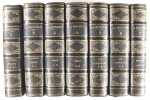
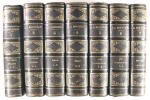
La nouvelle Héloise - Emile ou de l'éducation - Les confessions - Oeuvres choisies.
Paris A. Hiard, 7 volumes, in/12, reliure en demi-chagrin ; La nouvelle Héloise 1933, 263p ; 279 pages, 4 volumes en 2 tomes - Emile ou de l'éducation 1831, 252p. ; 288 pages, 4 volumes en 2 tomes - Les confessions 1832, portrait en frontispice de Jean-Jacques Rousseau. 266p. ; 248 pages, 4 volumes en 2 tomes - J. B. Rousseau : Oeuvres choisies, 1832, 202 pages et 221 pages. Des rousseurs, et des coiffes abîmées.
J. J. Rousseau / J. B. Rousseau Une seul livraison par semaine pendant le mois d'août
THORAVAL J, COIFFET JC, ROUSSEAU R ET ROUSSEAU Y.
Reference : R150155724
(1975)
ISBN : 2040074651
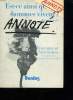
EST CE AINSI QUE LES HOMMES VIVENT ?
BORDAS.. 1975. In-8. Broché. Bon état, Couv. légèrement passée, Dos satisfaisant, Intérieur acceptable. 286 pages. Nombreuses illustrations en noir et blanc dans le texte et hors texte. Manque sur le premier plat de couverture. Note au stylo sur la page de titre. Quelques phrases sont soulignées au stabilo. Note au feutre sur le premier plat de couverture.. . . . Classification Dewey : 840-Littératures des langues romanes. Littérature française
Classification Dewey : 840-Littératures des langues romanes. Littérature française


Rousseau, Jean-Paul – Rousseau, Jacques
Reference : B24-201
(1996)
ISBN : 9782840780397
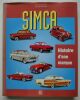
Simca. Histoire d’une marque.
Ed. Rétroviseur, 1996, 196pp, In-folio. Très bon état. Couverture rigide sous sa jaquette illustrée éditeur. (Dos insolé, bord supérieur de la jaquette très légèrement plié). Voir photos. Intérieur impeccable. Sans annotations ni phrases/illustrations soulignées. Bel exemplaire.

Hors frais d'expédition en France métropolitaine (tarifs compétitifs). Supplément tarifaire à prévoir pour expédition UE et hors-UE : NOUS CONTACTER. Expédition du livre à réception d'un paiement par chèque ou virement. Achat ou retrait possible en magasin.
J. THORAVAL, J.C. COIFFET, R. ROUSSEAU et Y. ROUSSEAU
Reference : LFA-126716384
(1978)
EST-CE AINSI QUE LES HOMMES VIVENT ?
Un ouvrage de 286 pages, format 170 x 230 mm, illustré, broché, publié en 1978, Bordas
Recueil de textes à l'usage des classes techniques Premières et terminales F. G. H.
Phone number : 04 74 33 45 19
Émile ou de l'éducation. 4 Tomes. - [THE EDUCATION OF MAN]
A la Haye, Chez Jean Néaulme, (Recte: Paris, Duchesne), 1762. 8vo. Bound in four beautiful uniform contemporary full mottled calf bindings with gilt title-and tome-lables to richly gilt spines. Gilt line-border to edges of bords. Lovely patterned edges. Spines and some corners lightly and expertly restored, barely noteable. Occasional very light brownspotting or dusting, but overall very nice and clean. Printed on good, heavy paper, with wide margins. An excellent copy. (2), VIII, (2), 466, (6) pp. + (4), 407, (1) pp. + (4), 384 pp." (4), 455, (1) pp. + 5 engraved plates (used as frontispieces and facing p. (141) of vol. 1 respectively). The first plate ""Thétis"" in the variant state without title (as described in MacEachern). Fully complete, exactly as described in MacEachern. With all the misprints: Vol. 1: 88 as S8, 443 as 433, 465 as 46" vol. 2: 356 as 256, 357 as 257 vol. 3: 383 as 363 vol. 4: 336 with first 3 broken (according to McEachern this is just the case in some copies). With the usual cancelled leaves: Vol 1: Av + B4" vol. 2: H3 + N6 (called I6). The final leaf ends with ""FIN"" and has no grapes (MacEachern: ""The grapes appear in three different forms..."").
The very scarce actual first edition, being the rarer, more sought-after, nicer 8vo-edition (as opposed to the much more common 12mo edition, which was printed about simultaneously, but which seems to have appeared later), the 8vo format also being the one preferred by Rousseau himself and the format in which he wanted his great work to appear.This magnificent work constitutes the climax of Rousseau's genius as well as the most important work on education since Plato. In Émile, Rousseau poses an entirely new approach to education and the upbringing of children. His thoughts were exceedingly controversial, the work was burnt by the executioner immediately after its first appearance and Rousseau had to flee the country due to a warrant for his arrest. The printing history of ""Émile"" is extremely complicated and has been a matter of intense dispute for many decades. Until Maceachern's bibliography from 1989, the edition that has now been established as the ""Second Paris octavo"" (MacEachern 4A) was generally considered the first printing of the work, but there is no longer any dispute about the fact that the present edition is in fact the actual first (1A). The first edition appeared in both 8vo(1A) and 12mo(1B), and it seems to be generally accepted that the 8vo-edition was distributed first, but that parts of the 12mo-edition may have been in printing a bit earlier. Rousseau himself seems to have preferred the 8vo-edition and wished for his great work to appear as this form first (""The question of the format gave rise to some dissension, for while Rousseau felt that the work was more suited to the octavo format, Duchesne preferred to print a duodecimo and only a limited number of the more expensive octavo. Rousseau finally agreed to Duchesne's plan with reluctance, declaring that in his opinion Duchesne was committing an error of judgment and that the octavo would certainly be the more sought after of the two formats."" - MacEachern, pp. 18-19). Rousseau himself was more involved in the coming-to-be of ""Émile"" than perhaps any other author has been in any other book. Throughout the entire process there were a large number of misunderstandings between himself and Duchene which more than once endangered the printing and publishing of this seminal work, and which has contributed greatly to the extremely complicated bibliographical data of it. In fact, up until very late in the process, Rousseau did not believe that the work was actually going to be finished and it took several instances of mediation between the two to keep the work on tracks. Finally, however, the work was a reality, and with it one of the greatest works of Western culture had been born.Rousseau's ""Émile"" constitutes the most significant modern treatise on the education of man, surpassed only by Plato's ""Republic"". The comparison with Plato is all the more apt, seeing that both works grow out of and are meant to remedy lacunae in the political philosophy of their authors.The conclusion to Rousseau's work on the social contract, also written during Rousseau's stay in Montmorency, had pointed to a predicament of political thought: that only if man were himself naturally inclined to freedom, could he make use of political freedom. ""Émile"" is the analysis of the conditions, under which a child can develop into a free human being. As such, it presents the conclusion to Rousseau's earlier works on inequality, political freedom and servitude.The paradox of Émile is that, while the development of human nature must be natural, if the child is to develop into a free human being, steering that development in the right - that is, free - direction requires constant intervention which, moreover, must be hidden from the child. Rousseau details this intervention in his analysis of the five stages in the education of the child, covering the period from birth to the age of 25.Being one of the most influential thinkers of the 18th century, Rousseau is considered one of the indirect causes of the French Revolution. In Rousseau one certainly finds one of the most influential spokesmen for 18th century thought, and it is primarily the thoughts of him and Voltaire that are put into action with the Revolution.""The first and last of these (i.e. Héloise and Émile), with their sentimental expression of deism, gave much offence, and Rousseau, like Voltaire, was forced to flee to Prussia. Restless and locally unpopular, he fled again to England, where he had a great welcome. Hume, who had offered him asylum, looked after him patiently..."" (PMM 207, Printing and the Mind of Man).The totalitarian tendency of Rousseau's philosophy of education has been noted by a number of philosophers, in recent times most famously, Karl Popper.McEachern: 1A
Om Oprindelsen til Uligheden blandt Menneskene, og dens Grundstøtter. Et kronet Priisskrivt. Oversat af det Franske af Salomon Soldin. - [FIRST DANISH EDITION OF ONE OF ROUSSEUS'S MAIN WORKS]
København, Soldins Forlag, 1800. 8vo. Contemporary half calf with gilt title-label. A bit of overall wear, mostly to extremities. Two ex libris to inside of front board, one being that of Anton Thomsen (Danish philosopher, 1877-1915), also with his signature and date on front free end-paper. Old owner's signature on title-page (A.D. Finns). Occasional marginal pencil notes and underlinings, otherwise nice and clean. (x), (2), 221 pp.
Scarce first Danish edition of one of Rousseau's main works, being one of the most important works of political thought in general: The ""Discourse on the Origins of Inequality"" (original Discours sur l’origine de l’inegalité, 1755) is considered Rousseau's first important work and the work that lays the foundation for his later thought.The work was translated by the editor and publisher Salomon Soldin (1774-1837) as his first independently published work. S. Soldin became famous for his work as editor, between 1804-1825 (and publisher, after 1811), of the renowned biweekly magazine Nyeste Skilderie af Kjøbenhavn, which, in addition to his own numerous articles, contained contributions from well-known authors such as Rasmus Nyerup, K. L. Rahbek, N. F. S. Grundtvig, and others (Frøland 2026). It was one of the most important magazines during its lifetime, where many of the most important literary feuds were published.According to Sørensen (2016): ""The cult of Rousseau also reached Denmark, and it is well known how Johann Friedrich Sturensee raised Crown Prince Frederik, according to a literal interpretation of Émile. Nevertheless, Danish interest in Rousseau remained within a narrow cultural environment, and after the turn of the century, Rousseau's influence faded."" (original in Danish"" 2016: 5). Like Rousseau's ""Discourse on the Sciences and Arts "" from 1750, the ""Discourse on the Origins of Inequality"" was written as a response to an essay competition from the Academy of Dijon. This work is thus often referred to as the ""Second Discourse"". Unlike the first, this did not win him a prize, even though it is was also at the time considered a far more accomplished work and now counts as one of his three main works (together with the ""Contract Social"" and ""Émile""). It is in the present work that Rousseau begins to develop his theories of human social development and moral psychology and it is furthermore this work that for the first time clearly divides him from the Encyclopédiste mainstream of the French Enlightenment. The work is famous for Rousseau's portrayal of a multi-stage evolution of humanity from the most primitive condition to something like a modern complex society, which has gone down in history as one of the most important portrayal of man and society. But furthermore the work is famous for its long preface.When Rousseau had converted to Catholicism, he also lost his rights to the status of Citizen of Geneva. This right was regained in 1754, though, when he reconverted to Calvinism, and a large part of his ""Discourse on the Origins of Inequality"" consists in a dedication to the state of Geneva. This preface is probably one of the most famous prefaces in the history of modern thought as it constitutes, not only a highly ironical and satirical praise of his birthplace, but also a masterpiece of utopian political thought. Geneva is praised as the good republic worthy of admiration for the stability of its laws and institutions, the common spirit of its inhabitants, the well behaved women that inhabit it, and the good relations with neighbouring states. Not only is this piece of political fiction that provides us with an imminent insight into how a state should ideally be according to Rousseau an ironical description of what Geneva was not, it was also a fierce attack on Paris. According to OCLC, merely five libraries world-wide own a copy (two in Switzerland, and one in Denmark, UK, and Germany respectively). ________________________________________________________________________________________________________________ Sources and further reading: Cranston, Maurice. ""The Social Contract"". Encyclopedia Britannica. 11 Mar. 2025, https://www.britannica.com/topic/The-Social-Contract. Accessed 1 July 2026.Frøland, Aleks. ""Salomon Soldin"". Dansk Biografisk Leksikon. https://biografiskleksikon.lex.dk/Salomon_Soldin. Accessed 1 July 2026 Nygaard, B. (2011). Rousseau and Revolution in the Making of a Modern Political Culture: Denmark 1750-1850. I M. Thorup, & H. R. Lauritsen (eds.), Rousseau and Revolution (s. 114-129). Bloomsbury Academic. Sørensen, A. D. (2016). Opdragelsens filosofi: Jean-Jacques Rousseau, Immanuel Kant, Søren Kierk. Aarhus Universitet. https://doi.org/10.7146/aul.133.116
Emil eller om Opdragelsen. Seks Deele. Oversat af Fransk (af Jo. Werfel) og udgiven med Tydsklands Opdragelsesrevisorers og en Deel Danske oplysende, bestemmende og rettende Anmærkninger. - [FIRST DANISH EDITION OF ROUSSEAU'S ""ÉMILE""]
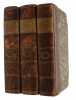
Kjøbenhavn (Copenhagen), Sebastian Popp, 1796 - 99. 8vo. Bound in three uniform contemporary half calf bindings with gilt title- and tome-labels to spines. Spines with some wear, but overall nice and tight. Internally very nice and clean. Printed on good paper. Contemporary owner's inscription to front free end-papers. XXX, (2), 336 pp. + (8), 346 pp. + (2), 368 pp. + 372 pp. + XXVI, 352 pp. + 324 pp.
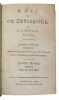
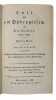
Rare first edition of the first Danish translation of Rousseau's monumental work (Emilius, or an Essay on Education), being one of the absolutely most important and influential works on education. Virtually no work has had as great an impact on paedagogics as this one. Being one of the most influential thinkers of the 18th century, Rousseau is considered one of the indirect causes of the French Revolution. In Rousseau one certainly finds one of the most influential spokesmen for 18th century thought, and it is primarily the thoughts of him and Voltaire that are put into action with the Revolution. Not only in France can the effects of his philosophy and thoughts on upbringing and education be clearly seen" -his ideas were of decisive character to the generation of artists, writers, poets, philosophers etc. in the beginning to middle of the 19th century, which seminally affects Danish thought, as it is in this period that our most important and famous cultural personas are being influenced (e.g. H.C. Andersen and Søren Kierkegaard)" thus this first Danish translation is of great importance and interest. In Danish literature there is talk about the Rousseauan spirit, and it is in this spirit that the entire literary production of H.C. Andersen can be viewed, -directly or indirectly. Rousseau's three main thoughts in Émile - on the childlike, on the natural and on simple religious faith - fits like a glove on the main messages and morals of H.C. Andersen's works.Søren Kierkegaard is known to have owned a copy of Rousseau's Émile in French as well as a copy of this first Danish translation (see ""Auktionsprotokol over Søren Kierkegaards Bogsamling"" no. 941-43). As opposed to H.C.A., though, the philosophy and educational program of Rousseau does not correspond with the Christianity of Kierkegaard, who, however, quotes and comments on Rousseau and his writings on several occasions in his diaries.In Émile, Rousseau poses an entirely new approach to education and the upbringing of children. His thoughts were exceedingly controversial, the work was burnt by the executioner immediately after its first appearance and Rousseau had to flee the country due to a warrant for his arrest. There is no need to say that these new thoughts were also widely influential on Danish thought, and this especially after the appearance of the Danish translation (34-37 years after the French original). Not only Kierkegaard and H.C.A. were influenced by this great thinker, so were the likes of Ingemann, one of our greatest poets.""The first and last of these (i.e. Héloise and Émile), with their sentimental expression of deism, gave much offence, and Rousseau, like Voltaire, was forced to flee to Prussia. Restless and locally unpopular, he fled again to England, where he had a great welcome. Hume, who had offered him asylum, looked after him patiently..."" (PMM 207, Printing and the Mind of Man). Bibliotheca Danica IV:1004.
Emil eller om Opdragelsen. Seks Deele. Oversat af Fransk (af Jo. Werfel) og udgiven med Tydsklands Opdragelsesrevisorers og en Deel Danske oplysende, bestemmende og rettende Anmærkninger. - [FIRST DANISH EDITION OF ROUSSEAU'S ""ÉMILE""]
Kbh. (Copenhagen), Sebastian Popp, 1796 - 99. 8vo. Bound in six cont. uniform hcalfs w. gilt title- and tome-labels on backs, backs w. gilt lines. Backs and corners w. traces of use, but a fine and clean copy on good paper (skrivepapir). XXX, 336" (8), 346368372352 XXVI, 324 pp.
Rare first edition of the first Danish translation of Rousseau's monumental work (Emilius, or an Essay on Education), being one of the absolutely most important and influential works on education. Virtually no work has had as great an impact on paedagogics as this one. Being one of the most influential thinkers of the 18th century, Rousseau is considered one of the indirect causes of the French Revolution. In Rousseau one certainly finds one of the most influential spokesmen for 18th century thought, and it is primarily the thoughts of him and Voltaire that are put into action with the Revolution. Not only in France can the effects of his philosophy and thoughts on upbringing and education be clearly seen -his ideas were of decisive character to the generation of artists, writers, poets, philosophers etc. in the beginning to middle of the 19th century, which seminally affects Danish thought, as it is in this period that our most important and famous cultural personas are being influenced (e.g. H.C. Andersen and Søren Kierkegaard)" thus this first Danish translation is of great importance and interest. In Danish literature there is talk about the Rousseauan spirit, and it is in this spirit that the entire literary production of H.C. Andersen can be viewed, -directly or indirectly. Rousseau's three main thoughts in Émile - on the childlike, on the natural and on simple religious faith - fits like a glove on the main messages and morals of H.C. Andersen's works.Søren Kierkegaard is known to have owned a copy of Rousseau's Émile in French as well as a copy of this first Danish translation (see ""Auktionsprotokol over Søren Kierkegaards Bogsamling"" no. 941-43). As opposed to H.C.A., though, the philosophy and educational program of Rousseau does not correspond with the Christianity of Kierkegaard, who, however, quotes and comments on R. and his writings on several occasions in his diaries.In Émile, Rousseau poses an entirely new approach to education and the upbringing of children. His thoughts were exceedingly controversial, the work was burnt by the executioner immediately after its first appearance and Rousseau had to flee the country due to a warrant for his arrest. There is no need to say that these new thoughts were also widely influential on Danish thought, and this especially after the appearance of the Danish translation (34-37 years after the French original). Not only Kierkegaard and H.C.A. were influenced by this great thinker, so were the likes of Ingemann, one of our greatest poets.""The first and last of these (i.e. Héloise and Émile), with their sentimental expression of deism, gave much offence, and Rousseau, like Voltaire, was forced to flee to Prussia. Restless and locally unpopular, he fled again to England, where he had a great welcome. Hume, who had offered him asylum, looked after him patiently..."" (PMM 207, Printing and the Mind of Man). Bibliotheca Danica IV:1004.
A Mr. D'Alembert...sur son Article Genève dans le VIIme. Volume de l'Encyclopédie et particulierement, sur le projet d'établir un Théatre de Comédie en cette Ville. - [THE PLACE OF ENTERTAINMENT IN SOCIETY]
Amsterdam, M.M.Rey, 1758. 8vo. Beautiful contemporary full mottled calf with five raised bands and gilt red leather title-label to richly gilt spine. All edges Minor loss to lower capital, but apart from that an absolutely beautiful copy, internally as well as externally. Very nice, clan and fresh. Printed on good paper, with good margins. Engraved title-vignette. XVIII, 264, (8) pp.
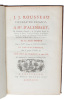
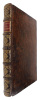
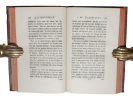
The rare first edition of this important work, which inaugurated one of the most significant intellectual debates of the 18th century.The letter is Rousseau's answer to the article on the city of Geneva, which his friend d'Alembert had written for the French ""Encyclopédie"". In the article, d'Alembert had suggested that the citizens of Geneva establish a theatre which - so d'Alembert - would lead to a refinement of the mores and ways of the Genevans, not to mention adding a bit of sparkle to a city which he described as dreary and sad. The response by Rousseau opened up what was one of the most important intellectual polemics of the 18th century.Rousseau, a citizen of Geneva by birth, uses the article by d'Alembert as a springboard for a reflection on the place of culture in society. He relates the institution of the theatre to the question of political morality and attempts to define boundaries between the morally innocuous and corruptive forms of entertainment. The letter is permeated by a pronounced Platonism. The arguments which Rousseau advances against the theatre closely recall those advanced by Plato in the Republic against the poets. As Plato, Rousseau focuses his attention on the artificial nature of the theatrical spectacle, which leads the mind astray, away from the concerns of an industrious and fulfilled life. For anybody with an interest in the work and life of Rousseau, the ""Lettre à d'Alembert"" is an invaluable document. Not only does it connect Rousseau's earlier writings - the Discourse on the Arts and Sciences (1750) and the Discourse on the Origin and Basis of Inequality among Men (1754) - to his later major work"" it also offers an insight into the differences of opinion that would lead Rousseau to break with the circle around the encyclopaedists. The present edition is unknown to Dufour and Tchmerzine, but recent research has determined that this is the actual first printing (see for instance: Azers, ""Histoire de l'Impression et la publication de la ""Lettre à d'Alembert"""", Sénelier).
Original handwritten manuscript-leaf in Rousseau's hand constituting in a series of notes on marriage from the ""Rituel de Chartres"" (printed in Paris in 1531). - [HANDWRITTEN NOTES BY ROUSSEAU ON MARRIAGE RITUALS]
(Unsigned, and no date, but penned between 1746 and 1751). 1 leaf 4to (25,5 x 19 cm), off-white paper in fine condition. Fully penned on both recto (24 lines) and verso (5 lines).
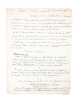
This magnificent manuscript leaf in Rousseau's hand constitutes notes on marriage rituals taken from ""Rituel des Chartres"", which was printed in Paris in 1531. This manuscript leaf is part of a grandiose project that Rousseau was working on with his employer Madame Dupin during his years as her secretary. The project was that of writing the history of womankind. With its focus on gender equality, the work is nothing less than pioneering and would no doubt have been a work of seminal importance in the history of feminism and women's rights, had it ever been published. The manuscript ended up comprising more than 2.000 pages, but was never printed. Louise Marie Madeline Fontaine Dupin (1706-1799) was one of the most famous salonnieres of the 18th century, renowned for the beauty as well as her intelligence. Rousseu met her in 1743 and took an instant liking to her. In 1745, she offered him the position as her private secretary and tutor to her son. During his six years in her employment, he spent most of the time working on the grandiose project of the history of women, until it was abandoned in 1751. ""In the years between 1745 and 1749 Jean Jacques Rousseau was employed by Louise Marie Madeline Dupin as a research assistant on her ambitious project to delineate in print the history of women. After years of labor by Rousseau and Madame Dupin her ""Ouvrage sur les Femmes"" was shelved, unfinished. The research notes, drafts, and fair copies written by Rousseau and his employer were stored at the chateau of Chenonceaux, essentially forgotten, until their sale at a series of auctions held between 1951 and 1958."" (Harry Ranson Center, University of Texas)
Original handwritten manuscript-leaf in Rousseau's hand concerning Rome, the mother of Romulus and Remus, taken from Dionysos Halicarnassos. - [HANDWRITTEN NOTES BY ROUSSEAU FROM DIONYS HALICARNASSOS' WORK ON THE HISTORY OF ANTIQUITY]
(Unsigned, and no date, but penned between 1746 and 1751). 1 leaf 4to (25,5 x 19 cm), off-white paper in fine condition. Penned on both recto (21 lines) and verso (6 lines) in columns taking up half the pages.
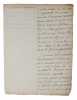
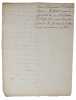
This magnificent manuscript leaf in Rousseau's hand constitutes notes taken from the seminal work of Dionysos Halicarnassos, on the foundation of Rome, more particularly on the story of Rome herself, the alleged mother of Romulus and Remus and how they named the city after their mother. This manuscript leaf is part of a grandiose project that Rousseau was working on with his employer Madame Dupin during his years as her secretary. The project was that of writing the history of womankind. With its focus on gender equality, the work is nothing less than pioneering and would no doubt have been a work of seminal importance in the history of feminism and women's rights, had it ever been published. The manuscript ended up comprising more than 2.000 pages, but was never printed. Louise Marie Madeline Fontaine Dupin (1706-1799) was one of the most famous salonnieres of the 18th century, renowned for the beauty as well as her intelligence. Rousseu met her in 1743 and took an instant liking to her. In 1745, she offered him the position as her private secretary and tutor to her son. During his six years in her employment, he spent most of the time working on the grandiose project of the history of women, until it was abandoned in 1751. ""In the years between 1745 and 1749 Jean Jacques Rousseau was employed by Louise Marie Madeline Dupin as a research assistant on her ambitious project to delineate in print the history of women. After years of labor by Rousseau and Madame Dupin her ""Ouvrage sur les Femmes"" was shelved, unfinished. The research notes, drafts, and fair copies written by Rousseau and his employer were stored at the chateau of Chenonceaux, essentially forgotten, until their sale at a series of auctions held between 1951 and 1958."" (Harry Ranson Center, University of Texas)
Henriette de Wolmar, ou la mere jalouse de sa fille Histoire veritable, Pour servir de suite a la Nouvelle Heloise, par J.J.R. - [A SEQUEL TO ROUSSEAU'S ""LA NOUVELLE HELOISE""]
Munster, Perrenon, 1769. 8vo. Bound in a very nice contemporary half calf binding with four raised bands and richlty gilt spine. Center and corners of boards with gilt flower ornamentation. Small paper-label to upper part of spine. Traces from label (ex-libris?) having been removed from verso of front board. A nice and clean copy. 143 pp.
The exceedingly rare second edition of Brument’s attempt at a sequel to Rousseau's ""La Nouvelle Héloïse"" with the story revolving around Henriette, the daughter of Julie de Wolmar, a central character in Rousseau's novel. The first edition was published in Geneve in 1768 – both editions are of the utmost scarcity and are rarely found in the trade. “Henriette de Wolmar” is part of a broader trend in the 18th century where Rousseau's “La Nouvelle Héloïse” inspired numerous derivative works, including sequels, parodies, and adaptations – all early examples of fan-fiction. The success of Rousseau's novel sparked a wave of creative responses, as readers and writers sought to expand, reinterpret or critique the original story. In Rousseau's original work, “La Nouvelle Héloïse”, Julie is portrayed as a virtuous woman who navigates the complexities of love, duty, and social expectations. Brument's sequel, however, shifts the narrative focus to Julie's role as a mother, particularly highlighting her possessiveness and jealousy towards her daughter. This jealousy serves as the central conflict of the story illustrating the psychological and emotional turmoil that can be within family relationships. Provenance: Valdemar's Castle.
Discours sur l'origine et les fondemens de l'inegalité parmi les hommes. - [THE INEQUALITY OF MAN]
Amsterdam, Marc Michel Rey, 1755. 8vo. A spendid recent pastiche-binding in perfect contemporary style. Marbled half caf with five raised bands to richly gilt spine. Marbled paper over boards. Occasional very light brownspotting and a very light marginal dam stain to ca 15 leaves. A splendid copy, with good margins and printed on good paper. Old ex libris to inside of front board. Title-page printed in red and black, engraved title-vignette, the engraved frontispiece (by Eisen, engraved by Sornique) bound at the end. 1 large engraved vignette and a few woodcut vignettes. Frontispiece + LXX, (2), 262, (2, -errata & avis pour le relieur) pp.
First edition, first issue, of one of Rousseau's main works and one of the most important works of political thought in general. The ""Discourse on the Origins of Inequality"" is considered Rousseau's first important work and the work that lays the foundation for his later thought.The present copy is with all the first issue pointers (e.g. the erroneous spelling of ""Jaques"", the accent aigu in ""conformé"" added by hand by M.M. Rey on p. 11) and the three cancels (pp. LXVII-LXVIII, 111-112, and 139-140). According to Tchemerzine, there were copies on thick, heavy paper (""Il existe des ex. en papier fort""), of which this is presumably one. At least the dedication (LXX pp.) in the present copy is printed on very thick paper, whereas the paper of the remaining leaves is a bit less heavy. The present copy has nice, wide margins. According to Dufour there are five counterfeit-editions bearing the same date (they are easily distinguishable from the first issue). Like his ""Discourse on the Sciences and Arts "" from 1750, the ""Discourse on the Origins of Inequality"" was written as a response to an essay competition from the Academy of Dijon. This work is thus often referred to as the ""Second Discourse"". Unlike the first, this did not win him a prize, even though it is was also then considered a far more accomplished work and now counts as one of his three main works (together with the ""Contract Social"" and ""Émile""). It is in the present work that Rousseau begins to develop his theories of human social development and moral psychology and it is furthermore this work that for the first time clearly divides him from the Encyclopédiste mainstream of the French Enlightenment. The work is famous for Rousseau's portrayal of a multi-stage evolution of humanity from the most primitive condition to something like a modern complex society, which has gone down in history as one of the most important portrayals of man and society. Furthermore, the work is famous for its long preface.When Rousseau had converted to Catholicism, he also lost his rights to the status of Citizen of Geneva. This right was regained in 1754, though, when he reconverted to Calvinism, and a large part of his ""Discourse on the Origins of Inequality"" consists in a dedication to the state of Geneva. This preface is probably one of the most famous prefaces in the history of modern thought as it constitutes, not only a highly ironical and satirical praise of his birthplace, but also a masterpiece of utopian political thought. Geneva is praised as the good republic worthy of admiration for the stability of its laws and institutions, the common spirit of its inhabitants, the well behaved women that inhabit it, and the good relations with neighbouring states. Not only is it this piece of political fiction that provides us with an imminent insight into how a state should ideally be according to Rousseau an ironical description of what Geneva was not, it was also a fierce attack on Paris. Tchemerzine X:32" Dufour:55.
Les Pensées de J.-J. Rousseau, citoyen de Genève
A Amsterdam, chez Marc-Michel Rey, A Amsterdam Relié 1763 In-12 (10,5 x 17 cm), reliure plein veau, dos à 5 nerfs orné de caissons dorés, xij-404 pages, recueil de pensées de J.-J. Rousseau, les textes ont été assemblés par Prault, libraire éditeur. A été relié in fine la Lettre de Rousseau à Christophe de Beaumont (1765, à Amsterdam chez Marc-Michel Rey, xlvij-143 pp.) ; épidermures sur le cuir, petit trou dans le cuir au premier plat, mors supérieur fendu en queue, petite mouillure et note manuscrite sur la page de titre, par ailleurs assez bon état. Livraison a domicile (La Poste) ou en Mondial Relay sur simple demande.
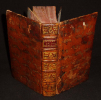
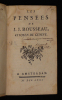
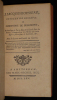
Pièces nouvelles du sieur Rousseau contenant : Seize nouvelles odes, deux épitres, sept allégories, plusieurs pièces mélées . Le Flateur comédie en vers, & La Ceinture Magique, petite comédie en prose. Avec un avertissement de l' Auteur.
Couverture rigide Londres, 1726 , in16 plein veau , 199pp , légères épidermures. Langue: Français
RECITS ET ANECDOTES DE LA BRIE FRANCAISE .
1988 Rousseau Couverture souple 1988 Rousseau et culture , 1988 , in8 broché, 135 pp . Etat neuf.
Oeuvres complètes de J. J. Rousseau, tome 27 : exposé succinct de la contestation qui s'est élevée entre M. Hume et M. Rousseau, avec les pièces justificatives
Poinçot Relié 1793 In-12 (13x20.5 cm), relié plein veau, liseré doré sur les plats, pièces de titre et d'auteur au dos lisse, tranches marbrées, 434 pages, il manque la page de titre gravée, tome 27 des oeuvres complètes de Rousseau chez Poinçot, 1793 ; coiffes, coins et mors un peu frottés, traces de frottement sur les plats, intérieur assez frais, bon état. Livraison a domicile (La Poste) ou en Mondial Relay sur simple demande.
Oeuvres complètes de J.-J. Rousseau, tomes V et VI (un volume), dont Emile
J. Bry Ainé, Libraire-Editeur Oeuvres complètes de Jean-Jacques Rousseau Relié 1856 In-8 (13.5x21.5 cm), relié demi-chagrin, titre et tomaison dorés au dos à quatre nerfs, deux tomes en un volume des Œuvres complètes de J.-J. Rousseau, dont Emile, 297-298 pages, gravures in et hors-texte ; dos insolé, coiffes et mors frottés, coins un peu frottés, traces de frottement et rayures sur les plats, rares rousseurs à l'intérieur, assez bon état. Livraison a domicile (La Poste) ou en Mondial Relay sur simple demande.
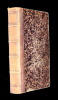
OEUVRES CHOISIES DE M ROUSSEAU . Nouvelle édition .
Couverture rigide Bruxelles , Fricx , 1759 , in12 plein veau , dos nerfs orné , 354pp Petit manque à la coiffe supérieurs. Langue: Français
OEUVRES CHOISIES DE M ROUSSEAU . Nouvelle édition .
Couverture rigide P, De Saint , Briason , 1747 , in12 plein veau , 392pp Reliure légèrement frottée avec un manque au bas du dos , page de titre restaurée. Langue: Français
Oeuvres complètes de J. J. Rousseau, avec des notes historiques.
Paris, Furne et Cie, 1837-1838. 4 volumes grand in-8, demi-basane brune de l’époque, dos lisse orné, fleurons estampés, roulettes et filets dorés, XI-756, 807, 876 et 880 pp., texte sur deux colonnes. 16 planches hors texte sous serpentes dont un portrait gravé de Rousseau d’après Latour et un facsimilé.
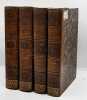
De la bibliothèque du réalisateur et bibliophile Max de Rieux (ex-libris). Dos et coupes un peu frottés, étiquette de collation sur les plats. Bon exemplaire. - Frais de port : -France 15 € -U.E. 15 € -Monde (z B : 27 €) (z C : 66 €)
Botanik for fruentimmere i breve til frue de L** oversat af fransk og med tillæg forøgt af Odin Wolff. Andet giennemseete og forøgede oplag.
Kiøbenhavn, 1790, Poulsens Forlag, 1790. 8vo. In contemporary half calf with four raise bands. ""Den Classenske bogsaml paa Corselitze"" (i.e. ""Classen's bookcollection in Corselitze Manor House"") in contemporary hand to title-page and small stamp to lower part of title-page. Internally nice and clean. XXIV, 112 pp.
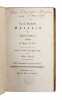
Uncommon second expanded Danish edition of Rousseau’s collection of letters on botany written by Rousseau to Madame Delessert, the mother of one of his young students. The work shows his appreciation for Linnaean classification and includes both scientific and philosophical reflections on nature. Bibliotheca danica II, 186.
Oeuvres complètes de Jean-Jacques Rousseau, écrits sur la musique (tomes 19, 20, 21, 22)
A Paris chez Poinçot, libraire, rue de la Harpe, N.°135 Oeuvres complètes Relié Quatre volumes in-12 de l'édition des oeuvres complètes de Rousseau publiées par Poinçot entre 1788 et 1793, volumes 19, 20, 21 et 22 de la collection, (13x20.5 cm), reliures pleine veau, dos lisses, roulettes dorées sur les plats, pièces de titre et de tomaison, tranches marbrées, reliure empire, volumes complets des 'Ecrits sur la musique' ; volume 19 : 456 pages, volume 20 : 460 pages, volume 21 : 459 pages, volume 22 : 397 pages ; cette série contient 4 frontispices et 13 planches de musique hors-texte dans le volume 22 ; coins et coiffes frottés, quelques rousseurs à l'intérieur de certains volumes, ensemble très agréable. Livraison a domicile (La Poste) ou en Mondial Relay sur simple demande.
Oeuvres et correspondance inédites de J.J. Rousseau
Paris, Michel Levy 1861 xx + 484pp., 1e édition, reliure cart. (dos en cuir avec titre et décorations dorés), 22cm., peu de rousseurs, bel état

