 Write to the booksellers
98 books for « huygens »Edit
-
Type
Book (97)
Music sheets (1)
-
Language
Dutch (1)
French (97)
-
Century
17th (4)
18th (4)
19th (1)
20th (31)
21st (3)
-
Countries
Belgium (57)
Denmark (4)
France (27)
Netherlands (8)
Switzerland (2)
-
Syndicate
CLAM (2)
ILAB (15)
NVVA (2)
SLACES (2)
SLAM (6)
Topics
- Adam (2)
- Ampere andré - marie (1)
- Archaeology (1)
- Architecture (2)
- Astronomy (4)
- Belgium (2)
- Bible (15)
- Buffon (1)
- Ceramic (1)
- Charity religion (1)
- Condorcet (1)
- Constable (1)
- Descartes rené (3)
- Discovery (1)
- Family (1)
- Greek (1)
- History (23)
- Humanism (2)
- Industrial arts & crafts - fine arts (1)
- Jacob (1)
- Justice (1)
- Latin (17)
- Law (1)
- Leibniz (5)
- Linguistics (1)
- Literature (4)
- Manuscripts (1)
- Mathematics (3)
- Middle ages (1)
- Optics (1)
- Philosophy (1)
- Physics (2)
- Pilgrimage (1)
- Poincaré raymond (1)
- Religions (5)
- Review (2)
- Sciences (7)
- Sciences & technique (4)
- Scores (1)
- Songs (1)
- Tea (2)
- Theology (13)
- Tyre (1)
- Various (4)
- War (1)
La bataille de l'Yser, 16-30 octobre 1914. Les Grandes Batailles 1914-1916.
Paris Librairie Schwarz 1917 Première édition. Portefeuille souple. Les couvertures sont un peu assombries, avec des entailles au dos et de petites déchirures fermées sur le bord ouvert. L'illustration en frontis d'après Steinlen est un portrait de Léon Huygens en train d'esquisser une scène. Page de titre avec vignette d'un canon. 16 pages de texte avec une vignette à chaque page, écrites par Pierre Nothomb. 28 planches dépliantes, dont 5 eaux-fortes originales (une sur la couverture) et 4 lithographies originales de Léon Huygens (ainsi que 12 héliogravures dépliantes d'après Huygens et 5 fac-similés de pochoir en couleurs dépliants d'après Charles Fouqueray, et un frontispice de Steinlen). 25 gravures sur bois d'après Huygens dans le texte, découpées par Louis Jou. L'une des gravures est un paysage à double page pliée de la scène de la bataille, avec la clé en dessous. Le contenu est détaché, tel qu'il a été publié. L'intérieur est en très bon état, avec une touche de noircissement seulement. Un portfolio peu commun. La bataille de l'Yser fut l'une des premières batailles de la Première Guerre mondiale. Elle opposa principalement les Français, les Belges et les Allemands, près de la côte belge. Au prix de grands sacrifices, les Belges ont tenu la ligne et inondé la zone autour de la rivière Yser. Cette zone est devenue la ligne de front jusqu'à la fin de la guerre. Le fait de conserver une petite partie de la Belgique revêtait une grande importance pour la propagande belge. Conforme à WorldCat / Numéro OCLC : 25645892.
First Edition. Softback portfolio. The covers are a little darkened, with nicking / splitting to the spine and small closed tears to the open edge. Frontis illustration after Steinlen is a portrait of Leon Huygens at work sketching a scene. Title page with vignette of a canon. 16 pages of text with a vignette to each page, written by Pierre Nothomb. 28 tipped in plates, including 5 original etchings (one on the cover) and 4 original lithographs by Léon Huygens (as well as 12 tipped-in heliogravures after Huygens and 5 tipped-in colour pochoir facsimiles after Charles Fouqueray, and frontispiece by Steinlen). 25 woodcuts after Huygens in text, cut by Louis Jou. One of the engravings is a folded double page landscape of the battle scene, with key below. Contents loose, as issued. Internally in very good condition, with a touch of darkening only. An uncommon portfolio. The battle of l'Yser was one of the earliest battles of the First World War. It was largely between the French, Belgians and Germans, near to the Belgian coast. At a great cost, the Belgians held the line, and flooded the area around the river Yser. This became the front line in this part until the end of the war. Keeping a small portion of Belgium was of great propaganda importance to the Belgians. Conforms to WorldCat / OCLC Number: 25645892. .
Nouveau traité de la pluralité des mondes traduit du latin en françois par M. D*** (DUFOUR) -- PREMIERE TRADUCTION EN FRANCAIS du KOSMETHEOROS DE C. HUYGENS -- BON EXEMPLAIRE
P., Moreau, 1702, un volume in 12 relié en pleine basane, dos orné de fers dorés (reliure de l'époque), (petit accroc sans gravité à la coiffe, mouillures pâles dans les marges de quelques feuillets), (12), 277pp., 9pp., 4 PLANCHES
---- PREMIERE TRADUCTION FRANCAISE du KOSMETHEOROS de HUYGENS paru en latin en 1698 ---- BON EXEMPLAIRE ---- "Huygens did not belive that complete certainty could be achieved in the study of nature, but thought that the philosopher must pursue the highest degree of probability of his theories. Clearly Huygens considered this degree to be adequate in the case of his explanations of light and gravity. It is difficult for the historian to assert how Huygens considered his theories about life on other planets and about the existence of beings comparable to man. The theories were expounded in his KOSMETHEOROS (1698). The argument of the book is very methodically set forth and its earnestness suggests that Huygens did indeed assign a very high degree of probability to these conjectures. In the Copernican world system the earth holds no privileged position among the other planets. It would therefore be unreasonable to suppose that life should be restricted to the earth alone. There must be life on the other planets and living beings endowed with reason who can contemplate the richness of the creation, since in their absence this creation would be senseless and the earth, again, would have an unreasonably privileged position... In the second part of Kosmostheoros Huygens discussed the different movements of the heavenly bodies and how they must appear to the inhabitants of the planets. He took the occasion to mention new advances in astronomy. He compared the intensity of light from various heavenly bodies - thus making the first attempt at photometry". (DSB VI p. 611)**7994/ARB4
"LEIBNIZ (LEIBNITZ), G.F. - CHRISTIAAN HUYGENS - JOHANN BERNOULLI - JACOB BERNOULLI ET AL. - THE DISCOVERY OF THE ""CATENARY CURVE"" , THE ""LOGARITHMIC CURVE"" AND THE ""POLAR COORDINATES"".
Reference : 41859
(1691)
1. De Linea in quam Flexile se pondere proprio curvat, ejeuque usu insignia adinveniendi quotcunque medias proportionales & Logarithmos. - 2. De Solutionibus Problematis Catenarii vel Funicularis in Actis A. 1691, aliisque a Dn. I.B. propositis. (1-2:...
Leipzig, Grosse & Gleditsch, 1691. 4to. Contemp. full vellum. Faint handwritten title on spine. a small stamp on titlepage. In: ""Acta Eruditorum Anno MDCLXXXXI"". (8),590,(6) pp. and 13 (of 15) folded engraved plates. The 2 first plates lacks, but they do not belong to the papers listed.Leibniz' papers: pp.277-281 a. 1 plate, pp. 435-439. Johann Bernoulli: pp. 274-276 a. 1 plate. Huygens: pp. 281-282. - Jacob Bernoulli: pp. 282-290 a. 1 plate.
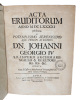
All papers first apperance. All 5 of extreme importence in the development of the Calculus. Leibniz' 2 papers on the catenary curve (paper 1-2 offered here) was written at the instigation of Jacques Bernoulli. Following the example of Blaise Pascal, who had initiated, in 1658, a contest for the construction of the cycloid, Leibniz also provoked the geometers of his time, by challenging them to submit, at the fixed date of mid-1691, their geometric method for the construction of the catenary curve. Leibniz later provided the answer, followed by Johann Bernoulli and Huygens.'These two papers are a historical account of the origin of the study of this transcendental curve, and, at the same time, the first physical-geometric construction showing the species-relationship between the catenary and the logarithmic curves, as two companion curves" one arithmetic, the other geometric. All of the differentials of the catenary curve, are arithmetic means of corresponding differentials of the logarithmic curve" and, all of the differentials of the logarithmic curve, are geometric means of the catenary.'""The Catenary is the form of a hanging fully flexible rope or chain (the name comes from ""catena"", which means 'chain'), suspended on two points. The interest in this curve originated with Galileo, who thought that is was a parabola. Young Christiaan Huygens proved in 1646 that this cannot be the case. What the actual form was remained an open question till 1691, when Leibniz, Johann Bernoulli and the then much older Huygens sent solutions to the problem to the ""Acta"" (Jakob Bernoulli, 1690, Johann Bernoulli 1691, Huygens 1691 and Leibniz 1691), - these 4 1691-papers offered here - in which the previous year Jakob Bernoulli had challenged mathematicians to solve it. As published, the solutions did not reveal the methods, but through later publications of manuscripts these methods have been known. Huygens applied with great ( paper 4) virtuosity the by then classical methods of 17th century infinitesimal mathematics, and he needed all his ingenuity to reach a satisfactory solution. Leibniz ( the papers 1-2) and Bernoulli (paper 3), applying the new Calculus, found the solutions in a much direct way. In fact, the catenary was a test-case between the old and the new style in the study of curves, and only because the champion of the old style was a giant like Huygens, the test-case can formally be considered as ending in a draw."" (Grattan-Guiness in ""From the Calculus to Set Theory, 1630-1910."").The paper by JACOB BERNOULLI ( no. 5 offered here) is a milestone papers as it marks the invention of the ""SYSTEM OF POLAR COORDINATES"" with points located by reference to a fixed point and a line through that point. Although newton had earlier also devised such a coordinate system (in 1671), his work was not known, so that the credit for the discovery generally goes to Bernoulli. (Parkinson, Breakthroughs (1691).Further papers contained in this volume of Acta Eruditorum:DENYS PAPIN: Mecanicorum de Viribus Motricibus sententia, asserta a D. Papino adversius C.G.G. L. (Leibniz) objectiones. pp. 6-13. The plate lacks. - and Dion. Papini Observationes quaedam circa materias ad Hydraulicam spectantes. Pp. 208-213 a. 1 plate. This importent paper is part of the LEIBNIZ-PAPIN-CONTROVERSY.JACOB BERNOULLI: Specimen Calculi Differentialis in dimensione Parabolæ helicoidis, ubi de flexuris curvarum in genere, carundem evolutionibus. Pp. 13-22. The plate lacks. - and J.B. Demonstratio Centri Oscillationis ex Natura Vectis, reperta occassione eorum, quæ super hac materia in Historia Literaria Roterodamensi recensentur, articulo...Pp.317-321.LEIBNIZ: O.V.E. Additio ad Schediasma de Medii Resistentia publicatum in Actis mensis Febr. 1889. Pp. 177-178. and O.V.E. Quadratura Arithmetica Communis Sectionum Conicarum quæ centrum babent,...Pp. 178-182 a. 1 plate.TSCHIRNHAUS: Singularia Effecta Vitri Caustici bipedalis, quod omnia magno sumtu hactenus constructa specula ustoria virtute superat, per D.T. Pp. 517-520
Divers ouvrages de mathématique et de physique. Par Messieurs de l'Académie royale des sciences.
Paris, Imprimerie Royale, 1693.
Première édition. Elle comprend 31 essais, la plupart en édition originale par Roberval, Huygens, Picard, Frénicle de Bessy, Auzout, Ole Römer and Mariotte : 9 par Roberval, 8 par Huygens, 5 par Picard, 4 par Frénicle de Bessy, 2 par Auzout, 2 par Ole Römer et 1 par Mariotte. Après la mort de Frénicle et Roberval, leurs ouvrages, restés manuscrits, furent confiés à Picard. Ce dernier, étant mort en 1682, tous ces manuscrits passèrent entre les mains de La Hire, qui les a publiés dans le présent ouvrage, avec ceux de Picard et quelques mémoires de Huygens. Roberval n'a publié que deux ouvrages de son vivant. On trouve ici ses mémoires les plus importants, qui n'avaient jamais été encore publiés: - Observations sur la composition des mouvements. - Projet d'un livre de méchanique, traitant des mouvements composés. - Traité des indivisibles. - De Trochoïde ejusque spatio... DSB 11, 486-490. Ce volume contient aussi : Frénicle de Bessy: - Méthode pour trouver la solution des problèmes par exclusions. - Abrégés des combinaisons. - Des carrés ou tables magiques... DSB 5, 158. Picard: - De la pratique des grands cadrans par le calcul. - De mensuris. - De mensura liquidorum & aridorum. -Fragmens de dioptrique. DSB 10, 395. Huygens: - De la cause de la pesanteur. - Démonstration de l'équilibre de la balance. - Construction d'un problème d'optique... L'ouvrage s'achève sur un mémoire de Mariotte: - Règles pour les jets d'eau, qui est suivi de deux courts mémoires de Römer. Nombreuses figures dans le texte. Exemplaire aux armes de Louis XIV sur les plats (Olivier 2494, fer 10) et son fleuron entre les nerfs. L'Académie des Sciences fut fondée par Colbert en 1666 et reçut l'approbation de Louis XIV en 1699. Toutes petites piqûres de vers (de la taille d'une épingle) dans la marge intérieure, quelques feuillets brunis en début d'ouvrage, très discrètes restaurations à la reliure. Très bel exemplaire de ce livre fort rare. /// In-folio de (6), 518, (1) pp. Veau marbré, dos à nerfs orné, armes de Louis XIV dorées sur les plats, tranches mouchetées. (Reliure de l'époque.) //// First edition of this collection of texts by Roberval, Huygens, Picard, Frénicle de Bessy, Auzout, Ole Römer and Mariotte. Most of them are published for the first time. Contemporary binding with the arms of Louis XIV.

Corpus Christianorum. Saewulf, John of Wurzburg, Theodericus Peregrinationes tres,
Turnhout, Brepols, 1994 Hardback, 235 p., + 1 map, 155 x 245 mm._Latin ISBN 9782503043913.
This edition brings together the narratives of three important 12th-century travellers to the newly established Crusader States in the Holy Land, one Anglo-Saxon: Saewulf, and two Germans: John of Wurzburg and Theoderic(us). All three narratives clearly convey the tremendous impression that these visits to the scene of Christ's wanderings on earth produced on our pilgrims. Apart from the independend value of their observations (mainly in Jerusalem, much less in Judea and Samaria), Saewulf is interesting for being the first to give a description of the situation in the Holy Land immediately after the capture of Jerusalem. His narrative reflects the often sorry state of affairs which prevailed at the end of the Fatimid period. The two others are, however, no less important witnesses, of a later period, shortly before Saladin's victory changed everything. . Iohannes Wirziburgensis (Iohannes Herbipolensis) ? Peregrinatio ? ed. R.B.C. Huygens Iohannes Wirziburgensis (Iohannes Herbipolensis) ? Peregrinatio (Appendix inscriptionum) ? ed. R.B.C. Huygens Iohannes Wirziburgensis (Iohannes Herbipolensis) ? Peregrinatio (Appendix liturgica) ? ed. R.B.C. Huygens Saewulf ? Peregrinatio ? ed. R.B.C. Huygens Theodericus quidam ? Peregrinatio ? ed. R.B.C. Huygens
Kosmotheoros sive de terris coelestibus, carumque ornatu, conjecturae -- TRES RARE EDITION ORIGINALE -- BON EXEMPLAIRE
La Hague, Moetjens, 1698, un volume in 4 relié en plein veau moucheté (reliure de l'époque), (petite tache brune sans gravité sur le premier plat de couverture, habiles restaurations aux coiffes et aux mors), 2pp., 144pp., 5 PLANCHES DEPLIANTES
---- TRES RARE EDITION ORIGINALE ---- BON EXEMPLAIRE ---- "THE FIRST ATTEMPT AT PHOTOMETRY" ---- "Huygens did not belive that complete certainty could be achieved in the study of nature, but thought that the philosopher must pursue the highest degree of probability of his theories. Clearly Huygens considered this degree to be adequate in the case of his explanations of light and gravity. It is difficult for the historian to assert how Huygens considered his theories about life on other planets and about the existence of beings comparable to man. The theories were expounded in his KOSMOSTHEOROS (1698). The argument of the book is very methodically set forth and its earnestness suggests that Huygens did indeed assign a very high degree of probability to these conjectures. In the Copernican world system the earth holds no privileged position among the other planets. It would therefore be unreasonable to suppose that life should be restricted to the earth alone. There must be life on the other planets and living beings endowed with reason who can contemplate the richness of the creation, since in their absence this creation would be senseless and the earth, again, would have an unreasonably privileged position... In the second part of Kosmostheoros Huygens discussed the different movements of the heavenly bodies and how they must appear to the inhabitants of the planets. He took the occasion to mention new advances in astronomy. He compared the intensity of light from various heavenly bodies - thus making the first attempt at photometry". (DSB VI p. 611)**2751/ARB3
Opuscula Posthuma [Tomus primus - secundus]
Amstellodami [Amsterdam], apud Janssonio-Waesbergios, 1728, in-4, [16]-226-[2]-184 pp, 43 pl, Demi-basane postérieure (fin XVIIIe, début XIXe s.), dos lisse et fileté, Ces deux tomes des Opuscula posthuma constituent une partie des Opera Reliqua, qui avaient été elles-mêmes publiées au sein des oeuvres collectives (Opera varia), éditées sous la direction de Gravesande en 1724-1728. Elles ont paru pour la première fois en 1703 (Leyde, Cornelius Boutesteyn). Elles contiennent, en tête de volume, la Dioptrica, illustrée de 19 planches, qui constitue une théorie complète du télescope et du microscope, accordant une grande place à la fabrication du verre et au polissage des lentilles. L'ouvrage s'achève sur la Descriptio automati planetarii dans laquelle Huygens fait usage des fractions continues "pour rapporter entre elles, avec des approximations croissantes, les périodes des différents corps célestes" (Houzeau et Lancaster) ; cette partie est illustrée des 4 planches du célèbre automate planétaire conçu par Huygens et construit par Van Ceulen en 1682. Les autres traités sont : - Commentarii de formandis poliendisque vitris ad telescopia (3 pl.) ; - Dissertatio de coronis et parheliis (8 pl.) ; - De motu corporum ex percussione (5 pl.) ; - De vi centrifuga (4 pl.) ; Huygens démontre ici les théorèmes relatifs à la force centrifuge qu'il avait exposé en 1673 dans l'Horologium oscillatorium. Le mathématicien, astronome et physicien néerlandais Christiaan Huygens (1629-1695) fut l'inventeur du télescope aérien, ainsi appelé parce que l'oculaire et l'objectif n'étaient plus reliés par un tube continu. Cet instrument permettait "de se passer du tube en disposant convenablement les lentilles le long d'un simple support longitudinal, destiné à les maintenir dans la position convenable. Dès cet instant, le problème de la construction des lunettes astronomiques se trouva transformé. Aucune limite de dimension n'était plus imposé aux lunettes dites aériennes; tout au moins ces limites ne dépendaient plus que de l'habileté des opticiens à tailler des verres de très grande distance focale" (Daumas, Les instruments scientifiques aux XVIIe et XVIIIe siècles, p. 46). Ce télescope permit à Huygens de découvrir la lune de Saturne et d'observer la véritable forme des anneaux de cette planète. Dos usé, rousseurs claires. DSB VI, 612. Houzeau & Lancaster, 3427. Poggendorff, I, 1165. Couverture rigide
![Opuscula Posthuma [Tomus primus - secundus]. HUYGENS, Christiaan](https://static.livre-rare-book.com/pictures/BBG/86905_01_thumb.jpg)
![Opuscula Posthuma [Tomus primus - secundus]. HUYGENS, Christiaan](https://static.livre-rare-book.com/pictures/BBG/86905_02_thumb.jpg)
![Opuscula Posthuma [Tomus primus - secundus]. HUYGENS, Christiaan](https://static.livre-rare-book.com/pictures/BBG/86905_03_thumb.jpg)
Bon [16]-226-[2]-184 pp., 43 pl.
HUYGENS, Christian & LEIBNITZ (LEIBNIZ) & L'HOPITAL. - UYLENBROEK, Petrus Joannes (1797-1844):
Reference : 53639aaf
Christiani Hugenii aliorumque seculi XVII virorum celebrium exercitationes mathematicae et philosophicae. ex manuscriptis in Bibliotheca Academiae Lugduno-Batavae. Fasciculus 1: Chr. Hugenii, Leibnitii et Hospitalii epistolas mutuas.
Hagae Comitum (The Hague, 's Gravenhage), ex typographia Regia, 1833, in-4to, 1 leaf + IV + 324 p. + 1 leaf (errata) + 2 folding plates, heavy foxing in places, light waterstaining to a few leaves and to bottom of both plates, upper corner of front endpaper cut off and repaired, half calf binding, marbled paper on covers, red title label on gold tooled spine, hinge of frontcover loose, slight rubbing.
» Important collection of 91 scientific letters «The correspondence of three of the greatest 17th century scientists. Some of these letters were very influencial to the development of certain aspects of mathematics.It is the first publication of Huygens' correspondence with Leibniz and L'Hopital translated from the Latin language into French and published by Petrus Joannes Uylenbroek. He was professor at the Dutch Academy of Physics and Astronomy in Leiden. This first part of this volume contains 56 letters between Leibniz (34) and Huygens (22) (LVI and not altogether LXXVI letters; printing error starting after letter number XLI: LXII-LXXVI), written between 1674 and 1694. The 2nd part (ff. 215ff.) contains 35 letters between the marquis Guillaume F.A. de L'Hopital (19) and Huygens (16), written between 1690 and 1695. Poggendorff II/1164 (Uylenbroek); DHBS VI/613 (Huygens), VIII/149-168 (Leibniz), VIII/304-305 (L'Hopital).

(SLACES, NVVA)
Phone number : 41 (0)26 3223808
Apologia Gommari Huygens Lyrani S.T.D. in Academia Lovaniensi pro Methodo Remittendi & Retinendi Peccata adversus Responsionem Brevem Authore (ut se vocat) Francisco Carolo Reymakers
Lovanii [Leuven], typis Hieronymi Nempaei [Hieronymus Nempaeus] 1674 117 + [1] pp., with printer's device on title page (medaillon with S. Thomas), 1st edition, 15cm., text in Latin, contemporary full-leather binding (joints split, few small losses of leather, gilt decorations on spine with a small worm hole), old handwritten ex-libris and ex-libris stamp on first blanco endpaper, The author Huygens (Lier 1631-1702) was a professor of Theology at the 'Academia Lovaniensi', [BOUND WITH: HUYGENS Gommarus, Tractatus III. Qui accessit Methodo Remittendi & Retinendi Peccata, Lovanii [Leuven], apud Hieronymi Nempaei, 1674, [30] + 71 + [5] pp.], R113649
Dans l'air qui tremble (1914-1915)
Georges Cres & Cie 1916 - nouvelle coll. "les proses", in 12 broché, 258 pages + catalogue de Crès, illustré hors texte de dessins de Huygens en noir et blanc, mention de 2ème édition. Couverture rempliée.
bon etat Remise de 20% pour toutes commandes supérieures à 200 €
Vrouwen rondom Huygens.
Leidschendam-Voorburg, Huygensmuseum Hofwijck, 2010.
114 p. Paperback 24 cm (Published on the occasion of the exhibition 'Vrouwen rondom Huygens' die van 9 april tot en met 27 juni 2010 wordt gehouden in Huygensmuseum Hofwijk en Stadsmuseum Leidschendam-Voorburg te Voorburg')
Partition de la chanson : Souvenir ... Souvenir Souvenir ... Souvenir
Barbey 1967

Bon état Format Coquille
Constantijn Huygens' Hofwijck
Culemborg, Blom & Olivierse 1888 xii + 92 + 105pp. + gravure, 23cm., 1e druk van deze editie van Huygens' Hofwijck (gebaseerd op de "Uitgave der Korenbloemen van 1672), gecart.band (linnen rug), enkele stempeltjes, goede staat, T73529
Revue d'Histoire des Sciences - Germaine Aujac - Jean-Louis Gardies sur Euxode et Dedekind - Michel Blay sur Christiaan Huygens
Reference : 101026
(1984)
Revue d'Histoire des Sciences - Tome 37 (XXXVII), n° 2 - Avril 1984 , (Le langage formulaire dans la géométrie grecque - Euxode et Dedekind - Christiaan Huygens et les phénomènes de la couleur)
Presses Universitaires de France - P.U.F. , Revue d'Histoire des Sciences Malicorne sur Sarthe, 72, Pays de la Loire, France 1984 Book condition, Etat : Bon broché, sous couverture imprimée éditeur bleu ciel grand In-8 1 vol. - 95 pages
quelques figures dans le texte en noir et blanc 1ere édition, 1984 Contents, Chapitres : 1. Articles : Germaine Aujac : Le langage formulaire dans la géométrie grecque - Jean-Louis Gardies : Euxode et Dedekind - Michel Blay : Christiaan Huygens et les phénomènes de la couleur - 2. Documentation, informations, analyses - Jean Seidengart : Une nouvelle traduction anglaise de la Théorie du ciel de Kant Couverture propre, légères pliures aux coins de la couverture, sinon bel exemplaire, intérieur frais et propre, papier à peine jauni - paginé 98 à 192
Revue d'Histoire des Sciences - V. Zoubov - Ad. Davy de Virville - Pierre Costabel sur Christian Huygens - Marie Boas - A. Birembaut sur Lexell - René Tresse sur J.-A. Chaptal
Reference : 100975
(1957)
Revue d'Histoire des Sciences - Tome 10 (X), n° 2 - Avril-Juin 1957 , (Les indivisibles et le continu dans l'ancienne littérature russe - De l'influence des idées préconçues sur les progrès de la botanique du XVe au XVIIIe siècle - La septième règle du choc élastique de Christian Huygens - Quelques aspects sociaux de la chimie au XVIIe siècle - L'Académie Royale des Sciences en 1780, vue par l'astronome suédois Lexell, 1740-1784 - J.-A. Chaptal et l'enseignement technique de 1800 à 1819)
Presses Universitaires de France - P.U.F. , Revue d'Histoire des Sciences Malicorne sur Sarthe, 72, Pays de la Loire, France 1957 Book condition, Etat : Bon broché, sous couverture imprimée éditeur crème grand In-8 1 vol. - 95 pages
quelques illustrations dans le texte en noir et blanc 1ere édition, 1957 "Contents, Chapitres : 1. Articles : V. Zoubov : Les ""indivisibles"" et le continu dans l'ancienne littérature russe - Ad. Davy de Virville : De l'influence des idées préconçues sur les progrès de la botanique du XVe au XVIIIe siècle - Pierre Costabel : La septième règle du choc élastique de Christian Huygens - Marie Boas : Quelques aspects sociaux de la chimie au XVIIe siècle - A. Birembaut : L'Académie Royale des Sciences en 1780, vue par l'astronome suédois Lexell, 1740-1784 - René Tresse : J.-A. Chaptal et l'enseignement technique de 1800 à 1819 - 2. Documentation, informations, analyses - Jean Rostand : A propos du pharmacien Coladon, précurseur possible de Mendel" Couverture légèrement jaunie sur les bords, légères pliures aux coins de la couverture et sur le bord supérieur du plat inférieur, sinon bel exemplaire, intérieur frais et propre, papier à peine jauni - paginé 98 à 192
Choquet-Bruhat (Yvonne), Coll (B.), Kerner (R.) et Lichnerowicz (André), eds. - A.S. Alves - L. Bel et J.M. Aguirregabiria - U. Bruzzo - B. Carter - E. Combet - E. Cremmer - A. Crumeyrolle - T. Damour - M. Dubois-Violette - F. Fayos, B. Coll et J.J. Ferrando sur Teukolsky - M. Francaviglia, M. Ferraris et O. Robutti - F. Grassi - S. Gutt - J. Hajj-Boutros - Y. Kosmann-Schwarzbach sur Noether - L. Mas, J. Carot et J. Ibanez - R.G. McLenaghan et J. Carminati on Huygens, Maxwell and Weyl - A. Papadopoulos - A. Perez-Rendon et J.J. Seisdedos on Henri Poincaré - F. Piazzese et G. Rizzi on Schwarzschild - J.M. Souriau
Reference : 101107
(1987)
Géométrie et physique - Journées relativistes de Marseille-Luminy d'avril 1985 , dans la collection Travaux en Cours n° 21 (Sur l'approche vers l'équilibre d'un gaz relativiste dans un champ stationnaire - Systèmes héréditaires et réductions dominantes - Supersymmetric gauge theories on supermanifolds - Différentiation bitensorielle dans un fibré non-affine appliquée à un champ de type harmonique couplé à un champ de jauge - Physique quantique et formules de localisation - Formulation des supergravités étendues - Spineurs symplectiques et transformation de Fourier - Sur les nouvelles méthodes d'approximation en relativité générale - Structures algébriques des anomalies et cohomologies de B.R.S. - Sur les potentiels de Debye et les relations de Teukolsky - J.J. Ferrando, B. Coll et F. Fayos : Sur le champ électromagnétique et les relations de Teukolsky - On the notion of energy and the existence of superpotentials in gravitational theories - Confining transition in cosmology - Quantifications isospectrales et déformations équivalentes - An interior solution to Einstein's fields equations with plane symmetry - Sur les théorèmes de Noether - Etude du tenseur impulsion-énergie associé à une géométrie - Recent results on the validity of Huygens principle for the scalar wave equation, Maxwell's equations and Weyl neutrino equation on curved space-time - La notion de p-invariance en relativité générale - Utiyama type theorems in the Poincaré gauge approach to gravity II - Equivalence principle and the electrostatic self-force in a Schwarzschild symmetry - Electrodynamique galiléenne)
Hermann à Paris , Travaux en Cours Malicorne sur Sarthe, 72, Pays de la Loire, France 1987 Book condition, Etat : Très Bon broché, sous couverture imprimée éditeur rouge et noir grand In-8 1 vol. - 221 pages
quelques figures dans le texte en noir 1ere édition, 1987 Contents, Chapitres : Introduction, liste des participants, table, x, Texte, 211 pages - A.S. Alves : Sur l'approche vers l'équilibre d'un gaz relativiste dans un champ stationnaire - L. Bel et J.M. Aguirregabiria : Systèmes héréditaires et réductions dominantes - U. Bruzzo : Supersymmetric gauge theories on supermanifolds - B. Carter : Différentiation bitensorielle dans un fibré non-affine appliquée à un champ de type harmonique couplé à un champ de jauge - E. Combet : Physique quantique et formules de localisation - E. Cremmer : Formulation des supergravités étendues - A. Crumeyrolle : Spineurs symplectiques et transformation de Fourier - T. Damour : Sur les nouvelles méthodes d'approximation en relativité générale - M. Dubois-Violette : Structures algébriques des anomalies et cohomologies de B.R.S. - F. Fayos, B. Coll et J.J. Ferrando : Sur les potentiels de Debye et les relations de Teukolsky - J.J. Ferrando, B. Coll et F. Fayos : Sur le champ électromagnétique et les relations de Teukolsky - M. Francaviglia, M. Ferraris et O. Robutti : On the notion of energy and the existence of superpotentials in gravitational theories - F. Grassi : Confining transition in cosmology - S. Gutt : Quantifications isospectrales et déformations équivalentes - J. Hajj-Boutros : An interior solution to Einstein's fields equations with plane symmetry - Y. Kosmann-Schwarzbach : Sur les théorèmes de Noether - L. Mas, J. Carot et J. Ibanez : Etude du tenseur impulsion-énergie associé à une géométrie - R.G. McLenaghan et J. Carminati : Recent results on the validity of Huygens principle for the scalar wave equation, Maxwell's equations and Weyl neutrino equation on curved space-time - A. Papadopoulos : La notion de p-invariance en relativité générale - A. Perez-Rendon et J.J. Seisdedos : Utiyama type theorems in the Poincaré gauge approach to gravity II - F. Piazzese et G. Rizzi : Equivalence principle and the electrostatic self-force in a Schwarzschild symmetry - J.M. Souriau : Electrodynamique galiléenne infimes traces de pliures aux coins des plats de la couverture, sinon bel exemplaire, frais et propre
Bkouche (Rudolph) sur Euclide, Félix Klein, David Hilbert - Jacques Morizot - sur Descartes - Marie Catherine Caramatie et Brigitte Delbreil sur Archimède - Evelyne Le Rest - sur Platon - sur Blaise Pascal - sur Huygens - Guy Wallet sur Leibniz - sur Lagrange - Eliane Cousquet
Reference : 100573
(1982)
La rigueur et le calcul - Documents historiques et épistémologiques - Groupe Inter-IREM d'épistémologie dans la collection Histoire des mathématiques , (1. La rigueur : Euclide, Félix Klein, David Hilbert et les autres - De l'histoire aux fondements - Sur la géométrie de Descartes - Sur les pas d'Archimède, Archimède pas à pas - Il faut que j'y songe encore, les axiomes de la géométrie - Platon et les mathématiques - 2. Le calcul : Introduction du calcul décimal et du système métrique à Rouen pendant la Révolution - Blaise Pascal - Pour une lecture d'un texte de Huygens - L'origine du calcul différentiel chez Leibniz - Lagrange et les équations algébriques - Le calcul vectoriel)
Editions CEDIC , Histoire des Mathématiques Malicorne sur Sarthe, 72, Pays de la Loire, France 1982 Book condition, Etat : Bon broché, sous couverture imprimée éditeur jaune petit In-4 oblong 1 vol. - 279 pages
très nombreuses illustrations dans le texte en noir dont de nombreux fac-similés de documents anciens, des portraits et des figures géométriques 1ere édition, 1982 Contents, Chapitres : Présentation et sommaire - 1. La rigueur : Rudolph Bkouche : Euclide, Félix Klein, David Hilbert et les autres - Jacques Morizot : De l'histoire aux fondements - IREM de Rouen : Sur la géométrie de Descartes - Marie Catherine Caramatie et Brigitte Delbreil : Sur les pas d'Archimède, Archimède pas à pas - Evelyne Le Rest : Il faut que j'y songe encore, les axiomes de la géométrie - J. Morizot : Platon et les mathématiques - 2. Le calcul : IREM de Rouen : Introduction du calcul décimal et du système métrique à Rouen pendant la Révolution - Pages et calculs choisis (Blaise Pascal - Pour une lecture d'un texte de Huygens) - Guy Wallet : L'origine du calcul différentiel chez Leibniz - IREM de Lyon : Lagrange et les équations algébriques - Eliane Cousquet : Le calcul vectoriel - Bibliographie générale pliures aux coins des plats de la couverture, les bords de la couverture, et sans doute le dos, sont insolés (décolorés), intérieur sinon propre, coin supérieur gauche un peu corné en début d'ouvrage, une tache à l'intérieur du coin supérieur du plat inférieur affectant à peine le coin des deux dernières pages, cela reste un bon exemplaire
Constantijn Huygens Trijntje Cornelis. ( 2 delen)
, Utrecht, HES Uitgevers, 1987., Gebonden, linnen licht bevuild, 23,5x34,5cm, 184pp. en 42 auto - en apografen.
Naar de autograaf uitgegeven. Eerste deel : volume 1 : I. Inleiding. II. Tekst naar de autograaf met manuscriptologische aantekeningen en variantenapparaat. III. Bijschriften met manuscriptologische aantekeningen en variantenapparaat. Volume 2 : IV Autograaf, facsimili. V. Apogrtaaf, facsimili.
Nouveau traité de la pluralité des mondes. Traduit du Latin en François par M. D. ***.
A Paris, chez Jean Moreau, 1702. In-12 de (24)-277-(9) pp, 5 planches, veau brun, dos orné à nerfs, pièce de titre en maroquin rouge (reliure de l'époque).
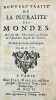
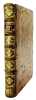
Première édition française du Cosmotheoros sive de terris coelestibus, earumque ornatu, conjecturae, dont l'originale latine fut publiée en 1698. S'inspirant des thèses coperniciennes, Huygens développe l'idée d'autres formes de vie autour d'autres soleils. « The argument of the book is very methodically set forth and its earnestness suggests that Huygens did indeed assign a very high degree of probability to these conjectures. In the Copernican world system the earth holds no privileged position among the other planets. It would therefore be unreasonable to suppose that life should be restricted to the earth alone. There must be life on the other planets and living beings endowed with reason who can contemplate the richness of the creation, since in their absence this creation would be senseless and the earth, again, would have an unreasonably privileged position » (DSB VI, 611).Ex-libris Charles Lacour. Petit accident à une coiffe et aux coins, des rousseurs. Bon exemplaire.
Oeuvres complètes de Christiaan Huygens publiés par la Société Hollandaise des Sciences. Tome premier: Correspondance 1638-1656.
La Haye, Martinus Nijhoff, 1888, in-4to, XIV + 621 p., Frontispice (portrait de Constantijn Huijgens et ses enfants), tampon de bibliothèque sur titre, notices (additions) au crayon papier au début, dans la genealogie de la famille Huygens, brochure originale, dos fendu, jaquette abîmée.
(SLACES, NVVA)
Phone number : 41 (0)26 3223808
Traité de la lumière
Dunod éditeur, 1992. Grand in/8 broché, couverture imprimée, 205 pages
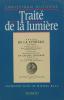
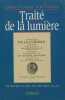
Réimpression d’une édition de 1690. Le lecteur d’aujourd’hui découvrira dans cet ouvrage des aperçus prophétiques concernant, par exemple la structure des cristaux ou la méthode scientifique que défendait l’auteur, théoricien d’envergure auquel nous devons également la mise au point de l’horloge à balancier, la découverte des anneaux de Saturne et le premier exposé complet du calcul des probabilités. Hollandais, C. Huygens, fut hautement respecté par son époque. A l’inverse de Newton, il prêcha en faveur de la thèse ondulatoire de la lumière. L’avenir allait leur donner raison à tous les deux.
A selection of the poems of Sir Constantijn Huygens (1596-1687). A parallel text translated, with an introduction and appendices by P. Davidson and A. van der Weel
Amsterdam, Amsterdam University Press, 1996.
XII,228 p. Stiff wrappers 24 cm
Constantin Huygens. Studiën, door Theod. Jorissen, Hoogleeraar te Amsterdam. Eerste deel.
Haarlem, A. Thieme, 1871.
V,402 p. Contemporary boards. 23 cm (Cover worn. All published)
HUYGENS, CONSTANTIJN.- KLOEK,E., F. BLOM & A. LEERINTVELD. (Eds.)
Reference : 154722
Vrouwen rondom Huygens.
Hilversum, Verloren, 2010.
247 p. Paperback 23 cm (12 essays, among which one on Anna Maria van Schurman and one on Anna and Tesselschade Roemers) (Een speciale uitgave van het tijdschrift 'De Zeventiende Eeuw')
LA METHODE QUE L'ON DOIT GARDER DANS L'USAGE DU SACREMENT DE PENITENCE, pour donner ou differer l'absolution, ou l'on verra les veritables devoirs des penitens et des confesseurs. par M. Gommar Huygens. Suivi de "Les Gémissements du Pecheur, ou acte de contrition, tiré de l'Écriture Sainte"
Lyon Chez André Pralard 1681 in 16 (14,5x8,5) 1 volume reliure pleine basane fauve de l'époque, dos à nerfs orné, 19 faux-feuillets préliminaires non chiffrés de préface et table des matières, 328 pages. Suivi de "Les Gémissements du Pecheur, ou acte de contrition, tiré de l'Écriture Sainte" 64 pages. Bon exemplaire ( Photographies sur demande / We can send pictures of this book on simple request )
Bon Couverture rigide

