 Write to the booksellers
66 books for « hospital j »Edit
-
Latest
Last month (1)
Last week (1)
-
Language
English (1)
French (65)
-
Century
16th (2)
17th (1)
18th (5)
19th (3)
20th (28)
-
Countries
Belgium (7)
Brazil (1)
Denmark (4)
France (49)
Switzerland (5)
-
Syndicate
ILAB (31)
NVVA (4)
SLACES (4)
SLAM (23)
SNCAO (1)
Topics
- Auvergne (3)
- Biography (3)
- Catholicism (2)
- Colette (1)
- Cooking (1)
- Early printed books (1)
- English literature (1)
- Engraving (books about) (1)
- Ex-libris (1)
- First edition (1)
- Flora (1)
- Folklore (1)
- French literature (1)
- Gastronomy (1)
- Gastronomy food (1)
- Genealogy (1)
- Geography (3)
- Geometry (3)
- History (8)
- Hospital jean d (2)
- Humanism (1)
- Italy (1)
- L'hospital michel de (1)
- Literature (4)
- Magazine (1)
- Mathematics (4)
- Medicine (3)
- Middle ages (1)
- Modern times (1)
- Newspapers press (1)
- Philosophy (1)
- Policy (2)
- Ravel maurice (1)
- Religions (1)
- Reviews (1)
- Rome (1)
- Saint bartholomew (1)
- Sciences (2)
- Spain (1)
- Speeches (1)
- Tardieu andré (1)
- Tea (2)
- Tiger (1)
- Turner (5)
- Turner hospital janette (2)
- Various (2)
- Vatican city (1)
L'HOSPITAL, G(uillaume)-F.-A. de (1661-1704) / STONE, M. (Edmund, about 1700-1768):
Reference : 98444aaf
Analyse des infiniment petits, pour l'intelligence des lignes courbes. Par Mr. le Marquis De L’Hospital. Seconde Edition. 1715 / Relié avec - bound-up with: 2) M. (Edmund) Stone: Analise des infiniment petits, comprenant le calcul intégral dans toute son étendue, avec son application aux Quadratures, Cubatures, Centres de Gravité, de Percussion, & de toutes sortes de Courbes. Servant de suite aux infiniment petits de ... L’Hôpital (sic): Traduit en François par M. Rondet, Maître de Mathématiques. (avec une préface de P. Castel) 1735.
1) A Paris, Chez François Montalant, / 2) A Paris, Julien-Michel Gandouin et Pierre-François Giffart, 1715 / 1735, in-4°, XV (+ 1 table) + 181 p. (+ 1 privilège) + 11 planches gravées dépl. / 2) CIV (=104 p.) + 162 p. + 1 f. (fautes à corriger) + 4 planches gravées dépl., petite tache d’eau marginale au début de l’ouvrage (sans gravité), reliure en plein veau d’époque, dos à 5 nerfs richement orné en or, tranches rouges, gardes en papier dominoté originales, bel exemplaire en parfait état.
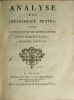
1) Seconde édition après l’édition originale du premier manuel de calcul différentiel, impr. à Paris, par l’Imprimerie Royale, en 1696. La seconde édition est purgée de ses fautes typographiques. Cette oeuvre principale de Guillaume de L'Hospital, à la fois précise et simple d'utilisation, fut longtemps une référence dans son domaine, et connut un vif succès à travers le XVIIIe siècle.2) Première édition en français du traité de Edmund Stone, publié en 1730 en anglais. Très rare.1) Second edition of this textbook (first edition printed in 1696: “the influence of which dominated most of the eighteenth century” (Boyer).“The «Analyse des infiniment petits» was the first textbook of the differential calculus. The existence of several commentaries on it attests its popularity. ... L'Hospital was a major figure in the early development of the calculus on the continent of Europe. He advanced its cause not only by his scientific works but also by his many contacts, including correspondance with Leibniz, with Jean Bernoulli, and with Huygens. Fontenelle tells us that it was L'Hospital who introduced Huygens to the new calculus” (DSB).The «Analyse des infiniment petits» “includes the original publication of ideas originated and developed by Leibniz and the Bernoullis. ... (for example) the ninth chapter of this textbook contains what is now know as ‘L'Hospital's rule’ for finding the limiting value of a fraction whose numerator and denominator tend to zero; however, this rule was actually the work of Bernoulli, who included it in his letter to L'Hospital of 22 July 1694” (Norman).2) Very rare first French edition, first published in 1730 in the English language.‘Edmund Stone was born sometime around 1700, the son of a gardener of the Duke of Argyll. He first learned to read at the age of eight and was completely self-taught. He mastered both French and Latin in order to read mathematical works. At the age of eighteen, Stone came to the attention of the duke when the latter found Stone's copy of Newton's Principia in his grounds and assumed that it had been removed from his library. Impressed by the young man, the duke "placed him in a position which afforded him opportunity to pursue his studies".Stone translated works of the Marquis de l'Hospital on conic sections (1720) and Bion on scientific instruments (1723). In 1725, he was admitted as a fellow of the Royal Society in 1725 and published A New Mathematical Dictionary. In 1730, he published The Method of Fluxions, both direct and Inverse: the first part is a translation and reworking in Newtonian notation of De l'Hospital's Analyse des infinement petits (in fact, written by Johann Bernoulli), and the second part is Stone's own.In 1736, he independently found two species of lines of the third order which had been overlooked by Newton and Stirling, but these had been discovered by others a few years earlier. He also published some other mathematical works.Following the death of the Duke of Argyll in 1743, Stone's situation deteriorated and he spent the latter part of his life in poverty’.Article on Edm. Stone by: Alex D D Craik, University of St Andrews. Barbier I/167f; DSB VIII/304-5; Poggendorff I/1146-7; Norman Collection 1345; cf. Cantor III/222 ff. und 244 ff.; Honeyman Collection 2006-7; Boyer 460-1; Struik 312-3; Kline 383; Hoefer NBG XXI/101ff; Quérard: La France Littéraire IX, 271; Poggendorff 1/II 1018. Image disp.

(SLACES, NVVA)
Phone number : 41 (0)26 3223808
"L'HÔPITAL (L'HOSPITAL), (GUILLAUME FRANÇOIS ANTOINE DE). - FIRST TREATISE ON THE DIFFERENTIAL CALCULUS.
Reference : 50313
(1768)
Analyse des infinite Petits. Suivie d'un nouveau Commentaire pour l'intelligence des endroits les plus difficiles de cet Ouvrage. Par l'Autheur du Guide des jeunes Mathématiciens dans l'étude des Lecons de Mathematique de M. l'Abbé de la Caille.
Avignon, Veuve Girard & Francois Seguin, 1768. 8vo. Contemp. full mottled calf. Wear to top of spine. Richly gilt spine, titlelabel with gilt lettering. (2),XXXI,380 pp. and 8 folded engraved plates. On verso of title-page a stamped exlibris. On inside frontcover an engraved exlibris ""John Cookney"". Internally clean, printed on good paper.
This edition of the first treatise on the differential calculus, first published 1696, is the first with the commentaries by the famous French astronomer Nicolas-Louis De Lacaille, taken from his noted ""Leçons élémentaires de mathématiques"".""The Analyse des infiniment petits was the first textbook of the differential calculus. The existence of several commentaries on it - one by Varignon (1725) - attests to its popularity. The question of its intellectual ownership has been much debated. Jean Bernoulli, who is known to have instructed L’Hospital in the calculus about 1691, complained after L’Hospital’s death that he (Bernoulli) had not been given enough credit for his contributions. L’Hospital himself, in the introduction to his books, freely acknowledges his indebtedness to Leibniz and to the Bernoulli brothers. On the other hand, he states that he regards the foundations provided by him as his own idea, although they also have been credited by some to Jean Bernoulli. However, these foundations can be found, less explicitly, also in Leibniz, although Leibniz made it clear that he did not accept L’Hospital’s Platonistic views on the reality of infinitely small and infinitely large quantities.""(DSB).
De theavilla capta [Ensemble] De caleti et guinae [Ensemble]Amplissimi cu iusdam viri epistola ad Francic. Lotaringum [Ensemble]De sacra Francisci II. Galliarum regis initiatione
Apud Federicum Morellum | Parisiis (Paris) 1558 - 1560 | 15 x 21 cm | 4 parties en un volume relié
Réunion rare de 4 plaquettes de Michel de L'Hôpital en éditions originales. Marque de l'imprimeur en page de titre. Tampon contemporain au chiffre sur 3 pages de titre sur 4 : quatre lettres semblent entrelacées : B. E. L. J. Seul le dernier texte : De sacra Francisci II date de 1560, tous les autres titres étant de 1558. Texte en Italiques. Reliure moderne en plein cartonnage marron signée Boichot, dos lisse orné d'une pièce de titre de maroquin rouge à la chinoise encadrée de deux doubles filets dorés, toutes tranches rouges. Petits trous de vers dans la partie inférieure du premier texte. Traces de mouillures pâles en bas de pages. Un trou de ver à gauche de la marque d'imprimeur et traversant les 4 feuillets. Taches de mouillures pâles sur l'ensemble. Idem, taches de mouillures pâles sur l'ensemble du troisième texte, idem sur le dernier texte, taches plus prononcées sur les derniers feuillets. Manque un feuillet blanc avant le titre De caleti et guinae, la signature commençant par A2 avec la page de titre. Celui qui incarnait selon Du Bellay "Le double honneur des muses et des lois" représenta pour beaucoup l'homme providentiel lorsqu'il fut nommé Chancellier de France par Catherine de Médicis. Cet humaniste qui fut formé au droit en Italie, artisan de la tolérance religieuse entre les protestants et les catholiques, et grand juriste de son temps, eut très tôt une renommée littéraire. La majorité de ses oeuvres sont cependant en rapport avec son rôle politique, nettement marquées par la sagesse des écrits de l'Antiquité (Cidéron) et l'enseignement de Saint Paul pour la religion ; on y distingue une sorte de stoïcisme chrétien. De son temps, ses fameuses Epitres furent comparées à celles d'Horace, et ses satires furent très appréciées de la cour. Il fut très tôt le protecteur des poètes de la Pléiade, et particulièrement de Ronsard qui lui adressa une ode en 1550 :Ode à Michel de L'Hospital. La publication chez Frédéric Morel des oeuvres de L'hospital confirme sa proximité avec les poètes de l'époque, Morel était en effet l'éditeur des poètes et des humanistes le plus renommé alors de Paris. Monsieur de Sainte Marthe prétendait que L'Hospital avait imité Horace plus qu'aucun autre poète, qu'il l'avait non seulement égalé pour la beauté de l'expression et la gravité des sentences, mais qu'il l'avait surpassé par la douceur de sa versification. Monsieur de Thou partageait cette opinion sur le poète néo-latin. Ses écrits furent réunis par Patisson en 1585. - Photographies et détails sur www.Edition-Originale.com -
Éloge historique de Michel de l'Hospital, chancelier de France. A Londres, 1778, 125 p.Relié avec / Bound with:CATINAT. - DE LA HARPE: Eloge de Nicolas de Catinat, Maréchal de France. Discours qui a remporté le prix de l'Académie Françoise, en 1775. 67 p.,
Paris, Demonvile, 1775, in-8vo, reliure en d.-cuir, dos richement orné.
I) Second edition. Michel de l'Hospital was a famous and important sixteenth century French stateman. He completed his legal studies in Padua after having been exiled by François I. In Italy he imbibed humanistic ideas, especially the belief in absolute government. As a stateman L'Hospital was an exponent of religious toleration and of a unified absolute monarchy and was one of the first men in France to express the politique idea that the welfare of the absolute monarchy should supersede all other interests. As chancellor of France from 1560 to 1568 he endeavored to save the nation from three outstanding problems threathening the monarchy. He tried to end religious controversy by advocating tolerance, he curtailed the powers of the nobels and, finally, he planned to establish a uniform legal code and an organized systems of tribunals.II) I) Conlon 77:1055. for the first edition of the ‘Eloge’; II) Hoefer 9, 210, donne l'auteur ‘La Guipe’ et (2e, même titre) M. Guibert.
(SLACES, NVVA)
Phone number : 41 (0)26 3223808
"L'HÔSPITAL, (GUILLAUME FRANÇOIS ANTOINE) MARQUIS DE. - CARTESIAN GEOMETRY APPLIED TO THE CONIC SECTIONS.
Reference : 48217
(1707)
Traité Analytique des Sections Coniques et de leur Usage pour la Resolution des Equations dans les Problêmes tant déterminez qu'indéterminez. Ouvrage Posthume.
Paris, Jean Boudot et Jean Boudet fils, 1707. 4to. Contemporary full calf. A bit of cracking to front hinges, so that cords are seen, but cover not loosening. Spine with 6 raised bands, richly gilt compartments. Wear to top of spine. Two small old paperlabels, one to upper compartment, one to frontcover. Covers slightly rubbed. (4),459,(5) pp. Large woodcut vignette on titlepage, 2 other vignettes, one engraved , one in woodcut. 32 folded engraved plates and one smaller folded plate (Fig. A). An old owners stamp on flyleaf. Internally clean and fine. A few tiny brownspots. Wide-margined and printed on good paper.
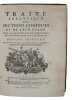
Scarce first edition of l'Hôspital's second book - his second successfull textbook - the manuscript of which was left completed at his death in 1704. His first book ""Analyse des infiniment petits pour l’intelligence des lignes courbes"", 1696 was the first textbook of the differential calculus, and his name lives on in the name of the rule for finding the limiting value of a fraction whose numerator and denominator tend to zero. His mathyematical teacher was Jean Bernoulli.The year in which Newton published the anti-Cartesian ""Arithmeticus"" there appeared in France a conspicuously successfull textbook on Cartesian geometry along the lines of that of Guisnée. This was the ""Traité Analytique des Sections Coniques"".... a book which contains less original material than that of Guisnée, but which is more extensive and closer to the modern manner of treatment. The work had been intended for publication at the time the authors famous calculus textbook appeared in 1696, but l'Hospital's illness apparently led to delay and it appeared posthumously in 1707. It is Cartesian in emphasis and although it consists of but one volume, follows generally the tripartite plan of Lahire and Ozanam: first an algebraic quasi-analytic treatment of the Conic Sections along the lines of Apollonian theory"" then an analytic study of the loci, and finally a long section on the customary construction by conics of the roots of cubic and quartic polynominal equations... LHospital sometimes used two axes and seems to have recognized the interchangeability of these, but he betrays some hesitation... In general, L'Hospital (like Descartes) was more interested in analytic geometry as a measure of ecpressing loci algebraivcally than as a method of deriving the properties of a curve from its equation."" (Carl B. Boyer ""History of Analytic geometry"", pp. 150-154.
Discours pour la majorité de Charles IX. Présenté par Robert Descimon.
Imprimerie Nationale, 1993, gr. in-8°, 134 pp, biblio, broché, couv. à rabats, bon état
Le chancelier Michel de L'Hospital (vers 1505-1573) est une des figures mythiques de l'histoire de France. A la tête de la justice et donc de l'Etat royal, il traverse, impassible et pacifique, les règnes sanglants de François II (la conjuration d'Amboise, mars 1560) et de Charles IX (la Saint-Barthélemy, août 1572). Auprès de nos contemporains cultivés, il symbolise le sens de l'Etat et de la tolérance religieuse. Certes, cette vision comporte sa part d'anachronisme. Mais si L'Hospital ne fut pas un héros libéral ou idéal, son action reste, car elle contribua à façonner les caractères de la "monarchie absolue" jusqu'à la Révolution française. Le Discours pour la majorité de Charles IX (Rouen, 1563) et les trois autres discours politiques qu'on trouvera rassemblés (Paris, 1560, au Parlement ; Orléans, 1560, aux Etats généraux ; Moulins, 1566, au conseil élargi) témoignent de la vigueur d'une pensée et d'une langue qui ont toute la saveur du XVIe siècle. Ce temps était celui de guerres religieuses épouvantables. C'est pour les conjurer que L'Hospital parle. Désormais les frais d'envoi sont de 6 € seulement pour les livres jusqu'à 1 kg (colissimo suivi), pour la France métropolitaine.
Trois papes au tournant de l'histoire
Librairie Académique Perrin 1969 240 pages in8. 1969. Reliure Editeur avec jaquette. 240 pages. Le livre 'Trois papes au tournant de l'histoire' de Jean Hospital publié par la Librairie Académique Perrin examine le rôle et les décisions de trois papes à des moments clés de l'histoire. L'extrait se concentre sur un pape décrit comme anxieux et hésitant surnommé 'notre éminentissime Hamlet' par son prédécesseur et conclut que le véritable pape de transition est le souverain pontife actuel contrairement aux attentes qui pointaient Jean XXIII


annotations au crayon papier dans l'ouvrage
"Antwerpen, Stuivenberg Ziekenhuis, 5 mounted photographs, rubberstamped. Etablissement Photographique Ancn. Maison A.Indenklef; Gustave Hermans succr., 98 Rue Dambrugge Anvers."
5. Map with 5 mounted photographs, exteriors of the Stuivenberg Hospital Buildings, photos of 28 x 39,5 cm mounted on boards of 48 x 66 cm. The photographs were taken immediately after the completion of the hospital building. They show overall views and parts of buildings of this huge complex. It was designed in 1872-73 by F. Baeckelmans and completed in 1877-84 by J.B. Bilmeyer and J. van Riel. It represents a typical modern 19th-century model of a large hospital with central service buildings and circular wards on two levels. Especially the circular wards were very innovative.
HISTORY of GEORGE HERIOT'S HOSPITAL with a memoir of the founder together with an account of the Heriot foundation schools
Edinburgh, Bell & Bradfute, 1859; un volume in 8 relié en plein veau glacé, dos orné de fers dorés, fers et filets dorés sur les plats, toutes tranches dorées (reliure de l'époque), 1 frontispice, 22pp., 390pp., 1 tableau dépliant, un plan de l'hôpital, 1 planche hors texte
New (second) edition revised and enlarged by Frederick W. Bedford ---- BON EXEMPLAIRE ---- Memoir of Geogre Heriot - From foundation to opening - The first and the second centuries after opening - Government and domestic economy of the institution - System of education - Account of the Heriot foundation schools - Description of the hospital - etc**2328/E3-2329/CAV.i1
Solution d'un Probléme Physico-Mathematique.
(Paris, Jean Boudot, 1703). 4to. Without wrappers. Extracted from ""Mémoires de l'Academie des Sciences. Année 1700"". Pp. 9-21 and 1 folded engraved plate.
First appearance of a paper in mathematical physics in which L'Hospital - best known by his draft of the first treatise oof the differential calculus - in which he applies the new mathematical tool, the calculus to physics. ""L'Hospital was a major figure in the early development of the calculus on the continent of Europe. he advanced its cause not only by his scientific works but also by his many contacts, including correspondence with Leibniz, Jean Bernouilli, and with Huygens. Fontenelle tells us that it was he who introduced Huygens to the new calculus.""(DSB).
Analyse des infiniment petits pour l'intelligence des lignes courbes
P., Montalant, 1716, un volume in 4 relié en plein veau, dos orné de fers dorés (reliure de l'époque), (un mors très légèrement fendu sur 2 cm, petite épidermure à un mors, plats légèrement frottés), 16pp., 182pp., 11 PLANCHES DEPLIANTES
---- BON EXEMPLAIRE ---- Seconde édition ---- "THE FIRST TEXTBOOK OF THE DIFFERENTIAL CALCULUS". (DSB) ---- "L'hospital was a major figure in the early development of the calculus on the continent... For several generations after his death, his fame was based on his book Analyse des infiniment petits pour l'intelligence des lignes courbes...". (DSB VIII pp. 304/305) ---- "G.F.A. L'Hospital (1661/1704), a pupil of Johann Bernoulli, has already been mentioned as taking part in the challenges issues by Leibniz and the Bernoullis. He helped powerfully in making the calculus of Leibniz better known to the mass of mathematicians by the publication of a treatise thereon, the Analyse des infiniment petits. This contains the method of finding the limiting value of a fraction whose two terms tend toward zero at the same time, due to Johann Bernoulli". (Cajori p. 224)**8080/ARB4
History of the Georges HERIOT'S HOSPITAL with a memoir of the founder together with an account of the Heriot foundation schools. Supplement of the third edition of the george Heriot's hospital and the heriot foundation schools
Edinburg, Bell & Bradfute, 1872, un volume in 8 relié en cartonnage bradel, 1 frontispice, 26pp., 437pp., 1 tableau dépliant, une plan de l'hopital, 1 planche hors texte
---- Third edition revised and enlarged by Frederick W. Bedford ---- Memoir of Georges Hariot - from the foundation to the opening - the first and the second centuries after opening - Government and domestic economy of the institution - System of education - Account of the Heriot foundation schools - Description of the hospital - etc**2329/CAV.i1
Bravo, le mensuel de Paris n° de Février 1931- n° spécial sur La Chance-Sommaire: La Chance- Et vous , y croyez-vous? Réponses de Colette, H. Decoin, G. Neveux, etc- 13 histoires de chances, enquête par Jean D'Hospital- Jules Romains et le Vieillard Boite
Bravo. 1931. In-Folio. Broché. Etat d'usage, Couv. défraîchie, Agraffes rouillées, Papier jauni. 51 pages. Couverture partiellement désolidarisée. Nombreuses rousseurs. Déchirures. Nombreuses illustrations en noir et blanc, in et hors texte. Nombreuses publicités illustrées en noir et blanc. Dos très frotté.. . . . Classification Dewey : 70.49-Presse illustrée, magazines, revues
Sommaire: La Chance- Et vous , y croyez-vous? Réponses de Colette, H. Decoin, G. Neveux, etc- 13 histoires de chances, enquête par Jean D'Hospital- Jules Romains et le Vieillard Boiteux- La plus belle minute du Professeur Gosset- L'acte de foi du ministre P.T.T.- La chance au jeu:une martingale infaillible- etc. Classification Dewey : 70.49-Presse illustrée, magazines, revues
L'HOSPITAL. Analyse des infiniment petits pour ... des lignes courbe 1715
L'HOSPITAL (Marquis de). Analyse des infiniment petits pour l'intelligence des lignes courbes. Seconde édition. A Paris, chez François Montalant (1715). 1 volume in-4 de XV-(1)-181-(1) pp., 11 planches dépliantes, reliure en veau, dos à nerfs orné, tranches rouges. Ce célèbre ouvrage est le premier livre en français à traiter de calcul différentiel. Selon Quérard, cette seconde édition est corrigée des nombreuses fautes typographiques qui entachent la première. L'édition originale date de 1696. Petite restauration sur le dos, un coin frotté. Bel exemplaire. Quérard. La France littéraire V, 295.
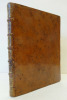
Mémoires de Monsieur le Chancelier de L'Hospital, Contenant Plusieurs Traitez de Paix, Appanages, Mariages, Neutralitez, Reconnoissances, foy & Hommages, & Autres Droicts de Souueraineté.
1672 Cologne, Chez Pierre Ab Egmond, 1672; in-12° de 253- (3)pp.; plein velin ivoire muet.
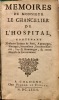
Il manque la dernière garde blanche, sinon bon exemplaire.( Reu-Bur)
Comme un tigre en cage Turner Hospital, Janette and Fortier-Masek, Marie-Odile
Le Serpent à plumes PHOTOS SUR DEMANDE
Merci de nous contacter à l'avance si vous souhaitez consulter une référence dans notre boutique à Authon-du-Perche.
Comme un tigre en cage
Le serpent à plume Editions In-12°,jolie reliure cartonnée rose sous jaquette illustrée,375 pages,jaquette un peu fanée bon et bel ensemble par ailleurs.
Bon Etat Mise à jour du Samedi 27 Juin 2026. Paiement PayPal immédiat, Mondial Relay pour : France, Allemagne, Autriche, Belgique, Espagne, Italie, Portugal, Luxembourg, Pays-Bas, Pologne (Communiquer votre point ou locker si connu). Une participation supplémentaire peut être demandée pour les colis lourds hors France où les envois compris entre 5 et 25 kg sont dégressifs : 2 à 4 kilogrammes - 7.99 / 5 à 10 kg - 15.99 / 15 -25 kg - 25.99. Certaines de nos collections ( Vian, Céline, Camus (...) peuvent être expédiées en Franco de port. Pour linternational hors Europe (Suisse, Canada, Japon, Etats-Unis, les frais dexpéditions peuvent varier selon le poids (mise à jour : 1 juin 2026).
Renvoy du discours de l'union contre la publicatin [sic] du Concile de Trente.
S.l.,s.n., 1607. Petit in-8° dérelié de 8 pp. Signatures : A4. Quelques mouillures.[C10]
L'une des deux éditions publiées à la même date. Celle-ci, en 8 pages avec une faute typographique au titre, la seconde en 16 pages. Elle est attribuée à l'archevêque d'Aix, Paul Hurault de L'Hospital par Pierre de L'Etoile. C'est un pamphlet assez violent contre les positions prises par Ribier dans son Discours au Roy paru quelques jours auparavant, qui prônait la réunification de l'Eglise par la tenue d'un nouveau concile ?cuménique. l'archevêque d'Aix y traite Ribier d'hérétique car il appelle les protestants "ses frères" et qu'il s'oppose dans son discours à la pleine réception du concile de Trente. Venard, n°3. On joint l'Apologie pour le Discours au Roy sur la réunion de ses sujets en une mesme et seule religion, par G. Ribier, qui est une réponse aux attaques de l'archevêque d'Aix. Cet exemplaire ne comporte pas de page de titre comme celui de la bibliothèque de Lyon (identifié par son incipit : "Depuis ce petit ouvrage mis au jour..."). 47 pp. Signatures : [A-F]4. Venard, n°5 (coll. erronée); Desgraves, 746.
[Chez Auguste Boulland et Cie] - L'HOSPITAL, Michel de ; TARDIEU, Ambroise
Reference : 66774
(1824)
Oeuvres de Michel L'Hospital, Chancelier de France. [ Album de planches, seul ]
Planches dessinées, gravées et décrites, par Amb. Tardieu, 1 vol. in-8 reliure postérieure demi-basane noire, dos à 5 nerfs, couvertures conservées, Chez Auguste Boulland et Cie, Paris, 1824, 20 planches et fac-similés dont 2 planches doubles et un grand fac-similé dépliant, avec feuillets de texte explicatif
![Oeuvres de Michel L'Hospital, Chancelier de France. [ Album de planches, seul ]. L'HOSPITAL, Michel de ; TARDIEU, Ambroise](https://static.livre-rare-book.com/pictures/CDL/66774_thumb.jpg)
![Oeuvres de Michel L'Hospital, Chancelier de France. [ Album de planches, seul ]. L'HOSPITAL, Michel de ; TARDIEU, Ambroise](https://static.livre-rare-book.com/pictures/CDL/66774_2_thumb.jpg)
![Oeuvres de Michel L'Hospital, Chancelier de France. [ Album de planches, seul ]. L'HOSPITAL, Michel de ; TARDIEU, Ambroise](https://static.livre-rare-book.com/pictures/CDL/66774_3_thumb.jpg)
Bel exemplaire du volume de planches, parfaitement complet. Peu commun. Bon exemplaire (petite fente en pli au fac-similé, très bel état par ailleurs, ex-libris en marge).
L'HOSPITAL, Le Marquis de (Guillaume-François-Antoine ,1661-1704):
Reference : 98454aaf
Traité analytique des sections coniques et de leur usage pour la résolution des équations dans les problèmes tant déterminez qu'indéterminez. Ouvrage Postume.
A Paris, Chez Fraçois Montalant, 1720, in-4°, 4 feuilles (titre - avertissement - table - privilège du Roy) + 459 p. avec un bandeau et une lettrine gravés sur cuivre + 33 planches dépl. avec 293 figures + plus une planche non chiffrée portant une figure notée A. (page 413), reliure en plein veau d’époque, dos à cinq nerfs richement orné en or, pièce de titre. tranches rouges, un coin légèrement touché, gardes en papier dominoté originales (caillouté veiné bleu clair rose rouge), bel exemplaire en parfait état.
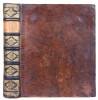
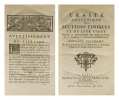
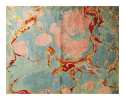
Deuxième édition posthume. Le géomètre français, G.-F. Antoine DE L'HOSPITAL, marquis de SAINTE-MESME et comte D'ENTREMONT fut initié à l'étude du calcul infinitésimal par Jean Bernoulli en 1692. S'il est moins important que son Analyse des infiniment petits, le Traité des sections coniques dont la première édition, posthume, est de 1707, fut pendant longtemps l'une des meilleures études sur cette partie de l'analyse et contribua aussi à placer le nom de son auteur à côté de ceux des géomètres les plus célèbres de son époque Leibniz, Huygens et les frères Bernoulli. Contemporary full calf binding, complete with 33 plates + 1 numbered A. Fine copy. Poggendorf I, 1146; Cantor III, 427; DSB VIII, 304. - cf. Pierre HUMBERT, Les Mathématiques de la Renaissance à la fin du XVIIIe siècle. DAUMAS, Histoire de la Science, 589. Image disp.
(SLACES, NVVA)
Phone number : 41 (0)26 3223808
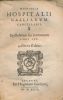
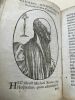
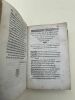
Galliarum cancellarii. Epistolarum seu Sermonum. Libri sex. Altera Editio
Per Hugonem Gazeium Lugduni, Per Hugonem Gazeium, 1592. In-12 plein vélin, XV (comprenant l'index et un portait gravé de Michel de l'Hospital) + 433 + 2 pages. Avec bandeau, lettrines et culs de lampes gravés. Trace de mouillure pale en fin d'ouvrage, manque de velin en parties inférieures du dos et du premier plat. Deuxième édition, la première étant de 1585 Bibliographie : Brunet III-1046. Bon exemplaire.
Toutes les expéditions sont faites en suivi au-dessus de 25 euros. Expédition quotidienne pour les envois simples, suivis, recommandés ou Colissimo.
Collection de divers éloges publiés à l'occasion du prix proposé par l'Académie Françoise, en 1777, pour le meilleur éloge du Chancelier de l'Hospital. 4 Parties en 1 volume
Paris, sans .éditeur M. DCC. LXXVIII, 1778, pt. in-8vo, 201 p. ; 156 p. ; 112 p. ; 123 p., cachets de bibliothèques sur titre, e.a. Hospice Bibliothèque du Simplon, reliure en demi-cuir, dos sur 5 nerfs orné de filets dorés et pièce de titre en cuir.
(SLACES, NVVA)
Phone number : 41 (0)26 3223808
Eloge historique de Michel de L'Hospital, Chancelier de France.
Sans lieu ni nom, 1777, in 8° broché, 127 pages ; à toutes marges ; couverture de parution muette.
PHOTOS sur DEMANDE. ...................... Photos sur demande ...................

Phone number : 04 77 32 63 69
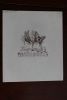
Portrait en pied gravé représentant Michel de L'HOSPITAL -
Eau-forte sur chine appliquée sur papier blanc - XIXéme siècle - format 22,5 x 16 cm pour le papier de chine - rousseurs sur les marges de papier blanc -
Dessiné par Béranger - Gravé par Porreau Jules -

