 Write to the booksellers
77 books for « his w »Edit
-
Type
Book (76)
Music sheets (1)
-
Language
English (2)
French (75)
-
Century
18th (2)
19th (10)
20th (17)
-
Countries
Belgium (9)
Canada (1)
Denmark (10)
France (49)
Switzerland (8)
-
Syndicate
ALAC (1)
ILAB (51)
NVVA (6)
SLACES (6)
SLAM (32)
Topics
- Alps (1)
- Architecture (1)
- Basel (2)
- Bible (1)
- Biography (2)
- Birds (1)
- Botticelli alessandro (1)
- Brittany (1)
- Chemistry (2)
- Comic strip (2)
- Dedication (1)
- Diplomacy (1)
- Economics (2)
- England (1)
- English (1)
- Esotericism (1)
- Essays (1)
- Ethnology (1)
- Ex-libris (1)
- Gibbon (1)
- Guittoneau ben (1)
- Helvética (3)
- Hinduism (1)
- History (5)
- Humanitarian sciences (1)
- Lavoisier (1)
- Law (1)
- Medicine (1)
- Miller (1)
- Music (7)
- Orchestra (14)
- Philosophy (1)
- Physics (7)
- Policy (1)
- Political sciences (1)
- Prehistory (2)
- Sciences (3)
- Scores (1)
- Sculpture (1)
- Songs (1)
- Switzerland (1)
- Tea (1)
- Testimonies / stories (1)
- United kingdom (1)
"LAVOISIER, (ANTOINE-LAURENT). - EMBODYING LAVOISIER'S QUANTITATIVE METHOD, HIS FIRST PAPER.
Reference : 44940
(1768)
Analyse du Gypse. (1765).
Paris, L'Imprimerie Royale, 1768. 4to. Extract from ""Mémoires fe Mathematique et de Physique, Présentés à l'Academie des Sciences par divers Savans"", Tome V. With tittlepage to vol. 5. Pp. 341-357. Clean and fine.
First appearance of Lavoisier's FIRST PUBLISHED CHEMICAL PAPER introducing quantitative methods in chemistry, and in which he for the first time brought a hydrometer in use to measure the specific gravities of components of a chemical solutions. Lavoisier defended the originality of his approach in the following words: ""It is to the art of combination that the knowledge of the specific gravities of fluids can bring most light. This aspect of chemistry is much less advanced than we thought, we possess barely the rudiments of it."" ""This first paper, which in so many respects embodies the quantitative methods Lavoisier was to employ in his later work, had in fact been largely anticipated by others, notably by Marggraf, who had already discovered the composition of gypsum and shown that it contained water (phlegm). Yet Lavoisier’s work was more through" and his paper, his first contribution to the Academy of Sciences (read to the Academy on 25 February 1765), appeared in 1768. (The paper offered). - Lavoisier’s earliest chemical investigation, his study of gypsum, was mineralogical in character" begun in the autumn of 1764, it was intended as the first paper in a series devoted to the analysis of mineral substances. This systematic inventory was to be carried out, not by the method of J. H. Pott ""who exposed minerals to the action of fire"" but by reactions in solution, by the ""wet way."" ""I have tried to copy nature,"" Lavoisier wrote. ""Water, this almost universal solvent ""is the cheif agent she employs"" it is also the one I have adopted in my work."" Using a hydrometer, he determined with the care the solubility of different samples of gypsum (samples of selenite, or lapis specularis, some supplied by Guettard and Rouelle). He made similar measurements with calcined gypsum(plaster of paris). Analysis convinced him that this gypsum was a neutral salt, a compound of vitriolic (sulfuric) acid and a calcareous or chalky base. Not content with having shown by analysis the composition of the gypsum, Lavoisier completed his proof by a synthesis following, as he said, the way that nature had formed the gypsum. He further demonstrated that gypsum, when transformed by strong heating into plaster of Paris, gives off a vapor, which he showed to be pure water, making up about a quarter of the weight of gypsum. Conversely, when plaster of Paris is mixed with water and turns into a solid mass, it avidly combines with water. Using the expression first coined by Rouelle, he called this the ""water of crystallization."" (DSB).Partington III, pp. 378-79. -
Dioptrische Untersuchungen.
Göttingen, Dieterischen Buchhandlung, 1841. 4to. Uncut in orig. blank stiff blue wrappers. (2),34,(2- errata leaf) pp. Wide-margined. A few mild brownspots in margins. otherwise a clean and fine copy.
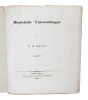
First edition of the peak of ""Gaussian dioptrics"", Gauss' greatest achievement in the field of optics, which has been called ""HIS GREATEST WORK"". He gives the data on the construction of the image when the principal points and foci of the system are given, and finally formulas for a simple lens of nonvanishing thickness are given.""In the same year he finished Dioptrische Untersuchungen (1841), in which he analyzed the path of light through a system of lenses and showed, among other things, that any system is equivalent to a properly chosen single lens. Although Gauss said that he had possessed the theory forty years before and considered it too elementary to publish, it has been labeled his greatest work by one of his scientific biographers (Clemens Schäfer. in Werke, XI, pt. 2, sec. 2, 189 ff.). In any case, it was his last significant scientific contribution."" (DSB).
"HELMHOLTZ, HERMANN von. - THE PRELUDE TO ""ÜBER DIE ERHALTUNG DER KRAFT"" AND HIS FIRST PAPER ON FORCE CONSERVATION
Reference : 45604
(1847)
Physiologische Wärmeerscheinungen. Bericht ""über die Theorie der physiologischen Wärmeerscheinungen für 1845"" (Report on the Work done on the Theory of Animal Heat in 1845).
Berlin, G. Reimer, 1847. Contemp. hcalf, profusely gilt spine. Light wear along edges. XXXII,622 pp. In: ""Fortschritte der Physik im Jahre 1845. Dargestellt von der physikalischen Gesellschaft zu Berlin"". I. Jahrgang. Redigirt von G. Karsten. XXXII,622 pp. A stamp on titlepage. Helmholtz's paper: pp. 346-355. Clean and fine.
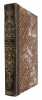
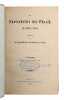
First appearance of this milestone paper which represents the first, and most importent, step towards his great work laid down in ""Über die Erhaltung der Kraft"", 1847. This is Helmholtz' FIRST PAPER ON THE CONSERVATION OF FORCE""At the beginning of October, 1846, Helnmholtz sent a 'Report on Work done on the Theory of Animal Heat for 1845', at du Bois' request, to the ""Fortschritte der Physik"", issued by the Physical Society. (the paper offered). This was merely an abstract from the article in the Encyclopaedic Dictionary.....BUT IT ANTICIPATES MORE DEFINITELY THE CONDCLUSIONS OF HIS GREAT WORK. He states without hesitation that the material theory of heat is no longer tenable, and that a kinetic theory must be substituted for it, since heat originates in mechanical forces, either directly by friction, or indirectly from an electrical current produced by themotion of magnets. This conception of heat as a motion involves the conclusion that mechanical, electrical and chemical forces must always be the definite equivalent of one and the same energy, whatever the mode by which one force is transformed into another. The empirical confirmation of this law must be the imperative duty of physicists and physiologists.""(Leo Koenigsberger in ""Hermann von Helmholtz"", pp. 34-35).""In the ""Fortschritte der Physik"" for 1845, which appeared in 1847, Helmholtz published a report on theories of physiological heat which he later acknowledged as belonging to his work on the conversation of force.""(Jungnickel & McCormach ""Intellectual Masteryof Nature, Vol. 1, p. 157).
Elson Henry William Morris Le Bour'his M.-M. Cestre Charles
Reference : DVD39JR
ISBN : B00184A7VY
Henry William Elson. Histoire des ëtats-Unis. Traduction franºaise par C. Cestre et M. M. Morris Le Bour'his. Avec 7 cartes
Gnrique Broch D'occasion tat correct 01/01/1930 100 pages
Die Theorie des Sättigungsgesetzes.
Leipzig, Barth, 1881. 8vo. No wrappers. In: ""Annalen der Physik und Chemie. Hrsg. von G. Wiedemann"", Neue Folge, Bd. XIII. No. 7. With titlepage to Bd. XIII. Pp. (385-) 544 a. 1 plate. (Entire issue offered). Planck's paper: pp. 535-543. Stamp to titlepage and verso of. Clean and fine.
First apperance of Planck's first scientific paper, not to mention his dissertation and his habilitationsschrift (1880).Akademie No. 3.
Verdampfen, Schmeltzen und Sublimiren.
Leipzig, Barth, 1882. 8vo. Contemp. hcalf. Raised bands gilt spine with gilt lettering. Spine a bit rubbed. In: ""Annalen der Physik und Chemie. Hrsg. von G. Wiedemann"", Neue Folge, Bd. XV. VIII,680 pp. and 8 plates. (Entire volume offered). Planck's paper: pp. 446-475. Internally clean and fine. Stamp to titlepage and verso of.
First apperance of Planck's second scientific paper, not to mention his dissertation and his habilitationsschrift (1880).Akademie No. 4.The volume contains further importent papers by E. Goldstein (4 papers on Cathode-Rays), by Ångström, Kohlrausch etc.
Ueber das thermodynamische Gleichgewicht von Gasmengen.
Leipzig, Barth, 1883. 8vo. Contemp. hcalf. Raised bands gilt spine with gilt lettering. Spine a bit rubbed. In: ""Annalen der Physik und Chemie. Hrsg. von G. Wiedemann"", Neue Folge, Bd. XIX. VIII,956 pp. and 10 plates. (Entire volume offered). Planck's paper: pp. 358-378. Internally clean and fine. Stamp to titlepage and verso of.
First apperance of Planck's third scientific paper, not to mention his dissertation and his habilitationsschrift (1880). The paper deals with thermo-dynamic equilibrium of gas-mixtures.Akademie No. 5.The volume contains further importent papers by Heinrich Hertz, W.C. Röntgen, Kohlrausch, Elster & Geitel etc.
GIBBON Edward Illustrated from his letters with occasional notes and narrative by John Sheffield.
Reference : 96123
(1796)
Miscellaneaous works of Edward Gibbon, esquire with memoirs of his life and writings composed by himself.
Couverture rigide. Volume 1 seul. Reliure à nerfs en mauvais état. 702 pages. Mors fendus, épidermures, coiffes usées. 23 x 29 cm.
Livre en anglais. volume 1 seul. Illustrated from his letters with occasional notes and narrative by John Sheffield. Editions A. Strahan - T. Cadell and V. Davies, 1796.
G.J. van Oordt. his contributions to science. Essays presented to G. J. van Oordt on the occasion of his retirement of the chair of general zoology and endocrinology in the University of Utrecht.
1962 109, [1] p., portrait, cloth. Good copy, as new.
Our life in the Swiss highlands. Second edition.
London, Adam and Charles Black, 1907, lg. in-8°, XXII + photograph of the author in his study + 278 p. + 20 colour plates + 1 pencil scetch on full-page + 1 folded map (the Swiss Highlands), some spots in the beginning, exlibris Peter E. Obergfell, dark green publishers cloth with gilt ornaments and title on front cover and spine. Fine copy.
Marvellous reading of life 100 years ago in the Swiss alpine regions. The epilogue gives an account of the rigours of a mediaeval winter, with endless snowing and avalanches. Image disp.

(SLACES, NVVA)
Phone number : 41 (0)26 3223808
Selvin Ben and his Vocalion Orchestra - Sullivan Jerry,Hosford Harry - Sullivan Jerry,Hosford Harry
Reference : 109529
(1923)
Partition de la chanson : Tripping Along ( With You and me ) Sur la couverture de la partition, photo de Ben Selvin and his Vocalion Orchestra
Jack Mills 1923
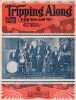
Etat moyen Format Américain Piano
HIS MAJESTY'S SHIP: les naufragés de la Miranda t1.
, Casterman, 2005 ; in-4, 56 pp., cartonnage de l'éditeur. tome 1 : album avec deux dessins et dédicace en pleine pages des auteurs : Roussel & SEITER.
tome 1 : album avec deux dessins et dédicace en pleine pages des auteurs : Roussel & SEITER.
Précis historique et économique du Traité de commerce entre la France et la Grande-Bretagne. signé à Versailles le 26 septembre 1786
Paris, E. Dentu, Sauton, 1869 in-8, 142 pp., un f. n. ch., demi-chagrin brun, dos à nerfs fleuronné, pièce de titre fauve rajoutée, encadrements à froid sur les plats de toile chagrinée, fers de lycée poussés au centre du plat supérieur [Collège Rollin], première couverture conservée (reliure de remploi).
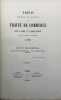
Unique édition. His de Butenval (1809-1883), ancien diplomate et désormais sénateur d'Empire, présente une critique raisonnée de l'opinion généralement négative qui a, en France, entouré ce traité de commerce depuis presque le lendemain de sa conclusion. Il faut préciser que l'auteur était anglophile et partisan du libre-échange.Exemplaire de l'importante bibliothèque napoléonienne du diplomate et historien Marcel Dunan (seconde vignette, dessinée par Maximilien Vox), avec classique reliure récupérée, dont il était coutumier. - - VENTE PAR CORRESPONDANCE UNIQUEMENT - LIEN DE PAIEMENT, NOUS CONSULTER.

The Life and Poetical Works of George Crabbe by His Son George Crabbe - A new and complete edition
John murray 1901 in8. 1901. Relié.
couverture frottée tachée intérieur propre
Basler Handelsherren des 19. Jahrhunderts.
Basel, Benno Schwabe, 1929, in-8°, 194 S., mit 13 Abbildungen, Original-Pappband.
Leonard Heusler 1754-1807 / Bernhard Cocin-Heusler 1777-1854 / J. G. Vonder Mühll-Burckhardt 1789.1853 / Eduard His-LaRoche 1792-1871 / Achiller Bischoff 1795-1867 / B. La Roche-(Stehelin Preiswerk) 1802-1876 / Carl Geigy 1798-1861 / J. J. Speiser-Hauser 1813-1886 / R. Paravicini-Vischer 1815-1886 / Alph. Koechlin-Geigy 1821-1893 / J. R. Geigy-Merian 1830-1917 / Rudolf Geigy-Merian 1830-1917 / Rud. Sarasin 1831-1905.
(SLACES, NVVA)
Phone number : 41 (0)26 3223808
Wilhelm His der Ältere. Lebenserinnerungen und ausgewählte Schriften. Hubers klassiker der Medizin 6.
Bern - Stuttgart, Hans Huber, 1965, gr. in-8°, 139 S., Original-Leinenband. Orig.-Umschlag.
(SLACES, NVVA)
Phone number : 41 (0)26 3223808
Mémoire sur la Constitution de l'Ether et de ses Combinaisons.
Paris, Crochard, 1833. No wrappers. In: ""Annales de Chimie et de Physique, Par MM. Gay-Lussac et Arago."", 2e Series, Tome 55, Cahier 2. Pp. 113-224 a. 1 folded plate. (Entire issue offered). Liebig's paper: pp. 113-156. Titlepage to volume 55.
First printing of Liebig's importent paper in which he expounds his Ether-theory.""Shortly afterward Liebig discovered an important new compound which he thought revealed another fatal flaw in Dumas’s theory. Since 1831, when Dobereiner had sent him an “ether-like” fluid obtained from the oxidation of alcohol, Liebig had tried several times to identify the resultant compounds. Dobereiner maintained that the fluid contained an ""oxygen ether."" In 1833 Liebig found two distinct compounds present. One of them, Dobereiner’s oxygen ether, he examined more thoroughly and renamed acetal.""
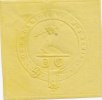
J C, « Quondam his vicimus armis », Angleterre (propriétaire), Ex-libris.
Reference : 011540
Ex-libris.
J C, « Quondam his vicimus armis », Angleterre (propriétaire), Ex-libris. Ex-libris ( 41*43mm), en relief. [329-4]
DISQUE VINYLE 33T TUXEDO JUNCTION, SINGING THE BLUES, SCHERZO FROM SYMPHONY, MACK THE KNIFE, THE WHISTLER AND HIS DOG, STARS AND STRIPES FOR EVER, ON THE ROAD TO MANDALAY, ROCKET, STRIKE UP THE BAND, SATIN DOLL, THE TROLLEY SONG, BOLERO.
DECCA. non daté. In-12. Broché. Bon état, Couv. convenable, Dos satisfaisant, Intérieur frais. POchette en couleurs, biographie de RAY HORRICKS et de BOB SHARPLES dérrière la pochette. Disque en anglais.. . . . Classification : 410-33 Tours
Disque n° SKL 4110 Classification : 410-33 Tours
HIS MAJESTY'S SHIP: les naufragés de la Miranda t1.
, Casterman, 2005 ; in-4, 56 pp., cartonnage de l'éditeur. EO tome 1 : DL janv 2005 ( n°41895).
EO tome 1 : DL janv 2005 ( n°41895).
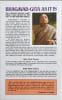
Bhagavad-Gita As It Is
THE BHAKTIVEDANTA BOOK TRUST 1990 904 pages in8. 1990. Reliure editeur cartonnée. 904 pages. Cette édition de la Bhagavad-gita traduite et commentée par A.C. Bhaktivedanta Swami Prabhupada présente le dialogue entre Krishna et Arjuna sur le champ de bataille. Elle offre un guide complet de la réalisation de soi et de la science de la dévotion avec des commentaires autorisés et des illustrations

Très bon état
Claude Le Jeune, Premier Livre de Melanges,
Turnhout, Brepols, 2004 Paperback, LXIV+480 p., 185 x 270 mm. ISBN 9782503514918.
Languages : French.


SCHELTE A BOLSWERT ( 1586 - 1659 ) - ( engraver ) - Gillis HENDRICX (? - 1677 ) ( editor ) - [ ] Engraving of Rubens' painting '' Et erat subditus iIllis'' ( The child Jezus walking between his parents Mary and
Reference : 53289
Original copper engraving of Rubens' painting '' Et erat subditus iIllis'' ( The child Jesus walking between his parents Mary and Joseph ). MODERN imprint.
Antwerpen, s.d. ( first half of 17th c.), original copper engraving, 450 x 330 mm. Modern imprint on strong '' Van Gelder & Zonen '' paper. Fine quality.
Johann Sebastian Bach
Leipzig, F.C.W. Vogel, 1895. In-folio, 22 pp. IX pl., demi-parchemin à la bradel, dos long, couverture conservée (petites taches).
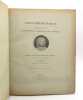
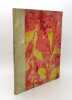
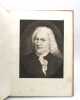
Édition originale de ce curieux ouvrage relatif à la découverte et à l'étude du crâne de Jean Sébastien Bach. Il est illustré de reproductions de plusieurs portraits et du fameux crâne en question. Ex-libris gravé Alfred Cortot. * Membre du SLAM et de la LILA / ILAB Member. La librairie est ouverte du lundi au vendredi de 14h à 19h. Merci de nous prévenir avant de passer,certains de nos livres étant entreposés dans une réserve.

