 Write to the booksellers
20 books for « hesiodus »Edit
-
Language
French (19)
Greek (1)
-
Century
17th (1)
19th (1)
-
Topics
Greek (13)
Junker (1)
Latin (12)
Literature (1)
Philosophy (2)
Rhetoric (2)
-
Countries
France (4)
Netherlands (15)
Switzerland (1)
-
Syndicate
ILAB (1)
SLAM (1)
HÊSIODOU ASKRAIOU TA HEURISKOMENA. Hesiodi Ascraei quae extant. Ex recensione Johannis Georgii Graevii, cum ejusdem animadversionibus & notis. Accedunt notae ineditae Josephi Scaligeri et Francisci Guieti. (Bound with:) Johannis Georgii Graevii Lectiones Hesiodeae, ut & notae Josephi Scaligeri et Franscisci Guieti.
Amsterdam (Amstelodami), Apud Danielem Elzevirium, 1667.
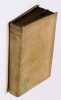
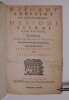
8vo. 2 volumes in 1: (XXXII),163,(9 fragmenta); (IV),183,8 (7 index & 1 errata),(1 blank) p. Vellum 16 cm (Ref: STCN 850625599; Neue Pauly, Supplement 2, p. 282: Hesiodus EF 10; Willems 1378; Berghman 830; Rahir 1439; Brunet 3,141; Graesse 3,263; Ebert 9603; Dibdin 2,34/35; Moss 1,470) (Details: Greek text and Latin translation. Boards with blind fillet border. First title printed in red and black. Woodcut printer's mark of Louis and Daniel Elzevier on both titles, both showing different versions of the Minerva type; they depict Minerva under an olive tree, she holds a banner with the motto: 'Ne extra oleas', to be understood as 'Stay within the bounds of wisdom') (Condition: Vellum slightly worn. Boards slightly curved. Old ownership entry on the front flyleaf and on the title. 2 gatherings loosening. A few old ink inscriptions in the margins. Small inkstains on 1 p. A small and faint waterstain in the lower corner of the beginning. Small wormhole in the upper margins of the second half, nimbling only at the head of a few letters) (Note: Hesiodus from Askra, a small town in Boiotia, born ca. 775 BC, is one of Greek's oldest poets. His poems are in Homeric hexameters and show his interest in ethics and systematization. His work was known throughout antiquity to rhapsodes, scholars and schoolboys. The Byzantines compiled scholia from ancient commentaries for eludication. The Renaissance didnot quite appreciate him. Until 1667 ca. 18 editions of his 'opera omnia' were published, not much. Hesiod's reception chiefly concerns myths and the motifs that he provides, and these motifs certainly appealed to mythographers, historians of religion, poets and painters. 'Hesiodic details of myth saturate European epic and mythopoeic writings, perhaps most spectacular in Dante, Milton, Blake (...) who make much of Hesiod's infernal regions, his Titans and primordial monsters, his giant battles'. (The Classical Tradition, N.Y, 2010, p. 435) Of Hesiod survives his 'Theogonia' or 'Theogony', which 'deals with the origin and genealogy of the gods (...) and the events that led to the kingship of Zeus: the castration of Uranos by Kronos and the overthrow of Kronos and the Titans by the Olympians'. (OCD, 2nd ed., p. 510) The 'Works and Days' or 'Erga kai Hêmerai' of Hesiod, which was always most read, has been called a 'gospel of labour'. The poet recommends the hard and honest life of a farmer. He 'inveighs against dishonesty and idleness by turns, using myth (...) parable, allegory and threats of divine anger. (...) The poem as a whole is a unique source for social conditions in early archaic Greece.' (OCD, 2nd ed. p. 511) The third poem that has survived is the 'Shield', or 'Aspis', a short narrative poem on Heracles' fight with Cycnus, a bloodthirsty son of the god Ares. It derives its name from the long description of Heracles' shield. 'Artists have never abandoned a fascination with Hesiod on the Muses. In the 19th century the artist Gustave Moreau created many visual representations of their initiation of the poet. Both Rubens and Goya painted famous and harrowing pictures of Kronos (Saturn) devouring one of his children, a motif from the Theogony; William Blake engraved a series after drawings by his friend John Flaxman (...). Georges Braque chose the 'Theogony' as the subject of 20 etchings'. (The Classical Tradition, N.Y., 2010, p. 436) This edition of Hesiod was produced by the Dutch classical scholar of German descent Johann Georg Greffe, or Graeve, better known as Graevius, 1632-1703, professor of Latin at the Univerisity of Utrecht during the last forty years of his life. The Hesiod was almost his only edition of a Greek classic. Graevius limited his attention mainly to writers of Latin prose, and primarily to Cicero. He is best known for his huge 12 volume 'Thesaurus antiquitatum Romanarum'. Graevius tells in the preface of this Hesiod edition that he corrected the text of the 'Works and Days' with the help of two manuscript owned by Isaac Vossius. One them contained commentary of Tzetzes. From the French scholar Emericus Bigotius he received, Graevius tells, annotations of J. Scaliger and Franciscus Guietus. Dibdin echoes this preface, 'Graevius has here presented us with an original edition; and partly by the help of Mss. and a careful examination of ancient editions, and partly by his own critical acumen, has rectified the text, and supplied some of the deficiences'. The first volume contains the revised text and corrected Latin translation. The second Graevius' own annotations and the observations of Scaliger and Guietus) (Provenance: On the title has been written in small type: 'Johannes Grimm me suis annumerat Anno MDCLXXXI, die 21 Aprilis'. On the front flyleaf: 'ex libris F.J. Brevet a.d. 1914'. The jurist Frederik Jacobus Brevet, 1893-1983, was a businessman and a man of letters. In 1958 he published a translation of 16 odes and an epode of Horace. In 1966 followed a more varied collection, 'Mozaïek', which contained, besides more translations of Horace, also Catullus, a number of poems from the 'Carmina Burana' and from the Greek poet Meleager, and poetry of his own. In 1978 appeared a translation of all 103 odes of Horace. From 1952 till the end his life he contributed many articles on classical culture to the periodical Hermeneus of the Dutch Classical Society (NKV). On the blank verso of the last leaf an old inscription: 'Hic est liber condiscipuli mei suavissimi', not followed by a name) (Collation: *-2*8; A-L8; A-M8) (Photographs on request)
HÊSIODOU ASKRAIOU ta heuriskomena. Hesiodi Ascraei quae extant. Daniel Heinsius interpretationem infinitis locis emendavit. Introductionem in Opera & Dies, in qua Hesiodi philosophia nunc primum exponitur, item notas, addidit.
Leiden (Lugduni Batavorum), Ex Officina Ioannis Patij, Iurati & Ordinarii Academiae Typographi, Prostant in Bibliopolio Commeliniano, 1613.
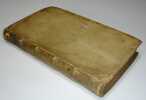
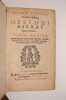
8vo. 2 parts in 1. (XXXVIII),(2 blank),1-204,(2, second title),205-312,(3),(3 blank) p. Vellum 18.5 cm (Ref: STCN ppn 059312521; Hoffmann 2,249; Graesse 3,263; Ebert 9599) (Details: 6 thongs laced through both joints. First title in red and black. Woodcut printer's mark on the title, it depicts Pallas Athena standing in an archway, at her feet the coat of arms of Leiden. Greek text with opposing Latin translation. The second part contains Heinsius' 'Introductio' and his 'notae, emendationes & observationes in Hesiodum') (Condition: Vellum soiled and scratched. Small wormhole in lower margin not affecting the text. Paper yellowing) (Note: Hesiodus from Askra, a small town in Boiotia, born ca. 775 BC, is one of Greek's oldest poets. His poems are in Homeric hexameters and show his interest in ethics and systematization. His work was known throughout antiquity to rhapsodes, scholars and schoolboys. The Byzantines compiled scholia from ancient commentaries for elucidation. The Renaissance did not quite appreciate him. Until 1667 ca. 18 editions of his 'opera omnia' were published, not much. Hesiod's reception chiefly concerns myths and the motifs that he provides, and these motifs certainly appealed to mythographers, historians of religion, poets and painters. 'Hesiodic details of myth saturate European epic and mythopoeic writings, perhaps most spectacular in Dante, Milton, Blake (...) who make much of Hesiod's infernal regions, his Titans and primordial monsters, his giant battles'. (The Classical Tradition, N.Y, 2010, p. 435) Of Hesiod survives his 'Theogonia' or 'Theogony', which 'deals with the origin and genealogy of the gods (...) and the events that led to the kingship of Zeus: the castration of Uranos by Kronos and the overthrow of Kronos and the Titans by the Olympians' (OCD, 2nd ed., p. 510) The 'Works and Days' or 'Erga kai Hêmerai' of Hesiod, which was always most read, has been called a 'gospel of labour'. The poet recommends the hard and honest life of a farmer. He 'inveighs against dishonesty and idleness by turns, using myth (...) parable, allegory and threads of divine anger. (...) The poem as a whole is a unique source for social conditions in early archaic Greece.' (OCD, 2nd ed. p. 511) The third poem that has survived is the 'Shield', or 'Aspis', a short narrative poem on Heracles' fight with Cycnus, a bloodthirsty son of the god Ares. It derives its name from the long description of Heracles' shield. 'Artists have never abandoned a fascination with Hesiod on the Muses. In the 19th century the artist Gustave Moreau created many visual representations of their initiation of the poet. Both Rubens and Goya painted famous and harrowing pictures of Kronos (Saturn) devouring one of his children, a motif from the Theogony; William Blake engraved a series after drawings by his friend John Flaxman (...). Georges Braque chose the 'Theogony' as the subject of 20 etchings'. (The Classical Tradition, N.Y., 2010, p. 436) This edition of Hesiod is a kind of 'editio minor' of the 'editio maior' that was produced by the Dutch classical scholar of Flemish origin Daniel Heinsius, 1580-1655, and which was published ten years earlier in 1603. For this edition in a smaller form he left out the Byzantine scholia (sine veterum interpretatione), and made some corrections in the text and the translation. 'The text is not formed altogether on the preceding editions: where it differs from them, the reason of such difference is given in the notes'. (Dibdin 2,33) Heinsius, who enjoyed an international reputation as an editor of classical texts, theorist of literary criticism, historian and neolatin poet, was professor of Poetics at the University of Leiden from 1603, extraordinarius Greek since 1605. After the death of J.J. Scaliger, to whose inner circle he belonged, he held the chair of Greek, from 1609 till 1647. His activities have been obscured to later generations by the very bulk and variety of his activities. He is still remembered for his neolatin poetry, and for his edition of Aristotle's treatise on poetry (1610), which he studied in connection with the Ars Poetica of Horace. In his pamphlet De tragoediae Constitutione, published in 1611, he deals with all the essential points in Aristotle's treatise, giving proof that he has thoroughly imbibed the author's spirit'. (J.E. Sandys, 'A history of classical scholarship, N.Y. 1964, vol. 2, p. 314)) (Provenance: On the front pastedown in pencil: '25 maart 1958', written by the Flemish linguist Walter Couvreur, 1914-1996, who was an Orientalist, and professor of Indoeuropean linguistics at the University of Gent. It indicates the date of aquisition. The place of acquisition he wrote on the flyleaf at the end: 'Leipzig, Deutsche Buch Export und Import') (Collation: ):( - 2):(8, 3):(4 (leaf 3):( blank); A-V8 (leaf V8 blank)) (Photographs on request)
Hesiodi Ascraei Quae exstant, ex recensione Joannis Georgii Graevii. Cum ejusdem animadversionibus & notis auctioribus. Accedit commentarius nunc primum editus Joannis Clerici, et Notae Variorum, scilicet Josephi Scaligeri, Danielis Heinsii, Francisci Guieti, & Stephani Clerici, ac Danielis Heinsii introductio in doctrinam Operum et Dierum. Nec non index Georgii Pasoris.
Amsterdam (Amstelodami), Apud G. Gallet, praefectum Typographiae Huguetanorum, 1701.
8vo. 2 volumes in 1: (XXVI),351,(1);(VIII),326 p., frontispiece, 2 folding plates. Vellum. 21 cm (Ref: STCN ppn 23618525X; Hoffmann 2,250; Brunet 3,141; Graesse 3,263; Ebert 9604: 'it is scarce and belongs to the series 'cum notis Variorum'; Dibdin 2,35; Moss 1,470/71) (Details: Greek text and parallel Latin translation. Boards with blind stamped decoration. Title printed in red & black. The frontispiece depicts a bucolic scene with group of nymphs, one of them giving a branch of a palm to a shepherd. The plates have as subject the plough and other farmer's tools. Volume 2 contains also 120 pages with extensive notes to Hesiod by Graevius, and the Introduction of 64 pages to the 'Works and Days' by Daniel Heinsius. At the end a 140 page index) (Condition: Vellum soiled. Head & tail of spine somewhat chafed. Upper hinge cracking, but strong. Both pastedowns discoloured and detached. Name erased from the front pastedown, resulting into a small hole. Front flyleaf removed. All 4 decorative fastening ribbons gone. First title slightly finger soiled) (Note: Hesiodus from Askra, a small town in Boiotia, born ca. 775 BC, is one of Greek's oldest poets. His poems are in Homeric hexameters and show his interest in ethics and systematization. His work was known throughout antiquity to rhapsodes, scholars and schoolboys. The Byzantines compiled scholia from ancient commentaries for elucidation. The Renaissance did not quite appreciate him. Until 1667 circa 18 editions of his 'opera omnia' were published, not much. Hesiod's reception chiefly concerns myths and the motifs that he provides, and these motifs certainly appealed to mythographers, historians of religion, poets and painters. 'Hesiodic details of myth saturate European epic and mythopoeic writings, perhaps most spectacular in Dante, Milton, Blake (...) who make much of Hesiod's infernal regions, his Titans and primordial monsters, his giant battles'. (The Classical Tradition, N.Y, 2010, p. 435) Of Hesiod survives his 'Theogonia' or 'Theogony', which 'deals with the origin and genealogy of the gods (...) and the events that led to the kingship of Zeus: the castration of Uranos by Kronos and the overthrow of Kronos and the Titans by the Olympians' (OCD, 2nd ed., p. 510) The 'Works and Days' or 'Erga kai Hêmerai' of Hesiod, which was always most read, has been called a 'gospel of labour'. The poet recommends the hard and honest life of a farmer. He 'inveighs against dishonesty and idleness by turns, using myth (...) parable, allegory and threats of divine anger. (...) The poem as a whole is a unique source for social conditions in early archaic Greece.' (Idem, p. 511) The third poem that has survived is the 'Shield', or 'Aspis', a short narrative poem on Heracles' fight with Cycnus, a bloodthirsty son of the god Ares. It derives its name from the long description of Heracles' shield. 'Artists have never abandoned a fascination with Hesiod on the Muses. In the 19th century the artist Gustave Moreau created many visual representations of their initiation of the poet. Both Rubens and Goya painted famous and harrowing pictures of Kronos (Saturn) devouring one of his children, a motif from the Theogony; William Blake engraved a series after drawings by his friend John Flaxman (...). Georges Braque chose the 'Theogony' as the subject of 20 etchings'. (The Classical Tradition, N.Y., 2010, p. 436) This edition of 1701 is, except for a short 'dedicatio' and 'ad lectorem' at the beginning of volume 1, the work of the Dutch/Swiss scholar Johannes Clericus, or Jean Le Clerc, 1657-1736, mainly a reissue of the Hesiod edition of 1667 that was produced by the Dutch classical scholar of German descent Johann Georg Greffe, better known as Graevius, 1632-1703, professor of Latin at the University of Utrecht during the last forty years of his life. The Hesiod was his only edition of a Greek classic. Graevius limited his attention mainly to writers of Latin prose, and primarily to Cicero. Graevius corrected the text of the 'Works and Days' with the help of two manuscripts owned by Isaac Vossius. One them contained commentary of Tzetzes. From the French scholar Emericus Bigotius he received annotations of J.J. Scaliger and Franciscus Guietus. The first volume contains the Greek text revised by Graevius, and a corrected Latin translation. The second Graevius' own annotations and the observations of Scaliger and Guietus, and the 'Introductio' to the 'Works and Days' of the Dutch scholar Daniel Heinsius)) (Provenance: On the verso of the front flyleaf 'Ex libris H.J. Borgers'. And on the flyleaf in the rear: 'Wilhelmus Henricus Wicherlink 1741, verus hujus libri possessor'. One H.J. Borgers published in 1826 in Leiden a dissertation: 'Specimen Academicum Inaugurale exhibens Recensionem et Interpretationem M. Tullii Ciceronis Paradoxorum ad M. Brutum'. One H.J. Borgers (the same or his father?) retired in 1854 as prorector of the Gymnasium of Nijmegen, where he started his teaching career in 1819. Dr. Willem Hendrik Wicherlinck, 1728-1808, belonged to the elite of the Dutch city of Zwolle. He was a member of the 'Raad van Zwolle' between 1770 and 1795, and a member of 'Gedeputeerde Staten van Overijssel' for Zwolle between 1784 and 1795) (Collation: pi1 (frontispiece), *8 (minus blank leaf *8), 2*6; A-Y8, 2*4, 2A-V8, 2X4 (leaf 2X4 blank) (The catchword on leaf *7 verso regularly connects to the following page **1 recto)) (Photographs on request)
De Werken en Dagen van Hesiodus. Naar het Grieksch in Nederduitsche verzen gevolgd door D.J. van Lennep. Tweede druk.
Amsterdam, Bij P. Meijer Warnars, 1834.
8vo. XX (recte XXII); 62,(2 blank) p., 1 plate. Contemporary boards. 20 cm (Ref: Geerebaert 45,2; OiN p. 199) (Details: Fine copy. Title page completely engraved by the Dutch artist Philippus Velijn. The introduction numbers 20 pages, the Dutch translation in iambic verser 40 pages; notes on pages 41/62) (Collation: *2 (chi 1, the title, inserted between leaf *1 and *2), (2)*8, 1-4/8 (the last leaf, leaf 4/8 blank)) (Photographs on request)
HESIODUS - CORNELIS SCHREVEL - PASOR - / PLUTARQUE - MINELLIUS, Johann - JUNKER, Christian - ISOCRATE
Reference : 99984
Esiodou Askraiou ta euriskomena. Hesiodi Ascraei quae extant, Cum notis, ex probatissimis quibusdam autoribus, brevissimis, selectissimisque. Accedit insuper Pasoris Index, auctior multo hac novissima editione, & multo correctior Opera & studio Cornelii Schrevelii / Plutarchi Chaeronensis peri paid n ato e, seu de puerorum educatione libellus, analysi grammatica, interpretatione simplici ad textum graecum et paraphrasi perspicua ad modum Johannis Minellii, illustratus studio M. Christiani Junckeri / Isocratis attici rhetoris orationes tres I. ad Demonicvm II. ad Nicoclem III. quas inscribitur Nicocles, Analysi Grammatica, interpretatione simplici ad textvm graecvm, & paraphrasi perspicva ad modum Johannis Minellii illustratae studio M. Christiani Ivnckeri.
Lipsiae (Leipzig), Sumptibus Jacobi Fritschii, 1703-1704, 1 volume in-12, (8) ff. (titre en rouge et noir, lectori, vita, epigrammata), 384 pages-(7) ff. (titre en rouge et noir, lectori), 381 pages, (1) f., 1 feuillet blanc, plein vélin crème avec titre manuscrit sur le dos, tranches gris ardoise. Petit manque de papier dans un coin de la page de titre, rares petites rousseurs, traces grises sur la couverture sinon bon état.Grec-latin
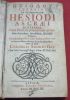
Les Travaux et les jours - Le Bouclier d'Héraclès - La Théogonie. Merci de nous contacter à l'avance si vous souhaitez consulter une référence au sein de notre librairie.
Esiodou Askraiou ta euriskomena. Hesiodi Ascraei quae extant, Cum notis, ex probatissimis quibusdam autoribus, brevissimis, selectissimisque. Accedit insuper Pasoris Index, auctior multo hac novissima editione, & multo correctior Opera & studio Cornelii Schrevelii.
Lugd. Batavorum (Leyde), Typis Francisci Hackii (Franciscus Hackius), 1650, 1 volume in-12 de 155x100 mm environ, 3 feuillets blancs, (8) ff. (titre en rouge et noir, lectori, vita, epigrammata), 346 pages, 6 feuillets blancs, plein vélin crème à recouvrements, avec titre date et lieu manuscrits sur le dos, tranches rouges. Une tache sur la page de titre, quelques rousseurs, des initiales et un nom manuscrits sur les gardes blanches, dernière garde blanche en partie décollée, sinon bon état.Grec-latin
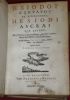
Les Travaux et les jours - Le Bouclier d'Héraclès - La Théogonie. Merci de nous contacter à l'avance si vous souhaitez consulter une référence au sein de notre librairie.
Hésiode. Texte établi et traduit par P. Mazon.
Paris, Les Belles Lettres, 1951.
Wrappers. (Budé)
Hésiode. Texte établi et traduit par P. MAZON.
Paris, Les Belles Lettres, 1960.
Wrappers. 20 cm (Budé)
Carmina. Recensuit A. RZACH. Editio IIIa. Accedit certamen quod dicitur Homeri et Hesiodi.
Leipzig, Teubner, 1913.
VI,273 p. Hardbound. 17 cm (BT, Bibliotheca Teubneriana)
Sämtliche Werke. Deutsch von Thassilo von Scheffer. Mit einer Übersetzung der Bruchstücke aus den Frauenkatalogen herausgegeben von Ernst Günther Schmidt.
Leipzig, Dieterich, 1965.
183 p. Cloth. 17 cm. (German translation only) (Backcover slightly spotted)
Works and days. Edited by T.A. SINCLAIR.
Ldn., MacMillan, 1932.
66,96 p. Cl. 22 cm) (Coffee stain in the upper margin of 2 leaves)
Works and days. Edited by T.A. Sinclair.
Hildesheim, Olms, 1966.
LXVI,96 p. Paperback 22 cm (Repr. edition London 1932) (Cover decently plasticized)
Werke und Tage. Griechisch und Deutsch. (Übertr. von H. VON DEN STEINEN).
Mainz, Mainzer Presse, 1930.
(97 p.) H.cl. 28 cm (Back sl. worn; name on front flyleaf erased)
Hesiodi Catalogi, sive Eoearum fragmenta. Collegit, disposuit, critica commentatione instruxit Augustus Traversa.
Napoli, Libreria Scientifica Editrice, (1951).
208 p. Boards. 23.5 cm (Collana di Studi Greci, 21) (Rebound)
Fragmenta Hesiodea. Ediderunt R. MERKELBACH et M.L. WEST.
Oxf., Clarendon Press, 1967.
XI,236 p., 5 pls. Cl. 22 cm (Frontcover sl. spotted)
Hésiode et Persès.
Amsterdam, NHUM, 1957.
14 p. Stiff wrappers. 24 cm (Mededelingen der KNAW)
Hésiode et la tradition orale. Contribution à l'étude du style formulaire.
Leiden, E.J. Brill, 1957.
31 p. Wrappers. 24 cm (Offprint Mnemosyne, Series IV, vol. X, 1957)
[Ex Officina Plantiniana Raphelengii] - HESIODUS ; (HEINSIUS, Daniel) ; [ HESIODE ; HESIOD ]
Reference : 65709
(1603)
Hesiodou Askraiou ta heuriskomena. Hesiodi Ascraei quae extant, Cum Graecis Scholiis, Procli, Moschopuli, Tzetzae, in Erga kai Hemeras : Io. Diaconi & incerti in reliqua. Accessit liber singularis, in quo doctrina Ergon kai Hemeron, eiusque institutum, contra opinionem, quae obinuit, ostenditur ; Item Notae, emendationes, observationes & Index copiosissimus in Hesiodum eiusque Interpretes ; Opera & studio Danielis Heinsii [ Suivi de : ] Danielis Heinsii Introductio in doctrinam, quae libris Hesiodi Ergon kai Hemeron continetur [ ...]
1 vol. in-4 (21,8 x 15,6 en marges) reliure XVIIe plein veau marbré, dos à 5 nerfs orné, triple filet doré d'encadrement en plats, coupes et chasses ornées, Ex Officina Plantiniana Raphelengii, s.l. [Leyde - Leiden ], 1603, 22 ff., 329 pp., 1 f. blanc, 159 pp.
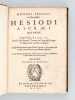
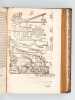
Selon Schweiger, "Heins. folgt der Basler Ausg., weicht aber haufig davon ab" ("Hensius suit l'édition bâloise, mais s'en écarte souvent"). A propos de cette même édition par Heinsius des oeuvres d'Hésiode (né à Ascra en Béotie), et contenant les scholies de Proclus et des commentateurs byzantins Manuel Moschopoulos (élève de Maxime Planude) et Jean Tzetzes, Graesse parle d'une "édition estimée". Bon état pour cette belle édition, ornée d'une belle gravure dans le texte (instruments aratoires). Notre exemplaire est enrichi de quelques annotations manuscrites marginales de l'époque (reliure un peu frottée avec petits mq. en mors, plats et coiffes, bon exemplaire par ailleurs, ex-libris en garde). According to Schweiger, "Heins. folgt der Basler Ausg., weicht aber haufig davon ab" ("Hensius follows the Basel edition, but often deviates from it"). About this same edition by Heinsius of the works of Hesiod (born in Ascra in Boeotia), containing the scholia of Proclus and the Byzantine commentators Manuel Moschopoulos (student of Maxime Planude) and Jean Tzetzès, Graesse speaks of an "esteemed edition ". Good condition for this beautiful edition, decorated with a beautiful engraving in the text (farm implements). Our copy is enriched with some marginal handwritten annotations from the period (slightly rubbed binding with small lacks on joints and cover, good copy otherwise, ex-libris). Graesse, III, 263 ; Schweiger, 143.
HESIODUS. - GOETTLINGIUS, Carolus. - JACOBS, Friderico. - ROST, Val. Chr. Fr.
Reference : 104095
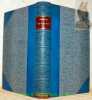
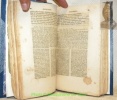
Hesiodi Carmina. Recensuit et commentariis instruxit Carolus Goettlingius. Edition Altera. Bibliotheca Graeca virorum doctorum opera recognita et commentariis instructa curantibus Friderico Jacobs et Val. Chr. Fr. Rost. A. Poetarum, Vol. V. contiens Hesiodi Carmina ed. Carolor Goettlingio. Edition Altera.
Gothae - Londini, Sumptibus Fridericae Hennings - Apud D. Nutt. 1843, 235x140mm, LXXXIV - 395pages, texte en grec ancien et latin. Reliure demi-basane bleue à coins. Pièces rouge de titre, d’auteur et de date d’édition dorés au dos à nerfs. Fleurons à froid au dos. Plats percaline. Couverture supérieure conservée - avec des déchirures sur le bords. Rousseurs marginales et éparses seulement sur les premières et dernières pages.
Pour un paiement via PayPal, veuillez nous en faire la demande et nous vous enverrons une facture PayPal
HESIODI CARMINA
B. G. Teubner, Leipzig. 1878. In-8. Relié demi-cuir. Bon état, Couv. convenable, Dos fané, Intérieur acceptable. 444 pages. Texte en grec ancien et Notes en latin (sur 2 colonnes). Titre et filets dorés sur le dos. Etiquette de code sur la couverture. Quelques tampons de bibliothèque. Dos insolé.. . . . Classification Dewey : 480-Langues helléniques. Grec
Recensuit et Commentariis Instruxit Carolus Goettlingius. Editio Tertia quam Curavit Ioannes Flach. Classification Dewey : 480-Langues helléniques. Grec



