 Write to the booksellers
80 books for « herodotus »Edit
-
Language
English (1)
French (77)
Greek (1)
Russian (1)
-
Century
16th (2)
18th (1)
19th (2)
21st (1)
-
Topics
English (2)
Greek (57)
History (12)
Latin (55)
Linguistics (1)
Protestantism (1)
Religions (1)
Stork (4)
-
Countries
Denmark (2)
France (6)
Greece (2)
Netherlands (69)
United States of America (1)
-
Syndicate
ILAB (7)
SLAM (3)
Les neuf livres des Histoires. Plus un recueil de George Gemiste dict Plethon, des choses auenues depuis la iournée de Mantinée. Le tout traduit de Grec en Francais par Pierre Salia. - [THE MONUMENTAL FIRST FRENCH EDITION OF THE HISTORIES OF HERODOTUS]
Paris, Iean Roigny, 1556. Folio. In contemporary linp vellum, with three (of four) of the original vellum ties. Binding with wear and inner hinge weak, but in completely original state, with no restorations. Only some light scattered brownspotting and a worm-tract to inner margin, just occasionally touching a few letters. Book-plate to pasted-down front end-paper. A lovely copy. (4), CCXLIII ff.
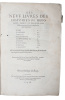
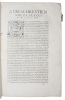
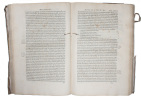
The scarce first edition of Saliat's translation of the complete Histories of Herodotus, being the extremely popular first French edition and arguably the most important French edition of the work ever published. Saliat's monumental 1556-translation of Herodutus was extremely influential end widely used and quoted. It greatly influenced the way that Herodotus was used and understood in Renaissance France. It was used by virtually all contemporary French intellectuals as the main reference - as for instance Sandys points out, it is from this that all of Montaigne's Herodotus-quotations are taken (Sandys, vol. II, p. 197). Pierre Saliat had published a small work in 1552 consisting the the first three books of Herodotus, and in 1556, his monumental translation of the complete work appeared" for the first time, all nine books were accessible in the French language. ""Little is known of Saliat's life except that he had produced two previous translations from Latin, Erasmus' ""On Methods of Instructing Children"" and a collection of Roman speeches. Both translations of Herdotus are dedicated to the king, Henry II, and Saliat notes that the work on the first three books had taken him six years to complete and that it had taken him a further five years to translate the remaining six books. In the preface to the 1556 translation, Saliat compares at length the scale and grandeur of the Persian Wars with Henry's recent invasion of Germany. Henry's deeds are portrayed as greater than those described by Herodotus... [The preface] reads as a salutary encomium of Henry's military and political prowess."" (Brill's Companion to the Reception of Herodotus in Antiquity and Beyond, p. 127). In short, Saliat views Herodotus' work as a manual for or collection of examples of warfare that is fully transferable to other times, rather than a mere memoralization of great deeds. Graesse: III:256.

Herodoti Halicarnassei Historiae libri IX: et de vita Homeri libellus. Illi ex interpretatione Laurentio Vallae adscripta, hic ex interpretatione Conradi Heresbachii; utraque ab Henr. Stephano recognita. Ex Ctesia excerptae historiae. Apologia Henr. Stephani pro Herodoto. Accedit in hac editione Spicilegium Frid. Sylburgii, ad Henr. Stephanum virum clariss.
Frankfurt (Francofurti), Apud haeredes Andreae Wecheli, 1584.
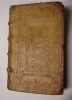
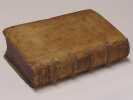
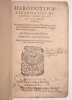
8vo. LXXII,592,(88) p. Pigskin 18.5 cm (Ref: VD16 H 2515. Weitere Nummern: VD16 C 6157, VD16 E 4005, VD16 H 2533; Hoffmann 2,236; Graesse 3,256; Ebert 9560, but see also 9542) (Details: Latin translation only. The binding of this book is important in the context of the cultural history of Lutheranism. The binding dates from the last 2 decades of the 16th century. The back has 4 raised bands. The boards are decorated with blind stamped triple fillet borders and a row consisting of floral motives and some tiny portraits. The central panel of the upper board shows a fine example of a well preserved portrait of Johann Friedrich I, the Magnanimous (der Grossmüthige), Elector of Saxony (Kurfürst und Herzog von Sachsen), 1503-1554, in full armour, with 3 lines of text at the bottom: 'Victus eras acie, fidei con / stantia tandem victorem / ante homines fecit et ante deum'; on the lower board the blindstamped impressive and also well preserved coat of arms of this Elector of Saxony, who became after his death a kind of protestant Saint. He still is, for the 3rd of March, the day he died, is still commemorated in the evangelical church of Germany. Because the portrait of this nobleman also figures on a book held in the Penn Libraries, where it is described as 'Elector of Saxony, possibly August I, 1526-1586' (Cicero, Philosophical works, 1565, copy in Rare Book & Manuscript Library, Call no.: LatC C4855.10 1565), we will investigate this in some detail. Johann Friedrich I was an ardent follower of Martin Luther, with whom he corresponded. He was a lifelong promotor of the reformatory movement, and one of the movement's most important political leaders. Johann Friedrich was defeated and taken prisoner on the 24th of april 1547 by troops of the emperor Charles V in the neighbourhood of Mühlberg (battle of Mühlberg), 'mannhaft fechtend, am Backen verwundet'. (On this wound on the cheek and the resulting scar, see below) On the 10th of May he was sentenced to death. This sentence was not carried out. Johann Friedrich had however to abdicate, but he refused to be converted to Catholicism. In captivity his political role came to an end, but in prison he became a protestant Saint. 'Mit diesem jähen Sturzen, war Johann Friedrichs politische Rolle zu Ende. Nicht aber seine politische Bedeutung für das evangelische Deutschland. Die heitere Ruhe mit dem er sein Unglück hinnahm, die Unerschütterlichkeit seiner religiösen Überzeugung (...) machten ihn zum leuchtende Vorbilde seiner Glaubensgenossen (...)'. Charles V tried to force him to accept catholicism, he humiliated him, but 'Alles, erklärte er (J.Fr.), habe er bisher hintangesetzt, um das Wort Gottes lauter und rein zu erhalten. Obwohl er bereits Alles verloren und ein armer Gefangener geworden, solle ihn doch Gott davor behüten, dass er nun zu letzt noch davon abweichen, die erkannte Wahrheit verleugnen, und das Papstthum annehmen solle'. The duke was released in 1552, and his way home was a real triumph. 'Die Heimkehr des fürstlichen Martyrers über Nürnberg und Bamberg glich einem Triumphzuge; wohin er kam, strömte das Volk ihm entgegen. (...) Zu Jena empfingen ihn Professoren und Studenten der neubegründeten Universität'. (...) Melanchthon wrote after his death: 'Die Bekenntniss und Beständigkeit Herzog Johann Friedrichs, hat unsere Kirche mehr gefrommt, als vielleicht die Victoria hat dienen mögen'. (German quotations: ADB 14 p.326/330) In 1551 Matthes Gebel made a medal with the portrait of a bearded duke, with a clearly visible scar on his left cheek. There is also an engraved portrait with a scar made in 1547, the year of the battle of Mühlberg. This scar on the left cheek, which is apparantly part of the iconography of the Duke, is also clearly visible on the blindstamped portrait on the front of this book. So our conclusion must be that this portrait belongs to Johann Friedrich I. The coat of arms on the backcover was made after an engraving of Lucas Cranach, a friend of Johann Friedrich. In Jena there is a statue of Johann Friedrich, the socalled 'Hanfried-Denkmal' to commemorate the founding of the University in 1558, of which Johann Friedrich had been the driving force. The 'Deutsches Historisches Museum' holds a number of paintings (1630), which depict the life of this protestant Saint in 28 scenes. Wechel's woodcut printer's mark on the title, depicting the winged horse Pegasus gracefully arched over a caduceus and 2 intertwined cornucopiae) (Condition: Cover soiled and worn at the extremities. Some damage to the head and tail of the back, and to the upper board. Corners heavily bumped. 2 old ownership inscriptions on the title. Small inscription with references to Cicero on the front pastedown. Small inscription on the verso of the title. Occasional old red ink underlinings. Occasional marginalia in the Apologia, probably made by Christoph Richter (see below) (Note: This book is a reissue of a revised Latin translation of Herodotus' 'Historiae', made by Lorenzo Valla, and published by the French humanist/scholar Henri Estienne, or in Latin Henricus Stephanus, in Geneva in 1566. Stephanus plays an important role in the history of the reception of Herodotus. In 1474 the Latin translation of Valla was first published. 1502 saw the 'editio princeps' of the Greek text. In the same time the work of the detractors and critics of this Greek historian came on the market, especially Plutarch's 'De Herodoti malignitate' (1509), but also works of Aristotle (Herodotus is ignorant), Flavius Josephus (he is a liar), Strabo (he likes to tell simple stories), Lucianus (does not tell the truth), Gellius (he invents stories). The supporters of Herodotus were in the minority. We only mention Cicero, who called him 'Pater historiae'. When Henri Estienne was planning to publish a new revised Latin translation of Herodotus, he decided to try his talents as a critic on Herodotus, and wrote in his defence his 'Apologia pro Herodoto', to accompany this revised translation, which was published by him in Geneva in 1566. This treatise is full of philological niceties and Latin and Greek quotations, to be read by a humanist forum. (See 'Henrici Stephani Apologia pro Herodoto. Henri Estienne, Apologie für Herodot, nach der Erstausgabe (Genf 1566) herausgegeben und übersetzt von Johannes Kramer', Meisenheim am Glan, Hain, 1980, p. VII. A copy of this book is sold together with this 1584 edition) In the introductory letter of the German classical scholar Fredericus Sylburg we are told, that this 1584 reissue was published, no, not for the money, but because there arose a demand for a Latin translation of Herodotus from Eastern Europe ('e Pannonia superiore, Boiemia, & aliis quibusdam locis', leaf a2 recto). It was brought on the market, not to compete with the folio edition of 1566, but for people who could not afford such an expensive book, and prefered a smaller and cheaper edition ('nostra vero tenuioris fortunae hominibus', leaf a2 recto). Sylburg added, he says, occasional marginal notes to the text of his own and other scholars) (Provenance: The provenance theme of this book is Saxonian and Lutheran. 1: An old and long inscription written on the front flyleaf: 'Tout avec Dieu. Pour temoigner ma tres bonne amitie et affection, que je porte a Monsr. Jean Trölschen, je luy ay donne ceste livre priant de le prandre a bon gre, et deme(u)rant jusque au tombeau, Son bien humble et bien affectione serviteur M. Jean Ernst Gerard Jenensis'. There are two Lutheran theologians bearing the name 'Johannes Ernst Gerhard', father (1621-1668) and son (1662-1707). Both were born and educated in Jena. The Father was appointed professor 'Historiarum' in Jena in 1652, his son taught theology in Jena, and became professor in Giessen in 1700. (ADB 8,772) Who the receiver 'Jean', or 'Johannes' or 'Hans Trölschen' was, we could not find out. 2: On the title in old ink 'Ex libris M. Johann Rolle .... Vicar'. 3: Below the imprint an old ink inscription: 'Sum ex libris Christoph. Richteri Altenburg', continued with a verse from the New Testament in Greek: 'Hêmôn gar to politeuma en ouranois huparchei', 'For our converstation is in heaven' (Ep. ad Ephesios 3,20). Christoph Richter, 'Altenburger Baumeister', was the architect of the 'Gottsackerkirche zur Auferstehung Christi' in Altenburg. This Lutheran church was built in late renaissance style between 1639-1650. (See the 'Liste der Kirchen im Altenburger Land' in Wikipedia) 4: Old ink inscription on the blank lower margin of the verso of the title: 'Hunc librum dono accepi a Dn. N. (Joh. erased) Christ. Ungewittero, ut monumentum aeternae suae benevolentiae, J.W. Riedesel'. This might be the Hessian protestant theologian Christoph Ungewitter, 1681-1756, who was 'Hofprediger' of the 'Landgraf' of Kassel. (ADB 39/303) The receiver of this book may be the jurist and diplomat 'Johann Wilhelm Freiherr von Riedesel zu Eisenbach', 1705-1782, of Hessian nobility. (NDB 21,570-72) He was 'Reichskammergerichtsassessor' in Wetzlar. (Much on him is to be found in: 'Reichspersonal, Funktionsträger für Kaiser und Reich', edited by A. Baumann, Köln, 2003). 5: On the front flyleaf in pencil '27 december 1960', written by the Flemish linguist Walter Couvreur, 1914-1996, professor of Indoeuropean linguistics at the University of Gent. The place of acquisition he wrote on the flyleaf at the end: 'Frankfurt, Mineur') (Collation: alpha-delta8, eta4; a-z8, A-T8, V4 (leaf V3 missigned V2)) (Photographs on request)
Herodotus, History. Selected pages / Istoriya. Izbrannye stranicy. In Russian
In Russian. Short description: Herodotus, History. Selected pages [ Istoriya. Izbrannye stranicy ] Saint Petersburg: Amphora, 1999. Please feel free to contact us for a detailed description of the copies available. SKU lom-SK001398
Reading Herodotus. A study of the logoi in Book 5 of Herodotus' Histories.
Cambridge, Cambridge University Press, 2007.
XV,343 p. Hardback. 23.5 cm (Including dustjacket)
Herodotus lacht.
Amsterdam, Uitgeversbedrijf 'De Spiegel', 1953.
115 p. Cloth 25 cm (Including slightly worn dustjacket; some stories of Herodotus retold)
Herodotus Historiën. Patronen en historische werkelijkheid bij Herodotus.
Amsterdam, Hakkert, 1976.
IX,117;161p. Wrappers. 22 cm (Dissertation)
Herodotus Historiën. Patronen en historische werkelijkheid bij Herodotus.
Amsterdam., Hakkert, 1976.
IX,117;161p. Wrappers. (Dissertation) (Three small coffeestains on frontcover)
Herodotus Translated by George Rawlinson and Edited by Manuel Komroff
Reference : AM7737
ISBN : B00085DB62
The History of Herodotus [Hardcover] Herodotus Translated by George Rawlinson and Edited by Manuel Komroff
RELIE. 544 PAGES. EDITION DE 1933. PATRONYME A L4ENCRE PAGE DE GARDE. DOS INSOLE. PHOTOS SUR DEMANDE
Merci de nous contacter à l'avance si vous souhaitez consulter une référence dans notre boutique à Authon-du-Perche.
A commentary on Herodotus, with introduction and appendixes by W.W. How and J. Wells.
Oxford, Clarendon Press, 1928.
2 volumes: XII,456; VIII,444 p. Cloth. 19 cm
A commentary on Herodotus, with introduction and appendixes by W.W. How and J. Wells.
Oxford, Clarendon Press, 1957.
2 volumes: XII,456; VIII,444 p. Cloth. 19 cm (Backs faded; front flyleaves removed; small stain on fore edge of volume 1)
Herodotus. (Transl.) by G.C. SWAYNE.
Edinburgh, Ldn., Blackwood, 1880.
(VI),180 p. Cl. 17 cm (Anthology)(Ancient classics for English readers)(Cover worn at extremities)
Notes on Herodotus, original and selected from the best commentators. 2nd edition with numerous additions and corrections by D.W. TURNER.
Lnd., Bell, 1882.
XXIV,472 p. Cl. 19 cm (Worn at extremities)
Een studie over enige archaische elementen in de stijl van Herodotus.
Meppel, Giethoorn, Huisman, 1975.
108 p. Wrappers 22 cm (Diss.)
Een studie over enige archaische elementen in de stijl van Herodotus.
Meppel, Giethoorn, Huisman, 1975.
108 p. Wrs. 22 cm (Diss.)(Feltpen markings on 24 p.; ballp. underl. on 6 p.)
Religieus-historische studie over Herodotus.
Antw., Nijmegen, Standaardboekhandel, Dekker & v.d.Vegt, 1946.
202 p. Wrs. (Diss.)
Religieus-historische studie over Herodotus.
Antw., Nijmegen, Standaardboekhandel, Dekker & v.d.Vegt, 1946.
202 p. Wrs. (Diss.)
Religieus-historische studie over Herodotus.
Antw., Nijmegen, Standaardboekhandel, Dekker & v.d.Vegt, 1946.
202 p. Wrs. (Diss.) (Back worn)
Religieus-historische studie over Herodotus.
Antwerpen, Nijmegen, Standaardboekhandel, Dekker & v.d.Vegt, 1946.
202 p. Boards. 24 cm (Dissertation)
Actio, aspect en het werkwoord. De temporele zinskonstrukties in het werk van Herodotus.
N.pl., 1980.
192 p. Wrappers. 29 cm (Dissertation, Leiden) (Summary in English, cyclostyled) (Cover somewhat soiled and slightly worn)
Tijdschrift voor Nederlandse classici. Jaargang 20 (1987), nr. 3: themanummer Herodotus.
Muiderberg, Coutinho, 1987.
ca. 130 p. Wrappers. 23 cm (Articles by W.J. van der Dussen, Sancisi-Weerdenburg, G.L.M. Schreiner, Singor, Van Hooff, M. van der Poel) (Slightly worn)

