 Write to the booksellers
8793 books for « hans h »Edit
-
Type
Autograph (2)
Book (8714)
Engraving (5)
Magazine (1)
Music sheets (67)
New book (4)
-
Latest
Last 3 days (3)
Last month (144)
Last week (11)
-
Language
Dutch (37)
English (26)
French (8536)
German (56)
Japanese (1)
Russian (136)
Swedish (1)
-
Century
16th (9)
17th (22)
18th (62)
19th (154)
20th (4006)
21st (383)
-
Countries
Belgium (1099)
Canada (38)
China (2)
Côte d'Ivoire (31)
Denmark (257)
France (5231)
Germany (5)
Greece (9)
Switzerland (1969)
United Kingdom (16)
United States of America (136)
-
Syndicate
ALAC (36)
CLAM (78)
CLAQ (12)
CNE (9)
ILAB (4246)
NVVA (640)
SLACES (640)
SLAM (2720)
SNCAO (4)
Topics
- Alps (64)
- Alsace (105)
- Andersen hans christian (564)
- Animals (24)
- Antwerp (21)
- Archaeology (103)
- Architecture (329)
- Army (76)
- Asia - orient (21)
- Austria (45)
- Autographs (23)
- Basel (39)
- Baumann hans (25)
- Belgium (84)
- Bellmer (144)
- Bible (22)
- Bibliography (32)
- Bibliophilism (27)
- Biography (54)
- Carossa hans (26)
- Children’s books (139)
- Christianity (25)
- Churches (19)
- Comic strip (28)
- Curiosa (31)
- Drawings (38)
- Economics (63)
- Egypt (23)
- Engraving (books about) (21)
- Engravings (45)
- Erni hans (30)
- Esotericism (19)
- Ethnology (32)
- Europe (23)
- Fallada hans (54)
- Fine arts (184)
- First edition (83)
- Genealogy (25)
- Geography (76)
- Geology (49)
- German literature (37)
- Germanic languages (671)
- Germany (182)
- Graphic art (49)
- Guide books (29)
- Habe hans (24)
- Haug hans (33)
- Helvética (519)
- Herlin hans (26)
- History (509)
- Holbein (54)
- Illustrated books (35)
- Industrial arts & crafts - fine arts (70)
- Ink (30)
- Jacob (26)
- Kirst hans hellmut (89)
- Kluber hans (31)
- Küng hans (65)
- Law (50)
- Legends (28)
- Linguistics (31)
- Literature (392)
- Medicine (80)
- Military arts (34)
- Mountaineering climbing (19)
- Music (53)
- Navy (43)
- Painters (33)
- Painting (38)
- Painting (118)
- Philology (38)
- Philosophy (138)
- Photography (121)
- Poetry (50)
- Policy (29)
- Psychology (27)
- Regionalism (20)
- Religions (97)
- Review (51)
- Scandinavian (22)
- Sciences (132)
- Scores (93)
- Sculpture (38)
- Sociology (29)
- Songs (62)
- Surrealism (55)
- Switzerland (495)
- Tales (96)
- Tea (33)
- Theatre (35)
- Theology (86)
- Travel (32)
- Travels & tourism (20)
- Various (41)
- War (150)
- Youth (55)
- Zoology (19)
- Zurich (77)
Histoire d'un remède très-efficace pour la foiblesse et pour la rougeur des yeux, et autres maladies du mesme organe. Avec un remède infaillible contre la morsure du chien enragé. Traduits de l'Anglois & enrichie [sic] de notespar M. Cantwel (...)
Paris Prault fils 1746 petit in-8 broché sous couverture d'attente de papier crème
4 ff.n.ch., pp. 9-32, une planche hors texte.Première édition de la traduction française de An Account of a medicine for soreness, weakness and other distempers of the eyes (Londres, 1745)Il s'agit en fait de l'unique opuscule médical du docteur anglo-irlandais Hans Sloane (1660-1753), plus connu pour son volumineux Voyage to the islands Madera, Barbados, Nieves, S. Christopher and Jamaica (1705), essentiellement centré sur l'histoire naturelle et qui se réfère à un séjour effectué en 1687-1688 comme médecin du duc d'Albermale, gouverneur de la colonie

La Cocaïne. Histoire. - Pathologie. - Clinique. - Thérapeutique. - Défense sociale. Traduction de S. Jankélévitch revue par l'auteur. Avec 5 figures dans le texte et 17 hors texte
Paris Payot 1928 in-8 broché, non coupé
2 ff.n.ch., pp. 8-493, un f.n.ch. de table, figures dans le texte et 6 planches hors texte.Première traduction française. Psychiatre suisse, Hans Wolfgang Maier (1882-1945) fit presque toute sa carrière dans la clinique psychiatrique du Burghölzlià Zurich."Les travaux préparatoires d'où ce livre est sorti remontent à l'année 1916, alors que les premiers cas de cocaïnomanie par inhalation nasale ont commencé à être observés un peu partout en Suisse"
Eine Weltreise. Plaudereien aus einer zweijährigen Erdumsegelung. Mit 120 Abbildungen und Plänen, einer Erdkarte und einem Anhang : "Die Igorroten". Neuer Abdruck
Leipzig-Vienne Verlag des bibliographischen Instituts 1890 in-8 percaline verte de l'éditeur, dos et plat supérieur ornés d'un décor noir et or, tranches marbrées
544 pp., illustrations en noir dans le texte, une carte en couleurs à double page hors texte.Au CCF, exemplaires seulement à la BnF et Strasbourg (pour l'édition originale de 1885). Le géographe Hans Meyer (1858-1925) était à la fois un explorateur et le fondateur de la maison d'édition qui publiait ses ouvrages. Cette relation d'une circumnavigation qui dura de 1881 à 1883 forme le plus connu de ses livres
A truly splendid and unique collection of 23 Hans Christian Andersen-items that together tell the true story of Andersen's life and sheds light on all aspects of his life and work. The collection is divided into the following (full descriptions belo... - [MAGNIFICENT HANS CHRISTIAN ANDERSEN-COLLECTION]
(1822) - 1872.
With the present Hans Christian Andersen-collection, we have aimed not at an exhaustive collection of ALL of his many writings nor at a LARGE collection, but at an exquisite, chosen collection that tells us the true story of Andersen's life. A collection that enlightens us about both the author and the man Hans Christian Andersen and that sheds light on all aspects of his life and work. A collection that epitomizes quality, scope, and importance, not merely numbers of items nor works that are not particularly important in his life's work. Every one of the 23 items in the present collection has been carefully chosen to represent a certain Aspect of Hans Christian Andersen at a certain time of his life, in an attempt to get as close to the great fairy tale author as possible. The items basically span his entire career - from his first book, published at the age of 17 (and only known in about 10 copies) to an original manuscript poem by the ageing author at the age of 67. The 23 carefully chosen and unique items cover his earliest publications that are of extreme scarcity, his three seminal fairy tale cycles that catapulted him into fame and created the genre of the fairy tale, for which he is now famous world-wide, five magnificent presentation-copies (among them an absolutely magnificent copy of his very first fairy tale, one of the best presentation-copies known) that each give us an insight into the poet Andersen and into his circle of friends, six splendid original letters that are all different in style and content and written from all over the world (among them one of the extremely rare letters known by him written in English, in Latin hand), an original manuscript, which is an extreme scarcity on private hands and something one may never come by again, two books from Andersen's own library, which is extremely rare to find, as only 75 such books are known and almost all of them are in institutional holdings, and finally the three main translations that ensured his fame in the rest of the world: the most important translations into German, English, and French respectively. The collection is divided into the following seven categories, and below follows a short preview and introduction to each. Upon request, a document with full, elaborate descriptions of each item will be provided. 1. Debuts/earliest publications (see also 3.1.)2. The three fairy tale collections/cycles3. Presentation-copies (see also: 2.3.)4. Letters5. Manuscript6. Books from Andersen's library7. The three main translations1. Debuts/earliest publications1.1. Ungdoms-Forsøg / Gjenfærdet ved Palnatokes Grav, en Original Fortælling" og Alfsol, en original Tragoedie. Ungdoms=Forsøg. Kjöbenhavn, [1822]. The extremely rare first printing of Hans Christian Andersen's first book - with facsimiles of the title-page, the contents-leaf and a further four leaves. The book is exceedingly rare. A title-issue appeared in 1827. No more than about ten copies in all of both the first issue and the title-issue are known to exist - only a couple of them are known in private collections, and less than a handful of copies are known outside of Denmark. The present publication, his first book, is of immense importance to Andersen's life and work and is arguably THE most important piece of Anderseniana. 1.2. Ved min Velgører Provst Gutfelds Død. Slagelse, 1823.The extremely rare first printing of the 1823-issues of this slightly obscure newspaper, which contains Hans Christian Andersen's third publication. This exceedingly rare piece of Anderseniana was published when the master of the fairy tale genre was merely 17 years old, namely in February 1823. The present publication constitutes one of the two pieces of publication that are at the epicentre of the coming-to-be of the greatest poet and author to emerge from Danish soil. This little piece is a heartfelt, almost perfectly stylized poem that constitutes an obituary of Hans Christian Andersen's early benefactor, Gutfeld, who was responsible for Collin accepting to be Andersen's benefactor. It was due to Gutfeld and his belief in Andersen that he made it on into the world and was taken seriously enough - at the mere age of 17 - to later be allowed to follow his heart and his life dream - that of writing.1.3. Fodreise fra Holmens Canal til Østpynten af Amager i Aarene 1828 og 1829. Kjöbenhavn, 1829. The rare first edition of Hans Christian Andersen's debut novel, ""Journey on Foot"", here in the extremely scarce original printed wrappers. Andersen himself considered this book his debut and refers to it as ""my first publication"". It came to play a tremendous role in the development of his writing and constitutes one of his most important works. It is the first piece of Andersen that yields any success and the first work for which he gained any recognition. ""It is a well-known fact that Hans Christian Andersen made his début as a writer three times during his youth. The first time he published a book was in 1822, when ""Youthful Attempts"" came out... He was 17 years old, penniless and in need for help, but the main part of the circulation ended up in the paper mill... The second time he made his début was in 1829, when he published ""Journey on Foot from Holmen's Canal to the Eastern Point of Amager"", a book which can hardly be classified as a travel book.. it seems a subtle and humorous arabesque and a literary satire. This book was published in the year after he had left grammar-school and was qualifying for the entrance examination to academic studies at the university. It can rightly be regarded as a key, which enables us to understand the entire development of his later production...2. The three fairy tale-collections2.1. Eventyr fortalte for Børn. (1.-3. Hefte) + Eventyr fortalte for Børn. Ny Samling (1.-3. Hefte). 2 Bind. Kjöbenhavn, 1835-1847. A lovely set of this exceedingly rare collection of Andersen's earliest fairy tales. This legendary fairy tale-collection that created the fairy tale-genre and brought Andersen international fame, consists in six parts that together make up two volumes. As with most of the other few existing copies, the present set is a mixture of issues and likewise has certain wants concerning title-pages, half-titles and tables of contents. ""During Andersen's lifetime 162 of his Fairy Tales were published, but the scarcest and most difficult to obtain are these six little pamphlets. We do not know exactly how many, or how few, copies were printed, but we do know that no copy with all the title pages and tables of contents has ever been offered for sale.""2.2. Nye Eventyr. 2 Bind (5 samlinger). Kjøbenhavn, 1844 - 48.First edition of Hans Christian Andersen's seminal second collection of fairy tales - the publication that made him internationally famous - with all five collections in first issue, also the first, which is of the utmost rarity. It is in this legendary first collection that we find the first printing of ""The Ugly Duckling""(not as is indicated in PMM in his first). The rarity of the first issue of volume 1, collection 1 is legendary. It was published on November 11th 1843 (dated 1844 on the title-page) in a very small number, probably due to the poor sales of Andersen's first fairy tale collection. Against all belief, this first collection sold out within a few days, catapulting Andersen into worldwide fame, and a second issue was published already on December 21st 1843. Thus, only very few copies of the first issue exist, and almost all collections of the ""New fairy Tales"" are bound with the second issue or the third of 1847, meaning that they do not contain the actual first printing of ""The Ugly Duckling"", ""The Nightingale"", ""The Angel"", and ""The Sweethearts"". 2.3. Nye Eventyr og Historier. 3 Series, 10 collections. Kjøbenhavn, 1858-1872.A splendid fully complete copy of Andersen's third fairy tale collection, WITH ALL 10 ISSUES IN FIRST EDITIONS, FIRST ISSUES, ALL IN THE ORIGINAL PRINTED WRAPPERS, AND ONE OF THEM WITH A SIGNED PRESENTATION-INSCRIPTION BY ANDERSEN - WITH 39 FAIRY TALES IN THEIR FIRST PRINTINGS. It is highly uncommon to find all ten issues of the series together, let alone in the original printed wrappers, each of which is a scarcity on their own. To our knowledge, only one other such set exists in a private collection, and that is in far from as fine condition as the present, where all but one of the issues (which does not have the back wrapper) are fully complete with the spines, exactly as issued. 3. Presentation-copies3.1. Digte. Kjöbenhavn, 1830.THE RARE FIRST EDITION - PRESENTATION-COPY, IN THE EXCEEDINGLY SCARCE ORIGINAL PRINTED WRAPPERS - OF ANDERSEN'S THIRD BOOK, CONTAINING HIS FIRST FAIRY TALE. The magnificent presentation-inscription - hitherto unknown and unregistered - is arguably one of the most important Andersen-presentations known to exist. It is inscribed to Henriette Collin, the then fiancée, later wife, of his closest and most important friend, who was more like a brother to him, Edvard Collin. It is one of the very early Andersen-presentations known. This first published collection of Andersen's poetry constitutes Andersen's third published book (at the age of 24) and contains, at the end, the first printing of any of his fairy tales, being also his very first fairy tale ""The Ghost"" (or ""The Spectre""). This is the first time that Andersen uses the term ""Eventyr"" (fairy tale), the term which came to denote the genre for which he received world-wide fame as one of the most important writers of all time. 3.2. Nye Eventyr. Tredie Samling. Kjøbenhavn, 1845.An excellent presentation-copy of the first edition of the third ""collection"" of Andersen's second fairy tale-collection, containing five of his best fairy tales in the first printing - among them the cherished tales ""The Red Shoes"" and ""The Shepherdess and the Chimney-Sweep "". Inscribed copies of Andersen's fairy tales are very rare and extremely sought-after. But the present presentation-copy is even more interesting, as it is inscribed to a fellow author of tales for children - ""The poet Kaalund/ in kind remembrance/ of our first meeting/ the 29th of April 1845/ from the [NEW FAIRY TALES] (the printed half title) 's author."" -in the collection of Andersen's fairy tales that appeared almost simultaneously with Kaalund's renowned ""Tales for Children"" (""Fabler for Børn""). 3.3. Historier. Anden Samling. Kjøbenhavn, 1853.First edition, in splendid condition, with the original printed wrappers, of the second part of Andersen's ""Story""-collection, containing first printings of four of his famous fairy-tales. With a lovely, poetical presentation-inscription to Frederikke Larcher, signed ""H.C. Andersen"", translated as thus: ""I put my bouquet on the board of the stage/ you yourself make the impression of a fresh bouquet"". Frederikke Larcher was a stage actress, and Andersen might have given the little book as a gift upon her last performance.3.4. Nye Eventyr og Historier. Anden Række (første samling). Kjøbenhavn, 1861.An excellent copy, in the original printed, illustrated wrappers, of the separately published first part of the second series of ""Nye Eventyr og Historier"", with a lovely presentation-inscription to the title-page, translating thus ""The splendid, the spirited,/ Mrs. Agentinde Renck/ send this bouquet of stories/ from my garden of poetry this spring/ Most heartfelt and respectfully/ H.C. Andersen."" This splendid volume contains first printings of one of Andersen's most famous, most beloved and most frequently recounted fairy-tales/stories: ""What the Old Man does is Always Right"". Apart from that masterpiece of moral story-telling, the present publication contains five other of Andersen's great stories in first printings.3.5. Da Spanierne var her. Originalt romantisk Lystspil i tre Acter. Kjøbenhavn (Copenhagen), 1865. An excellent copy of the first edition of Andersen's famed play, in the scarce original binding and with a magnificent presentation-inscription to Rudolph Kranold, who at the time was director of the Royal Theatre in Copenhagen. His short reign here (until 1866) coincides exactly with the work on and premiere of one of the plays that was very closest to Andersen's heart, namely ""When the Spanish were Here"", which premiered at the Royal Theatre on April 6, 1865. Reading Andersen's diaries allows us to actually follow the play the entire way through to the stage. It is evident, both from his diaries and from the present presentation-inscription, that the play meant a lot to Andersen. As the inscription indicates, he's anxious that the play not be taken down again and he clearly asks Kranold to take good care of this play that is close to his heart. 4. Letters4.1. Autographed letter, signed in full (""Hans Christian Andersen""), in English, for the Scottish author William Hurton. Dated ""Copenhagen 2 October 1851"".The present letter is of the utmost interest, as it is written in English (in Andersen's own hand!) and also in Latin letters, as opposed the gothic handwriting that Andersen usually uses. Letters and inscriptions in Andersen's Latin hand are of the utmost scarcity. Out of the few known letters in Andersen's hand, we have even fewer letters by him written in English. He made an exception for William Hurton, to whom a few letters have been preserved, demonstrating his reverence for this Scottishman so fascinated by Andersen himself. Almost all of these letters are in institutional holdings, and the present one on private hands is a true scarcity. 4.2. Autographed letter, signed ""H. C. Andersen"", for Frederik Bøgh. Dated ""Basnæs ved Skjelskjør/ den 3 Juli 1862"". 4 pages.This very lengthy letter from Andersen to Frederik Bøgh is interesting in several respects. First of all, Andersen here mentions several of his works: new songs for the revised version of his opera ""The Raven"", proofreading and numerous comments for the ""new edition of Fairy Tales and Stories"", and a brand new fairy tale: ""Finally, I have written a new fairy tale: ""Snowdrop""."" Furthermore, Andersen talks about his health and problems he has with his eye as well as the weather and his impending travel plans. It is clear from the letter that he is very close to his young student friend Bøgh. 4.3. Autographed letter, signed ""H. C. Andersen"", for Frederik Bøgh. Dated ""Tanger I Marokko/ den 8 Nov: 1862."".An absolutely splendid letter with rare observations about Moroccan culture, the people, how they dress and behave, the food, the landscape, etc. It is clear that Tanger, with its ""wild, romantic nature"", its palm trees, its wilderness, the wild boars and hyenas, is very far from the coldness of the North. Andersen's fascination with the ""half naked men"" and women in horrible dress, with the bare headed Moorish Jews in kaftans, ""the naked brown kids that screamed and roared"", and the slaves that carry goods, leaps from the pages of the letter and paint a picture of a place that to a Dane in 1862 must seem oddly fascinating and so different. There is no doubt that this rich culture served as direct inspiration for Andersen's story-writing. 4.4. Autographed letter, signed ""H. C. Andersen"", for Frederik Bøgh. Dated ""Toledo den 6 December 1862"".A splendid letter from Toledo, which Andersen paints so clearly as only he can. ""Toledo is a dead city, but with the life of poetry"", he writes, after having described in detail, to his dear friend back home, the ruins and the melancholy that is Toledo. 4.5. Autographed letter, signed ""H. C. Andersen"", for ""Kjære William"" (i.e. William Melchior). Dated "" Frijsenborg den 27 August/ 1868. "". A lovely, cheerful birthday letter for the young birthday boy William Melchior, who was turning 7 years old. The letter is utterly charming and describes the journey of the birthday letter itself, flying over land and sea, from Jutland to Copenhagen. The letter not only portrays the ease with which Andersen communicates with children, it also constitutes a miniature version of beloved Andersen-stories such as ""Little Tuk"" and ""A Piece of Pearl String"". 4.6. Autographed letter, signed ""H. C. Andersen"", for Frederik Bøgh. Dated "" den 9 Maj 1873"".This Beautiful little letter for Nicolai Bøgh bears witness to the heartfelt bond that Andersen felt towards his young friend. This little gem of a letter is very poetical - most of it is almost like a poem, describing the sun coming through the clouds and liking the clouds to snow and the heaven to Paradise. Furthermore, Andersen mentions his friends' illness, liking him to a bird that needs to be free. Bøgh had fallen ill the previous year, from an illness that would eventually kill him 9 years later, at the mere age of 45. 5. Manuscript5.1. Original handwritten and signed manuscript for a poem entitled ""Stormfloden"" (i.e. The Storm or The Storm Surge). November (22nd), 1872. 1 1/2 handwritten pp.Original manuscripts by Andersen are of the utmost scarcity, and only very few are known on private hands. The present is the manuscript for a poem that Andersen wrote just a couple of years before he died and which was published as the preface to a ""Christmas Present"" by Vilhelm Gregersen in December 1872, just a few weeks after Andersen wrote it. The poem is very dramatic and doomsday-like, but has an uplifting an upbuilding ending. It is inspired by the dramatic storm or storm surge that hit Copenhagen on November 13th, 1872.6. Books from Andersen's Library6.1. F. ANDERSEN, C.J. HANSEN, J.P.E. HARTMANN, P. HEISE and A. WINDING. Ni Fleerstemmige Mandssange. Udgivne af Foreningen ""Fremtiden"". Kjöbenhavn, 1866.Hans Christian Andersen's own copy, with his ownership signature to the bottom of the front wrapper, of this pamphlet of ""Nine Polyphonic Male Songs"". The pamphlet contains nine lovely songs written by the greatest Danish authors of the period, set to music by the most famous Danish musicians of the period. Andersen's contribution is the song ""Hun har mig glemt"" (She Has me Forgotten), which he had printed for the first time in 1854, but in a different version, with different wording. Here, it is set to music by F. Andersen. 6.2. G.h. [GEORG EMIL BETZONICH]. En Kjærligheds-Historie. Fortælling. Kjøbenhavn, 1862.A truly rare example of a book that has belonged to Andersen, with a long presentation-inscription from the author to Hans Christian Andersen to front free end-paper, dated on Andersen's 58th birthday. The author of the novel Georg Emil Betzonich (1829 - 1901) is not a famous author today, nor was he very famous at the time. It is interesting, however, that Andersen kept his book in his library. The book passed to Edvard Collin, who inherited Andersen's entire estate, when Andersen died in 1875, and also Collin kept it. It was sold at the auction of his belongings in 1886.7. The three main Translations7.1. Jugendleben und Träume eines Italienischen Dichters. Nacch H.C. Andersens Dänischen Original: Improvisatoren. Ins Deutsche übertragen von L. Kruse. 2 Theile. Hamburg, August Campe, 1835.The very rare first edition of the first German translation of Andersen's first novel, ""Improvisatoren"", being the first of Andersen's books to be translated into any foreign language. It is fair to say that no other translation before or after was as important to Andersen as the present. Before the work even appeared, Andersen had a list of recipients for the German translation. Among these was Adalbert Chamisso, to whom he wrote in April 1835: ""Here I send you my Italian son" he speaks the German language, so your family can also understand him. I wish that in the great Germany people will be aware of my book and that I may deserve that awareness. That Kruse is introducing me as an author of novels should be somewhat of a recommendation"… For making such an effort of being known outside of little Denmark, I think, I cannot be blamed."" 7.2. Danish Fairy Legends and Tales. (Translated by Caroline Peachey). London, William Pickering (Chiswick), 1846.The very rare first edition - ANDERSEN'S CLOSE FRIEND HENRIETTE SCAVENIUS' (BORN MOLTKE) COPY - of this highly important Andersen-translation, which contains the very first appearance in English of some of Andersen's most famous and beloved fairy tales: ""The Emperor's New Clothes, ""The Nightingale"", ""The Wild Swans"", ""The Buck-Wheat"" and ""The Dustman"", and for the first time we here find the titles ""The Ugly Duckling"" (previously called ""The Ugly Duck"") and ""The Real Princess"" (previously called ""The Princess and the Peas"").7.3. Contes pour les enfants. Traduit du Danois par V. Caralp. Illustrations à deux teintes par Derancourt. Paris, Morizot, (1848).Extremely scarce first edition of the first translations of any of Hans Christian Andersen's fairy tales to appear in French. This first French Andersen-collection constitutes the introduction of Hans Christian Andersen's works in French literature, the introduction of the fairy-tale-genre in France, and a cornerstone in the history French children's literature.
Dance in Close-Up. Erwin Olaf / Hans van Manen.
BE - , Hannibal Books, 2022 Hardcover, 120 pages, 32x31cm. English edition. Magnifiques illustrations en couleurs FINE!. ISBN 9789464366273.
Een unieke kijk op dans en choreografie door fotograaf Erwin Olaf en choreograaf Hans van Manen Ballet inspireert mij. De mens heeft de capaciteit om zich uit te drukken in vele kunstvormen, maar bij dans en zeker bij klassiek modern ballet verbaas ik me altijd weer over die ongelooflijk hoge vorm van expressie. Het is zo precies en zo ontzettend ambachtelijk, dat bewonder ik enorm. Fotograaf en filmmaker Erwin Olaf Dat de fotograaf kijkt via de camera is anders dan het direct aankijken van de figuur. Dat is voyeuristisch. De camera kan iets wat je als toeschouwer niet kan: een close-up maken. Choreograaf Hans van Manen Dit jaar viert de grootmeester van de Nederlandse dans, choreograaf Hans van Manen, zijn negentigste verjaardag. Dat wordt internationaal gevierd door vooraanstaande balletgezelschappen met het omvangrijke Hans van Manen-festival van 8 tot 29 juni 2022, de exclusieve publicatie Dance in Close-Up en de gelijknamige expo in Galerie Ron Mandos in Amsterdam van 19 juni tot 17 juli 2022. Vanaf de jaren zeventig tot de jaren negentig was Hans van Manen niet alleen een van ?s werelds vooraanstaandste choreografen maar eveneens een internationaal gevierde fotograaf. Het was in die tijd dat de toen piepjonge fotograaf Erwin Olaf de ver maarde kunstenaar ontmoette, die hem onmiddellijk bij de hand nam en hem met de wereld van de beel dende kunst en studiofotografie liet kennismaken. In dit boek wordt hun veertigjarige vriendschap gevierd met een fotoserie waarin Van Manen momenten uit zijn choreografie n regisseert, uiterst precies vastgelegd door Erwin Olaf. Met tekstbijdragen van auteurs Nina Siegal en Michael James Gardner.The grand master of Dutch dance, Hans van Manen, celebrates his ninetieth birthday this year. That has given rise to international celebrations by leading ballet companies with the Hans van Manen festival from 8 to 29 June 2022, the exclusive publication Dance in Close-Up and the exhibition of the same name in Galerie Ron Mandos in Amsterdam from 19 June to 17 July 2022. From the 1970s to the 1990s, Hans van Manen was not only one of the world?s leading choreographers, but also an internationally acclaimed photographer. It was during this period that the then very young photographer Erwin Olaf met the famed artist, who immediately took him under his wing and introduced him to the world of the visual arts and studio photography. This book celebrates their forty years of friendship, with a photo series in which Van Manen directs moments from his choreographic career, recorded with the utmost precision by Erwin Olaf. With text contributions from the authors Nina Siegal and Michael James Gardner.
JULES CÉSAR. Avec 5 gravures de Hans Bellmer (1955)
Pierre Seghers, Paris 1955. Un volume in-8 (21,3 x 11,3) broché sous cartonnage de papier marbré de l’éditeur, 70 pages, étiquette de papier bleu, portant le titre, contrecollée au dos, étui éditeur. Édition originale. 1/99 ex. num. sur vélin de Rives, le n° 5. - 5 SUPERBES GRAVURES SUR CUIVRE DE HANS BELLMER à la pointe-sèche et au burin. - Tirage total à 106 : 1 ex. unique, 6 Japon, 99 vélin de Rives + 7 H.C. L'exemplaire porte UN TRÈS BEL ENVOI À L'ENCRE DE JOYCE MANSOUR sur un feuillet liminaire. Référence : Mandiargues, Hans Bellmer, Œuvre gravé, 31-33, reproduit. -- ENGLISH DESCRIPTION: Hans BELLMER - MANSOUR, Joyce : JULES CÉSAR. With 5 etchings by Hans Bellmer (1955). Pierre Seghers, Paris 1955. A volume 8° (21.3 x 11.3) in the publisher's marbled paperboard cover, 70 pages, blue paper label, bearing the title, laminated on the back, in the publisher's slipcase. First edition, first printing. 5 SUPERB ORIGINAL ETCHINGS BY HANS BELLMER with drypoint and chisel. Edition: 1/99 ex. number on Rives vellum (n°5) (total print run of 106: 1 unique, 6 Japan, 99 Rives vellum + 7 H.C.). L'un des ouvrages illustrés par Hans Bellmer parmi mes préférés ! Cet exemplaire avec une belle dédicace manuscrite de Joyce Mansour. One of my favorites… and more and more, so since meeting him is rare… With a dedicace in ink by Joyce Mansour. Reference: Mandiargues, Hans Bellmer, engraved works, 31-33, reproduced.
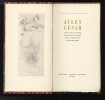
Un de mes préférés… d'autant plus que sa rencontre se fait de plus en plus rare… Référence : Mandiargues, Hans Bellmer, Œuvre gravé, 31-33, reproduit. Exemplaire en très bel état, légers frottements à l'étui comme pour la majorité des exemplaires.
Variationen ber ein Thema. Hrsg. vom Hans Orlowski-Kreis. (Mit einer Einf hrung von Hans-Werner Schober) HANS ORLOWSKI. Schober, Hans-Werner
Berlin, , Hans von Hans-Orlowski-Kreis, 1969., Series of 10 sheet-sized Orig woodcuts by Hans Orlowski. 2 unn. Bll., 10 unn. Boards. Folio. Loose as published in Orig.-Pp.-Folder with light linen spine. One of 100 numbered copies n . 21. .
commemorating the artist's 75th birthday. Typographic design by Hans-Werner Schwarzenberger.
Walther Oschilewski (texte) - Hans Orlowski (graveur sur bois)
Reference : 25791
(1948)
HANS ORLOWSKI. HOLZSCHNITTE. (Hans Orlowski. Gravures sur bois)
Dietmannsried et Heidelberg Walter Rau 1948 in-folio en feuilles sous chemise un volume, 10 gravures sur bois en noir par Hans Orlowski en feuilles libres dans une chemise rempliée grand in-folio éditeur, couverture illustrée d'un bois d'Hans Orlowski en noir et imprimée en rouge et noir, 2 pages de présentation par Walther Oschilewski + 10 feuilles de gravures sur bois par Hans Orlowski, 1948 Dietmannsried et Heidelberg Walter Rau Editeur,
Hans Otto Orlowski (né le 1er mars 1894 à Insterburg, en Prusse orientale ; le 3 mai 1967 à Berlin) était un peintre et bûcheron allemand. De 1911 à 1915, Orlowski étudie avec Harold Bengen à l'École des Arts et Métiers de Charlottenburg, se spécialisant dans les linogravures. Après avoir participé à la Première Guerre mondiale et avoir été blessé, la première participation à une exposition a eu lieu. En 1918, il participe à la Sécession berlinoise. De 1918 à 1919, il fréquente lÉcole nationale des beaux-arts de Berlin et y étudie avec Philipp Franck. De 1922 à 1945, il travaille à l'école des arts et métiers. En 1931, il y fut nommé professeur. Orlowski est l'auteur de nombreuses gravures sur bois et séries d'illustrations. En 1924, il fait un voyage à Paris et se détourne de l'expressionnisme. Il détruit lui-même ses premières uvres. La première exposition personnelle a lieu à la galerie Gurlitt de Berlin en 1934. En 1945, il devient directeur d'une classe de peinture murale et de vitrail à l'Université des Beaux-Arts de Berlin. En 1953, il expose à Munich, Linz et Würzburg. En 1954, il fonde la « Jubiläumsstiftung 1848/1948 Bildende Kunst ». 1964 fut sa dernière exposition à Berlin ...... RARE .... en trés bon état (very good condition). en trés bon état
Die Quadrat-Bücher. In Ergänzung der Illustrierten Zweimonatsschrift für neue Dichtung "hortulus" herausgegeben.
43 Bände in 38 Bänden (ohne Band 42). St. Gallen (ab Band 25: St. Gallen und Stuttgart), Tschudy Verlag, 1959-1964. 18,5x18,3 cm. Originalpappbände.
1. Sylvanus, Erwin: Korczak und die Kinder. Ein Stück. Mit einem Bildnis von Doktor Janusz Korczak und vier Bünhenfotos. - 2. Marti, Kurt: Republikanische Gedichte. Mit sechs Original-Linolschnitten von Max Sulzer. - 3. Zürich zum Beispiel. Signatur einer Stadt in lyrischen Texten von heute. Mit vier Original-Lithographien von Max Truniger. (Titelblatt mit winzigem Randausriss). - 4. Erklär mir, Liebe. Liebesgedichte deutscher Sprache seit 1945. Mit vier Farbzeichnungen von Hans Erni. - 5. Hoboken, Eva van: Die Brücke bewegt sich. Gedichte. Mit Bewegungsübungen aus einer japanischen Schreibschule und einem Nachwort von Eugen Gomringer. - 6. Hilty, Hans Rudolf: Jeanne d'Arc bei Schiller und Anouilh. Skizzen einer Geistesgeschichte des modernen Dramas. Mit neuen Abbildungen. - 7. Frisch, Max: Schinz. Skizze. Mit fünf Zeichnungen von Varlin. - 8. Vadian, Joachim: Hahnenkampf oder Hennen im Laufgitter (Gallus Pugnans). Eine Renaissance-Posse. Neu für di Bühne bearbeitet von Hans Rudolf Hilty. Mit Beiträgen von Josef Nadler und Werner Näf und acht Bildtafeln. - 9. Arnet, Edwin: Die Möwen von Zürich. Skizze zu einem Filmbuch. Mit vier dreifarbigen Original-Handätzungen von Max Hunzkier. - 10. Elytis, Odysseus: Körper des Sommers. Ausgewählte Gedichte neugriechisch und deutsch. Mit einer Zeichnung von Ghika. - 11. Gomringer, Eugen: 33 konstellationen mit 6 konstellationen von Max Bill. - 12. Andersch, Alfred: Der Tod des James Dean. Eine Funkmontage. Texte von John Dos Passos, Robert Lowry, E.E. Cummings, Allen Ginsberg, Robinson Jeffers, Kenneth Patchen, Kenneth Rexroth, Delmore Schwartz, beigleitet von der Trompete von Miles Davis. Mit neun Fotos. - 13. Turel, Adrien: Weltsaite Mensch. Ausgewählte Gedichte. Mit zwei Fotos. - 14. Der schwermütige Ladekran. Japanische Lyrik unserer Tage. Mit drei Zeichnungen von Shinzaburo Ishii. - 15/16. Die dritte Generation. 42 junge Schweizer Künstler. Plastik, Malerei, Zeichnung. Mit 42 Werkabbildungen und 42 Porträtfotos. - 17. Ramuz, C.F. / Strawinskij, I.: L'histoire du soldat. Die Geschichte vom Soldaten. Mit Dokumenten zur Entstehung des Werkes und sechs Abbildungen. - 18. Vogel, Wladimir: Wagadus Untergang durch die Eitelkeit. Spielmannsgeschichten der alten Berber aufgezeichnet von Leo Frobenius. Oratorium für Soli, gemischten Chor, fünf Saxophone und Klarinette von Wladimir Vogel. Mit dreizehn Abbildungen. - 19. Fornaro, Arturo: Angebot des Frühlichts. Gedichte. Offerta dell'alba. Poesie. - 20. Tschubak, Sadegh: Der Aristokrat und das Tier. Novelle aus dem heutigen Persien. Mit acht Zeichnungen von Li Gelpke. - 21. Levertov, Denise: Mit Augen an unserm Hinterkopf. Gedichte englisch und deutsch. Mit vier Zeichnungen von Marco Richterich. - 22. Burckhardt, Carl J.: Die Episode Randa. Novelle. Mit vier Original-Lithographien von Hermann Alfred Sigg. - 23. Valangin, Aline: Raum ohne Kehrreim. Ausgewählte Gedichte. Espace sans refrain. Poèmes choisis. Mit drei Scherenschnitten von Hans Arp. - 24. Hilpert, Heinz: Das Theater ein Leben. Erfahrungen und Erinnerungen. Mit 27 Fotos. - 25. Read, Herbert: Vocal avowals. Worte sagen aus. Gedichte englisch und deutsch mit fünf Zeichnungen von Ben Nicholson. - 26. Weder, Heinz: Kuhlmann. Prosa. Mit zwölf Zeichnungen von Max von Mühlenen. - 27. Oswald von Wolkenstein: Biographische Gedichte des Herrn Oswald von Wolkenstein. I, Original und in neuer Übertragung. Mit sechs Bildern nach Radierungen von Ambrosius Humm. - 28/29. József, Attila: Am Rande der Stadt. A város permén. Ausgewählte Gedichte ungarisch und deutsch. Mit fünf Farbzeichnungen von Imre Reiner und zwei Fotos. - 30. Lindtberg, Leopold: Regiearbeit. Texte von Leopold Lindtberg,.Kurt Hirschfeld, Ernst Ginsberg, Rolf Liebermann, Martin Schlappner, Hans Wings. Mit 40 Fotos. - 31. Bremer, Claus: Theater ohne Vorhang. Drei dramaturgische Essays mit einem Vorwort von Gustav Rudolf Sellner und sieben Fotos. - 32. Hans Arp und die Worte der Dichter. Mit fünf Abbildungen. Gedichte von und für Arp. - 33. Jaeckle, Erwin: Im Gitter der Stunden. Nachrichten aus dem Hotel Demut. Ein Gedichtzyklus mit zwei Abbildungen nach Werken von Josef Albers. - 34. Hohl, Ludwig: Wirklichkeiten. Prosa. Mit sechs Farbzeichnungen von Hans Aeschbacher und einer Foto. - 35. Otto, Teo: Skizzen eines Bühnenbildners. 35 Zeichnungen. Mit Texten von Max Frisch, Kurt Hirschfeld und Oskar Wälterlin. - 36/37. Wohnort Halen. Eine Architekturreportage. 95 Fotos von Leonardo Bezzola. Texte von Esther Thormann-Wirz und Fritz Thormann. - 38. Lehner, Peter: Fase Kran. Gedichte mit sechs Zeichnungen von Paul Lehmann. - 39. Matzig, Richard B.: Notturno. Eine neuzeitliche Harlekinade für die Marionetten von Ascona. Mit neun Zeichnungen von Harriet L. Klaiber. - 40/41. Zwischen Augen und Atem. Tussen ogen en adem Niederländische Lyrik seit 1945. Niederländisch und deutsch mit vier Original-Holzschnitten und einer Zeichnung von Gerrd Bruning. - 43. Carmi, T. Le serpent d'airain. Poèmes. Die Kupferschlange. Gedichte. Im hebräischen Original und in französischer und deutscher Übertragung mit drei Zeichnungen von Schoschana Heimann. - 44. Dank an Kurt Hirschfeld. Samuel Bächli, Harry Buckwitz, Friedrich Dürrenmatt, Max Frisch, Peter Löffler, Erwin Parker, Jean Rodolphe von Salis, Richard Schweizer, Gody Suter, Jakob Teichmann, Anna Katharina Wyler-Salten. Mit elf Fotos. - Es fehlt Band 42. Büchner, Georg: Woyzeck. Ein Stück, mit Zeichnungen von Werner Gölz. - Einige Rückenkanten etwas bestossen.
[Hans Hofmann] - Morris, Catherine; Sandler, Irving; Hofmann, Hans; Rush, Michael [Editor]
Reference : 010386
(2009)
Hans Hofmann: Circa 1950
The Rose art Museum 2009 In-4 Cartonnage illustré éditeur
Published in conjunction with exhibition, January 14 - April 5, 2009, at the Rose Art Museum of Brandeis University, with catalogue of 40 Abstract Expressionist paintings and drawings exhibited. Foreword and introductory essay, "Hans Hofmann, circa 1950: Painter & Writer" by Michael Rush; "The Artist and His Time" by Catherine Morris; "Hans Hofmann, I Hate to Repeat Myself" by Irving Sandler. Hardcover. >Neuf, sous film. Neuf 0
Marcel Marceau présente : Pantomimes de style et Pantomimes de Bip. Avec Pierre Verry. [Envoi autographe signé à Hans Richter]
Paris S.N. Mercure 1969 in-4 plaquette agrafée Paris, S.N. Mercure, sd [1969]. 31 x 24 cm, in-4, (20) pp. y compris les couvertures, abondamment illustré en noir, plaquette agrafée sous couverture illustrée.
![Marcel Marceau présente : Pantomimes de style et Pantomimes de Bip. Avec Pierre Verry. [Envoi autographe signé à Hans Richter]. [Richter, Hans] - ...](https://static.livre-rare-book.com/pictures/AJM/4821_1_thumb.jpg)
![Marcel Marceau présente : Pantomimes de style et Pantomimes de Bip. Avec Pierre Verry. [Envoi autographe signé à Hans Richter]. [Richter, Hans] - ...](https://static.livre-rare-book.com/pictures/AJM/4821_2_thumb.jpg)
Programme enrichi d'un bel ENVOI autographe signé au peintre et réalisateur d'avant-garde Hans Richter : "A Hans Richter, avec ma franche admiration et mon coeur, Marcel Marceau 69 / Bip [fleur]". Comporte au revers de la couverture le cachet de la succession Hans Richter (Estate Hans Richter) et le numéro d'inventaire PM 10. Large mouillure angulaire. Assez bon
[Hans Demeulenaere , Pierre Martin Vielcazat] - Hans Demeulenaere
Reference : 029178
(2019)
An Idiot's end
2019 Hans Demeulenaere Soft cover 1st Edition Signed by Author
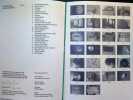
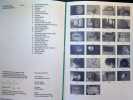
Couverture souple, 30 x 22 cm, pages non numérotées, néerlandais, Signé par l'Auteur, Première édition, Illustrations, état : Comme Neuf Le résultat d'un travail initié par Hans Demeulenaere et Pierre Martin Vielcazat lors d'une résidence au Centre Frans Masereel (Kasterlee). Présenté pour la première fois lors de l'exposition Never Relaxed, Never Relaxed, Never Relaxed à la Galerie EL, Welle (B). Édition limitée à 30 exemplaires. n° 20/30 signé par Hans Demeulenaere. 5 des 30 exemplaires font partie de l'édition 'W hole', réalisée en collaboration avec Meryem Bayram. Impression Riso par Quintal Editions, Paris (F). Design : Pierre Martin Vielcazat & Hans Demeulenaere. Pages non numérotées. travail en feuilles libres [Cette description peut avoir été traduite par une IA.]
À Sade.
Premier tirage de la suite et envoi signé de Bellmer Étui passé. [Paris, Alain Mazo], 1961. 1 vol. (380 x 287 mm) de 10 gravures. En feuilles, sous chemise et étui de l'éditeur. Premier tirage de cette superbe suite de dix gravures libres au burin et à la pointe sèche, résultant de la surimpression de deux cuivres, et tirées en deux couleurs. Une des 20 rares suites en couleurs, toutes signées et justifiées par Bellmer. Chaque gravure, séparée par 2 feuillets blancs, est justifiée au crayon en chiffre romain et signée par Bellmer (exemplaire VIII/XX). Exemplaire personnalisé par Hans Bellmer, qui a biffé le titre À Sade et l'a remplacé par «Moeurs et coutumes» et y a ajouté un grand envoi signé : « pour Luce Barbier, avec les grandes amitiés de Hans et Unica ». Il comporte également à la place du feuillet de justification imprimé, une justification manuscrite de la main de l'artiste.
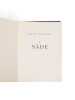
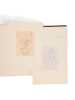
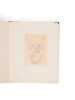
Depuis le début des années 30, Hans Bellmer s'intéresse à l'oeuvre de Sade : « j'ai l'intention de me consacrer intensément à l'oeuvre de Sade, en plusieurs projets d'illustration des 120 journées de Sodome et de La Philosophie dans le boudoir », qui resteront inachevés. Cependant, Bellmer réalisera des dessins qui lui serviront, ultérieurement, pour la réalisation de ses deux grandes suites rendant hommage à Sade : À Sade (1961) et Petit traité de morale (1968). Dans ces deux ouvrages, les épreuves résultent de la surimpression de deux cuivres gravés. Pour les exemplaires en couleurs, elles sont donc en deux teintes variables selon chaque planche ; « chacun dans une couleur différente - combin[ant] les images par condensation au sens freudien du terme, créant ainsi des gravures totalement différentes malgré la répétition des cuivres » (Flahutez, op. cit.). Le tirage de À Sade est limité à 55 exemplaires en noir (dont 5 sur Japon), auxquelles s'ajoutent 20 suites d'auteur en deux couleurs, justifiées au crayon à la main, tirées à part sur vélin d'Arches. Luce Barbier est la fille de Charles-Henri Barbier, ami d'enfance nantais de Claude Cahun ; cette dernière et Suzanne Malherbe en feront leur légataire universel. Plusieurs oeuvres de Bellmer des collections du Centre Pompidou sont entrées en dation via Luce et Bettina Barbier, en 2001. Le feuillet de justification de cet exemplaire a été entièrement exceptionnellement composé et autographié par Bellmer. On connaît, pour ces exemplaires en couleurs, trois autres portant également le titre modifié. Ils ont en revanche une justification imprimée. Pierre Dourthe, Bellmer, pp. 224-238 ; Bibliothèque Filipacchi, Hans Bellmer, 16-17 ; Dutel 942 ; Eros invaincu 117 ; Collection Gérard Nordman, II, n° 76 ; Pierre Dourthe, Bellmer, le principe de perversion, Paris, 1999, n° 330 ; Hans Bellmer. Anatomie du désir, Paris, Centre Pompidou, 2006, n° 216, p. 21 ; Fabrice Flahutez, Hans Bellmer : l’anagramme et l’estampe au service d’un rêve surréaliste, 2003, n° 52, p. 79-94
LES CONTES DE HANS CHRISTIAN ANDERSEN. Traduits en français par Etienne Avenard avec 195 illustrations de Hans Tegner
Paris Chez Jean de Bonnot 1975 in 4 (27,5x21) 1 fort volume reliure plein cuir marron, ornée de l'éditeur, dos et plats ornés d'un décor estampé à froid et doré, tête dorée, IV [2] et 508 pages |2], avec 195 illustrations de Hans Tegner, dont hors-texte. Traduits en français par Etienne Avenard. Bel exemplaire
Très bon Couverture rigide
MONDSAND. Exemplaire de tête avec 7 eaux-fortes originales signées de Hans Arp.
Pfullingen, Günther Neske Verlag, 1959. Un volume in-4 (279 x 211 mm), reliure éditeur toilée gris clair, dos à la bradel, plat supérieur illustrée d’un dessin de Arp reproduit. ÉDITION ORIGINALE. Texte en allemand. - EXEMPLAIRE DE TÊTE AVEC SEPT GRAVURES DE HANS ARP SIGNÉES AU CRAYON. - TIRAGE : un des 33 exemplaires de tête, celui-ci numéroté X, signé par Hans Arp, les seuls à comporter toutes les gravures signées. Rarissime et magnifique, les gravures de toute beauté. Références : Arntz 396-402b - Tiessen I, 46. - ENGLISH DESCRIPTION : Pfullingen, Günther Neske Verlag, 1959. A volume in-4 (279 x 211 mm). Publisher's cloth binding, light gray canvas, back to the bradel, upper cover illustrated with a drawing by Arp reproduced. ORIGINAL FIRST EDITION, with the text in German. HEAD COPY WITH 7 ORIGINAL ENGRAVINGS BY HANS ARP SIGNED IN PENCIL. - EDITION: one of 33 deluxe copies, this one numbered X, signed by Hans Arp, the only ones to include all the signed seven engravings. - ILLUSTRATION: 7 original etchings signed by Hans Arp. Extremely scarce , the engravings of great beauty. Literature: Arntz 396-402b - Tiessen I, 46. GERMAN DESCRIPTION: MONDSAND. Gedichte. Mit 7 signierten Original-Radierungen von Arp. Pfullingen, Neske, 1959. 4°. [32] Bll. (das erste u. letzte weiss). Original-Seideneinband mit Rückentitel u. Deckelillustration. In privatem Schuber. - Erste Ausgabe. - Eines von 33 römisch nummerierten Exemplaren (X) der Vorzugsausgabe, im Druckvermerk zusätzlich von Arp signiert. - Druck der Radierungen bei Fequet & Baudier in Paris. Schönes Exemplar (Arntz 396-402b - Tiessen I, 46).
Rarissime et magnifique, les gravures signées de toute beauté. Références : Arntz 396-402b - Tiessen I, 46.
Les contes de Hans Christian Andersen.
Jean de Bonnot 1975 Jean de Bonnot, 1975, IV-506 p., reliure éditeur marron avec décor historié doré, tranche de tête dorée, environ 275x205mm, illustrations de Hans Tegner. Bon état.

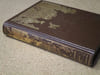
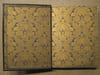
Traduit en français par Etienne Avenard, avec 195 illustrations de Hans Tegner. Merci de nous contacter à l'avance si vous souhaitez consulter une référence au sein de notre librairie.
Eileen Agar, Hans Arp, Hans Bellmer, Victor Brauner, Leonora Carrington, Giorgio de Chirico, Joseph Cornell, Salvador Dali, Paul Delvaux, Óscar Dominguez, Marcel Duchamp, Max Ernst, Alberto Giacometti, S.W. Hayter, Maurice Henry, Humphrey Jennings, René Magritte, André Masson, Matta, E.L.T. Mesens, Joan Miró, Henry Moore, Paul Nash, Meret Oppenheim, Roland Penrose, Pablo Picasso, Man Ray, Kurt Seligmann, Max Servais, Jindrich Styrský, Sophie Taeuber-Arp, Toyen, Raoul Ubac.
Reference : 105531
EXPOSITION INTERNATIONALE DU SURREALISME
Catalogue de l'Exposition Internationale du Surréalisme du 17 janvier au 24 février 1938, huit pages , 240x160mm, répertoriant les 229 pièces exposées.
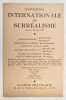
Catalogue de l'Exposition Internationale du Surréalisme du 17 janvier au 24 février 1938, huit pages ,240x160mm, répertoriant les 229 pièces exposées.Participants: Eileen Agar, Hans Arp, Hans Bellmer, Victor Brauner, Leonora Carrington, Giorgio de Chirico, Joseph Cornell, Salvador Dali, Paul Delvaux, Óscar Dominguez, Marcel Duchamp, Max Ernst, Alberto Giacometti, S.W. Hayter, Maurice Henry, Humphrey Jennings, René Magritte, André Masson, Matta, E.L.T. Mesens, Joan Miró, Henry Moore, Paul Nash, Meret Oppenheim, Roland Penrose, Pablo Picasso, Man Ray, Kurt Seligmann, Max Servais, Jindrich Styrský, Sophie Taeuber-Arp, Toyen, Raoul Ubac.La page de titre annonce: «Les organisateurs de l'exposition» sont André Breton et Paul Éluard; le «générateur arbitre» Marcel Duchamp assisté de Claude Le Gentil; les conseillers se nomment Salvador Dali, Max Ernst, Man Ray et Wolfgang Paalen.» ; «Les mannequins de la maison P. L. E. M". habillés par Yves Tanguy, André Masson, Kurt Seligmann, Sonia Mossé, Hans Arp, Oscar Dominguez, Léo Malet, Max Ernst, Marcel Duchamp, Joan Miro, Marcel Jean, Man Ray, Espinoza, Matta Echaurren, Maurice Henry, Salvador Dali.». Schwarz 461 (304), Lebel 176.(105531) Très bon
Padberg, Hans / Seiler, Harald / Geist, Hans-Friedrich / Vrinant, Robert.
Reference : 29416
Theo Kerg et son oeuvre vus par Hans Padberg.
Neuchatel, Editions du Griffon, 1956 Broche avec jaquette papier illustr., 49pp., 21.5x24cm., reproductions en n/b et en coul., tres bon etat.
Texte en allemande et francais. ?Ce fascicule a ete publie a l'occasion d'une exposition itinerante dans les musees allemands en 1956.
Hans Andersen Christian. Hans Andersens Fairy Tales. Compilation: 26 fairy tale
Hans Andersen Christian. Hans Andersens Fairy Tales. Compilation: 26 fairy tales. In Russian /Andersen Khans Kristian. Hans Andersens Fairy Tales (Skazki Gansa Andersena. Sbornik: 26 skazok). Illustrations: Dagmar Berkova. Prague. Artia. 1979. 264 p. We have thousands of titles and often several copies of each title may be available. Please feel free to contact us for a detailed description of the copies available. SKUalbb10dc8b3521de5ee.
Hans Aeschbacher. Mit Beiträgen von Fritz Billeter, Adolf Max Vogt, Hans Aeschbacher und Jörg Steiner.
Zürich ABC Verlag. 1976. 4°. 192 S. Mit vielen meist s/w. Abbildungen. Originalpappband mit Schutzumschlag.
Originalausgabe. - Mit handschriftlicher Widmung an die Bieler Galeristin Silvia Steiner "meine Verehrung zu Dir bleibt immerdar in Bewunderung herzlichst, Dein Hans" datiert 30. Januar 1977. - Schutzumschlag mit kleinem Einriss.
Les Simulachres & historiées faces de la mort, autant élégammēt pourtraictes que artificiellement imaginées. Première et précieuse édition de La Danse des morts de Hans Holbein, imprimée à Lyon en 1538 illustrée de façon magistrale de 41 dessins du maître, gravés par Hans Lützelburger.
Les plus grand exemplaire (hauteur: 177 mm) répertorié sur le marché depuis plusieurs décennies. Lyon, Melchior & Gaspar Trechsel, 1538. Petit in-4 de (52) feuillets, signés A-M4. Plein maroquin brun, fleuron central à froid, dos à nerfs orné, filets or sur les coupes, roulette intérieure, tranches dorées. Reliure signée de Trautz-Bauzonnet, vers 1865. 177 x 123 mm.
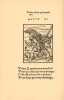
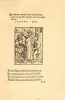
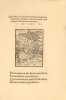
«Earliest known edition of this remarkable work with its most fascinating designs of exquisite finish» (Murray). Brunet, III, 254; Brun, Le livre français illustré de la Renaissance, p. 222; Mortimer 284; Murray 247; Massmann S. 8; Minns 213; Holbein-Kat. Basel 1960, nr. 418; Woltmann92-149; Hollstein XIVa, 202, 99; 247 ; Brunschwig, 428; Baudrier, V, 175; Rothschild, I, 15. “Suite de 41 compositions merveilleusement gravées d’après les dessins d’Holbein. Le monogramme HL qui se voit au f. 36 sur le lit de la duchesse est celui de Hans Lützelbürger (planche XX)». Brun. First edition of Holbein's Dance of Death, whose iconographic influence continues to the present day. «Holbein’s contribution to the traditional Dance of Death was a sharpening of the humor and satire and a heightening of the drama, so that the customary procession of figures becomes instead under his hand a series of fully realized scenes» (Mortimer). Erste Druckausgabe von Holbeins Basler Totentanz. «Die Folge besteht aus 51 Bildern, von denen 41 beim Tode Lützelburgers, vor Johannistag 1526, vollendet waren und in der Ausgabe von 1538 erschienen. Melchior Trechsel hatte die Stöcke direkt bei Lützelburger bestellt und am Johannistag 1526 bezogen ; nach Aussage des Vorworts von 1538 getraute man sich nicht, die restlichen Stöcke schneiden zu lassen» (Holbein-Kat.). (Première édition imprimée de la danse macabre bâloise de Holbein. "La suite se compose de 51 images, dont 41 étaient achevées à la mort de Lützelburger, avant la Saint-Jean 1526, et qui ont été publiées dans l'édition de 1538…). Premier tirage, de grande rareté, de cette remarquable et célèbre suite de la danse des morts, imaginée par Holbein et « qui doit » selon les bibliographes « être rangée parmi les plus beaux livres qui aient été publiés ». Cette très précieuse danse des morts comprend 41 estampes gravées par Hanz Lützelburger, sur les dessins de Hans Holbein. Le monogramme H signe la gravure de la Duchesse. En 1536 le génial artiste est choisi comme l'un des peintres de Henri VIII. En 1538 Holbein part pour la Belgique puis visite Lyon. Ce voyage coïncida avec la première publication dans cette ville, par Gaspar et Melchior Trechsel des « Simulacres et Historiées faces de la mort ». Les 41 bois gravés qui ornent le volume avaient été tirés à Bâle dès 1530, mais n'avaient jamais été réunis en recueil. Le collaborateur bâlois de Holbein, Hans Lùtzelburger, exécute ici les gravures d'après les dessins de son maître (voir son monogramme "HL" au f. 36). La première réunion en série de ces images à la fois glaçantes et teintées d'humour confère toute son importance à ce qui allait devenir l'un des livres illustrés les plus célèbres de la Renaissance. Le dernier ouvrage connu d'Holbein fut un dessin daté de 1543, année où le grand artiste fut terrassé par une épidémie de peste. L’iconographie absolument remarquable témoigne du génie d’Holbein, dans l’originalité, l’expression et le réalisme des scènes évoquant les différentes classes de la société, ainsi que dans la finesse extrême du dessin. « The wonderful pictures of its most facinating designs of exquisite finish » furent la source où plusieurs artistes postérieurs puiseront leur inspiration. Chacune des gravures est mise en page sous un extrait de 3 lignes latines de la Bible et est accompagnée d'un quatrain en français. Toutes les classes de la société sont réunies dans cette mise en scène magistrale, au réalisme fascinant. L’ouvrage connut d’ailleurs un tel succès que 12 éditions se succédèrent de 1538 à 1562. La danse macabre d'Holbein 1- La création 22- Le prêtre 2- La tentation 23- Le moine 3- L'expulsion du Paradis 24- La nonne 4- Adam travaillant le sol 25- La vieille dame 5- Os de tous les morts 26- Le médecin 6- Le pape 27- L'astrologue 7- L'empereur 28- L'homme riche 8- Le roi 29- Le marchand 9- Le cardinal 30- Le navigateur 10- L'impératrice 31- Le chevalier 11- La reine 32- Le comte 12- L'évêque 33- Le vieil homme 1 3- Le duc 34- La comtesse 14- L'abbé 35- La noble 15- L'abbesse 36- La duchesse 1 6- Le noble 37- Le vendeur ambulant 17- Le chanoine 38- L'agriculteur 18- Le juge 39- L'enfant 19- L'avocat 40- Le jugement dernier 20- Le sénateur 41- Les armoiries de la Mort 21- Le prédicateur Les quatrains et épître en français sont attribués à Jean de Vauzelles ou Gilles Corrozet. Le plus grand exemplaire (hauteur: 177 mm) répertorié sur le marché depuis plusieurs décennies. Provenance: l'exemplaire provient de la célèbre bibliothèque de l'entrepreneur, philanthrope et bibliophile Charles William Dyson Perrins (1864-1958); Sam Josefowitz, Pully – puis par descendance aux propriétaires actuels.
Hans Steffens. Peintures - Livres. Musée Bibliothèque Pierre-André Benoit.Rochebelle - Alès. 5 juillet - 20 octobre 1991.
Alès, PAB, 1991. cahiers libres, sous couverture, illustrée par Hans Steffens. in-8, titre, 38 pages illustrées par Hans Steffens et accompagnées d'un texte manuscrit de PAB + 14 pages de texte ( oeuvres exposées, biographie, listes des expositions et oeuvres conservées dans les musées et collections publiques), un des 40 premiers exemplaires sur Rives, numéroté et signé à la main par PAB avec une gravure originale sous serpente de Hans Steffens signée et numrotée
Emblemata Evangelica Hans Bol
BE, Erfgoedfonds, 2015 Softcover-90pp Illustrated. met prachtige illustraties. 24x20cm, NL.*nieuw ISBN 9789082377224.
In 2014 kocht het Erfgoedfonds van de Koning Boudewijnstichting dit album aan op een Londense veiling. Het bevat dertien ontwerptekeningen van de Mechelse landschapsschilder en tekenaar Hans Bol (1534-1593) ? die algemeen wordt beschouwd als de opvolger van Pieter Bruegel de Oude ? evenals de bijbehorende gravures van Adriaen Collaert (ca. 1560-1612). Verrassend was dat het om een nog onbekende reeks tekeningen van Hans Bol gaat. Dat zowel alle originele ontwerptekeningen als de naar hun voorbeeld gegraveerde prenten bewaard bleven, in voortreffelijke conditie daarenboven, maakt het album des te uitzonderlijker. Deze reeks maandvoorstellingen met Bijbelse taferelen werd in 1585 in Antwerpen uitgegeven door de familie Sadeler en kende een enorm succes vanwege zijn kwaliteit en innoverend karakter. Door de aankoop kon de Koning Boudewijnstichting het album voorgoed veiligstellen en het terug naar Belgie halen. Het werd ondergebracht in het Prentenkabinet van de Koninklijke Bibliotheek van Belgie, waar het niet alleen in de beste omstandigheden wordt bewaard, maar tevens wordt onderzocht en voor het publiek toegankelijk gemaakt. Stefaan Hautekeete, Hans Bolkenner en conservator van de tekeningencollectie bij de Koninklijke Musea voor Schone Kunsten van Belgie in Brussel, en Joris Van Grieken, conservator van het Prentenkabinet van de Koninklijke Bibliotheek van Belgie, leiden u binnen in de wereld van de Emblemata Evangelica. Zij introduceren u op bijzonder boeiende wijze in het productieproces en de afzetmarkt van de 16e-eeuwse kopergravure en leggen alle geheimen bloot van Hans Bols Emblemata Evangelica
Dokumente aus dem Nachlass von Hans Iklé aus St. Gallen.
2 Briefe, 1 Verpflichtungsschein (Pferdekauf), 2 gedruckte Hefte (18 u.19 S.), Notizbuch ca. 30 Bl., ms. Genealogie auf 7 Bl., 2 Fotografien.
Interessante Originalunterlagen von Hans Adalbert Iklé, Sohn von Adolph Iklé, dem Mitbegründer des Stickereiwarenunternehmens Iklé Fréres in St. Gallen. Hans Iklé war 1936 Olympiateilnehmer in Berlin in der Disziplin Springreiten. Davon zeugen ein handgeschriebenes Büchlein mit dem Titel „Reiterfolge“ geführt von 1928 bis 1947. Hier findet sich auch ein Eintrag zur Teilnahme an der Olympiade auf dem Wallach ,Exilé’. Beiliegend auch der Verpflichtungsschein zum Kauf für eben dieses Pferdes durch den Oberleutnant Iklé beim Eidg. Kavallerie-Remontendepot in Bern im Jahre 1935 (mit genauer Beschreibung des Tieres und Preisangabe). Weitere Dokumente befassen sich mit dem Stammbaum der Familie, so eine in englisch verfasste und als Heft gebundene Maschinenschrift mit dem Titel „The Family Iklé“, welche vom amerikanischen Familienzweig stammt, und einige handgeschriebene Blätter mit einem scherzhaften Stammbaum, der die Abstammung Iklés von Karl dem Grossen nachweisen will (Geburtstagsgeschenk zum 70sten) sowie 2 Briefe von und an Hans Iklé zum Thema Familienforschung (1987/92). Es folgen noch ein gedruckter Nachruf auf Richard Iklé (gest. 1952) und ein Kondolenzfoto von Gertrud Iklé-Frischknecht (gest. 1977). Abschliessend liegt noch ein s/w Foto von Hans Iklé selbst bei (ohne Datum, ca. 1950).

(SLACES, NVVA)
Phone number : 41 (0)26 3223808
PANTA RHEI. Vortragsreihe der Hans Erni Stiftung. Band 1 bis 22. Zus. 22 Bde
Verlag Hans Erni Stiftung, 1981 - 1999, gr. in-8vo, (24.5x16.5 cm), Liste d. bis dann erschienene Publikationen in Bd. 22. Reihe reich illustriert in s/w und Farbe mit Zeichnungen und Malereien von Hans Erni, Silberner Orig.-Pappband.
(SLACES, NVVA)
Phone number : 41 (0)26 3223808

