 Write to the booksellers
4 books for « hans christian orsted »Edit
-
Type
Autograph (1)
Book (3)
-
Topics
Physics (4)
Sciences (1)
Tea (1)
-
Countries
Denmark (3)
France (1)
Hans Christian Orsted - Belle lettre autographe signée à Monsieur Puerari - 1819
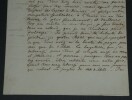
Hans Christian Orsted (Ørsted). Belle et longue lettre autographe signée à Marc Nicolas Puerari,1819 Physicien et chimiste danois Lettre autographe signée de Hans Christian Orsted (Ørsted), datée 29 avril [1819]. Adressée à Marc Nicolas Puerari, botaniste suisse ayant fait carrière au Danemark. Rédigé à l'encre brune sur un double feuillet de papier vélin. "Monsieur, J'ai pendant longtemps eu le dessin de venir vous voir, et de vous payer les frais du journal que vous avez bien voulu me faire passer par vos mains ; mais ayant presque toujours des leçons à donner ou quelqu'autre occupation semblable à l'heure où on vous trouve le plus facilement, et d'ailleurs trop peu maître de mon temps, je suis tombé dans un retard, que je ne voudrais plus prolonger. Je prend donc la liberté de joindre ici quatre Rbdl qui ne surpassent ce que vous avez eu la bonté de payer pour moi que de 4 Schill. La bagatelle que j'ai déboursé pour vous se compte aussi en Mark et schilling, et pourra, puisque vous en parlez encore, être rabbatu une autre fois, quand vous aurez déboursé pour moi une somme qui contient un surplus de Mk & Schill. J'ai été, je le sens, envers vous et envers vos collègues amis à Genève, peu exact ; mais je puis avec fondement vous promettre plus d'exactitude dans l'avenir, puisque plusieurs occupations qui m'ont pris une grande partie de mon temps pendant quelques années vont bientôt cesser. J'ai l'honneur de vous saluer et de vous présenter l'assurance de mon estime distinguée. Ayez la complaisance de donner les cahiers que vous avez pour moi au porteur de cette lettre." Une lettre révélatrice des contraintes de temps d un savant en pleine activité, rédigée peu avant sa découverte capitale de l interaction entre électricité et magnétisme (1820), moment fondateur de la physique moderne. Dimensions : 20 x 24,8 cm État : Traces d'onglet au dos sinon bel état de conservation. Voir photos et description pour plus de détails. Nombre de pages : 2 pages


ØRSTED (OERSTED), HANS CHRISTIAN. - THE DEBUT OF HANS CHRISTIAN OERSTED.
Reference : 57779
(1809)
Videnskaben om Naturens almindelige Love. Første Bind (alt som udkom). (The Science of the General Laws of Nature. First volume (all published).
Kjøbenhavn (Copenhagen), Fr. Brummer, 1809. Cont. hcalf. Gilt spine. Titlelabel with gilt lettering. A paperlabel pasted on top of spine. Stamps on title-page. XXX,378 pp. and 11 engraved plates with many figs. A fine copy.

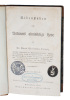
Scarce first edition of Hans Christian Oersted's first printed book (The Science of the General Laws of Nature). Oersted is universally known for his discovery of the Electro-Magnetism in 1820. In this his first printed book, Oersted proposes at least three theses that he were to follow for the rest of his life, and which he made the foundation for his discovery of Electro-Magnetism: the crucial role that experiments and thereby empiricism play in the perception of nature the fact that each individual phenomenon in nature in accordance with the philosophy of nature must be understood as a whole" and that the laws of nature are the same everywhere, in the smallest and in the greatest parts of the universe. The sort of philosophy of nature that Oersted studies and develops is by him comprehended as a product of human striving towards with its reason to ""include and penetrate the entire nature, and to explain it in its full context"" (from ""Science of the General Laws of Nature"" - own translation), which is why this philosophy is also the science of the general laws of nature (that are the same everywhere). It thus not only includes the science of movement, but also that of electricity, magnetism, light, warmth, and chemical connections, such as they all follow directly from ordinary forces of nature, and Oested's discovery in 1820 of the connection between magnetism and electricity must be seen in this connection.Both H.C. Andersen and Søren Kierkegaard admit to having been influenced by the writings of Oersted. ""He was an enthusiastic follower of the ""Naturphilosophie"" school in Germany, whose main object was the unification of physical forces, thus producing a monistic theory of the universe. It was to further this purpose that Oersted sought in actual phenomena the electro-magnetic identity of which he had already convinced himself on metaphysical grounds"" (Percy H. Muir in Printing and The Mind of Man).

Videnskaben om Naturens Almindelige Love. Første Bind (alt som udkom). (The Science of the General Laws of Nature. First volume [all that was published]).
Kjøbenhavn (Copenhagen), Fr. Brummer, 1809. Beskedent samtidigt hshirtbd. Permer løse. Brugsspor, her og der brunplettet. En del blade med svag fugtskjold. XXX,378 pp. samt 11 kobberstukne plancher. Ydremargin af plancher med brugsspor.
Originaltrykket af Ørsteds første bog, som er meget sjældent forkommende. Scarce first edition of Hans Christian Oersted's first printed book (The Science of the General Laws of Nature). Oersted is universally known for his discovery of the Electro-Magnetism in 1820. In this his first printed book, Oersted proposes at least three theses that he were to follow for the rest of his life, and which he made the foundation for his discovery of Electro-Magnetism: the crucial role that experiments and thereby empiricism play in the perception of nature the fact that each individual phenomenon in nature in accordance with the philosophy of nature must be understood as a whole" and that the laws of nature are the same everywhere, in the smallest and in the greatest parts of the universe. The sort of philosophy of nature that Oersted studies and develops is by him comprehended as a product of human striving towards with its reason to ""include and penetrate the entire nature, and to explain it in its full context"" (from ""Science of the General Laws of Nature"" - own translation), which is why this philosophy is also the science of the general laws of nature (that are the same everywhere). It thus not only includes the science of movement, but also that of electricity, magnetism, light, warmth, and chemical connections, such as they all follow directly from ordinary forces of nature, and Oested's discovery in 1820 of the connection between magnetism and electricity must be seen in this connection.Both H.C. Andersen and Søren Kierkegaard admit to having been influenced by the writings of Oersted. ""He was an enthusiastic follower of the ""Naturphilosophie"" school in Germany, whose main object was the unification of physical forces, thus producing a monistic theory of the universe. It was to further this purpose that Oersted sought in actual phenomena the electro-magnetic identity of which he had already convinced himself on metaphysical grounds"" (Percy H. Muir in Printing and The Mind of Man).
Gesammelte Schriften. Deutsch von K.L. Kannegiesser. 6 Bde. (1. Bd.:4. Aufl. - 2. Bd.:3. Aufl.).
Leipzig, Carl B. Lorck, o.J. (ca. 1851). Bound in 3 contemp. hcalf. Gilt backs. Large crowned coat of arms on frontcovers, gilt. Engraved portrait of Oersted and 4 plates. Printed on good paper. A fine clean copy.
First German edition.

